Closure
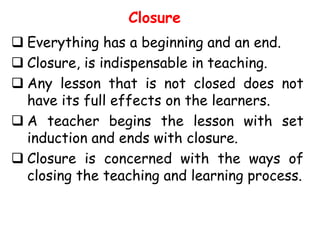
 Everything has a beginning and an end.
 Closure, is indispensable in teaching.
 Any lesson that is not closed does not
have its full effects on the learners.
 A teacher begins the lesson with set
induction and ends with closure.
 Closure is concerned with the ways of
closing the teaching and learning process.
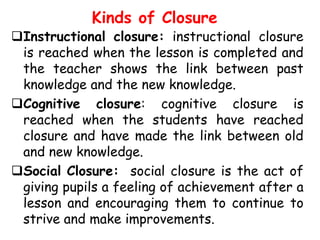
Kinds of Closure

Instructional closure: instructional closure
is reached when the lesson is completed and
the teacher shows the link between past
knowledge and the new knowledge.
Cognitive closure: cognitive closure is
reached when the students have reached
closure and have made the link between old
and new knowledge.
Social Closure: social closure is the act of
giving pupils a feeling of achievement after a
lesson and encouraging them to continue to
strive and make improvements.
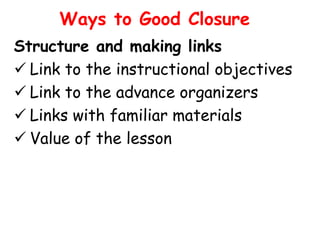
Ways to Good Closure
Structure and making links
 Link to the instructional objectives
 Link to the advance organizers
 Links with familiar materials
 Value of the lesson
Ways to Good Closure (3)
Follow up Resources
Provide information on relevant
resources that can be complementary
for the lesson:
 Textual
 Video
 Audio
 Multimedia
Ways to Good Closure (2)
Reviewing and summarizing
Reviewing
Reiteration of key points, recapitulating
Revising or reviewing the lesson
Summarizing
Teacher: The teacher summarises the
major points and
Students: Get the students to
summarise the major points or concept.
Ways to Good Closure (3)

Evaluate the lesson
 Ask questions to elucidate for
information on students’ learning gain.
 Involve students in activities, e.g.
 Use new concepts of ideas,
 Dramatization.
 Demonstrate newly acquired skills,
 Express opinions about the value of
what was done.
 Give follow up assignments to assist
students in “chaining” of contents.
Mudasiru Olalere Yusuf (PhD)

Department of Educational Technology,
University of Ilorin, Nigeria
E-mail: moyusuf@unilorin.edu.ng; lereyusuf@yahoo.com;
Facebook: http://www.facebook.com/mudasiruoy
Twittter: @moyusuf
Blog: http://wordpress.com/#!/my-blogs/

(2013)
8
Thank
You

Microteaching closure

  • 2.
    Closure  Everything hasa beginning and an end.  Closure, is indispensable in teaching.  Any lesson that is not closed does not have its full effects on the learners.  A teacher begins the lesson with set induction and ends with closure.  Closure is concerned with the ways of closing the teaching and learning process.
  • 3.
    Kinds of Closure Instructionalclosure: instructional closure is reached when the lesson is completed and the teacher shows the link between past knowledge and the new knowledge. Cognitive closure: cognitive closure is reached when the students have reached closure and have made the link between old and new knowledge. Social Closure: social closure is the act of giving pupils a feeling of achievement after a lesson and encouraging them to continue to strive and make improvements.
  • 4.
    Ways to GoodClosure Structure and making links  Link to the instructional objectives  Link to the advance organizers  Links with familiar materials  Value of the lesson
  • 5.
    Ways to GoodClosure (3) Follow up Resources Provide information on relevant resources that can be complementary for the lesson:  Textual  Video  Audio  Multimedia
  • 6.
    Ways to GoodClosure (2) Reviewing and summarizing Reviewing Reiteration of key points, recapitulating Revising or reviewing the lesson Summarizing Teacher: The teacher summarises the major points and Students: Get the students to summarise the major points or concept.
  • 7.
    Ways to GoodClosure (3) Evaluate the lesson  Ask questions to elucidate for information on students’ learning gain.  Involve students in activities, e.g.  Use new concepts of ideas,  Dramatization.  Demonstrate newly acquired skills,  Express opinions about the value of what was done.  Give follow up assignments to assist students in “chaining” of contents.
  • 8.
    Mudasiru Olalere Yusuf(PhD) Department of Educational Technology, University of Ilorin, Nigeria E-mail: moyusuf@unilorin.edu.ng; lereyusuf@yahoo.com; Facebook: http://www.facebook.com/mudasiruoy Twittter: @moyusuf Blog: http://wordpress.com/#!/my-blogs/ (2013) 8
  • 9.