Education System in France
Government Role
Government Role
Ministry of National
Education
• officially called Ministère de
l'Éducation nationale, de la
Jeunesse et de la Vie associative
• Regulates all educational programs
in France
• Headed by the Minister of National
Education
Government Role
The teachers in public primary
and secondary schools are all
state civil servants, making the
ministère the largest employer in
the country. Professors and
researchers in France's
universities are also employed by
Bulletin officiel de l'éducation
nationale, de l'enseignement
supérieur et de la recherche (B.O.)
It is the reference for all French
educators which lists all current
programmes and teaching
directives.
 ELIGIBILITY,HIRING & SALARY
OF TEACHERS
Government Role
Primary School & Kindergarten
Teachers
• educated in "Instituts Universitaires de
Formation des Maîtres" (IUFM)
• have usually a "master" (Bac+5)
• Their weekly service is about 28 hours a
week.
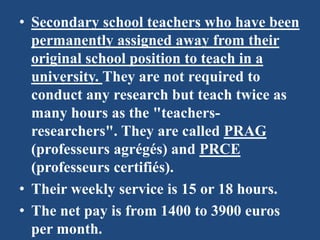
• Secondary school teachers who have been
permanently assigned away from their
original school position to teach in a
university. They are not required to
conduct any research but teach twice as
many hours as the "teachers-
researchers". They are called PRAG
(professeurs agrégés) and PRCE
(professeurs certifiés).
• Their weekly service is 15 or 18 hours.
• The net pay is from 1400 to 3900 euros
per month.
"Teacher-researchers“
(enseignants-chercheurs)
• they teach classes and conduct research in their
field of expertise with a full tenure
• The net pay for faculty is approximately from
2000 to 8800 (with extra duties) euros per
month.
• The maximum possible net salary for second-
class full professors and chief senior lecturers
(maître de conférence hors classe)—the end of
career status for most full-time teacher-
researchers in French universities—is 3760
Euros a month (2011)
In the overseas departments and
territories of France, the school calendar
is set by the local recteur.
The major school breaks are:
• All Saints (la Toussaint), two weeks around the
end of October and the beginning of November;
• Christmas (Noël), two weeks around Christmas
Day and New Year's Day;
• winter (hiver), two weeks starting in mid
February;
• spring (printemps) or Easter (Pâques), two weeks
starting in mid April;
• summer (été), two months starting in early July.
Teacher Education Training
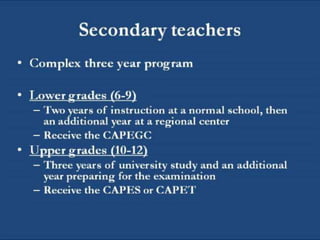
Teachers are recruited via two
competitive examinations:
1) examination for school teachers
2) examination for secondary and
high school teachers.
Teacher Education Training
National initiative training modules
(MFIN)
The national initiative training
modules are complementary training
courses enabled by the second
paragraphs of articles 4 and 9 of
decree no. 2004-13 of January 5 on the
creation of CAPA-SH and 2CA-SH.
Objective of the MFIN
Their objective is to more
thoroughly develop and reinforce
their knowledge and professional
capacities and/or assist their
capacity to adapt to given
professional circumstances.
Cultural Perspective
The French educational system is
highly centralised
It is divided into three different stages:
primary education, or enseignement
primaire, corresponding to grade school in
the United States; secondary education, or
collège and lycée, corresponding to middle
and high school in the United States; and
higher education (l'université or les
Grandes écoles).
• Since the Jules Ferry laws of 1881-2, named
after the then Minister of Public
Instruction, all state-funded schools,
including universities, are independent from
the (Roman Catholic) Church.
• Secular educational policy has become
critical in recent issues of French
multiculturalism, as in the "affair of the
Islamic headscarf"
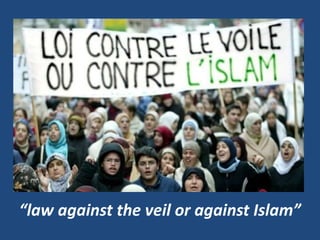
“law against the veil or against Islam”
“Affair of the Islamic
Headscarf"
The French law on secularity and
conspicuous religious symbols in
schools bans wearing conspicuous
religious symbols in French public
(i.e. government-operated) primary
and secondary schools.
• "Law #2004-228 of March 15, 2004
concerning, as an application of the principle
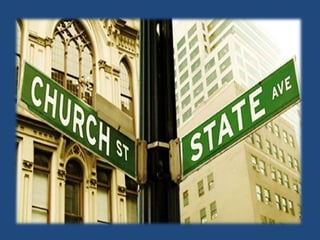
of the separation of church and state, the
wearing of symbols or garb which show
religious affiliation in public primary and
secondary schools“
• The bill passed France's national legislature
and was signed into law by President
Jacques Chirac on 15 March 2004 (thus the
technical name is law 2004-228 of 15 March
2004) and came into effect on 2 September
2004, at the beginning of the new school
In order to enforce the law, effective decisions
whether certain items are "ostentatious" or not will
have to be taken. In order to achieve that:
• the Minister of Education will issue circulaires, or
instructions for its services; it seems that large
crosses, full hijabs or yarmulkes would be banned,
while small symbols such as small Stars of David or
crosses in pendants would not be;
• headmasters will have to judge whether particular
attire is or not acceptable with respect to the law;
• if necessary, families will go to administrative
courts to challenge the school authorities' decision;
a final decision may not be reached until the Conseil
d'État at litigation (supreme administrative court),
decides some points of jurisprudence.
• In 2012, the United Nations Human Rights
Committee stated that the expulsion of a Sikh
pupil from his school in 2008 because of his
Sikh turban or keski was a violation of the
International Covenant on Civil and Political
Rights signed by France.
• As a consequence of the law, the years
following the ban has seen an increasing
number of Islamic secondary schools being
established, some Muslim female students
chose to study at home, and others migrating
away from France with their families.

educational system in FRANCE

  • 1.
    Education System inFrance Government Role Government Role
  • 2.
    Ministry of National Education •officially called Ministère de l'Éducation nationale, de la Jeunesse et de la Vie associative • Regulates all educational programs in France • Headed by the Minister of National Education
  • 3.
    Government Role The teachersin public primary and secondary schools are all state civil servants, making the ministère the largest employer in the country. Professors and researchers in France's universities are also employed by
  • 4.
    Bulletin officiel del'éducation nationale, de l'enseignement supérieur et de la recherche (B.O.) It is the reference for all French educators which lists all current programmes and teaching directives.
  • 5.
     ELIGIBILITY,HIRING &SALARY OF TEACHERS Government Role
  • 6.
    Primary School &Kindergarten Teachers • educated in "Instituts Universitaires de Formation des Maîtres" (IUFM) • have usually a "master" (Bac+5) • Their weekly service is about 28 hours a week.
  • 9.
    • Secondary schoolteachers who have been permanently assigned away from their original school position to teach in a university. They are not required to conduct any research but teach twice as many hours as the "teachers- researchers". They are called PRAG (professeurs agrégés) and PRCE (professeurs certifiés). • Their weekly service is 15 or 18 hours. • The net pay is from 1400 to 3900 euros per month.
  • 10.
    "Teacher-researchers“ (enseignants-chercheurs) • they teachclasses and conduct research in their field of expertise with a full tenure • The net pay for faculty is approximately from 2000 to 8800 (with extra duties) euros per month. • The maximum possible net salary for second- class full professors and chief senior lecturers (maître de conférence hors classe)—the end of career status for most full-time teacher- researchers in French universities—is 3760 Euros a month (2011)
  • 11.
    In the overseasdepartments and territories of France, the school calendar is set by the local recteur. The major school breaks are: • All Saints (la Toussaint), two weeks around the end of October and the beginning of November; • Christmas (Noël), two weeks around Christmas Day and New Year's Day; • winter (hiver), two weeks starting in mid February; • spring (printemps) or Easter (Pâques), two weeks starting in mid April; • summer (été), two months starting in early July.
  • 13.
    Teacher Education Training Teachersare recruited via two competitive examinations: 1) examination for school teachers 2) examination for secondary and high school teachers.
  • 14.
    Teacher Education Training Nationalinitiative training modules (MFIN) The national initiative training modules are complementary training courses enabled by the second paragraphs of articles 4 and 9 of decree no. 2004-13 of January 5 on the creation of CAPA-SH and 2CA-SH.
  • 15.
    Objective of theMFIN Their objective is to more thoroughly develop and reinforce their knowledge and professional capacities and/or assist their capacity to adapt to given professional circumstances.
  • 16.
  • 17.
    The French educationalsystem is highly centralised It is divided into three different stages: primary education, or enseignement primaire, corresponding to grade school in the United States; secondary education, or collège and lycée, corresponding to middle and high school in the United States; and higher education (l'université or les Grandes écoles).
  • 19.
    • Since theJules Ferry laws of 1881-2, named after the then Minister of Public Instruction, all state-funded schools, including universities, are independent from the (Roman Catholic) Church. • Secular educational policy has become critical in recent issues of French multiculturalism, as in the "affair of the Islamic headscarf"
  • 20.
    “law against theveil or against Islam”
  • 21.
    “Affair of theIslamic Headscarf" The French law on secularity and conspicuous religious symbols in schools bans wearing conspicuous religious symbols in French public (i.e. government-operated) primary and secondary schools.
  • 22.
    • "Law #2004-228of March 15, 2004 concerning, as an application of the principle of the separation of church and state, the wearing of symbols or garb which show religious affiliation in public primary and secondary schools“ • The bill passed France's national legislature and was signed into law by President Jacques Chirac on 15 March 2004 (thus the technical name is law 2004-228 of 15 March 2004) and came into effect on 2 September 2004, at the beginning of the new school
  • 23.
    In order toenforce the law, effective decisions whether certain items are "ostentatious" or not will have to be taken. In order to achieve that: • the Minister of Education will issue circulaires, or instructions for its services; it seems that large crosses, full hijabs or yarmulkes would be banned, while small symbols such as small Stars of David or crosses in pendants would not be; • headmasters will have to judge whether particular attire is or not acceptable with respect to the law; • if necessary, families will go to administrative courts to challenge the school authorities' decision; a final decision may not be reached until the Conseil d'État at litigation (supreme administrative court), decides some points of jurisprudence.
  • 24.
    • In 2012,the United Nations Human Rights Committee stated that the expulsion of a Sikh pupil from his school in 2008 because of his Sikh turban or keski was a violation of the International Covenant on Civil and Political Rights signed by France. • As a consequence of the law, the years following the ban has seen an increasing number of Islamic secondary schools being established, some Muslim female students chose to study at home, and others migrating away from France with their families.