A Literary Exploration on
A poem
written by Edith Tiempo
Rose Katherine H. Javier
Discussant
The Author:
Edith L. Tiempo
(April 22, 1919 – August 21, 2011
Bayombong, Nueva Vizcaya )
 poet, fiction writer, teacher and literary
critic was a Filipino writer in the English language.
 founded (in 1962) and directed the Silliman National
Writers Workshop in Dumaguete City together with
her late husband, writer and critic Edilberto K.
Tiempo
 She has two children, Rowena and Maldon
 conferred the National Artist Award for Literature in
1999
 Two of her most anthologized pieces are “Lament
for the Littlest Fellow” and “Bonsai”
The Piece
Bonsai
Edith Tiempo
All that I love
I fold over once
And once again
And keep in a box
Or a slit in a hollow post
Or in my shoe.
All that I love?
Why, yes, but for the moment-
And for all time, both.
Something that folds and keeps
easy,
Son’s note or Dad’s one gaudy tie,
A roto picture of a queen,
A blue Indian shawl, even
A money bill.
It’s utter sublimation,
A feat, this heart’s control
Moment to moment
To scale all love down
To a cupped hand’s size
Till seashells are broken pieces
From God’s own bright teeth,
And life and love are real
Things you can run and
Breathless hand over
To the merest child.
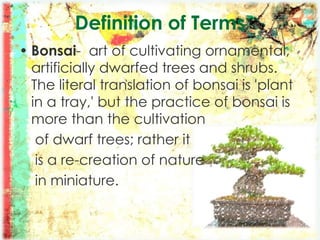
Definition of Terms
• Bonsai- art of cultivating ornamental,
artificially dwarfed trees and shrubs.
The literal translation of bonsai is 'plant
in a tray,' but the practice of bonsai is
more than the cultivation
of dwarf trees; rather it
is a re-creation of nature
in miniature.
• Roto (Rotoscoping)-a technique where
individual frames of an actor’s filmed
performance are projected onto sheets of
paper and traced to create a series of
drawings.
• Sublimation- the channeling of impulses or
energies regarded as unacceptable,
especially sexual desires, toward activities
regarded as more socially acceptable,
often creative activities
Definition of Terms
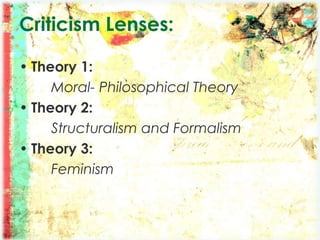
Criticism Lenses:
• Theory 1:
Moral- Philosophical Theory
• Theory 2:
Structuralism and Formalism
• Theory 3:
Feminism
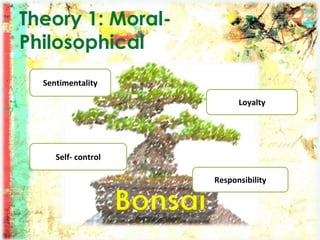
Theory 1: Moral-
Philosophical
Bonsai
Sentimentality
Loyalty
Responsibility
Self- control
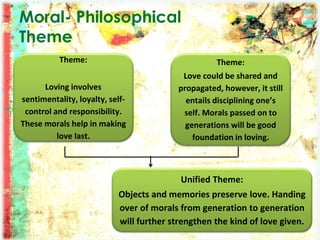
Moral- Philosophical
Theme
Unified Theme:
Objects and memories preserve love. Handing
over of morals from generation to generation
will further strengthen the kind of love given.
Theme:
Loving involves
sentimentality, loyalty, self-
control and responsibility.
These morals help in making
love last.
Theme:
Love could be shared and
propagated, however, it still
entails disciplining one’s
self. Morals passed on to
generations will be good
foundation in loving.
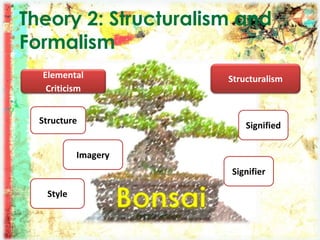
Theory 2: Structuralism and
Formalism
Elemental
Criticism
Structure
Imagery
Style
Structuralism
Signifier
Signified
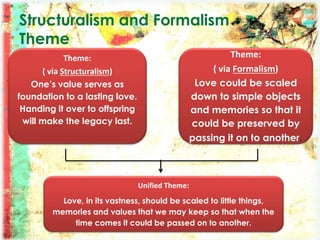
Structuralism and Formalism
Theme
Theme:
( via Formalism)
Love could be scaled
down to simple objects
and memories so that it
could be preserved by
passing it on to another.
Theme:
( via Structuralism)
One’s value serves as
foundation to a lasting love.
Handing it over to offspring
will make the legacy last.
Unified Theme:
Love, in its vastness, should be scaled to little things,
memories and values that we may keep so that when the
time comes it could be passed on to another.
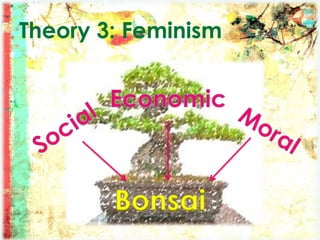
Theory 3: Feminism
Bonsai
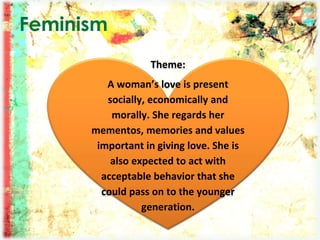
Feminism
Theme:
A woman’s love is present
socially, economically and
morally. She regards her
mementos, memories and values
important in giving love. She is
also expected to act with
acceptable behavior that she
could pass on to the younger
generation.
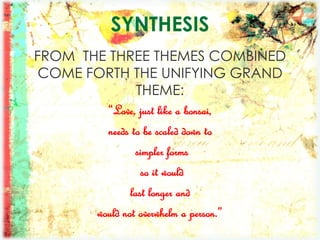
SYNTHESIS
FROM THE THREE THEMES COMBINED
COME FORTH THE UNIFYING GRAND
THEME:
“Love, just like a bonsai,
needs to be scaled down to
simpler forms
so it would
last longer and
would not overwhelm a person.”
- End-
Thank You
To God be the Glory!
-rkhjavier-

BONSAI: A Literary Exploration

  • 1.
    A Literary Explorationon A poem written by Edith Tiempo Rose Katherine H. Javier Discussant
  • 2.
    The Author: Edith L.Tiempo (April 22, 1919 – August 21, 2011 Bayombong, Nueva Vizcaya )  poet, fiction writer, teacher and literary critic was a Filipino writer in the English language.  founded (in 1962) and directed the Silliman National Writers Workshop in Dumaguete City together with her late husband, writer and critic Edilberto K. Tiempo  She has two children, Rowena and Maldon  conferred the National Artist Award for Literature in 1999  Two of her most anthologized pieces are “Lament for the Littlest Fellow” and “Bonsai”
  • 3.
    The Piece Bonsai Edith Tiempo Allthat I love I fold over once And once again And keep in a box Or a slit in a hollow post Or in my shoe. All that I love? Why, yes, but for the moment- And for all time, both. Something that folds and keeps easy, Son’s note or Dad’s one gaudy tie, A roto picture of a queen, A blue Indian shawl, even A money bill. It’s utter sublimation, A feat, this heart’s control Moment to moment To scale all love down To a cupped hand’s size Till seashells are broken pieces From God’s own bright teeth, And life and love are real Things you can run and Breathless hand over To the merest child.
  • 4.
    Definition of Terms •Bonsai- art of cultivating ornamental, artificially dwarfed trees and shrubs. The literal translation of bonsai is 'plant in a tray,' but the practice of bonsai is more than the cultivation of dwarf trees; rather it is a re-creation of nature in miniature.
  • 5.
    • Roto (Rotoscoping)-atechnique where individual frames of an actor’s filmed performance are projected onto sheets of paper and traced to create a series of drawings. • Sublimation- the channeling of impulses or energies regarded as unacceptable, especially sexual desires, toward activities regarded as more socially acceptable, often creative activities Definition of Terms
  • 6.
    Criticism Lenses: • Theory1: Moral- Philosophical Theory • Theory 2: Structuralism and Formalism • Theory 3: Feminism
  • 7.
  • 8.
    Moral- Philosophical Theme Unified Theme: Objectsand memories preserve love. Handing over of morals from generation to generation will further strengthen the kind of love given. Theme: Loving involves sentimentality, loyalty, self- control and responsibility. These morals help in making love last. Theme: Love could be shared and propagated, however, it still entails disciplining one’s self. Morals passed on to generations will be good foundation in loving.
  • 9.
    Theory 2: Structuralismand Formalism Elemental Criticism Structure Imagery Style Structuralism Signifier Signified
  • 10.
    Structuralism and Formalism Theme Theme: (via Formalism) Love could be scaled down to simple objects and memories so that it could be preserved by passing it on to another. Theme: ( via Structuralism) One’s value serves as foundation to a lasting love. Handing it over to offspring will make the legacy last. Unified Theme: Love, in its vastness, should be scaled to little things, memories and values that we may keep so that when the time comes it could be passed on to another.
  • 11.
  • 12.
    Feminism Theme: A woman’s loveis present socially, economically and morally. She regards her mementos, memories and values important in giving love. She is also expected to act with acceptable behavior that she could pass on to the younger generation.
  • 13.
    SYNTHESIS FROM THE THREETHEMES COMBINED COME FORTH THE UNIFYING GRAND THEME: “Love, just like a bonsai, needs to be scaled down to simpler forms so it would last longer and would not overwhelm a person.”
  • 14.
    - End- Thank You ToGod be the Glory! -rkhjavier-

Editor's Notes

  • #2 A pleasant Saturday morning to everyone here today. I am Ms. Rose Katherine H. Javier and I am going to present a literary exploration on the poem entitled Bonsai written by National Artist Awardee Edith L. Tiempo.
  • #3 Let us first take a glance at the author’s life and works. Edith Tiempo was born on April 22, 1919 in Bayombong, Nueva Vizcaya. She, together with her late husband, writer and critic, Edilberto K. Tiempo, established the Silliman National Writers Workshop in Dumaguete City in 1962. She gave birth to two children, Rowena and Maldon. Some of her known pieces are “Lament for the Littlest Fellow” and “Bonsai.”
  • #4 Here’s a copy of the poem Bonsai.
  • #5 Here are some terms from the poem. Bonsai. It is the art of cultivating artificially dwarfed trees and shrubs. The literal translation of bonsai is “plant in a tray.”
  • #6 The other terms are roto (stanza 2, line 6) and sublimation (stanza 3, line 1). Roto is the shortened form of rotoscoping or a technique where individual film frames are projected onto sheets of paper and traced to create a series of drawings. Sublimation is the channeling of unacceptable impulses, especially sexual desires, toward activities regarded as more socially acceptable, often creative activities.
  • #7 Three literary lenses were used in the criticism of Bonsai. These are Moral- Philosophical theory, Structuralism and Formalism, and Feminism.
  • #8 I decided on featuring four themes under the morals, these are sentimentality, loyalty, self- control and responsibility. Sentimentality was reflected on the first stanza wherein the persona keeps important objects and memories. Loyalty was depicted on the second stanza confirming that the love she has is for all time. Idea of self- control was revealed on the third stanza when sublimation and scaling of love was mentioned. Lastly, responsibility was rendered on the last stanza wherein handing over, not just of objects to offspring, but to a greater extent, the values to strengthen love.
  • #9 From the Moral- Philosophical theory I have extracted the two themes which I combined . First, on the moral side is “Loving involves sentimentality, loyalty, self- control and responsibility. These morals help in making love last.” Second, on the Philosophical side: “Love could be shared and propagated, however, it still entails disciplining one’s self. Morals passed on to generations will be good foundation in loving. Combining these two I extracted the unified theme : “Objects and memories preserve love. Handing over of morals from generation to generation will further strengthen the kind of love given.”
  • #10 Under theory 2 I used Structuralism and Formalism. Elemental criticism was utilized under formalism. With regards to the structure of the poem it is a free verse with four stanzas with no metrical pattern. It has imagery which used synecdoche, one would be the title of the poem—bonsai. Bonsai, a plant that needs continuous trimming is compared to a person who trims or scales down the love she gives to see its perfect form. The poem has allusion, rhetorical statement, oxymoron and metaphor. The Signified and signifier concept of Structuralism was incorporated in the piece.
  • #11 Using Ferdinand de Saussure’s Signifier and Signified concept under structuralism I came up with the theme “One’s value serves as foundation to a lasting love. Handing it over to offspring will make the legacy last.” Using Cleanth Brook’s elemental criticism under Formalism I extracted the theme “Love could be scaled down to simple objects and memories so that it could be preserved by passing it on to another.” Combining these two themes, a unified theme was formed: “Love, in its vastness, should be scaled to little things, memories and values that we may keep so that when the time comes it could be passed on to another.”
  • #12 The poem was analyzed in three aspects namely, social, economic, and moral. Socially, the woman values the love, in the form of objects and memories, that she acquires. Also, she is willing to impart those objects, memories and values to her offspring. Economically, she mentioned the objects in her collection. She explicitly revealed that she doesn’t look at the monetary value of objects in her collection but rather, she cherish things according to their relevance to her life. Morally, a woman is expected to control her sexual desires and divert those to acceptable behavior. She also believes that we will be judged by God based on how we live our lives. Lastly, she knows, as a mother, that she has the responsibility to hand over, not just things and memories to her offspring, but also values which strengthens love.
  • #13 The final literary lens that I used is Feminism not just because the author is a woman but also for the feeling that this poem had given me. I can relate to the poem since I, too, was raised by my parents with love and morals. From the Feminist analysis that I did, I made use of the Social, Economic and Moral aspects I came up with the theme “A woman’s love is present socially, economically and morally. She regards her mementos, memories and values important in giving love. She is also expected to act with acceptable behavior that she could pass on to the younger generation.”
  • #14 To synthesize, the three themes aforementioned come forth the unifying grand theme “Love, just like a bonsai, needs to be scaled down to simpler forms so it would last longer and would not overwhelm a person. These simpler things are the objects, memories ad values passed on to one another. These are the strong foundations that define the endurance of love.
  • #15 Thank you!