Presented to: Worthy Sir Dr. Muhammad Iqbal
Anjum
Presented By:
Pir Azrar Ahmed Chishti
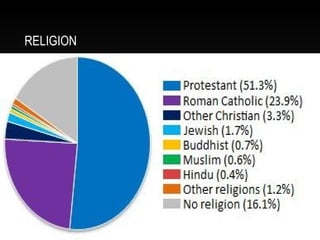
RELIGION
AIMS AND GOALS OF FRENCH EDUCATION
• 1. Protecting early childhood.
• 2. Universal primary education.
• 3. Access to lifelong education.
• 4. Achieving a 50% improvement in levels
• of adult literacy.
• 5. Improving the quality of education.
• 6. Gender equality in access to school.
• Internationalization of Education
CURRICULUM
• the curriculum is the same for all French students in any
given grade, which includes public, semi-public and
subsidized(pay some amount of) institutions. However,
there exist specialized sections and a variety of options
that students can choose.
• Kindergarten: the curriculum includes reading and
writing, numeracy and even sometimes a foreign
language, as well as artistic and creative activities.
• Primary class: The primary school curriculum in France is
similar to that in other countries, and includes literacy
and numeracy, with classes in French, arithmetic, but
also geography and history, the arts, and more and more
frequently a foreign language, usually English.
EDUCATIONAL INFORMATION
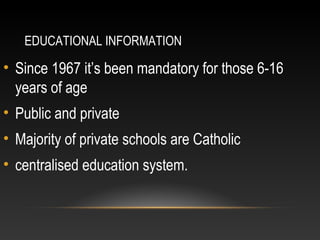
• Since 1967 it’s been mandatory for those 6-16
years of age
• Public and private
• Majority of private schools are Catholic
• centralised education system.
• Regulated by the Ministry of National
Education
• Minister of National Education is Xavier
Darcos
• Anyone ages 3-5 can go to a nursery school
http://manisa.meb.gov.tr/English/Resim/image007.jpg
NATIONAL EDUCATION STRUCTURE
MINISTRY OF NATIONAL EDUCATION
• Founded in 1857
• First educational system at the level of Ministry
• Organization
• The Central Organization
• Provincial Organization
• Overseas Organization
• Affiliated Institutions
• educational policy is fixed at the national level; curricula and
contents are designed by the Ministry of Education.
• country is divided into 30 educational
regions called académies. Each region is
managed by a representative of the
Minister, the Recteur d'académie, appointed
by the State.
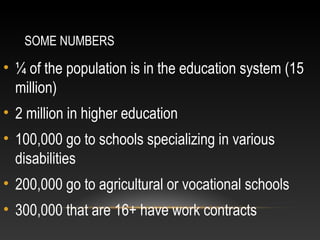
SOME NUMBERS
• ¼ of the population is in the education system (15
million)
• 2 million in higher education
• 100,000 go to schools specializing in various
disabilities
• 200,000 go to agricultural or vocational schools
• 300,000 that are 16+ have work contracts
DROP-OUT
FRENCH EDUCATION STRUCTURE
• Primary education
• Ages 3-11
• Secondary education
• Ages 11-18
• Higher education
• 18+
STRUCTURE OF FRENCH EDUCATION
PRE-SCHOOL
• Not mandatory
• Very popular
• Ages 3 to 5
• Also known as nursery classe
PRIMARY EDUCATION
• Mandatory at age 6
• Learn to write and read the
first year after kindergarden
PRIMARY EDUCATION
• Set up similar to our elementary school
• 1 or 2 teachers for numerous subjects
• Don’t teach religion
• Teach about the Republic instead
• March 2004-government banned all conspicuous
religious symbols from school and other public
institutions
SECONDARY EDUCATION
• Collège (high school) for
the first 4 years right after
primary school
• Ages 11-15
• Lycée (high school-
preparing for college) for
the next 3 years
• 15-18
BREVET
• Brevet-first official diploma
• Awarded at the end of the 9th
grade after achieving basic
skills.
• Not required to enter high school
• Consists of the grades from the final year and a final
exam
• Only French, mathematics, history, and geography
BACCALAURÉAT
• High school diploma
• Given at the end of the High school
• Needed in order to get into a university or any
professional work
• Refers to the diploma and the exams that go along
with it
• Similar to SATs or ACTs
BACCALAURÉAT GÉNÉRAL
• Most students get this
• Divided into 3 areas of study
• Can be any 3 areas of study
SECONDARY EDUCATION
• During the final year of collège, students are allowed to
pick some of their subjects
• Also get to pick what direction they want their curriculum
to take
• For lycée students can either choose to go to a general,
technical, or vocational schools
• Prepares students for baccalauréat exams taken when 18
REPEATING YEARS, MOVING UP IN
CLASS, CHANGING COURSES, ETC.
• Decision of school teachers, administrations,
families, and the students
• Parents can appeal the decision
• Parents and teachers resolve any problems
SPECIALIST/ADAPTIVE CLASSES
• Primary and secondary schools
• Try to bring students back to mainstream system
• Help students with psychological, emotional, or
behavior problems
• Help students that are slow learners
HIGHER EDUCATION
• Grandes écoles
• More prestigious
• Highly competitive selection system
• Ex. 12,000 candidates for 400 spots
• Universities
HIGHER EDUCATION
• In Paris and suburbs
• 13 universities that don’t specialize in any specific area
• Large number of institutions that do specialize in
specific areas
• Universities are named after the big cities they are
located near followed by numbers
• Paris I to XIII
HIGHER EDUCATION
• Also named after famous French people
• Influenced by the European standards
• Difficult to change major subjects without falling
behind a semester or a whole year
• Complex and rigid system
• Low tuition because they are funded by the state
• Grandes écoles ( Elite Schools) are very
prestigious
• Responsible for many of France’s scientists and
executives
MAJOR HOLIDAYS AND BREAKS
• All Saints
• 1 ½ weeks at the end of October/beginning of November
• Christmas
• 2 weeks around Christmas Day and New Years Day
• Winter
• 2 weeks in mid-February
• Spring/Easter
• 2 weeks starting in mid-April
• Summer
• 2 months starting in early-July
SPORTS
• Paid for by
parents/students
• Most popular in football
(soccer)
Teacher Education & Structure in
France
Teacher
Education
Structure
• Teacher is a civil servant.
• Recruited through Competition.
• CAPES –all general subjects
• CAPET– for technical subjects
• CAPLP – for vocational education
• CAPEPS – for sports
• Agrégation– a higher level competition).
• For primary teachers, the competition (CRPE) is organized at the level of
the académie. Orgnised into two parts Written and Oral.
• Primary teachers are appointed at the level of académie (posted anywhere in
France).
• Secondary teachers recruited at National level ( appointed any secondary
school in France).
• Secondary teachers teach only one subject (except some
in vocational education). Primary teachers have to teach
all subjects of the primary school curriculum.
• France has to recruit around 15,000 to 20,000 talented
and gifted teachers per year.
TEACHER EDUCATION BEFORE 1990
• Primary teachers trained in trained in Ecoles Normales
• Secondary teachers trained at university. They first had to obtain
a licence (Bachelor degree) in the subject of their choice, then
prepare at university for the State competitive examination to be
recruited. Recruited in the specified subject.
• vocational education teachers recruited and trained in special
institutions:ENNA (National Normal Schools for Apprenticeship).
PRESENT
• Several reforms of teacher education in France.
• IUFMs (university institutes for teacher training)
• ESPEs (Ecoles Supérieures du Professorat et de
l'Education – higher schools for teaching and
education professions).
TRENDS IN EDUCATION
• Internationalization of Education Policy
• Merketization
• Institutional Autonomy
• Decentralization
• Growing importance of accountability
• Technical Education
• Statistical Improvements in Training
French education system

French education system

  • 2.
    Presented to: WorthySir Dr. Muhammad Iqbal Anjum Presented By: Pir Azrar Ahmed Chishti
  • 5.
  • 6.
    AIMS AND GOALSOF FRENCH EDUCATION • 1. Protecting early childhood. • 2. Universal primary education. • 3. Access to lifelong education. • 4. Achieving a 50% improvement in levels • of adult literacy. • 5. Improving the quality of education. • 6. Gender equality in access to school. • Internationalization of Education
  • 7.
    CURRICULUM • the curriculumis the same for all French students in any given grade, which includes public, semi-public and subsidized(pay some amount of) institutions. However, there exist specialized sections and a variety of options that students can choose. • Kindergarten: the curriculum includes reading and writing, numeracy and even sometimes a foreign language, as well as artistic and creative activities.
  • 8.
    • Primary class:The primary school curriculum in France is similar to that in other countries, and includes literacy and numeracy, with classes in French, arithmetic, but also geography and history, the arts, and more and more frequently a foreign language, usually English.
  • 9.
    EDUCATIONAL INFORMATION • Since1967 it’s been mandatory for those 6-16 years of age • Public and private • Majority of private schools are Catholic • centralised education system.
  • 10.
    • Regulated bythe Ministry of National Education • Minister of National Education is Xavier Darcos • Anyone ages 3-5 can go to a nursery school
  • 11.
  • 12.
    MINISTRY OF NATIONALEDUCATION • Founded in 1857 • First educational system at the level of Ministry • Organization • The Central Organization • Provincial Organization • Overseas Organization • Affiliated Institutions • educational policy is fixed at the national level; curricula and contents are designed by the Ministry of Education.
  • 13.
    • country isdivided into 30 educational regions called académies. Each region is managed by a representative of the Minister, the Recteur d'académie, appointed by the State.
  • 14.
    SOME NUMBERS • ¼of the population is in the education system (15 million) • 2 million in higher education • 100,000 go to schools specializing in various disabilities • 200,000 go to agricultural or vocational schools • 300,000 that are 16+ have work contracts
  • 16.
  • 17.
    FRENCH EDUCATION STRUCTURE •Primary education • Ages 3-11 • Secondary education • Ages 11-18 • Higher education • 18+
  • 18.
  • 19.
    PRE-SCHOOL • Not mandatory •Very popular • Ages 3 to 5 • Also known as nursery classe
  • 20.
    PRIMARY EDUCATION • Mandatoryat age 6 • Learn to write and read the first year after kindergarden
  • 21.
    PRIMARY EDUCATION • Setup similar to our elementary school • 1 or 2 teachers for numerous subjects • Don’t teach religion • Teach about the Republic instead • March 2004-government banned all conspicuous religious symbols from school and other public institutions
  • 22.
    SECONDARY EDUCATION • Collège(high school) for the first 4 years right after primary school • Ages 11-15 • Lycée (high school- preparing for college) for the next 3 years • 15-18
  • 23.
    BREVET • Brevet-first officialdiploma • Awarded at the end of the 9th grade after achieving basic skills. • Not required to enter high school • Consists of the grades from the final year and a final exam • Only French, mathematics, history, and geography
  • 24.
    BACCALAURÉAT • High schooldiploma • Given at the end of the High school • Needed in order to get into a university or any professional work • Refers to the diploma and the exams that go along with it • Similar to SATs or ACTs
  • 25.
    BACCALAURÉAT GÉNÉRAL • Moststudents get this • Divided into 3 areas of study • Can be any 3 areas of study
  • 26.
    SECONDARY EDUCATION • Duringthe final year of collège, students are allowed to pick some of their subjects • Also get to pick what direction they want their curriculum to take • For lycée students can either choose to go to a general, technical, or vocational schools • Prepares students for baccalauréat exams taken when 18
  • 27.
    REPEATING YEARS, MOVINGUP IN CLASS, CHANGING COURSES, ETC. • Decision of school teachers, administrations, families, and the students • Parents can appeal the decision • Parents and teachers resolve any problems
  • 28.
    SPECIALIST/ADAPTIVE CLASSES • Primaryand secondary schools • Try to bring students back to mainstream system • Help students with psychological, emotional, or behavior problems • Help students that are slow learners
  • 29.
    HIGHER EDUCATION • Grandesécoles • More prestigious • Highly competitive selection system • Ex. 12,000 candidates for 400 spots • Universities
  • 30.
    HIGHER EDUCATION • InParis and suburbs • 13 universities that don’t specialize in any specific area • Large number of institutions that do specialize in specific areas • Universities are named after the big cities they are located near followed by numbers • Paris I to XIII
  • 31.
    HIGHER EDUCATION • Alsonamed after famous French people • Influenced by the European standards • Difficult to change major subjects without falling behind a semester or a whole year • Complex and rigid system
  • 32.
    • Low tuitionbecause they are funded by the state • Grandes écoles ( Elite Schools) are very prestigious • Responsible for many of France’s scientists and executives
  • 35.
    MAJOR HOLIDAYS ANDBREAKS • All Saints • 1 ½ weeks at the end of October/beginning of November • Christmas • 2 weeks around Christmas Day and New Years Day • Winter • 2 weeks in mid-February • Spring/Easter • 2 weeks starting in mid-April • Summer • 2 months starting in early-July
  • 36.
    SPORTS • Paid forby parents/students • Most popular in football (soccer)
  • 37.
    Teacher Education &Structure in France
  • 39.
  • 40.
    • Teacher isa civil servant. • Recruited through Competition. • CAPES –all general subjects • CAPET– for technical subjects • CAPLP – for vocational education • CAPEPS – for sports • Agrégation– a higher level competition). • For primary teachers, the competition (CRPE) is organized at the level of the académie. Orgnised into two parts Written and Oral. • Primary teachers are appointed at the level of académie (posted anywhere in France). • Secondary teachers recruited at National level ( appointed any secondary school in France).
  • 41.
    • Secondary teachersteach only one subject (except some in vocational education). Primary teachers have to teach all subjects of the primary school curriculum. • France has to recruit around 15,000 to 20,000 talented and gifted teachers per year.
  • 42.
    TEACHER EDUCATION BEFORE1990 • Primary teachers trained in trained in Ecoles Normales • Secondary teachers trained at university. They first had to obtain a licence (Bachelor degree) in the subject of their choice, then prepare at university for the State competitive examination to be recruited. Recruited in the specified subject. • vocational education teachers recruited and trained in special institutions:ENNA (National Normal Schools for Apprenticeship).
  • 43.
    PRESENT • Several reformsof teacher education in France. • IUFMs (university institutes for teacher training) • ESPEs (Ecoles Supérieures du Professorat et de l'Education – higher schools for teaching and education professions).
  • 48.
    TRENDS IN EDUCATION •Internationalization of Education Policy • Merketization • Institutional Autonomy • Decentralization • Growing importance of accountability • Technical Education • Statistical Improvements in Training

Editor's Notes

  • #7 Franch is also the financer of this programme in whole world.
  • #30 Grand schools.
  • #41 take their wishes and different priority criteria into account. IUFMs Motto Recruit more, train better
  • #45 take 3 years at university (and obtain the ‘licence’ – Bachelor degree); and then take 2 years at IUFM, with the recruitment competition at the end of the 1st year.
  • #46 during the 2nd year, students were given the status of ‘trainee-teachers’ and paid as civil servants. After Presidential Elections IUFMs were cancelled and replaced by new institutions: ESPEs (Ecoles Supérieures du Professorat et de l'Education). ESPEs are internal schools within universities, and there is one ESPE in each académie, which makes 32 ESPEs in France.