COMPARATIVE
EDUCATION
Prepared by:
Jennifer M. Oestar
Student, Ph. D. Development Education
Ded 519
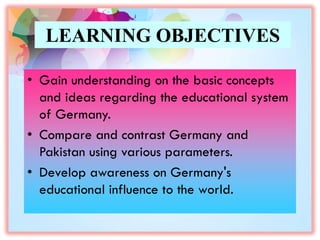
LEARNING OBJECTIVES
• Gain understanding on the basic concepts
and ideas regarding the educational system
of Germany.
• Compare and contrast Germany and
Pakistan using various parameters.
• Develop awareness on Germany's
educational influence to the world.
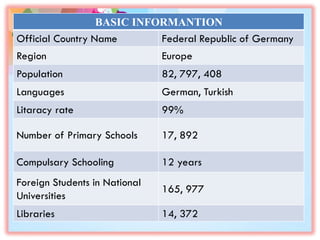
BASIC INFORMANTION
Official Country Name Federal Republic of Germany
Region Europe
Population 82, 797, 408
Languages German, Turkish
Litaracy rate 99%
Number of Primary Schools 17, 892
Compulsary Schooling 12 years
Foreign Students in National
Universities
165, 977
Libraries 14, 372
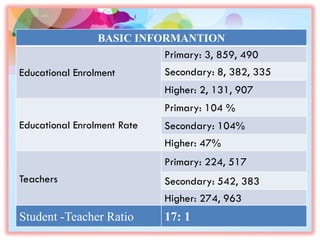
BASIC INFORMANTION
Educational Enrolment
Primary: 3, 859, 490
Secondary: 8, 382, 335
Higher: 2, 131, 907
Educational Enrolment Rate
Primary: 104 %
Secondary: 104%
Higher: 47%
Teachers
Primary: 224, 517
Secondary: 542, 383
Higher: 274, 963
Student -Teacher Ratio 17: 1
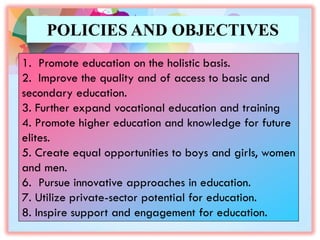
POLICIES AND OBJECTIVES
1. Promote education on the holistic basis.
2. Improve the quality and of access to basic and
secondary education.
3. Further expand vocational education and training
4. Promote higher education and knowledge for future
elites.
5. Create equal opportunities to boys and girls, women
and men.
6. Pursue innovative approaches in education.
7. Utilize private-sector potential for education.
8. Inspire support and engagement for education.
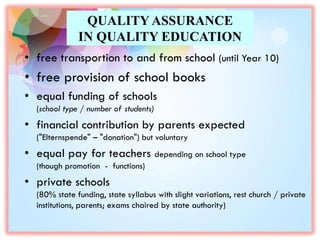
QUALITY ASSURANCE
IN QUALITY EDUCATION
• free transportion to and from school (until Year 10)
• free provision of school books
• equal funding of schools
(school type / number of students)
• financial contribution by parents expected
("Elternspende" – "donation") but voluntary
• equal pay for teachers depending on school type
(though promotion - functions)
• private schools
(80% state funding, state syllabus with slight variations, rest church / private
institutions, parents; exams chaired by state authority)
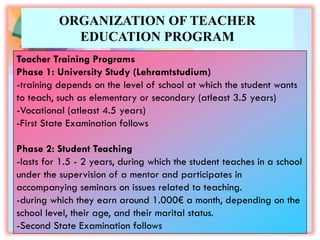
ORGANIZATION OF TEACHER
EDUCATION PROGRAM
Teacher Training Programs
Phase 1: University Study (Lehramtstudium)
-training depends on the level of school at which the student wants
to teach, such as elementary or secondary (atleast 3.5 years)
-Vocational (atleast 4.5 years)
-First State Examination follows
Phase 2: Student Teaching
-lasts for 1.5 - 2 years, during which the student teaches in a school
under the supervision of a mentor and participates in
accompanying seminars on issues related to teaching.
-during which they earn around 1.000€ a month, depending on the
school level, their age, and their marital status.
-Second State Examination follows
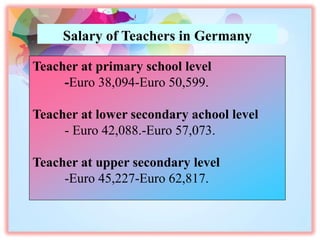
Teacher at primary school level
-Euro 38,094-Euro 50,599.
Teacher at lower secondary achool level
- Euro 42,088.-Euro 57,073.
Teacher at upper secondary level
-Euro 45,227-Euro 62,817.
Salary of Teachers in Germany
• every year consists of two terms
• term one: September till February
• term two: February till July
• vacations:
• autumn (2 weeks)
• Christmas (3 weeks)
• Easter (2 weeks)
• summer (6 weeks)
CURRICULUM
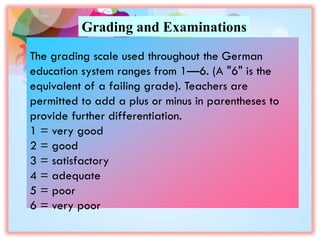
The grading scale used throughout the German
education system ranges from 1—6. (A "6" is the
equivalent of a failing grade). Teachers are
permitted to add a plus or minus in parentheses to
provide further differentiation.
1 = very good
2 = good
3 = satisfactory
4 = adequate
5 = poor
6 = very poor
Grading and Examinations
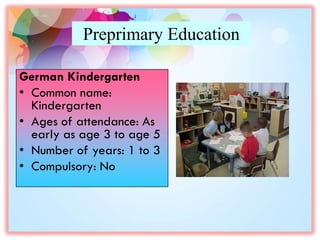
Preprimary Education
German Kindergarten
• Common name:
Kindergarten
• Ages of attendance: As
early as age 3 to age 5
• Number of years: 1 to 3
• Compulsory: No
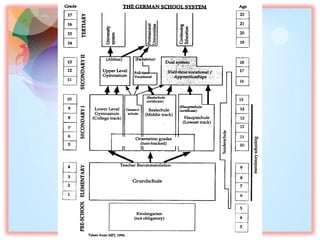
Primary Education
Common name: Grundschule/ Volksschule
• Ages of attendance: 6 to 9
• Number of years: 4
• Start of universal enrollment: Age 6
• Compulsory: Yes
• One main teacher who teaches many subjects and
then usually 3 others(I.e. music, art, and physical
education.)
• They learn to read and write
• Basic math
• Religion
• Social standards and values
• Music
• P.E.
• Art
• HSU (Heimat und Sachunterricht) which
combines biology, history, and geography.
Lower Secondary Education
 Common name:
a. Hauptschule–General secondary school
b. Realschule–Enhanced general education secondary school
c. Gymnasium–Academic secondary school
d. Gesamtschule–Integrated secondary school, meaning that
students are not split into separate general education
and academic tracks
• Ages of attendance: 10 to 15
• Number of years: 5 to 6
• Universal enrollment: Yes
• Compulsory: Yes
• Entrance/exit criteria: In some Länder, admissions tests determine if a
student can take the education tracks of Realschule or Gymnasium
Hauptschule
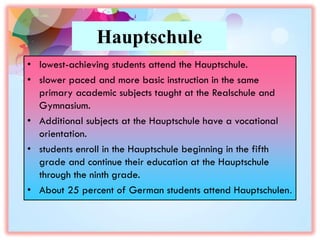
• lowest-achieving students attend the Hauptschule.
• slower paced and more basic instruction in the same
primary academic subjects taught at the Realschule and
Gymnasium.
• Additional subjects at the Hauptschule have a vocational
orientation.
• students enroll in the Hauptschule beginning in the fifth
grade and continue their education at the Hauptschule
through the ninth grade.
• About 25 percent of German students attend Hauptschulen.
Realschule
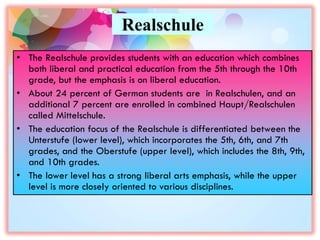
• The Realschule provides students with an education which combines
both liberal and practical education from the 5th through the 10th
grade, but the emphasis is on liberal education.
• About 24 percent of German students are in Realschulen, and an
additional 7 percent are enrolled in combined Haupt/Realschulen
called Mittelschule.
• The education focus of the Realschule is differentiated between the
Unterstufe (lower level), which incorporates the 5th, 6th, and 7th
grades, and the Oberstufe (upper level), which includes the 8th, 9th,
and 10th grades.
• The lower level has a strong liberal arts emphasis, while the upper
level is more closely oriented to various disciplines.
Gesamtschule
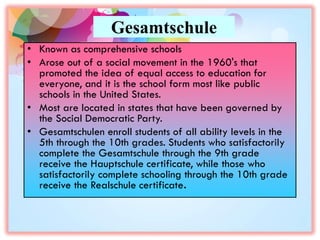
• Known as comprehensive schools
• Arose out of a social movement in the 1960's that
promoted the idea of equal access to education for
everyone, and it is the school form most like public
schools in the United States.
• Most are located in states that have been governed by
the Social Democratic Party.
• Gesamtschulen enroll students of all ability levels in the
5th through the 10th grades. Students who satisfactorily
complete the Gesamtschule through the 9th grade
receive the Hauptschule certificate, while those who
satisfactorily complete schooling through the 10th grade
receive the Realschule certificate.
Upper Secondary Education
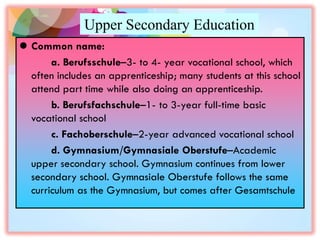
 Common name:
a. Berufsschule–3- to 4- year vocational school, which
often includes an apprenticeship; many students at this school
attend part time while also doing an apprenticeship.
b. Berufsfachschule–1- to 3-year full-time basic
vocational school
c. Fachoberschule–2-year advanced vocational school
d. Gymnasium/Gymnasiale Oberstufe–Academic
upper secondary school. Gymnasium continues from lower
secondary school. Gymnasiale Oberstufe follows the same
curriculum as the Gymnasium, but comes after Gesamtschule
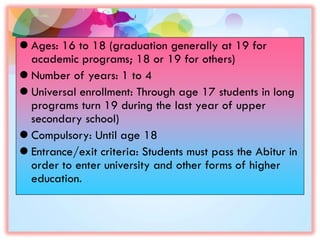
 Ages: 16 to 18 (graduation generally at 19 for
academic programs; 18 or 19 for others)
 Number of years: 1 to 4
 Universal enrollment: Through age 17 students in long
programs turn 19 during the last year of upper
secondary school)
 Compulsory: Until age 18
 Entrance/exit criteria: Students must pass the Abitur in
order to enter university and other forms of higher
education.
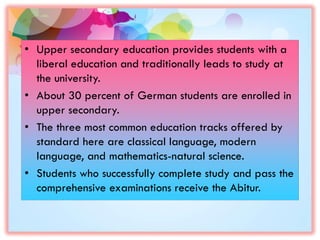
• Upper secondary education provides students with a
liberal education and traditionally leads to study at
the university.
• About 30 percent of German students are enrolled in
upper secondary.
• The three most common education tracks offered by
standard here are classical language, modern
language, and mathematics-natural science.
• Students who successfully complete study and pass the
comprehensive examinations receive the Abitur.
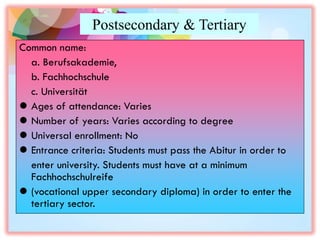
Postsecondary & Tertiary
Common name:
a. Berufsakademie,
b. Fachhochschule
c. Universität
 Ages of attendance: Varies
 Number of years: Varies according to degree
 Universal enrollment: No
 Entrance criteria: Students must pass the Abitur in order to
enter university. Students must have at a minimum
Fachhochschulreife
 (vocational upper secondary diploma) in order to enter the
tertiary sector.
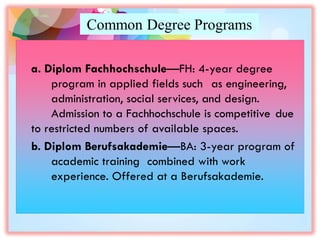
Common Degree Programs
a. Diplom Fachhochschule—FH: 4-year degree
program in applied fields such as engineering,
administration, social services, and design.
Admission to a Fachhochschule is competitive due
to restricted numbers of available spaces.
b. Diplom Berufsakademie—BA: 3-year program of
academic training combined with work
experience. Offered at a Berufsakademie.
Common Degree Programs
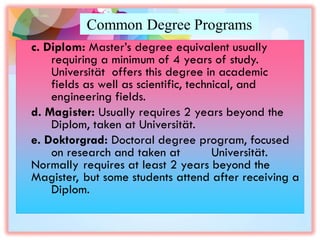
c. Diplom: Master’s degree equivalent usually
requiring a minimum of 4 years of study.
Universität offers this degree in academic
fields as well as scientific, technical, and
engineering fields.
d. Magister: Usually requires 2 years beyond the
Diplom, taken at Universität.
e. Doktorgrad: Doctoral degree program, focused
on research and taken at Universität.
Normally requires at least 2 years beyond the
Magister, but some students attend after receiving a
Diplom.
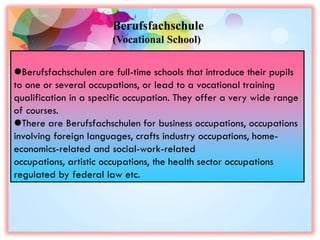
Berufsfachschulen are full-time schools that introduce their pupils
to one or several occupations, or lead to a vocational training
qualification in a specific occupation. They offer a very wide range
of courses.
There are Berufsfachschulen for business occupations, occupations
involving foreign languages, crafts industry occupations, home-
economics-related and social-work-related
occupations, artistic occupations, the health sector occupations
regulated by federal law etc.
Berufsfachschule
(Vocational School)
CONTINUOUS PROFESSIONAL
DEVELOPMENT
1. Comprehensive Teacher Education
2. Reflection & self-regualtion in teacher
education
3. Reflection & organization of mutual
exchange between theory and practice.
4. Teacher-reeducation
TRENDS AND ISSUES IN
QUALITY EDUCATION
1. Silent discrimination.
2. Traditionally highly stratified system.
3. Lack of uniformity in the system.
4. Highly centralized by the states/ government.
5. Half-day class period specially for primary level.
TRENDS AND ISSUES IN
QUALITY EDUCATION
1. Silent discrimination.
2. Traditionally highly startified system.
3. Lack of uniformity in the system.
4. Highly centralized by the states.
5. Half day classes especially for primary level.
Bibliography
Gerhart Hoffmeister and Frederic C. Tubach,
Germany: 2000 Year. From the Nazi Era to
German Unification (New York: Ungar
Publishing, 1992), 159-179.
Milotich, Ute E. The Educational System in
Germany: Case Study Findings. Washington, DC:
US Department of Education, 1999.
World Education Encyclopedia 2001
Bibliography
Survey of the German Educational System
by Eugen Weber, Marianum School, Fulda, Germany
ewebmar@web.de 29th March 2007 Hochschule Fulda,
Germany
Organisation of the education system in Germany
Eurybase, European commission
http://www.eures.ee/public/documents/0/Hariduss%C3%B
Csteem%20Saksamaal%20inglise%20keeles.pdf
f0R lisTeniNg!!!
Jennifer M. Oestar
Ph.D. Dev. Ed.

Comparative education germany

  • 1.
    COMPARATIVE EDUCATION Prepared by: Jennifer M.Oestar Student, Ph. D. Development Education Ded 519
  • 4.
    LEARNING OBJECTIVES • Gainunderstanding on the basic concepts and ideas regarding the educational system of Germany. • Compare and contrast Germany and Pakistan using various parameters. • Develop awareness on Germany's educational influence to the world.
  • 5.
    BASIC INFORMANTION Official CountryName Federal Republic of Germany Region Europe Population 82, 797, 408 Languages German, Turkish Litaracy rate 99% Number of Primary Schools 17, 892 Compulsary Schooling 12 years Foreign Students in National Universities 165, 977 Libraries 14, 372
  • 6.
    BASIC INFORMANTION Educational Enrolment Primary:3, 859, 490 Secondary: 8, 382, 335 Higher: 2, 131, 907 Educational Enrolment Rate Primary: 104 % Secondary: 104% Higher: 47% Teachers Primary: 224, 517 Secondary: 542, 383 Higher: 274, 963 Student -Teacher Ratio 17: 1
  • 7.
    POLICIES AND OBJECTIVES 1.Promote education on the holistic basis. 2. Improve the quality and of access to basic and secondary education. 3. Further expand vocational education and training 4. Promote higher education and knowledge for future elites. 5. Create equal opportunities to boys and girls, women and men. 6. Pursue innovative approaches in education. 7. Utilize private-sector potential for education. 8. Inspire support and engagement for education.
  • 8.
    QUALITY ASSURANCE IN QUALITYEDUCATION • free transportion to and from school (until Year 10) • free provision of school books • equal funding of schools (school type / number of students) • financial contribution by parents expected ("Elternspende" – "donation") but voluntary • equal pay for teachers depending on school type (though promotion - functions) • private schools (80% state funding, state syllabus with slight variations, rest church / private institutions, parents; exams chaired by state authority)
  • 9.
    ORGANIZATION OF TEACHER EDUCATIONPROGRAM Teacher Training Programs Phase 1: University Study (Lehramtstudium) -training depends on the level of school at which the student wants to teach, such as elementary or secondary (atleast 3.5 years) -Vocational (atleast 4.5 years) -First State Examination follows Phase 2: Student Teaching -lasts for 1.5 - 2 years, during which the student teaches in a school under the supervision of a mentor and participates in accompanying seminars on issues related to teaching. -during which they earn around 1.000€ a month, depending on the school level, their age, and their marital status. -Second State Examination follows
  • 10.
    Teacher at primaryschool level -Euro 38,094-Euro 50,599. Teacher at lower secondary achool level - Euro 42,088.-Euro 57,073. Teacher at upper secondary level -Euro 45,227-Euro 62,817. Salary of Teachers in Germany
  • 11.
    • every yearconsists of two terms • term one: September till February • term two: February till July • vacations: • autumn (2 weeks) • Christmas (3 weeks) • Easter (2 weeks) • summer (6 weeks) CURRICULUM
  • 12.
    The grading scaleused throughout the German education system ranges from 1—6. (A "6" is the equivalent of a failing grade). Teachers are permitted to add a plus or minus in parentheses to provide further differentiation. 1 = very good 2 = good 3 = satisfactory 4 = adequate 5 = poor 6 = very poor Grading and Examinations
  • 13.
    Preprimary Education German Kindergarten •Common name: Kindergarten • Ages of attendance: As early as age 3 to age 5 • Number of years: 1 to 3 • Compulsory: No
  • 14.
    Primary Education Common name:Grundschule/ Volksschule • Ages of attendance: 6 to 9 • Number of years: 4 • Start of universal enrollment: Age 6 • Compulsory: Yes • One main teacher who teaches many subjects and then usually 3 others(I.e. music, art, and physical education.)
  • 15.
    • They learnto read and write • Basic math • Religion • Social standards and values • Music • P.E. • Art • HSU (Heimat und Sachunterricht) which combines biology, history, and geography.
  • 16.
    Lower Secondary Education Common name: a. Hauptschule–General secondary school b. Realschule–Enhanced general education secondary school c. Gymnasium–Academic secondary school d. Gesamtschule–Integrated secondary school, meaning that students are not split into separate general education and academic tracks • Ages of attendance: 10 to 15 • Number of years: 5 to 6 • Universal enrollment: Yes • Compulsory: Yes • Entrance/exit criteria: In some Länder, admissions tests determine if a student can take the education tracks of Realschule or Gymnasium
  • 17.
    Hauptschule • lowest-achieving studentsattend the Hauptschule. • slower paced and more basic instruction in the same primary academic subjects taught at the Realschule and Gymnasium. • Additional subjects at the Hauptschule have a vocational orientation. • students enroll in the Hauptschule beginning in the fifth grade and continue their education at the Hauptschule through the ninth grade. • About 25 percent of German students attend Hauptschulen.
  • 18.
    Realschule • The Realschuleprovides students with an education which combines both liberal and practical education from the 5th through the 10th grade, but the emphasis is on liberal education. • About 24 percent of German students are in Realschulen, and an additional 7 percent are enrolled in combined Haupt/Realschulen called Mittelschule. • The education focus of the Realschule is differentiated between the Unterstufe (lower level), which incorporates the 5th, 6th, and 7th grades, and the Oberstufe (upper level), which includes the 8th, 9th, and 10th grades. • The lower level has a strong liberal arts emphasis, while the upper level is more closely oriented to various disciplines.
  • 19.
    Gesamtschule • Known ascomprehensive schools • Arose out of a social movement in the 1960's that promoted the idea of equal access to education for everyone, and it is the school form most like public schools in the United States. • Most are located in states that have been governed by the Social Democratic Party. • Gesamtschulen enroll students of all ability levels in the 5th through the 10th grades. Students who satisfactorily complete the Gesamtschule through the 9th grade receive the Hauptschule certificate, while those who satisfactorily complete schooling through the 10th grade receive the Realschule certificate.
  • 20.
    Upper Secondary Education Common name: a. Berufsschule–3- to 4- year vocational school, which often includes an apprenticeship; many students at this school attend part time while also doing an apprenticeship. b. Berufsfachschule–1- to 3-year full-time basic vocational school c. Fachoberschule–2-year advanced vocational school d. Gymnasium/Gymnasiale Oberstufe–Academic upper secondary school. Gymnasium continues from lower secondary school. Gymnasiale Oberstufe follows the same curriculum as the Gymnasium, but comes after Gesamtschule
  • 21.
     Ages: 16to 18 (graduation generally at 19 for academic programs; 18 or 19 for others)  Number of years: 1 to 4  Universal enrollment: Through age 17 students in long programs turn 19 during the last year of upper secondary school)  Compulsory: Until age 18  Entrance/exit criteria: Students must pass the Abitur in order to enter university and other forms of higher education.
  • 22.
    • Upper secondaryeducation provides students with a liberal education and traditionally leads to study at the university. • About 30 percent of German students are enrolled in upper secondary. • The three most common education tracks offered by standard here are classical language, modern language, and mathematics-natural science. • Students who successfully complete study and pass the comprehensive examinations receive the Abitur.
  • 23.
    Postsecondary & Tertiary Commonname: a. Berufsakademie, b. Fachhochschule c. Universität  Ages of attendance: Varies  Number of years: Varies according to degree  Universal enrollment: No  Entrance criteria: Students must pass the Abitur in order to enter university. Students must have at a minimum Fachhochschulreife  (vocational upper secondary diploma) in order to enter the tertiary sector.
  • 24.
    Common Degree Programs a.Diplom Fachhochschule—FH: 4-year degree program in applied fields such as engineering, administration, social services, and design. Admission to a Fachhochschule is competitive due to restricted numbers of available spaces. b. Diplom Berufsakademie—BA: 3-year program of academic training combined with work experience. Offered at a Berufsakademie.
  • 25.
    Common Degree Programs c.Diplom: Master’s degree equivalent usually requiring a minimum of 4 years of study. Universität offers this degree in academic fields as well as scientific, technical, and engineering fields. d. Magister: Usually requires 2 years beyond the Diplom, taken at Universität. e. Doktorgrad: Doctoral degree program, focused on research and taken at Universität. Normally requires at least 2 years beyond the Magister, but some students attend after receiving a Diplom.
  • 26.
    Berufsfachschulen are full-timeschools that introduce their pupils to one or several occupations, or lead to a vocational training qualification in a specific occupation. They offer a very wide range of courses. There are Berufsfachschulen for business occupations, occupations involving foreign languages, crafts industry occupations, home- economics-related and social-work-related occupations, artistic occupations, the health sector occupations regulated by federal law etc. Berufsfachschule (Vocational School)
  • 28.
    CONTINUOUS PROFESSIONAL DEVELOPMENT 1. ComprehensiveTeacher Education 2. Reflection & self-regualtion in teacher education 3. Reflection & organization of mutual exchange between theory and practice. 4. Teacher-reeducation
  • 29.
    TRENDS AND ISSUESIN QUALITY EDUCATION 1. Silent discrimination. 2. Traditionally highly stratified system. 3. Lack of uniformity in the system. 4. Highly centralized by the states/ government. 5. Half-day class period specially for primary level.
  • 30.
    TRENDS AND ISSUESIN QUALITY EDUCATION 1. Silent discrimination. 2. Traditionally highly startified system. 3. Lack of uniformity in the system. 4. Highly centralized by the states. 5. Half day classes especially for primary level.
  • 31.
    Bibliography Gerhart Hoffmeister andFrederic C. Tubach, Germany: 2000 Year. From the Nazi Era to German Unification (New York: Ungar Publishing, 1992), 159-179. Milotich, Ute E. The Educational System in Germany: Case Study Findings. Washington, DC: US Department of Education, 1999. World Education Encyclopedia 2001
  • 32.
    Bibliography Survey of theGerman Educational System by Eugen Weber, Marianum School, Fulda, Germany ewebmar@web.de 29th March 2007 Hochschule Fulda, Germany Organisation of the education system in Germany Eurybase, European commission http://www.eures.ee/public/documents/0/Hariduss%C3%B Csteem%20Saksamaal%20inglise%20keeles.pdf
  • 33.
    f0R lisTeniNg!!! Jennifer M.Oestar Ph.D. Dev. Ed.