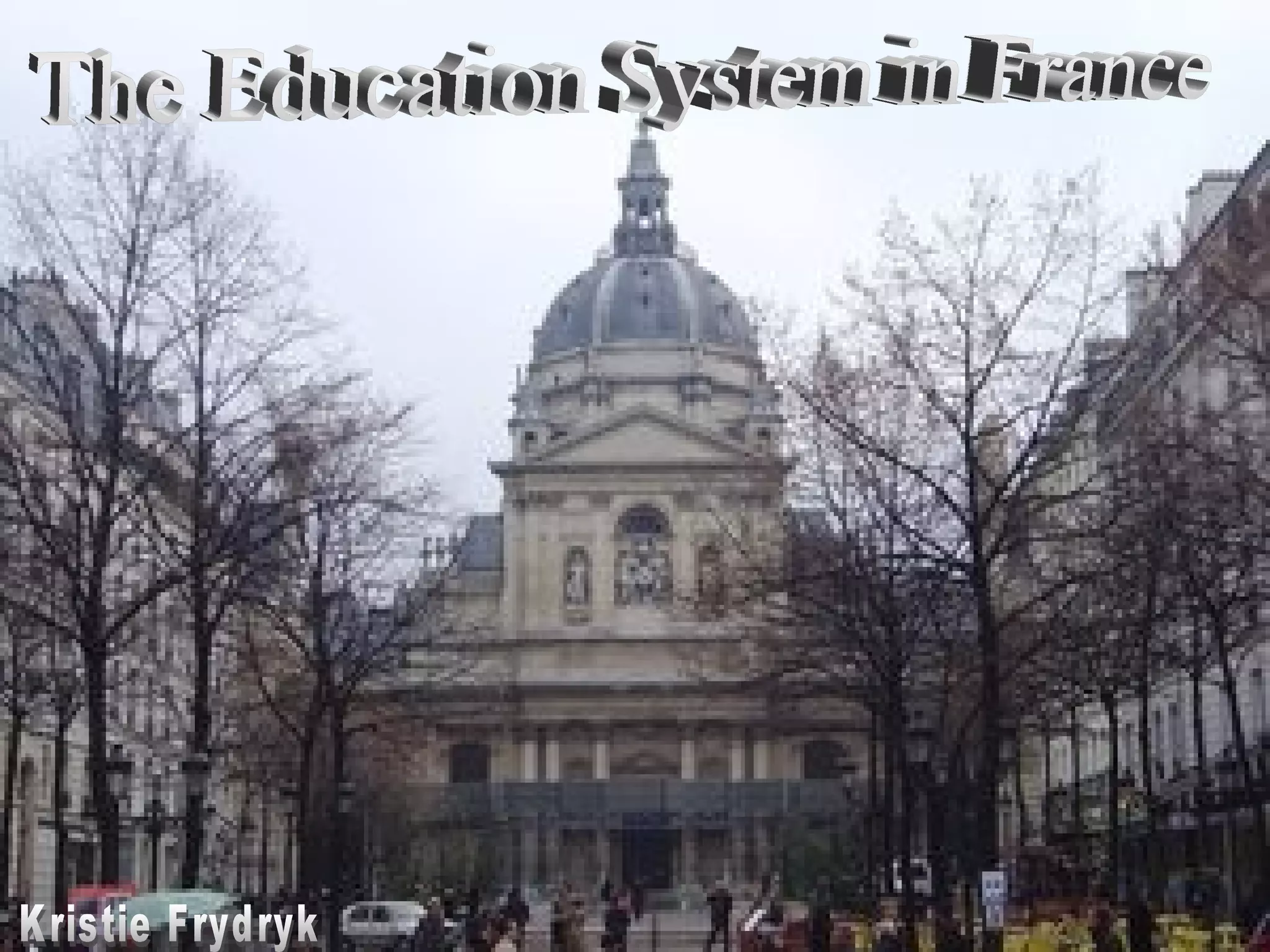
American University of Paris


  http://data.commonground.com.au/images/hc07/pics/HC07_0016.jpg
History

• 1960’s and 1970’s
• Since 1967 it’s been mandatory for those
  6-16 years of age
• Public and private
• Majority of private schools are Catholic
More History

• Regulated by the Ministry of National
  Education
• Minister of National Education as of May
  2007 is Xavier Darcos
• Anyone ages 3-5 can go to a nursery
  school
http://manisa.meb.gov.tr/English/Resim/image007.jpg
Ministry of National Education

• Founded in 1857
• First educational system at the level of
  Ministry
• Organization
  –   The Central Organization
  –   Provincial Organization
  –   Overseas Organization
  –   Affiliated Institutions
Some Numbers

• ¼ of the population is in the education
    system (15 million)
•   2 million in higher education
•   100,000 go to schools specializing in
    various disabilities
•   200,000 go to agricultural or vocational
    schools
•   300,000 that are 16+ have work contracts
French Education

• Primary education
  – Ages 3-11
• Secondary education
  – Ages 11-18
• Higher education
  – 18+
Pre-School

•   Not mandatory
•   Very popular
•   Ages 3 to 5
•   Also known as nursery classe
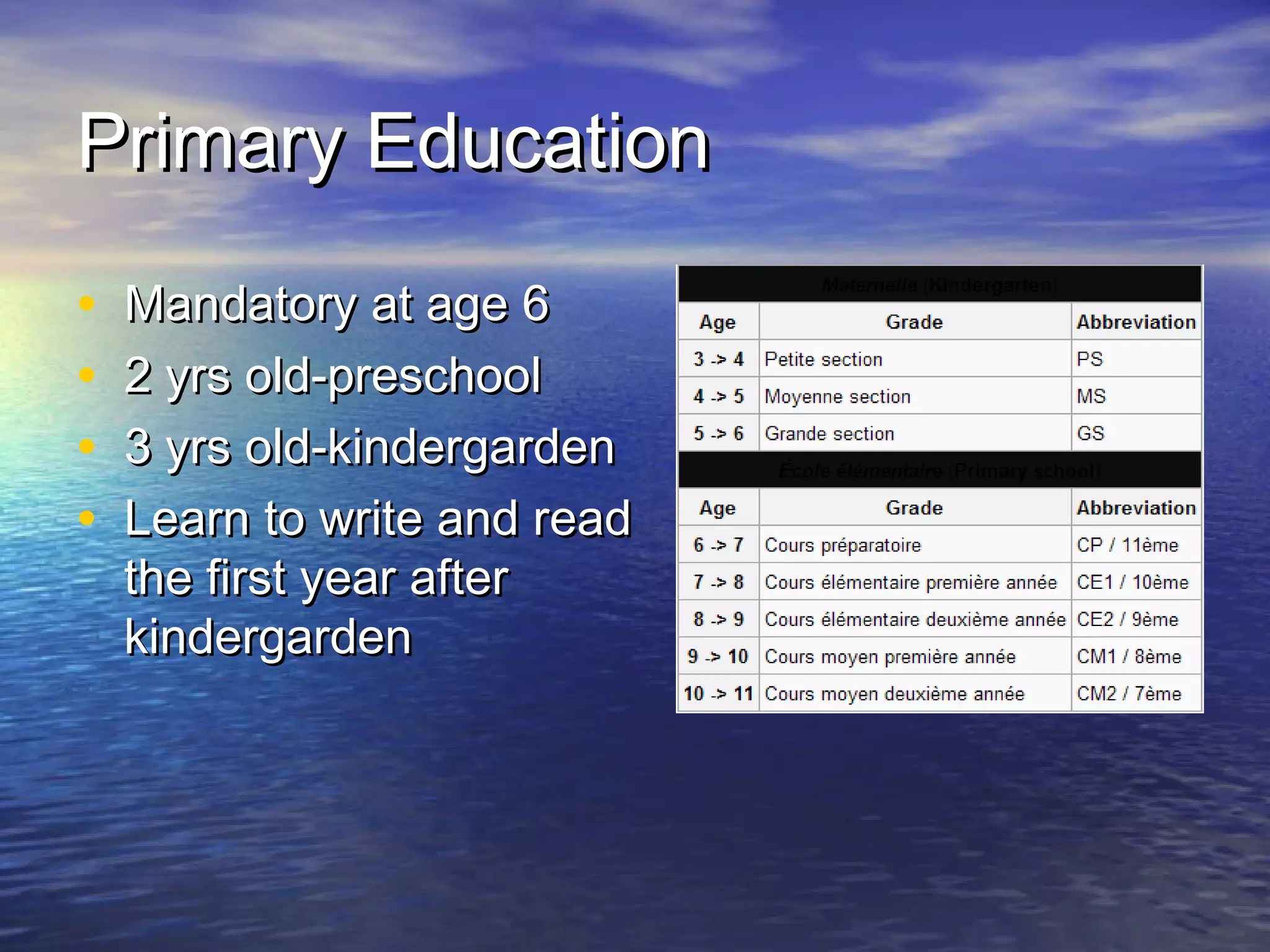
Primary Education

•   Mandatory at age 6
•   2 yrs old-preschool
•   3 yrs old-kindergarden
•   Learn to write and read
    the first year after
    kindergarden
Primary Education cont.

• Set up similar to our elementary school
    – 1 or 2 teachers for numerous subjects
•   Don’t teach religion
•   Teach about the Republic instead
•   March 2004-government banned all
    conspicuous religious symbols from
    school and other public institutions
More Primary Education

• 60,000 primary schools


• Split up into three different zones and
 shifted one or two weeks for vacations to
 avoid overcrowding in popular vacation
 spots (ski resorts and seashore resorts)
Holidays

• All Saints, Christmas, and summer
  vacations occur simultaneously
• Winter and Spring breaks are the only
  breaks that are divided into three zones
Major Holidays and Breaks
• All Saints
   – 1 ½ weeks at the end of October/beginning of November
• Christmas
   – 2 weeks around Christmas Day and New Years Day
• Winter
   – 2 weeks in mid-February
• Spring/Easter
   – 2 weeks starting in mid-April
• Summer
   – 2 months starting in early-July
Secondary Education

• Collège (high school)
  for the first 4 years
  right after primary
  school
  – Ages 11-15
• Lycée (high school-
  preparing for college)
  for the next 3 years
  – 15-18
Brevet

• Brevet-first official diploma
  –   Not required to enter high school
  –   Consists of the grades from the final year and
      a final exam
       • Only French, mathematics, history, and geography
Baccalauréat

• High school diploma
• Needed in order to get into a university or
  any professional work
• Refers to the diploma and the exams that
  go along with it
  – Similar to SATs or ACTs
Baccalauréat Général

•   Most students get this
•   Divided into 3 areas of study
•   Can be any 3 areas of study
Secondary Education cont.

• During the final year of collège, students
  are allowed to pick some of their subjects
• Also get to pick what direction they want
  their curriculum to take
• For lycée students can either choose to go
  to a general, technical, or vocational
  schools
• Prepares students for baccalauréat exams
  taken when 18
Sports

• Paid for by
    parents/students
•   Most popular in
    football (soccer)
Repeating Years, Moving up in
Class, Changing Courses, etc.
• Decision of school teachers,
  administrations, families, and the students
• Parents can appeal the decision
• Parents and teachers resolve any
  problems
Specialist/Adaptive Classes

• Primary and secondary schools
• Try to bring students back to mainstream
  system
• Help students with psychological,
  emotional, or behavior problems
• Help students that are slow learners
Higher education

• Grandes écoles
  –   More prestigious
  –   Highly competitive selection system
  –   Ex. 12,000 candidates for 400 spots
• Universities
Higher Education Cont.

• In Paris and suburbs
  – 13 universities that don’t specialize in any specific
    area
  – Large number of institutions that do specialize in
    specific areas
• Universities are named after the big cities they
  are located near followed by numbers
  – Paris I to XIII
More Higher Education

• Also named after famous French people
• Influenced by the European standards
• Difficult to change majors without falling
  behind a semester or a whole year
• Complex and rigid system
• Low tuition because they are funded by
  the state
• Grandes écoles are very prestigious
• Responsible for many of France’s
  scientists and executives
Misc

• Three trimesters
• If transferring from an English speaking
  country, the student gets placed in a
  grade a year bellow.
• Usually takes 5 trimesters for an English
  speaking student to catch up
Works Cited

Discover France! 27 Nov. 2007
  <http://www.discoverfrance.net/France/
     Education/     DF_education.shtml>.


"French Education System." Wikipedia. 30
     Nov. 2007 <http://www.wikipedia.com>.

The education system in france

  • 2.
    American University ofParis http://data.commonground.com.au/images/hc07/pics/HC07_0016.jpg
  • 3.
    History • 1960’s and1970’s • Since 1967 it’s been mandatory for those 6-16 years of age • Public and private • Majority of private schools are Catholic
  • 4.
    More History • Regulatedby the Ministry of National Education • Minister of National Education as of May 2007 is Xavier Darcos • Anyone ages 3-5 can go to a nursery school
  • 6.
  • 7.
    Ministry of NationalEducation • Founded in 1857 • First educational system at the level of Ministry • Organization – The Central Organization – Provincial Organization – Overseas Organization – Affiliated Institutions
  • 8.
    Some Numbers • ¼of the population is in the education system (15 million) • 2 million in higher education • 100,000 go to schools specializing in various disabilities • 200,000 go to agricultural or vocational schools • 300,000 that are 16+ have work contracts
  • 9.
    French Education • Primaryeducation – Ages 3-11 • Secondary education – Ages 11-18 • Higher education – 18+
  • 10.
    Pre-School • Not mandatory • Very popular • Ages 3 to 5 • Also known as nursery classe
  • 11.
    Primary Education • Mandatory at age 6 • 2 yrs old-preschool • 3 yrs old-kindergarden • Learn to write and read the first year after kindergarden
  • 12.
    Primary Education cont. •Set up similar to our elementary school – 1 or 2 teachers for numerous subjects • Don’t teach religion • Teach about the Republic instead • March 2004-government banned all conspicuous religious symbols from school and other public institutions
  • 13.
    More Primary Education •60,000 primary schools • Split up into three different zones and shifted one or two weeks for vacations to avoid overcrowding in popular vacation spots (ski resorts and seashore resorts)
  • 15.
    Holidays • All Saints,Christmas, and summer vacations occur simultaneously • Winter and Spring breaks are the only breaks that are divided into three zones
  • 16.
    Major Holidays andBreaks • All Saints – 1 ½ weeks at the end of October/beginning of November • Christmas – 2 weeks around Christmas Day and New Years Day • Winter – 2 weeks in mid-February • Spring/Easter – 2 weeks starting in mid-April • Summer – 2 months starting in early-July
  • 17.
    Secondary Education • Collège(high school) for the first 4 years right after primary school – Ages 11-15 • Lycée (high school- preparing for college) for the next 3 years – 15-18
  • 18.
    Brevet • Brevet-first officialdiploma – Not required to enter high school – Consists of the grades from the final year and a final exam • Only French, mathematics, history, and geography
  • 19.
    Baccalauréat • High schooldiploma • Needed in order to get into a university or any professional work • Refers to the diploma and the exams that go along with it – Similar to SATs or ACTs
  • 20.
    Baccalauréat Général • Most students get this • Divided into 3 areas of study • Can be any 3 areas of study
  • 21.
    Secondary Education cont. •During the final year of collège, students are allowed to pick some of their subjects • Also get to pick what direction they want their curriculum to take • For lycée students can either choose to go to a general, technical, or vocational schools • Prepares students for baccalauréat exams taken when 18
  • 22.
    Sports • Paid forby parents/students • Most popular in football (soccer)
  • 23.
    Repeating Years, Movingup in Class, Changing Courses, etc. • Decision of school teachers, administrations, families, and the students • Parents can appeal the decision • Parents and teachers resolve any problems
  • 24.
    Specialist/Adaptive Classes • Primaryand secondary schools • Try to bring students back to mainstream system • Help students with psychological, emotional, or behavior problems • Help students that are slow learners
  • 25.
    Higher education • Grandesécoles – More prestigious – Highly competitive selection system – Ex. 12,000 candidates for 400 spots • Universities
  • 26.
    Higher Education Cont. •In Paris and suburbs – 13 universities that don’t specialize in any specific area – Large number of institutions that do specialize in specific areas • Universities are named after the big cities they are located near followed by numbers – Paris I to XIII
  • 27.
    More Higher Education •Also named after famous French people • Influenced by the European standards • Difficult to change majors without falling behind a semester or a whole year • Complex and rigid system
  • 28.
    • Low tuitionbecause they are funded by the state • Grandes écoles are very prestigious • Responsible for many of France’s scientists and executives
  • 29.
    Misc • Three trimesters •If transferring from an English speaking country, the student gets placed in a grade a year bellow. • Usually takes 5 trimesters for an English speaking student to catch up
  • 30.
    Works Cited Discover France!27 Nov. 2007 <http://www.discoverfrance.net/France/ Education/     DF_education.shtml>. "French Education System." Wikipedia. 30 Nov. 2007 <http://www.wikipedia.com>.