DIGITAL IMAGE PROCESSING
EDGE DETECTION
Submitted by
M.Neya shree
Edges are significant local changes of intensity in a digital image. An
edge can be defined as a set of connected pixels that forms a boundary
between two disjoint regions. There are three types of edges:
● Horizontal edges
● Vertical edges
● Diagonal edges
Edge Detection is a method of segmenting an image into regions of
discontinuity. It is a widely used technique in digital image processing like
● pattern recognition
● image morphology
● feature extraction
Edge detection allows users to observe the features of an
image for a significant change in the gray level. This texture
indicating the end of one region in the image and the beginning
of another. It reduces the amount of data in an image and
preserves the structural properties of an image.
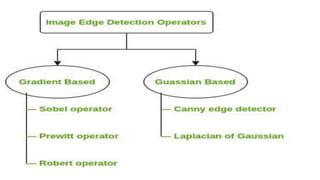
Edge Detection Operators are of two types:
● Gradient – based operator which computes first-order
derivations in a digital image like, Sobel operator, Prewitt
operator, Robert operator
● Gaussian – based operator which computes second-order
derivations in a digital image like, Canny edge detector,
Laplacian of Gaussian
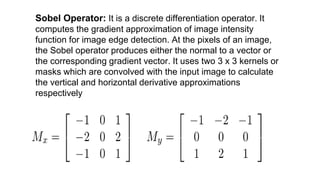
Sobel Operator: It is a discrete differentiation operator. It
computes the gradient approximation of image intensity
function for image edge detection. At the pixels of an image,
the Sobel operator produces either the normal to a vector or
the corresponding gradient vector. It uses two 3 x 3 kernels or
masks which are convolved with the input image to calculate
the vertical and horizontal derivative approximations
respectively
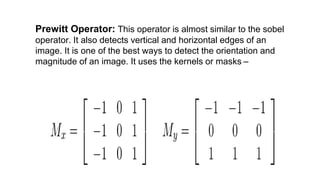
Prewitt Operator: This operator is almost similar to the sobel
operator. It also detects vertical and horizontal edges of an
image. It is one of the best ways to detect the orientation and
magnitude of an image. It uses the kernels or masks –
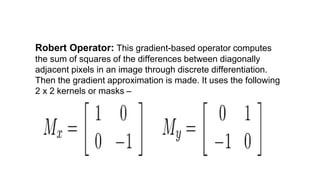
Robert Operator: This gradient-based operator computes
the sum of squares of the differences between diagonally
adjacent pixels in an image through discrete differentiation.
Then the gradient approximation is made. It uses the following
2 x 2 kernels or masks –
Thank you

Edge detection.pptx

  • 1.
    DIGITAL IMAGE PROCESSING EDGEDETECTION Submitted by M.Neya shree
  • 2.
    Edges are significantlocal changes of intensity in a digital image. An edge can be defined as a set of connected pixels that forms a boundary between two disjoint regions. There are three types of edges: ● Horizontal edges ● Vertical edges ● Diagonal edges Edge Detection is a method of segmenting an image into regions of discontinuity. It is a widely used technique in digital image processing like ● pattern recognition ● image morphology ● feature extraction
  • 3.
    Edge detection allowsusers to observe the features of an image for a significant change in the gray level. This texture indicating the end of one region in the image and the beginning of another. It reduces the amount of data in an image and preserves the structural properties of an image. Edge Detection Operators are of two types: ● Gradient – based operator which computes first-order derivations in a digital image like, Sobel operator, Prewitt operator, Robert operator ● Gaussian – based operator which computes second-order derivations in a digital image like, Canny edge detector, Laplacian of Gaussian
  • 5.
    Sobel Operator: Itis a discrete differentiation operator. It computes the gradient approximation of image intensity function for image edge detection. At the pixels of an image, the Sobel operator produces either the normal to a vector or the corresponding gradient vector. It uses two 3 x 3 kernels or masks which are convolved with the input image to calculate the vertical and horizontal derivative approximations respectively
  • 6.
    Prewitt Operator: Thisoperator is almost similar to the sobel operator. It also detects vertical and horizontal edges of an image. It is one of the best ways to detect the orientation and magnitude of an image. It uses the kernels or masks –
  • 7.
    Robert Operator: Thisgradient-based operator computes the sum of squares of the differences between diagonally adjacent pixels in an image through discrete differentiation. Then the gradient approximation is made. It uses the following 2 x 2 kernels or masks –
  • 9.