Ectopic Pregnancy Semyatov S. Associate professor Dep. Obtetrics&Gynaecology of PFUR
Definition Any pregnancy where the fertilised ovum gets implanted & develops in a site other than normal uterine cavity.
Incidence 1 in 100 ( from 1:25 to 1:250) normal pregnancies 1:28 in West Indies 4,5-16,8:1000 in Russia Mortality - 0,4% in Russia  The Secondary Infertility - 40% after operation
Incidence Recent evidence indicates that the incidence of ectopic pregnancy has been rising in many countries. USA-5 fold UK-2 fold France 15/1000 pregnancies India-1in100 deliveries Recurrence rate - 15% after 1 st , 25% after 2 ectopics
Overview Incidence Increasing (Ќ 1:66 Pregnancies) Mortality Decreasing With Better Detection Surgical and Medical Treatment Available Recurrence Rate ~ 15%
History Ectopic pregnancy was first described in 963 Ad by Albucasis.  1884 -- Robert Lawson Tait of Birmingham prformed the first successful Salpingectomy operation 1953 -- Stromme – Conservative surgery of  Salpingostomy 1973 -- Shapiro & Adller – Laparoscopic Salpingectomy 1991 -- Young et al – Laparoscopic Salpingotomy
Aetiology Any factor that causes delayed transport of  the fertilised  ovum  through the. Fallopian tube favours implantation in the tubal mucosa itself  thus giving rise to a tubal ectopic pregnancy. These factors may be Congenital or Acquired.
Aetiology CONGENITAL - Tubal Hypoplasia , Tortuosity , Congenital diverticuli , Accessory ostia , Partial stenosis
Aetiology Previous Ectopic Pregnancy PID Congenital Defects in Fallopian Tubes (Assesory ostia, Partial stenosis, Hypoplasia, Infantilism) Migration of  the Ova Externa Pelvic Abnormalities (Fundul Fibroma, adenomiosis of Fallopian Tubes) Tubal  Reconstrustive Surgery
Aetiology Tubectomy Operation Infertility IUD (~4% pregnancies with IUD in Situ are Ectopic, Progestogen Containing IUD Have a 9 Fold Higher Risk of an Ectopic Pregnancy) IVF Induction Ovulation with Gonadotropins Extraneous Factors (Appendicitis, Endometriosis) Kartegener’s Syndrome (zebra)
Sites Ampulla (78-95%) Isthmus (8-12%) Interstitial portion (2%) - very rare form Cornua (< 2%) or in accessory horn  Ovary (0,5-3%, 20-30% in IUD users) Abdomen (< 2%): Primary - very rare. Secondary. Cervix (< 2%) Combined Uterine Pregnancy and Ectopic Gestation - 1-3% in IVF, 1:4 000 - 1: 30 000
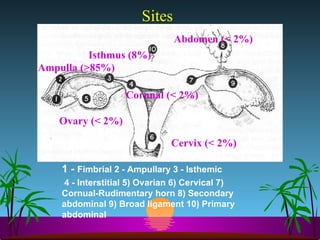
Sites 1 -  Fimbrial 2 - Ampullary 3 - Isthemic 4 - Interstitial 5) Ovarian 6) Cervical 7) Cornual-Rudimentary horn 8) Secondary abdominal 9) Broad ligament 10) Primary abdominal Ampulla (>85%) Isthmus (8%) Cornual (< 2%) Ovary (< 2%) Abdomen (< 2%) Cervix (< 2%)
Symptoms Amenorrhea ~ in 75% cases Abdominal Pain - in 95% cases. Shoulder and Epigasrtric Pain Vaginal Bleeding  Syncope Pelvic Mass
Endometrium Under Hormonal Effect of the Ectopic Pregnancy it Hypertrophies and Converted into  a  Decidua
Clinical Course Unruptured (Progressive) - without specific sings Tubal Abortion - minimal sings Tubal Rupture (into the peritoneal cavity or between the leaves of broad ligaments - rare) - massive hemoperitoneum and severe shock
Evaluation and Diagnosis The diagnosis of ectopic gestation often presents great difficulty and it is usually missed because it is NOT suspected.  “ Pregnancy in the fallopian tube is a black cat on a dark night. It may make its presence felt in subtle ways and leap at you or it may slip past unobserved. Although it is difficult to distinguish from cats of other colours in darkness, illumination clearly identifies it.”   - Mc. Fadyen - 1981
Evaluation and Diagnosis Women, during the childbearing period of life complaining of pain in the lower abdomen associated with continuous vaginal bleeding should be suspected of ectopic gestation
Evaluation and Diagnosis History and Physical Exam Vaginal Examination CBC, T+S Serial Quantitative   -hCG (BSU) Ultrasound TAS & TVS Progesterone Level? Culdocentesis Laparoscopy  D&C HSG
Serial BSU’s  -hCG* Levels Double Every 48 Hrs < 66% Rise / 48 Hrs Consistent With Ectopic Pregnancy Single Determination Not Helpful Best If Done Within Same Laboratory Never Rules Out Ectopic Pregnancy *  generally greater than > 6 500 miu/mL
Ultrasound May or May Not Be Helpful Discriminatory Zone: TVS: 1500-2000 mIU/ml (5th Week of Gestation) TAS: 6500 mIU/ml +IUP: Generally Excludes Ectopic
Culdocentesis Highly Specific if Interpreted Correctly: Presence of Free-Flowing, NON-Clotting Blood  Negative Tap Inconclusive May Obviate U/S Most Helpful in Emergent Situations to Confirm Diagnosis, But Remains Controversial
Progesterone Levels > 15 ng/ml a/w IUP < 15: SAb or Ectopic May Take Several Days for Result  Clinical Use Not Yet Widespread
Differential diagnosis Appendicitis (Perforated)  PID Rupture of Follicle or Corpus Luteum Cyst Threatened Abortion Splenic Rupture Perforated Gastric or Duodenal Ulcer
Differential diagnosis Acute Pancreatities Myocardial Infarct Pyosalpinx Septic Abortion Pelvic Abcess Retroverted Gravid Uterus Twisted Ovarian Cyst Rupture of Chocolate cyst
Treatment  Observation Laparoscopy Laparotomy MTX Hyperosmolar Glucose KCl RU-486 Prostaglandin F2 alfa
Observation Many Tubal Pregnancies Abort Israeli Study: Majority of Untreated Ectopics Resolve Not Yet Acceptable Standard of Care in US
Laparotomy Acute Ectopic Gestation  Salpingoectomy Secondary Abdominal Pregnancy Interstial Pregnancy Cornual Pregnancy Cervical Pregnancy  Auto-Transfusion
Laparoscopy Allows Diagnosis and Treatment  Salpingostomy Salpingectomy (Total / Partial) Cornual Resection Minimally Invasive, Unlike Laparotomy Few Contraindications: Unstable Patient (Possibly)
MTX Toxic to Trophoblast Cells Minimal Side Effects May Preserve Fertility in Cases of Cervical Pregnancy Requires Compliant Patient, Time  Pain Not Uncommon BSU May Rise Initially 25-50 mg into Gestational Sac
MTX Tubal Patency is Restored in 82% cases Oral - 50-100 mg (toxicity on GIT) Intramusculary 1 mg/kg NB.  Laparoscopic Injection of MTX, Prostaglandin F2 alfa, RU 486 (anti-progesterone), Potassium Chloride into gestational sac is possible only if the sac measures less than 3 cm,  and fetal heart  is absent
Persistent Trophoblast Most Often A/W Salpingostomy Laparoscopic ~ 3% Minilap <1% Most Easily Treated With MTX
Cervical Pregnancy Incidence ~1:1 000 Profuse painless bleeding following a short period of Amenorrhea PE: a patulous external os and productsmof conception in the cevical canal, internal os is closed and the uterus is firm and normal in size
Cervical Pregnancy US helps in the correct diagnisis Treatment: - Suction Evacuation and Tamponade by inserting a distended Foley Catheter for 24 hours - Hysterectomy  - Hysteroscopic Resection using    Resectoscope  - MTX
Outcomes 15% Repeat Ectopic Rate Ќ 2 Ectopics: 33% Pregnancy Rate 25% Ectopic No Benefit To Removing Ovary Along With Tube
Summary Ectopic Pregnancy is a Common, Treatable Problem Sensitive BSU Assays Allow Early Detection Surgical and Medical Options Exist Ruptured Ectopics Should be Unusual with Compliant Patients and Appropriate Medical Care

ectopic pregnancy

  • 1.
    Ectopic Pregnancy SemyatovS. Associate professor Dep. Obtetrics&Gynaecology of PFUR
  • 2.
    Definition Any pregnancywhere the fertilised ovum gets implanted & develops in a site other than normal uterine cavity.
  • 3.
    Incidence 1 in100 ( from 1:25 to 1:250) normal pregnancies 1:28 in West Indies 4,5-16,8:1000 in Russia Mortality - 0,4% in Russia The Secondary Infertility - 40% after operation
  • 4.
    Incidence Recent evidenceindicates that the incidence of ectopic pregnancy has been rising in many countries. USA-5 fold UK-2 fold France 15/1000 pregnancies India-1in100 deliveries Recurrence rate - 15% after 1 st , 25% after 2 ectopics
  • 5.
    Overview Incidence Increasing(Ќ 1:66 Pregnancies) Mortality Decreasing With Better Detection Surgical and Medical Treatment Available Recurrence Rate ~ 15%
  • 6.
    History Ectopic pregnancywas first described in 963 Ad by Albucasis. 1884 -- Robert Lawson Tait of Birmingham prformed the first successful Salpingectomy operation 1953 -- Stromme – Conservative surgery of Salpingostomy 1973 -- Shapiro & Adller – Laparoscopic Salpingectomy 1991 -- Young et al – Laparoscopic Salpingotomy
  • 7.
    Aetiology Any factorthat causes delayed transport of the fertilised ovum through the. Fallopian tube favours implantation in the tubal mucosa itself thus giving rise to a tubal ectopic pregnancy. These factors may be Congenital or Acquired.
  • 8.
    Aetiology CONGENITAL -Tubal Hypoplasia , Tortuosity , Congenital diverticuli , Accessory ostia , Partial stenosis
  • 9.
    Aetiology Previous EctopicPregnancy PID Congenital Defects in Fallopian Tubes (Assesory ostia, Partial stenosis, Hypoplasia, Infantilism) Migration of the Ova Externa Pelvic Abnormalities (Fundul Fibroma, adenomiosis of Fallopian Tubes) Tubal Reconstrustive Surgery
  • 10.
    Aetiology Tubectomy OperationInfertility IUD (~4% pregnancies with IUD in Situ are Ectopic, Progestogen Containing IUD Have a 9 Fold Higher Risk of an Ectopic Pregnancy) IVF Induction Ovulation with Gonadotropins Extraneous Factors (Appendicitis, Endometriosis) Kartegener’s Syndrome (zebra)
  • 11.
    Sites Ampulla (78-95%)Isthmus (8-12%) Interstitial portion (2%) - very rare form Cornua (< 2%) or in accessory horn Ovary (0,5-3%, 20-30% in IUD users) Abdomen (< 2%): Primary - very rare. Secondary. Cervix (< 2%) Combined Uterine Pregnancy and Ectopic Gestation - 1-3% in IVF, 1:4 000 - 1: 30 000
  • 12.
    Sites 1 - Fimbrial 2 - Ampullary 3 - Isthemic 4 - Interstitial 5) Ovarian 6) Cervical 7) Cornual-Rudimentary horn 8) Secondary abdominal 9) Broad ligament 10) Primary abdominal Ampulla (>85%) Isthmus (8%) Cornual (< 2%) Ovary (< 2%) Abdomen (< 2%) Cervix (< 2%)
  • 13.
    Symptoms Amenorrhea ~in 75% cases Abdominal Pain - in 95% cases. Shoulder and Epigasrtric Pain Vaginal Bleeding Syncope Pelvic Mass
  • 14.
    Endometrium Under HormonalEffect of the Ectopic Pregnancy it Hypertrophies and Converted into a Decidua
  • 15.
    Clinical Course Unruptured(Progressive) - without specific sings Tubal Abortion - minimal sings Tubal Rupture (into the peritoneal cavity or between the leaves of broad ligaments - rare) - massive hemoperitoneum and severe shock
  • 16.
    Evaluation and DiagnosisThe diagnosis of ectopic gestation often presents great difficulty and it is usually missed because it is NOT suspected. “ Pregnancy in the fallopian tube is a black cat on a dark night. It may make its presence felt in subtle ways and leap at you or it may slip past unobserved. Although it is difficult to distinguish from cats of other colours in darkness, illumination clearly identifies it.” - Mc. Fadyen - 1981
  • 17.
    Evaluation and DiagnosisWomen, during the childbearing period of life complaining of pain in the lower abdomen associated with continuous vaginal bleeding should be suspected of ectopic gestation
  • 18.
    Evaluation and DiagnosisHistory and Physical Exam Vaginal Examination CBC, T+S Serial Quantitative  -hCG (BSU) Ultrasound TAS & TVS Progesterone Level? Culdocentesis Laparoscopy D&C HSG
  • 19.
    Serial BSU’s -hCG* Levels Double Every 48 Hrs < 66% Rise / 48 Hrs Consistent With Ectopic Pregnancy Single Determination Not Helpful Best If Done Within Same Laboratory Never Rules Out Ectopic Pregnancy * generally greater than > 6 500 miu/mL
  • 20.
    Ultrasound May orMay Not Be Helpful Discriminatory Zone: TVS: 1500-2000 mIU/ml (5th Week of Gestation) TAS: 6500 mIU/ml +IUP: Generally Excludes Ectopic
  • 21.
    Culdocentesis Highly Specificif Interpreted Correctly: Presence of Free-Flowing, NON-Clotting Blood Negative Tap Inconclusive May Obviate U/S Most Helpful in Emergent Situations to Confirm Diagnosis, But Remains Controversial
  • 22.
    Progesterone Levels >15 ng/ml a/w IUP < 15: SAb or Ectopic May Take Several Days for Result Clinical Use Not Yet Widespread
  • 23.
    Differential diagnosis Appendicitis(Perforated) PID Rupture of Follicle or Corpus Luteum Cyst Threatened Abortion Splenic Rupture Perforated Gastric or Duodenal Ulcer
  • 24.
    Differential diagnosis AcutePancreatities Myocardial Infarct Pyosalpinx Septic Abortion Pelvic Abcess Retroverted Gravid Uterus Twisted Ovarian Cyst Rupture of Chocolate cyst
  • 25.
    Treatment ObservationLaparoscopy Laparotomy MTX Hyperosmolar Glucose KCl RU-486 Prostaglandin F2 alfa
  • 26.
    Observation Many TubalPregnancies Abort Israeli Study: Majority of Untreated Ectopics Resolve Not Yet Acceptable Standard of Care in US
  • 27.
    Laparotomy Acute EctopicGestation Salpingoectomy Secondary Abdominal Pregnancy Interstial Pregnancy Cornual Pregnancy Cervical Pregnancy Auto-Transfusion
  • 28.
    Laparoscopy Allows Diagnosisand Treatment Salpingostomy Salpingectomy (Total / Partial) Cornual Resection Minimally Invasive, Unlike Laparotomy Few Contraindications: Unstable Patient (Possibly)
  • 29.
    MTX Toxic toTrophoblast Cells Minimal Side Effects May Preserve Fertility in Cases of Cervical Pregnancy Requires Compliant Patient, Time Pain Not Uncommon BSU May Rise Initially 25-50 mg into Gestational Sac
  • 30.
    MTX Tubal Patencyis Restored in 82% cases Oral - 50-100 mg (toxicity on GIT) Intramusculary 1 mg/kg NB. Laparoscopic Injection of MTX, Prostaglandin F2 alfa, RU 486 (anti-progesterone), Potassium Chloride into gestational sac is possible only if the sac measures less than 3 cm, and fetal heart is absent
  • 31.
    Persistent Trophoblast MostOften A/W Salpingostomy Laparoscopic ~ 3% Minilap <1% Most Easily Treated With MTX
  • 32.
    Cervical Pregnancy Incidence~1:1 000 Profuse painless bleeding following a short period of Amenorrhea PE: a patulous external os and productsmof conception in the cevical canal, internal os is closed and the uterus is firm and normal in size
  • 33.
    Cervical Pregnancy UShelps in the correct diagnisis Treatment: - Suction Evacuation and Tamponade by inserting a distended Foley Catheter for 24 hours - Hysterectomy - Hysteroscopic Resection using Resectoscope - MTX
  • 34.
    Outcomes 15% RepeatEctopic Rate Ќ 2 Ectopics: 33% Pregnancy Rate 25% Ectopic No Benefit To Removing Ovary Along With Tube
  • 35.
    Summary Ectopic Pregnancyis a Common, Treatable Problem Sensitive BSU Assays Allow Early Detection Surgical and Medical Options Exist Ruptured Ectopics Should be Unusual with Compliant Patients and Appropriate Medical Care