Ectopic Pregnancy
Kavya Liyanage
What is an
Ectopic pregnancy?
Implantation of the conceptus outside the
normal uterine cavity.
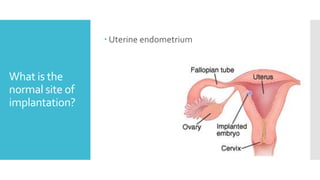
What is the
normal site of
implantation?
 Uterine endometrium
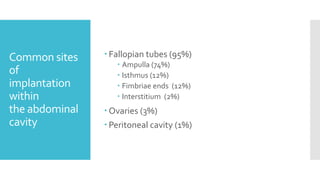
Common sites
of
implantation
within
the abdominal
cavity
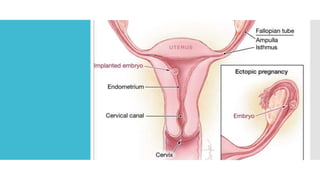
 Fallopian tubes (95%)
 Ampulla (74%)
 Isthmus (12%)
 Fimbriae ends (12%)
 Interstitium (2%)
 Ovaries (3%)
 Peritoneal cavity (1%)
Heterotopic
Pregnancy
 Simultaneous development of a pregnancy within and
outside the uterine cavity
 Risk of incidence is rising with in vitro fertilization (IVF)
treatment
Risk factors
for
ectopic
pregnancy
 Tubal disease
 Eg- Chlamydia infection that cause pelvic infection
accounts for 40% of ectopic pregnancies
 Previous ectopic pregnancies
 Previous tubal surgery
 Subfertility
 Use of intrauterine device
What is the clinical
presentation?
• Subacute abdominal pain
• Vaginal bleeding in early pregnancy
Abdominal
pain
 The pain maybe localized to the iliac fossa
 Sometimes the pain presents as a tip of the
shoulder pain, due to the free blood in
abdominal cavity causing diaphragmatic
irritation and symptoms of dizziness
Per vaginal
bleeding
 Usually dark red
 Indicative of old blood
When the
ectopic
pregnancy
ruptures
 Massive intraperitoneal bleeding causing
 Hypovolemic shock
 Acute abdomen
Investigations
• Observations
• Laboratory investigations
• HCG
• Transvaginal ultrasound scan
Observations
 Blood pressure
 Pulse
 Temperature
Laboratory
investigations
 Haemoglobin
 Blood group
 β-hCG
HCG level
 In 85% pregnancies, hCG level almost double in every
48 hours.
 In ectopic pregnancies, the level is suboptimal.
Transvaginal
ultrasound
scan
(TVS)
 An intrauterine pregnancy is detected byTVS at 4.5 weeks of
gestation
 At that time hCG level is about 1500 mIU/mL.
 At 5th week of gestation, fetal heart beat is detected inTVS.
 There, the hCG level is about 3000 mIU/mL.
 A discrepancy between hCG level andTVS may suggest ectopic
pregnancy.
 Free fluid detected inTVS suggests of a ruptured ectopic
pregnancy.
Management basis
• Clinical presentation
• β-hCG
• Ultrasound findings
• Patient's choice
Management
methods
 Expectant approach
 Medical approach
 Surgical approach
Expectant
approach
 Suitable for haemodynamically stable and asymptomatic patients
 Assuming that significant proportion of all tubal pregnancies will
resolve with regression or tubal abortion without treatment
Medical
approach
 Intramuscular methotrexate
 Which is a folic acid analog that inhibit DNA synthesis
in trophoblastic cells
Methotrexat
e treatment
Indications
 Cornual pregnancy
 Persistent trophoblastic
disease
 Patient with one
fallopian tube and
fertility desired
 When trophoblastic cells
adherent to bowel or
blood vessel
Contraindications
 Chronic liver, renal or
haematological disorder
 Active infection
 Immunodeficincy
 Breast feeding
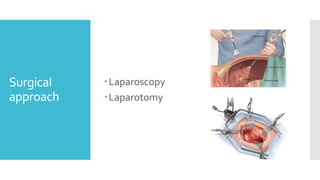
Surgical
approach
Laparoscopy
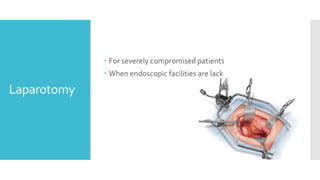
Laparotomy
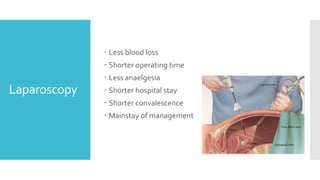
Laparoscopy
 Less blood loss
 Shorter operating time
 Less anaelgesia
 Shorter hospital stay
 Shorter convalescence
 Mainstay of management
Laparotomy
 For severely compromised patients
 When endoscopic facilities are lack
During
surgery
Salpingectomy
 Removal of fallopian tube
 Treatment of choice when one normal tube
is remaining
Salpingotomy
 Fallopian tube opened at the site of ectopic
pregnancy and trophoblastic cells extracted
 Associated with higher rate of subsequent
ectopic pregnancy
ThankYou!

Ectopic Pregnancy