TEKS 8C: Calculate percent composition and empirical and molecular formulas.
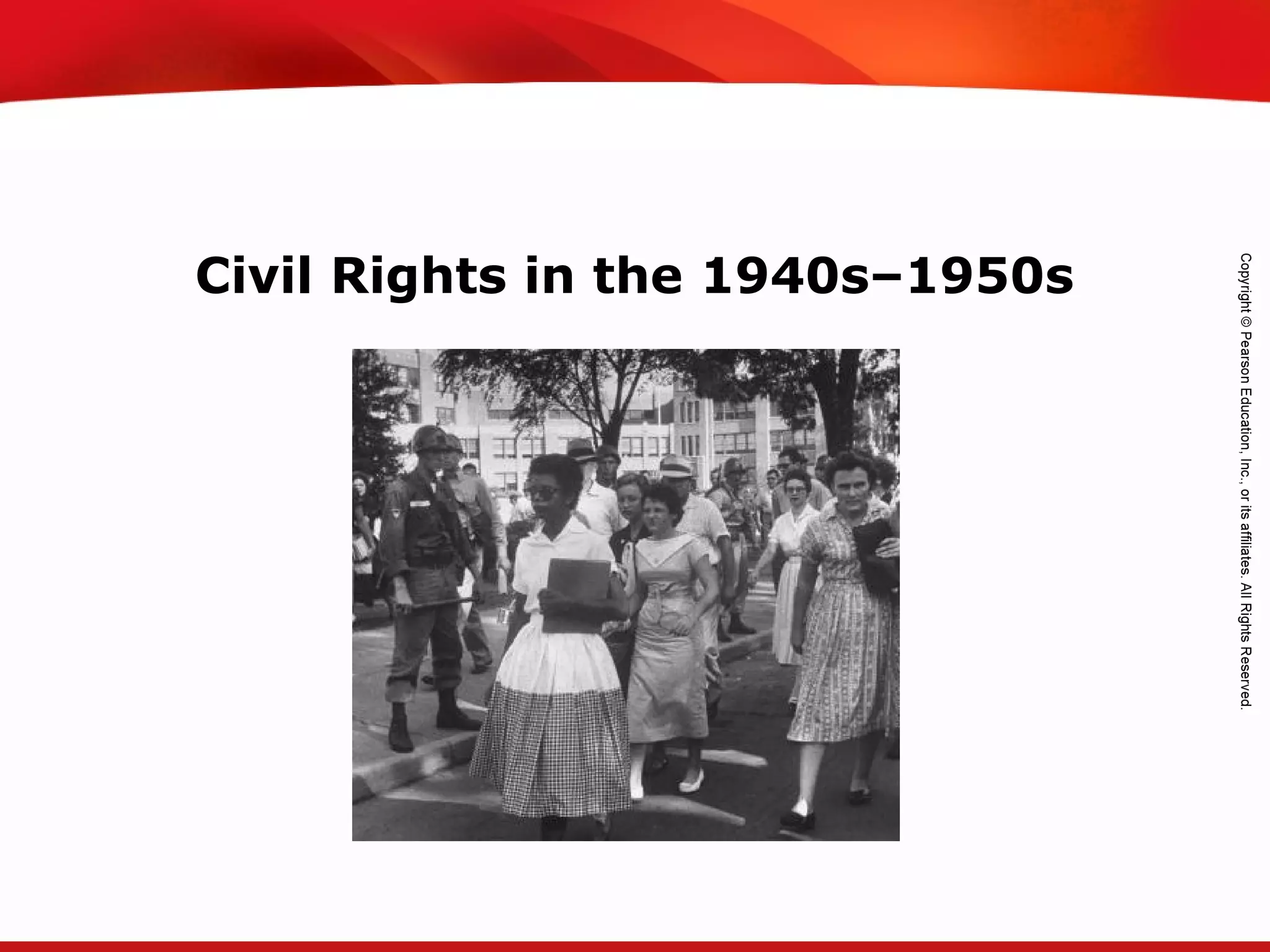
Civil Rights in the 1940s–1950s
TEKS 8C: Calculate percent composition and empirical and molecular formulas.
• Describe efforts to end segregation in the 1940s
and 1950s.
• Explain the importance of Brown v. Board of
Education.
• Describe the controversy over school
desegregation in Little Rock, Arkansas.
• Discuss the Montgomery bus boycott and its
impact.
Objectives
TEKS 8C: Calculate percent composition and empirical and molecular formulas.
Terms and People
• de jure segregation − segregation that is
imposed by law
• de facto segregation − segregation by
unwritten custom or tradition
• Thurgood Marshall − African American lawyer
who led the legal team that challenged
segregation in the courts; later named a
Supreme Court justice
TEKS 8C: Calculate percent composition and empirical and molecular formulas.
• Earl Warren – Supreme Court Chief Justice
who wrote the decision that ended segregation
in public schools
• Rosa Parks − African American woman
arrested in Montgomery, Alabama, for refusing
to give up her bus seat to a white person,
leading to a prolonged bus boycott
Terms and People (continued)
TEKS 8C: Calculate percent composition and empirical and molecular formulas.
• Montgomery bus boycott − a 1955–1956
protest by African Americans in Montgomery,
Alabama, against racial segregation in the bus
system
• Martin Luther King, Jr. − Baptist preacher
and civil rights leader who advocated
nonviolent protest against segregation
Terms and People (continued)
TEKS 8C: Calculate percent composition and empirical and molecular formulas.
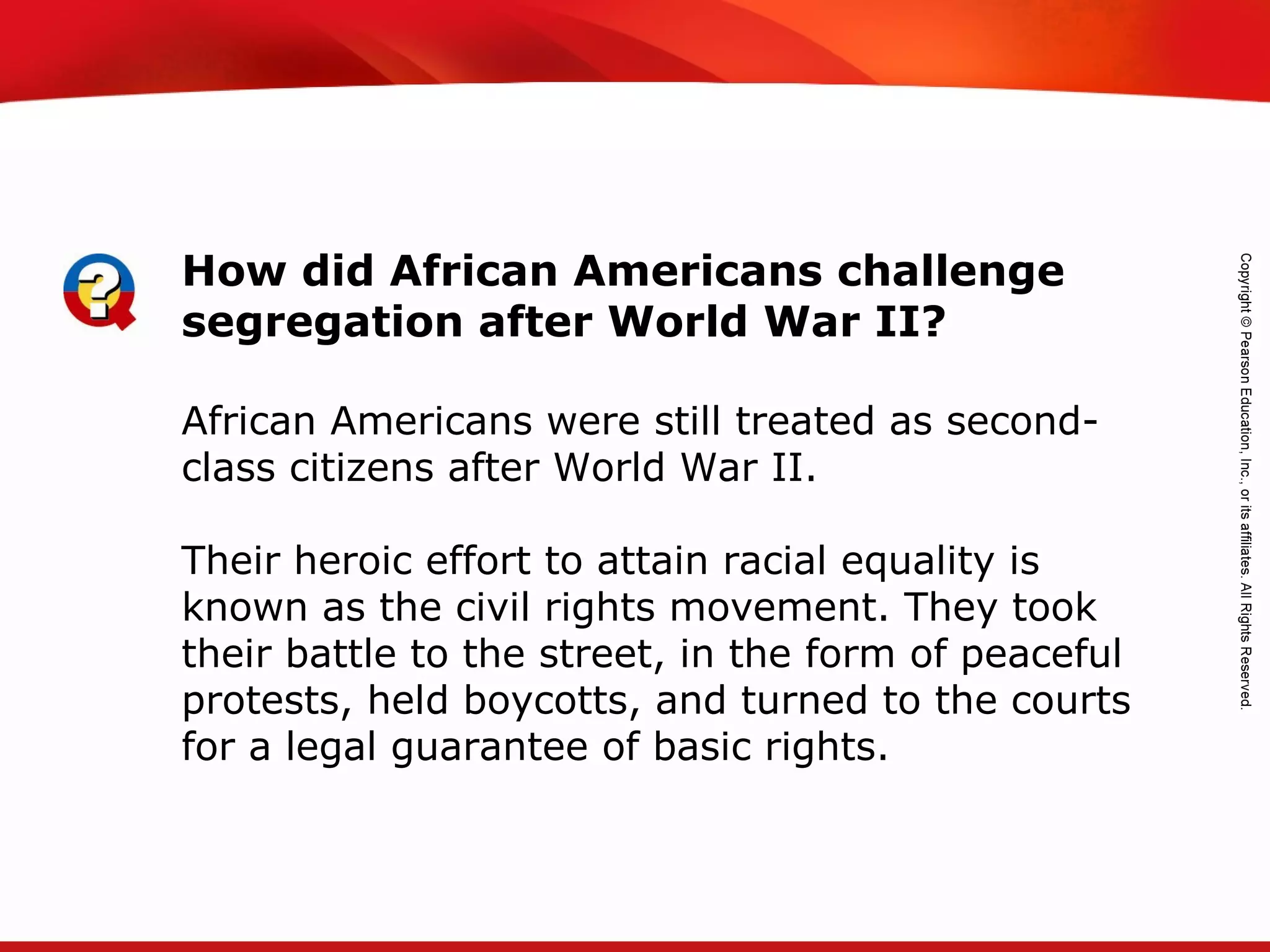
African Americans were still treated as second-
class citizens after World War II.
Their heroic effort to attain racial equality is
known as the civil rights movement. They took
their battle to the street, in the form of peaceful
protests, held boycotts, and turned to the courts
for a legal guarantee of basic rights.
How did African Americans challenge
segregation after World War II?
TEKS 8C: Calculate percent composition and empirical and molecular formulas.
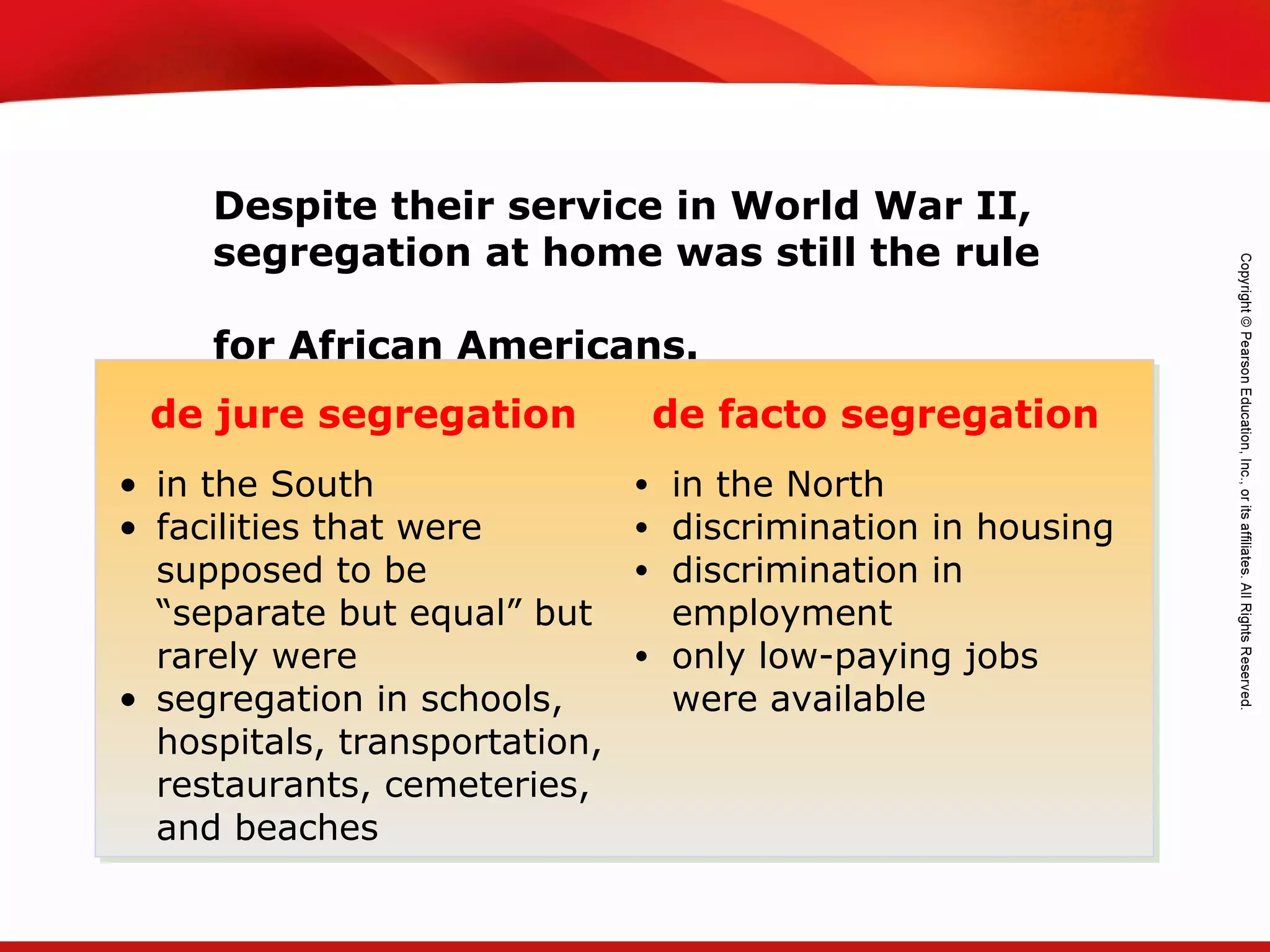
Despite their service in World War II,
segregation at home was still the rule
for African Americans.
de jure segregation de facto segregation
• in the South
• facilities that were
supposed to be
“separate but equal” but
rarely were
• segregation in schools,
hospitals, transportation,
restaurants, cemeteries,
and beaches
• in the North
• discrimination in housing
• discrimination in
employment
• only low-paying jobs
were available
TEKS 8C: Calculate percent composition and empirical and molecular formulas.
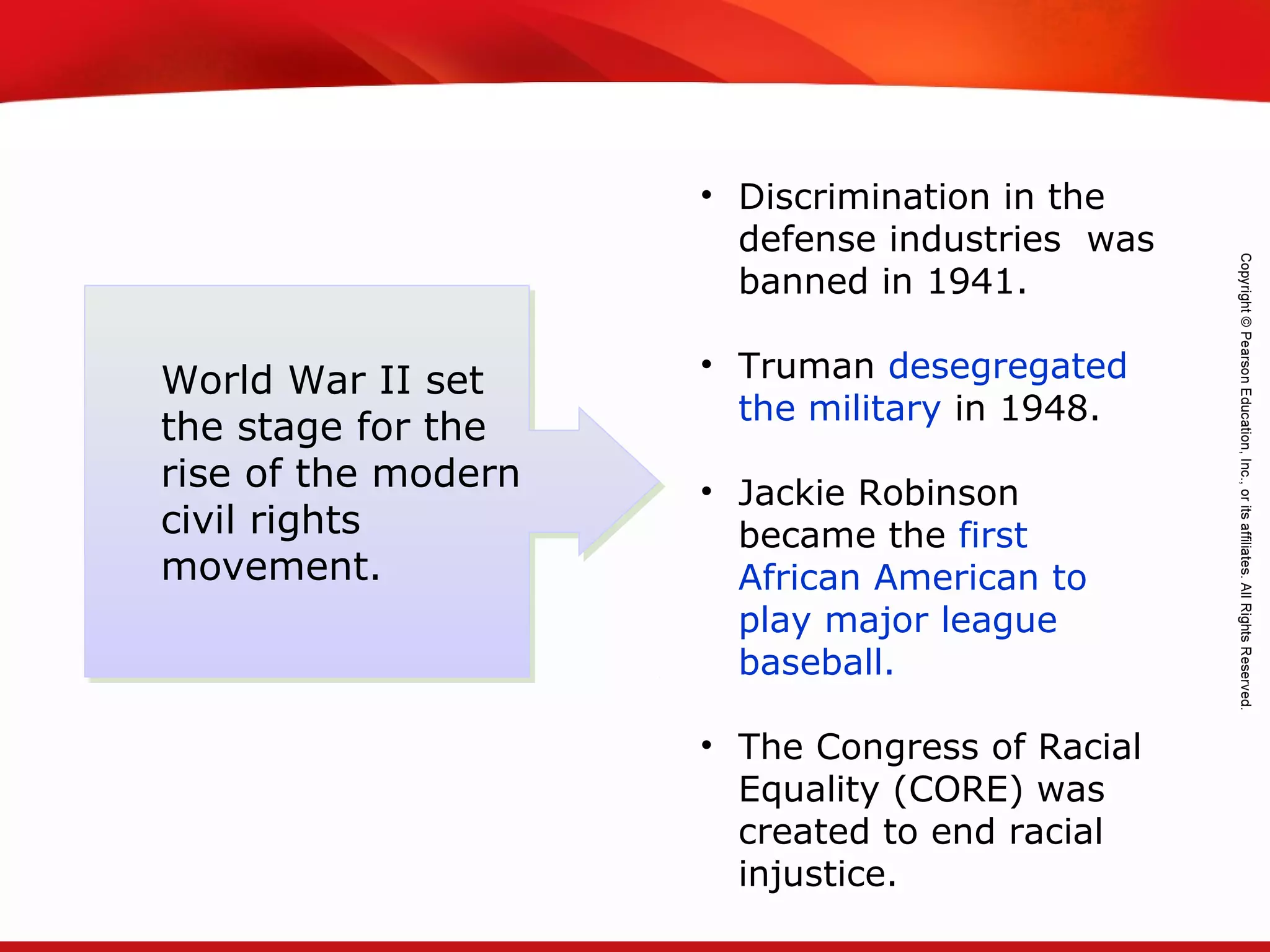
• Discrimination in the
defense industries was
banned in 1941.
• Truman desegregated
the military in 1948.
• Jackie Robinson
became the first
African American to
play major league
baseball.
• The Congress of Racial
Equality (CORE) was
created to end racial
injustice.
World War II set
the stage for the
rise of the modern
civil rights
movement.
TEKS 8C: Calculate percent composition and empirical and molecular formulas.
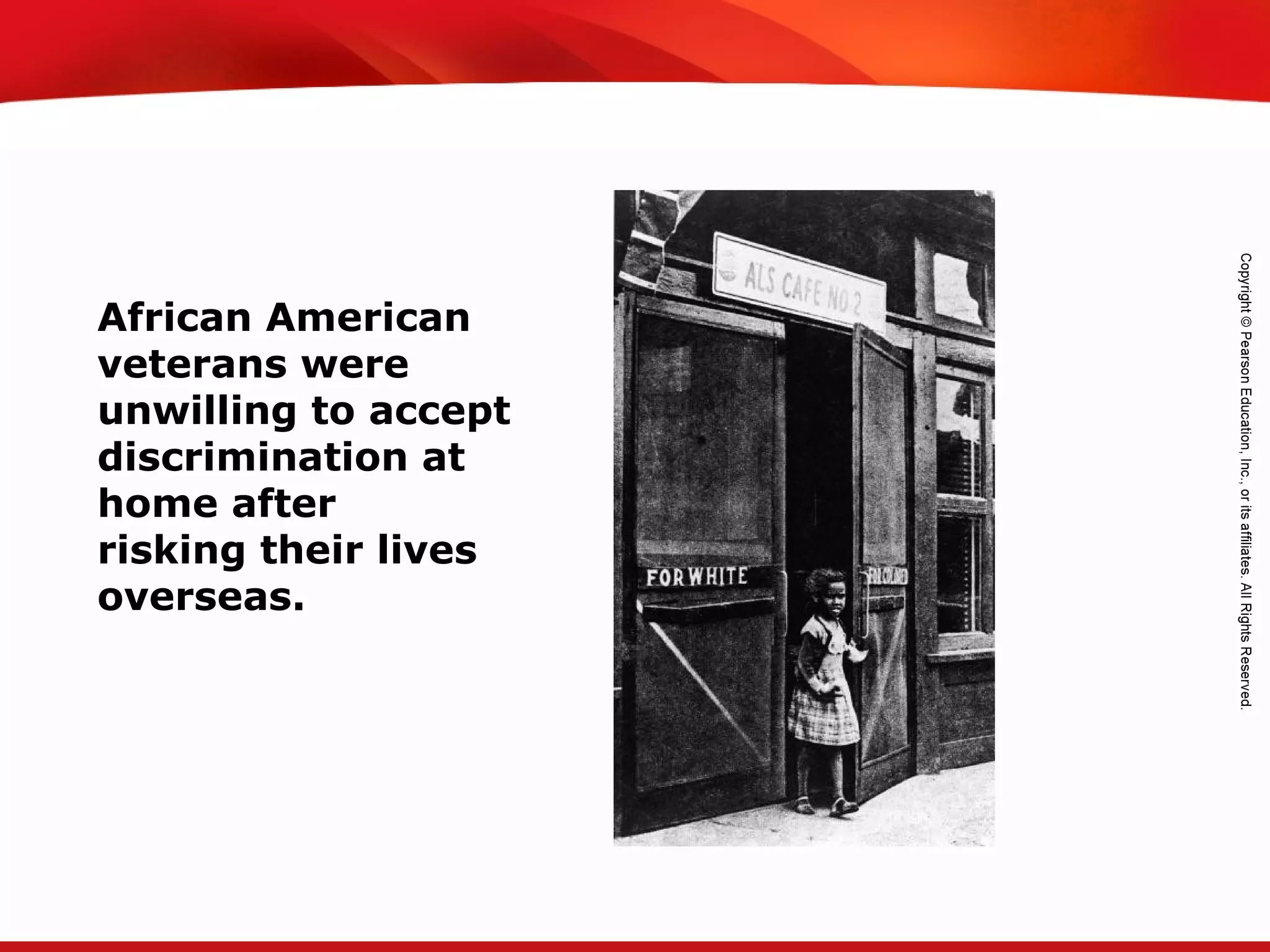
African American
veterans were
unwilling to accept
discrimination at
home after
risking their lives
overseas.
TEKS 8C: Calculate percent composition and empirical and molecular formulas.
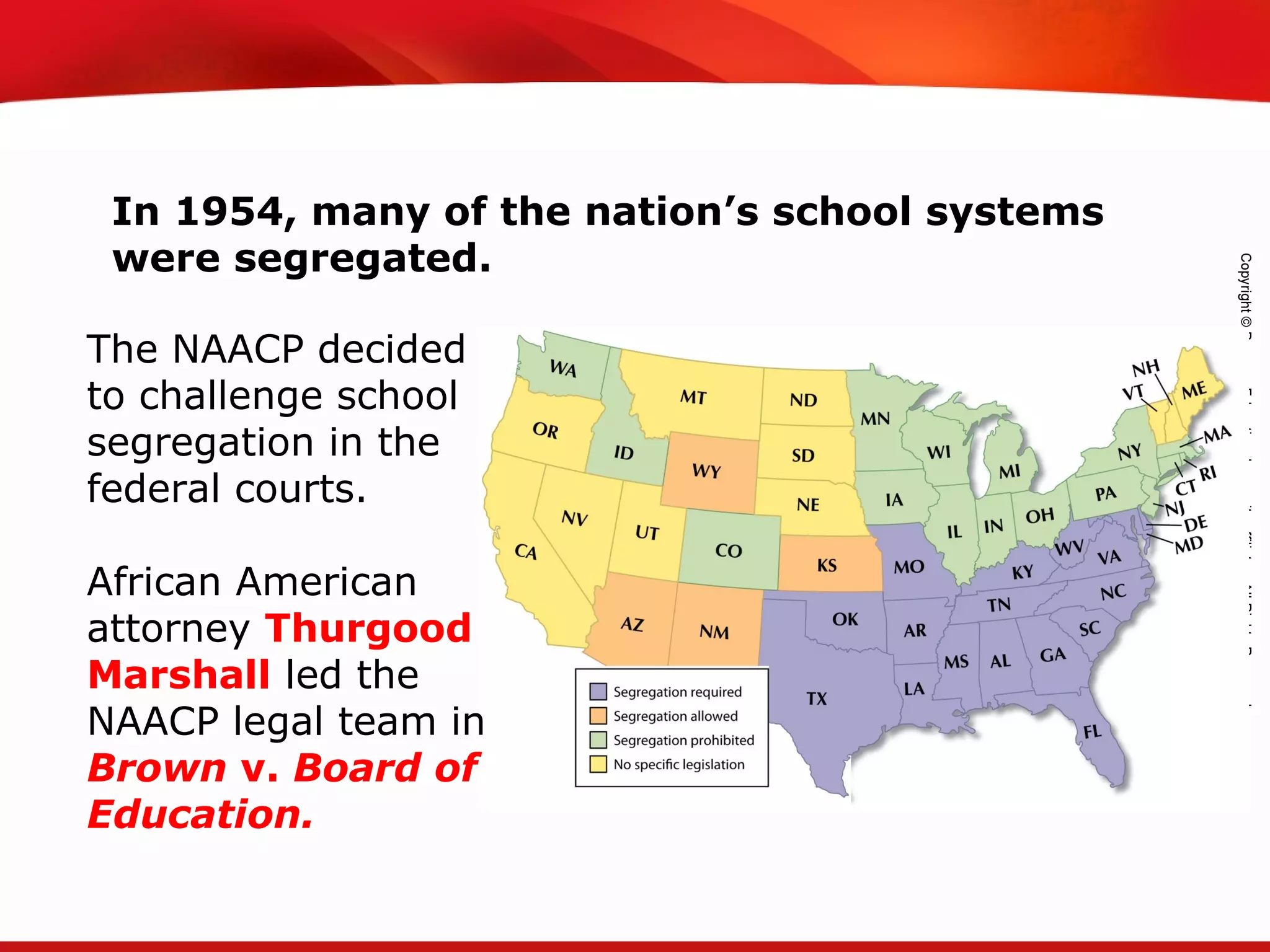
In 1954, many of the nation’s school systems
were segregated.
The NAACP decided
to challenge school
segregation in the
federal courts.
African American
attorney Thurgood
Marshall led the
NAACP legal team in
Brown v. Board of
Education.
TEKS 8C: Calculate percent composition and empirical and molecular formulas.
The decision to Brown v. Board of Education was
written by Chief Justice Earl Warren.
The decision concluded that:
The Chief Justice asked “Does segregation of children in
public schools solely on the basis of race . . . deprive
children of the minority group of equal education
opportunities?” He concluded, “We believe it does.”
• segregated public education
violated the Fourteenth
Amendment.
• “Separate but equal” had no place
in public education.
TEKS 8C: Calculate percent composition and empirical and molecular formulas.
The Brown v. Board of Education ruling was significant
and controversial.
About 100 white
Southern members of
Congress opposed
the decision; in 1956
they endorsed “The
Southern Manifesto”
to lawfully oppose
Brown.
In a second
decision, Brown II,
the courts urged
implementation of
the decision “with
all deliberate
speed” across the
nation.
TEKS 8C: Calculate percent composition and empirical and molecular formulas.
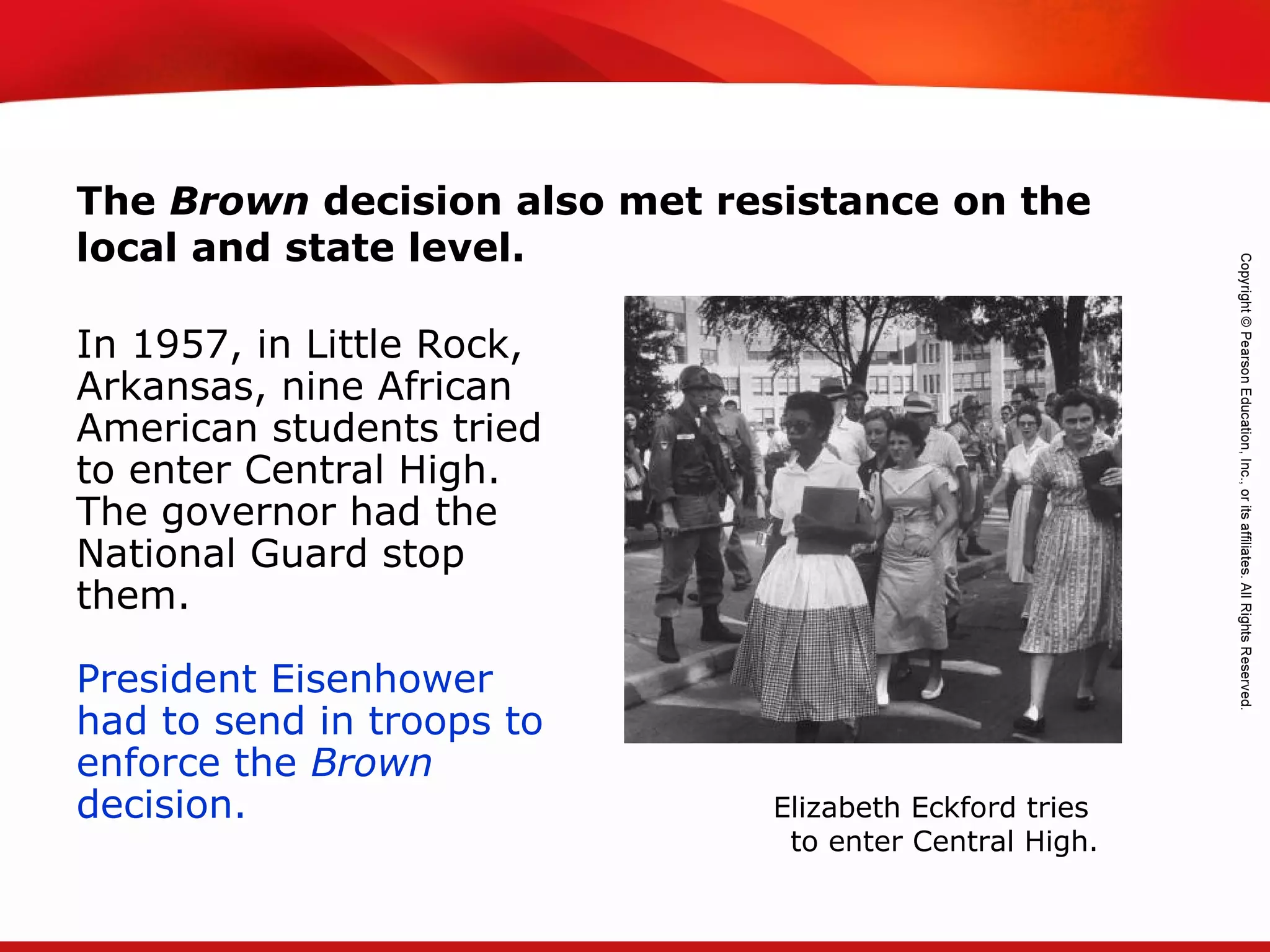
In 1957, in Little Rock,
Arkansas, nine African
American students tried
to enter Central High.
The governor had the
National Guard stop
them.
President Eisenhower
had to send in troops to
enforce the Brown
decision.
The Brown decision also met resistance on the
local and state level.
Elizabeth Eckford tries
to enter Central High.
TEKS 8C: Calculate percent composition and empirical and molecular formulas.
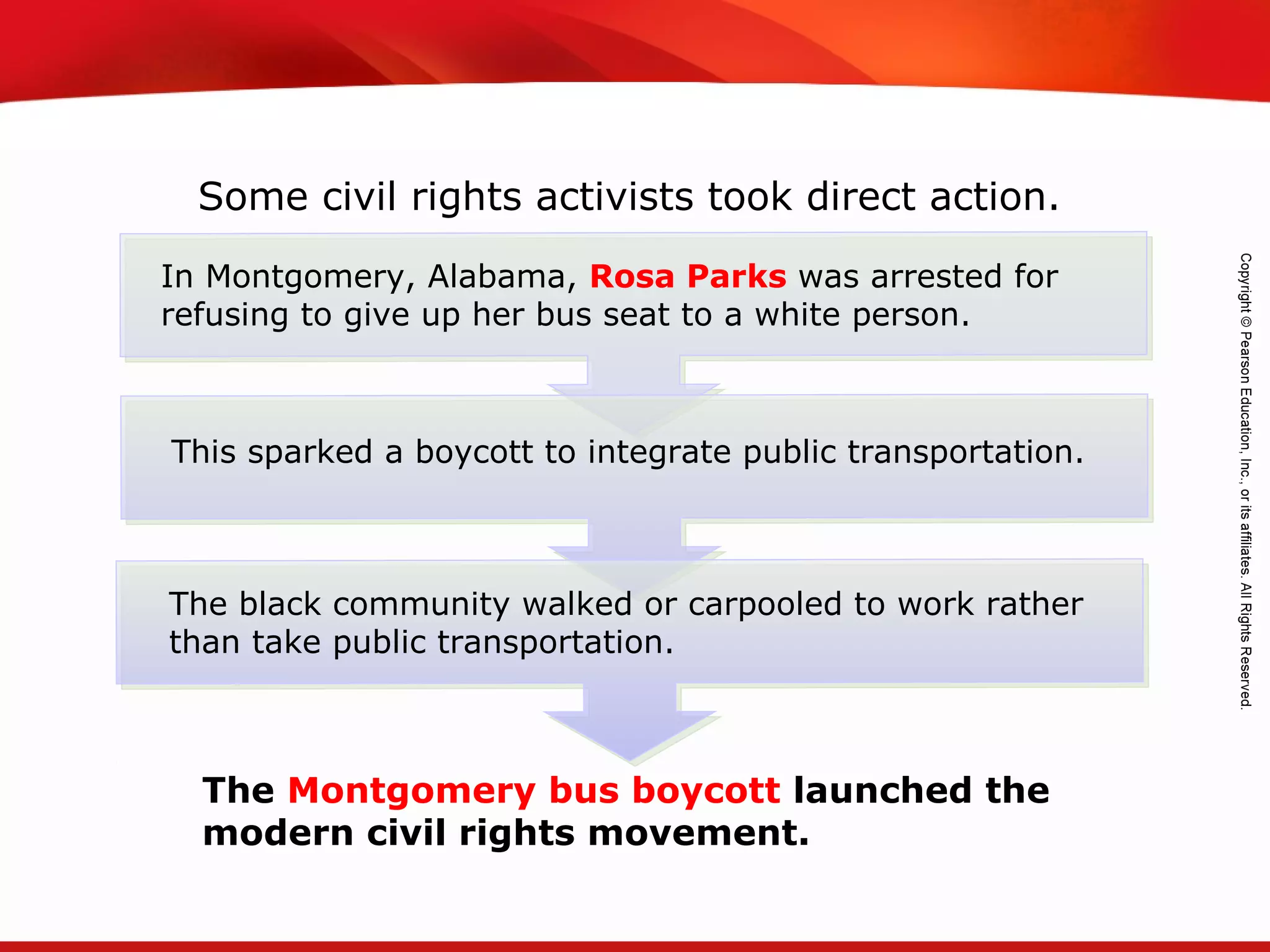
Some civil rights activists took direct action.
In Montgomery, Alabama, Rosa Parks was arrested for
refusing to give up her bus seat to a white person.
This sparked a boycott to integrate public transportation.
The black community walked or carpooled to work rather
than take public transportation.
The Montgomery bus boycott launched the
modern civil rights movement.
TEKS 8C: Calculate percent composition and empirical and molecular formulas.
Martin Luther King, Jr.
In 1956, the Supreme Court ruled that
segregated busing was unconstitutional, and
the boycott ended.
• Martin Luther King, Jr.’s inspiring
speech at a boycott meeting
propelled him into the leadership of
the nonviolent civil rights movement.
• The black community continued its
bus boycott for more than a year
despite threats and violence.
TEKS 8C: Calculate percent composition and empirical and molecular formulas.
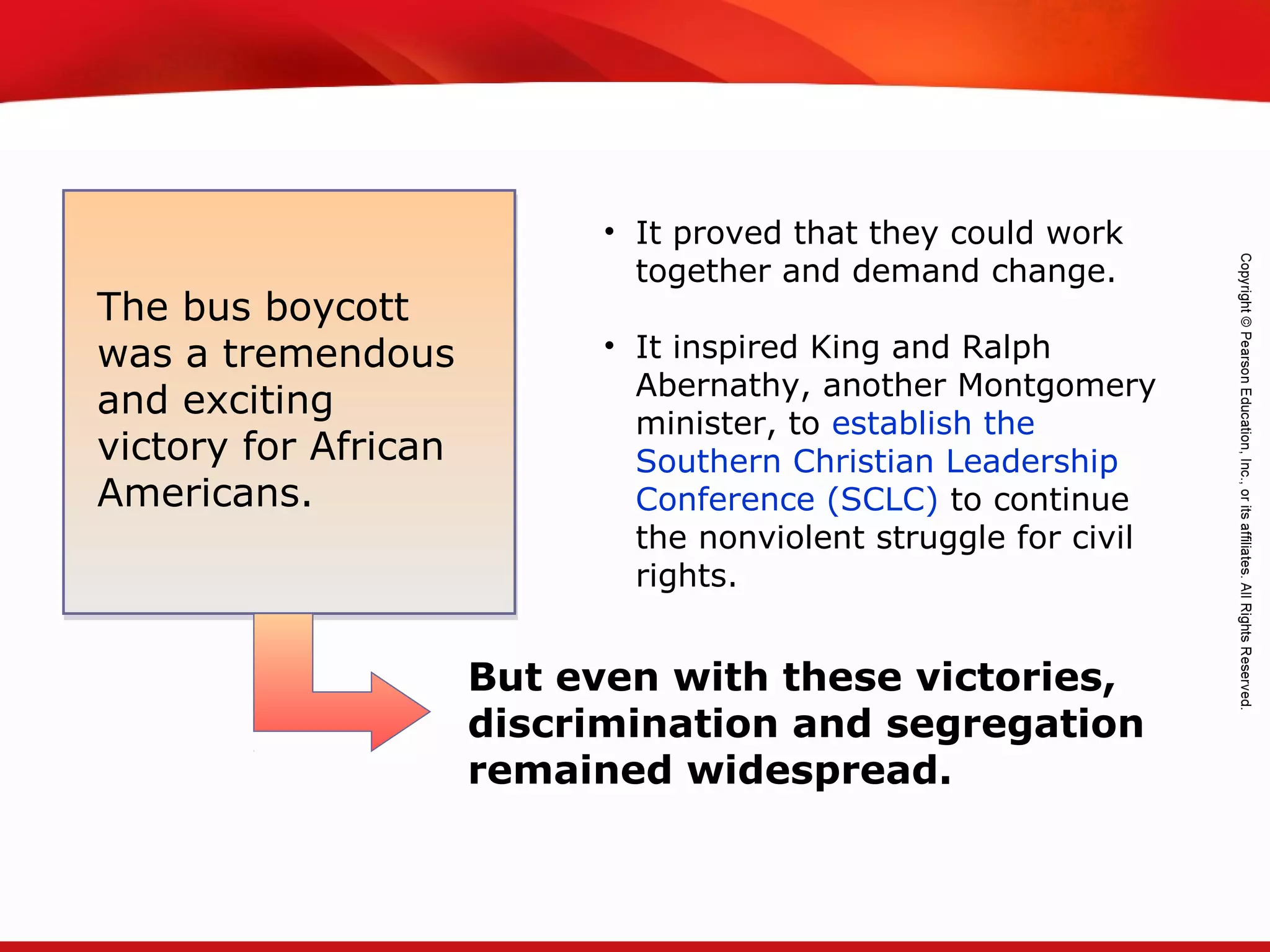
• It proved that they could work
together and demand change.
• It inspired King and Ralph
Abernathy, another Montgomery
minister, to establish the
Southern Christian Leadership
Conference (SCLC) to continue
the nonviolent struggle for civil
rights.
The bus boycott
was a tremendous
and exciting
victory for African
Americans.
But even with these victories,
discrimination and segregation
remained widespread.

Week 7 day two civil rights 1940s 50s

  • 1.
    TEKS 8C: Calculatepercent composition and empirical and molecular formulas. Civil Rights in the 1940s–1950s
  • 2.
    TEKS 8C: Calculatepercent composition and empirical and molecular formulas. • Describe efforts to end segregation in the 1940s and 1950s. • Explain the importance of Brown v. Board of Education. • Describe the controversy over school desegregation in Little Rock, Arkansas. • Discuss the Montgomery bus boycott and its impact. Objectives
  • 3.
    TEKS 8C: Calculatepercent composition and empirical and molecular formulas. Terms and People • de jure segregation − segregation that is imposed by law • de facto segregation − segregation by unwritten custom or tradition • Thurgood Marshall − African American lawyer who led the legal team that challenged segregation in the courts; later named a Supreme Court justice
  • 4.
    TEKS 8C: Calculatepercent composition and empirical and molecular formulas. • Earl Warren – Supreme Court Chief Justice who wrote the decision that ended segregation in public schools • Rosa Parks − African American woman arrested in Montgomery, Alabama, for refusing to give up her bus seat to a white person, leading to a prolonged bus boycott Terms and People (continued)
  • 5.
    TEKS 8C: Calculatepercent composition and empirical and molecular formulas. • Montgomery bus boycott − a 1955–1956 protest by African Americans in Montgomery, Alabama, against racial segregation in the bus system • Martin Luther King, Jr. − Baptist preacher and civil rights leader who advocated nonviolent protest against segregation Terms and People (continued)
  • 6.
    TEKS 8C: Calculatepercent composition and empirical and molecular formulas. African Americans were still treated as second- class citizens after World War II. Their heroic effort to attain racial equality is known as the civil rights movement. They took their battle to the street, in the form of peaceful protests, held boycotts, and turned to the courts for a legal guarantee of basic rights. How did African Americans challenge segregation after World War II?
  • 7.
    TEKS 8C: Calculatepercent composition and empirical and molecular formulas. Despite their service in World War II, segregation at home was still the rule for African Americans. de jure segregation de facto segregation • in the South • facilities that were supposed to be “separate but equal” but rarely were • segregation in schools, hospitals, transportation, restaurants, cemeteries, and beaches • in the North • discrimination in housing • discrimination in employment • only low-paying jobs were available
  • 8.
    TEKS 8C: Calculatepercent composition and empirical and molecular formulas. • Discrimination in the defense industries was banned in 1941. • Truman desegregated the military in 1948. • Jackie Robinson became the first African American to play major league baseball. • The Congress of Racial Equality (CORE) was created to end racial injustice. World War II set the stage for the rise of the modern civil rights movement.
  • 9.
    TEKS 8C: Calculatepercent composition and empirical and molecular formulas. African American veterans were unwilling to accept discrimination at home after risking their lives overseas.
  • 10.
    TEKS 8C: Calculatepercent composition and empirical and molecular formulas. In 1954, many of the nation’s school systems were segregated. The NAACP decided to challenge school segregation in the federal courts. African American attorney Thurgood Marshall led the NAACP legal team in Brown v. Board of Education.
  • 11.
    TEKS 8C: Calculatepercent composition and empirical and molecular formulas. The decision to Brown v. Board of Education was written by Chief Justice Earl Warren. The decision concluded that: The Chief Justice asked “Does segregation of children in public schools solely on the basis of race . . . deprive children of the minority group of equal education opportunities?” He concluded, “We believe it does.” • segregated public education violated the Fourteenth Amendment. • “Separate but equal” had no place in public education.
  • 12.
    TEKS 8C: Calculatepercent composition and empirical and molecular formulas. The Brown v. Board of Education ruling was significant and controversial. About 100 white Southern members of Congress opposed the decision; in 1956 they endorsed “The Southern Manifesto” to lawfully oppose Brown. In a second decision, Brown II, the courts urged implementation of the decision “with all deliberate speed” across the nation.
  • 13.
    TEKS 8C: Calculatepercent composition and empirical and molecular formulas. In 1957, in Little Rock, Arkansas, nine African American students tried to enter Central High. The governor had the National Guard stop them. President Eisenhower had to send in troops to enforce the Brown decision. The Brown decision also met resistance on the local and state level. Elizabeth Eckford tries to enter Central High.
  • 14.
    TEKS 8C: Calculatepercent composition and empirical and molecular formulas. Some civil rights activists took direct action. In Montgomery, Alabama, Rosa Parks was arrested for refusing to give up her bus seat to a white person. This sparked a boycott to integrate public transportation. The black community walked or carpooled to work rather than take public transportation. The Montgomery bus boycott launched the modern civil rights movement.
  • 15.
    TEKS 8C: Calculatepercent composition and empirical and molecular formulas. Martin Luther King, Jr. In 1956, the Supreme Court ruled that segregated busing was unconstitutional, and the boycott ended. • Martin Luther King, Jr.’s inspiring speech at a boycott meeting propelled him into the leadership of the nonviolent civil rights movement. • The black community continued its bus boycott for more than a year despite threats and violence.
  • 16.
    TEKS 8C: Calculatepercent composition and empirical and molecular formulas. • It proved that they could work together and demand change. • It inspired King and Ralph Abernathy, another Montgomery minister, to establish the Southern Christian Leadership Conference (SCLC) to continue the nonviolent struggle for civil rights. The bus boycott was a tremendous and exciting victory for African Americans. But even with these victories, discrimination and segregation remained widespread.

Editor's Notes