UNIT 2
HOW MARKETS
WORK
C H A P T E R 5 D E M A N D A N D S U P P LY
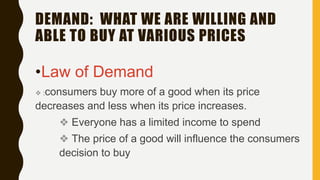
DEMAND: WHAT WE ARE WILLING AND
ABLE TO BUY AT VARIOUS PRICES
•Law of Demand
❖ :consumers buy more of a good when its price
decreases and less when its price increases.
❖ Everyone has a limited income to spend
❖ The price of a good will influence the consumers
decision to buy
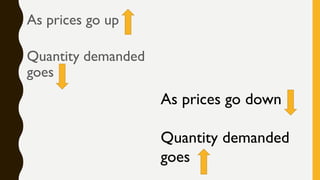
As prices go up
Quantity demanded
goes
As prices go down
Quantity demanded
goes
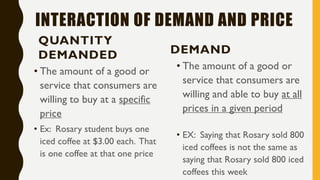
INTERACTION OF DEMAND AND PRICE
QUANTITY
DEMANDED
• The amount of a good or
service that consumers are
willing to buy at a specific
price
• Ex: Rosary student buys one
iced coffee at $3.00 each. That
is one coffee at that one price
DEMAND
• The amount of a good or
service that consumers are
willing and able to buy at all
prices in a given period
• EX: Saying that Rosary sold 800
iced coffees is not the same as
saying that Rosary sold 800 iced
coffees this week
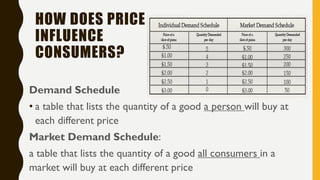
HOW DOES PRICE
INFLUENCE
CONSUMERS?
Demand Schedule
• a table that lists the quantity of a good a person will buy at
each different price
Market Demand Schedule:
a table that lists the quantity of a good all consumers in a
market will buy at each different price
DEMAND AND DIMINISHING
MARGINAL UTILITY
• Marginal Utility - is the
extra usefulness or
satisfaction a person
receives from getting or
using one more unit of a
product.
• Diminishing Marginal
Utility – is the decreasing
satisfaction we have by buying
more of the same product.
REASON FOR LAW OF DEMAND
Substitution Effect: When
consumers react to an increase in
a good’s price by consuming less
of that good and more of other
goods.
❖ Example: Price of pizza rises,
pizza becomes more expensive
than other foods so consumers
buy an alternative food item and
substitute it for pizza. = drop in
the amount of pizza demanded.
Income Effect: The change in
consumption resulting from a change
in real income.
❖ Example: Price of pizza rises, you
feel poorer because our limited budget
just wont buy as much as it used to
(feels as if you have less money) =
fewer slices of pizza bought.
❖ Together: they explain why an
increase in price decreases the
quantity purchased.
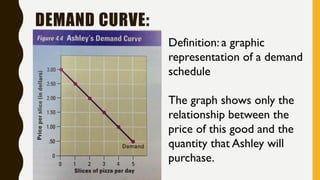
DEMAND CURVE:
Definition: a graphic
representation of a demand
schedule
The graph shows only the
relationship between the
price of this good and the
quantity that Ashley will
purchase.
DEMAND CURVE
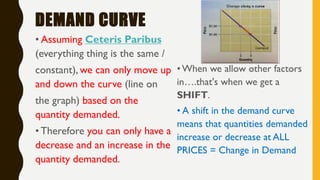
• Assuming Ceteris Paribus
(everything thing is the same /
constant), we can only move up
and down the curve (line on
the graph) based on the
quantity demanded.
• Therefore you can only have a
decrease and an increase in the
quantity demanded.
• When we allow other factors
in….that's when we get a
SHIFT.
• A shift in the demand curve
means that quantities demanded
increase or decrease at ALL
PRICES = Change in Demand
NORMAL GOOD V INFERIOR GOOD
• INFERIOR GOODS:
a good that consumers demand
less of when their income
increases.
(You would buy these in smaller
quantities or not at all if you had
enough money to afford
something better)
• NORMAL GOODS:
A good that consumers
demand more of when their
incomes increase
(Wouldn’t care about the prices
that much because you can
afford them).
WHAT CAUSES A SHIFT?
Income Example:
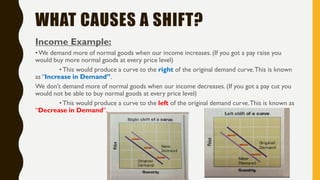
•We demand more of normal goods when our income increases. (If you got a pay raise you
would buy more normal goods at every price level)
•This would produce a curve to the right of the original demand curve.This is known
as “Increase in Demand”.
We don't demand more of normal goods when our income decreases. (If you got a pay cut you
would not be able to buy normal goods at every price level)
•This would produce a curve to the left of the original demand curve.This is known as
“Decrease in Demand”.
FACTORS THAT CAUSE A CHANGE IN
DEMAND
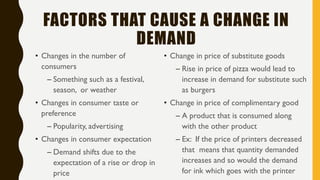
• Changes in the number of
consumers
– Something such as a festival,
season, or weather
• Changes in consumer taste or
preference
– Popularity, advertising
• Changes in consumer expectation
– Demand shifts due to the
expectation of a rise or drop in
price
• Change in price of substitute goods
– Rise in price of pizza would lead to
increase in demand for substitute such
as burgers
• Change in price of complimentary good
– A product that is consumed along
with the other product
– Ex: If the price of printers decreased
that means that quantity demanded
increases and so would the demand
for ink which goes with the printer
SUPPLY
• IFYOU OWNED A BUSINESS AND ALL OF A SUDDENYOU
REALIZEDTHAT CUSTOMERSWERE WILLINGTO PAYTWICE
AS MUCH FORYOUR PRODUCT…
• WHAT WOULDYOU DO?!
H U L A H O O P
H U D S U C K E R
P ROX Y
• YOUWOULD RAISEYOUR
PRICES
• WORK LESS HOURS B/CYOU
HAD MORE $
• BUT WHAT WOULD OTHER
PEOPLE STARTTO DO?
• JUMP INTOTHE MARKET
AND START SELLINGTHE
SAME GOOD
https://www.youtube.com/watch?v=D
2QlitH4nYY
Therefore, economists use the term quantity supplied to
explain: how much of a good is offered for sale at a
specific price.
SUPPLY
• amount of a product that would be
offered for sale at all possible
prices that could exist in the
market
• Producers get paid for the
products, so they will offer more at
higher prices.
LAW OF SUPPLY
• the tendency of suppliers to offer
more of a good at a higher price
(the higher the price, the larger the
quantity produced)
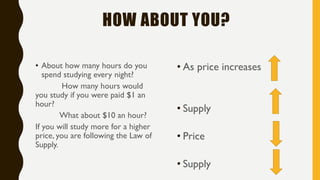
HOW ABOUT YOU?
• About how many hours do you
spend studying every night?
How many hours would
you study if you were paid $1 an
hour?
What about $10 an hour?
If you will study more for a higher
price, you are following the Law of
Supply.
• As price increases
• Supply
• Price
• Supply
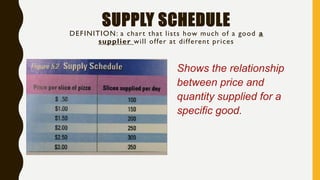
SUPPLY SCHEDULE
DEFINITION: a chart that lists how much of a good a
supplier will offer at different prices
Shows the relationship
between price and
quantity supplied for a
specific good.
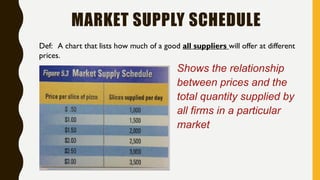
MARKET SUPPLY SCHEDULE
Shows the relationship
between prices and the
total quantity supplied by
all firms in a particular
market
Def: A chart that lists how much of a good all suppliers will offer at different
prices.
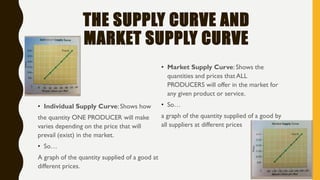
THE SUPPLY CURVE AND
MARKET SUPPLY CURVE
• Individual Supply Curve: Shows how
the quantity ONE PRODUCER will make
varies depending on the price that will
prevail (exist) in the market.
• So…
A graph of the quantity supplied of a good at
different prices.
• Market Supply Curve: Shows the
quantities and prices that ALL
PRODUCERS will offer in the market for
any given product or service.
• So…
a graph of the quantity supplied of a good by
all suppliers at different prices
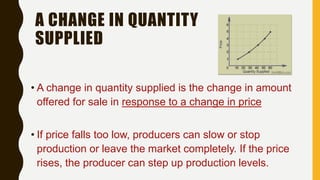
A CHANGE IN QUANTITY
SUPPLIED
• A change in quantity supplied is the change in amount
offered for sale in response to a change in price
• If price falls too low, producers can slow or stop
production or leave the market completely. If the price
rises, the producer can step up production levels.
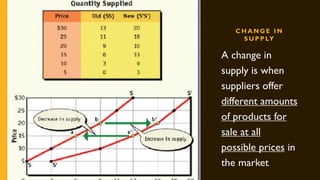
C H A N G E I N
S U P P LY
A change in
supply is when
suppliers offer
different amounts
of products for
sale at all
possible prices in
the market
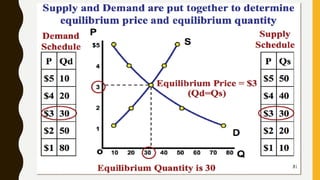
EQUILIBRIUM
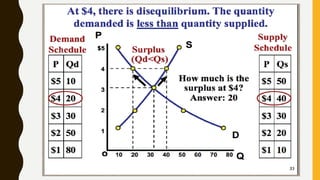
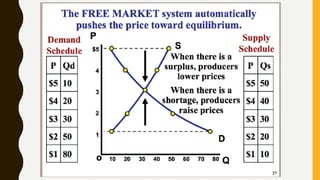
• Definition: the point at which quantity demanded and
quantity supplied are equal.
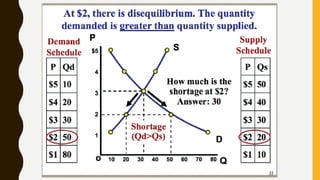
• Disequilibrium: describes any price or quantity not at
equilibrium, and occurs when quantity supplied is not equal
to quantity demanded in a market.
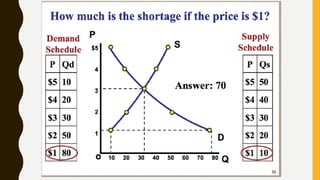
(ex: surplus or shortage)
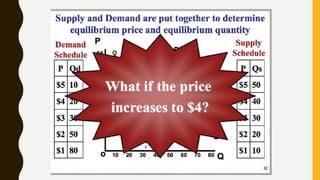
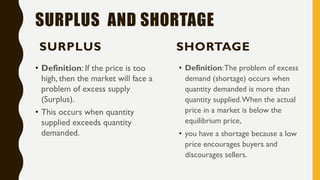
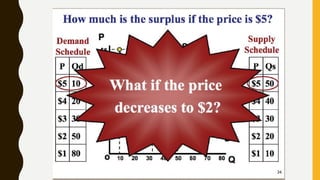
SURPLUS AND SHORTAGE
SURPLUS
• Definition: If the price is too
high, then the market will face a
problem of excess supply
(Surplus).
• This occurs when quantity
supplied exceeds quantity
demanded.
SHORTAGE
• Definition:The problem of excess
demand (shortage) occurs when
quantity demanded is more than
quantity supplied.When the actual
price in a market is below the
equilibrium price,
• you have a shortage because a low
price encourages buyers and
discourages sellers.
S H I F T I N G S U P P LY
A N D D E M A N D
https://www.youtube.com/watch?v=V0
tIOqU7m-c
ELASTICITY
DEMAND ELASTICITY
• Definition: this measures how consumers react to a change in
price (so how drastically we will cut back or increase our demand
for a good when the price rises or falls)
• So… how quantity responds to price
It measures how sensitive consumers are to price changes.
• Can be applied to income, the quantity of a product supplied by a
firm, or to demand
INELASTIC VS. ELASTIC
INELASTIC
• Demand is inelastic when a
change in price causes a small
change in demand.
• So… the demand for a good
that you will keep buying
despite a price increase
ELASTIC
• Demand is elastic when a
change in price causes a large
change in demand.
• So…a good you buy much
less of after a small price
increase.
DISCUSSION QUESTION
WHAT ARE EXAMPLES OF ITEMS FOR
WHICH AN INCREASE IN PRICE WOULD
CAUSEYOU ORYOUR FAMILYTO
RECONSIDER BUYINGTHEM?
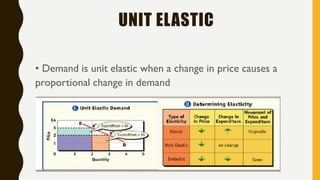
UNIT ELASTIC
• Demand is unit elastic when a change in price causes a
proportional change in demand
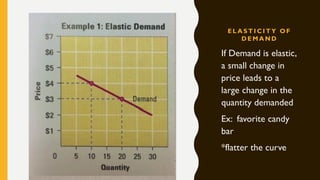
E L A S T I C I T Y O F
D E M A N D
If Demand is elastic,
a small change in
price leads to a
large change in the
quantity demanded
Ex: favorite candy
bar
*flatter the curve
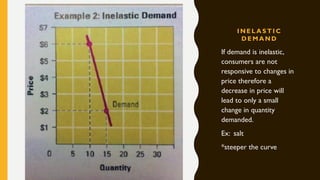
I N E L A S T I C
D E M A N D
If demand is inelastic,
consumers are not
responsive to changes in
price therefore a
decrease in price will
lead to only a small
change in quantity
demanded.
Ex: salt
*steeper the curve
ELASTICITY
EXPLAINED
H T T P S : / / W W W. Y O U T U B E . C O M / W AT C H ? V = H H C B
L I X I A A K
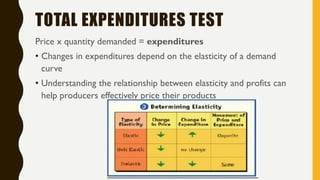
TOTAL EXPENDITURES TEST
Price x quantity demanded = expenditures
• Changes in expenditures depend on the elasticity of a demand
curve
• Understanding the relationship between elasticity and profits can
help producers effectively price their products
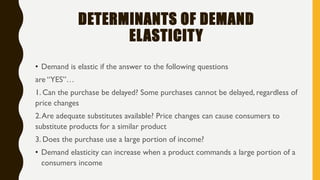
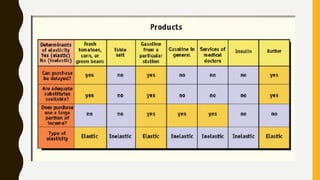
DETERMINANTS OF DEMAND
ELASTICITY
• Demand is elastic if the answer to the following questions
are “YES”…
1. Can the purchase be delayed? Some purchases cannot be delayed, regardless of
price changes
2.Are adequate substitutes available? Price changes can cause consumers to
substitute products for a similar product
3. Does the purchase use a large portion of income?
• Demand elasticity can increase when a product commands a large portion of a
consumers income
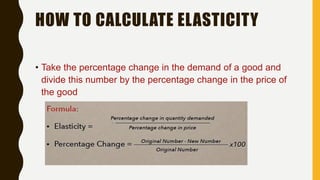
HOW TO CALCULATE ELASTICITY
• Take the percentage change in the demand of a good and
divide this number by the percentage change in the price of
the good
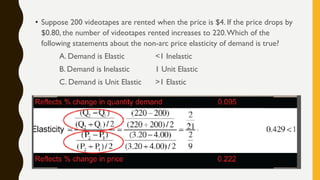
• Suppose 200 videotapes are rented when the price is $4. If the price drops by
$0.80, the number of videotapes rented increases to 220.Which of the
following statements about the non-arc price elasticity of demand is true?
A. Demand is Elastic <1 Inelastic
B. Demand is Inelastic 1 Unit Elastic
C. Demand is Unit Elastic >1 Elastic
SUPPLY ELASTICITY
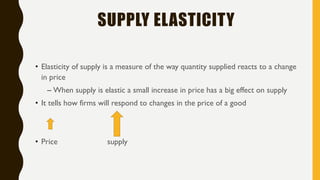
• Elasticity of supply is a measure of the way quantity supplied reacts to a change
in price
– When supply is elastic a small increase in price has a big effect on supply
• It tells how firms will respond to changes in the price of a good
• Price supply
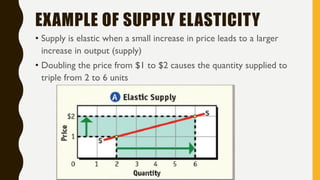
EXAMPLE OF SUPPLY ELASTICITY
• Supply is elastic when a small increase in price leads to a larger
increase in output (supply)
• Doubling the price from $1 to $2 causes the quantity supplied to
triple from 2 to 6 units
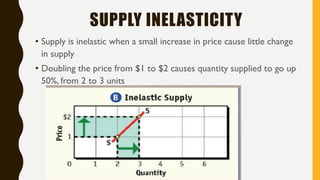
SUPPLY INELASTICITY
• Supply is inelastic when a small increase in price cause little change
in supply
• Doubling the price from $1 to $2 causes quantity supplied to go up
50%, from 2 to 3 units
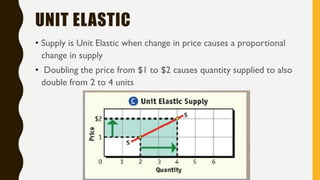
UNIT ELASTIC
• Supply is Unit Elastic when change in price causes a proportional
change in supply
• Doubling the price from $1 to $2 causes quantity supplied to also
double from 2 to 4 units
DETERMINANTS
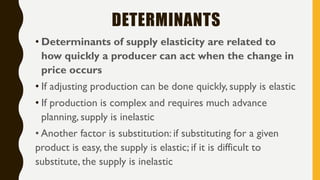
• Determinants of supply elasticity are related to
how quickly a producer can act when the change in
price occurs
• If adjusting production can be done quickly, supply is elastic
• If production is complex and requires much advance
planning, supply is inelastic
• Another factor is substitution: if substituting for a given
product is easy, the supply is elastic; if it is difficult to
substitute, the supply is inelastic
Unit 2  supply and demand f 2019

Unit 2 supply and demand f 2019

  • 1.
    UNIT 2 HOW MARKETS WORK CH A P T E R 5 D E M A N D A N D S U P P LY
  • 2.
    DEMAND: WHAT WEARE WILLING AND ABLE TO BUY AT VARIOUS PRICES •Law of Demand ❖ :consumers buy more of a good when its price decreases and less when its price increases. ❖ Everyone has a limited income to spend ❖ The price of a good will influence the consumers decision to buy
  • 3.
    As prices goup Quantity demanded goes As prices go down Quantity demanded goes
  • 4.
    INTERACTION OF DEMANDAND PRICE QUANTITY DEMANDED • The amount of a good or service that consumers are willing to buy at a specific price • Ex: Rosary student buys one iced coffee at $3.00 each. That is one coffee at that one price DEMAND • The amount of a good or service that consumers are willing and able to buy at all prices in a given period • EX: Saying that Rosary sold 800 iced coffees is not the same as saying that Rosary sold 800 iced coffees this week
  • 5.
    HOW DOES PRICE INFLUENCE CONSUMERS? DemandSchedule • a table that lists the quantity of a good a person will buy at each different price Market Demand Schedule: a table that lists the quantity of a good all consumers in a market will buy at each different price
  • 6.
    DEMAND AND DIMINISHING MARGINALUTILITY • Marginal Utility - is the extra usefulness or satisfaction a person receives from getting or using one more unit of a product. • Diminishing Marginal Utility – is the decreasing satisfaction we have by buying more of the same product.
  • 7.
    REASON FOR LAWOF DEMAND Substitution Effect: When consumers react to an increase in a good’s price by consuming less of that good and more of other goods. ❖ Example: Price of pizza rises, pizza becomes more expensive than other foods so consumers buy an alternative food item and substitute it for pizza. = drop in the amount of pizza demanded. Income Effect: The change in consumption resulting from a change in real income. ❖ Example: Price of pizza rises, you feel poorer because our limited budget just wont buy as much as it used to (feels as if you have less money) = fewer slices of pizza bought. ❖ Together: they explain why an increase in price decreases the quantity purchased.
  • 8.
    DEMAND CURVE: Definition: agraphic representation of a demand schedule The graph shows only the relationship between the price of this good and the quantity that Ashley will purchase.
  • 9.
    DEMAND CURVE • AssumingCeteris Paribus (everything thing is the same / constant), we can only move up and down the curve (line on the graph) based on the quantity demanded. • Therefore you can only have a decrease and an increase in the quantity demanded. • When we allow other factors in….that's when we get a SHIFT. • A shift in the demand curve means that quantities demanded increase or decrease at ALL PRICES = Change in Demand
  • 10.
    NORMAL GOOD VINFERIOR GOOD • INFERIOR GOODS: a good that consumers demand less of when their income increases. (You would buy these in smaller quantities or not at all if you had enough money to afford something better) • NORMAL GOODS: A good that consumers demand more of when their incomes increase (Wouldn’t care about the prices that much because you can afford them).
  • 11.
    WHAT CAUSES ASHIFT? Income Example: •We demand more of normal goods when our income increases. (If you got a pay raise you would buy more normal goods at every price level) •This would produce a curve to the right of the original demand curve.This is known as “Increase in Demand”. We don't demand more of normal goods when our income decreases. (If you got a pay cut you would not be able to buy normal goods at every price level) •This would produce a curve to the left of the original demand curve.This is known as “Decrease in Demand”.
  • 12.
    FACTORS THAT CAUSEA CHANGE IN DEMAND • Changes in the number of consumers – Something such as a festival, season, or weather • Changes in consumer taste or preference – Popularity, advertising • Changes in consumer expectation – Demand shifts due to the expectation of a rise or drop in price • Change in price of substitute goods – Rise in price of pizza would lead to increase in demand for substitute such as burgers • Change in price of complimentary good – A product that is consumed along with the other product – Ex: If the price of printers decreased that means that quantity demanded increases and so would the demand for ink which goes with the printer
  • 13.
    SUPPLY • IFYOU OWNEDA BUSINESS AND ALL OF A SUDDENYOU REALIZEDTHAT CUSTOMERSWERE WILLINGTO PAYTWICE AS MUCH FORYOUR PRODUCT… • WHAT WOULDYOU DO?!
  • 14.
    H U LA H O O P H U D S U C K E R P ROX Y • YOUWOULD RAISEYOUR PRICES • WORK LESS HOURS B/CYOU HAD MORE $ • BUT WHAT WOULD OTHER PEOPLE STARTTO DO? • JUMP INTOTHE MARKET AND START SELLINGTHE SAME GOOD https://www.youtube.com/watch?v=D 2QlitH4nYY
  • 15.
    Therefore, economists usethe term quantity supplied to explain: how much of a good is offered for sale at a specific price. SUPPLY • amount of a product that would be offered for sale at all possible prices that could exist in the market • Producers get paid for the products, so they will offer more at higher prices. LAW OF SUPPLY • the tendency of suppliers to offer more of a good at a higher price (the higher the price, the larger the quantity produced)
  • 16.
    HOW ABOUT YOU? •About how many hours do you spend studying every night? How many hours would you study if you were paid $1 an hour? What about $10 an hour? If you will study more for a higher price, you are following the Law of Supply. • As price increases • Supply • Price • Supply
  • 17.
    SUPPLY SCHEDULE DEFINITION: achart that lists how much of a good a supplier will offer at different prices Shows the relationship between price and quantity supplied for a specific good.
  • 18.
    MARKET SUPPLY SCHEDULE Showsthe relationship between prices and the total quantity supplied by all firms in a particular market Def: A chart that lists how much of a good all suppliers will offer at different prices.
  • 19.
    THE SUPPLY CURVEAND MARKET SUPPLY CURVE • Individual Supply Curve: Shows how the quantity ONE PRODUCER will make varies depending on the price that will prevail (exist) in the market. • So… A graph of the quantity supplied of a good at different prices. • Market Supply Curve: Shows the quantities and prices that ALL PRODUCERS will offer in the market for any given product or service. • So… a graph of the quantity supplied of a good by all suppliers at different prices
  • 20.
    A CHANGE INQUANTITY SUPPLIED • A change in quantity supplied is the change in amount offered for sale in response to a change in price • If price falls too low, producers can slow or stop production or leave the market completely. If the price rises, the producer can step up production levels.
  • 21.
    C H AN G E I N S U P P LY A change in supply is when suppliers offer different amounts of products for sale at all possible prices in the market
  • 23.
    EQUILIBRIUM • Definition: thepoint at which quantity demanded and quantity supplied are equal. • Disequilibrium: describes any price or quantity not at equilibrium, and occurs when quantity supplied is not equal to quantity demanded in a market. (ex: surplus or shortage)
  • 27.
    SURPLUS AND SHORTAGE SURPLUS •Definition: If the price is too high, then the market will face a problem of excess supply (Surplus). • This occurs when quantity supplied exceeds quantity demanded. SHORTAGE • Definition:The problem of excess demand (shortage) occurs when quantity demanded is more than quantity supplied.When the actual price in a market is below the equilibrium price, • you have a shortage because a low price encourages buyers and discourages sellers.
  • 32.
    S H IF T I N G S U P P LY A N D D E M A N D https://www.youtube.com/watch?v=V0 tIOqU7m-c
  • 33.
  • 34.
    DEMAND ELASTICITY • Definition:this measures how consumers react to a change in price (so how drastically we will cut back or increase our demand for a good when the price rises or falls) • So… how quantity responds to price It measures how sensitive consumers are to price changes. • Can be applied to income, the quantity of a product supplied by a firm, or to demand
  • 35.
    INELASTIC VS. ELASTIC INELASTIC •Demand is inelastic when a change in price causes a small change in demand. • So… the demand for a good that you will keep buying despite a price increase ELASTIC • Demand is elastic when a change in price causes a large change in demand. • So…a good you buy much less of after a small price increase.
  • 36.
    DISCUSSION QUESTION WHAT AREEXAMPLES OF ITEMS FOR WHICH AN INCREASE IN PRICE WOULD CAUSEYOU ORYOUR FAMILYTO RECONSIDER BUYINGTHEM?
  • 37.
    UNIT ELASTIC • Demandis unit elastic when a change in price causes a proportional change in demand
  • 38.
    E L AS T I C I T Y O F D E M A N D If Demand is elastic, a small change in price leads to a large change in the quantity demanded Ex: favorite candy bar *flatter the curve
  • 39.
    I N EL A S T I C D E M A N D If demand is inelastic, consumers are not responsive to changes in price therefore a decrease in price will lead to only a small change in quantity demanded. Ex: salt *steeper the curve
  • 40.
    ELASTICITY EXPLAINED H T TP S : / / W W W. Y O U T U B E . C O M / W AT C H ? V = H H C B L I X I A A K
  • 41.
    TOTAL EXPENDITURES TEST Pricex quantity demanded = expenditures • Changes in expenditures depend on the elasticity of a demand curve • Understanding the relationship between elasticity and profits can help producers effectively price their products
  • 42.
    DETERMINANTS OF DEMAND ELASTICITY •Demand is elastic if the answer to the following questions are “YES”… 1. Can the purchase be delayed? Some purchases cannot be delayed, regardless of price changes 2.Are adequate substitutes available? Price changes can cause consumers to substitute products for a similar product 3. Does the purchase use a large portion of income? • Demand elasticity can increase when a product commands a large portion of a consumers income
  • 44.
    HOW TO CALCULATEELASTICITY • Take the percentage change in the demand of a good and divide this number by the percentage change in the price of the good
  • 45.
    • Suppose 200videotapes are rented when the price is $4. If the price drops by $0.80, the number of videotapes rented increases to 220.Which of the following statements about the non-arc price elasticity of demand is true? A. Demand is Elastic <1 Inelastic B. Demand is Inelastic 1 Unit Elastic C. Demand is Unit Elastic >1 Elastic
  • 46.
    SUPPLY ELASTICITY • Elasticityof supply is a measure of the way quantity supplied reacts to a change in price – When supply is elastic a small increase in price has a big effect on supply • It tells how firms will respond to changes in the price of a good • Price supply
  • 47.
    EXAMPLE OF SUPPLYELASTICITY • Supply is elastic when a small increase in price leads to a larger increase in output (supply) • Doubling the price from $1 to $2 causes the quantity supplied to triple from 2 to 6 units
  • 48.
    SUPPLY INELASTICITY • Supplyis inelastic when a small increase in price cause little change in supply • Doubling the price from $1 to $2 causes quantity supplied to go up 50%, from 2 to 3 units
  • 49.
    UNIT ELASTIC • Supplyis Unit Elastic when change in price causes a proportional change in supply • Doubling the price from $1 to $2 causes quantity supplied to also double from 2 to 4 units
  • 50.
    DETERMINANTS • Determinants ofsupply elasticity are related to how quickly a producer can act when the change in price occurs • If adjusting production can be done quickly, supply is elastic • If production is complex and requires much advance planning, supply is inelastic • Another factor is substitution: if substituting for a given product is easy, the supply is elastic; if it is difficult to substitute, the supply is inelastic