Demand
Essential Question:
What determines what we buy?
Unit 2
The Elements of a Market
Economy
The Market Forces of Supply and
Demand
●Supply and demand are the forces that make
market economies work.
●A market is a group of buyers and sellers of a
particular good or service.
●The terms supply and demand refer to the
behavior of people . . . as they interact with
one another in markets.
The Market Forces of Supply and
Demand
Buyers
determine
demand.
Sellers
determine
supply
What Is Demand?
● Demand is the willingness and ability of
buyers to purchase different quantities of a
good, at different prices, during a specific
time period.
Both willingness and ability must be present; if either
is missing, there is no demand.
● Quantity demanded is different from
demand. Quantity demanded is the
AMOUNT of a good that buyers are willing
and able to purchase.
Quantity demanded is always a number.
The Law of
Demand
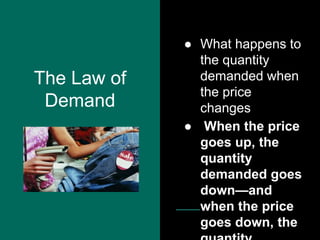
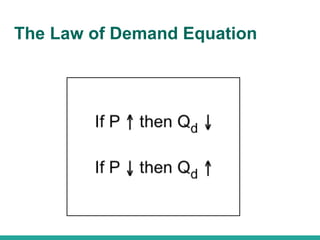
● What happens to
the quantity
demanded when
the price
changes
● When the price
goes up, the
quantity
demanded goes
down—and
when the price
goes down, the
The Law of Demand Equation
The Law of
Diminishing
Marginal Utility
What happens
to your level of
satisfaction as
you buy more
and more units
of the same
good?
Testing the
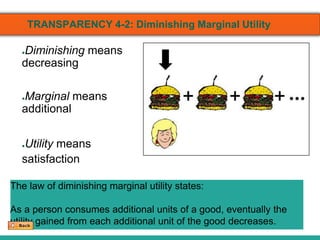
TRANSPARENCY 4-2: Diminishing Marginal Utility
●Diminishing means
decreasing
●Marginal means
additional
●Utility means
satisfaction
The law of diminishing marginal utility states:
As a person consumes additional units of a good, eventually the
utility gained from each additional unit of the good decreases.
The Law of Demand : A Visual
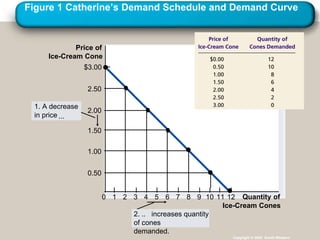
● The table of numbers is called a schedule and the
graph is called a curve.
● We use the graph to help simplify the complicated
aspects of demand.
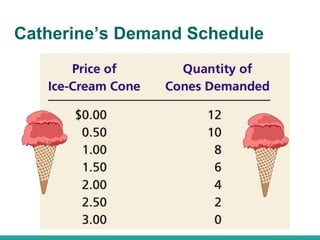
Catherine’s Demand Schedule
Figure 1 Catherine’s Demand Schedule and Demand Curve
Copyright © 2004 South-Western
Price of
Ice-Cream Cone
0
2.50
2.00
1.50
1.00
0.50
1 2 3 4 5 6 7 8 9 10 11 Quantity of
Ice-Cream Cones
$3.00
12
1. A decrease
in price ...
2. ..
.
increases quantity
of cones
demanded.
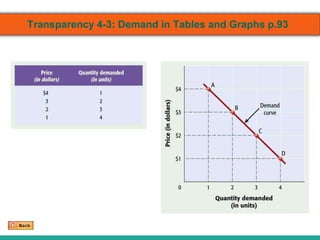
Transparency 4-3: Demand in Tables and Graphs p.93
Demand curveDemand schedule
Individual and Market Demand Curves
We can look at individual or market demand
curves; which are different.
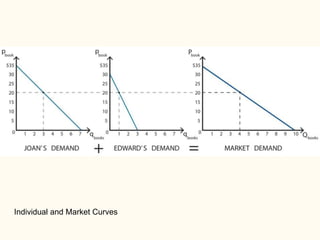
● An individual demand curve represents
one person’s demand for a good.
● A market demand curve is the SUM of all
the individual demand curves for a good.
Individual and Market Curves
Demand Videos
The Economic Lowdown
ACDC Guy
The Demand Curve Shifts
Change in Quantity Demanded
A direct price change affects the quantity
demanded of that good. It does not affect
demand.
Because of a change in price of the GOOD BEING
GRAPHED
Results in movement along the demand curve. NOT A
SHIFT.
Remember: Demand and quantity demanded are
not the same thing.
0
D
Price of Ice-
Cream
Cones
Quantity of Ice-Cream Cones
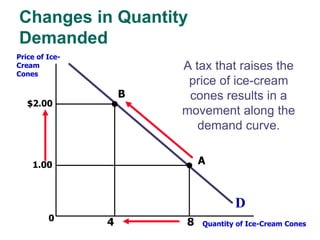
A tax that raises the
price of ice-cream
cones results in a
movement along the
demand curve.
A
B
8
1.00
$2.00
4
Changes in Quantity
Demanded
Change in Demand
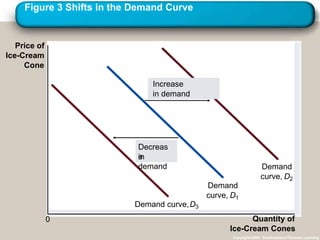
● Results in a shift in the demand curve, either
to the left or right.
● When demand goes up, the demand curve
shifts to the right. When demand goes
down, the demand curve shifts to the left.
● Results from a change in a determinant of
demand ( a ceteris paribus variable)
Figure 3 Shifts in the Demand Curve
Copyright©2003 Southwestern/Thomson Learning
Price of
Ice-Cream
Cone
Quantity of
Ice-Cream Cones
Increase
in demand
Decreas
ein
demand
Demand curve,D3
Demand
curve, D1
Demand
curve, D2
0
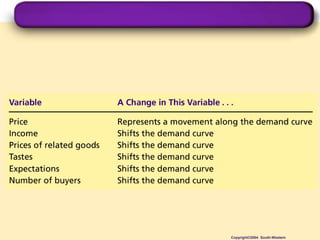
5 Factors Cause Demand
Curves to Shift
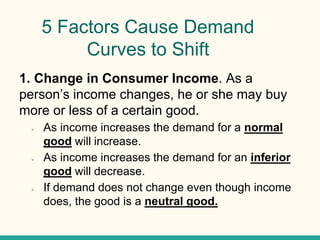
1. Change in Consumer Income. As a
person’s income changes, he or she may buy
more or less of a certain good.
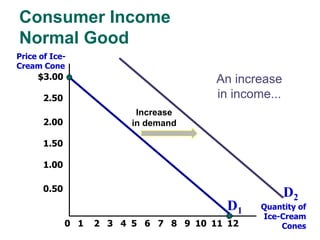
● As income increases the demand for a normal
good will increase.
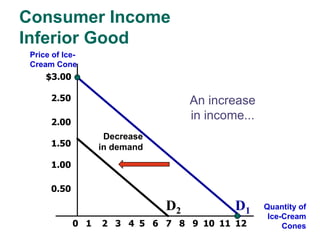
● As income increases the demand for an inferior
good will decrease.
● If demand does not change even though income
does, the good is a neutral good.
$3.00
2.50
2.00
1.50
1.00
0.50
21 3 4 5 6 7 8 9 10 1211
Price of Ice-
Cream Cone
Quantity of
Ice-Cream
Cones0
Increase
in demand
An increase
in income...
D1
D2
Consumer Income
Normal Good
$3.00
2.50
2.00
1.50
1.00
0.50
21 3 4 5 6 7 8 9 10 1211
Price of Ice-
Cream Cone
Quantity of
Ice-Cream
Cones0
Decrease
in demand
An increase
in income...
D1D2
Consumer Income
Inferior Good
2. Change in the Prices of Related Goods.
 When two goods are substitutes, the
demand for one moves in the same direction
as the price of the other.
Example: Price of peanuts goes up,
demand for pretzels goes up.
 When two goods are complements, the
demand for one moves in the opposite
direction of the price of the other.
Complements are goods used together.
Example: Price of tennis rackets goes up,
demand for tennis balls falls.
3. Change in the Number of Buyers: A change
in the number of buyers, either an increase or a
decrease, can change demand.
4. Change in Expectations or Future price:
Buyers’ expectations of future prices can cause
them to buy now or wait to buy. Both actions
affect current demand.
5. Change in Preferences: Changes in
preferences cause changes in demand.
The only factor that affects quantity
demanded is a direct price change of the
good. Remember: Demand and quantity
demanded are not the same thing.
Copyright©2004 South-Western
Elasticity of Demand
What Is Elasticity?
● Elasticity measures how a price change
affects the quantity of a particular good
that people want to buy.
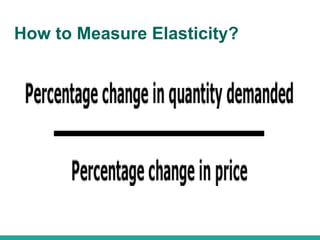
Elasticity of Demand
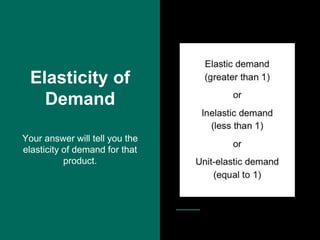
● Demand for a good can be elastic, inelastic, or unit-
elastic.
● Elastic means that a price change has a
significant impact on the quantity demanded.
● Inelastic means that there is a minor change in
quantity demanded when the price changes. And
● Unit-elastic means that the impact of a price
change is neutral—that is, neither major nor minor.
How to Measure Elasticity?
Elasticity of
Demand
Your answer will tell you the
elasticity of demand for that
product.
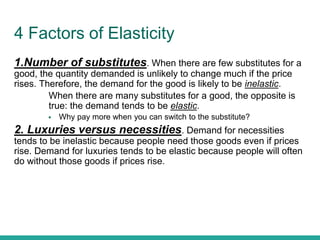
4 Factors of Elasticity
1.Number of substitutes. When there are few substitutes for a
good, the quantity demanded is unlikely to change much if the price
rises. Therefore, the demand for the good is likely to be inelastic.
● When there are many substitutes for a good, the opposite is
true: the demand tends to be elastic.
 Why pay more when you can switch to the substitute?
2. Luxuries versus necessities. Demand for necessities
tends to be inelastic because people need those goods even if prices
rise. Demand for luxuries tends to be elastic because people will often
do without those goods if prices rise.
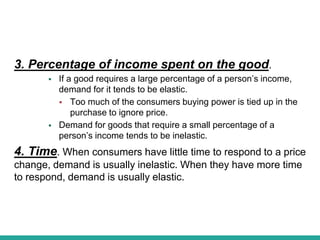
3. Percentage of income spent on the good.
 If a good requires a large percentage of a person’s income,
demand for it tends to be elastic.
 Too much of the consumers buying power is tied up in the
purchase to ignore price.
 Demand for goods that require a small percentage of a
person’s income tends to be inelastic.
4. Time. When consumers have little time to respond to a price
change, demand is usually inelastic. When they have more time
to respond, demand is usually elastic.
Relationship Between Elasticity and
Revenue● Elasticity of demand matters to sellers of goods because it
relates to their total revenue
● Price x Quantity Sold= Total Revenue
● You can look at how the elasticity of a good affects revenue
when sellers change the price of a good
● Elastic demand (think LUXURY) and an increase in price lead
to a decrease in total revenue.
● Elastic demand (think LUXURY) and a decrease in price lead
to an increase in total revenue.
● Inelastic demand (think NECESSITY) and an increase in
price lead to an increase in total revenue.
● Inelastic demand (think NECESSITY) and a decrease in price
lead to a decrease in total revenue.

Unit 2 demand

  • 1.
    Demand Essential Question: What determineswhat we buy? Unit 2 The Elements of a Market Economy
  • 2.
    The Market Forcesof Supply and Demand ●Supply and demand are the forces that make market economies work. ●A market is a group of buyers and sellers of a particular good or service. ●The terms supply and demand refer to the behavior of people . . . as they interact with one another in markets.
  • 3.
    The Market Forcesof Supply and Demand Buyers determine demand. Sellers determine supply
  • 4.
    What Is Demand? ●Demand is the willingness and ability of buyers to purchase different quantities of a good, at different prices, during a specific time period. Both willingness and ability must be present; if either is missing, there is no demand. ● Quantity demanded is different from demand. Quantity demanded is the AMOUNT of a good that buyers are willing and able to purchase. Quantity demanded is always a number.
  • 5.
    The Law of Demand ●What happens to the quantity demanded when the price changes ● When the price goes up, the quantity demanded goes down—and when the price goes down, the
  • 6.
    The Law ofDemand Equation
  • 7.
    The Law of Diminishing MarginalUtility What happens to your level of satisfaction as you buy more and more units of the same good? Testing the
  • 8.
    TRANSPARENCY 4-2: DiminishingMarginal Utility ●Diminishing means decreasing ●Marginal means additional ●Utility means satisfaction The law of diminishing marginal utility states: As a person consumes additional units of a good, eventually the utility gained from each additional unit of the good decreases.
  • 9.
    The Law ofDemand : A Visual ● The table of numbers is called a schedule and the graph is called a curve. ● We use the graph to help simplify the complicated aspects of demand.
  • 10.
  • 11.
    Figure 1 Catherine’sDemand Schedule and Demand Curve Copyright © 2004 South-Western Price of Ice-Cream Cone 0 2.50 2.00 1.50 1.00 0.50 1 2 3 4 5 6 7 8 9 10 11 Quantity of Ice-Cream Cones $3.00 12 1. A decrease in price ... 2. .. . increases quantity of cones demanded.
  • 12.
    Transparency 4-3: Demandin Tables and Graphs p.93 Demand curveDemand schedule
  • 13.
    Individual and MarketDemand Curves We can look at individual or market demand curves; which are different. ● An individual demand curve represents one person’s demand for a good. ● A market demand curve is the SUM of all the individual demand curves for a good.
  • 14.
  • 15.
  • 16.
  • 17.
    Change in QuantityDemanded A direct price change affects the quantity demanded of that good. It does not affect demand. Because of a change in price of the GOOD BEING GRAPHED Results in movement along the demand curve. NOT A SHIFT. Remember: Demand and quantity demanded are not the same thing.
  • 18.
    0 D Price of Ice- Cream Cones Quantityof Ice-Cream Cones A tax that raises the price of ice-cream cones results in a movement along the demand curve. A B 8 1.00 $2.00 4 Changes in Quantity Demanded
  • 19.
    Change in Demand ●Results in a shift in the demand curve, either to the left or right. ● When demand goes up, the demand curve shifts to the right. When demand goes down, the demand curve shifts to the left. ● Results from a change in a determinant of demand ( a ceteris paribus variable)
  • 20.
    Figure 3 Shiftsin the Demand Curve Copyright©2003 Southwestern/Thomson Learning Price of Ice-Cream Cone Quantity of Ice-Cream Cones Increase in demand Decreas ein demand Demand curve,D3 Demand curve, D1 Demand curve, D2 0
  • 21.
    5 Factors CauseDemand Curves to Shift 1. Change in Consumer Income. As a person’s income changes, he or she may buy more or less of a certain good. ● As income increases the demand for a normal good will increase. ● As income increases the demand for an inferior good will decrease. ● If demand does not change even though income does, the good is a neutral good.
  • 22.
    $3.00 2.50 2.00 1.50 1.00 0.50 21 3 45 6 7 8 9 10 1211 Price of Ice- Cream Cone Quantity of Ice-Cream Cones0 Increase in demand An increase in income... D1 D2 Consumer Income Normal Good
  • 23.
    $3.00 2.50 2.00 1.50 1.00 0.50 21 3 45 6 7 8 9 10 1211 Price of Ice- Cream Cone Quantity of Ice-Cream Cones0 Decrease in demand An increase in income... D1D2 Consumer Income Inferior Good
  • 24.
    2. Change inthe Prices of Related Goods.  When two goods are substitutes, the demand for one moves in the same direction as the price of the other. Example: Price of peanuts goes up, demand for pretzels goes up.  When two goods are complements, the demand for one moves in the opposite direction of the price of the other. Complements are goods used together. Example: Price of tennis rackets goes up, demand for tennis balls falls.
  • 25.
    3. Change inthe Number of Buyers: A change in the number of buyers, either an increase or a decrease, can change demand. 4. Change in Expectations or Future price: Buyers’ expectations of future prices can cause them to buy now or wait to buy. Both actions affect current demand. 5. Change in Preferences: Changes in preferences cause changes in demand. The only factor that affects quantity demanded is a direct price change of the good. Remember: Demand and quantity demanded are not the same thing.
  • 26.
  • 27.
  • 28.
    What Is Elasticity? ●Elasticity measures how a price change affects the quantity of a particular good that people want to buy.
  • 29.
    Elasticity of Demand ●Demand for a good can be elastic, inelastic, or unit- elastic. ● Elastic means that a price change has a significant impact on the quantity demanded. ● Inelastic means that there is a minor change in quantity demanded when the price changes. And ● Unit-elastic means that the impact of a price change is neutral—that is, neither major nor minor.
  • 30.
    How to MeasureElasticity?
  • 31.
    Elasticity of Demand Your answerwill tell you the elasticity of demand for that product.
  • 32.
    4 Factors ofElasticity 1.Number of substitutes. When there are few substitutes for a good, the quantity demanded is unlikely to change much if the price rises. Therefore, the demand for the good is likely to be inelastic. ● When there are many substitutes for a good, the opposite is true: the demand tends to be elastic.  Why pay more when you can switch to the substitute? 2. Luxuries versus necessities. Demand for necessities tends to be inelastic because people need those goods even if prices rise. Demand for luxuries tends to be elastic because people will often do without those goods if prices rise.
  • 33.
    3. Percentage ofincome spent on the good.  If a good requires a large percentage of a person’s income, demand for it tends to be elastic.  Too much of the consumers buying power is tied up in the purchase to ignore price.  Demand for goods that require a small percentage of a person’s income tends to be inelastic. 4. Time. When consumers have little time to respond to a price change, demand is usually inelastic. When they have more time to respond, demand is usually elastic.
  • 34.
    Relationship Between Elasticityand Revenue● Elasticity of demand matters to sellers of goods because it relates to their total revenue ● Price x Quantity Sold= Total Revenue ● You can look at how the elasticity of a good affects revenue when sellers change the price of a good ● Elastic demand (think LUXURY) and an increase in price lead to a decrease in total revenue. ● Elastic demand (think LUXURY) and a decrease in price lead to an increase in total revenue. ● Inelastic demand (think NECESSITY) and an increase in price lead to an increase in total revenue. ● Inelastic demand (think NECESSITY) and a decrease in price lead to a decrease in total revenue.