Questions…
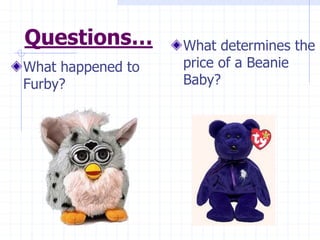
What happened to
Furby?
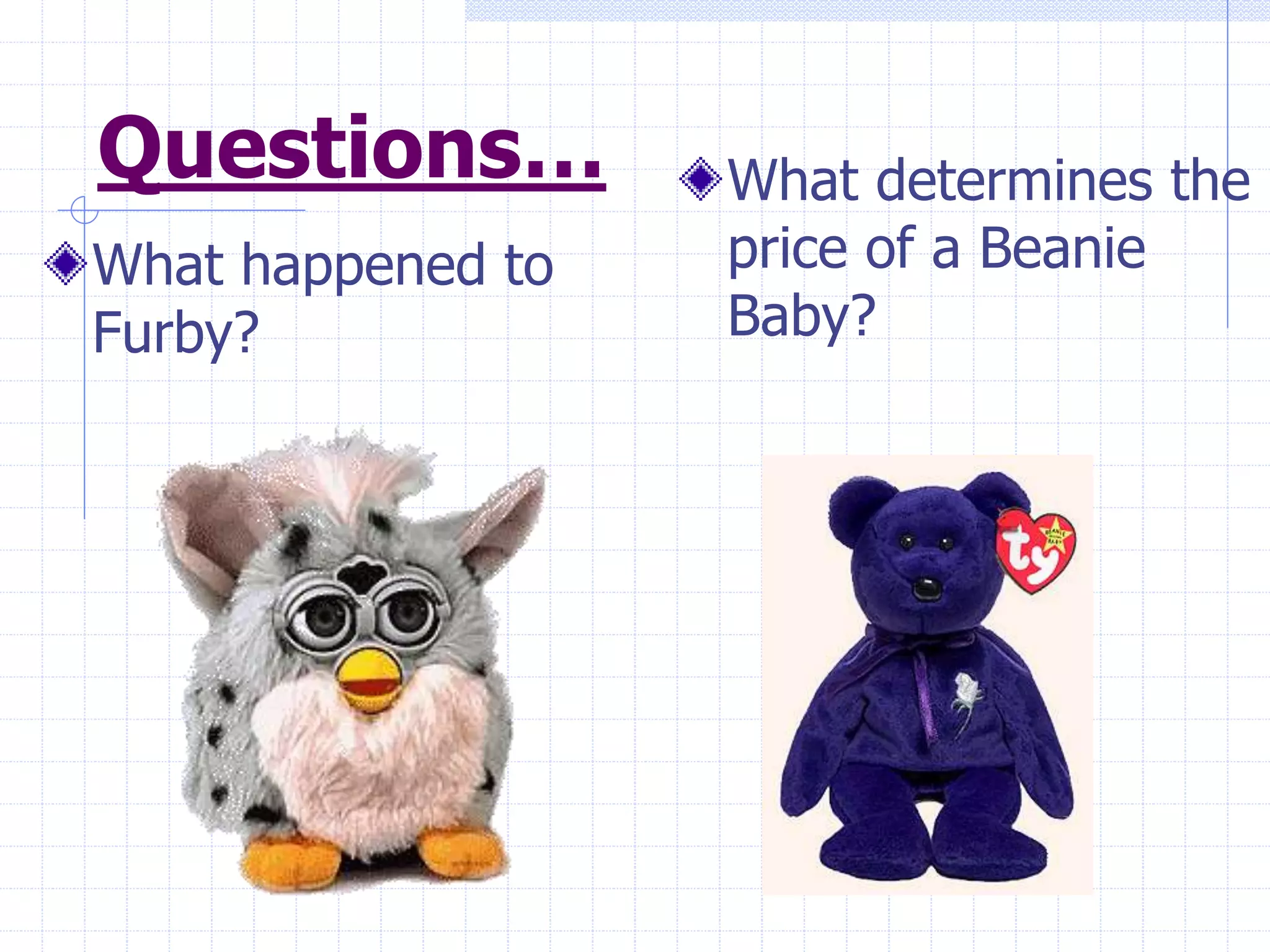
What determines the
price of a Beanie
Baby?
Demand
The desire to own something and the ability
to pay for it.
Law of Demand:
A rise in price causes a
decrease in quantity
demanded;
A decline in price causes an
increase in quantity
demanded.
An INVERSE relationship.
https://www.youtube.com/watch?v=5IWotuQB
gs4
Graphing Quantity Demanded:
 Quantity Demanded
(Horizontal Axis):Amount of a
good/service that consumers would
purchase at a particular price.
 Price (Vertical Axis):What it
costs in terms of currency to buy
the good/service (what’s on price
tag)
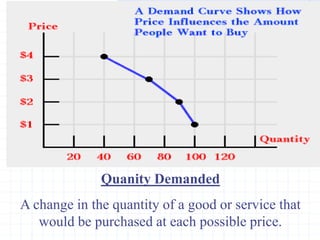
Quanity Demanded
A change in the quantity of a good or service that
would be purchased at each possible price.
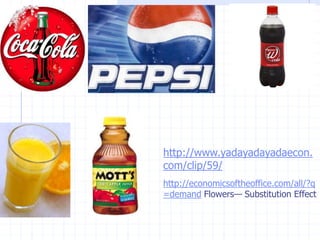
Reactions Change Spending Patterns:
Substitution Effect: Consumers react to
increase in price by consuming less of the
good & more of other goods.
Substitute- product that is interchangeable
in use with another product.
An increase in price of substitute increases
demand for other substitutes.
Examples?
https://www.youtube.com/watch?v=RRDSj62tlvQ
http://www.yadayadayadaecon.
com/clip/59/
http://economicsoftheoffice.com/all/?q
=demand Flowers— Substitution Effect
“Switching costs”
To avoid substitution effect, some
companies charge customers
when switching to another
competing firm.
Income
Income Effect: Change in consumption
resulting from a change (or perception
of change) in income
There would be no demand for a product
w/out the ability to pay for it.
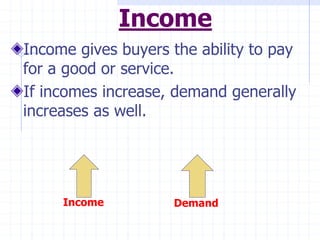
Income
Income gives buyers the ability to pay
for a good or service.
If incomes increase, demand generally
increases as well.
Income Demand
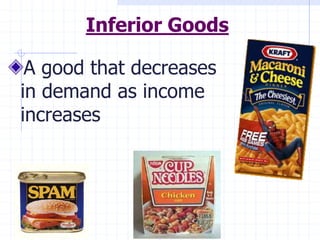
Inferior Goods
A good that decreases
in demand as income
increases
Normal Goods
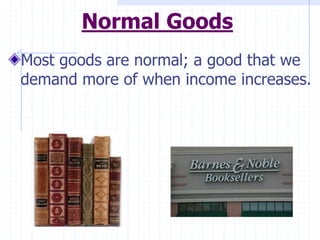
Most goods are normal; a good that we
demand more of when income increases.
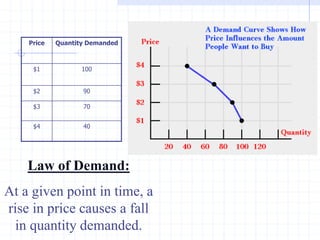
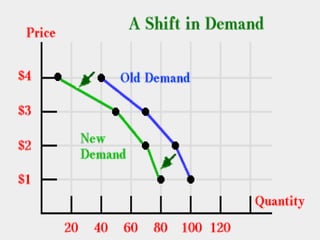
Law of Demand:
At a given point in time, a
rise in price causes a fall
in quantity demanded.
Price Quantity Demanded
$1 100
$2 90
$3 70
$4 40
Shifts in the Demand Curve:
Consumers change perceptions
about the worth of a product
• Deciding if they want it, not how

much of it they want
 Influenced by any factor other
than price
 Remember: Price generally refers
to movement along the curve!
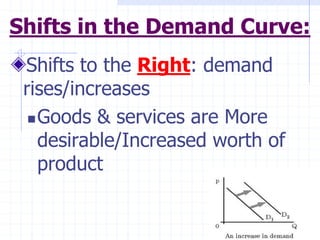
Shifts in the Demand Curve:
Shifts to the Right: demand
rises/increases
Goods & services are More
desirable/Increased worth of
product
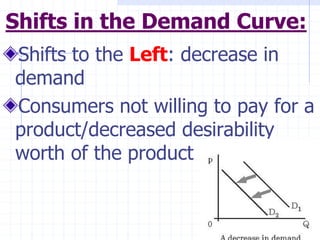
Shifts in the Demand Curve:
Shifts to the Left: decrease in
demand
Consumers not willing to pay for a
product/decreased desirability
worth of the product
What Shifts Demand?
5 determinants:
• Tastes & Preferences
• Income
• Price & Availability of
Substitutes & Complements
• Consumer Expectations
• Population
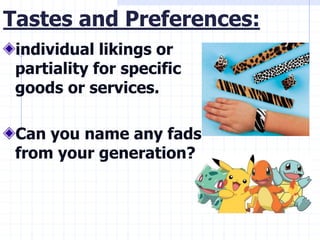
Tastes and Preferences:
individual likings or
partiality for specific
goods or services.
Can you name any fads
from your generation?
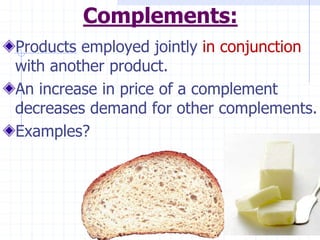
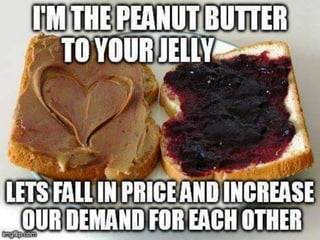
Complements:
Products employed jointly in conjunction
with another product.
An increase in price of a complement
decreases demand for other complements.
Examples?
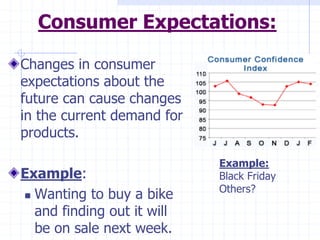
Consumer Expectations:
Changes in consumer
expectations about the
future can cause changes
in the current demand for
products.
Example:
 Wanting to buy a bike
and finding out it will
be on sale next week.
Example:
Black Friday
Others?
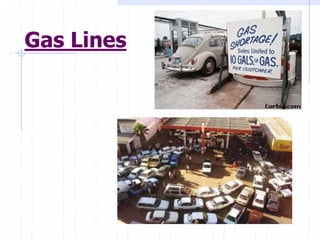
Gas Lines
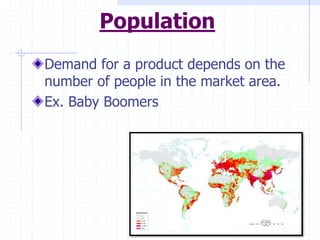
Population
Demand for a product depends on the
number of people in the market area.
Ex. Baby Boomers
Warm Up
Name the 5 determinants that can shift
the demand curve?
Application
With a partner near you work on pages
4-6
Are there goods that you’d always find
$$$ to buy, even if the price rose

drastically?
• Any you would cut back on or even
stop buying all together?
Economists describe the way that
consumers respond to price changes as
Elasticity of Demand.

Elastic or Inelastic Demand:
Elastic-
 Demand is very sensitive to a
change in price
 (You will by less of a good after a
small price increase)
Inelastic-
 Demand that is not very sensitive
to a change in price.
 (You will keep buying no matter
what the price)
Come up w/ a list of 3 elastic & 3 inelastic goods
Be prepared to defend your answer.
Elastic Inelastic
Which goods are Elastic vs.
Inelastic? Explain.
Wireless Speakers
Salt
Fur Coat
A Car
A new pair of Sneakers
A Computer
Prescription Drugs
Diamonds
Peanuts
Gasoline
Factors that determine the value
of price elasticity of demand:
# of close Substitutes
Necessity v. Luxury
% of Income Spent on Good
Habit-Forming Goods
Time Period under consideration
# of Close Substitutes
https://www.youtube.com/wa
tch?v=dE3Q3NvN2ZE
Hudsucker Proxy:
https://www.youtube.com/watch?v=Ng
3XHPdexNM
Necessity v. Luxury-What are your
basic needs?
http://www.today.com/money/1-770-hamburger-glamburger-2D80199722
% Of Income Spent on Good/Service
$1100–
http://abcnews.go.com/GMA/american-coffee-habits-spend-
coffee/story?id=16923079
Are they Habit-Forming Goods?
Govts tend to place ‘sin
taxes’ on inelastic goods
to Limit consumption
Time Period Under Consideration
More time under consideration =
more elastic demand
. Ex. Gasoline
 Over a Month- demand won’t
change much
 Over a Year -will change more
Additional time allows consumers to
alter behaviors
Price Elasticity of Demand:
the relative size of the change in
quantity demanded for
good/service as a result of a
change in its price.
Objective: Measure consumers
responsiveness of demand
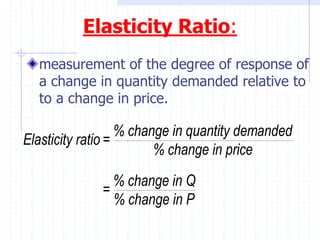
Elasticity Ratio:
measurement of the degree of response of
a change in quantity demanded relative to
to a change in price.
Elasticity ratio=
% change in quantity demanded
% change in price
=
% change in Q
% change in P
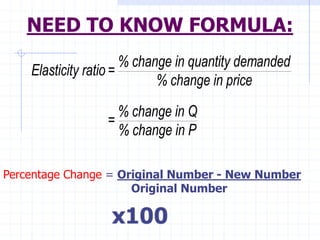
NEED TO KNOW FORMULA:
Elasticity ratio=
% change in quantity demanded
% change in price
=
% change in Q
% change in P
Percentage Change = Original Number - New Number
Original Number
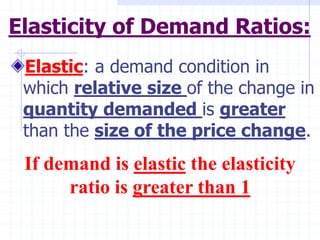
Elasticity of Demand Ratios:
Elastic: a demand condition in
which relative size of the change in
quantity demanded is greater
than the size of the price change.
If demand is elastic the elasticity
ratio is greater than 1
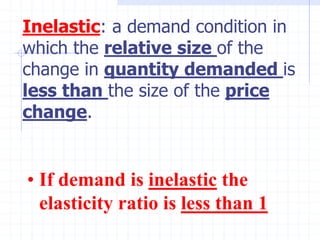
Inelastic: a demand condition in
which the relative size of the
change in quantity demanded is
less than the size of the price
change.
• If demand is inelastic the
elasticity ratio is less than 1
Unitary elasticity: a demand
condition in which the relative
change in the quantity
demanded is the same as the
size of the price change.
• If demand elasticity is unitary,
elasticity ratio is exactly 1
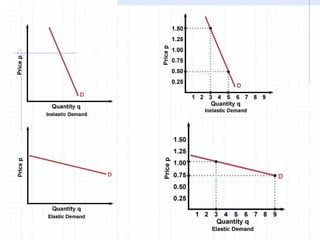
Its ALL about the SLOPE!
In general, the slope of a
demand curve indicates how
elastic or inelastic demand
is.
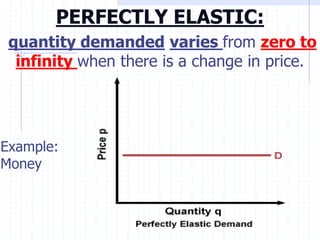
PERFECTLY ELASTIC:
quantity demanded varies from zero to
infinity when there is a change in price.
Example:
Money
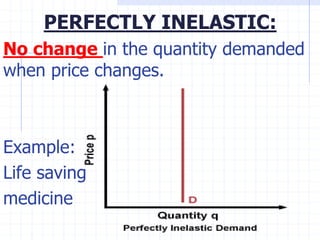
PERFECTLY INELASTIC:
No change in the quantity demanded
when price changes.
Example:
Life saving
medicine
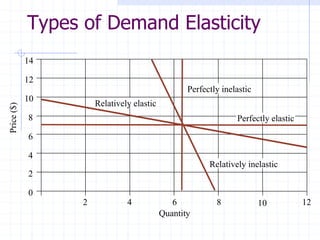
Types of Demand Elasticity
Price
($)
2 4 6 8 10 12
Quantity
Relatively elastic
Perfectly inelastic
Perfectly elastic
Relatively inelastic
14
10
8
6
12
4
2
0
Supply and Demand Review
https://www.youtube.com/watch?v=g9aDizJpd_s

leadership

  • 1.
    Questions… What happened to Furby? Whatdetermines the price of a Beanie Baby?
  • 2.
    Demand The desire toown something and the ability to pay for it.
  • 3.
    Law of Demand: Arise in price causes a decrease in quantity demanded; A decline in price causes an increase in quantity demanded. An INVERSE relationship. https://www.youtube.com/watch?v=5IWotuQB gs4
  • 4.
    Graphing Quantity Demanded: Quantity Demanded (Horizontal Axis):Amount of a good/service that consumers would purchase at a particular price.  Price (Vertical Axis):What it costs in terms of currency to buy the good/service (what’s on price tag)
  • 5.
    Quanity Demanded A changein the quantity of a good or service that would be purchased at each possible price.
  • 6.
    Reactions Change SpendingPatterns: Substitution Effect: Consumers react to increase in price by consuming less of the good & more of other goods. Substitute- product that is interchangeable in use with another product. An increase in price of substitute increases demand for other substitutes. Examples? https://www.youtube.com/watch?v=RRDSj62tlvQ
  • 7.
  • 8.
    “Switching costs” To avoidsubstitution effect, some companies charge customers when switching to another competing firm.
  • 9.
    Income Income Effect: Changein consumption resulting from a change (or perception of change) in income There would be no demand for a product w/out the ability to pay for it.
  • 10.
    Income Income gives buyersthe ability to pay for a good or service. If incomes increase, demand generally increases as well. Income Demand
  • 11.
    Inferior Goods A goodthat decreases in demand as income increases
  • 13.
    Normal Goods Most goodsare normal; a good that we demand more of when income increases.
  • 14.
    Law of Demand: Ata given point in time, a rise in price causes a fall in quantity demanded. Price Quantity Demanded $1 100 $2 90 $3 70 $4 40
  • 16.
    Shifts in theDemand Curve: Consumers change perceptions about the worth of a product • Deciding if they want it, not how much of it they want  Influenced by any factor other than price  Remember: Price generally refers to movement along the curve!
  • 17.
    Shifts in theDemand Curve: Shifts to the Right: demand rises/increases Goods & services are More desirable/Increased worth of product
  • 18.
    Shifts in theDemand Curve: Shifts to the Left: decrease in demand Consumers not willing to pay for a product/decreased desirability worth of the product
  • 20.
    What Shifts Demand? 5determinants: • Tastes & Preferences • Income • Price & Availability of Substitutes & Complements • Consumer Expectations • Population
  • 21.
    Tastes and Preferences: individuallikings or partiality for specific goods or services. Can you name any fads from your generation?
  • 22.
    Complements: Products employed jointlyin conjunction with another product. An increase in price of a complement decreases demand for other complements. Examples?
  • 24.
    Consumer Expectations: Changes inconsumer expectations about the future can cause changes in the current demand for products. Example:  Wanting to buy a bike and finding out it will be on sale next week. Example: Black Friday Others?
  • 25.
  • 26.
    Population Demand for aproduct depends on the number of people in the market area. Ex. Baby Boomers
  • 28.
    Warm Up Name the5 determinants that can shift the demand curve?
  • 29.
    Application With a partnernear you work on pages 4-6
  • 30.
    Are there goodsthat you’d always find $$$ to buy, even if the price rose drastically? • Any you would cut back on or even stop buying all together? Economists describe the way that consumers respond to price changes as Elasticity of Demand.
  • 31.
    Elastic or InelasticDemand: Elastic-  Demand is very sensitive to a change in price  (You will by less of a good after a small price increase) Inelastic-  Demand that is not very sensitive to a change in price.  (You will keep buying no matter what the price)
  • 32.
    Come up w/a list of 3 elastic & 3 inelastic goods Be prepared to defend your answer. Elastic Inelastic
  • 33.
    Which goods areElastic vs. Inelastic? Explain. Wireless Speakers Salt Fur Coat A Car A new pair of Sneakers A Computer Prescription Drugs Diamonds Peanuts Gasoline
  • 34.
    Factors that determinethe value of price elasticity of demand: # of close Substitutes Necessity v. Luxury % of Income Spent on Good Habit-Forming Goods Time Period under consideration
  • 35.
    # of CloseSubstitutes https://www.youtube.com/wa tch?v=dE3Q3NvN2ZE
  • 36.
  • 37.
    Necessity v. Luxury-Whatare your basic needs? http://www.today.com/money/1-770-hamburger-glamburger-2D80199722
  • 39.
    % Of IncomeSpent on Good/Service $1100– http://abcnews.go.com/GMA/american-coffee-habits-spend- coffee/story?id=16923079
  • 40.
    Are they Habit-FormingGoods? Govts tend to place ‘sin taxes’ on inelastic goods to Limit consumption
  • 41.
    Time Period UnderConsideration More time under consideration = more elastic demand . Ex. Gasoline  Over a Month- demand won’t change much  Over a Year -will change more Additional time allows consumers to alter behaviors
  • 42.
    Price Elasticity ofDemand: the relative size of the change in quantity demanded for good/service as a result of a change in its price. Objective: Measure consumers responsiveness of demand
  • 43.
    Elasticity Ratio: measurement ofthe degree of response of a change in quantity demanded relative to to a change in price. Elasticity ratio= % change in quantity demanded % change in price = % change in Q % change in P
  • 44.
    NEED TO KNOWFORMULA: Elasticity ratio= % change in quantity demanded % change in price = % change in Q % change in P Percentage Change = Original Number - New Number Original Number
  • 45.
    Elasticity of DemandRatios: Elastic: a demand condition in which relative size of the change in quantity demanded is greater than the size of the price change. If demand is elastic the elasticity ratio is greater than 1
  • 46.
    Inelastic: a demandcondition in which the relative size of the change in quantity demanded is less than the size of the price change. • If demand is inelastic the elasticity ratio is less than 1
  • 47.
    Unitary elasticity: ademand condition in which the relative change in the quantity demanded is the same as the size of the price change. • If demand elasticity is unitary, elasticity ratio is exactly 1
  • 48.
    Its ALL aboutthe SLOPE! In general, the slope of a demand curve indicates how elastic or inelastic demand is.
  • 50.
    PERFECTLY ELASTIC: quantity demandedvaries from zero to infinity when there is a change in price. Example: Money
  • 51.
    PERFECTLY INELASTIC: No changein the quantity demanded when price changes. Example: Life saving medicine
  • 52.
    Types of DemandElasticity Price ($) 2 4 6 8 10 12 Quantity Relatively elastic Perfectly inelastic Perfectly elastic Relatively inelastic 14 10 8 6 12 4 2 0
  • 53.
    Supply and DemandReview https://www.youtube.com/watch?v=g9aDizJpd_s