

LIFE INSURANCE ACT
        1956
WhAT IS LIC ACT ?
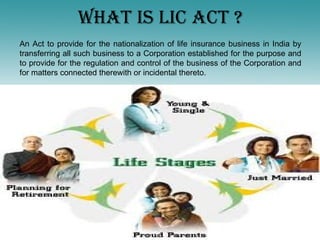
An Act to provide for the nationalization of life insurance business in India by
transferring all such business to a Corporation established for the purpose and
to provide for the regulation and control of the business of the Corporation and
for matters connected therewith or incidental thereto.
FUNCTIONS OF CORPORATION?
• (1) Subject to the rules, if any, made by the
  Central Government in this behalf, it shall be
  the general duty of the Corporation to carry on
  life insurance business, whether in or outside
  India, and the Corporation shall so exercise its
  powers under this Act as to secure that life
  insurance business is developed to the best
  advantage of the community.
the Corporation shall have power--
• (a) to carry on capital redemption
  business, annuity certain business or
  reinsurance business in so far as such
  reinsurance business appertains to life
  insurance business;
• (b) to acquire, hold and dispose of any
  property for the purpose of its business;
• (c) to transfer the whole or any part of the life insurance
  business carried on outside India to any other person or
  persons, if in the interests of the Corporation it is
  expedient so to do.

• (e) to advance or lend money upon the security of any
  movable or immovable property or otherwise;

• (f) to borrow or raise any money in such manner and
  upon such security as the Corporation may think fit;
• (h) to carry on any other business which may
  seem to the Corporation to be capable of being
  conveniently carried on in connection with its
  business and calculated directly or indirectly to
  render profitable the business of the Corporation;

• (i) to do all such things as may be incidental or
  conducive to the proper exercise of any of the
  powers of the Corporation.
• (3) In the discharge of any of its functions
  the Corporation shall act so far as may be
  on business principles
POWER TO ImPOSE CONdITIONS
• (1) In entering into any arrangement, under
  section 6, with any concern, the Corporation
  may impose such conditions as it may think
  necessary or expedient for protecting the
  interest of the Corporation and for securing
  that the accommodation granted by it is put to
  the best use by the concern.
• (3) Any director appointed as aforesaid shall—

• (a) hold office during the pleasure of the
  Corporation and may be removed or substituted
  by any person by order in writing by the
  Corporation;

• 1. Ins. by Act 52 of 1975, s. 41 (w. e. f. 16- 2-
  1976 ).
• (b) not incur any obligation or liability by
  reason only of his being a director or for
  anything done or omitted to be done in good
  faith in the discharge of his duties as a
  director or anything in relation thereto;

• (c) not be liable to retirement by rotation and
  shall not be taken into account for computing
  the number of directors liable to such
  retirement
CHAPTER II:
  ESTABLIShmENT OF LIFE
INSURANCE CORPORATION OF
          INdIA
3.ESTABLIShmENT ANd INCORPORATION
       OF LIFE INSURANCE CORPORATION OF
                     INdIA.
• (1) With effect from such date as the Central Government
  may, by notification in the Official Gazette, appoint, there shall
  be established a Corporation called the Life Insurance
  Corporation of India.

• (2) The Corporation shall be a body corporate having
  perpetual succession and a common seal with power subject
  to the provisions of this Act, to acquire, hold and dispose of
  property, and may by its name sue and be sued.
4. CONSTITUTION OF ThE
•                           CORPORATION.
    (1) The Corporation shall consist of such number of person not exceeding
    [sixteen] as the Central Government may think fit to appoint thereto and one of
    them shall be appointed by the Central Government to be the Chairman thereof.

•   (2) Before appointing a person to be a member, the Central Government shall
    satisfy itself that the person will have no such financial or other interest as is likely
    to affect prejudicially the exercise of performance by him of his functions as a
    member, and the Central Government shall also satisfy itself from time to time
    with respect to every member that he has no such interest; and any person who
    is, or whom the Central Government proposes to appoint and who has consented
    to be, a member shall, whenever required by the Central Government so to do,
    furnish to it such information as the Central Government considers necessary for
    the performance of its duties under this sub-section.
•   (3) A member who is in any way directly or indirectly interested in a
    contract made or proposed to be made by the Corporation shall, as
    soon as possible after the relevant circumstances have come to his
    knowledge, disclose the nature of his interest to the Corporation;
    and the member shall not take part in any deliberation or discussion
    of the Corporation with respect to that contract.
5. CAPITAL OF ThE
                  CORPORATION
• (1) The original capital of the Corporation shall be five crores
  of rupees provided by the Central Government after due
  appropriation made by Parliament by law for the purpose,
  and the terms and conditions relating to the provision of such
  capital shall be such as may be determined by the Central
  Government.

• (2) The Central Government may, on the recommendation of
  the Corporation, reduce the capital of the Corporation to such
  extent and in such manner as the Central Government may
  determine.
mAIN FEATURES OF LIC
1. SAvINg INSTITUTION:
•Life insurance both promotes and mobilizes saving in the country. The income tax concession
provides further incentive to higher income persons to save through LIC policies. The total
volume of insurance business has also been growing with the spread of insurance-
consciousness in the country. The total new business of LIC during 1995-96 was Rs. 51815
crore sum assured under 10.20 lakh policies.
•The LIC business can grow at still faster speed if the following improvements are made:
•The organizational and operational efficiency of the LIC should be increased.
•New types of insurance covers should be introduced.
     I. The services of LIC should be extended to smaller places.
     II. The message of life insurance should be made more popular.
     III. The general price level should be kept stable so that the insuring public does
          not get cheated of a large amount of the real value of its long-term saving
          through inflation.
2. TERm FINANCINg INSTITUTION:
•LIC also functions as a large term financing institution (or a capital market) in
the country. The annual net accrual of investible funds from life insurance
business (after making all kinds of payments liabilities to the policy holders)
and net income from its vast investment are quite large. During 1994-95,
LIC's total income was Rs. 18,102.92crore, consisting of premium income of
Rs. 1152,80crore investment income of Rs. 6336.19crore, and miscellaneous
income of Rs. 238.33crore.
3. INvESTmENT INSTITUTIONS:
LIC is a big investor of funds in government securities. Under the law, LIC is
required to invest at least 50% of its accruals in the form of premium income
in government and other approved securities.
LIC funds are also made available directly to the private sector through
investment in shares, debentures, and loans. LIC also plays a significant role
in developing the business of underwriting of new issues.
ChAPTER Iv:
TRANSFER OF EXISTINg LIFE
INSURANCE BUSINESS TO ThE
      CORPORATION
14. POWER OF CORPORATION TO mOdIFy
      CONTRACTS OF LIFE INSURANCE IN
              CERTAIN CASES
• The Corporation may, having regard to the financial condition on
  the appointed day of any insurer whose controlled business has
  been transferred to an vested in the Corporation, reduce the
  amounts of insurance under contracts of life insurance entered into
  by such insurer before the 19th day of January, 1956, in such
  manner and subject to such conditions as it thinks fit:

   Provided that no such reduction shall be made except in accordance with
   a scheme prepared by the Corporation in this behalf and approved by the
   Central Government.
15. RIghT OF CORPORATION TO
        SEEk RELIEF IN RESPECT OF
     CERTAIN TRANSACTIONS OF hE
                               INSURER
(1) Where an insurer whose controlled business has been transferred to and
   vested in the Corporation under this Act has, at any time within five years
   before the 19th day of January, 1956,-
    I. made any payment to any person without consideration;
    II. sold or disposed of any property of the insurer without consideration or for
         an inadequate consideration.
    III. acquired any property or rights for an excessive consideration.
    IV. entered into or varied any agreement so as to require an excessive
         consideration to be paid or given by the insurer;
    V. entered into any other transaction of such an onerous nature as to cause a
         loss to, impose a liability on, the insurer exceeding any benefit accruing to
         the insurer.
(2) The Tribunal may make such order against any of the
parties to the application as it thinks just having regard to the
extend to which those parties were respectively responsible for
the transaction or benefited from it and all the circumstances of
the case.

 (3) Where an application is made to the Tribunal under this
section in respect of any transaction and application is
determined in favor of the Corporation, the Tribunal shall have
exclusive jurisdiction to determine any claims outstanding in
respect of the transaction.
11. TRANSFER OF SERvICE OF EXISTINg
           EmPLOyEES OF INSURERS TO ThE
                            CORPORATION
(1) Every whole-time employee of an insurer whose controlled business has been
transferred to and vested in the Corporation and who was employed by the insurer
wholly or mainly in connection with his controlled business immediately before the
appointed day shall, on and from the appointed day, become an employee of the
Corporation, and shall hold his office therein by the same tenure, at the same
remuneration and upon the same terms and conditions and with the same rights and
privileges as to pension and gratuity and other matters as he would have held the
same on the appointed day if this Act had not been passed, and shall continue to do
so unless and until his employment in the Corporation is terminated or until his
remuneration, terms and conditions are duly altered by the Corporation:

Provided that nothing contained in this sub-section shall apply to any such employee
who has, by notice in writing given to the Central Government prior to the appointed
day, intimated his intention of not becoming an employee of the Corporation.
(3) If any question arises as to whether any person was a whole-
time employee of an insurer or as to whether any employee was
employed wholly or mainly in connection with the controlled
business of an insurer immediately before the appointed day the
question shall be referred to the Central Government whose
decision shall be final.

(4) Notwithstanding anything contained in the Industrial Disputes
Act 1947 (14 of 1947), or in any other law for the time being in
force, the transfer of the services of any employee of an insurer
to the Corporation shall not entitle any such employee to any
compensation under that Act or other law, and no such claim
shall be entertained by any court, tribunal or other authority.
13. dUTy TO dELIvER POSSESSION OF
      PROPERTy ANd dOCUmENTS RELATINg
                   ThERETO
1) Where any property appertaining to the controlled business of any insurer
has been transferred to an vested in the Corporation under this Act, then, -

(a) every person, in whose possession , custody or control any such property
may be, shall deliver the property to the Corporation forthwith;

(b) and person who, on the appointed day, has in his possession, custody or
control any book, documents or other papers relating to such controlled
business shall be liable to account for the said books, documents and papers
to the Corporation, and shall deliver them to the Corporation or to such
person as the Corporation may direct.
(2) In particular, all the assets of an insurer appertaining
to life insurance business held in deposit by the
Reserve Bank of India under the Insurance Act or by
trustees in trust shall be delivered to the Corporation.

(3) Without prejudice to the other provisions contained
in this section, it shall be lawful for the Corporation to
take all necessary steps for securing possession of all
properties which have been transferred to and vested in
it under this Act.
Life insurance act 1956

Life insurance act 1956

  • 1.
  • 2.
    WhAT IS LICACT ? An Act to provide for the nationalization of life insurance business in India by transferring all such business to a Corporation established for the purpose and to provide for the regulation and control of the business of the Corporation and for matters connected therewith or incidental thereto.
  • 3.
    FUNCTIONS OF CORPORATION? •(1) Subject to the rules, if any, made by the Central Government in this behalf, it shall be the general duty of the Corporation to carry on life insurance business, whether in or outside India, and the Corporation shall so exercise its powers under this Act as to secure that life insurance business is developed to the best advantage of the community.
  • 4.
    the Corporation shallhave power-- • (a) to carry on capital redemption business, annuity certain business or reinsurance business in so far as such reinsurance business appertains to life insurance business; • (b) to acquire, hold and dispose of any property for the purpose of its business;
  • 5.
    • (c) totransfer the whole or any part of the life insurance business carried on outside India to any other person or persons, if in the interests of the Corporation it is expedient so to do. • (e) to advance or lend money upon the security of any movable or immovable property or otherwise; • (f) to borrow or raise any money in such manner and upon such security as the Corporation may think fit;
  • 6.
    • (h) tocarry on any other business which may seem to the Corporation to be capable of being conveniently carried on in connection with its business and calculated directly or indirectly to render profitable the business of the Corporation; • (i) to do all such things as may be incidental or conducive to the proper exercise of any of the powers of the Corporation.
  • 7.
    • (3) Inthe discharge of any of its functions the Corporation shall act so far as may be on business principles
  • 8.
    POWER TO ImPOSECONdITIONS • (1) In entering into any arrangement, under section 6, with any concern, the Corporation may impose such conditions as it may think necessary or expedient for protecting the interest of the Corporation and for securing that the accommodation granted by it is put to the best use by the concern.
  • 9.
    • (3) Anydirector appointed as aforesaid shall— • (a) hold office during the pleasure of the Corporation and may be removed or substituted by any person by order in writing by the Corporation; • 1. Ins. by Act 52 of 1975, s. 41 (w. e. f. 16- 2- 1976 ).
  • 10.
    • (b) notincur any obligation or liability by reason only of his being a director or for anything done or omitted to be done in good faith in the discharge of his duties as a director or anything in relation thereto; • (c) not be liable to retirement by rotation and shall not be taken into account for computing the number of directors liable to such retirement
  • 11.
    CHAPTER II: ESTABLIShmENT OF LIFE INSURANCE CORPORATION OF INdIA
  • 12.
    3.ESTABLIShmENT ANd INCORPORATION OF LIFE INSURANCE CORPORATION OF INdIA. • (1) With effect from such date as the Central Government may, by notification in the Official Gazette, appoint, there shall be established a Corporation called the Life Insurance Corporation of India. • (2) The Corporation shall be a body corporate having perpetual succession and a common seal with power subject to the provisions of this Act, to acquire, hold and dispose of property, and may by its name sue and be sued.
  • 13.
    4. CONSTITUTION OFThE • CORPORATION. (1) The Corporation shall consist of such number of person not exceeding [sixteen] as the Central Government may think fit to appoint thereto and one of them shall be appointed by the Central Government to be the Chairman thereof. • (2) Before appointing a person to be a member, the Central Government shall satisfy itself that the person will have no such financial or other interest as is likely to affect prejudicially the exercise of performance by him of his functions as a member, and the Central Government shall also satisfy itself from time to time with respect to every member that he has no such interest; and any person who is, or whom the Central Government proposes to appoint and who has consented to be, a member shall, whenever required by the Central Government so to do, furnish to it such information as the Central Government considers necessary for the performance of its duties under this sub-section.
  • 14.
    (3) A member who is in any way directly or indirectly interested in a contract made or proposed to be made by the Corporation shall, as soon as possible after the relevant circumstances have come to his knowledge, disclose the nature of his interest to the Corporation; and the member shall not take part in any deliberation or discussion of the Corporation with respect to that contract.
  • 15.
    5. CAPITAL OFThE CORPORATION • (1) The original capital of the Corporation shall be five crores of rupees provided by the Central Government after due appropriation made by Parliament by law for the purpose, and the terms and conditions relating to the provision of such capital shall be such as may be determined by the Central Government. • (2) The Central Government may, on the recommendation of the Corporation, reduce the capital of the Corporation to such extent and in such manner as the Central Government may determine.
  • 16.
    mAIN FEATURES OFLIC 1. SAvINg INSTITUTION: •Life insurance both promotes and mobilizes saving in the country. The income tax concession provides further incentive to higher income persons to save through LIC policies. The total volume of insurance business has also been growing with the spread of insurance- consciousness in the country. The total new business of LIC during 1995-96 was Rs. 51815 crore sum assured under 10.20 lakh policies. •The LIC business can grow at still faster speed if the following improvements are made: •The organizational and operational efficiency of the LIC should be increased. •New types of insurance covers should be introduced. I. The services of LIC should be extended to smaller places. II. The message of life insurance should be made more popular. III. The general price level should be kept stable so that the insuring public does not get cheated of a large amount of the real value of its long-term saving through inflation.
  • 17.
    2. TERm FINANCINgINSTITUTION: •LIC also functions as a large term financing institution (or a capital market) in the country. The annual net accrual of investible funds from life insurance business (after making all kinds of payments liabilities to the policy holders) and net income from its vast investment are quite large. During 1994-95, LIC's total income was Rs. 18,102.92crore, consisting of premium income of Rs. 1152,80crore investment income of Rs. 6336.19crore, and miscellaneous income of Rs. 238.33crore. 3. INvESTmENT INSTITUTIONS: LIC is a big investor of funds in government securities. Under the law, LIC is required to invest at least 50% of its accruals in the form of premium income in government and other approved securities. LIC funds are also made available directly to the private sector through investment in shares, debentures, and loans. LIC also plays a significant role in developing the business of underwriting of new issues.
  • 18.
    ChAPTER Iv: TRANSFER OFEXISTINg LIFE INSURANCE BUSINESS TO ThE CORPORATION
  • 19.
    14. POWER OFCORPORATION TO mOdIFy CONTRACTS OF LIFE INSURANCE IN CERTAIN CASES • The Corporation may, having regard to the financial condition on the appointed day of any insurer whose controlled business has been transferred to an vested in the Corporation, reduce the amounts of insurance under contracts of life insurance entered into by such insurer before the 19th day of January, 1956, in such manner and subject to such conditions as it thinks fit: Provided that no such reduction shall be made except in accordance with a scheme prepared by the Corporation in this behalf and approved by the Central Government.
  • 20.
    15. RIghT OFCORPORATION TO SEEk RELIEF IN RESPECT OF CERTAIN TRANSACTIONS OF hE INSURER (1) Where an insurer whose controlled business has been transferred to and vested in the Corporation under this Act has, at any time within five years before the 19th day of January, 1956,- I. made any payment to any person without consideration; II. sold or disposed of any property of the insurer without consideration or for an inadequate consideration. III. acquired any property or rights for an excessive consideration. IV. entered into or varied any agreement so as to require an excessive consideration to be paid or given by the insurer; V. entered into any other transaction of such an onerous nature as to cause a loss to, impose a liability on, the insurer exceeding any benefit accruing to the insurer.
  • 21.
    (2) The Tribunalmay make such order against any of the parties to the application as it thinks just having regard to the extend to which those parties were respectively responsible for the transaction or benefited from it and all the circumstances of the case. (3) Where an application is made to the Tribunal under this section in respect of any transaction and application is determined in favor of the Corporation, the Tribunal shall have exclusive jurisdiction to determine any claims outstanding in respect of the transaction.
  • 22.
    11. TRANSFER OFSERvICE OF EXISTINg EmPLOyEES OF INSURERS TO ThE CORPORATION (1) Every whole-time employee of an insurer whose controlled business has been transferred to and vested in the Corporation and who was employed by the insurer wholly or mainly in connection with his controlled business immediately before the appointed day shall, on and from the appointed day, become an employee of the Corporation, and shall hold his office therein by the same tenure, at the same remuneration and upon the same terms and conditions and with the same rights and privileges as to pension and gratuity and other matters as he would have held the same on the appointed day if this Act had not been passed, and shall continue to do so unless and until his employment in the Corporation is terminated or until his remuneration, terms and conditions are duly altered by the Corporation: Provided that nothing contained in this sub-section shall apply to any such employee who has, by notice in writing given to the Central Government prior to the appointed day, intimated his intention of not becoming an employee of the Corporation.
  • 23.
    (3) If anyquestion arises as to whether any person was a whole- time employee of an insurer or as to whether any employee was employed wholly or mainly in connection with the controlled business of an insurer immediately before the appointed day the question shall be referred to the Central Government whose decision shall be final. (4) Notwithstanding anything contained in the Industrial Disputes Act 1947 (14 of 1947), or in any other law for the time being in force, the transfer of the services of any employee of an insurer to the Corporation shall not entitle any such employee to any compensation under that Act or other law, and no such claim shall be entertained by any court, tribunal or other authority.
  • 24.
    13. dUTy TOdELIvER POSSESSION OF PROPERTy ANd dOCUmENTS RELATINg ThERETO 1) Where any property appertaining to the controlled business of any insurer has been transferred to an vested in the Corporation under this Act, then, - (a) every person, in whose possession , custody or control any such property may be, shall deliver the property to the Corporation forthwith; (b) and person who, on the appointed day, has in his possession, custody or control any book, documents or other papers relating to such controlled business shall be liable to account for the said books, documents and papers to the Corporation, and shall deliver them to the Corporation or to such person as the Corporation may direct.
  • 25.
    (2) In particular,all the assets of an insurer appertaining to life insurance business held in deposit by the Reserve Bank of India under the Insurance Act or by trustees in trust shall be delivered to the Corporation. (3) Without prejudice to the other provisions contained in this section, it shall be lawful for the Corporation to take all necessary steps for securing possession of all properties which have been transferred to and vested in it under this Act.