E-COMMERCE & CRM
HAMAD NAWAZ
BRIEF HISTORY OF E-COMMERCE
 1970s: Electronic Funds Transfer (EFT).
 Used by the banking industry to exchange account information over secured
networks.
 Late 1970s and early 1980s: Electronic Data Interchange (EDI) for e-commerce
within companies.
 Used by businesses to transmit data from one business to another.
 1990s: the World Wide Web on the Internet provides easy-to-use technology for
information publishing and dissemination.
 Cheaper to do business (economies of scale).
 Enable diverse business activities (economies of scope)
COMMERCE
 Commerce is a division of trade or production which deals
with the exchange of goods and services from producer to final
consumer.
 It comprises the trading of something of economic value such
as goods, services, information, or money between two or
more entities.
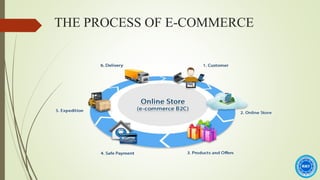
THE PROCESS OF E-COMMERCE
E-COMMERCE
 It is commonly known as electronic marketing.
 It consist of buying and selling goods and services over an electronic system
such as the internet.
 E-commerce is the purchasing , selling & exchanging goods and services over
computer network or internet through which transactions or terms of sale are
performed electronically.
ELECTRONIC DATA INTERCHANGE
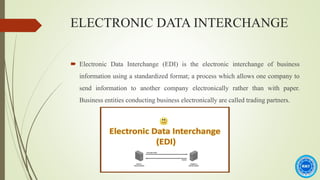
 Electronic Data Interchange (EDI) is the electronic interchange of business
information using a standardized format; a process which allows one company to
send information to another company electronically rather than with paper.
Business entities conducting business electronically are called trading partners.
CRM E-COMMERCE
 A CRM system is something that allows you to store, manage and use customer relationship
data to improve your business in specific ways.
 A customer relationship management system is a central location or piece of software that
you can use to store customer details, accounts, information, and leads that can then be
leveraged for future sales opportunities. Small and large businesses will benefit from some
ecommerce CRM systems in that they firmly place client data in the 'cloud' - which means
that it can be accessed by multiple people, anywhere, at any time, from any number of
mobile devices. For the mobile developer who has spent time, energy and money building a
responsive mobile e-commerce website, CRM is more important than ever. Using select
CRM practices and processes, sales on an ecommerce website with integrated CRM will
help you better understand your cross-channel customers, and what makes them buy from
you.
E-COMMERCE CRM
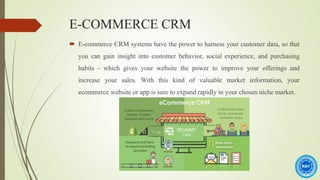
 E-commerce CRM systems have the power to harness your customer data, so that
you can gain insight into customer behavior, social experience, and purchasing
habits - which gives your website the power to improve your offerings and
increase your sales. With this kind of valuable market information, your
ecommerce website or app is sure to expand rapidly in your chosen niche market.
NATURE OF E-RELATIONSHIP
 BUSINESS-TO-BUSINESS (B2B)
 BUSINESS-TO-CONSUMER (B2C)
 CONSUMER-TO-CONSUMER (C2C)
 CONSUMER-TO-BUSINESS (C2B)
BUSINESS-TO-BUSINESS (B2B)
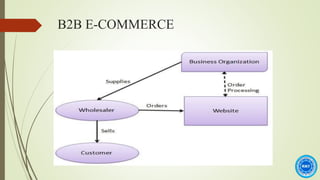
 B2B e-commerce is simply defined as ecommerce between companies. About
80% of e-commerce is of this type.
 B2B CRM stands for Business to Business Customer Relationship
Management and refers to systems, technologies, strategies, and processes that
help B2B companies manage their relationships with existing and potential
customers. B2B CRM can help B2B companies better understand their customers'
needs.
B2B E-COMMERCE
BUSINESS-TO-CONSUMER (B2C)
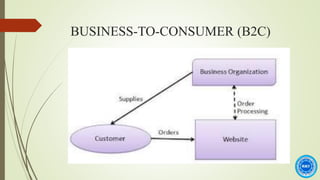
 Business-to-consumer e-commerce, or commerce between companies and
consumers, involves customers gathering information; purchasing physical
goods or receiving products over an electronic network.
 A B2C CRM is a single platform that brings customer data and campaign
execution together, enabling marketers to better understand buyers and use data
to directly power campaigns across channels. B2C CRMs are built to scale
with your business.
BUSINESS-TO-CONSUMER (B2C)
CONSUMER-TO-CONSUMER (C2C)
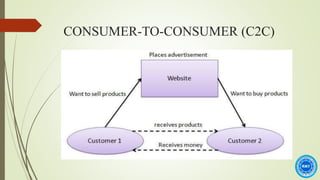
 Consumer-to-consumer e-commerce or C2C is simply commerce between private
individuals or consumers
 In the concept of e-Business within the C2C, the consumers among themselves
actively sell or exchange goods or information about it. An example of C2C
business relationship are various online exchanges, auctions and goods exchange.
The most famous example of C2C is eBay. C2C also includes various discussions
forums or pages on social networks. In these cases, the Word Of Mouth
Marketing may apply.
CONSUMER-TO-CONSUMER (C2C)
CONSUMER TO BUSINESS
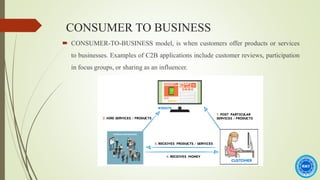
 CONSUMER-TO-BUSINESS model, is when customers offer products or services
to businesses. Examples of C2B applications include customer reviews, participation
in focus groups, or sharing as an influencer.
E-COMMERCE APPS FOR CRM
 SugarCRM
 Salesforce.
 Zoho.
 Act!
 Microsoft Dynamics.
 SAP.
 Maximizer.
 Ready Cloud.
ADVANTAGES OF E-COMMERCE
 Faster buying/selling procedure, as well as easy to find products.
 Buying/selling 24/7.
 More reach to customers, there is no theoretical geographic limitations.
 Low operational costs and better quality of services.
 No need of physical company set-ups.
 Easy to start and manage a business.
 Customers can easily select products from different providers without moving
around physically.
DISADVANTAGES OF E-COMMERCE
 Unable to examine products personally
 Not everyone is connected to the Internet
 There is the possibility of credit card number theft
 Mechanical failures can cause unpredictable effects on the total processes.
FUTURE OF E-COMMERCE IN
PAKISTAN
 According to business world estimate near about Sixty thousand new jobs will be
created for the internet world alone in the next two years.
 e-Commerce transactions are expected to cross the Rs. 1000 crore milestone in
2013-15, a jump of around 350 percent from the 2008-09.
 eBay said that consumers would be trading goods worth almost three crore rupees
everyday, across the globe.
HOW TO DEVELOP TRUST IN
ECOMMERCE?
The whole machinery of e-Commerce functions on trust. Customers trust online stores
to sell them genuine products, online stores trust customers to pay promptly and sellers
trust store owners to give them their due.
Ways to Develop Trust
 Be transparent
 Show you’re trustworthy
 Be easily reachable
 Show testimonials
 Be social
 Build security
 Be responsible
STEPS TO BUILD BETTER CUSTOMER
RELATIONSHIPS ONLINE
 Minimize customer effort, maximize the experience
 Offer different service options
 Personalize their visits
 Develop loyalty programs
 Learn from your customers
 Establish their trust
E-COMMERCE & CRM

E-COMMERCE & CRM

  • 1.
  • 2.
    BRIEF HISTORY OFE-COMMERCE  1970s: Electronic Funds Transfer (EFT).  Used by the banking industry to exchange account information over secured networks.  Late 1970s and early 1980s: Electronic Data Interchange (EDI) for e-commerce within companies.  Used by businesses to transmit data from one business to another.  1990s: the World Wide Web on the Internet provides easy-to-use technology for information publishing and dissemination.  Cheaper to do business (economies of scale).  Enable diverse business activities (economies of scope)
  • 3.
    COMMERCE  Commerce isa division of trade or production which deals with the exchange of goods and services from producer to final consumer.  It comprises the trading of something of economic value such as goods, services, information, or money between two or more entities.
  • 4.
    THE PROCESS OFE-COMMERCE
  • 5.
    E-COMMERCE  It iscommonly known as electronic marketing.  It consist of buying and selling goods and services over an electronic system such as the internet.  E-commerce is the purchasing , selling & exchanging goods and services over computer network or internet through which transactions or terms of sale are performed electronically.
  • 6.
    ELECTRONIC DATA INTERCHANGE Electronic Data Interchange (EDI) is the electronic interchange of business information using a standardized format; a process which allows one company to send information to another company electronically rather than with paper. Business entities conducting business electronically are called trading partners.
  • 7.
    CRM E-COMMERCE  ACRM system is something that allows you to store, manage and use customer relationship data to improve your business in specific ways.  A customer relationship management system is a central location or piece of software that you can use to store customer details, accounts, information, and leads that can then be leveraged for future sales opportunities. Small and large businesses will benefit from some ecommerce CRM systems in that they firmly place client data in the 'cloud' - which means that it can be accessed by multiple people, anywhere, at any time, from any number of mobile devices. For the mobile developer who has spent time, energy and money building a responsive mobile e-commerce website, CRM is more important than ever. Using select CRM practices and processes, sales on an ecommerce website with integrated CRM will help you better understand your cross-channel customers, and what makes them buy from you.
  • 8.
    E-COMMERCE CRM  E-commerceCRM systems have the power to harness your customer data, so that you can gain insight into customer behavior, social experience, and purchasing habits - which gives your website the power to improve your offerings and increase your sales. With this kind of valuable market information, your ecommerce website or app is sure to expand rapidly in your chosen niche market.
  • 9.
    NATURE OF E-RELATIONSHIP BUSINESS-TO-BUSINESS (B2B)  BUSINESS-TO-CONSUMER (B2C)  CONSUMER-TO-CONSUMER (C2C)  CONSUMER-TO-BUSINESS (C2B)
  • 10.
    BUSINESS-TO-BUSINESS (B2B)  B2Be-commerce is simply defined as ecommerce between companies. About 80% of e-commerce is of this type.  B2B CRM stands for Business to Business Customer Relationship Management and refers to systems, technologies, strategies, and processes that help B2B companies manage their relationships with existing and potential customers. B2B CRM can help B2B companies better understand their customers' needs.
  • 11.
  • 12.
    BUSINESS-TO-CONSUMER (B2C)  Business-to-consumere-commerce, or commerce between companies and consumers, involves customers gathering information; purchasing physical goods or receiving products over an electronic network.  A B2C CRM is a single platform that brings customer data and campaign execution together, enabling marketers to better understand buyers and use data to directly power campaigns across channels. B2C CRMs are built to scale with your business.
  • 13.
  • 14.
    CONSUMER-TO-CONSUMER (C2C)  Consumer-to-consumere-commerce or C2C is simply commerce between private individuals or consumers  In the concept of e-Business within the C2C, the consumers among themselves actively sell or exchange goods or information about it. An example of C2C business relationship are various online exchanges, auctions and goods exchange. The most famous example of C2C is eBay. C2C also includes various discussions forums or pages on social networks. In these cases, the Word Of Mouth Marketing may apply.
  • 15.
  • 16.
    CONSUMER TO BUSINESS CONSUMER-TO-BUSINESS model, is when customers offer products or services to businesses. Examples of C2B applications include customer reviews, participation in focus groups, or sharing as an influencer.
  • 17.
    E-COMMERCE APPS FORCRM  SugarCRM  Salesforce.  Zoho.  Act!  Microsoft Dynamics.  SAP.  Maximizer.  Ready Cloud.
  • 18.
    ADVANTAGES OF E-COMMERCE Faster buying/selling procedure, as well as easy to find products.  Buying/selling 24/7.  More reach to customers, there is no theoretical geographic limitations.  Low operational costs and better quality of services.  No need of physical company set-ups.  Easy to start and manage a business.  Customers can easily select products from different providers without moving around physically.
  • 19.
    DISADVANTAGES OF E-COMMERCE Unable to examine products personally  Not everyone is connected to the Internet  There is the possibility of credit card number theft  Mechanical failures can cause unpredictable effects on the total processes.
  • 20.
    FUTURE OF E-COMMERCEIN PAKISTAN  According to business world estimate near about Sixty thousand new jobs will be created for the internet world alone in the next two years.  e-Commerce transactions are expected to cross the Rs. 1000 crore milestone in 2013-15, a jump of around 350 percent from the 2008-09.  eBay said that consumers would be trading goods worth almost three crore rupees everyday, across the globe.
  • 21.
    HOW TO DEVELOPTRUST IN ECOMMERCE? The whole machinery of e-Commerce functions on trust. Customers trust online stores to sell them genuine products, online stores trust customers to pay promptly and sellers trust store owners to give them their due. Ways to Develop Trust  Be transparent  Show you’re trustworthy  Be easily reachable  Show testimonials  Be social  Build security  Be responsible
  • 22.
    STEPS TO BUILDBETTER CUSTOMER RELATIONSHIPS ONLINE  Minimize customer effort, maximize the experience  Offer different service options  Personalize their visits  Develop loyalty programs  Learn from your customers  Establish their trust