Framework for E-Business
MBA 9607 - Managing E-Business
July 14, 2017
Complex World of E-Business
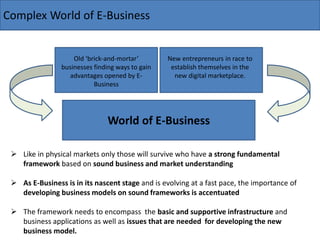
World of E-Business
Old ri k-and- ortar
businesses finding ways to gain
advantages opened by E-
Business
New entrepreneurs in race to
establish themselves in the
new digital marketplace.
 Like in physical markets only those will survive who have a strong fundamental
framework based on sound business and market understanding
 As E-Business is in its nascent stage and is evolving at a fast pace, the importance of
developing business models on sound frameworks is accentuated
 The framework needs to encompass the basic and supportive infrastructure and
business applications as well as issues that are needed for developing the new
business model.
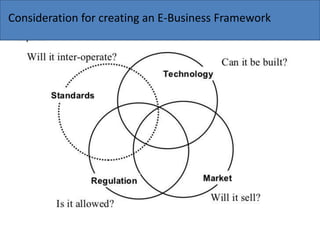
Consideration for creating an E-Business Framework
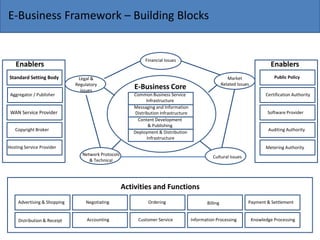
E-Business Framework – Building Blocks
Standard Setting Body
WAN Service Provider
Hosting Service Provider
Software Provider
Certification AuthorityAggregator / Publisher
Copyright Broker
Metering Authority
Auditing Authority
Public Policy
Common Business Service
Infrastructure
Messaging and Information
Distribution Infrastructure
Content Development
& Publishing
E-Business Core
Financial Issues
Market
Related Issues
Cultural Issues
Network Protocols
& Technical
Legal &
Regulatory
issues
Deployment & Distribution
Infrastructure
EnablersEnablers
Advertising & Shopping Negotiating Ordering Billing Payment & Settlement
Distribution & Receipt Accounting Customer Service Information Processing Knowledge Processing
Activities and Functions
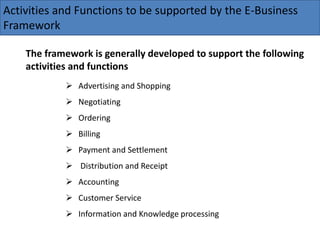
Activities and Functions to be supported by the E-Business
Framework
 Advertising and Shopping
 Negotiating
 Ordering
 Billing
 Payment and Settlement
 Distribution and Receipt
 Accounting
 Customer Service
 Information and Knowledge processing
The framework is generally developed to support the following
activities and functions
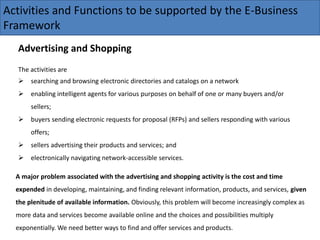
Activities and Functions to be supported by the E-Business
Framework
A major problem associated with the advertising and shopping activity is the cost and time
expended in developing, maintaining, and finding relevant information, products, and services, given
the plenitude of available information. Obviously, this problem will become increasingly complex as
more data and services become available online and the choices and possibilities multiply
exponentially. We need better ways to find and offer services and products.
Advertising and Shopping
The activities are
 searching and browsing electronic directories and catalogs on a network
 enabling intelligent agents for various purposes on behalf of one or many buyers and/or
sellers;
 buyers sending electronic requests for proposal (RFPs) and sellers responding with various
offers;
 sellers advertising their products and services; and
 electronically navigating network-accessible services.
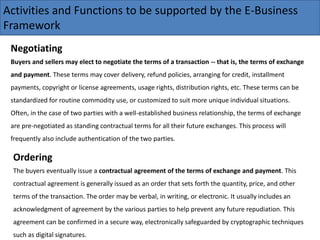
Activities and Functions to be supported by the E-Business
Framework
Negotiating
Buyers and sellers may elect to negotiate the terms of a transaction -- that is, the terms of exchange
and payment. These terms may cover delivery, refund policies, arranging for credit, installment
payments, copyright or license agreements, usage rights, distribution rights, etc. These terms can be
standardized for routine commodity use, or customized to suit more unique individual situations.
Often, in the case of two parties with a well-established business relationship, the terms of exchange
are pre-negotiated as standing contractual terms for all their future exchanges. This process will
frequently also include authentication of the two parties.
Ordering
The buyers eventually issue a contractual agreement of the terms of exchange and payment. This
contractual agreement is generally issued as an order that sets forth the quantity, price, and other
terms of the transaction. The order may be verbal, in writing, or electronic. It usually includes an
acknowledgment of agreement by the various parties to help prevent any future repudiation. This
agreement can be confirmed in a secure way, electronically safeguarded by cryptographic techniques
such as digital signatures.
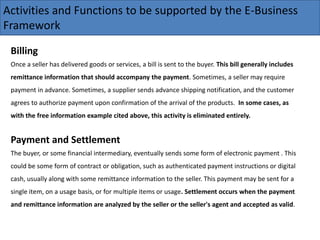
Activities and Functions to be supported by the E-Business
Framework
Billing
Once a seller has delivered goods or services, a bill is sent to the buyer. This bill generally includes
remittance information that should accompany the payment. Sometimes, a seller may require
payment in advance. Sometimes, a supplier sends advance shipping notification, and the customer
agrees to authorize payment upon confirmation of the arrival of the products. In some cases, as
with the free information example cited above, this activity is eliminated entirely.
Payment and Settlement
The buyer, or some financial intermediary, eventually sends some form of electronic payment . This
could be some form of contract or obligation, such as authenticated payment instructions or digital
cash, usually along with some remittance information to the seller. This payment may be sent for a
single item, on a usage basis, or for multiple items or usage. Settlement occurs when the payment
and remittance information are analyzed by the seller or the seller's agent and accepted as valid.
Activities and Functions to be supported by the E-Business
Framework
Distribution and Receipt
Either before, after, or concurrent with payment, the seller arranges for delivery of the purchased
goods or services to the buyer; and the buyer provides the seller with proof of receipt of delivery.
Policies regarding customer satisfaction and return should be negotiated prior to this activity and
made part of the contract between buyer and seller. For larger, more complex orders, distribution
may involve more than two parties and entail complicated distribution coordination strategies. An
ancillary distribution service involves acting as a fiduciary and holding goods, certificates, bonds,
stocks, etc., in trust.
Accounting
This activity is particularly important to corporate customers and suppliers. Both buyer and seller must
reconcile all electronic transactions in the accounts receivable and accounts payable, inventory
information, and accounting systems. Account and management information system records must
also be updated. This activity can involve third parties if the transacting businesses outsource their
accounting services.
Activities and Functions to be supported by the E-Business
Framework
Customer Service
Customer service entails :
 Providing the buyer with timely information as to the progress of the transaction;
 Handling customer requirements when transactions go awry - i.e., resolving any mistakes,
disputes, or complaints concerning product quality, delivery, or payment (this includes managing
returns and refunds, further exchanges, and/or repairs); and
 Providing expert advice and assistance in the use of the products and services.
Customer service concerns may also include providing general cash management advice, including
addressing foreign exchange imbalances and risk exposures; collecting delinquent payments and late
fees; and repossessing products for which payment is long.
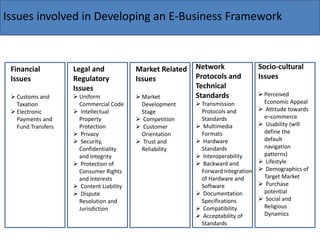
Issues involved in Developing an E-Business Framework
Financial
Issues
 Customs and
Taxation
 Electronic
Payments and
Fund Transfers
Legal and
Regulatory
Issues
 Uniform
Commercial Code
 Intellectual
Property
Protection
 Privacy
 Security,
Confidentiality
and Integrity
 Protection of
Consumer Rights
and Interests
 Content Liability
 Dispute
Resolution and
Jurisdiction
Market Related
Issues
 Market
Development
Stage
 Competition
 Customer
Orientation
 Trust and
Reliability
Network
Protocols and
Technical
Standards
 Transmission
Protocols and
Standards
 Multimedia
Formats
 Hardware
Standards
 Interoperability
 Backward and
Forward Integration
of Hardware and
Software
 Documentation
Specifications
 Compatibility
 Acceptability of
Standards
Socio-cultural
Issues
 Perceived
Economic Appeal
 Attitude towards
e–commerce
 Usability (will
define the
default
navigation
patterns)
 Lifestyle
 Demographics of
Target Market
 Purchase
potential
 Social and
Religious
Dynamics
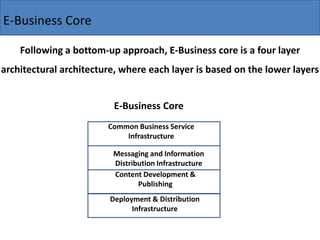
E-Business Core
Following a bottom-up approach, E-Business core is a four layer
architectural architecture, where each layer is based on the lower layers
Common Business Service
Infrastructure
Messaging and Information
Distribution Infrastructure
Content Development &
Publishing
E-Business Core
Deployment & Distribution
Infrastructure
Copyright 2006 John Wiley & Sons, Inc.
Common Business Services Infrastructure
 The common business infrastructure for E-Business
consists of six main elements:
 Security
 Authentication
 Encryption
 Electronic Payments
 Search Engines
 Web Services & Personalization
Copyright 2006 John Wiley & Sons, Inc.
Security
 Major concern for doing business on the Internet.
 Businesses feel vulnerable to attack.
 Encryption is used to help secure data.
 HTTPS (HTTP with SSL) is used to encrypt data to ensure its integrity
and safety.
 Secure Sockets Layer (SSL) is a standard for secure interactions use on the
Web. SSL, uses a combination of private key encryption (using a one-time
session key) and digital signatures to enhance the security of transmission.
 Concerns remain for e-commerce transactions since there are
numerous examples of data and privacy issues.
Copyright 2006 John Wiley & Sons, Inc.
 Authentication is the security process of verifying that a
user is who he or she says they are.
 Passwords are the most common type of authentication.
 Digital signatures are now gaining popularity for
authenticating transmitted information.
Authentication
Copyright 2006 John Wiley & Sons, Inc.
 Digital signatures take the place of ordinary signatures
in online transactions to prove that the sender of a
message is who he or she claims to be.
 When received, the digital signature is compared with a
k o opy of the se der s digital sig ature.
 Digital signatures are also sent in encrypted form to
ensure they have not been forged.
Authentication: Digital Signatures
Copyright 2006 John Wiley & Sons, Inc.
Encryption
 Encryption systems translate data into a secret code (many types of
encryption used).
 Encryption systems include 4 main components:
 Plaintext: the unencrypted message
 An encryption algorithm: that works like the locking mechanism to a safe
 A key that works like the safe s o i atio
 Ciphertext is produced from the plaintext message by the encryption
function.
 Decryption is the same process in reverse (like a modulation /
de odulatio ), ut it does t al ays use the sa e key or algorith .
Plaintext results from decryption.
Copyright 2006 John Wiley & Sons, Inc.
Encryption Techniques
 The two main encryption techniques now in use
 Symmetric encryption in which both sender and
receiver use the same key.
 Asymmetric or public key encryption, which uses
two separate keys, called public and private keys.
Copyright 2006 John Wiley & Sons, Inc.
Symmetric Encryption
 Symmetric or private key encryption, uses the same
algorithm and key to both encrypt and decrypt a message.
 Historically, this is the most common encryption technique.
 Since the key must be distributed it is vulnerable to
interception. This is a weakness of symmetric key
encryption
Copyright 2006 John Wiley & Sons, Inc.
Asymmetric or Public Key Encryption
 A second popular technique is asymmetric or public key
encryption (PKE).
 PKE is alled asy etri si e it uses t o differe t o e ay
keys:
 a public key used to encrypt messages, and
 a private key used to decrypt them.
 PKE greatly reduces the key management problem since the
private key is never distributed.
 PGP (pretty good privacy) is a popular form of PKE available as
shareware.
Copyright 2006 John Wiley & Sons, Inc.
Electronic Payments
 A number of payment methods are used by businesses to
make and receive payments on the Internet.
 These methods are basically the equivalent of off-line
payment methods.
 A few of the most popular types:
 Virtual Terminals.
 Transaction Processors.
 Internet Checking.
 Electronic Funds Transfer (EFT).
Copyright 2006 John Wiley & Sons, Inc.
Search Engines
 Search engines are used to index the contents of the
Internet so that information about a specific topic can be
located.
 Managers should pay attention to search engines for two
reasons:
 They provide useful and extensive access to information.
 And, they can provide the visibility that becoming listed with
them provides.
 Google, founded in 1991 by two Stanford Ph.D. students, is the
most popular search engine.
Copyright 2006 John Wiley & Sons, Inc.
Web Services & Personalization
 A web service is a standardized way of integrating web-based
applications.
 Organizations can share data transparently.
 Web services are the basic building blocks of the SOA (Service
Oriented Architecture).
 They are excellent for integrating systems across organizational
boundaries.
 Perso alizatio is the sele ti e deli ery of o te t a d
ser i es to usto ers a d prospe ti e usto ers .
 Can offer customized services to meet the past and future interests
of customers.
Copyright 2006 John Wiley & Sons, Inc.
Messaging and Information Distribution Infrastructure
 Second building block of supporting framework for e-
commerce.
 Includes email, instant messaging, Voice over IP (VoIP),
point-to-point file transfers (FTP), and groupware.
 E-mail is still largest use in this area.
 ISP (Internet Service Provider) connects the user to the Internet.
Copyright 2006 John Wiley & Sons, Inc.
Content Development & Publishing
 Third building block of supporting framework for e-
commerce. Includes standards for various multimedia file
types. Examples of materials transported in this way
include:
 Video
 Audio
 Text/Electronic documents
 Graphics & Photos
 Realtime/Non-realtime applications
Copyright 2006 John Wiley & Sons, Inc.
Deployment & Distribution Infrastructure
 Fourth building block of supporting framework for e-
commerce includes data communications circuits over
which information travels. Includes:
 Packet-switched networking (telephony is circuit-switched)
 Packets contain overhead information including addressing
 They are also routed, like mail
 All of this flows across Internet backbones
 Newer Internet access technologies include wireless access, cable
access and DSL.
Copyright 2006 John Wiley & Sons, Inc.
Key Enablers - Public Policy
 Public policy is one of two key enablers for developing the E-
Business framework. Public policy issues include:
 universal access,
 privacy,
 information pricing,
 information access.
 Privacy issues include what information is private and/or
who should have the right to use/sell information about
Internet users:
 Requesting personal information on visiting a web site
 Creating customer profiles
 Leaving electronic footprints when visiting a web site
Copyright 2006 John Wiley & Sons, Inc.
Key Enablers - Technical Standards
 Standardization is the second supporting pillar for e-Commerce.
Standards are critical for electronic interaction.
 Secure Electronic Transaction (SET) for secure payments of
online credit card transactions is one of the most heavily
promoted standards
 Other application standards include file transfer protocol (FTP),
hypertext transfer protocol (HTTP), simple network
management protocol (SNMP), post office protocol (POP), and
multimedia internet mail extensions (MIME)
 Interoperability
 Flexibility and Forward Integration
 Latest Technology and Applications
 Backward Integration
 Technology Convergence
 Information Intensive Products
 Revenue Collection Methods
 Legacy Systems
 Transaction Devices
Considerations for Developing Generic E-Business Framework
 Interoperability
E-Business framework must be based on a common set of services and standards that
ensure interoperability
 Flexibility and Forward integration
E-Business is in its nascent stage and is constantly improving. New services and
business application areas will constantly emerge. Any framework developed for E-
Business should be able to accommodate future enhancements and trends in the
infrastructure, industry and applications
 Latest Technological and applications
As the technological and business logic develops during the evolution of E-Business the
framework should be able to incorporate those newer technologies and business
logic.
 Backward Integration
A successful E-Business infrastructure must let the user transfer easily and
transparently between these older systems and newer all-electronic systems
Considerations for Developing Generic E-Business Framework
 Technology Convergence
An E-Business framework should have the ability to accommodate the plethora of
technologies, devices and their convergence, needed to reach and sustain the mass
market.
 Information-intensive products
An important class of products are those that are pure information. These
products are actually enabled by information technology and not just
distributed more efficiently by it. Information products include electronic
publications, catalogs, videos, and the like, as well as interactive video games,
software programs, electronic tokens, customized design specifications, and
even electronic keys to hotel rooms, cars, storage compartments, and airport
boarding gates. Many of these products are not offered by a vendor they are
designed or tailored by a customer. Customers can, for example, choose their
own selection of articles to be bound in an electronic book, or customize their
own clothing designs. This capability adds a customer-driven activity - a design
phase - to the purchase cycle
Considerations for Developing Generic E-Business Framework
 New revenue collection methods
The E-Business framework shall have to support advanced types of revenue
collection in addition to traditional methods For example, an information product
service provider could distribute its product widely and charge on a usage basis. One
innovative approach that permits usage accounting and payment is called
Meterware. Meterware, electronic cash and checks that don't need an online
payment processor, and other advanced revenue collection ideas create
opportunities for reaching new customers and for distributing products and services.
 Legacy systems
Many legacy systems exist in the E-Business domain. These include paper checks,
mainframe-based settlement and payment systems, etc. A successful E-Business
infrastructure should the user transfer easily and transparently between these older
systems and newer, all-electronic systems, applications, and processes.
 Transaction devices
E-Business transactions will involve all kinds of legacy and newly developed
devices and media, and networks. The framework should accommodate the
technologies and devices needed to reach and sustain the mass market.
E-Business Implementation : A Life Cycle Approach
Proper implementation requires deliberate attention to seven stages
of technology life cycle
 Awareness Training
Provides an understanding of what the technology is, a general sense of what it can do for a
business, and how to begin implementation.
 Business Analysis:
It is easy to jump immediately from "awareness" to the details of "requirements analysis", but
doing so is a mistake. To assure maximum value from EC, there must be a thorough
understanding of how the new technology can help the business.
 Requirements Analysis
Yields an understanding of what kind of EC functionality is needed to meet business
requirements. As an example: business need equals to keep customers informed of changing
product availability and price. Requirement equals to web based catalogue
E-Business Implementation : A Life Cycle Approach (Contd....)
 Design
Sets out specifics, e.g. Who are my potential vendors? By when do I need different parts of the
system up and running? What will the system cost?
 Implementation
The system becomes real. New technology comes in the door. Training is conducted. New
business process begins to function. And so on.
 Integration and Validation
Make sure the system performs as per its specifications.
 Maintenance
Keeps the system running, deals with unforeseen circumstances, and plans for improvement.
Steps for Successful E-Business Implementation
 Start High
Implies that the executives in the organization must embrace the E-Business initiative. E-
Business is a business initiative instead of a technical task
 Think Fresh
Signifies that the organization must disregard all of its old ideas and paradims and how
business is operated and develop radical new ways to conduct business
 Know your market
The orga izatio s ra d ide tity, usto ers, o petitio a d supply hai should e a alyzed i
the k o your arket phase
 Set Vision
The organization must set a vision on what it wants to do
Steps for Successful E-Business Implementation (Contd ....)
 Define Strategy
The Vision outlines what the organization should do, an organization must also define a
Strategy, which should dictate how the organization will reach its Vision
 Create
The organization must uild the apa ility to reate the E-Business solution
 Regularly Refresh
The organization must revise its E-Business strategy regularly as speed and innovation are the
keys to the E-Business world
Critical Success factors for E-Business
Identifying the Critical success Factors allows an organization to achieve its E-
Business initiative
 Critical Success Factor 1
Identify a suitable E-Business Vision for the organization. The Vision is important as it
provides everyone in the organization with direction on where to go
 Critical Success factor 2
Must have an E-Business champion who will help make this Vision a reality. This person must
be a strong leader who owns the E-Business process at the organization
 Critical Success Factor 3
Creation of healthy company culture to energize all employees to take active part in the
initiative
 Critical Success Factor 4
Development of a plan to achieve the transformation. The plan must be documented and
include milestones and metrics that describe the transformation journey
 Critical Success Factor 5
A rigorous communication strategy must be implement . This will allow the organization to
receive feedback from the constituents
 Critical Success Factor 6
Ability to create flexible E-Business solution. This will allow the organization to grow in future
as well as have personalized approach to the various customers and suppliers
Critical Success factors for E-Business (Contd ....)
Class Discussion
What do you feel is the biggest challenge for an E-Business organization
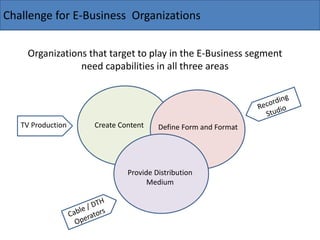
Challenge for E-Business Organizations
Create Content Define Form and Format
Provide Distribution
Medium
TV Production
Organizations that target to play in the E-Business segment
need capabilities in all three areas

Framework for e business-v2

  • 1.
    Framework for E-Business MBA9607 - Managing E-Business July 14, 2017
  • 2.
    Complex World ofE-Business World of E-Business Old ri k-and- ortar businesses finding ways to gain advantages opened by E- Business New entrepreneurs in race to establish themselves in the new digital marketplace.  Like in physical markets only those will survive who have a strong fundamental framework based on sound business and market understanding  As E-Business is in its nascent stage and is evolving at a fast pace, the importance of developing business models on sound frameworks is accentuated  The framework needs to encompass the basic and supportive infrastructure and business applications as well as issues that are needed for developing the new business model.
  • 3.
    Consideration for creatingan E-Business Framework
  • 4.
    E-Business Framework –Building Blocks Standard Setting Body WAN Service Provider Hosting Service Provider Software Provider Certification AuthorityAggregator / Publisher Copyright Broker Metering Authority Auditing Authority Public Policy Common Business Service Infrastructure Messaging and Information Distribution Infrastructure Content Development & Publishing E-Business Core Financial Issues Market Related Issues Cultural Issues Network Protocols & Technical Legal & Regulatory issues Deployment & Distribution Infrastructure EnablersEnablers Advertising & Shopping Negotiating Ordering Billing Payment & Settlement Distribution & Receipt Accounting Customer Service Information Processing Knowledge Processing Activities and Functions
  • 5.
    Activities and Functionsto be supported by the E-Business Framework  Advertising and Shopping  Negotiating  Ordering  Billing  Payment and Settlement  Distribution and Receipt  Accounting  Customer Service  Information and Knowledge processing The framework is generally developed to support the following activities and functions
  • 6.
    Activities and Functionsto be supported by the E-Business Framework A major problem associated with the advertising and shopping activity is the cost and time expended in developing, maintaining, and finding relevant information, products, and services, given the plenitude of available information. Obviously, this problem will become increasingly complex as more data and services become available online and the choices and possibilities multiply exponentially. We need better ways to find and offer services and products. Advertising and Shopping The activities are  searching and browsing electronic directories and catalogs on a network  enabling intelligent agents for various purposes on behalf of one or many buyers and/or sellers;  buyers sending electronic requests for proposal (RFPs) and sellers responding with various offers;  sellers advertising their products and services; and  electronically navigating network-accessible services.
  • 7.
    Activities and Functionsto be supported by the E-Business Framework Negotiating Buyers and sellers may elect to negotiate the terms of a transaction -- that is, the terms of exchange and payment. These terms may cover delivery, refund policies, arranging for credit, installment payments, copyright or license agreements, usage rights, distribution rights, etc. These terms can be standardized for routine commodity use, or customized to suit more unique individual situations. Often, in the case of two parties with a well-established business relationship, the terms of exchange are pre-negotiated as standing contractual terms for all their future exchanges. This process will frequently also include authentication of the two parties. Ordering The buyers eventually issue a contractual agreement of the terms of exchange and payment. This contractual agreement is generally issued as an order that sets forth the quantity, price, and other terms of the transaction. The order may be verbal, in writing, or electronic. It usually includes an acknowledgment of agreement by the various parties to help prevent any future repudiation. This agreement can be confirmed in a secure way, electronically safeguarded by cryptographic techniques such as digital signatures.
  • 8.
    Activities and Functionsto be supported by the E-Business Framework Billing Once a seller has delivered goods or services, a bill is sent to the buyer. This bill generally includes remittance information that should accompany the payment. Sometimes, a seller may require payment in advance. Sometimes, a supplier sends advance shipping notification, and the customer agrees to authorize payment upon confirmation of the arrival of the products. In some cases, as with the free information example cited above, this activity is eliminated entirely. Payment and Settlement The buyer, or some financial intermediary, eventually sends some form of electronic payment . This could be some form of contract or obligation, such as authenticated payment instructions or digital cash, usually along with some remittance information to the seller. This payment may be sent for a single item, on a usage basis, or for multiple items or usage. Settlement occurs when the payment and remittance information are analyzed by the seller or the seller's agent and accepted as valid.
  • 9.
    Activities and Functionsto be supported by the E-Business Framework Distribution and Receipt Either before, after, or concurrent with payment, the seller arranges for delivery of the purchased goods or services to the buyer; and the buyer provides the seller with proof of receipt of delivery. Policies regarding customer satisfaction and return should be negotiated prior to this activity and made part of the contract between buyer and seller. For larger, more complex orders, distribution may involve more than two parties and entail complicated distribution coordination strategies. An ancillary distribution service involves acting as a fiduciary and holding goods, certificates, bonds, stocks, etc., in trust. Accounting This activity is particularly important to corporate customers and suppliers. Both buyer and seller must reconcile all electronic transactions in the accounts receivable and accounts payable, inventory information, and accounting systems. Account and management information system records must also be updated. This activity can involve third parties if the transacting businesses outsource their accounting services.
  • 10.
    Activities and Functionsto be supported by the E-Business Framework Customer Service Customer service entails :  Providing the buyer with timely information as to the progress of the transaction;  Handling customer requirements when transactions go awry - i.e., resolving any mistakes, disputes, or complaints concerning product quality, delivery, or payment (this includes managing returns and refunds, further exchanges, and/or repairs); and  Providing expert advice and assistance in the use of the products and services. Customer service concerns may also include providing general cash management advice, including addressing foreign exchange imbalances and risk exposures; collecting delinquent payments and late fees; and repossessing products for which payment is long.
  • 11.
    Issues involved inDeveloping an E-Business Framework Financial Issues  Customs and Taxation  Electronic Payments and Fund Transfers Legal and Regulatory Issues  Uniform Commercial Code  Intellectual Property Protection  Privacy  Security, Confidentiality and Integrity  Protection of Consumer Rights and Interests  Content Liability  Dispute Resolution and Jurisdiction Market Related Issues  Market Development Stage  Competition  Customer Orientation  Trust and Reliability Network Protocols and Technical Standards  Transmission Protocols and Standards  Multimedia Formats  Hardware Standards  Interoperability  Backward and Forward Integration of Hardware and Software  Documentation Specifications  Compatibility  Acceptability of Standards Socio-cultural Issues  Perceived Economic Appeal  Attitude towards e–commerce  Usability (will define the default navigation patterns)  Lifestyle  Demographics of Target Market  Purchase potential  Social and Religious Dynamics
  • 12.
    E-Business Core Following abottom-up approach, E-Business core is a four layer architectural architecture, where each layer is based on the lower layers Common Business Service Infrastructure Messaging and Information Distribution Infrastructure Content Development & Publishing E-Business Core Deployment & Distribution Infrastructure
  • 13.
    Copyright 2006 JohnWiley & Sons, Inc. Common Business Services Infrastructure  The common business infrastructure for E-Business consists of six main elements:  Security  Authentication  Encryption  Electronic Payments  Search Engines  Web Services & Personalization
  • 14.
    Copyright 2006 JohnWiley & Sons, Inc. Security  Major concern for doing business on the Internet.  Businesses feel vulnerable to attack.  Encryption is used to help secure data.  HTTPS (HTTP with SSL) is used to encrypt data to ensure its integrity and safety.  Secure Sockets Layer (SSL) is a standard for secure interactions use on the Web. SSL, uses a combination of private key encryption (using a one-time session key) and digital signatures to enhance the security of transmission.  Concerns remain for e-commerce transactions since there are numerous examples of data and privacy issues.
  • 15.
    Copyright 2006 JohnWiley & Sons, Inc.  Authentication is the security process of verifying that a user is who he or she says they are.  Passwords are the most common type of authentication.  Digital signatures are now gaining popularity for authenticating transmitted information. Authentication
  • 16.
    Copyright 2006 JohnWiley & Sons, Inc.  Digital signatures take the place of ordinary signatures in online transactions to prove that the sender of a message is who he or she claims to be.  When received, the digital signature is compared with a k o opy of the se der s digital sig ature.  Digital signatures are also sent in encrypted form to ensure they have not been forged. Authentication: Digital Signatures
  • 17.
    Copyright 2006 JohnWiley & Sons, Inc. Encryption  Encryption systems translate data into a secret code (many types of encryption used).  Encryption systems include 4 main components:  Plaintext: the unencrypted message  An encryption algorithm: that works like the locking mechanism to a safe  A key that works like the safe s o i atio  Ciphertext is produced from the plaintext message by the encryption function.  Decryption is the same process in reverse (like a modulation / de odulatio ), ut it does t al ays use the sa e key or algorith . Plaintext results from decryption.
  • 18.
    Copyright 2006 JohnWiley & Sons, Inc. Encryption Techniques  The two main encryption techniques now in use  Symmetric encryption in which both sender and receiver use the same key.  Asymmetric or public key encryption, which uses two separate keys, called public and private keys.
  • 19.
    Copyright 2006 JohnWiley & Sons, Inc. Symmetric Encryption  Symmetric or private key encryption, uses the same algorithm and key to both encrypt and decrypt a message.  Historically, this is the most common encryption technique.  Since the key must be distributed it is vulnerable to interception. This is a weakness of symmetric key encryption
  • 20.
    Copyright 2006 JohnWiley & Sons, Inc. Asymmetric or Public Key Encryption  A second popular technique is asymmetric or public key encryption (PKE).  PKE is alled asy etri si e it uses t o differe t o e ay keys:  a public key used to encrypt messages, and  a private key used to decrypt them.  PKE greatly reduces the key management problem since the private key is never distributed.  PGP (pretty good privacy) is a popular form of PKE available as shareware.
  • 21.
    Copyright 2006 JohnWiley & Sons, Inc. Electronic Payments  A number of payment methods are used by businesses to make and receive payments on the Internet.  These methods are basically the equivalent of off-line payment methods.  A few of the most popular types:  Virtual Terminals.  Transaction Processors.  Internet Checking.  Electronic Funds Transfer (EFT).
  • 22.
    Copyright 2006 JohnWiley & Sons, Inc. Search Engines  Search engines are used to index the contents of the Internet so that information about a specific topic can be located.  Managers should pay attention to search engines for two reasons:  They provide useful and extensive access to information.  And, they can provide the visibility that becoming listed with them provides.  Google, founded in 1991 by two Stanford Ph.D. students, is the most popular search engine.
  • 23.
    Copyright 2006 JohnWiley & Sons, Inc. Web Services & Personalization  A web service is a standardized way of integrating web-based applications.  Organizations can share data transparently.  Web services are the basic building blocks of the SOA (Service Oriented Architecture).  They are excellent for integrating systems across organizational boundaries.  Perso alizatio is the sele ti e deli ery of o te t a d ser i es to usto ers a d prospe ti e usto ers .  Can offer customized services to meet the past and future interests of customers.
  • 24.
    Copyright 2006 JohnWiley & Sons, Inc. Messaging and Information Distribution Infrastructure  Second building block of supporting framework for e- commerce.  Includes email, instant messaging, Voice over IP (VoIP), point-to-point file transfers (FTP), and groupware.  E-mail is still largest use in this area.  ISP (Internet Service Provider) connects the user to the Internet.
  • 25.
    Copyright 2006 JohnWiley & Sons, Inc. Content Development & Publishing  Third building block of supporting framework for e- commerce. Includes standards for various multimedia file types. Examples of materials transported in this way include:  Video  Audio  Text/Electronic documents  Graphics & Photos  Realtime/Non-realtime applications
  • 26.
    Copyright 2006 JohnWiley & Sons, Inc. Deployment & Distribution Infrastructure  Fourth building block of supporting framework for e- commerce includes data communications circuits over which information travels. Includes:  Packet-switched networking (telephony is circuit-switched)  Packets contain overhead information including addressing  They are also routed, like mail  All of this flows across Internet backbones  Newer Internet access technologies include wireless access, cable access and DSL.
  • 27.
    Copyright 2006 JohnWiley & Sons, Inc. Key Enablers - Public Policy  Public policy is one of two key enablers for developing the E- Business framework. Public policy issues include:  universal access,  privacy,  information pricing,  information access.  Privacy issues include what information is private and/or who should have the right to use/sell information about Internet users:  Requesting personal information on visiting a web site  Creating customer profiles  Leaving electronic footprints when visiting a web site
  • 28.
    Copyright 2006 JohnWiley & Sons, Inc. Key Enablers - Technical Standards  Standardization is the second supporting pillar for e-Commerce. Standards are critical for electronic interaction.  Secure Electronic Transaction (SET) for secure payments of online credit card transactions is one of the most heavily promoted standards  Other application standards include file transfer protocol (FTP), hypertext transfer protocol (HTTP), simple network management protocol (SNMP), post office protocol (POP), and multimedia internet mail extensions (MIME)
  • 29.
     Interoperability  Flexibilityand Forward Integration  Latest Technology and Applications  Backward Integration  Technology Convergence  Information Intensive Products  Revenue Collection Methods  Legacy Systems  Transaction Devices Considerations for Developing Generic E-Business Framework
  • 30.
    Considerations for DevelopingGeneric E-Business Framework  Interoperability E-Business framework must be based on a common set of services and standards that ensure interoperability  Flexibility and Forward integration E-Business is in its nascent stage and is constantly improving. New services and business application areas will constantly emerge. Any framework developed for E- Business should be able to accommodate future enhancements and trends in the infrastructure, industry and applications  Latest Technological and applications As the technological and business logic develops during the evolution of E-Business the framework should be able to incorporate those newer technologies and business logic.  Backward Integration A successful E-Business infrastructure must let the user transfer easily and transparently between these older systems and newer all-electronic systems
  • 31.
    Considerations for DevelopingGeneric E-Business Framework  Technology Convergence An E-Business framework should have the ability to accommodate the plethora of technologies, devices and their convergence, needed to reach and sustain the mass market.  Information-intensive products An important class of products are those that are pure information. These products are actually enabled by information technology and not just distributed more efficiently by it. Information products include electronic publications, catalogs, videos, and the like, as well as interactive video games, software programs, electronic tokens, customized design specifications, and even electronic keys to hotel rooms, cars, storage compartments, and airport boarding gates. Many of these products are not offered by a vendor they are designed or tailored by a customer. Customers can, for example, choose their own selection of articles to be bound in an electronic book, or customize their own clothing designs. This capability adds a customer-driven activity - a design phase - to the purchase cycle
  • 32.
    Considerations for DevelopingGeneric E-Business Framework  New revenue collection methods The E-Business framework shall have to support advanced types of revenue collection in addition to traditional methods For example, an information product service provider could distribute its product widely and charge on a usage basis. One innovative approach that permits usage accounting and payment is called Meterware. Meterware, electronic cash and checks that don't need an online payment processor, and other advanced revenue collection ideas create opportunities for reaching new customers and for distributing products and services.  Legacy systems Many legacy systems exist in the E-Business domain. These include paper checks, mainframe-based settlement and payment systems, etc. A successful E-Business infrastructure should the user transfer easily and transparently between these older systems and newer, all-electronic systems, applications, and processes.  Transaction devices E-Business transactions will involve all kinds of legacy and newly developed devices and media, and networks. The framework should accommodate the technologies and devices needed to reach and sustain the mass market.
  • 33.
    E-Business Implementation :A Life Cycle Approach Proper implementation requires deliberate attention to seven stages of technology life cycle  Awareness Training Provides an understanding of what the technology is, a general sense of what it can do for a business, and how to begin implementation.  Business Analysis: It is easy to jump immediately from "awareness" to the details of "requirements analysis", but doing so is a mistake. To assure maximum value from EC, there must be a thorough understanding of how the new technology can help the business.  Requirements Analysis Yields an understanding of what kind of EC functionality is needed to meet business requirements. As an example: business need equals to keep customers informed of changing product availability and price. Requirement equals to web based catalogue
  • 34.
    E-Business Implementation :A Life Cycle Approach (Contd....)  Design Sets out specifics, e.g. Who are my potential vendors? By when do I need different parts of the system up and running? What will the system cost?  Implementation The system becomes real. New technology comes in the door. Training is conducted. New business process begins to function. And so on.  Integration and Validation Make sure the system performs as per its specifications.  Maintenance Keeps the system running, deals with unforeseen circumstances, and plans for improvement.
  • 35.
    Steps for SuccessfulE-Business Implementation  Start High Implies that the executives in the organization must embrace the E-Business initiative. E- Business is a business initiative instead of a technical task  Think Fresh Signifies that the organization must disregard all of its old ideas and paradims and how business is operated and develop radical new ways to conduct business  Know your market The orga izatio s ra d ide tity, usto ers, o petitio a d supply hai should e a alyzed i the k o your arket phase  Set Vision The organization must set a vision on what it wants to do
  • 36.
    Steps for SuccessfulE-Business Implementation (Contd ....)  Define Strategy The Vision outlines what the organization should do, an organization must also define a Strategy, which should dictate how the organization will reach its Vision  Create The organization must uild the apa ility to reate the E-Business solution  Regularly Refresh The organization must revise its E-Business strategy regularly as speed and innovation are the keys to the E-Business world
  • 37.
    Critical Success factorsfor E-Business Identifying the Critical success Factors allows an organization to achieve its E- Business initiative  Critical Success Factor 1 Identify a suitable E-Business Vision for the organization. The Vision is important as it provides everyone in the organization with direction on where to go  Critical Success factor 2 Must have an E-Business champion who will help make this Vision a reality. This person must be a strong leader who owns the E-Business process at the organization  Critical Success Factor 3 Creation of healthy company culture to energize all employees to take active part in the initiative
  • 38.
     Critical SuccessFactor 4 Development of a plan to achieve the transformation. The plan must be documented and include milestones and metrics that describe the transformation journey  Critical Success Factor 5 A rigorous communication strategy must be implement . This will allow the organization to receive feedback from the constituents  Critical Success Factor 6 Ability to create flexible E-Business solution. This will allow the organization to grow in future as well as have personalized approach to the various customers and suppliers Critical Success factors for E-Business (Contd ....)
  • 39.
    Class Discussion What doyou feel is the biggest challenge for an E-Business organization
  • 40.
    Challenge for E-BusinessOrganizations Create Content Define Form and Format Provide Distribution Medium TV Production Organizations that target to play in the E-Business segment need capabilities in all three areas