CRM
S. G. Lakhdive
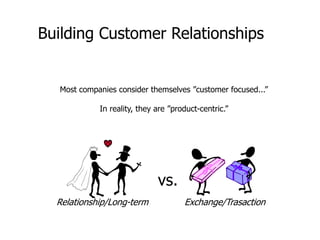
Building Customer Relationships
Most companies consider themselves ”customer focused...”
In reality, they are ”product-centric.”
vs.
Exchange/TrasactionRelationship/Long-term
Customer Relationship Management (CRM)
You need to BUILD (and integrate) a customer-
relationships infrastructure...
Few companies make ”customer focus” a reality
•Business models did not require it.
•Technology was not available
Defining CRM
Goals of integrating sales & service:
•Use existing relationships to grow revenue
•Use integrated information for excellent service
•Introduce more repeatable sales processes and
procedures
•Create new value...instill loyalty
•Be PROactive, not REactive...
Becoming ”customer” focused...
 Don’t focus on ”improving” customer service...
 LIKE IN REAL RELATIONSHIPS:
-Be consistent
-Be dependable/reliable
-Focus on EVERY encounter
 True for MNEs (multi national enterprise) & SMEs (small
and medium enterprise) ...
If you can’t make me ”love” you,
at least make me ”like” you!
Definition
• Marketing was initially focused only on
developing, selling and delivering products.
• Since 1996 it was argued that marketing
should be about developing and maintaining a
longer term customer relationship.
• CRM (Customer Relationship Management)
refers to all marketing activities aimed at
establishing, developing and maintaining
successful customer relationships.
E-CRM
• E-CRM is the process of maximizing sales to
the existing customer, encouraging
continuous relationships through the use of
digital communications technologies such as
operational databases, personalized web
messages, Customer Service, Email and Social
Media Marketing.
Benefits of e CRM
• Reducing costs in customer targeting
(customizing emails on large scale therefore
reducing costs for direct mail)
• Increasing the meaning of information
• Better and relevant understanding of
customers and relationship dynamics
• Encouraging customer relationship/customer
development and retention through loyalty
programmes
What is e CRM about?
• CRM involves four key marketing activities
(the 'customer lifecycle').
• Customer Selection
• Customer Acquisition
• Customer Retention
• Customer Extension
Customer Selection
1. Who do you target?
2. What value do they bring to your objectives?
3. What is their lifecycle?
4. Where do we find these customers?
Customer Acquisition
1. Focus on the right segments and target them
2. Minimize acquisition costs (Try to minimize
acquisition costs. Methods include traditional off-line
techniques (e.g. advertising, direct mail) and online
techniques (e.g. search engine marketing, online PR,
online partnerships, interactive adverts, opt-in e-mail
and viral marketing)
3. Make customer relationship and service quality a
priority (Service quality is key )
4. Approach the appropriate platforms (Choice of
distribution channel also very important)
Search engine marketing
• Search engine optimisation (SEO) - improving
the position of a company in search engine
listings for key terms or phrases.
• For example, increasing the number of
inbound links to a page through 'link building'
can improve the ranking with Google.
Customer Retention
Goal :
• To keep customers
• To keep customers using the online channel.
1. Know customers’ needs individually in order to
develop a good e CRM strategy
2. Offer value continuously in order to retain online
interest and improve customer relationship
3. Focus on delivering service quality to the utmost
standard
4. Choose the right channels for your strategy
Techniques for retaining customers
• Personalization - delivering individualized content
through web-pages or e-mail. For example, portals
such as Yahoo! enable users to configure their home
pages to give them the information they are most
interested in.
• Mass customization - delivering customized content
to groups of users through web-pages or e-mail. For
example, Amazon may recommend a particular book
based on what other customers in a particular
segment have been buying.
• Extranets - for example, Dell Computers uses an
extranet to provide additional services to its 'Dell
Premier' customers.
• Opt-in e-mail - asking customers whether they wish to
receive further offers.
• Online communities - firms can set up communities
where customers create the content. These could be
focused on purpose (e.g. Auto trader is for people
buying/selling cars), positions (e.g. the teenage chat
site Doobedo), interest (e.g. Football365) or profession.
Despite the potential for criticism of a company's
products on a community, firms will understand where
service quality can be improved, gain a better
understanding of customer needs and be in a position
to answer criticism.
Customer Extension
1. Recognize the customer’s relationship
interest and respond
2. “Cross Sell” (closely related products )and
“Up Sell” (more expensive products)
• For example, having bought a book from
Amazon you could be contacted with offers of
other books, DVDs or DVD players.
3. Service Quality
Key to these are the 'sense, respond,
adjust' model.
• Sense - monitor customer activities to classify
them according to value, growth,
responsiveness and defection risk.
• Respond with timely, relevant
communications to encourage desired
behaviors.
• Adjust - monitor responses and continue with
additional communications.
CRM systems.
Should focus on are sales, customer service and
marketing automation.
• Sales, also called sales force automation
(SFA)
• Customer service and support
• Marketing automation
Sales Force Automation
• sales force automation is a technique of using
software to automate the business tasks of sales,
including order processing, contact management,
information sharing, inventory monitoring and control,
order tracking, customer management, salesforecast
analysis and employee performance evaluation.
• Field sales.
• Call center telephone sales.
• Third-party brokers, distributors or agents.
• Retail.
• E-commerce, which is sometimes referred to as
technology-enabled selling.
Customer service and support
• Field service and dispatch technicians.
• Internet-based service or self-service via a
Web site.
• Call centers that handle all channels of
customer contact, not just voice.
Marketing automation
• Content-management applications that allow a
company's employees to view and access
business rules for marketing to customers.
• A campaign management system, which is a
database management tool used by marketers to
design campaigns and track their impact on
various customer segments over time.
• Data analysis or business intelligence tools for ad
hoc querying, reporting and analyzing customer
information, plus a data warehouse or data mart
to support strategic decisions.
CRM data
• Personal and profile data
– Contact details
– Preferences
• Transaction data
– Sales history
• Communications data
– Campaign history
– Research / Feedback / Support queries
– Contact reports (B2B)
Customer Types
• Platinum Heavy, reliable users, not price-sensitive, try
new products, loyal
• Gold Large users who push for price breaks, shop around
and not so loyal
• Iron Low volume or intermittent users; cost to serve
them is quite high
• Lead Demanding, want special attention but don’t buy
much and show no loyalty
Advantages of CRM
• While company is quickly growing, customers are more
satisfied as well
• Service provided in a better way, and a quicker way
• Sales force automated
• Integrated customer information
• Certain processes eliminated
• Operation cost cut, and time efficient
• Brand names more quickly established
• A central database so that everyone in your company can
keep track of customer contacts
• Sales and marketing teams can benefit from having all this
inside knowledge about customers
• Lets you set up rules for distributing work throughout your
company
• Lets you pick and choose the functionality that you want
Disadvantages:
• -Organizational wise change of priority to customers.
- Significant investment of time and money
- Threatens management’s control/power struggle
- Heightens people’s resistance to change
- Inappropriate integration leads to disaster

Customer rm

  • 1.
  • 2.
    Building Customer Relationships Mostcompanies consider themselves ”customer focused...” In reality, they are ”product-centric.” vs. Exchange/TrasactionRelationship/Long-term
  • 3.
    Customer Relationship Management(CRM) You need to BUILD (and integrate) a customer- relationships infrastructure... Few companies make ”customer focus” a reality •Business models did not require it. •Technology was not available
  • 4.
    Defining CRM Goals ofintegrating sales & service: •Use existing relationships to grow revenue •Use integrated information for excellent service •Introduce more repeatable sales processes and procedures •Create new value...instill loyalty •Be PROactive, not REactive...
  • 5.
    Becoming ”customer” focused... Don’t focus on ”improving” customer service...  LIKE IN REAL RELATIONSHIPS: -Be consistent -Be dependable/reliable -Focus on EVERY encounter  True for MNEs (multi national enterprise) & SMEs (small and medium enterprise) ... If you can’t make me ”love” you, at least make me ”like” you!
  • 6.
    Definition • Marketing wasinitially focused only on developing, selling and delivering products. • Since 1996 it was argued that marketing should be about developing and maintaining a longer term customer relationship. • CRM (Customer Relationship Management) refers to all marketing activities aimed at establishing, developing and maintaining successful customer relationships.
  • 7.
    E-CRM • E-CRM isthe process of maximizing sales to the existing customer, encouraging continuous relationships through the use of digital communications technologies such as operational databases, personalized web messages, Customer Service, Email and Social Media Marketing.
  • 8.
    Benefits of eCRM • Reducing costs in customer targeting (customizing emails on large scale therefore reducing costs for direct mail) • Increasing the meaning of information • Better and relevant understanding of customers and relationship dynamics • Encouraging customer relationship/customer development and retention through loyalty programmes
  • 9.
    What is eCRM about? • CRM involves four key marketing activities (the 'customer lifecycle'). • Customer Selection • Customer Acquisition • Customer Retention • Customer Extension
  • 10.
    Customer Selection 1. Whodo you target? 2. What value do they bring to your objectives? 3. What is their lifecycle? 4. Where do we find these customers?
  • 11.
    Customer Acquisition 1. Focuson the right segments and target them 2. Minimize acquisition costs (Try to minimize acquisition costs. Methods include traditional off-line techniques (e.g. advertising, direct mail) and online techniques (e.g. search engine marketing, online PR, online partnerships, interactive adverts, opt-in e-mail and viral marketing) 3. Make customer relationship and service quality a priority (Service quality is key ) 4. Approach the appropriate platforms (Choice of distribution channel also very important)
  • 12.
    Search engine marketing •Search engine optimisation (SEO) - improving the position of a company in search engine listings for key terms or phrases. • For example, increasing the number of inbound links to a page through 'link building' can improve the ranking with Google.
  • 13.
    Customer Retention Goal : •To keep customers • To keep customers using the online channel. 1. Know customers’ needs individually in order to develop a good e CRM strategy 2. Offer value continuously in order to retain online interest and improve customer relationship 3. Focus on delivering service quality to the utmost standard 4. Choose the right channels for your strategy
  • 14.
    Techniques for retainingcustomers • Personalization - delivering individualized content through web-pages or e-mail. For example, portals such as Yahoo! enable users to configure their home pages to give them the information they are most interested in. • Mass customization - delivering customized content to groups of users through web-pages or e-mail. For example, Amazon may recommend a particular book based on what other customers in a particular segment have been buying. • Extranets - for example, Dell Computers uses an extranet to provide additional services to its 'Dell Premier' customers.
  • 15.
    • Opt-in e-mail- asking customers whether they wish to receive further offers. • Online communities - firms can set up communities where customers create the content. These could be focused on purpose (e.g. Auto trader is for people buying/selling cars), positions (e.g. the teenage chat site Doobedo), interest (e.g. Football365) or profession. Despite the potential for criticism of a company's products on a community, firms will understand where service quality can be improved, gain a better understanding of customer needs and be in a position to answer criticism.
  • 16.
    Customer Extension 1. Recognizethe customer’s relationship interest and respond 2. “Cross Sell” (closely related products )and “Up Sell” (more expensive products) • For example, having bought a book from Amazon you could be contacted with offers of other books, DVDs or DVD players. 3. Service Quality
  • 17.
    Key to theseare the 'sense, respond, adjust' model. • Sense - monitor customer activities to classify them according to value, growth, responsiveness and defection risk. • Respond with timely, relevant communications to encourage desired behaviors. • Adjust - monitor responses and continue with additional communications.
  • 18.
    CRM systems. Should focuson are sales, customer service and marketing automation. • Sales, also called sales force automation (SFA) • Customer service and support • Marketing automation
  • 19.
    Sales Force Automation •sales force automation is a technique of using software to automate the business tasks of sales, including order processing, contact management, information sharing, inventory monitoring and control, order tracking, customer management, salesforecast analysis and employee performance evaluation. • Field sales. • Call center telephone sales. • Third-party brokers, distributors or agents. • Retail. • E-commerce, which is sometimes referred to as technology-enabled selling.
  • 20.
    Customer service andsupport • Field service and dispatch technicians. • Internet-based service or self-service via a Web site. • Call centers that handle all channels of customer contact, not just voice.
  • 21.
    Marketing automation • Content-managementapplications that allow a company's employees to view and access business rules for marketing to customers. • A campaign management system, which is a database management tool used by marketers to design campaigns and track their impact on various customer segments over time. • Data analysis or business intelligence tools for ad hoc querying, reporting and analyzing customer information, plus a data warehouse or data mart to support strategic decisions.
  • 22.
    CRM data • Personaland profile data – Contact details – Preferences • Transaction data – Sales history • Communications data – Campaign history – Research / Feedback / Support queries – Contact reports (B2B)
  • 23.
    Customer Types • PlatinumHeavy, reliable users, not price-sensitive, try new products, loyal • Gold Large users who push for price breaks, shop around and not so loyal • Iron Low volume or intermittent users; cost to serve them is quite high • Lead Demanding, want special attention but don’t buy much and show no loyalty
  • 24.
    Advantages of CRM •While company is quickly growing, customers are more satisfied as well • Service provided in a better way, and a quicker way • Sales force automated • Integrated customer information • Certain processes eliminated • Operation cost cut, and time efficient • Brand names more quickly established • A central database so that everyone in your company can keep track of customer contacts • Sales and marketing teams can benefit from having all this inside knowledge about customers • Lets you set up rules for distributing work throughout your company • Lets you pick and choose the functionality that you want
  • 25.
    Disadvantages: • -Organizational wisechange of priority to customers. - Significant investment of time and money - Threatens management’s control/power struggle - Heightens people’s resistance to change - Inappropriate integration leads to disaster