UNIT 2 :
E Commerce and internet marketing
• Introduction to E Marketing
• Online Marketing Mix
• Online Consumer and CRM in Virtual world
• Online Branding , Traffic Building and E Commerce
• Managing Content in Digital age
• Content Planning and writing
• Consumer Buying Behavior in Digital age
• Factors Affecting the Consumer Buying Behavior
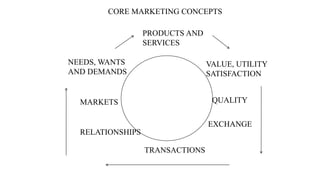
MARKETS
NEEDS, WANTS
AND DEMANDS
PRODUCTS AND
SERVICES
VALUE, UTILITY
SATISFACTION
QUALITY
EXCHANGE
RELATIONSHIPS
TRANSACTIONS
CORE MARKETING CONCEPTS
FUNDAMENTAL TERMINOLOGIES
NEEDS : FELT DEPREIVATION
WANTS : FORM TAKEN BY HUMAN NEEDS AS THEY ARE SHAPED BY
CULTURE AND PERSONALITY.
DEMAND : WANTS BACKED BY PURCHASING POWER.
PRODUCT : ANY OFFERING TO SATISFY NEEDS AND WANTS MAINLY
PHYSICAL OBJECTS, SERVICES, INFORMATION, PROPERTIES
EXPERIENCES, EVENTS, PLACES, ORGANISATIONS, IDEAS,
PERSONS.
UTILITY
FEATURES : PHYSICAL ATTRIBUTES OF THE PRODUCT
ADVANTAGES : OPERATIONAL FEATURES OF THE PRODUCT
BENEFITS : IMPLICIT, SUBJECTIVE OUTCOME AFTER USE OF THE
PRODUCT WHICH LEADS SATISFACTION.
VALUE : IT IS (FUNCTIONAL BENEFIT+ EMOTIONAL BENEFIT)/
(MONEY + TIME+ ENERGY + PSYCHIC COSTS)
SATISFACTION : PERFORMANCE VS EXPECTATION FUNCTION
EXCHANGE : OBTAINING OF SOMETHING BY OFFERING SOMETHING ELSE
IN RETURN.
TRANSACTION : MARKETING’S UNIT OF MEASUREMENT OF THE EXCHANGE.
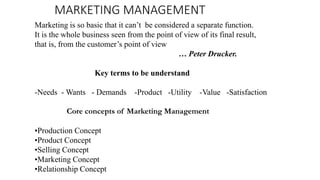
MARKETING MANAGEMENT
Marketing is so basic that it can’t be considered a separate function.
It is the whole business seen from the point of view of its final result,
that is, from the customer’s point of view
… Peter Drucker.
Key terms to be understand
-Needs - Wants - Demands -Product -Utility -Value -Satisfaction
Core concepts of Marketing Management
•Production Concept
•Product Concept
•Selling Concept
•Marketing Concept
•Relationship Concept
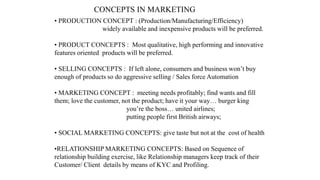
CONCEPTS IN MARKETING
• PRODUCTION CONCEPT : (Production/Manufacturing/Efficiency)
widely available and inexpensive products will be preferred.
• PRODUCT CONCEPTS : Most qualitative, high performing and innovative
features oriented products will be preferred.
• SELLING CONCEPTS : If left alone, consumers and business won’t buy
enough of products so do aggressive selling / Sales force Automation
• MARKETING CONCEPT : meeting needs profitably; find wants and fill
them; love the customer, not the product; have it your way… burger king
you’re the boss… united airlines;
putting people first British airways;
• SOCIAL MARKETING CONCEPTS: give taste but not at the cost of health
•RELATIONSHIP MARKETING CONCEPTS: Based on Sequence of
relationship building exercise, like Relationship managers keep track of their
Customer/ Client details by means of KYC and Profiling.
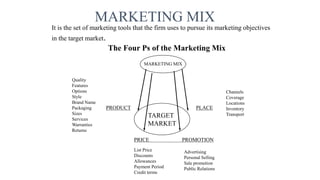
MARKETING MIX
It is the set of marketing tools that the firm uses to pursue its marketing objectives
in the target market.
MARKETING MIX
TARGET
MARKET
PRODUCT PLACE
Quality
Features
Options
Style
Brand Name
Packaging
Sizes
Services
Warranties
Returns
Channels
Coverage
Locations
Inventory
Transport
PRICE PROMOTION
List Price
Discounts
Allowances
Payment Period
Credit terms
Advertising
Personal Selling
Sale promotion
Public Relations
The Four Ps of the Marketing Mix
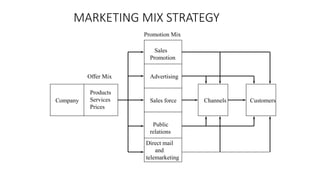
MARKETING MIX STRATEGY
Offer Mix
Products
Services
Prices
Company
Promotion Mix
Channels Customers
Sales
Promotion
Advertising
Sales force
Public
relations
Direct mail
and
telemarketing
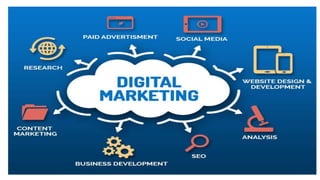
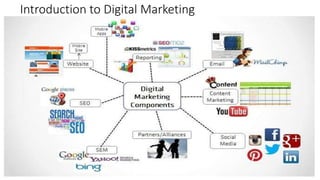
Introduction to Digital Marketing
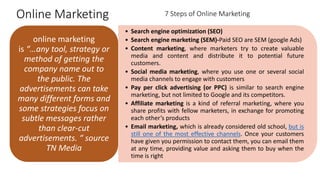
Online Marketing
• Search engine optimization (SEO)
• Search engine marketing (SEM)-Paid SEO are SEM (google Ads)
• Content marketing, where marketers try to create valuable
media and content and distribute it to potential future
customers.
• Social media marketing, where you use one or several social
media channels to engage with customers
• Pay per click advertising (or PPC) is similar to search engine
marketing, but not limited to Google and its competitors.
• Affiliate marketing is a kind of referral marketing, where you
share profits with fellow marketers, in exchange for promoting
each other’s products
• Email marketing, which is already considered old school, but is
still one of the most effective channels. Once your customers
have given you permission to contact them, you can email them
at any time, providing value and asking them to buy when the
time is right
online marketing
is “…any tool, strategy or
method of getting the
company name out to
the public. The
advertisements can take
many different forms and
some strategies focus on
subtle messages rather
than clear-cut
advertisements. “ source
TN Media
7 Steps of Online Marketing
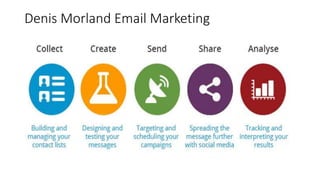
Denis Morland Email Marketing
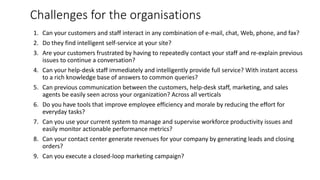
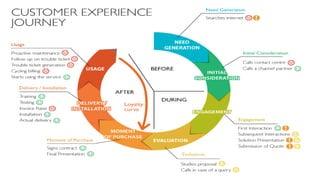
Challenges for the organisations
1. Can your customers and staff interact in any combination of e-mail, chat, Web, phone, and fax?
2. Do they find intelligent self-service at your site?
3. Are your customers frustrated by having to repeatedly contact your staff and re-explain previous
issues to continue a conversation?
4. Can your help-desk staff immediately and intelligently provide full service? With instant access
to a rich knowledge base of answers to common queries?
5. Can previous communication between the customers, help-desk staff, marketing, and sales
agents be easily seen across your organization? Across all verticals
6. Do you have tools that improve employee efficiency and morale by reducing the effort for
everyday tasks?
7. Can you use your current system to manage and supervise workforce productivity issues and
easily monitor actionable performance metrics?
8. Can your contact center generate revenues for your company by generating leads and closing
orders?
9. Can you execute a closed-loop marketing campaign?
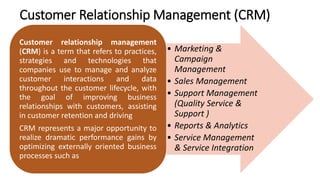
• Marketing &
Campaign
Management
• Sales Management
• Support Management
(Quality Service &
Support )
• Reports & Analytics
• Service Management
& Service Integration
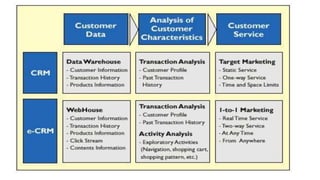
Customer relationship management
(CRM) is a term that refers to practices,
strategies and technologies that
companies use to manage and analyze
customer interactions and data
throughout the customer lifecycle, with
the goal of improving business
relationships with customers, assisting
in customer retention and driving
CRM represents a major opportunity to
realize dramatic performance gains by
optimizing externally oriented business
processes such as
Customer Relationship Management (CRM)
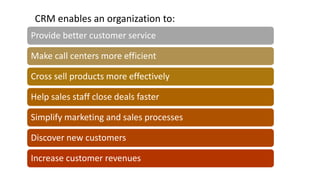
Provide better customer service
Make call centers more efficient
Cross sell products more effectively
Help sales staff close deals faster
Simplify marketing and sales processes
Discover new customers
Increase customer revenues
CRM enables an organization to:
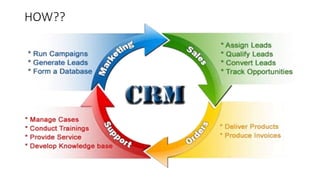
HOW??
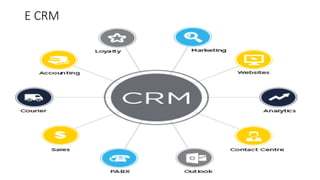
E CRM
Recency, Frequency, and Monetary Value
Organizations can find their most valuable
customers through “RFM” - Recency, Frequency,
and Monetary value
• How recently a customer purchased items (Recency)
• How frequently a customer purchased items (Frequency)
• How much a customer spends on each purchase (Monetary
Value)
Online Branding
• Email Signatures
• Social Media
• Video Links
• Content Marketing
• E Brochures
• Infographics (Graphs and Charts)
• Customer Testimonials
• PR
• Website Optimization
Online branding is a way
to get more exposure for
your brand on all levels
of online marketing,
especially search and
social. Building authority
takes online branding to
the next level by making
each online presence for
a brand authoritative. It
goes beyond just about
creating a blog or social
media account.
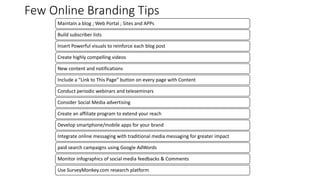
Few Online Branding Tips
Maintain a blog ; Web Portal ; Sites and APPs
Build subscriber lists
Insert Powerful visuals to reinforce each blog post
Create highly compelling videos
New content and notifications
Include a “Link to This Page” button on every page with Content
Conduct periodic webinars and teleseminars
Consider Social Media advertising
Create an affiliate program to extend your reach
Develop smartphone/mobile apps for your brand
Integrate online messaging with traditional media messaging for greater impact
paid search campaigns using Google AdWords
Monitor infographics of social media feedbacks & Comments
Use SurveyMonkey.com research platform
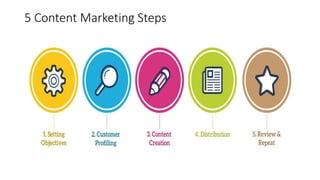
5 Content Marketing Steps
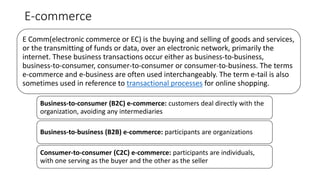
E-commerce
E Comm(electronic commerce or EC) is the buying and selling of goods and services,
or the transmitting of funds or data, over an electronic network, primarily the
internet. These business transactions occur either as business-to-business,
business-to-consumer, consumer-to-consumer or consumer-to-business. The terms
e-commerce and e-business are often used interchangeably. The term e-tail is also
sometimes used in reference to transactional processes for online shopping.
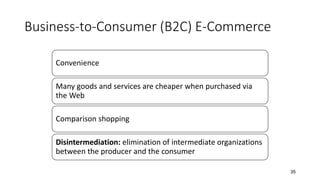
Business-to-consumer (B2C) e-commerce: customers deal directly with the
organization, avoiding any intermediaries
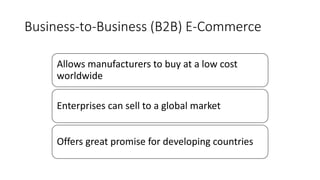
Business-to-business (B2B) e-commerce: participants are organizations
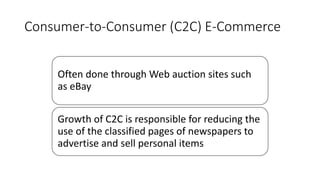
Consumer-to-consumer (C2C) e-commerce: participants are individuals,
with one serving as the buyer and the other as the seller
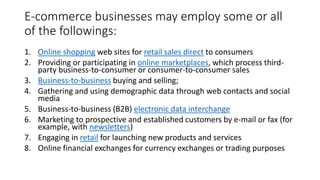
E-commerce businesses may employ some or all
of the followings:
1. Online shopping web sites for retail sales direct to consumers
2. Providing or participating in online marketplaces, which process third-
party business-to-consumer or consumer-to-consumer sales
3. Business-to-business buying and selling;
4. Gathering and using demographic data through web contacts and social
media
5. Business-to-business (B2B) electronic data interchange
6. Marketing to prospective and established customers by e-mail or fax (for
example, with newsletters)
7. Engaging in retail for launching new products and services
8. Online financial exchanges for currency exchanges or trading purposes
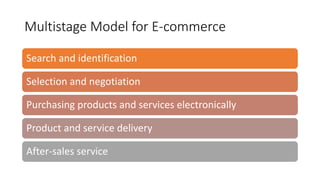
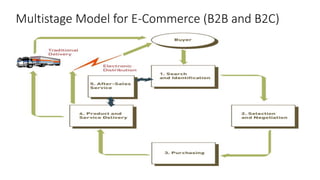
Multistage Model for E-commerce
Search and identification
Selection and negotiation
Purchasing products and services electronically
Product and service delivery
After-sales service
Multistage Model for E-Commerce (B2B and B2C)
Business-to-Business (B2B) E-Commerce
Allows manufacturers to buy at a low cost
worldwide
Enterprises can sell to a global market
Offers great promise for developing countries
35
Business-to-Consumer (B2C) E-Commerce
Convenience
Many goods and services are cheaper when purchased via
the Web
Comparison shopping
Disintermediation: elimination of intermediate organizations
between the producer and the consumer
Consumer-to-Consumer (C2C) E-Commerce
Often done through Web auction sites such
as eBay
Growth of C2C is responsible for reducing the
use of the classified pages of newspapers to
advertise and sell personal items
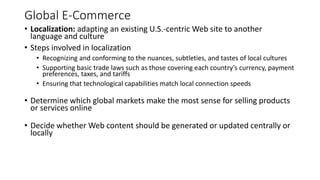
Global E-Commerce
• Localization: adapting an existing U.S.-centric Web site to another
language and culture
• Steps involved in localization
• Recognizing and conforming to the nuances, subtleties, and tastes of local cultures
• Supporting basic trade laws such as those covering each country’s currency, payment
preferences, taxes, and tariffs
• Ensuring that technological capabilities match local connection speeds
• Determine which global markets make the most sense for selling products
or services online
• Decide whether Web content should be generated or updated centrally or
locally
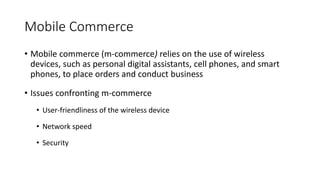
Mobile Commerce
• Mobile commerce (m-commerce) relies on the use of wireless
devices, such as personal digital assistants, cell phones, and smart
phones, to place orders and conduct business
• Issues confronting m-commerce
• User-friendliness of the wireless device
• Network speed
• Security
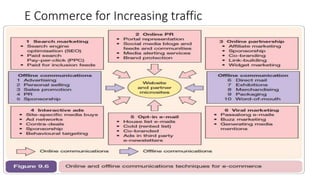
E Commerce for Increasing traffic
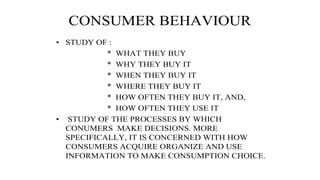
CONSUMER BEHAVIOUR
• STUDY OF :
* WHAT THEY BUY
* WHY THEY BUY IT
* WHEN THEY BUY IT
* WHERE THEY BUY IT
* HOW OFTEN THEY BUY IT, AND,
* HOW OFTEN THEY USE IT
• STUDY OF THE PROCESSES BY WHICH
CONUMERS MAKE DECISIONS. MORE
SPECIFICALLY, IT IS CONCERNED WITH HOW
CONSUMERS ACQUIRE ORGANIZE AND USE
INFORMATION TO MAKE CONSUMPTION CHOICE.
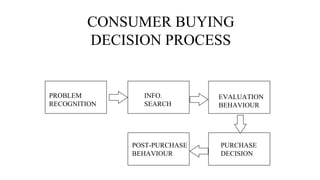
CONSUMER BUYING
DECISION PROCESS
PROBLEM
RECOGNITION
INFO.
SEARCH
EVALUATION
BEHAVIOUR
PURCHASE
DECISION
POST-PURCHASE
BEHAVIOUR
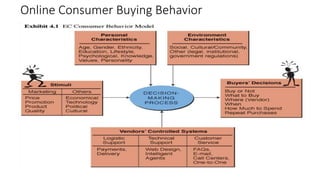
Online Consumer Buying Behavior
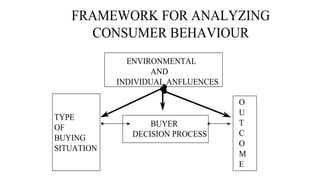
FRAMEWORK FOR ANALYZING
CONSUMER BEHAVIOUR
ENVIRONMENTAL
AND
INDIVIDUAL ANFLUENCES
BUYER
DECISION PROCESS
O
U
T
C
O
M
E
TYPE
OF
BUYING
SITUATION
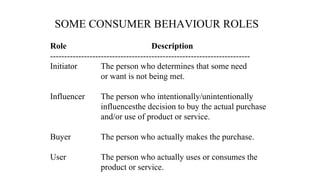
SOME CONSUMER BEHAVIOUR ROLES
Role Description
-----------------------------------------------------------------------
Initiator The person who determines that some need
or want is not being met.
Influencer The person who intentionally/unintentionally
influencesthe decision to buy the actual purchase
and/or use of product or service.
Buyer The person who actually makes the purchase.
User The person who actually uses or consumes the
product or service.
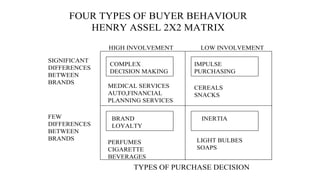
FOUR TYPES OF BUYER BEHAVIOUR
HENRY ASSEL 2X2 MATRIX
SIGNIFICANT
DIFFERENCES
BETWEEN
BRANDS
FEW
DIFFERENCES
BETWEEN
BRANDS
HIGH INVOLVEMENT LOW INVOLVEMENT
COMPLEX
DECISION MAKING
IMPULSE
PURCHASING
BRAND
LOYALTY
INERTIA
MEDICAL SERVICES
AUTO,FINANCIAL
PLANNING SERVICES
CEREALS
SNACKS
PERFUMES
CIGARETTE
BEVERAGES
LIGHT BULBES
SOAPS
TYPES OF PURCHASE DECISION
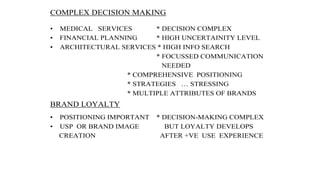
COMPLEX DECISION MAKING
• MEDICAL SERVICES * DECISION COMPLEX
• FINANCIAL PLANNING * HIGH UNCERTAINITY LEVEL
• ARCHITECTURAL SERVICES * HIGH INFO SEARCH
* FOCUSSED COMMUNICATION
NEEDED
* COMPREHENSIVE POSITIONING
* STRATEGIES … STRESSING
* MULTIPLE ATTRIBUTES OF BRANDS
BRAND LOYALTY
• POSITIONING IMPORTANT * DECISION-MAKING COMPLEX
• USP OR BRAND IMAGE BUT LOYALTY DEVELOPS
CREATION AFTER +VE USE EXPERIENCE
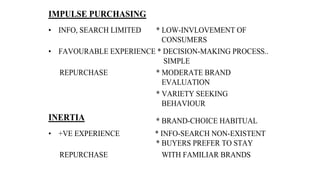
IMPULSE PURCHASING
• INFO, SEARCH LIMITED * LOW-INVLOVEMENT OF
CONSUMERS
• FAVOURABLE EXPERIENCE * DECISION-MAKING PROCESS..
SIMPLE
REPURCHASE * MODERATE BRAND
EVALUATION
* VARIETY SEEKING
BEHAVIOUR
INERTIA * BRAND-CHOICE HABITUAL
• +VE EXPERIENCE * INFO-SEARCH NON-EXISTENT
* BUYERS PREFER TO STAY
REPURCHASE WITH FAMILIAR BRANDS
Principles of Marketing, Sixth Canadian Edition
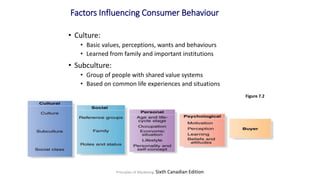
Factors Influencing Consumer Behaviour
• Culture:
• Basic values, perceptions, wants and behaviours
• Learned from family and important institutions
• Subculture:
• Group of people with shared value systems
• Based on common life experiences and situations
Figure 7.2
Principles of Marketing, Sixth Canadian Edition
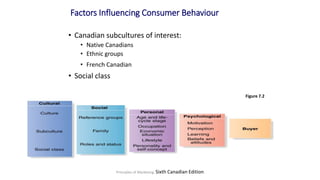
Factors Influencing Consumer Behaviour
• Canadian subcultures of interest:
• Native Canadians
• Ethnic groups
• French Canadian
• Social class
Figure 7.2
Principles of Marketing, Sixth Canadian Edition
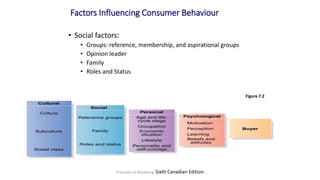
Factors Influencing Consumer Behaviour
• Social factors:
• Groups: reference, membership, and aspirational groups
• Opinion leader
• Family
• Roles and Status
Figure 7.2
Principles of Marketing, Sixth Canadian Edition
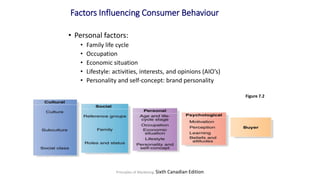
Factors Influencing Consumer Behaviour
• Personal factors:
• Family life cycle
• Occupation
• Economic situation
• Lifestyle: activities, interests, and opinions (AIO’s)
• Personality and self-concept: brand personality
Figure 7.2
Principles of Marketing, Sixth Canadian Edition
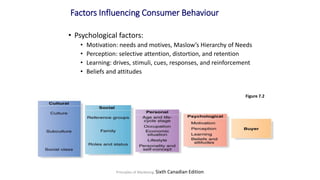
Factors Influencing Consumer Behaviour
• Psychological factors:
• Motivation: needs and motives, Maslow’s Hierarchy of Needs
• Perception: selective attention, distortion, and retention
• Learning: drives, stimuli, cues, responses, and reinforcement
• Beliefs and attitudes
Figure 7.2
Important Questions Unit-II
1. Explain the Marketing concepts with examples (10)
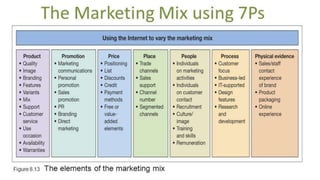
2. Explain the online Marketing Mix with 7Ps? (10)
3. Outline the key components of the Marketing Mix Strategy ? With examples? (10)
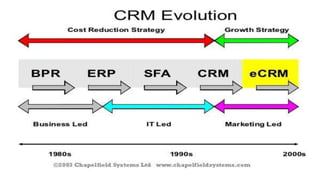
4. Key Challenges for any organization ? How organizations have evolved over the period of time with respect to
the use of tools ? (10)
5. Define Online Marketing and explain the 7Steps of online marketing? (10)
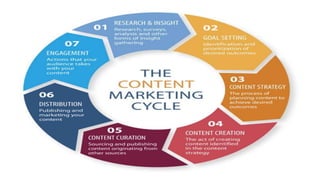
6. Define the content Marketing ? Explain the content marketing Cycle ?
7. Define CRM? Its 5 components ? (10)
8. How does CRM helps in integrating organization ? Explain with how eCRM is different from CRM? (10)
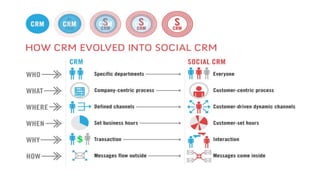
9. Explain the Evolution CRM and explain the Evolution of CRM to Social CRM with respect to 5W 1H? (10)
10. Explain the term Online Branding and Tips for online branding ? (10)
11. Define E Commerce ? B2B;B2C;C2C ?
12. Explain process of multistage E Comm process ? (10)
13. Strategy for website traffic building is done ? (10)
14. Consumer Buying Behavior in Digital age ? Factors Affecting the Consumer Buying Behavior (10)

Digital marketing unit 2

  • 2.
    UNIT 2 : ECommerce and internet marketing • Introduction to E Marketing • Online Marketing Mix • Online Consumer and CRM in Virtual world • Online Branding , Traffic Building and E Commerce • Managing Content in Digital age • Content Planning and writing • Consumer Buying Behavior in Digital age • Factors Affecting the Consumer Buying Behavior
  • 3.
    MARKETS NEEDS, WANTS AND DEMANDS PRODUCTSAND SERVICES VALUE, UTILITY SATISFACTION QUALITY EXCHANGE RELATIONSHIPS TRANSACTIONS CORE MARKETING CONCEPTS
  • 4.
    FUNDAMENTAL TERMINOLOGIES NEEDS :FELT DEPREIVATION WANTS : FORM TAKEN BY HUMAN NEEDS AS THEY ARE SHAPED BY CULTURE AND PERSONALITY. DEMAND : WANTS BACKED BY PURCHASING POWER. PRODUCT : ANY OFFERING TO SATISFY NEEDS AND WANTS MAINLY PHYSICAL OBJECTS, SERVICES, INFORMATION, PROPERTIES EXPERIENCES, EVENTS, PLACES, ORGANISATIONS, IDEAS, PERSONS. UTILITY FEATURES : PHYSICAL ATTRIBUTES OF THE PRODUCT ADVANTAGES : OPERATIONAL FEATURES OF THE PRODUCT BENEFITS : IMPLICIT, SUBJECTIVE OUTCOME AFTER USE OF THE PRODUCT WHICH LEADS SATISFACTION. VALUE : IT IS (FUNCTIONAL BENEFIT+ EMOTIONAL BENEFIT)/ (MONEY + TIME+ ENERGY + PSYCHIC COSTS) SATISFACTION : PERFORMANCE VS EXPECTATION FUNCTION EXCHANGE : OBTAINING OF SOMETHING BY OFFERING SOMETHING ELSE IN RETURN. TRANSACTION : MARKETING’S UNIT OF MEASUREMENT OF THE EXCHANGE.
  • 5.
    MARKETING MANAGEMENT Marketing isso basic that it can’t be considered a separate function. It is the whole business seen from the point of view of its final result, that is, from the customer’s point of view … Peter Drucker. Key terms to be understand -Needs - Wants - Demands -Product -Utility -Value -Satisfaction Core concepts of Marketing Management •Production Concept •Product Concept •Selling Concept •Marketing Concept •Relationship Concept
  • 6.
    CONCEPTS IN MARKETING •PRODUCTION CONCEPT : (Production/Manufacturing/Efficiency) widely available and inexpensive products will be preferred. • PRODUCT CONCEPTS : Most qualitative, high performing and innovative features oriented products will be preferred. • SELLING CONCEPTS : If left alone, consumers and business won’t buy enough of products so do aggressive selling / Sales force Automation • MARKETING CONCEPT : meeting needs profitably; find wants and fill them; love the customer, not the product; have it your way… burger king you’re the boss… united airlines; putting people first British airways; • SOCIAL MARKETING CONCEPTS: give taste but not at the cost of health •RELATIONSHIP MARKETING CONCEPTS: Based on Sequence of relationship building exercise, like Relationship managers keep track of their Customer/ Client details by means of KYC and Profiling.
  • 7.
    MARKETING MIX It isthe set of marketing tools that the firm uses to pursue its marketing objectives in the target market. MARKETING MIX TARGET MARKET PRODUCT PLACE Quality Features Options Style Brand Name Packaging Sizes Services Warranties Returns Channels Coverage Locations Inventory Transport PRICE PROMOTION List Price Discounts Allowances Payment Period Credit terms Advertising Personal Selling Sale promotion Public Relations The Four Ps of the Marketing Mix
  • 9.
    MARKETING MIX STRATEGY OfferMix Products Services Prices Company Promotion Mix Channels Customers Sales Promotion Advertising Sales force Public relations Direct mail and telemarketing
  • 10.
  • 11.
    Online Marketing • Searchengine optimization (SEO) • Search engine marketing (SEM)-Paid SEO are SEM (google Ads) • Content marketing, where marketers try to create valuable media and content and distribute it to potential future customers. • Social media marketing, where you use one or several social media channels to engage with customers • Pay per click advertising (or PPC) is similar to search engine marketing, but not limited to Google and its competitors. • Affiliate marketing is a kind of referral marketing, where you share profits with fellow marketers, in exchange for promoting each other’s products • Email marketing, which is already considered old school, but is still one of the most effective channels. Once your customers have given you permission to contact them, you can email them at any time, providing value and asking them to buy when the time is right online marketing is “…any tool, strategy or method of getting the company name out to the public. The advertisements can take many different forms and some strategies focus on subtle messages rather than clear-cut advertisements. “ source TN Media 7 Steps of Online Marketing
  • 12.
  • 14.
    Challenges for theorganisations 1. Can your customers and staff interact in any combination of e-mail, chat, Web, phone, and fax? 2. Do they find intelligent self-service at your site? 3. Are your customers frustrated by having to repeatedly contact your staff and re-explain previous issues to continue a conversation? 4. Can your help-desk staff immediately and intelligently provide full service? With instant access to a rich knowledge base of answers to common queries? 5. Can previous communication between the customers, help-desk staff, marketing, and sales agents be easily seen across your organization? Across all verticals 6. Do you have tools that improve employee efficiency and morale by reducing the effort for everyday tasks? 7. Can you use your current system to manage and supervise workforce productivity issues and easily monitor actionable performance metrics? 8. Can your contact center generate revenues for your company by generating leads and closing orders? 9. Can you execute a closed-loop marketing campaign?
  • 16.
    • Marketing & Campaign Management •Sales Management • Support Management (Quality Service & Support ) • Reports & Analytics • Service Management & Service Integration Customer relationship management (CRM) is a term that refers to practices, strategies and technologies that companies use to manage and analyze customer interactions and data throughout the customer lifecycle, with the goal of improving business relationships with customers, assisting in customer retention and driving CRM represents a major opportunity to realize dramatic performance gains by optimizing externally oriented business processes such as Customer Relationship Management (CRM)
  • 17.
    Provide better customerservice Make call centers more efficient Cross sell products more effectively Help sales staff close deals faster Simplify marketing and sales processes Discover new customers Increase customer revenues CRM enables an organization to:
  • 18.
  • 19.
  • 21.
    Recency, Frequency, andMonetary Value Organizations can find their most valuable customers through “RFM” - Recency, Frequency, and Monetary value • How recently a customer purchased items (Recency) • How frequently a customer purchased items (Frequency) • How much a customer spends on each purchase (Monetary Value)
  • 24.
    Online Branding • EmailSignatures • Social Media • Video Links • Content Marketing • E Brochures • Infographics (Graphs and Charts) • Customer Testimonials • PR • Website Optimization Online branding is a way to get more exposure for your brand on all levels of online marketing, especially search and social. Building authority takes online branding to the next level by making each online presence for a brand authoritative. It goes beyond just about creating a blog or social media account.
  • 25.
    Few Online BrandingTips Maintain a blog ; Web Portal ; Sites and APPs Build subscriber lists Insert Powerful visuals to reinforce each blog post Create highly compelling videos New content and notifications Include a “Link to This Page” button on every page with Content Conduct periodic webinars and teleseminars Consider Social Media advertising Create an affiliate program to extend your reach Develop smartphone/mobile apps for your brand Integrate online messaging with traditional media messaging for greater impact paid search campaigns using Google AdWords Monitor infographics of social media feedbacks & Comments Use SurveyMonkey.com research platform
  • 27.
  • 30.
    E-commerce E Comm(electronic commerceor EC) is the buying and selling of goods and services, or the transmitting of funds or data, over an electronic network, primarily the internet. These business transactions occur either as business-to-business, business-to-consumer, consumer-to-consumer or consumer-to-business. The terms e-commerce and e-business are often used interchangeably. The term e-tail is also sometimes used in reference to transactional processes for online shopping. Business-to-consumer (B2C) e-commerce: customers deal directly with the organization, avoiding any intermediaries Business-to-business (B2B) e-commerce: participants are organizations Consumer-to-consumer (C2C) e-commerce: participants are individuals, with one serving as the buyer and the other as the seller
  • 31.
    E-commerce businesses mayemploy some or all of the followings: 1. Online shopping web sites for retail sales direct to consumers 2. Providing or participating in online marketplaces, which process third- party business-to-consumer or consumer-to-consumer sales 3. Business-to-business buying and selling; 4. Gathering and using demographic data through web contacts and social media 5. Business-to-business (B2B) electronic data interchange 6. Marketing to prospective and established customers by e-mail or fax (for example, with newsletters) 7. Engaging in retail for launching new products and services 8. Online financial exchanges for currency exchanges or trading purposes
  • 32.
    Multistage Model forE-commerce Search and identification Selection and negotiation Purchasing products and services electronically Product and service delivery After-sales service
  • 33.
    Multistage Model forE-Commerce (B2B and B2C)
  • 34.
    Business-to-Business (B2B) E-Commerce Allowsmanufacturers to buy at a low cost worldwide Enterprises can sell to a global market Offers great promise for developing countries
  • 35.
    35 Business-to-Consumer (B2C) E-Commerce Convenience Manygoods and services are cheaper when purchased via the Web Comparison shopping Disintermediation: elimination of intermediate organizations between the producer and the consumer
  • 36.
    Consumer-to-Consumer (C2C) E-Commerce Oftendone through Web auction sites such as eBay Growth of C2C is responsible for reducing the use of the classified pages of newspapers to advertise and sell personal items
  • 37.
    Global E-Commerce • Localization:adapting an existing U.S.-centric Web site to another language and culture • Steps involved in localization • Recognizing and conforming to the nuances, subtleties, and tastes of local cultures • Supporting basic trade laws such as those covering each country’s currency, payment preferences, taxes, and tariffs • Ensuring that technological capabilities match local connection speeds • Determine which global markets make the most sense for selling products or services online • Decide whether Web content should be generated or updated centrally or locally
  • 38.
    Mobile Commerce • Mobilecommerce (m-commerce) relies on the use of wireless devices, such as personal digital assistants, cell phones, and smart phones, to place orders and conduct business • Issues confronting m-commerce • User-friendliness of the wireless device • Network speed • Security
  • 39.
    E Commerce forIncreasing traffic
  • 41.
    CONSUMER BEHAVIOUR • STUDYOF : * WHAT THEY BUY * WHY THEY BUY IT * WHEN THEY BUY IT * WHERE THEY BUY IT * HOW OFTEN THEY BUY IT, AND, * HOW OFTEN THEY USE IT • STUDY OF THE PROCESSES BY WHICH CONUMERS MAKE DECISIONS. MORE SPECIFICALLY, IT IS CONCERNED WITH HOW CONSUMERS ACQUIRE ORGANIZE AND USE INFORMATION TO MAKE CONSUMPTION CHOICE.
  • 42.
  • 43.
  • 44.
    FRAMEWORK FOR ANALYZING CONSUMERBEHAVIOUR ENVIRONMENTAL AND INDIVIDUAL ANFLUENCES BUYER DECISION PROCESS O U T C O M E TYPE OF BUYING SITUATION
  • 45.
    SOME CONSUMER BEHAVIOURROLES Role Description ----------------------------------------------------------------------- Initiator The person who determines that some need or want is not being met. Influencer The person who intentionally/unintentionally influencesthe decision to buy the actual purchase and/or use of product or service. Buyer The person who actually makes the purchase. User The person who actually uses or consumes the product or service.
  • 46.
    FOUR TYPES OFBUYER BEHAVIOUR HENRY ASSEL 2X2 MATRIX SIGNIFICANT DIFFERENCES BETWEEN BRANDS FEW DIFFERENCES BETWEEN BRANDS HIGH INVOLVEMENT LOW INVOLVEMENT COMPLEX DECISION MAKING IMPULSE PURCHASING BRAND LOYALTY INERTIA MEDICAL SERVICES AUTO,FINANCIAL PLANNING SERVICES CEREALS SNACKS PERFUMES CIGARETTE BEVERAGES LIGHT BULBES SOAPS TYPES OF PURCHASE DECISION
  • 47.
    COMPLEX DECISION MAKING •MEDICAL SERVICES * DECISION COMPLEX • FINANCIAL PLANNING * HIGH UNCERTAINITY LEVEL • ARCHITECTURAL SERVICES * HIGH INFO SEARCH * FOCUSSED COMMUNICATION NEEDED * COMPREHENSIVE POSITIONING * STRATEGIES … STRESSING * MULTIPLE ATTRIBUTES OF BRANDS BRAND LOYALTY • POSITIONING IMPORTANT * DECISION-MAKING COMPLEX • USP OR BRAND IMAGE BUT LOYALTY DEVELOPS CREATION AFTER +VE USE EXPERIENCE
  • 48.
    IMPULSE PURCHASING • INFO,SEARCH LIMITED * LOW-INVLOVEMENT OF CONSUMERS • FAVOURABLE EXPERIENCE * DECISION-MAKING PROCESS.. SIMPLE REPURCHASE * MODERATE BRAND EVALUATION * VARIETY SEEKING BEHAVIOUR INERTIA * BRAND-CHOICE HABITUAL • +VE EXPERIENCE * INFO-SEARCH NON-EXISTENT * BUYERS PREFER TO STAY REPURCHASE WITH FAMILIAR BRANDS
  • 49.
    Principles of Marketing,Sixth Canadian Edition Factors Influencing Consumer Behaviour • Culture: • Basic values, perceptions, wants and behaviours • Learned from family and important institutions • Subculture: • Group of people with shared value systems • Based on common life experiences and situations Figure 7.2
  • 50.
    Principles of Marketing,Sixth Canadian Edition Factors Influencing Consumer Behaviour • Canadian subcultures of interest: • Native Canadians • Ethnic groups • French Canadian • Social class Figure 7.2
  • 51.
    Principles of Marketing,Sixth Canadian Edition Factors Influencing Consumer Behaviour • Social factors: • Groups: reference, membership, and aspirational groups • Opinion leader • Family • Roles and Status Figure 7.2
  • 52.
    Principles of Marketing,Sixth Canadian Edition Factors Influencing Consumer Behaviour • Personal factors: • Family life cycle • Occupation • Economic situation • Lifestyle: activities, interests, and opinions (AIO’s) • Personality and self-concept: brand personality Figure 7.2
  • 53.
    Principles of Marketing,Sixth Canadian Edition Factors Influencing Consumer Behaviour • Psychological factors: • Motivation: needs and motives, Maslow’s Hierarchy of Needs • Perception: selective attention, distortion, and retention • Learning: drives, stimuli, cues, responses, and reinforcement • Beliefs and attitudes Figure 7.2
  • 55.
    Important Questions Unit-II 1.Explain the Marketing concepts with examples (10) 2. Explain the online Marketing Mix with 7Ps? (10) 3. Outline the key components of the Marketing Mix Strategy ? With examples? (10) 4. Key Challenges for any organization ? How organizations have evolved over the period of time with respect to the use of tools ? (10) 5. Define Online Marketing and explain the 7Steps of online marketing? (10) 6. Define the content Marketing ? Explain the content marketing Cycle ? 7. Define CRM? Its 5 components ? (10) 8. How does CRM helps in integrating organization ? Explain with how eCRM is different from CRM? (10) 9. Explain the Evolution CRM and explain the Evolution of CRM to Social CRM with respect to 5W 1H? (10) 10. Explain the term Online Branding and Tips for online branding ? (10) 11. Define E Commerce ? B2B;B2C;C2C ? 12. Explain process of multistage E Comm process ? (10) 13. Strategy for website traffic building is done ? (10) 14. Consumer Buying Behavior in Digital age ? Factors Affecting the Consumer Buying Behavior (10)