Chapter 7 : E_CRM
By:
Marya sholevar
Winter 2014
From RM to CRM

The concept of relationship marketing was first coined by
Leonard Berry in 1983. He considered it to consist of attracting,
maintaining and enhancing customer relationships within
organizations. In the years that followed, companies were
engaging more and more in a meaningful dialogue with
individual customers. In doing so, new organizational forms as
well as technologies were used, eventually resulting in what we
know as Customer Relationship Management (CRM).

The main difference between RM and CRM is that the first
does not acknowledge the use of technology, where the latter
uses Information Technology (IT) in implementing RM
strategies.
Customer Relationship
Management (CRM)

CRM is a strategy by which companies optimise
profitability through enhanced customer satisfaction.

CRM is about automating and enhancing the
customer-centric business processes of Sales,
Marketing, and Service.

CRM not only deals with automating these
processes, but also focuses on ensuring that the
front-office applications improve customer
satisfaction, resulting in added customer loyalty that
directly affects the organization’s bottom line.
Electronic Customer
Relationship Management (E-
CRM)

E-CRM This concept is derived from E-commerce. It also
uses net environment i.e., intranet, extranet and internet

Definition of E-CRM: Electronic CRM concerns all
forms of managing relationships with customers making
use of Information Technology (IT).

The goal is to drive consistency within all channels
relative to sales, customer service and marketing
initiatives to achieve a flawless customer
experience and maximize customer satisfaction,
customer loyalty and revenue.
Electronic Customer
Relationship Management (E-
CRM)

E-CRM (Electronic Customer Relationship Management)
expands the traditional CRM techniques by integrating
new electronic channels, such as Web, wireless, and
voice technologies and combines it with e-business
applications into the overall enterprise CRM strategy.

Therefore ,it is just an expanded, integrated version of
CRM . Thus, Old CRM + Internet = e-CRM
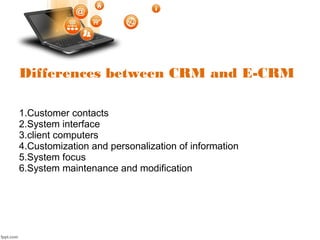
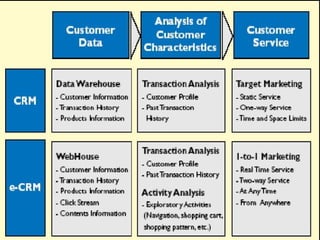
Differences between CRM and E-CRM
1.Customer contacts
2.System interface
3.client computers
4.Customization and personalization of information
5.System focus
6.System maintenance and modification
Why E-CRM?

Gather and combine customer information into a unified
picture

Response faster and accurately

Build customer loyalty

Due to the introduction of new technology

Due to globalization

Changing customer attitudes and expectations

To gain competitive advantage

To measure, create and increase income for the business

To reduce costs
Different levels of E-CRM

Foundational services:

This includes the minimum necessary services such as web
site effectiveness and responsiveness as well as order
fulfillment.

Customer-centered services:

These services include order tracking, product configuration
and customization as well as security/trust.
Different levels of E-CRM

Value-added services:

These are extra services such as online auctions and online
training and education
Goals of E-CRM

Reduce :

Costs of marketing

Improve :

Accuracy and relevancy of recommendations

Customer satisfaction
Goals of E-CRM

Increase :

Conversion rate, i.e., Turn browsers into buyers

Customer retention and frequency

Order size

customer response

competitiveness through differentiation

Profitability.
Key applications of E-CRM
1- Information integration application

An incomplete view of customers reduces their loyalty and trust

Consolidating customer data and information from different
sources

To keep up with every customer’s interaction
Key applications of E-CRM
2- Customer analysis application

Measures, predicts, and interprets customer behaviors

Predictive models to identify the customers most likely to
perform a particular activity

Online analytical processing, data mining and statistics
Key applications of E-CRM
3- Real-time decision application

To coordinate and synchronize communications across
disparate customer

An effective real-time decision application promotes
information exchange between the company and every
customer
Key applications of E-CRM
4- Personalized messaging application

Building customer profiles and enables customized product
and service offerings based on the information integration
application
Benefits of E-CRM

Retaining existing customers.

Selling more to existing customers.

Finding and winning new customers.

Interactions lead to trusted relationships:

Focus the business on improving customer relationships and
earning a greater share of each customer’s business.
Benefits of E-CRM

Increasing efficiency.

Improving marketing and sales decision making.

Enables 24/7 customers interaction: optimize interactive
relationships between customers and companies.

Personalization through technology: enable a business to
extend its personalized messaging through the Web and email.

Chapter 7 e crm

  • 1.
    Chapter 7 :E_CRM By: Marya sholevar Winter 2014
  • 2.
    From RM toCRM  The concept of relationship marketing was first coined by Leonard Berry in 1983. He considered it to consist of attracting, maintaining and enhancing customer relationships within organizations. In the years that followed, companies were engaging more and more in a meaningful dialogue with individual customers. In doing so, new organizational forms as well as technologies were used, eventually resulting in what we know as Customer Relationship Management (CRM).  The main difference between RM and CRM is that the first does not acknowledge the use of technology, where the latter uses Information Technology (IT) in implementing RM strategies.
  • 3.
    Customer Relationship Management (CRM)  CRMis a strategy by which companies optimise profitability through enhanced customer satisfaction.  CRM is about automating and enhancing the customer-centric business processes of Sales, Marketing, and Service.  CRM not only deals with automating these processes, but also focuses on ensuring that the front-office applications improve customer satisfaction, resulting in added customer loyalty that directly affects the organization’s bottom line.
  • 4.
    Electronic Customer Relationship Management(E- CRM)  E-CRM This concept is derived from E-commerce. It also uses net environment i.e., intranet, extranet and internet  Definition of E-CRM: Electronic CRM concerns all forms of managing relationships with customers making use of Information Technology (IT).  The goal is to drive consistency within all channels relative to sales, customer service and marketing initiatives to achieve a flawless customer experience and maximize customer satisfaction, customer loyalty and revenue.
  • 5.
    Electronic Customer Relationship Management(E- CRM)  E-CRM (Electronic Customer Relationship Management) expands the traditional CRM techniques by integrating new electronic channels, such as Web, wireless, and voice technologies and combines it with e-business applications into the overall enterprise CRM strategy.  Therefore ,it is just an expanded, integrated version of CRM . Thus, Old CRM + Internet = e-CRM
  • 6.
    Differences between CRMand E-CRM 1.Customer contacts 2.System interface 3.client computers 4.Customization and personalization of information 5.System focus 6.System maintenance and modification
  • 8.
    Why E-CRM?  Gather andcombine customer information into a unified picture  Response faster and accurately  Build customer loyalty  Due to the introduction of new technology  Due to globalization  Changing customer attitudes and expectations  To gain competitive advantage  To measure, create and increase income for the business  To reduce costs
  • 9.
    Different levels ofE-CRM  Foundational services:  This includes the minimum necessary services such as web site effectiveness and responsiveness as well as order fulfillment.  Customer-centered services:  These services include order tracking, product configuration and customization as well as security/trust.
  • 10.
    Different levels ofE-CRM  Value-added services:  These are extra services such as online auctions and online training and education
  • 12.
    Goals of E-CRM  Reduce:  Costs of marketing  Improve :  Accuracy and relevancy of recommendations  Customer satisfaction
  • 13.
    Goals of E-CRM  Increase:  Conversion rate, i.e., Turn browsers into buyers  Customer retention and frequency  Order size  customer response  competitiveness through differentiation  Profitability.
  • 14.
    Key applications ofE-CRM 1- Information integration application  An incomplete view of customers reduces their loyalty and trust  Consolidating customer data and information from different sources  To keep up with every customer’s interaction
  • 15.
    Key applications ofE-CRM 2- Customer analysis application  Measures, predicts, and interprets customer behaviors  Predictive models to identify the customers most likely to perform a particular activity  Online analytical processing, data mining and statistics
  • 16.
    Key applications ofE-CRM 3- Real-time decision application  To coordinate and synchronize communications across disparate customer  An effective real-time decision application promotes information exchange between the company and every customer
  • 17.
    Key applications ofE-CRM 4- Personalized messaging application  Building customer profiles and enables customized product and service offerings based on the information integration application
  • 18.
    Benefits of E-CRM  Retainingexisting customers.  Selling more to existing customers.  Finding and winning new customers.  Interactions lead to trusted relationships:  Focus the business on improving customer relationships and earning a greater share of each customer’s business.
  • 19.
    Benefits of E-CRM  Increasingefficiency.  Improving marketing and sales decision making.  Enables 24/7 customers interaction: optimize interactive relationships between customers and companies.  Personalization through technology: enable a business to extend its personalized messaging through the Web and email.