Trends in Information Systems
Enterprise Business Systems
Trends in Information Systems
Electronic & Enterprise Business
Electronic business (e-business) refers to the use of the Web, Internet,
intranets, extranets or some combination thereof to conduct business. E-
business is similar to e-commerce, but it goes beyond the simple buying
and selling of products and services online. Enterprise business includes a
much wider range of businesses processes, such as supply chain
management, electronic order processing and customer relationship
management. Enterprise business processes, therefore, can help
companies to operate more effectively and efficiently.
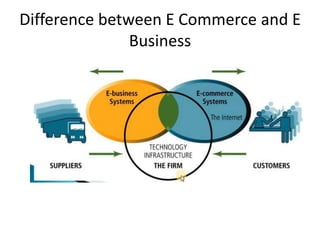
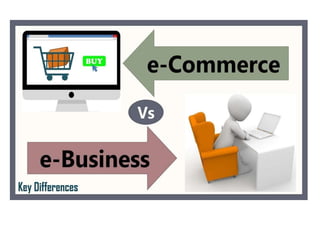
Difference between E Commerce and E
Business
Key Differences Between e-commerce
and e-business
The points presented below are substantial so far as the difference between e
commerce and e-business is concerned:
1. Buying and Selling of goods and services through the internet is known as e-
commerce. Unlike e-business, which is an electronic presence of business, by
which all the business activities are conducted through the internet.
2. e-commerce is a major component of e-business.
3. e-commerce includes transactions which are related to money, but e-business
includes monetary as well as allied activities.
4. e-commerce has an extroverted approach that covers customers,
suppliers, distributors, etc. On the other hand, e-business has an ambivert
approach that covers internal as well as external processes.
5. e-commerce requires a website that can represent the business.
Conversely, e-business requires a website, Customer Relationship
Management and Enterprise Resource Planning for running the business
over the internet.
6. e-commerce uses the internet to connect with the rest of the world. In
contrast to e-business, the internet, intranet and extranet are used for
connecting with the parties.
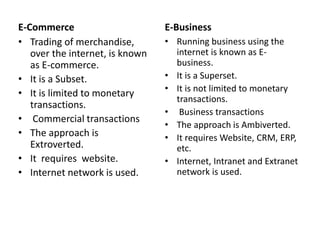
E-Commerce
• Trading of merchandise,
over the internet, is known
as E-commerce.
• It is a Subset.
• It is limited to monetary
transactions.
• Commercial transactions
• The approach is
Extroverted.
• It requires website.
• Internet network is used.
E-Business
• Running business using the
internet is known as E-
business.
• It is a Superset.
• It is not limited to monetary
transactions.
• Business transactions
• The approach is Ambiverted.
• It requires Website, CRM, ERP,
etc.
• Internet, Intranet and Extranet
network is used.
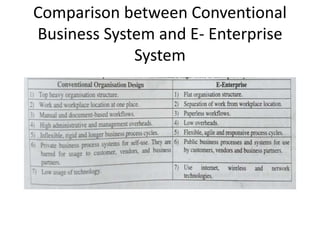
Comparison between Conventional
Business System and E- Enterprise
System
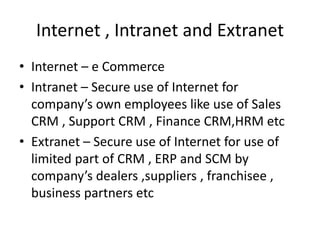
Internet , Intranet and Extranet
• Internet – e Commerce
• Intranet – Secure use of Internet for
company’s own employees like use of Sales
CRM , Support CRM , Finance CRM,HRM etc
• Extranet – Secure use of Internet for use of
limited part of CRM , ERP and SCM by
company’s dealers ,suppliers , franchisee ,
business partners etc
What are E Business Software
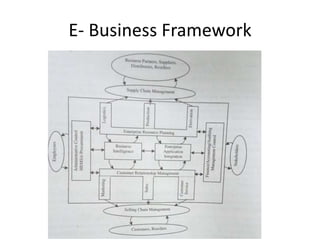
• ERP , CRM and SCM
• While the primary goal of ERP is to improve
and streamline internal business processes,
CRM attempts to enhance the relationship
with customers and SCM aims to facilitate the
collaboration between the organization, its
suppliers, the manufacturers, the distributors
and the partners
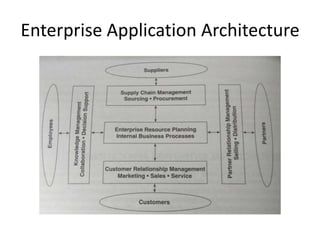
Enterprise Application Architecture
E- Business Framework
ERP
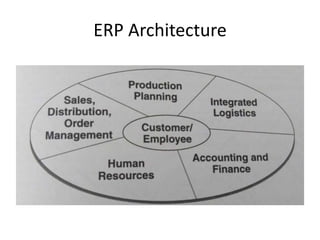
• Enterprise Resource Planning (ERP) like
SAP,Oracle Financials etc concentrates on the
efficiency of the firm’s internal production
,distribution and financial processes
ERP Architecture
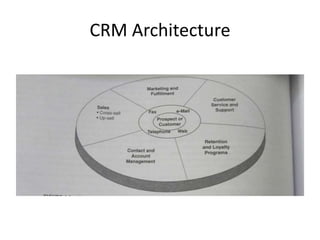
CRM
• Customer Relationship Management
(CRM)focusses on acquiring and retaining
profitable customers via marketing , sales and
support services .
• Partner Relationship Management (PRM)
aims to acquire and retain partners to increase
sales and distribution for firm’s products and
services
CRM Architecture
SCM
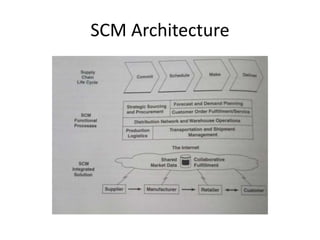
• Supply Chain Management (SCM) focusses on
developing efficient and effective sourcing and
procurement processes with suppliers for the
products and services needed by the firm.
SCM
• SCM is the backbone of e Commerce
• SCM starts with delivery of raw materials from
suppliers to a manufacturer and ends with
delivery of finished product or service to the
end customer
• Customer is integral part of SCM like ERP and
SCM
• Supply Chain is integration of Demand and
Supply .Demand comes from the customer
SCM Architecture
E Business Relationships and
Differences
• The difference between CRM & SCM. ... The
primary distinction is that CRM is a marketing process,
whereas SCM is a distribution process. With both
systems, companies rely on software to facilitate more
effective and efficient business activities and gather
information to make forecasts.
•
• Enterprise Resource Planning (ERP) and Customer
Relationship Management(CRM) are similar in many
ways, as they are both used to increase the overall
profitability of a business. These systems overlap in
some areas, and can be completely integrated in others
SCM & ERP
• One of the most basic ways to describe
the difference between SCM and ERP is that
while supply chain management software
handles data on incoming raw materials from
outside vendors or suppliers, ERP software is
much more focused on internal work
processes.
CRM ERP Overlap
• Is CRM part of ERP?
• Both. As a unique category, CRM normally
consists of sales force automation, marketing
automation and customer support. As part of
ERP, CRM is one of the five ERP pillars, with
the other four pillars being financial
accounting, distribution or supply chain
management, manufacturing and human
resources/payroll.
CRM
• 1.Better & Consolidated Data Organization in one
place
• Capture Sales Leads
• Customer Acquisition
• Customer Retention
• Auto Reminders –Emails alerts to customers on
bill payments etc
• Capture all leads from all sources and share with
sales
• Structure Management Data Reports
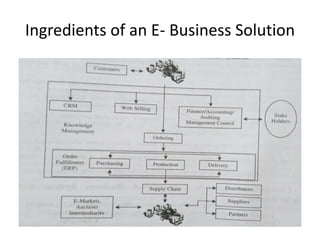
Ingredients of an E- Business Solution
Top 14 Most Popular CRM Software
• HubSpot CRM.
• Salesforce CRM
• Freshsales
• Zoho CRM
• Pipedrive
• bpm'online CRM
• amoCRM
• vCita
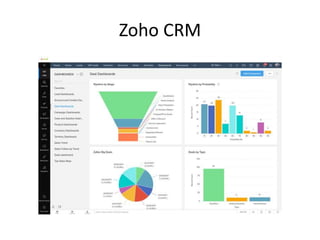
Zoho CRM
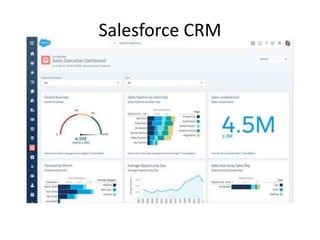
Salesforce CRM
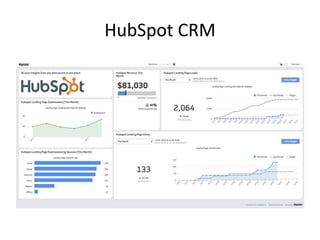
HubSpot CRM
ERP
• ERP is a centralized solution (database and software )
integrating with all functions of the organization
- Sales
- Inventory
- Production Planning
- Shop Floor
- Finance
- Support
- HR
- Vendors
Popular ERP Vendors
• Microsoft Dynamics
• Oracle e-Business Suite
• SAGE
• SAP Business One
• Infor Global Solutions
• NetERP from NetSuite
• Lawson Software
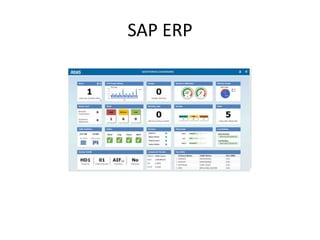
SAP ERP
Top 10: Supply chain management
software companies
• 1 – SAP
• 2 – Oracle
• 3 – JDA
• 4 – Infor Global Solutions
• 5 – Manhattan Associates
• 6 – Epicor Software Corporation
• 7 - Descartes Systems Group
• 8 – HighJump
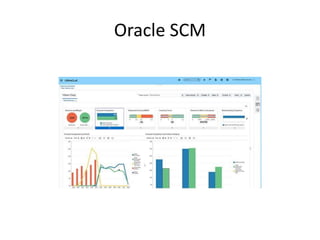
Oracle SCM
What is e-commerce & m-commerce?
The term e-commerce stands for electronic commerce. It is usually abbreviated as
e-commerce, but it is sometimes used as ecommerce, e Commerce or simply as EC.
The terms e-business or e- tailing are sometimes used as synonyms. The term m
Commerce is gradually taking its place as a part of e-commerce that is focused on
transactions via mobile devices.
E-commerce is the process of buying and selling online. It is a business transaction
where the funds and data are transferred through an electronic network. This way,
the sales of all kinds of products, both physical and digital, and services are
arranged between two participants in the transaction. Depending on those
participants, e-commerce includes several types of transactions:
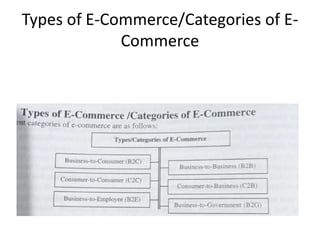
• Business to business (B2B)
• Business to customer (B2C)
• Customer to customer (C2C)
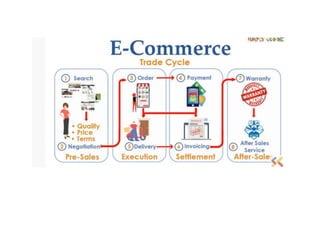
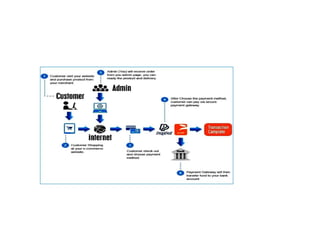
The Process of e-commerce
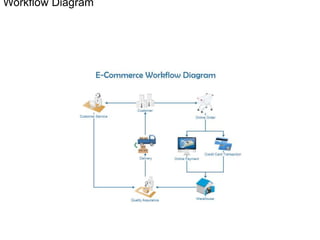
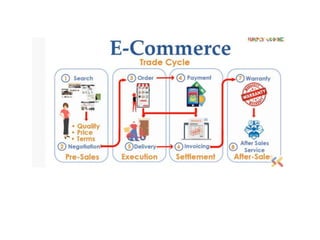
• A consumer uses Web browser to connect to the home page of a
merchant’s website on the internet
• The consumer browses the catalog of the products featured on the
site and selects items to purchase. The selected items are placed in
the electronic equivalent of a shopping cart.
• When the consumer is ready to complete the purchase of selected
items, has to provide a bill-to and ship-to address for purchase and
delivery
• When the merchant’s Web server receive this information, it
computes the total cost of the order including tax ,shipping, and
handling charges and then displays the total to the customer.
• The customer can now provide payment information such as a credit
card number and then submit the order.
• When the credit card number is validated and the order is completed
at the Commerce Server Site the merchant’s site displays a receipt
confirmation the customer’s purchase.
• The Commerce Server Site then forward the order to a processing
Network for payment processing and fulfillment.
Workflow Diagram
Types of E-Commerce/Categories of E-
Commerce
Types of E-Commerce
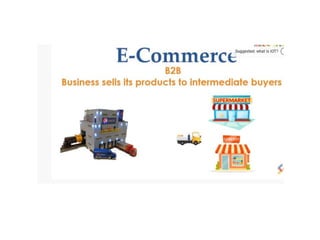
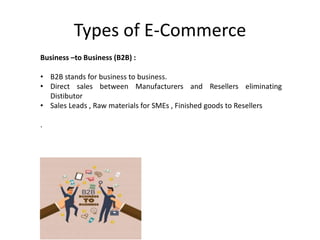
Business –to Business (B2B) :
• B2B stands for business to business.
• Direct sales between Manufacturers and Resellers eliminating
Distibutor
• Sales Leads , Raw materials for SMEs , Finished goods to Resellers
.
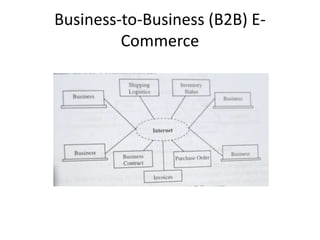
Business-to-Business (B2B) E-
Commerce
B2B Ecommerce in India
• India Mart
• Trade Mart
• AmazonBusiness.in
• Power2SME.com
• Industrybuying.com
• Bizongo.in
• Tolexo.com
• JustByLive.com
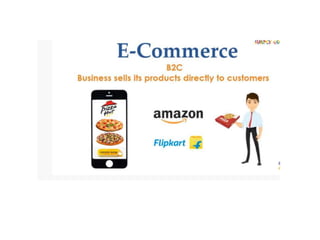
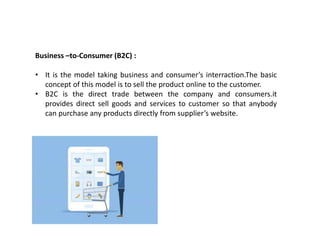
Business –to-Consumer (B2C) :
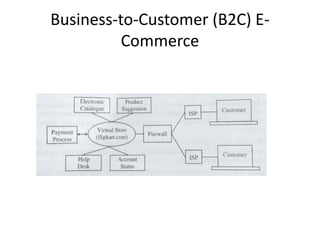
• It is the model taking business and consumer’s interraction.The basic
concept of this model is to sell the product online to the customer.
• B2C is the direct trade between the company and consumers.it
provides direct sell goods and services to customer so that anybody
can purchase any products directly from supplier’s website.
Business-to-Customer (B2C) E-
Commerce
B2C Examples in India
• Amazon
• Flipkart
• Snapdeal
• Infibeam
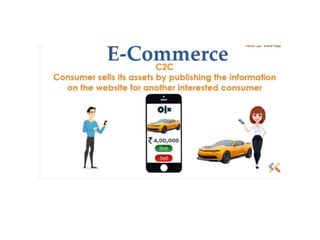
Consumer –To –Consumer (C2C) :
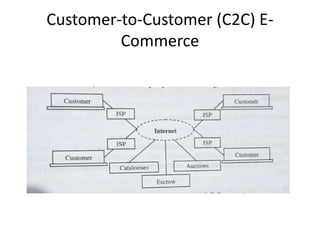
• There are many sites offering free classified ,auctions and forums where
individuals can buy and sell thanks to online payment systems like PayPal
where people can send and receive money online with ease. EBay’s
auction service is a great example of where person to person transections
take place everyday since 1995.
• Typical Services – Free Classifieds and Auctions
Customer-to-Customer (C2C) E-
Commerce
C2C Examples in India
• eBay
• OLX
• Nearbyme
• Kraftly
• Onceagain.com
• Quickr.com
• Touchtalent.com
• Airbnb
• Craiglist.org
• Gittigidiyor.com
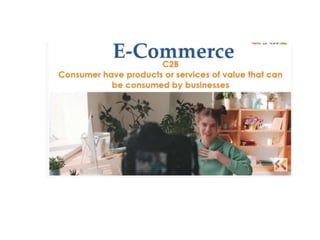
C2B
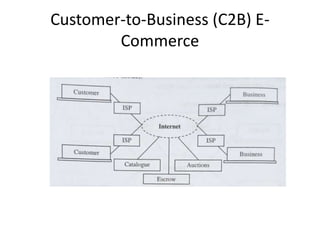
• Customer writes reviews for new product or
gives an useful idea for new product
development , then he /she is creating value
foe the company if the company adopts the
review or idea
• Company can facilitate C2B model by setting
discussions forums on their websites
C2B examples
• www.mobshop.com
• www.pazaryerim.com
• www.priceline.com
Customer-to-Business (C2B) E-
Commerce
Business to Employee (B2E)
• Business provides many services or products
to their employees
• Deliver products /services to employees using
intra-business network (Intranet)
• Example : Employee portal – Communications
, compensation & benefits services
Government to Citizen (G2C)
• E Governance services
• Citizen services like
• Filing Tax returns
• Birth and Death certificates
• Property tax
• Water bill etc
• PWD services
Business to Government (B2G)
• Electronic procurement by Government via
portal like GEMS
Topic3-Ebusiness and ECommerce.pptx

Topic3-Ebusiness and ECommerce.pptx

  • 1.
    Trends in InformationSystems Enterprise Business Systems
  • 2.
  • 3.
    Electronic & EnterpriseBusiness Electronic business (e-business) refers to the use of the Web, Internet, intranets, extranets or some combination thereof to conduct business. E- business is similar to e-commerce, but it goes beyond the simple buying and selling of products and services online. Enterprise business includes a much wider range of businesses processes, such as supply chain management, electronic order processing and customer relationship management. Enterprise business processes, therefore, can help companies to operate more effectively and efficiently.
  • 4.
    Difference between ECommerce and E Business
  • 6.
    Key Differences Betweene-commerce and e-business The points presented below are substantial so far as the difference between e commerce and e-business is concerned: 1. Buying and Selling of goods and services through the internet is known as e- commerce. Unlike e-business, which is an electronic presence of business, by which all the business activities are conducted through the internet. 2. e-commerce is a major component of e-business. 3. e-commerce includes transactions which are related to money, but e-business includes monetary as well as allied activities.
  • 7.
    4. e-commerce hasan extroverted approach that covers customers, suppliers, distributors, etc. On the other hand, e-business has an ambivert approach that covers internal as well as external processes. 5. e-commerce requires a website that can represent the business. Conversely, e-business requires a website, Customer Relationship Management and Enterprise Resource Planning for running the business over the internet. 6. e-commerce uses the internet to connect with the rest of the world. In contrast to e-business, the internet, intranet and extranet are used for connecting with the parties.
  • 8.
    E-Commerce • Trading ofmerchandise, over the internet, is known as E-commerce. • It is a Subset. • It is limited to monetary transactions. • Commercial transactions • The approach is Extroverted. • It requires website. • Internet network is used. E-Business • Running business using the internet is known as E- business. • It is a Superset. • It is not limited to monetary transactions. • Business transactions • The approach is Ambiverted. • It requires Website, CRM, ERP, etc. • Internet, Intranet and Extranet network is used.
  • 9.
    Comparison between Conventional BusinessSystem and E- Enterprise System
  • 10.
    Internet , Intranetand Extranet • Internet – e Commerce • Intranet – Secure use of Internet for company’s own employees like use of Sales CRM , Support CRM , Finance CRM,HRM etc • Extranet – Secure use of Internet for use of limited part of CRM , ERP and SCM by company’s dealers ,suppliers , franchisee , business partners etc
  • 11.
    What are EBusiness Software • ERP , CRM and SCM • While the primary goal of ERP is to improve and streamline internal business processes, CRM attempts to enhance the relationship with customers and SCM aims to facilitate the collaboration between the organization, its suppliers, the manufacturers, the distributors and the partners
  • 12.
  • 13.
  • 14.
    ERP • Enterprise ResourcePlanning (ERP) like SAP,Oracle Financials etc concentrates on the efficiency of the firm’s internal production ,distribution and financial processes
  • 15.
  • 16.
    CRM • Customer RelationshipManagement (CRM)focusses on acquiring and retaining profitable customers via marketing , sales and support services . • Partner Relationship Management (PRM) aims to acquire and retain partners to increase sales and distribution for firm’s products and services
  • 17.
  • 18.
    SCM • Supply ChainManagement (SCM) focusses on developing efficient and effective sourcing and procurement processes with suppliers for the products and services needed by the firm.
  • 19.
    SCM • SCM isthe backbone of e Commerce • SCM starts with delivery of raw materials from suppliers to a manufacturer and ends with delivery of finished product or service to the end customer • Customer is integral part of SCM like ERP and SCM • Supply Chain is integration of Demand and Supply .Demand comes from the customer
  • 20.
  • 21.
    E Business Relationshipsand Differences • The difference between CRM & SCM. ... The primary distinction is that CRM is a marketing process, whereas SCM is a distribution process. With both systems, companies rely on software to facilitate more effective and efficient business activities and gather information to make forecasts. • • Enterprise Resource Planning (ERP) and Customer Relationship Management(CRM) are similar in many ways, as they are both used to increase the overall profitability of a business. These systems overlap in some areas, and can be completely integrated in others
  • 22.
    SCM & ERP •One of the most basic ways to describe the difference between SCM and ERP is that while supply chain management software handles data on incoming raw materials from outside vendors or suppliers, ERP software is much more focused on internal work processes.
  • 23.
    CRM ERP Overlap •Is CRM part of ERP? • Both. As a unique category, CRM normally consists of sales force automation, marketing automation and customer support. As part of ERP, CRM is one of the five ERP pillars, with the other four pillars being financial accounting, distribution or supply chain management, manufacturing and human resources/payroll.
  • 24.
    CRM • 1.Better &Consolidated Data Organization in one place • Capture Sales Leads • Customer Acquisition • Customer Retention • Auto Reminders –Emails alerts to customers on bill payments etc • Capture all leads from all sources and share with sales • Structure Management Data Reports
  • 25.
    Ingredients of anE- Business Solution
  • 26.
    Top 14 MostPopular CRM Software • HubSpot CRM. • Salesforce CRM • Freshsales • Zoho CRM • Pipedrive • bpm'online CRM • amoCRM • vCita
  • 27.
  • 28.
  • 29.
  • 30.
    ERP • ERP isa centralized solution (database and software ) integrating with all functions of the organization - Sales - Inventory - Production Planning - Shop Floor - Finance - Support - HR - Vendors
  • 31.
    Popular ERP Vendors •Microsoft Dynamics • Oracle e-Business Suite • SAGE • SAP Business One • Infor Global Solutions • NetERP from NetSuite • Lawson Software
  • 32.
  • 33.
    Top 10: Supplychain management software companies • 1 – SAP • 2 – Oracle • 3 – JDA • 4 – Infor Global Solutions • 5 – Manhattan Associates • 6 – Epicor Software Corporation • 7 - Descartes Systems Group • 8 – HighJump
  • 34.
  • 36.
    What is e-commerce& m-commerce? The term e-commerce stands for electronic commerce. It is usually abbreviated as e-commerce, but it is sometimes used as ecommerce, e Commerce or simply as EC. The terms e-business or e- tailing are sometimes used as synonyms. The term m Commerce is gradually taking its place as a part of e-commerce that is focused on transactions via mobile devices. E-commerce is the process of buying and selling online. It is a business transaction where the funds and data are transferred through an electronic network. This way, the sales of all kinds of products, both physical and digital, and services are arranged between two participants in the transaction. Depending on those participants, e-commerce includes several types of transactions: • Business to business (B2B) • Business to customer (B2C) • Customer to customer (C2C)
  • 37.
    The Process ofe-commerce • A consumer uses Web browser to connect to the home page of a merchant’s website on the internet • The consumer browses the catalog of the products featured on the site and selects items to purchase. The selected items are placed in the electronic equivalent of a shopping cart. • When the consumer is ready to complete the purchase of selected items, has to provide a bill-to and ship-to address for purchase and delivery
  • 38.
    • When themerchant’s Web server receive this information, it computes the total cost of the order including tax ,shipping, and handling charges and then displays the total to the customer. • The customer can now provide payment information such as a credit card number and then submit the order. • When the credit card number is validated and the order is completed at the Commerce Server Site the merchant’s site displays a receipt confirmation the customer’s purchase. • The Commerce Server Site then forward the order to a processing Network for payment processing and fulfillment.
  • 40.
  • 41.
  • 43.
    Types of E-Commerce Business–to Business (B2B) : • B2B stands for business to business. • Direct sales between Manufacturers and Resellers eliminating Distibutor • Sales Leads , Raw materials for SMEs , Finished goods to Resellers .
  • 44.
  • 45.
    B2B Ecommerce inIndia • India Mart • Trade Mart • AmazonBusiness.in • Power2SME.com • Industrybuying.com • Bizongo.in • Tolexo.com • JustByLive.com
  • 47.
    Business –to-Consumer (B2C): • It is the model taking business and consumer’s interraction.The basic concept of this model is to sell the product online to the customer. • B2C is the direct trade between the company and consumers.it provides direct sell goods and services to customer so that anybody can purchase any products directly from supplier’s website.
  • 48.
  • 49.
    B2C Examples inIndia • Amazon • Flipkart • Snapdeal • Infibeam
  • 51.
    Consumer –To –Consumer(C2C) : • There are many sites offering free classified ,auctions and forums where individuals can buy and sell thanks to online payment systems like PayPal where people can send and receive money online with ease. EBay’s auction service is a great example of where person to person transections take place everyday since 1995. • Typical Services – Free Classifieds and Auctions
  • 52.
  • 53.
    C2C Examples inIndia • eBay • OLX • Nearbyme • Kraftly • Onceagain.com • Quickr.com • Touchtalent.com • Airbnb • Craiglist.org • Gittigidiyor.com
  • 55.
    C2B • Customer writesreviews for new product or gives an useful idea for new product development , then he /she is creating value foe the company if the company adopts the review or idea • Company can facilitate C2B model by setting discussions forums on their websites
  • 56.
    C2B examples • www.mobshop.com •www.pazaryerim.com • www.priceline.com
  • 57.
  • 58.
    Business to Employee(B2E) • Business provides many services or products to their employees • Deliver products /services to employees using intra-business network (Intranet) • Example : Employee portal – Communications , compensation & benefits services
  • 59.
    Government to Citizen(G2C) • E Governance services • Citizen services like • Filing Tax returns • Birth and Death certificates • Property tax • Water bill etc • PWD services
  • 60.
    Business to Government(B2G) • Electronic procurement by Government via portal like GEMS