Changes in Ecosystems:
Ecological Succession
What is Ecological Succession?
• The gradual replacement of one type of plant community by the
other in the development of vegetation towards a climax which
is the culmination stage for a given environment is referred to
as Plant Succession.
• Plant succession is an orderly process of community change in
an unit area
• Natural, gradual changes in the types of species
that live in an area.
• Can be primary or secondary.
• The gradual replacement of one plant community by
another through natural processes over time.
Causes of Succession
The main causes of succession are :
a) Climatic causes
b) Topographic causes ,like erosion
c) Biotic causes like grazing, cultivation
 Depending upon the nature of bare area on
which it develops, the succession may be of two
kinds: Primary and Secondary.
1) Primary succession: When the succession starts
on the extreme bare area on which there was no
previous existence of vegetation it is called
Primary succession or autogenic succession.
 A forest rock surface expose by landslide
 A new lake formed by construction of a dam
4
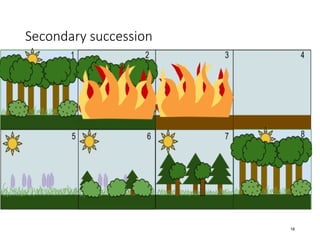
2) Secondary succession: This type of succession
starts on the secondary bare area which was
once occupied by original vegetation but later
become completely devoid of vegetation by any
process of denudation. Secondary succession has
fewer stages than the primary succession and
the climax is reached very quickly in the
secondary succession.
 Clear felled forest areas and abandoned
agriculture field
5
Primary Succession
•Begins in a place without any soil:
•Sides of volcanoes
•Landslides
•Flooding
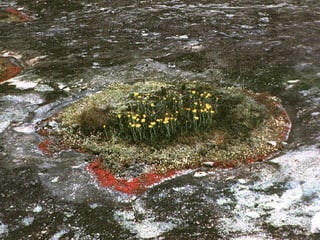
•First, lichens that do not need soil to
survive grow on rocks.
•Next, mosses grow to hold newly made soil
•Known as PIONEER SPECIES:
hardy species which are the first to colonize
previously disrupted or damaged ecosystems.
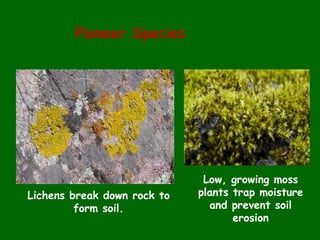
Pioneer Species
Lichens break down rock to
form soil.
Low, growing moss
plants trap moisture
and prevent soil
erosion
Primary Succession
•Soil starts to form as lichens and
the forces of weather and erosion
help break down rocks into smaller
pieces.
•When lichens die, they decompose,
adding small amounts of organic
matter to the rock to make soil.
Primary Succession
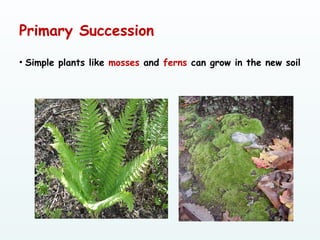
• Simple plants like mosses and ferns can grow in the new soil
Primary Succession
• The simple plants die, adding more organic material
(nutrients) to the soil.
• The soil layer thickens, and grasses, wildflowers, and other
plants begin to take over.
Primary Succession
• These plants die, and they add more nutrients to the soil.
• Shrubs and trees can survive now.
Primary Succession
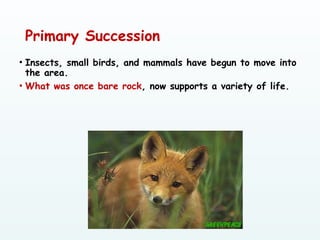
• Insects, small birds, and mammals have begun to move into
the area.
• What was once bare rock, now supports a variety of life.
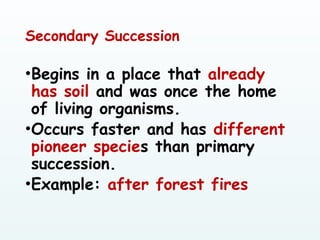
Secondary Succession
•Begins in a place that already
has soil and was once the home
of living organisms.
•Occurs faster and has different
pioneer species than primary
succession.
•Example: after forest fires
Secondary succession
16
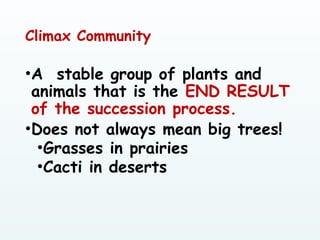
Climax Community
•A stable group of plants and
animals that is the END RESULT
of the succession process.
•Does not always mean big trees!
•Grasses in prairies
•Cacti in deserts
Origin and development of communities
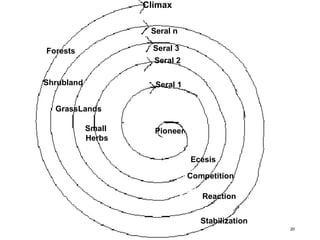
Stage 1. Nudation – exposure of new surface.
Stage2.Migration – arrival of seed/ propogules to area
from neighbouring.
Stage 3. Germination of seed/propogules. When optimum
condition exists.
Stage 4. Ecesis – only few germinated seeds/propogules
establishes successfully. The successful establishment is
called Ecesis.
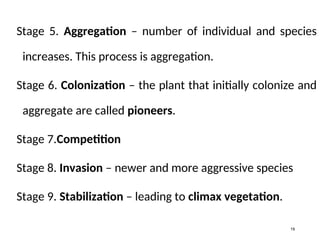
Stage 5. Aggregation – number of individual and species
increases. This process is aggregation.
Stage 6. Colonization – the plant that initially colonize and
aggregate are called pioneers.
Stage 7.Competition
Stage 8. Invasion – newer and more aggressive species
Stage 9. Stabilization – leading to climax vegetation.
19
20
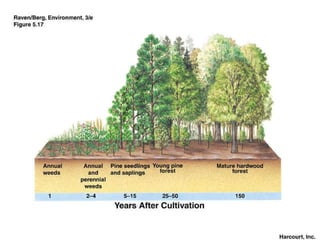
Climax
Seral n
Seral 3
Seral 2
Seral 1
Pioneer
Forests
Shrubland
GrassLands
Small
Herbs
Ecesis
Competition
Reaction
Stabilization
Strategy of Succession
The strategy of succession is mainly based on theory of law of
maximum energy in biological system.
21
22
• In early stage of Ecological succession (young
nature),
• Rate of primary production (Photosynthesis – P)
exceeds the rate of community respiration (R), so
that P/R is > 1.
(a) In heterotrophic succession (development sequ-
ence) R > P
(b) In autotrophic succession P > R
(c) In climax (mature) ecosystem P/R approaches 1.
 Successions which depends upon the moisture
condition of the place.
Xerarch – Dry condition such as bare rock, wind
blown sand, rocky slopes
 Stage –I rocks, in hospitable environment
 Stage –II lichens, mosses- tolerating drought and
production of organic matter
 Stage –III more shrubs
 Stage –IV tolerant trees
23
 Hydrarch succession – wet environment
- Water, wet land, marshy land
 Mesarch succession – moist environment
mainly in deep and texture soils
 Mainly secondary succession
24
Hydrosere: The plant succession which start in the aquatic environment is
called “hydrarch”. A series of changes taking place in the vegetation of
hydrarch is called hydrosere.
b) Halosere: It is special type of sere which begins on a salty soil or in
saline water.
c) Xerosere: When the vegetational succession develops in xeric or dry
habitat, it is called xerarch or xerosere. Xerosere may be of two types:
i) Psammosere: It refers to the vegetational succession that begins
on the sandy habitat.
ii) Lithosere: It refers to succession that occurs on rock surface.
25
Questions
1. What is the difference between primary succession and secondary
succession?
2. What is a pioneer species?
3. What is the role of lichens in primary succession?

ECOLOGICAL SUCCESSIONjtryuuyttyjuhty.ppt

  • 1.
  • 2.
    What is EcologicalSuccession? • The gradual replacement of one type of plant community by the other in the development of vegetation towards a climax which is the culmination stage for a given environment is referred to as Plant Succession. • Plant succession is an orderly process of community change in an unit area • Natural, gradual changes in the types of species that live in an area. • Can be primary or secondary. • The gradual replacement of one plant community by another through natural processes over time.
  • 3.
    Causes of Succession Themain causes of succession are : a) Climatic causes b) Topographic causes ,like erosion c) Biotic causes like grazing, cultivation
  • 4.
     Depending uponthe nature of bare area on which it develops, the succession may be of two kinds: Primary and Secondary. 1) Primary succession: When the succession starts on the extreme bare area on which there was no previous existence of vegetation it is called Primary succession or autogenic succession.  A forest rock surface expose by landslide  A new lake formed by construction of a dam 4
  • 5.
    2) Secondary succession:This type of succession starts on the secondary bare area which was once occupied by original vegetation but later become completely devoid of vegetation by any process of denudation. Secondary succession has fewer stages than the primary succession and the climax is reached very quickly in the secondary succession.  Clear felled forest areas and abandoned agriculture field 5
  • 6.
    Primary Succession •Begins ina place without any soil: •Sides of volcanoes •Landslides •Flooding •First, lichens that do not need soil to survive grow on rocks. •Next, mosses grow to hold newly made soil •Known as PIONEER SPECIES: hardy species which are the first to colonize previously disrupted or damaged ecosystems.
  • 7.
    Pioneer Species Lichens breakdown rock to form soil. Low, growing moss plants trap moisture and prevent soil erosion
  • 8.
    Primary Succession •Soil startsto form as lichens and the forces of weather and erosion help break down rocks into smaller pieces. •When lichens die, they decompose, adding small amounts of organic matter to the rock to make soil.
  • 10.
    Primary Succession • Simpleplants like mosses and ferns can grow in the new soil
  • 11.
    Primary Succession • Thesimple plants die, adding more organic material (nutrients) to the soil. • The soil layer thickens, and grasses, wildflowers, and other plants begin to take over.
  • 12.
    Primary Succession • Theseplants die, and they add more nutrients to the soil. • Shrubs and trees can survive now.
  • 13.
    Primary Succession • Insects,small birds, and mammals have begun to move into the area. • What was once bare rock, now supports a variety of life.
  • 15.
    Secondary Succession •Begins ina place that already has soil and was once the home of living organisms. •Occurs faster and has different pioneer species than primary succession. •Example: after forest fires
  • 16.
  • 17.
    Climax Community •A stablegroup of plants and animals that is the END RESULT of the succession process. •Does not always mean big trees! •Grasses in prairies •Cacti in deserts
  • 18.
    Origin and developmentof communities Stage 1. Nudation – exposure of new surface. Stage2.Migration – arrival of seed/ propogules to area from neighbouring. Stage 3. Germination of seed/propogules. When optimum condition exists. Stage 4. Ecesis – only few germinated seeds/propogules establishes successfully. The successful establishment is called Ecesis.
  • 19.
    Stage 5. Aggregation– number of individual and species increases. This process is aggregation. Stage 6. Colonization – the plant that initially colonize and aggregate are called pioneers. Stage 7.Competition Stage 8. Invasion – newer and more aggressive species Stage 9. Stabilization – leading to climax vegetation. 19
  • 20.
    20 Climax Seral n Seral 3 Seral2 Seral 1 Pioneer Forests Shrubland GrassLands Small Herbs Ecesis Competition Reaction Stabilization
  • 21.
    Strategy of Succession Thestrategy of succession is mainly based on theory of law of maximum energy in biological system. 21
  • 22.
    22 • In earlystage of Ecological succession (young nature), • Rate of primary production (Photosynthesis – P) exceeds the rate of community respiration (R), so that P/R is > 1. (a) In heterotrophic succession (development sequ- ence) R > P (b) In autotrophic succession P > R (c) In climax (mature) ecosystem P/R approaches 1.
  • 23.
     Successions whichdepends upon the moisture condition of the place. Xerarch – Dry condition such as bare rock, wind blown sand, rocky slopes  Stage –I rocks, in hospitable environment  Stage –II lichens, mosses- tolerating drought and production of organic matter  Stage –III more shrubs  Stage –IV tolerant trees 23
  • 24.
     Hydrarch succession– wet environment - Water, wet land, marshy land  Mesarch succession – moist environment mainly in deep and texture soils  Mainly secondary succession 24
  • 25.
    Hydrosere: The plantsuccession which start in the aquatic environment is called “hydrarch”. A series of changes taking place in the vegetation of hydrarch is called hydrosere. b) Halosere: It is special type of sere which begins on a salty soil or in saline water. c) Xerosere: When the vegetational succession develops in xeric or dry habitat, it is called xerarch or xerosere. Xerosere may be of two types: i) Psammosere: It refers to the vegetational succession that begins on the sandy habitat. ii) Lithosere: It refers to succession that occurs on rock surface. 25
  • 26.
    Questions 1. What isthe difference between primary succession and secondary succession? 2. What is a pioneer species? 3. What is the role of lichens in primary succession?