
Ecology of Individuals and
Populations
Factors that Regulate
Populations
Basilan, Glecy B.
Orenday, Johnrey V.
Ugtuhan, Carren P.
BS Biology III
Basilan | Orenday | Ugtuhan | (c) 2014 1
IMPORTANT TERMINOLOGIES
 Population
 Community
 Density
 Natality
 Mortality
 Biotic factors
 Carrying capacity
Basilan | Orenday | Ugtuhan | (c) 2014 2
Factors Regulating
Population Size
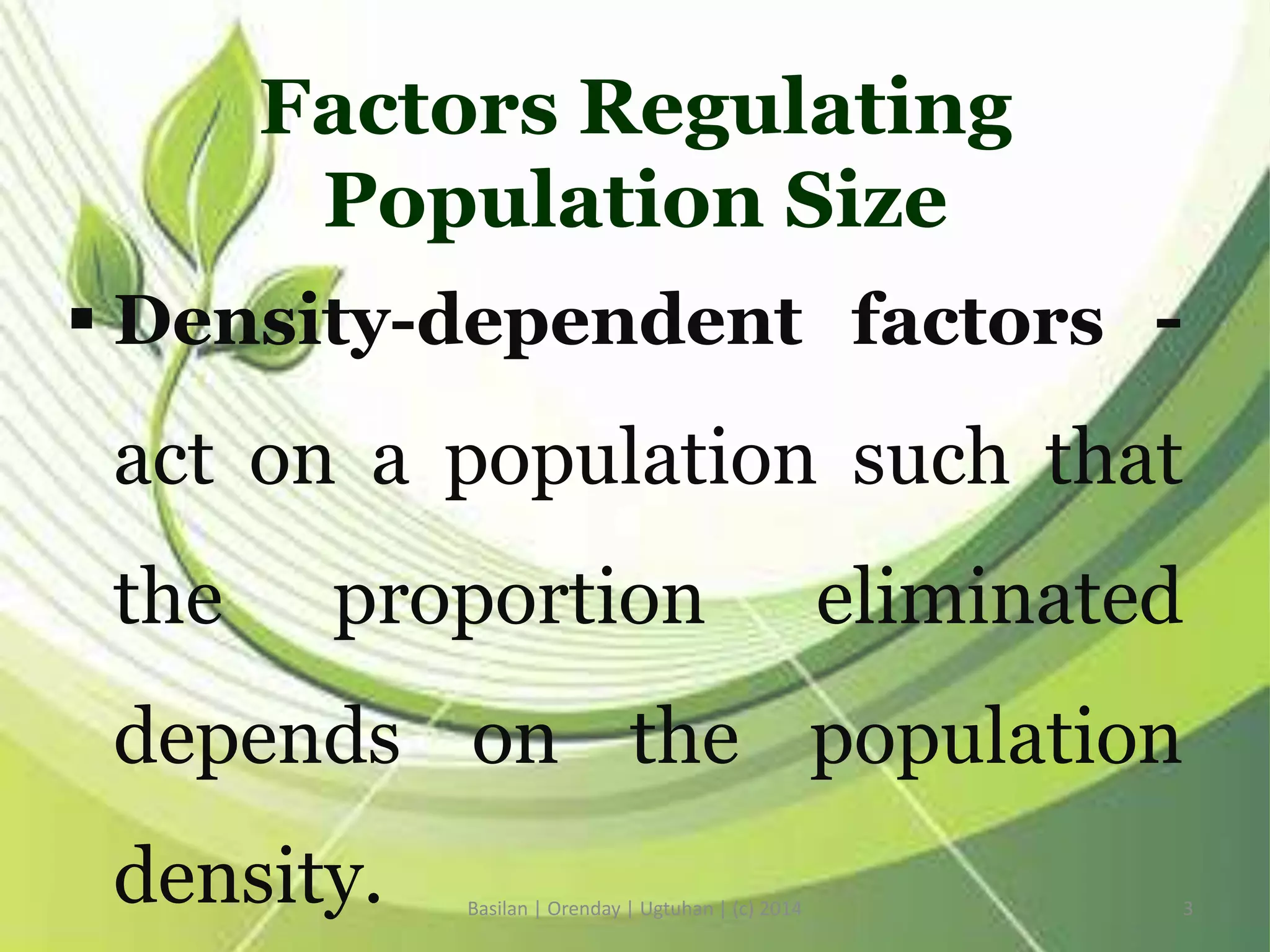
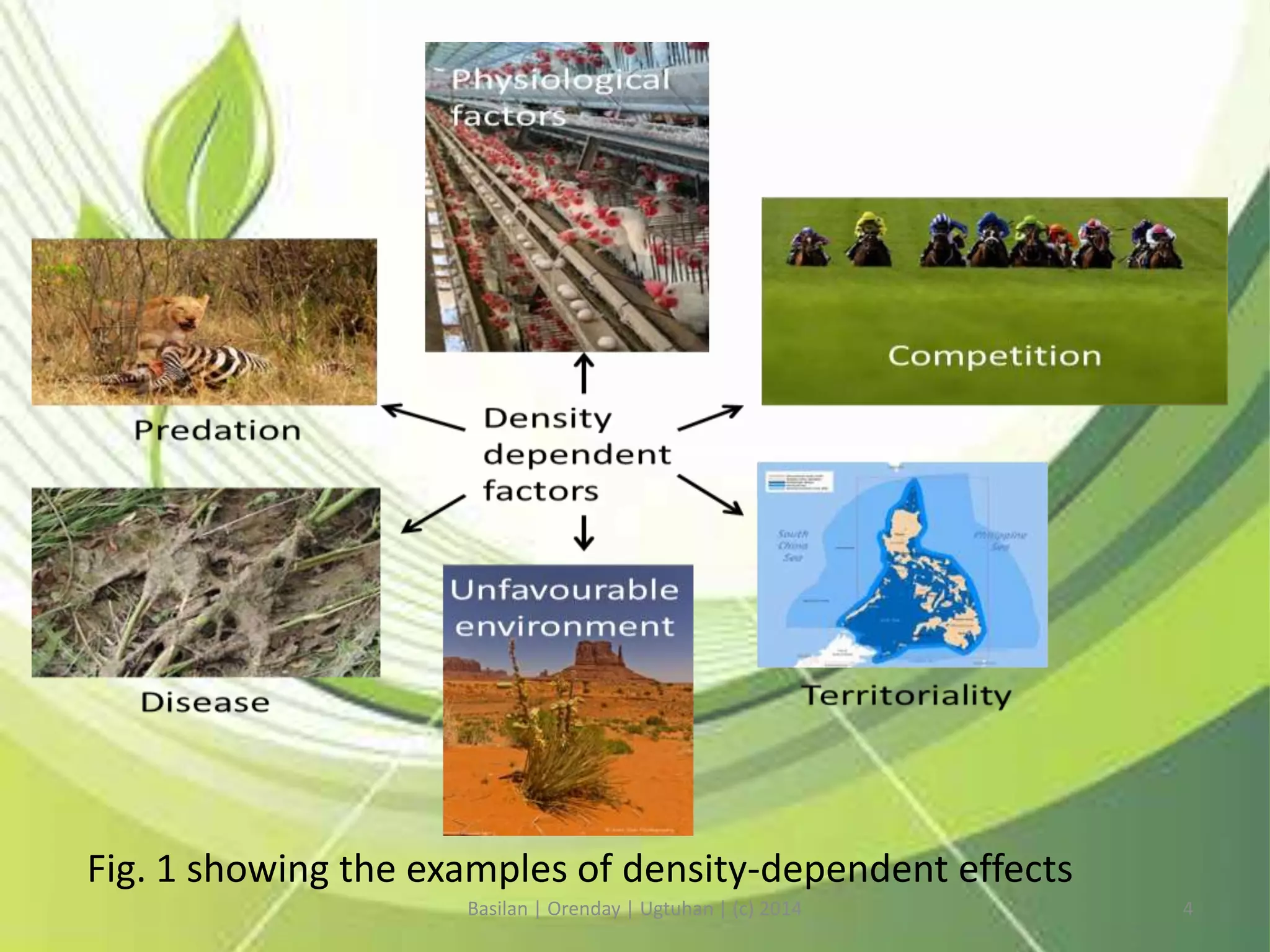
 Density-dependent factors -
act on a population such that
the proportion eliminated
depends on the population
density. Basilan | Orenday | Ugtuhan | (c) 2014 3
Fig. 1 showing the examples of density-dependent effects
Basilan | Orenday | Ugtuhan | (c) 2014 4
Factors Regulating
Population Size
 Density-independent - factors
that eliminate a proportion of a
population regardless of
population density.
Basilan | Orenday | Ugtuhan | (c) 2014 5
Density-independent
factors
• Forest fire
• Modification of weather
conditions
• Severe storm and flooding
• Earthquakes and volcanic
eruptions
Basilan | Orenday | Ugtuhan | (c) 2014 6
Fig. 2 showing the examples of density-independent effect –
Forest fire Basilan | Orenday | Ugtuhan | (c) 2014 7
“Resource availability affects life
history adaptations.”
Basilan | Orenday | Ugtuhan | (c) 2014 8
TWO TYPES OF LIFE
STRATEGIES
• K-selected species (Equilibrium)
• Characteristics of r-selected
species (Opportunist)
Basilan | Orenday | Ugtuhan | (c) 2014 9
Characteristics of K-selected
species (Equilibrium)
 late maturation
 longer life spans
 more parental care
 intense competition for resources
Basilan | Orenday | Ugtuhan | (c) 2014 10
Characteristics of r-selected
species (Opportunist)
 early maturation
 shorter life spans
 less parental care
 little competition for resources
Basilan | Orenday | Ugtuhan | (c) 2014 11

Factors that regulate population ppt presentation

  • 1.
    Ecology of Individualsand Populations Factors that Regulate Populations Basilan, Glecy B. Orenday, Johnrey V. Ugtuhan, Carren P. BS Biology III Basilan | Orenday | Ugtuhan | (c) 2014 1
  • 2.
    IMPORTANT TERMINOLOGIES  Population Community  Density  Natality  Mortality  Biotic factors  Carrying capacity Basilan | Orenday | Ugtuhan | (c) 2014 2
  • 3.
    Factors Regulating Population Size Density-dependent factors - act on a population such that the proportion eliminated depends on the population density. Basilan | Orenday | Ugtuhan | (c) 2014 3
  • 4.
    Fig. 1 showingthe examples of density-dependent effects Basilan | Orenday | Ugtuhan | (c) 2014 4
  • 5.
    Factors Regulating Population Size Density-independent - factors that eliminate a proportion of a population regardless of population density. Basilan | Orenday | Ugtuhan | (c) 2014 5
  • 6.
    Density-independent factors • Forest fire •Modification of weather conditions • Severe storm and flooding • Earthquakes and volcanic eruptions Basilan | Orenday | Ugtuhan | (c) 2014 6
  • 7.
    Fig. 2 showingthe examples of density-independent effect – Forest fire Basilan | Orenday | Ugtuhan | (c) 2014 7
  • 8.
    “Resource availability affectslife history adaptations.” Basilan | Orenday | Ugtuhan | (c) 2014 8
  • 9.
    TWO TYPES OFLIFE STRATEGIES • K-selected species (Equilibrium) • Characteristics of r-selected species (Opportunist) Basilan | Orenday | Ugtuhan | (c) 2014 9
  • 10.
    Characteristics of K-selected species(Equilibrium)  late maturation  longer life spans  more parental care  intense competition for resources Basilan | Orenday | Ugtuhan | (c) 2014 10
  • 11.
    Characteristics of r-selected species(Opportunist)  early maturation  shorter life spans  less parental care  little competition for resources Basilan | Orenday | Ugtuhan | (c) 2014 11