VRINDA VINOD
I MSC BOTANY
SN COLLEGE KOLLAM
ECOLOGICAL SUCCESSION
Ecological succession
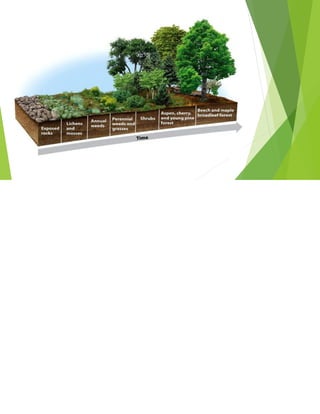
 Ecological succession is the orderly appearance and
disappearance of communities or ecosystems in an area in
regular succession,until an equilibrium state is attained or
a stable final community is established.
 It is the sequential replacement of communities and it
culminates in a stable climax with high biomass,complex
species interaction and maximum energy flow .
 It is natural ecological as well as evolutionary process by
which an area gets successively colonized by different
communities,until a stable and complex final community
is established
Types of Successional communities
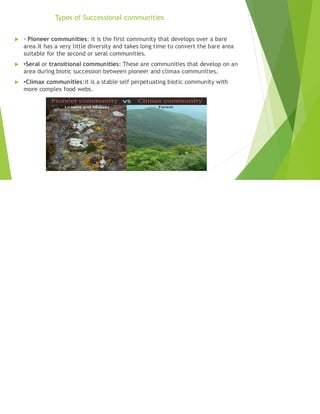
 Pioneer communities: it is the first community that develops over a bare
area.It has a very little diversity and takes long time to convert the bare area
suitable for the second or seral communities.
 Seral or transitional communities: These are communities that develop on an
area during biotic succession between pioneer and climax communities.
 Climax communities:it is a stable self perpetuating biotic community with
more complex food webs.
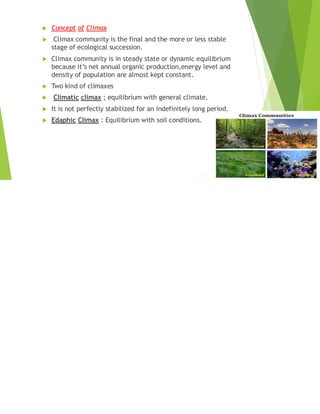
 Concept of Climax
 Climax community is the final and the more or less stable
stage of ecological succession.
 Climax community is in steady state or dynamic equilibrium
because it’s net annual organic production,energy level and
density of population are almost kept constant.
 Two kind of climaxes
 Climatic climax ; equilibrium with general climate.
 It is not perfectly stabilized for an indefinitely long period.
 Edaphic Climax : Equilibrium with soil conditions.
Mechanism of ecological succession
 Mechanism of ecological succession involves a
continuous, sequential and unidirectional change in
the species composition of a natural community.
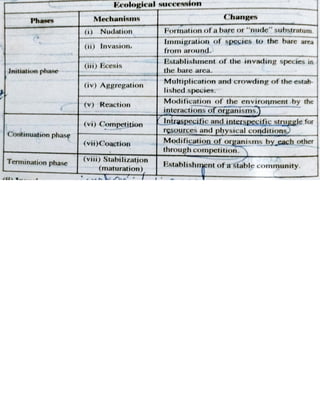
 It is completed in three broad phases by the operation
of eight major mechanisms.
 The three phases are ;-
 1.Initiation phase
 2.Continuation phase
 3.Termination phase
 The major mechanisms responsible for ecological
succession include;-
 1.NUDATION
 2.INVASION
 3.ECESIS
 4.AGGREGATION
 5.COMPETITION
 6. COACTION
 7.REACTION
 8.STABILISATION/ MATURATION
Types of Ecological succession
 1.Primary & Secondary succession (Based on
starting)
 2.Autogenic and Allogenic succesion (Based on
Cause)
 3.Autotrophic and heterotrophic Succession
(Based on community)
 4.Hydrosere and Xerosere( Based on substratum)
 PRIMARY SUCCESSION
 . Starts from an area where there was no previous
living matter.
 . Example –succession on bare rock, newly dug out
pond etc
 . First community establishing the new area-
pioneer community (lichen, phytoplankton)
 . Relatively slow and long term process
 . Seral stages of primary succesion are called
primary seres/priseres.
 SECONDARY SUCCESSION
 . Starts from a previously built-up substratum(already
existing living matter)
 . Sudden changes causes the disappearance of the existing
community.
 Example –fire, snowfall, biotic interventions
 . Thus the area leaving very few organisms and plenty of
organic matter.
 . Relatively short tern process and faster than primary
succesion because nutrients are already available and
environmental conditions are more favourable.
 The seral stages of secondary succession are called
secondary seres or sub-seres.
 Example –succession on fire destroyed grasslands, cleared
forests etc.
Based on Cause :
 Autogenic / Biotic succession
 It is self driven and it involves the interaction
btw organisms and their environment.
 Allogenic succesion
 Replacement of existing community by external
conditions and not by the existing organisms.
 This is common in polluted ponds, areas of
massive soil erosion etc.
Based on Community :
 Autotrophic succession
 Mainly green plants are the dominant species.
 Heterotrophic succession
 Detritivorous heterotrophs are the dominant
species (eg:Bacteria, fungi, animals)
Based on medium and substratum

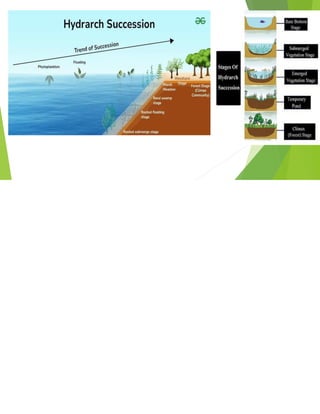
 Hydrarch succession(Hydrosere)
 . Ecological succession in stagnant fresh water bodies,
such as pools, ponds, lakes, marshes, swamps etc.
 Starts with the colonisation of the water body by
phytoplanktons which form the pioneer community. From
this stage onwards, succsssion proceeds to climax stage,
represented by large trees or forest.
 Different stages of hydrosere are:-
 Phytoplankton stage Rooted submerged stage Rooted
floating stage Reed-swamp stage sedge-meadow
stage woodland stage forest stage.
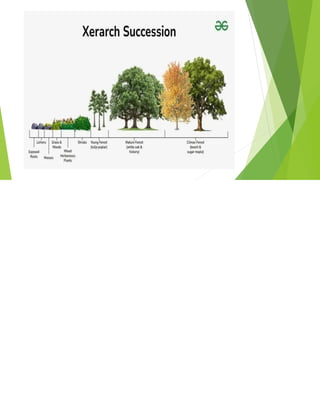
 XEROSERE (xerarch succession)
 Ecological succession in xeric (dry habitats)such as bare
rocks, wind –blown sand, rocky slopes, etc where there
is an extreme scarcity of water is termed as xerarch
succession.
 It is of two kinds.
 A)lithosere : succession on bare rocks
 b)psammosere : succession in sandy deserts.
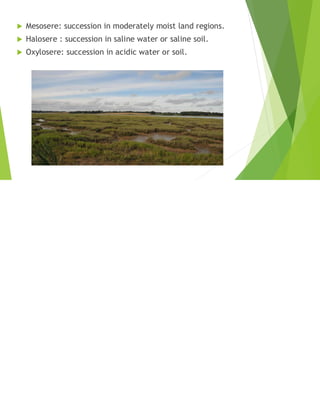
 Mesosere: succession in moderately moist land regions.
 Halosere : succession in saline water or saline soil.
 Oxylosere: succession in acidic water or soil.
Ecological succession,types , mechanism,example

Ecological succession,types , mechanism,example

  • 1.
    VRINDA VINOD I MSCBOTANY SN COLLEGE KOLLAM ECOLOGICAL SUCCESSION
  • 2.
    Ecological succession  Ecologicalsuccession is the orderly appearance and disappearance of communities or ecosystems in an area in regular succession,until an equilibrium state is attained or a stable final community is established.  It is the sequential replacement of communities and it culminates in a stable climax with high biomass,complex species interaction and maximum energy flow .  It is natural ecological as well as evolutionary process by which an area gets successively colonized by different communities,until a stable and complex final community is established
  • 4.
    Types of Successionalcommunities  Pioneer communities: it is the first community that develops over a bare area.It has a very little diversity and takes long time to convert the bare area suitable for the second or seral communities.  Seral or transitional communities: These are communities that develop on an area during biotic succession between pioneer and climax communities.  Climax communities:it is a stable self perpetuating biotic community with more complex food webs.
  • 5.
     Concept ofClimax  Climax community is the final and the more or less stable stage of ecological succession.  Climax community is in steady state or dynamic equilibrium because it’s net annual organic production,energy level and density of population are almost kept constant.  Two kind of climaxes  Climatic climax ; equilibrium with general climate.  It is not perfectly stabilized for an indefinitely long period.  Edaphic Climax : Equilibrium with soil conditions.
  • 6.
    Mechanism of ecologicalsuccession  Mechanism of ecological succession involves a continuous, sequential and unidirectional change in the species composition of a natural community.  It is completed in three broad phases by the operation of eight major mechanisms.  The three phases are ;-  1.Initiation phase  2.Continuation phase  3.Termination phase
  • 7.
     The majormechanisms responsible for ecological succession include;-  1.NUDATION  2.INVASION  3.ECESIS  4.AGGREGATION  5.COMPETITION  6. COACTION  7.REACTION  8.STABILISATION/ MATURATION
  • 9.
    Types of Ecologicalsuccession  1.Primary & Secondary succession (Based on starting)  2.Autogenic and Allogenic succesion (Based on Cause)  3.Autotrophic and heterotrophic Succession (Based on community)  4.Hydrosere and Xerosere( Based on substratum)
  • 10.
     PRIMARY SUCCESSION . Starts from an area where there was no previous living matter.  . Example –succession on bare rock, newly dug out pond etc  . First community establishing the new area- pioneer community (lichen, phytoplankton)  . Relatively slow and long term process  . Seral stages of primary succesion are called primary seres/priseres.
  • 11.
     SECONDARY SUCCESSION . Starts from a previously built-up substratum(already existing living matter)  . Sudden changes causes the disappearance of the existing community.  Example –fire, snowfall, biotic interventions  . Thus the area leaving very few organisms and plenty of organic matter.  . Relatively short tern process and faster than primary succesion because nutrients are already available and environmental conditions are more favourable.  The seral stages of secondary succession are called secondary seres or sub-seres.  Example –succession on fire destroyed grasslands, cleared forests etc.
  • 12.
    Based on Cause:  Autogenic / Biotic succession  It is self driven and it involves the interaction btw organisms and their environment.  Allogenic succesion  Replacement of existing community by external conditions and not by the existing organisms.  This is common in polluted ponds, areas of massive soil erosion etc.
  • 13.
    Based on Community:  Autotrophic succession  Mainly green plants are the dominant species.  Heterotrophic succession  Detritivorous heterotrophs are the dominant species (eg:Bacteria, fungi, animals)
  • 14.
    Based on mediumand substratum   Hydrarch succession(Hydrosere)  . Ecological succession in stagnant fresh water bodies, such as pools, ponds, lakes, marshes, swamps etc.  Starts with the colonisation of the water body by phytoplanktons which form the pioneer community. From this stage onwards, succsssion proceeds to climax stage, represented by large trees or forest.  Different stages of hydrosere are:-  Phytoplankton stage Rooted submerged stage Rooted floating stage Reed-swamp stage sedge-meadow stage woodland stage forest stage.
  • 16.
     XEROSERE (xerarchsuccession)  Ecological succession in xeric (dry habitats)such as bare rocks, wind –blown sand, rocky slopes, etc where there is an extreme scarcity of water is termed as xerarch succession.  It is of two kinds.  A)lithosere : succession on bare rocks  b)psammosere : succession in sandy deserts.
  • 18.
     Mesosere: successionin moderately moist land regions.  Halosere : succession in saline water or saline soil.  Oxylosere: succession in acidic water or soil.