ECOLOGICAL FOOTPRINT
By
Elegbeleye Oladipo Ayodamope
OUTLINE
 INTRODUCTION
 OBJECTIVES
 BODY
 CONCLUSION
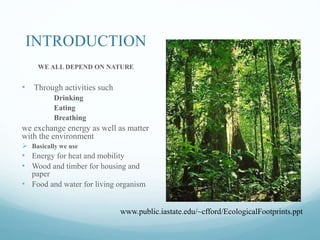
INTRODUCTION
WE ALL DEPEND ON NATURE
• Through activities such
Drinking
Eating
Breathing
we exchange energy as well as matter
with the environment
 Basically we use
• Energy for heat and mobility
• Wood and timber for housing and
paper
• Food and water for living organism
www.public.iastate.edu/~cfford/EcologicalFootprints.ppt
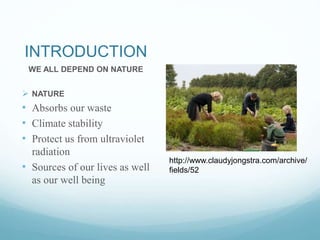
INTRODUCTION
WE ALL DEPEND ON NATURE
 NATURE
• Absorbs our waste
• Climate stability
• Protect us from ultraviolet
radiation
• Sources of our lives as well
as our well being
http://www.claudyjongstra.com/archive/
fields/52
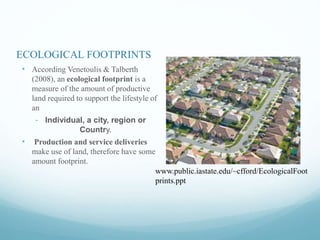
ECOLOGICAL FOOTPRINTS
• According Venetoulis & Talberth
(2008), an ecological footprint is a
measure of the amount of productive
land required to support the lifestyle of
an
- Individual, a city, region or
Country.
• Production and service deliveries
make use of land, therefore have some
amount footprint.
www.public.iastate.edu/~cfford/EcologicalFoot
prints.ppt
ECOLOGICAL
FOOTPRINT
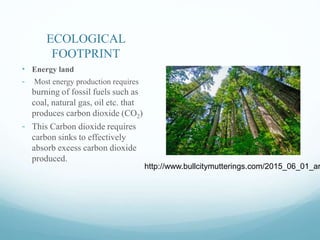
• Energy land
- Most energy production requires
burning of fossil fuels such as
coal, natural gas, oil etc. that
produces carbon dioxide (CO2)
- This Carbon dioxide requires
carbon sinks to effectively
absorb excess carbon dioxide
produced.
http://www.bullcitymutterings.com/2015_06_01_ar
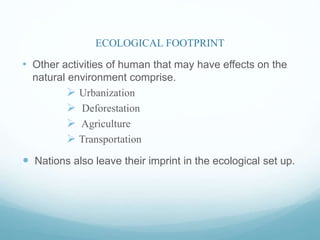
ECOLOGICAL FOOTPRINT
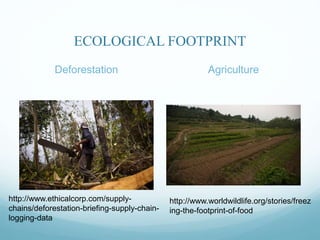
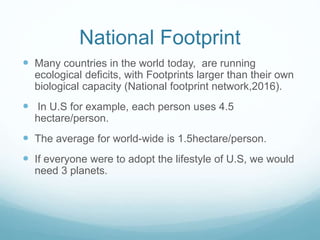
• Other activities of human that may have effects on the
natural environment comprise.
 Urbanization
 Deforestation
 Agriculture
 Transportation
 Nations also leave their imprint in the ecological set up.
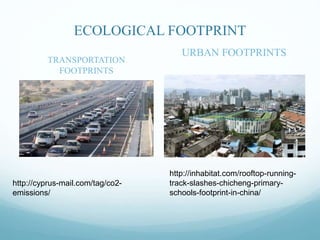
ECOLOGICAL FOOTPRINT
TRANSPORTATION
FOOTPRINTS
URBAN FOOTPRINTS
http://cyprus-mail.com/tag/co2-
emissions/
http://inhabitat.com/rooftop-running-
track-slashes-chicheng-primary-
schools-footprint-in-china/
ECOLOGICAL FOOTPRINT
Deforestation Agriculture
http://www.worldwildlife.org/stories/freez
ing-the-footprint-of-food
http://www.ethicalcorp.com/supply-
chains/deforestation-briefing-supply-chain-
logging-data
National Footprint
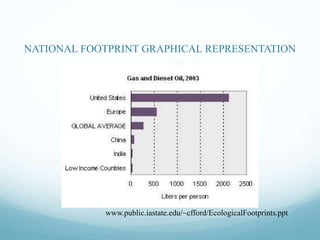
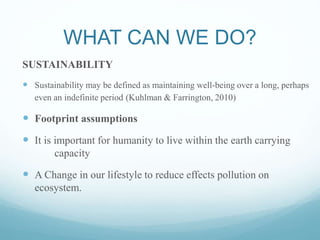
 Many countries in the world today, are running
ecological deficits, with Footprints larger than their own
biological capacity (National footprint network,2016).
 In U.S for example, each person uses 4.5
hectare/person.
 The average for world-wide is 1.5hectare/person.
 If everyone were to adopt the lifestyle of U.S, we would
need 3 planets.
NATIONAL FOOTPRINT GRAPHICAL REPRESENTATION
www.public.iastate.edu/~cfford/EcologicalFootprints.ppt
WHAT CAN WE DO?
SUSTAINABILITY
 Sustainability may be defined as maintaining well-being over a long, perhaps
even an indefinite period (Kuhlman & Farrington, 2010)
 Footprint assumptions
 It is important for humanity to live within the earth carrying
capacity
 A Change in our lifestyle to reduce effects pollution on
ecosystem.
WHAT CAN WE
DO?
• We should resort to other sources of
energy other fossil fuels.
• Moving towards solar energy would
reduce our footprint
http://www.bdlive.co.za/business/energy/2013/10/
16/eskom-secures-r1.3bn-to-build-solar-power-
plant
WHAT CAN WE
DO?
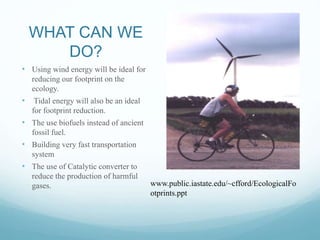
• Using wind energy will be ideal for
reducing our footprint on the
ecology.
• Tidal energy will also be an ideal
for footprint reduction.
• The use biofuels instead of ancient
fossil fuel.
• Building very fast transportation
system
• The use of Catalytic converter to
reduce the production of harmful
gases. www.public.iastate.edu/~cfford/EcologicalFo
otprints.ppt

Ecological foot print