ENVIRONMENTAL SCIENCE
TOPIC- ECOLOGICAL FOOTPRINTS
CERTIFICATE
This is to certify that Miss. RUCHI MANKAR of
Government College of Engineering
Aurangabad. Branch ‘Mechanical Engineering’
Year SE has successfully completed Research
on Project titled ‘ECOLOGICAL
FOOTPRINTS’ under the guidance of
Prof.V.R.Potdar during the academic year 2018-
19.
EXAMINAR SIGNATURE
INDEX
• INTRODUCTION
• OBJECTIVES
• DEFINATIONS
• TYPES
• REVIEW LITERATURE
• GRAPHICAL REPRESENTATIONS
• METHODOLOGY
• SUGGESTIONS
• RESULTS
• SUMMARY
• DISCUSSION
• CONCLUSION
• BIBLIOGRAPHY
OBJECTIVES
• Understand that consciously or unconsciously
footprints everyday actions leave a footprints on the
earth and there are things that can be done to
reduce this footprints both in their own lives ,and
how their world operates
• Develop a list of individual personal lifestyle changes
to reduce their footprints.
• Develop ideas to changing the communityto make it
easier for more people to leave less of a footprints in
their daily lives.
REVIEW LITERATURE
• Before embarking on to the study of any area of interest
it is essential to look into the pertinent work previously
done on it. Since it gives a fabulous insight about the
topic and gives way to mend away the lacunae left in the
process of exploration of the research study. It helps in
finding of the New horizons of our field of research.
• There is a fair amount of literature on Ecological
footprints almost in every country there is a attention to
the concept.
• There is a footprints quiz on www.myfootprient.org
ECOLOGICAL FOOTPRINTS -
• ‘’EARTH PROVIDES ENOUGH TO SATISFY
EVERY MAN NEEDS BUT’S NOT EVERY MAN’S
GREED.
• Introduction- The climate changes along with the
degradation of the environment is mainly due to
over usage of natural resources .certain
strategies and methodology of accounting the
ongoing depletion has been formulated .the
concept of ecological footprints is a such which
is use to manage the nature reserves while
reducing the nation demand on ecosystem
We Depend on Nature
• Nature
– Absorbs our wastes
– Provides climate stability
– Protects us from ultraviolet
radiation
• In cities we tend to think of nature
as a collection of commodities we
obtain from around the world
• But nature is the very source of our
lives and well being
Ecological Footprints
The amount of
ecologically
productive land
used by
individuals, cities,
countries, etc.
Production and
use of goods and
services involve
land use: have
ecological
footprints
Ecological Footprints
• Energy Land
– Fossil energy
consumption requires
Co2 sink
Ecological Footprints
Consumed Land
Built environment
Ecological Footprints
• Farm Land
– Food
production
Ecological Footprints
• Forest Land
– forest
products
Transportation Footprints
• If one person travels 5
kilometers twice each
workday:
– Bicycle: 122 sq
meters
– Buses : 301 sq
meters
– Cars: 1,442 sq
meters
Agricultural Footprints
• Open Field production of
tomatoes takes up more land
than greenhouse production
• But Greenhouse production
has a much larger ecological
footprint (10-20x)
– Energy
– Fertilizer
– Other inputs
Urban Footprints
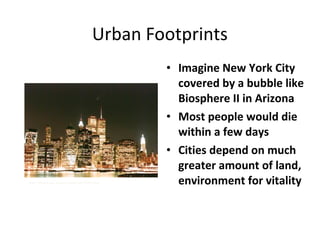
• Imagine New York City
covered by a bubble like
Biosphere II in Arizona
• Most people would die
within a few days
• Cities depend on much
greater amount of land,
environment for vitalityhttp://antwrp.gsfc.nasa.gov/apod/ap970408.html
Urban Footprints
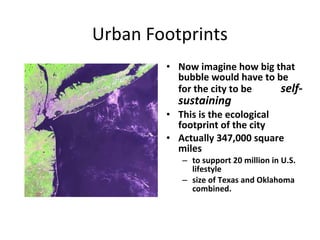
• Now imagine how big that
bubble would have to be
for the city to be self-
sustaining
• This is the ecological
footprint of the city
• Actually 347,000 square
miles
– to support 20 million in U.S.
lifestyle
– size of Texas and Oklahoma
combined.
National Footprints
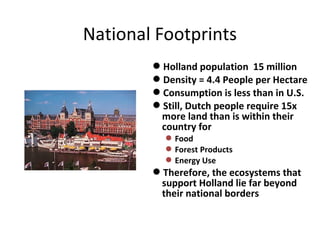
Holland population 15 million
Density = 4.4 People per Hectare
Consumption is less than in U.S.
Still, Dutch people require 15x
more land than is within their
country for
Food
Forest Products
Energy Use
Therefore, the ecosystems that
support Holland lie far beyond
their national borders
National Footprints
• In U.S. each person uses about 4.5
hectares/person
• Worldwide average = 1.5 hectares/person
• Therefore if everybody were to adopt the U.S.
consumptive style, we would need 3 planets
Iowa Footprint
• Iowa Population is
2,776,000
• U.S. average footprint is 4.5
hectares/person
• Iowans need 12.5 million
hectares of average land to
support themselves
• Iowa area is 14.5 million
hectares
• Therefore we can support
at least another 444,000
Americans
Inequity
• We all compete for
ecologically overloaded
world
• Excess consumption by
affluent countries takes up
ecological footprint that
would be used by poorer
nations
http://www.thesavvytraveller.com/agraphics/insights/geography/1ge
neral/photoessays/dalusio_menzel/material_world.jpg
Resource Distribution
• Wealthiest 25% of the world
uses 75% of the world’s
resources
• If four people landed on an
island, could divide the land
up into 4 equal sections,
trade goods.
• Is it fair if one of those
people claims ¾ of the land,
forcing the other 3 to live off
of ¼ of the land?
Can everyone live like we do?
No. There is not enough
earth to support it
Thus all poor countries
cannot follow the miracle of
developed countries
Someone must bear the
ecological burden of
consumption by the affluent
Our continued over-
consumption hits the poor
hardest
METHODOLOGY
• Literature based methodology is very helpful as one can easily
get scientific information regarding their topics without actual
carrying out experiments.
• The 2008 edition of the national footprints account calculates
the ecological footprints and bio capacity for 201 countries.
• The Ecological footprints is calculated by the following
equation:
• ECOLOGICAL FOOTPRINTS = ( annual demand in terms in
tones / national yield in annual tones per ha) in to yield
factor in to equivalence factor.
STRENGTHS AND LIMITATIONS -
• Strengths – Didactic strength and Easy to
communicate.
• Weakness –Not suitable to support policy
making and choice of CO2 Emission is
subjective
Answer to Science
• Footprint analysis may not
tell whole story
• Is good enough to show us
what must be done
• Newtonian physics good
enough to get us to moon
• Avoid paralysis by analysis
• Footprints may actually
underestimate impact of
humans on environment
Aurangabad region
Natural Capital: Forests
http://www.iisd.org/wcfsd/worldmap.jpg
South
America
Europe
East
Asia
Technology Fix Objection
• For hundreds of years
people have worried that
we would run out of
resources
• Technological revolution has
increased abundance and
lowered prices of goods and
services
• Thus one farmer produces
more than 200 farmers did
200 years ago
What Should We Do?
I asked the author of this
book what kind of technology
research he thought the
universities should be doing
Answer: Research to help us
reduce our ecological
footprint without reducing
our standard of living:
sustainability
RESULT:-
The ecological footprints is designed to calculated the biosphere
regenerative capacity is occupied bye human activities
SUMMARY:-
In this project we have seen that :-
1. What is ecological footprint
3. Types of ecological footprints
4. Method of control to reduced footprints.
5. Effect of ecological footprints
DISCUSSION
We know the various factors of ecological
footprints
and their effects on environment. Therefore
the method which are suggested in above are
essential for footprints.
CONCLUSION:-
By this project we conclude that :
1. Various causes of ecological footprints.
2. Controlled methods for reducing .
BIBLIOGRAPHY:-
1. Wikipedia.org
2. Livescience.com
3. Google images
4. Buzzle.com
5. Google my footprints .org .in.
6.

ecological footprinting

  • 1.
  • 2.
    CERTIFICATE This is tocertify that Miss. RUCHI MANKAR of Government College of Engineering Aurangabad. Branch ‘Mechanical Engineering’ Year SE has successfully completed Research on Project titled ‘ECOLOGICAL FOOTPRINTS’ under the guidance of Prof.V.R.Potdar during the academic year 2018- 19. EXAMINAR SIGNATURE
  • 3.
    INDEX • INTRODUCTION • OBJECTIVES •DEFINATIONS • TYPES • REVIEW LITERATURE • GRAPHICAL REPRESENTATIONS • METHODOLOGY • SUGGESTIONS • RESULTS • SUMMARY • DISCUSSION • CONCLUSION • BIBLIOGRAPHY
  • 4.
    OBJECTIVES • Understand thatconsciously or unconsciously footprints everyday actions leave a footprints on the earth and there are things that can be done to reduce this footprints both in their own lives ,and how their world operates • Develop a list of individual personal lifestyle changes to reduce their footprints. • Develop ideas to changing the communityto make it easier for more people to leave less of a footprints in their daily lives.
  • 5.
    REVIEW LITERATURE • Beforeembarking on to the study of any area of interest it is essential to look into the pertinent work previously done on it. Since it gives a fabulous insight about the topic and gives way to mend away the lacunae left in the process of exploration of the research study. It helps in finding of the New horizons of our field of research. • There is a fair amount of literature on Ecological footprints almost in every country there is a attention to the concept. • There is a footprints quiz on www.myfootprient.org
  • 6.
    ECOLOGICAL FOOTPRINTS - •‘’EARTH PROVIDES ENOUGH TO SATISFY EVERY MAN NEEDS BUT’S NOT EVERY MAN’S GREED. • Introduction- The climate changes along with the degradation of the environment is mainly due to over usage of natural resources .certain strategies and methodology of accounting the ongoing depletion has been formulated .the concept of ecological footprints is a such which is use to manage the nature reserves while reducing the nation demand on ecosystem
  • 7.
    We Depend onNature • Nature – Absorbs our wastes – Provides climate stability – Protects us from ultraviolet radiation • In cities we tend to think of nature as a collection of commodities we obtain from around the world • But nature is the very source of our lives and well being
  • 8.
    Ecological Footprints The amountof ecologically productive land used by individuals, cities, countries, etc. Production and use of goods and services involve land use: have ecological footprints
  • 9.
    Ecological Footprints • EnergyLand – Fossil energy consumption requires Co2 sink
  • 10.
  • 11.
    Ecological Footprints • FarmLand – Food production
  • 12.
    Ecological Footprints • ForestLand – forest products
  • 13.
    Transportation Footprints • Ifone person travels 5 kilometers twice each workday: – Bicycle: 122 sq meters – Buses : 301 sq meters – Cars: 1,442 sq meters
  • 14.
    Agricultural Footprints • OpenField production of tomatoes takes up more land than greenhouse production • But Greenhouse production has a much larger ecological footprint (10-20x) – Energy – Fertilizer – Other inputs
  • 15.
    Urban Footprints • ImagineNew York City covered by a bubble like Biosphere II in Arizona • Most people would die within a few days • Cities depend on much greater amount of land, environment for vitalityhttp://antwrp.gsfc.nasa.gov/apod/ap970408.html
  • 16.
    Urban Footprints • Nowimagine how big that bubble would have to be for the city to be self- sustaining • This is the ecological footprint of the city • Actually 347,000 square miles – to support 20 million in U.S. lifestyle – size of Texas and Oklahoma combined.
  • 17.
    National Footprints Holland population15 million Density = 4.4 People per Hectare Consumption is less than in U.S. Still, Dutch people require 15x more land than is within their country for Food Forest Products Energy Use Therefore, the ecosystems that support Holland lie far beyond their national borders
  • 18.
    National Footprints • InU.S. each person uses about 4.5 hectares/person • Worldwide average = 1.5 hectares/person • Therefore if everybody were to adopt the U.S. consumptive style, we would need 3 planets
  • 19.
    Iowa Footprint • IowaPopulation is 2,776,000 • U.S. average footprint is 4.5 hectares/person • Iowans need 12.5 million hectares of average land to support themselves • Iowa area is 14.5 million hectares • Therefore we can support at least another 444,000 Americans
  • 20.
    Inequity • We allcompete for ecologically overloaded world • Excess consumption by affluent countries takes up ecological footprint that would be used by poorer nations http://www.thesavvytraveller.com/agraphics/insights/geography/1ge neral/photoessays/dalusio_menzel/material_world.jpg
  • 21.
    Resource Distribution • Wealthiest25% of the world uses 75% of the world’s resources • If four people landed on an island, could divide the land up into 4 equal sections, trade goods. • Is it fair if one of those people claims ¾ of the land, forcing the other 3 to live off of ¼ of the land?
  • 22.
    Can everyone livelike we do? No. There is not enough earth to support it Thus all poor countries cannot follow the miracle of developed countries Someone must bear the ecological burden of consumption by the affluent Our continued over- consumption hits the poor hardest
  • 23.
    METHODOLOGY • Literature basedmethodology is very helpful as one can easily get scientific information regarding their topics without actual carrying out experiments. • The 2008 edition of the national footprints account calculates the ecological footprints and bio capacity for 201 countries. • The Ecological footprints is calculated by the following equation: • ECOLOGICAL FOOTPRINTS = ( annual demand in terms in tones / national yield in annual tones per ha) in to yield factor in to equivalence factor.
  • 24.
    STRENGTHS AND LIMITATIONS- • Strengths – Didactic strength and Easy to communicate. • Weakness –Not suitable to support policy making and choice of CO2 Emission is subjective
  • 25.
    Answer to Science •Footprint analysis may not tell whole story • Is good enough to show us what must be done • Newtonian physics good enough to get us to moon • Avoid paralysis by analysis • Footprints may actually underestimate impact of humans on environment
  • 26.
  • 27.
  • 28.
  • 29.
  • 30.
  • 31.
    Technology Fix Objection •For hundreds of years people have worried that we would run out of resources • Technological revolution has increased abundance and lowered prices of goods and services • Thus one farmer produces more than 200 farmers did 200 years ago
  • 32.
    What Should WeDo? I asked the author of this book what kind of technology research he thought the universities should be doing Answer: Research to help us reduce our ecological footprint without reducing our standard of living: sustainability
  • 33.
    RESULT:- The ecological footprintsis designed to calculated the biosphere regenerative capacity is occupied bye human activities SUMMARY:- In this project we have seen that :- 1. What is ecological footprint 3. Types of ecological footprints 4. Method of control to reduced footprints. 5. Effect of ecological footprints
  • 34.
    DISCUSSION We know thevarious factors of ecological footprints and their effects on environment. Therefore the method which are suggested in above are essential for footprints.
  • 35.
    CONCLUSION:- By this projectwe conclude that : 1. Various causes of ecological footprints. 2. Controlled methods for reducing . BIBLIOGRAPHY:- 1. Wikipedia.org 2. Livescience.com 3. Google images 4. Buzzle.com 5. Google my footprints .org .in. 6.