

Ecological Footprint: tracking global human 
pressure on ecosystems and biodiversity 
Side event at COP12 
Pyeongchang (Korea) 
October 15, 2014 
Alessandro Galli and Sebastian Winkler 
Global Footprint Network
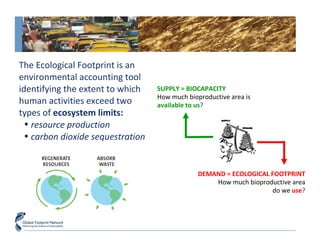
The Ecological Footprint is an 
environmental accounting tool 
identifying the extent to which 
human activities exceed two 
types of ecosystem limits: 
• resource production 
• carbon dioxide sequestration 
SUPPLY = BIOCAPACITY 
How much bioproductive area is 
available to us? 
DEMAND = ECOLOGICAL FOOTPRINT 
How much bioproductive area 
do we use?
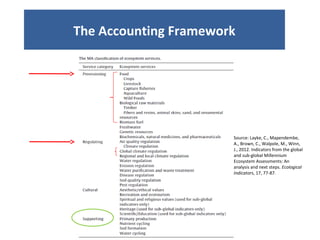
The Accounting Framework 
Source: Layke, C., Mapendembe, 
A., Brown, C., Walpole, M., Winn, 
J., 2012. Indicators from the global 
and sub-global Millennium 
Ecosystem Assessments: An 
analysis and next steps. Ecological 
Indicators, 17, 77-87.
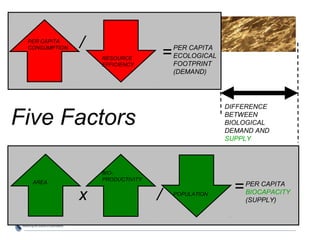
/ =PER CAPITA 
ECOLOGICAL 
FOOTPRINT 
(DEMAND) 
PER CAPITA 
CONSUMPTION 
RESOURCE 
EFFICIENCY 
DIFFERENCE 
BETWEEN 
BIOLOGICAL 
DEMAND AND 
SUPPLY 
PER CAPITA 
BIOCAPACITY 
(SUPPLY) x 
AREA 
BIO-PRODUCTIVITY 
/ POPULATION = 
Five Factors
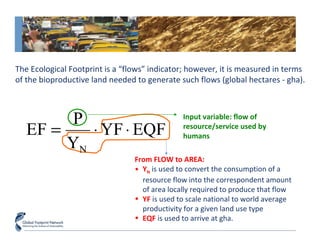
The Ecological Footprint is a “flows” indicator; however, it is measured in terms 
of the bioproductive land needed to generate such flows (global hectares - gha). 
Input variable: flow of 
resource/service used by 
= × × 
YF EQF humans 
EF P 
Y 
N 
From FLOW to AREA: 
• YN is used to convert the consumption of a 
resource flow into the correspondent amount 
of area locally required to produce that flow 
• YF is used to scale national to world average 
productivity for a given land use type 
• EQF is used to arrive at gha.
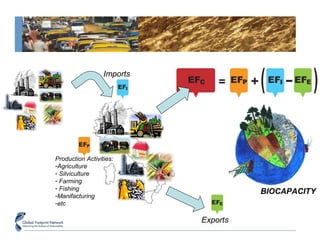
Imports 
Exports 
Production Activities: 
-Agriculture 
- Silviculture 
- Farming 
- Fishing 
-Manifacturing 
-etc 
BIOCAPACITY
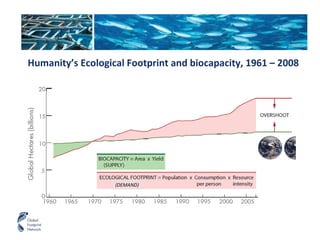
Humanity’s Ecological Footprint and biocapacity, 1961 – 2008 
(DEMAND)
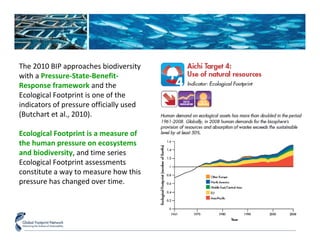
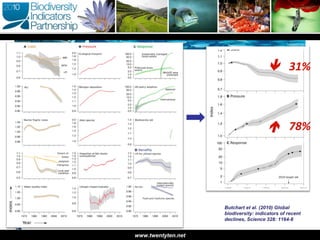
The 2010 BIP approaches biodiversity 
with a Pressure-State-Benefit- 
Response framework and the 
Ecological Footprint is one of the 
indicators of pressure officially used 
(Butchart et al., 2010). 
Ecological Footprint is a measure of 
the human pressure on ecosystems 
and biodiversity, and time series 
Ecological Footprint assessments 
constitute a way to measure how this 
pressure has changed over time.
www.twentyten.net 
 31% 
 78% 
Butchart et al. (2010) Global 
biodiversity: indicators of recent 
declines, Science 328: 1164-8
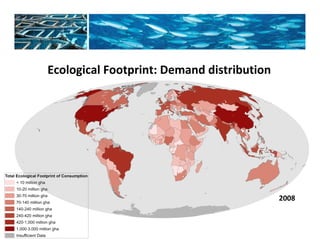
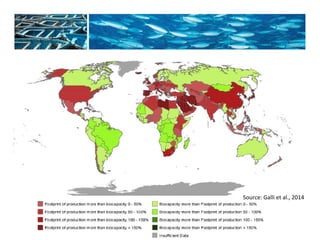
Ecological Footprint: Demand distribution 
2008
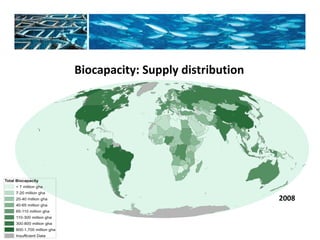
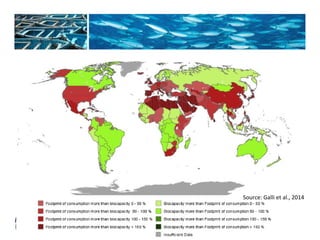
Biocapacity: Supply distribution 
2008
Source: Galli et al., 2014
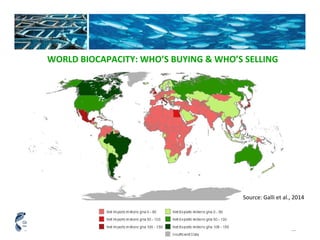
WORLD BIOCAPACITY: WHO’S BUYING & WHO’S SELLING 
Source: Galli et al., 2014
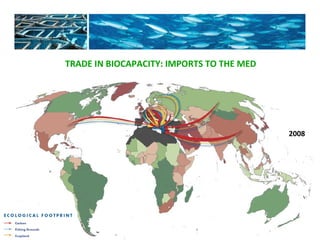
2008 
TRADE IN BIOCAPACITY: IMPORTS TO THE MED
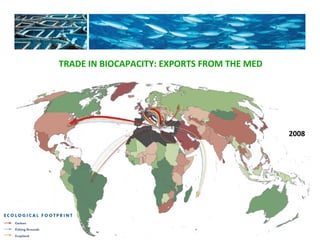
2008 
TRADE IN BIOCAPACITY: EXPORTS FROM THE MED
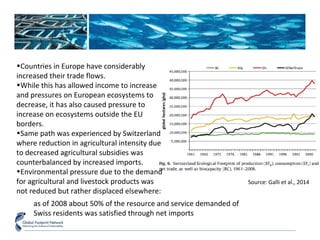
•Countries in Europe have considerably 
increased their trade flows. 
•While this has allowed income to increase 
and pressures on European ecosystems to 
decrease, it has also caused pressure to 
increase on ecosystems outside the EU 
borders. 
•Same path was experienced by Switzerland 
where reduction in agricultural intensity due 
to decreased agricultural subsidies was 
counterbalanced by increased imports. 
•Environmental pressure due to the demand 
for agricultural and livestock products was 
not reduced but rather displaced elsewhere: 
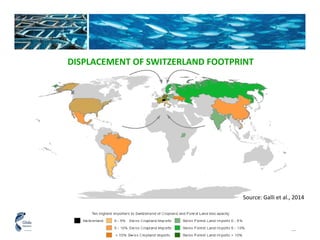
as of 2008 about 50% of the resource and service demanded of 
Swiss residents was satisfied through net imports 
Source: Galli et al., 2014
DISPLACEMENT OF SWITZERLAND FOOTPRINT 
Source: Galli et al., 2014
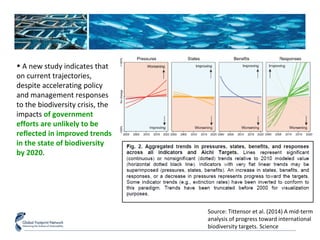
Source: Tittensor et al. (2014) A mid-term 
analysis of progress toward international 
biodiversity targets. Science 
• A new study indicates that 
on current trajectories, 
despite accelerating policy 
and management responses 
to the biodiversity crisis, the 
impacts of government 
efforts are unlikely to be 
reflected in improved trends 
in the state of biodiversity 
by 2020.
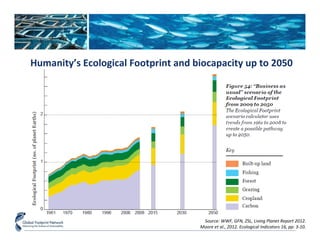
Humanity’s Ecological Footprint and biocapacity up to 2050 
Source: WWF, GFN, ZSL, Living Planet Report 2012. 
Moore et al., 2012. Ecological Indicators 16, pp: 3-10.
NPV+: 
Choosing the Winning Investments
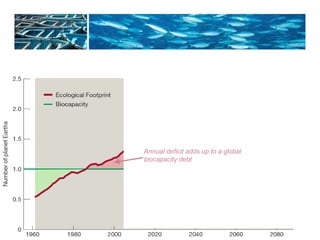
Annual deficit adds up to a global 
biocapacity debt
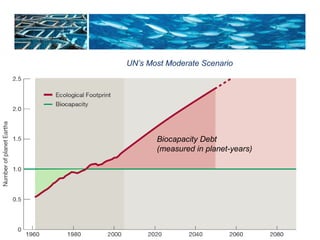
UN’s Most Moderate Scenario 
Biocapacity Debt 
(measured in planet-years)
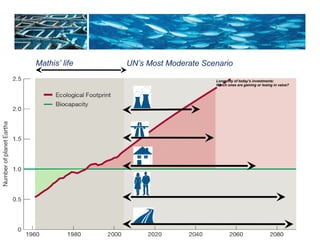
Mathis’ life UN’s Most Moderate Scenario 
Longevity of today’s investments: 
Which ones are gaining or losing in value?
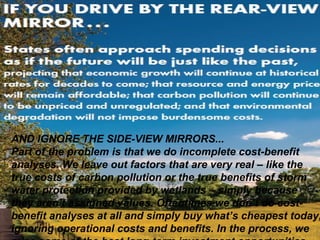
AND IGNORE THE SIDE-VIEW MIRRORS... 
Part of the problem is that we do incomplete cost-benefit 
analyses. We leave out factors that are very real – like the 
true costs of carbon pollution or the true benefits of storm 
water protection provided by wetlands – simply because 
they aren’t assigned values. Oftentimes we don’t do cost-benefit 
analyses at all and simply buy what’s cheapest today, 
ignoring operational costs and benefits. In the process, we 
miss some of the best long-term investment opportunities.
Which Investment to Choose? 
NPV! Net Present Value 
In the NPV+ framework, any investment may be a “capital 
project;” all costs and benefits – even those where no 
monetary exchange occurs – are “cash flows;” and those 
cash flows can be evaluated using the conventional net 
present value (NPV) formula, which calculates the value 
of a long-term investment in present-day dollars.
COUNT THE UNCOUNTED 
Assessing NPV+ 
NPV+ expands on conventional cost-benefit 
analysis by including unpriced factors such as 
the benefits of ecological resiliency and the 
costs of environmental degradation.
Key lessons of NPV+ 
(Net Present Value+)
Key Lessons from NPV+ 
• Nature has a budget. Resource constraints will increasingly 
affect economic performance. 
• Net Present Value assessments, informed by the realities 
imposed by the biophysical context, can help distinguish 
between effective and dangerous real asset investments. 
• By recognizing new trends, good forecasting, and including 
unpriced factors, NPV+ can help regional governments build 
resilience. 
• will you build long-lasting opportunities with your investment, or 
are you locking yourself into a trap with your investment?
Thank you! 
For more information please visit: 
http://www.footprintnetwork.org 
Sebastian Winkler 
VP, Outreach and Programmes 
Global Footprint Network 
@sebastian.winkler@footprintnetwork.org

Ecological Footprint: tracking global human pressure on ecosystems and biodiversity

  • 1.
    Ecological Footprint: trackingglobal human pressure on ecosystems and biodiversity Side event at COP12 Pyeongchang (Korea) October 15, 2014 Alessandro Galli and Sebastian Winkler Global Footprint Network
  • 2.
    The Ecological Footprintis an environmental accounting tool identifying the extent to which human activities exceed two types of ecosystem limits: • resource production • carbon dioxide sequestration SUPPLY = BIOCAPACITY How much bioproductive area is available to us? DEMAND = ECOLOGICAL FOOTPRINT How much bioproductive area do we use?
  • 3.
    The Accounting Framework Source: Layke, C., Mapendembe, A., Brown, C., Walpole, M., Winn, J., 2012. Indicators from the global and sub-global Millennium Ecosystem Assessments: An analysis and next steps. Ecological Indicators, 17, 77-87.
  • 5.
    / =PER CAPITA ECOLOGICAL FOOTPRINT (DEMAND) PER CAPITA CONSUMPTION RESOURCE EFFICIENCY DIFFERENCE BETWEEN BIOLOGICAL DEMAND AND SUPPLY PER CAPITA BIOCAPACITY (SUPPLY) x AREA BIO-PRODUCTIVITY / POPULATION = Five Factors
  • 6.
    The Ecological Footprintis a “flows” indicator; however, it is measured in terms of the bioproductive land needed to generate such flows (global hectares - gha). Input variable: flow of resource/service used by = × × YF EQF humans EF P Y N From FLOW to AREA: • YN is used to convert the consumption of a resource flow into the correspondent amount of area locally required to produce that flow • YF is used to scale national to world average productivity for a given land use type • EQF is used to arrive at gha.
  • 7.
    Imports Exports ProductionActivities: -Agriculture - Silviculture - Farming - Fishing -Manifacturing -etc BIOCAPACITY
  • 8.
    Humanity’s Ecological Footprintand biocapacity, 1961 – 2008 (DEMAND)
  • 9.
    The 2010 BIPapproaches biodiversity with a Pressure-State-Benefit- Response framework and the Ecological Footprint is one of the indicators of pressure officially used (Butchart et al., 2010). Ecological Footprint is a measure of the human pressure on ecosystems and biodiversity, and time series Ecological Footprint assessments constitute a way to measure how this pressure has changed over time.
  • 10.
    www.twentyten.net  31%  78% Butchart et al. (2010) Global biodiversity: indicators of recent declines, Science 328: 1164-8
  • 11.
  • 12.
  • 13.
  • 14.
  • 15.
    WORLD BIOCAPACITY: WHO’SBUYING & WHO’S SELLING Source: Galli et al., 2014
  • 16.
    2008 TRADE INBIOCAPACITY: IMPORTS TO THE MED
  • 17.
    2008 TRADE INBIOCAPACITY: EXPORTS FROM THE MED
  • 18.
    •Countries in Europehave considerably increased their trade flows. •While this has allowed income to increase and pressures on European ecosystems to decrease, it has also caused pressure to increase on ecosystems outside the EU borders. •Same path was experienced by Switzerland where reduction in agricultural intensity due to decreased agricultural subsidies was counterbalanced by increased imports. •Environmental pressure due to the demand for agricultural and livestock products was not reduced but rather displaced elsewhere: as of 2008 about 50% of the resource and service demanded of Swiss residents was satisfied through net imports Source: Galli et al., 2014
  • 19.
    DISPLACEMENT OF SWITZERLANDFOOTPRINT Source: Galli et al., 2014
  • 20.
    Source: Tittensor etal. (2014) A mid-term analysis of progress toward international biodiversity targets. Science • A new study indicates that on current trajectories, despite accelerating policy and management responses to the biodiversity crisis, the impacts of government efforts are unlikely to be reflected in improved trends in the state of biodiversity by 2020.
  • 21.
    Humanity’s Ecological Footprintand biocapacity up to 2050 Source: WWF, GFN, ZSL, Living Planet Report 2012. Moore et al., 2012. Ecological Indicators 16, pp: 3-10.
  • 22.
    NPV+: Choosing theWinning Investments
  • 23.
    Annual deficit addsup to a global biocapacity debt
  • 24.
    UN’s Most ModerateScenario Biocapacity Debt (measured in planet-years)
  • 25.
    Mathis’ life UN’sMost Moderate Scenario Longevity of today’s investments: Which ones are gaining or losing in value?
  • 26.
    AND IGNORE THESIDE-VIEW MIRRORS... Part of the problem is that we do incomplete cost-benefit analyses. We leave out factors that are very real – like the true costs of carbon pollution or the true benefits of storm water protection provided by wetlands – simply because they aren’t assigned values. Oftentimes we don’t do cost-benefit analyses at all and simply buy what’s cheapest today, ignoring operational costs and benefits. In the process, we miss some of the best long-term investment opportunities.
  • 27.
    Which Investment toChoose? NPV! Net Present Value In the NPV+ framework, any investment may be a “capital project;” all costs and benefits – even those where no monetary exchange occurs – are “cash flows;” and those cash flows can be evaluated using the conventional net present value (NPV) formula, which calculates the value of a long-term investment in present-day dollars.
  • 29.
    COUNT THE UNCOUNTED Assessing NPV+ NPV+ expands on conventional cost-benefit analysis by including unpriced factors such as the benefits of ecological resiliency and the costs of environmental degradation.
  • 31.
    Key lessons ofNPV+ (Net Present Value+)
  • 32.
    Key Lessons fromNPV+ • Nature has a budget. Resource constraints will increasingly affect economic performance. • Net Present Value assessments, informed by the realities imposed by the biophysical context, can help distinguish between effective and dangerous real asset investments. • By recognizing new trends, good forecasting, and including unpriced factors, NPV+ can help regional governments build resilience. • will you build long-lasting opportunities with your investment, or are you locking yourself into a trap with your investment?
  • 33.
    Thank you! Formore information please visit: http://www.footprintnetwork.org Sebastian Winkler VP, Outreach and Programmes Global Footprint Network @sebastian.winkler@footprintnetwork.org

Editor's Notes

  • #7 Moreover, SEEA relies on a production-based approach and thus harmonizing NFA with SEEA means harmoning P used in the calculation of EFP with P defined in SEEA.
  • #10 Target 4: By 2020, at the latest, Governments, business and stakeholders at all levels have taken steps to achieve or have implemented plans for sustainable production and consumption and have kept the impacts of use of natural resources well within safe ecological limits Other Aichi Biodiversity targets (1, 2, 3, 5…) as well Resolution WCC-2012-121 from the IUCN World Conservation Congress 2012: Promoting external international responsibility with regard to the impacts on global biodiversity
  • #11 Fig. 1. Indicator trends for (A) the state of biodiversity, (B) pressures upon it, (C) responses to address its loss, and (D) the benefits humans derive from it. Data scaled to 1 in 1970 (or for first year of data if >1970), modeled (if >13 data points; see Table 1), and plotted on a logarithmic ordinate axis. Shading shows 95% confidence intervals except where unavailable.
  • #12 Residents of ecological creditor countries consume on average less resources than their ecosystems can regenerate. This is in net terms (three is trade of course). Ecological debtor countries are the opposite. Hence they run, in net terms, a deficit.
  • #13 Residents of ecological creditor countries consume on average less resources than their ecosystems can regenerate. This is in net terms (three is trade of course). Ecological debtor countries are the opposite. Hence they run, in net terms, a deficit.
  • #16 As countries become more dependent on external ecosystems, they expose their economies to price volatility and possible supply disruption. Access to ecological resources and services become subject not only to “physical limits” (the total amount globally available) but also “economic limits” (the ability of countries to purchase these resources and services).
  • #17 Residents of ecological creditor countries consume on average less resources than their ecosystems can regenerate. This is in net terms (three is trade of course). Ecological debtor countries are the opposite. Hence they run, in net terms, a deficit.
  • #18 Residents of ecological creditor countries consume on average less resources than their ecosystems can regenerate. This is in net terms (three is trade of course). Ecological debtor countries are the opposite. Hence they run, in net terms, a deficit.
  • #22 What is we have a clue?
  • #23 Draft – as of May 23, 2012 Contacts: Dr. Mathis Wackernagel Global Footprint Network Oakland, CA, USA +1 510 839 8879 [email_address]   Sebastian Winkler Global Footprint Network Brussels, Belgium [email_address]   Dr. Gemma Cranston Global Footprint Network Geneva, Switzerland +41 22 797 41 10 [email_address]
  • #24 Context Over Mathis Wackernagel’s life time (born in 1962), humanity has moved from using about half the planet’s biocapacity to using resources and emitting waste 50 percent faster than the biosphere can renew them. Demand has grown far more rapidly than supply. This graph does not show the shift in supply because it is simplified. It shows supply in number of planets - which is constant at one planet. But of course it is a different planet every year – changed by evolving ecological and agricultural management practices (and inputs), technological efficiency, changing climate, soil and ecosystem degradation, etc. The graph above just shows the ratio between demand over supply. If this same graph was drawn in terms of absolute productivity, we would see a 20 % increase in global biocapacity over the last 50 years. This does not mean that this biocapacity increase could not be declining again in the future. Indeed, with lacking inputs such as freshwater or soils, or climate change, overall productivity may decline again. But consider this: compared to this 20% increase of supply, demand has increased nearly 300 percent. The impact on the planet is not just the annual deficit (or overuse), but the accumulation of the deficit over time (i.e., the debt). How does this debt develop in the future? We cannot know for sure, since the future, by nature, is not knowable. But we can translate other people’s assumptions about the future into Footprint and biocapacity outcomes. What if? What if the most moderate projections of UN bodies came true? Low population growth scenarios, decarbonization, improvements in agricultural productivity, no surprises or threshold effects. The result of the all-encompassing projection are shown on the next slide.
  • #25 Conventional thinking is becoming a liability: Here are the results. Translating UN’s Most Moderate Scenario into Footprint shows unviable path. This level of ecological debt accumulation is becoming physically impossible. The debt is growing to a level that is hard to sustain. Even today, the debt is in the order of six to seven planet years. Here the debt grows ten fold within less than 40 years. Since this is a moderate scenario, and most policies are gearing towards exceeding moderate projections, this growing pressure is most likely the context in which our investments will have to operate.
  • #26 Where to invest? Investments into real assets have long time horizons. These assets have significant life spans. Power plants may be built for 40 years or more. Bridges should last 80 or more years. Land use patterns can shape cities for centuries. Another key asset: People. People born today will live hopefully 70 or 80 years. Or more. Therefore the question becomes – as we invest in these real assets, which will not go away, are we committing ourselves to winners or losers. Are we investing in long-lasting traps or long-lasting opportunities? What kind of investments will be gaining, and which ones will be losing? Understanding the context within which these assets will operate in the future helps distinguish more effectively the potential value proposition (or risks) of investment options. Essentially, as a first approximation, we propose that investments need to be selected on a comprehensive Net Present Value assessment, beyond static “excel formulas”, but informed by future cost and benefit streams.
  • #28 Succeeding with our policy and investment choices In the new era of the global auction, it becomes even more significant to focus on making your decisions work for you. Are your decisions truly increasing your net wealth? What is the actual NPV+ of your investment, considering long-term trends shaping the economic performance of the next decades. Hence: Old rules of the game: maximize economic growth (and with it resource throughput), regardless of effects on your net wealth. New rules of the game: protect your assets and focus on generating wealth. In a resource constrained world, your ecological assets are becoming an ever more significant contribution to your long-term wealth. Your per-capita wealth enables well-being. Use NPV and not GDP thinking as the guide for choosing among options. In the past, the name of the game in our global economy has been quick profits – often at the planet’s expense. But in today’s world, where humanity is already exceeding planetary limits, ecological assets are becoming ever more critical and strategic. They are most valuable when they are managed well, and therefore able to serve your economy for years to come. True NPV+ assessments (+, because they go far beyond the mechanistic excel formula) help you distinguish which investments help you generate value, and which ones will lose in a resource constrained world.
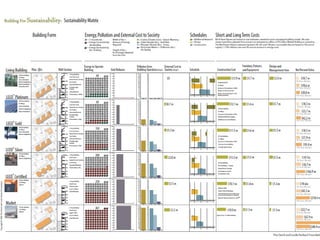
  • #29 An example of how NPV has been used in the pasts NPV is not new. A vivid visual presentation of results of a great application is presented here. This is line with what Global Footprint Network is proposing here. This example was executed by the Architecture firm BNIM in a project proposal for Packard Foundation. They illustrated the life cycle costs of providing a new Headquarter Office for Packard Foundation (it was never executed). BNIM describes: The Sustainability Report & Matrix was the BNIM design team’s response to setting sustainability goals for a proposed headquarters for the David & Lucile Packard Foundation workplace in Los Altos, California— a 90,000 square foot office facility that would consolidate the client’s staff and resources to one location. Six levels of design were measured with regard to the USGBC’s Leadership in Energy and Environment Design (LEED) rating system were measured: (1) the Market Building; (2) LEED Certified; (3) LEED Silver; (4) LEED Gold; (5) LEED Platinum; and (6) the Living Building (zero negative impact on the environment). The design team found the Living Building (zero negative impact on the environment) to be very compelling, bringing the issue of true replicability to the fore. http://www.bnim.com/work/david-and-lucile-packard-foundation-sustainability-report-and-matrix
  • #30 How is it executed? 1) Determine time horizon. What is a reasonable time for this investment to operate (or would need to be replaced if it did not last that time period). We suggest at least 25 years, if not 50. 2) Identify: a) initial costs plus cost stream in the future b) benefits stream in the future. 3) Choose reasonable resource prices and interest rates for now and the future. (based on scenarios for sensitivity analysis). Both interest rates and resource prices will be influenced by the resource trends depicted in slide 2-4. But a number of scenarios are possible Considering the rapid increase of resource demand, but limited supply, there are two more likely scenarios: a) resource overuse is strangling the economy. Low growth also means low real interest rates. Since the economy will be flat, this also translates into not so rapidly increasing, or potentially flat, resource costs; b) rapid growth of the economy continues, driving up resource prices, but also keeping real interest rates at the higher end. The unlikely scenarios are: c) high growth rates and low resource costs (this only happens in a vastly resource abundant world). d) A slightly more plausible scenario is a case of a low growth economy and growing resource costs… D would shift choices even more radically than a) and b).
  • #32 Why is NPV+ significant? Life cycle costs are real costs. If we do not consider them carefully, we will invest sub-optimally. It is not about long-term versus short term. Even if we buy an investment and sell it again within a few weeks, the life cycle cost burden is still associated with that investment. An astute investor would look at the investment with the life cycle costs fully integrated. Because they will affect the bottom line. Therefore, we would suggest that all decisions be based on a rough NPV assessment (based on predetermined energy cost and interest rate scenario). These assessments will also make apparent that, as a rule of thumb, investments which depend on easily accessible and easily affordable resources in order to operate properly, will most likely lose in value. Vice versa, those investments that provide services in the long run, without needed the input of cheap resources will gain in value. Hence the question remains: will you build long-lasting opportunities with your investment, or are you locking yourself into a trap with your investment? Perhaps the most important consideration is the following – your investments will underperform precisely then, when the economy is turning sour and you depend most on that investment to get you through bad times. Having invested in the wrong assets means that you will lose exactly then when you need your investment most. It is like having somebody pull the mattress under you away, just as you are falling on the ground.
  • #33 Why NPV? Context: For most of the 20th century, resources were relatively cheap and easily available. As a result most countries have become increasingly dependent on large amounts of natural resources they do not have. While resources are still relatively cheap, this increasing global demand is meeting a supply crunch. It takes now more effort to harvest the fossil fuels and the minerals, and in some places the fresh water. As a result, basic commodities such as food and fibers are becoming costlier. These resource dynamics are turning into ever more significant driver of economic performance. Economic planners and investors ignoring these trends may put their investments at peril. NPV assessments help identfy, which investments produce a true return on investment, and which ones are more likely to become a loosing proposition.