Introduction to Ecological Footprints and
Sustainability
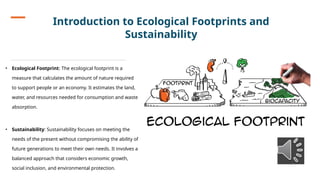
• Ecological Footprint: The ecological footprint is a
measure that calculates the amount of nature required
to support people or an economy. It estimates the land,
water, and resources needed for consumption and waste
absorption.
• Sustainability: Sustainability focuses on meeting the
needs of the present without compromising the ability of
future generations to meet their own needs. It involves a
balanced approach that considers economic growth,
social inclusion, and environmental protection.
Components of Ecological Footprint
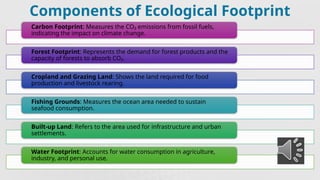
Carbon Footprint: Measures the CO₂ emissions from fossil fuels,
indicating the impact on climate change.
Forest Footprint: Represents the demand for forest products and the
capacity of forests to absorb CO₂.
Cropland and Grazing Land: Shows the land required for food
production and livestock rearing.
Fishing Grounds: Measures the ocean area needed to sustain
seafood consumption.
Built-up Land: Refers to the area used for infrastructure and urban
settlements.
Water Footprint: Accounts for water consumption in agriculture,
industry, and personal use.
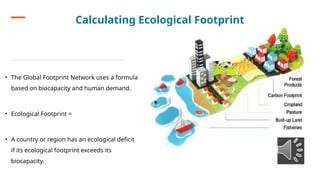
• The Global Footprint Network uses a formula
based on biocapacity and human demand.
• Ecological Footprint =
• A country or region has an ecological deficit
if its ecological footprint exceeds its
biocapacity.
Calculating Ecological Footprint
Ecological Footprints
Across the World
High-Income Countries: The United States and
Qatar have large ecological footprints due to high
energy use, urbanization, and consumption
patterns. For example, the average American
footprint is roughly five times larger than the global
average.
Emerging Economies: Countries like China and
India have rapidly increasing ecological footprints
due to industrial growth, rising consumption, and
urbanization, which place significant pressure on
resources.
Low-Income Countries: Countries in sub-Saharan
Africa often have lower ecological footprints due to
limited industrial activities and lower consumption.
However, even small increases in demand can strain
local resources due to limited biocapacity.
Case Studies on Ecological
Footprint and Sustainability
The Netherlands' Circular Economy Initiatives
• The Netherlands aims to become a circular economy by 2050. The government has
implemented policies to reduce waste and promote resource efficiency in
construction, agriculture, and manufacturing.
• Examples include Amsterdam’s circular housing projects and Rotterdam’s initiative
to recycle 50% of its waste.
• These initiatives aim to minimize the ecological footprint by optimizing resource
use and reducing carbon emissions.
Bhutan’s Gross National Happiness and Low Ecological Footprint
• Bhutan prioritizes Gross National Happiness (GNH) over GDP. This
approach has maintained a relatively low ecological footprint by focusing
on conservation, sustainable agriculture, and renewable energy.
• Over 70% of Bhutan’s land is under forest cover, and the country is
carbon negative, meaning it absorbs more CO₂ than it emits
Case Studies on Ecological
Footprint and Sustainability
Singapore’s Water Management Strategies
•Singapore, with limited natural freshwater sources, has developed
sustainable water management practices to reduce its ecological footprint.
•The country uses water recycling (NEWater) and desalination, reducing
dependency on imported water and promoting sustainable water use.
Case Studies on Ecological
Footprint and Sustainability
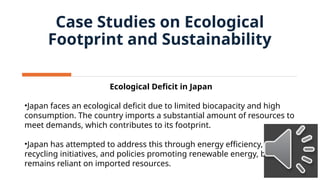
Ecological Deficit in Japan
•Japan faces an ecological deficit due to limited biocapacity and high
consumption. The country imports a substantial amount of resources to
meet demands, which contributes to its footprint.
•Japan has attempted to address this through energy efficiency,
recycling initiatives, and policies promoting renewable energy, but
remains reliant on imported resources.
Case Studies on Ecological
Footprint and Sustainability
Strategies for Reducing Ecological Footprints
Renewable Energy Transition: Moving from fossil fuels to renewables like solar, wind, and
hydro reduces the carbon footprint significantly. For example, Denmark aims for 100%
renewable energy by 2050.
Sustainable Agriculture: Reducing chemical inputs, optimizing water use, and adopting
organic farming practices can lessen ecological footprints in the agricultural sector. For
instance, New Zealand promotes sustainable dairy farming to minimize its ecological impact.
Resource Efficiency and Circular Economy: Reusing, recycling, and designing products for
longevity reduces demand for new resources. Japan’s “3R” (Reduce, Reuse, Recycle) policy
aims to achieve a zero-waste society.
Urban Planning and Green Cities: Green cities like Vancouver and Curitiba integrate
sustainable transportation, green spaces, and efficient waste management to lower urban
ecological footprints.
Reducing Meat Consumption: Shifting to plant-based diets can lower individual ecological
footprints. A study by Oxford University found that a global shift to plant-based diets could
reduce food-related greenhouse gas emissions by 70%.
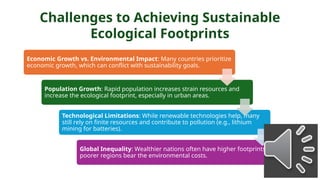
Challenges to Achieving Sustainable
Ecological Footprints
Economic Growth vs. Environmental Impact: Many countries prioritize
economic growth, which can conflict with sustainability goals.
Population Growth: Rapid population increases strain resources and
increase the ecological footprint, especially in urban areas.
Technological Limitations: While renewable technologies help, many
still rely on finite resources and contribute to pollution (e.g., lithium
mining for batteries).
Global Inequality: Wealthier nations often have higher footprints, while
poorer regions bear the environmental costs.
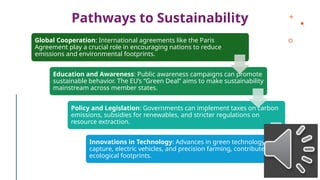
Pathways to Sustainability
Global Cooperation: International agreements like the Paris
Agreement play a crucial role in encouraging nations to reduce
emissions and environmental footprints.
Education and Awareness: Public awareness campaigns can promote
sustainable behavior. The EU’s “Green Deal” aims to make sustainability
mainstream across member states.
Policy and Legislation: Governments can implement taxes on carbon
emissions, subsidies for renewables, and stricter regulations on
resource extraction.
Innovations in Technology: Advances in green technology, like carbon
capture, electric vehicles, and precision farming, contribute to reducing
ecological footprints.

Ecological Footprints and Sustainability

  • 2.
    Introduction to EcologicalFootprints and Sustainability • Ecological Footprint: The ecological footprint is a measure that calculates the amount of nature required to support people or an economy. It estimates the land, water, and resources needed for consumption and waste absorption. • Sustainability: Sustainability focuses on meeting the needs of the present without compromising the ability of future generations to meet their own needs. It involves a balanced approach that considers economic growth, social inclusion, and environmental protection.
  • 3.
    Components of EcologicalFootprint Carbon Footprint: Measures the CO₂ emissions from fossil fuels, indicating the impact on climate change. Forest Footprint: Represents the demand for forest products and the capacity of forests to absorb CO₂. Cropland and Grazing Land: Shows the land required for food production and livestock rearing. Fishing Grounds: Measures the ocean area needed to sustain seafood consumption. Built-up Land: Refers to the area used for infrastructure and urban settlements. Water Footprint: Accounts for water consumption in agriculture, industry, and personal use.
  • 4.
    • The GlobalFootprint Network uses a formula based on biocapacity and human demand. • Ecological Footprint = • A country or region has an ecological deficit if its ecological footprint exceeds its biocapacity. Calculating Ecological Footprint
  • 5.
    Ecological Footprints Across theWorld High-Income Countries: The United States and Qatar have large ecological footprints due to high energy use, urbanization, and consumption patterns. For example, the average American footprint is roughly five times larger than the global average. Emerging Economies: Countries like China and India have rapidly increasing ecological footprints due to industrial growth, rising consumption, and urbanization, which place significant pressure on resources. Low-Income Countries: Countries in sub-Saharan Africa often have lower ecological footprints due to limited industrial activities and lower consumption. However, even small increases in demand can strain local resources due to limited biocapacity.
  • 6.
    Case Studies onEcological Footprint and Sustainability The Netherlands' Circular Economy Initiatives • The Netherlands aims to become a circular economy by 2050. The government has implemented policies to reduce waste and promote resource efficiency in construction, agriculture, and manufacturing. • Examples include Amsterdam’s circular housing projects and Rotterdam’s initiative to recycle 50% of its waste. • These initiatives aim to minimize the ecological footprint by optimizing resource use and reducing carbon emissions.
  • 7.
    Bhutan’s Gross NationalHappiness and Low Ecological Footprint • Bhutan prioritizes Gross National Happiness (GNH) over GDP. This approach has maintained a relatively low ecological footprint by focusing on conservation, sustainable agriculture, and renewable energy. • Over 70% of Bhutan’s land is under forest cover, and the country is carbon negative, meaning it absorbs more CO₂ than it emits Case Studies on Ecological Footprint and Sustainability
  • 8.
    Singapore’s Water ManagementStrategies •Singapore, with limited natural freshwater sources, has developed sustainable water management practices to reduce its ecological footprint. •The country uses water recycling (NEWater) and desalination, reducing dependency on imported water and promoting sustainable water use. Case Studies on Ecological Footprint and Sustainability
  • 9.
    Ecological Deficit inJapan •Japan faces an ecological deficit due to limited biocapacity and high consumption. The country imports a substantial amount of resources to meet demands, which contributes to its footprint. •Japan has attempted to address this through energy efficiency, recycling initiatives, and policies promoting renewable energy, but remains reliant on imported resources. Case Studies on Ecological Footprint and Sustainability
  • 10.
    Strategies for ReducingEcological Footprints Renewable Energy Transition: Moving from fossil fuels to renewables like solar, wind, and hydro reduces the carbon footprint significantly. For example, Denmark aims for 100% renewable energy by 2050. Sustainable Agriculture: Reducing chemical inputs, optimizing water use, and adopting organic farming practices can lessen ecological footprints in the agricultural sector. For instance, New Zealand promotes sustainable dairy farming to minimize its ecological impact. Resource Efficiency and Circular Economy: Reusing, recycling, and designing products for longevity reduces demand for new resources. Japan’s “3R” (Reduce, Reuse, Recycle) policy aims to achieve a zero-waste society. Urban Planning and Green Cities: Green cities like Vancouver and Curitiba integrate sustainable transportation, green spaces, and efficient waste management to lower urban ecological footprints. Reducing Meat Consumption: Shifting to plant-based diets can lower individual ecological footprints. A study by Oxford University found that a global shift to plant-based diets could reduce food-related greenhouse gas emissions by 70%.
  • 11.
    Challenges to AchievingSustainable Ecological Footprints Economic Growth vs. Environmental Impact: Many countries prioritize economic growth, which can conflict with sustainability goals. Population Growth: Rapid population increases strain resources and increase the ecological footprint, especially in urban areas. Technological Limitations: While renewable technologies help, many still rely on finite resources and contribute to pollution (e.g., lithium mining for batteries). Global Inequality: Wealthier nations often have higher footprints, while poorer regions bear the environmental costs.
  • 12.
    Pathways to Sustainability GlobalCooperation: International agreements like the Paris Agreement play a crucial role in encouraging nations to reduce emissions and environmental footprints. Education and Awareness: Public awareness campaigns can promote sustainable behavior. The EU’s “Green Deal” aims to make sustainability mainstream across member states. Policy and Legislation: Governments can implement taxes on carbon emissions, subsidies for renewables, and stricter regulations on resource extraction. Innovations in Technology: Advances in green technology, like carbon capture, electric vehicles, and precision farming, contribute to reducing ecological footprints.

Editor's Notes

  • #2 . This metric helps assess the demand on Earth’s ecosystems and the impact of human activities on environmental sustainability.