THE PER UNIT SYSTEM
Introduction:
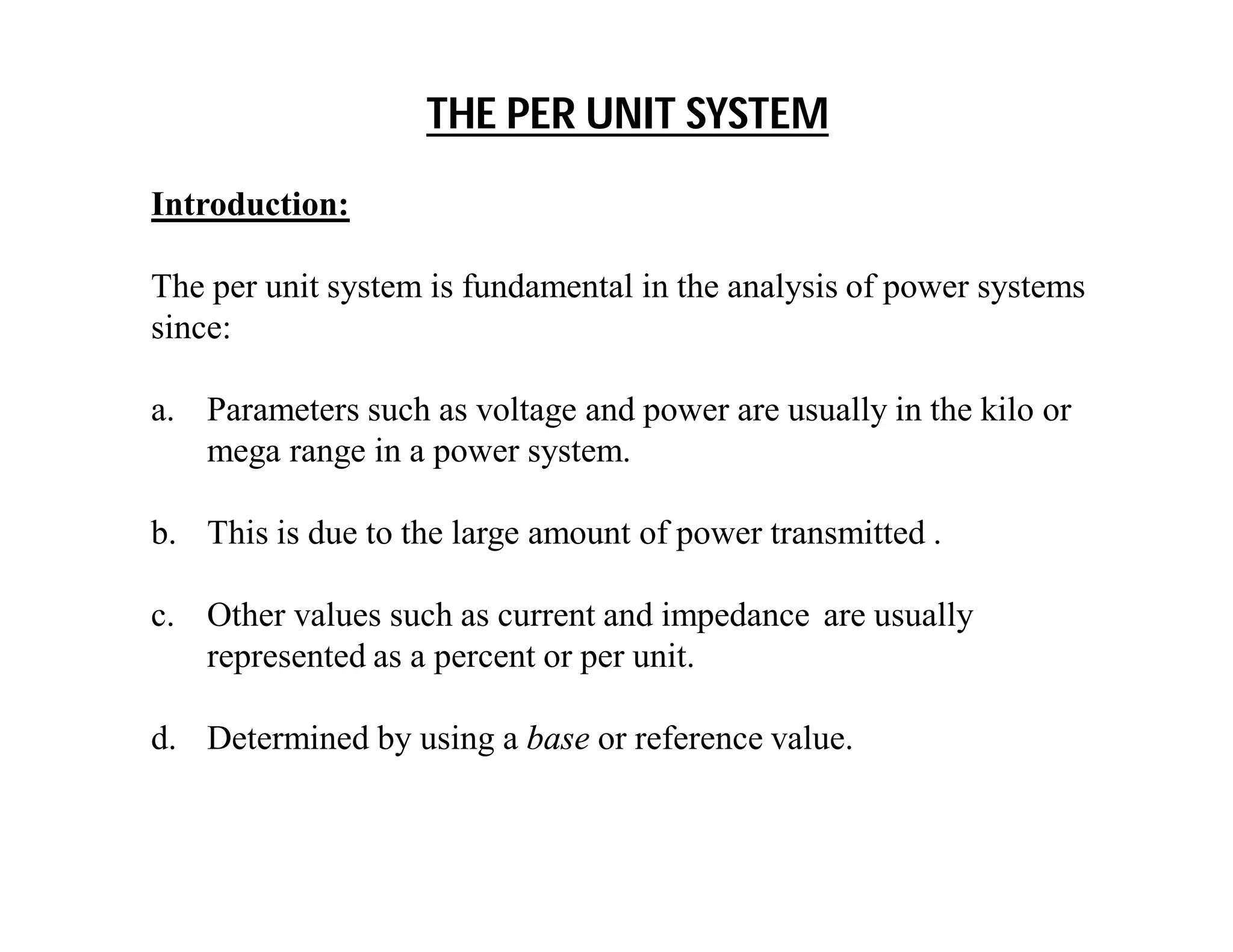
The per unit system is fundamental in the analysis of power systems
since:
a. Parameters such as voltage and power are usually in the kilo or
mega range in a power system.
b. This is due to the large amount of power transmitted .
c. Other values such as current and impedance are usually
represented as a percent or per unit.
d. Determined by using a base or reference value.
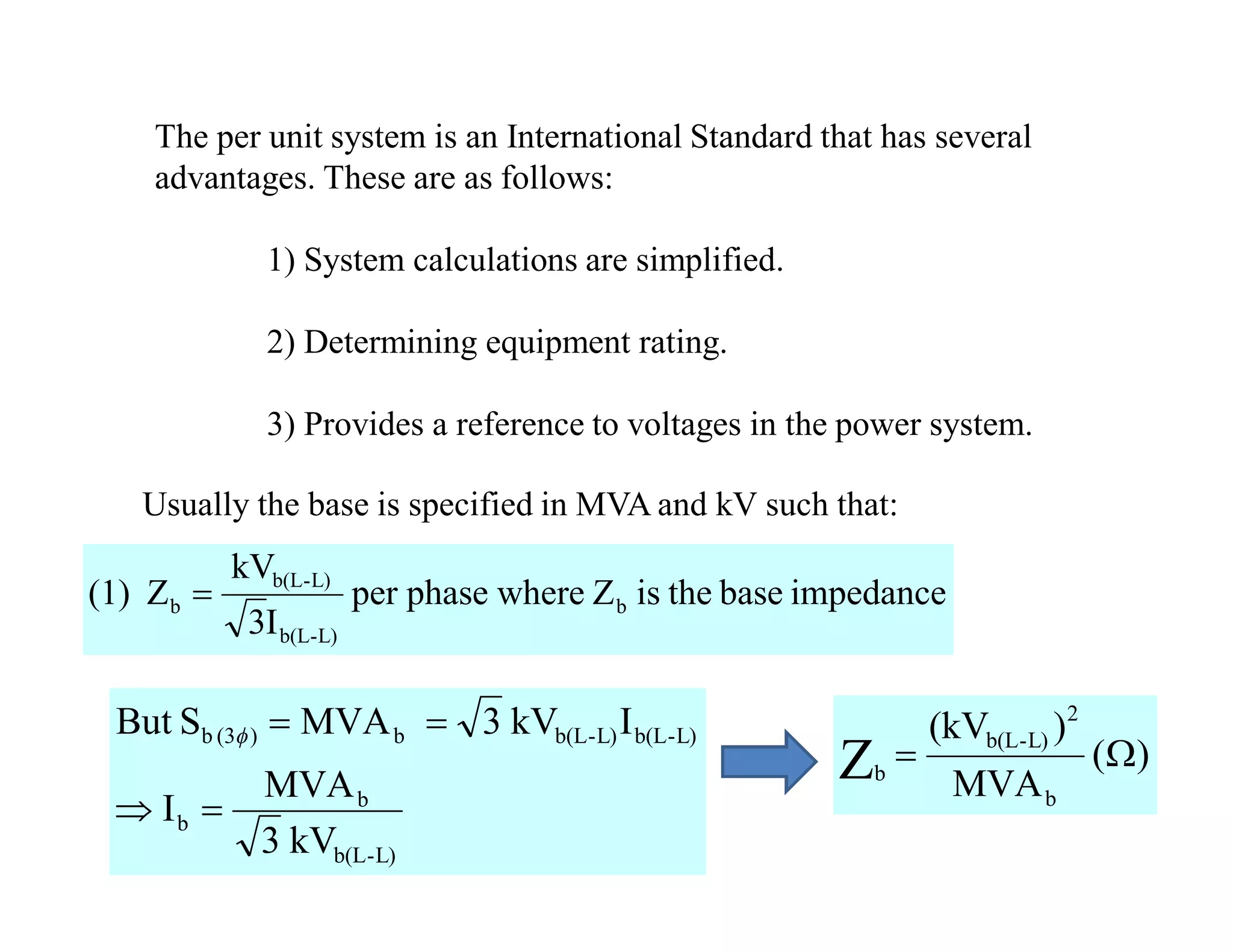
The per unit system is an International Standard that has several
advantages. These are as follows:
1) System calculations are simplified.
2) Determining equipment rating.
3) Provides a reference to voltages in the power system.
Usually the base is specified in MVA and kV such that:
impedancebasetheisZwherephaseper
I3
kV
Z(1) b
L)-b(L
L)-b(L
b 
)(
MVA
)(kV
b
2
L)-b(L
bZ 
L)-b(L
b
b
L)-b(LL)-b(Lb)(3b
kV3
MVA
I
IkV3MVASBut


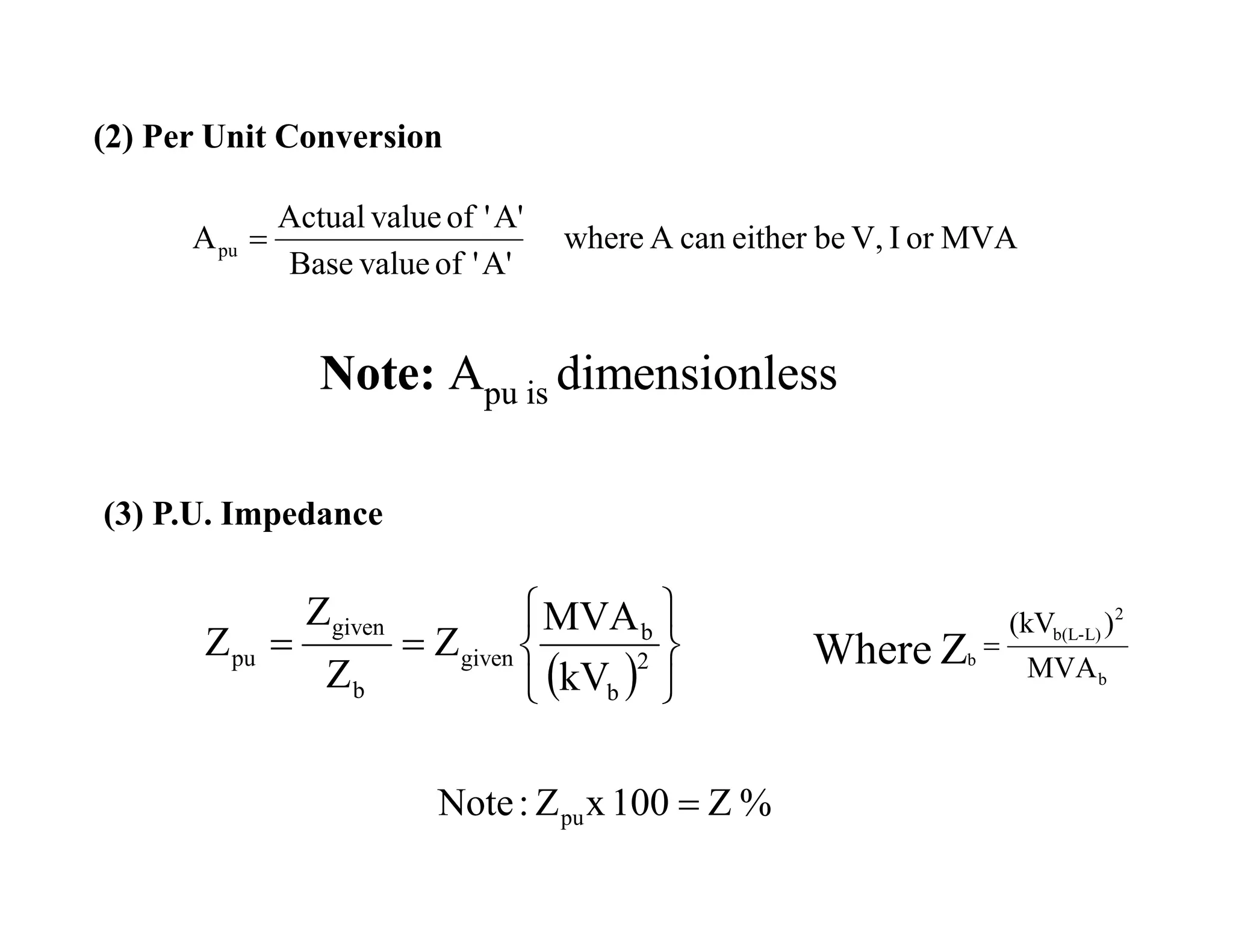
(2) Per Unit Conversion
MVAorIV,beeithercanAwhere
A''ofvalueBase
A''ofvalueActual
Apu 
Note: Apu is dimensionlessNote: Apu is dimensionless
  





 2
b
b
given
b
given
pu
kV
MVA
Z
Z
Z
Z
(3) P.U. Impedance
MVA
)(kV
b
2
L)-b(L
bZWhere 
%Z100xZ:Note pu 
 
MVA
1
αkVαZ
2
b
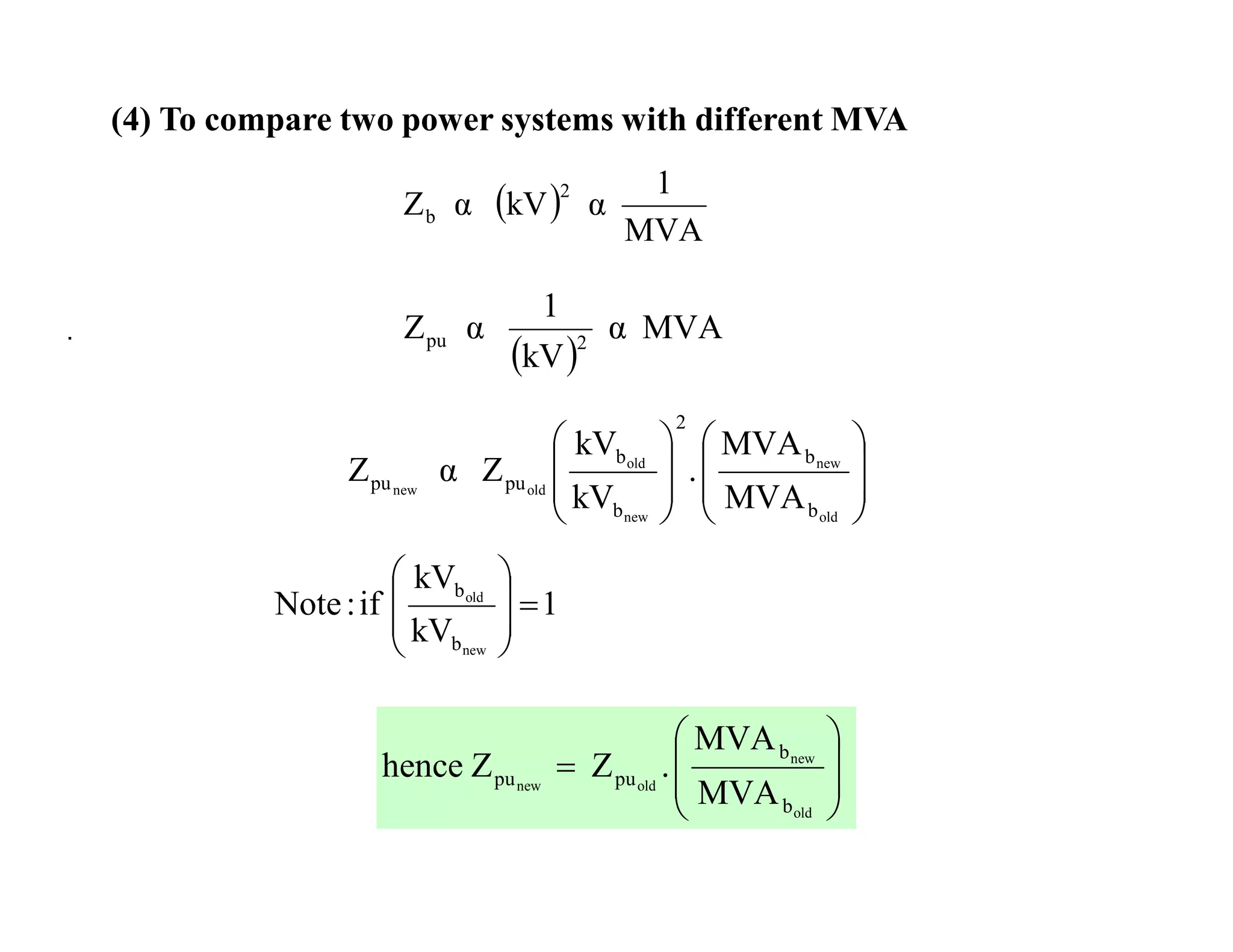
(4) To compare two power systems with different MVA
.
 
MVAα
kV
1
αZ 2pu
MVA
MVA
.
kV
kV
ZαZ
old
new
new
old
oldnew
b
b
2
b
b
pupu
















1
kV
kV
if:Note
new
old
b
b









MVA
MVA
.ZZhence
old
new
oldnew
b
b
pupu









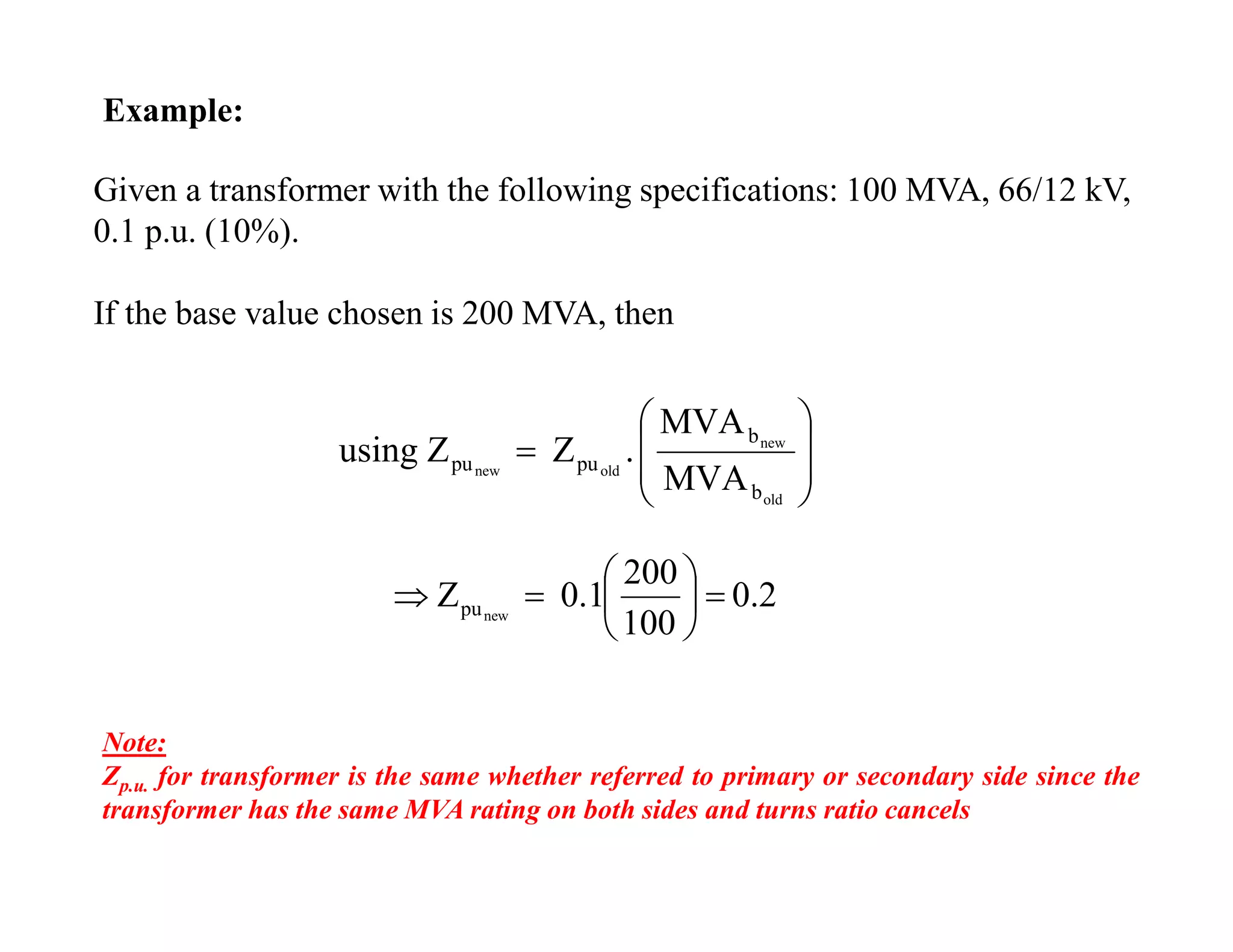
Example:
MVA
MVA
.ZZusing
old
new
oldnew
b
b
pupu









Given a transformer with the following specifications: 100 MVA, 66/12 kV,
0.1 p.u. (10%).
If the base value chosen is 200 MVA, then
0.2
100
200
0.1Z newpu 






Note:
Zp.u. for transformer is the same whether referred to primary or secondary side since the
transformer has the same MVA rating on both sides and turns ratio cancels

ECNG 3015 chapter 2 - pu system

  • 1.
    THE PER UNITSYSTEM Introduction: The per unit system is fundamental in the analysis of power systems since: a. Parameters such as voltage and power are usually in the kilo or mega range in a power system. b. This is due to the large amount of power transmitted . c. Other values such as current and impedance are usually represented as a percent or per unit. d. Determined by using a base or reference value.
  • 2.
    The per unitsystem is an International Standard that has several advantages. These are as follows: 1) System calculations are simplified. 2) Determining equipment rating. 3) Provides a reference to voltages in the power system. Usually the base is specified in MVA and kV such that: impedancebasetheisZwherephaseper I3 kV Z(1) b L)-b(L L)-b(L b  )( MVA )(kV b 2 L)-b(L bZ  L)-b(L b b L)-b(LL)-b(Lb)(3b kV3 MVA I IkV3MVASBut  
  • 3.
    (2) Per UnitConversion MVAorIV,beeithercanAwhere A''ofvalueBase A''ofvalueActual Apu  Note: Apu is dimensionlessNote: Apu is dimensionless          2 b b given b given pu kV MVA Z Z Z Z (3) P.U. Impedance MVA )(kV b 2 L)-b(L bZWhere  %Z100xZ:Note pu 
  • 4.
      MVA 1 αkVαZ 2 b (4) Tocompare two power systems with different MVA .   MVAα kV 1 αZ 2pu MVA MVA . kV kV ZαZ old new new old oldnew b b 2 b b pupu                 1 kV kV if:Note new old b b          MVA MVA .ZZhence old new oldnew b b pupu         
  • 5.
    Example: MVA MVA .ZZusing old new oldnew b b pupu          Given a transformerwith the following specifications: 100 MVA, 66/12 kV, 0.1 p.u. (10%). If the base value chosen is 200 MVA, then 0.2 100 200 0.1Z newpu        Note: Zp.u. for transformer is the same whether referred to primary or secondary side since the transformer has the same MVA rating on both sides and turns ratio cancels