Per Unit System
The per-unit value of any quantity is defined as the ratio of actual
value in any unit to the base or reference value in the same unit. Any
quantity is converted into per unit quantity by dividing the numeral
value by the chosen base value of the same dimension. The per-unit
value is dimensionless.
Per Unit System
Any value can be taken as the Base Value. However, it is chosen to
make computation easy. It is usually taken equal to the rating of a
machine/transformer in the power circuit. Power equipment
impedance ratings are usually given in p.u. (expressed in %) based on
their rated voltage and VA.
Basic Units
The 4 basic electrical quantities are:
• Voltage V (volt)
• Current I (amp)
• Impedance Z (ohm)
• Power S (VA)
For single-phase circuits,
• V(volt) = Z(ohm) × I(amp);
• S (VA) = V(volt) × I(amp)*
Per unit notation
In per unit notation, the physical quantity is expressed as a fraction of the reference
value, i.e.
per unit value = actual value/base value in the same unit.
e.g. V(in per unit) = V(in kV)/V base (in kV)
where the base value is a reference value for magnitude.
Base Quantities
In per unit notation we would like to keep
the basic relations: Vpu = Zpu Ipu; Spu = Vpu Ipu*
Hence the base quantities should be chosen such that
Base voltage (VB) =
base impedance (ZB) × base current (IB)
Base power (SB) =
base voltage (VB) × base current(IB)
Base Quantities
Thus only two of the base quantities can be arbitrarily chosen, the
other two will follow directly.
It is common practice to specify
base power (SB) and base voltage (VB)
Then it follows
base current IB = SB/VB
base impedance ZB = VB/IB =V𝐵2/SB
Percentage Values
An equivalent way to express the per unit value is the percentage value where
Percentage value = per unit value × 100%
However, percentage values are not so convenient to use since
Vpercent ≠ Zpercent × Ipercent
Base Value for 3-phase systems
For 3-phase systems it is common practice to describe system
operation with:
total 3-phase power S = 𝑆3−ɸ
line voltage V = Vline
line current I = Iline
equivalent impedance/phase Z = Zph
with (in magnitude)
V = √3ZI; S = √3VI.
Base Value for 3-phase systems
Hence if base values are chosen for:
total 3-phase power SB
line voltage VB
Then
base line current
IB = SB/ √3VB
base impedance
ZB = VB/ √3IB = V𝐵2/SB
Equivalent circuit for transformer
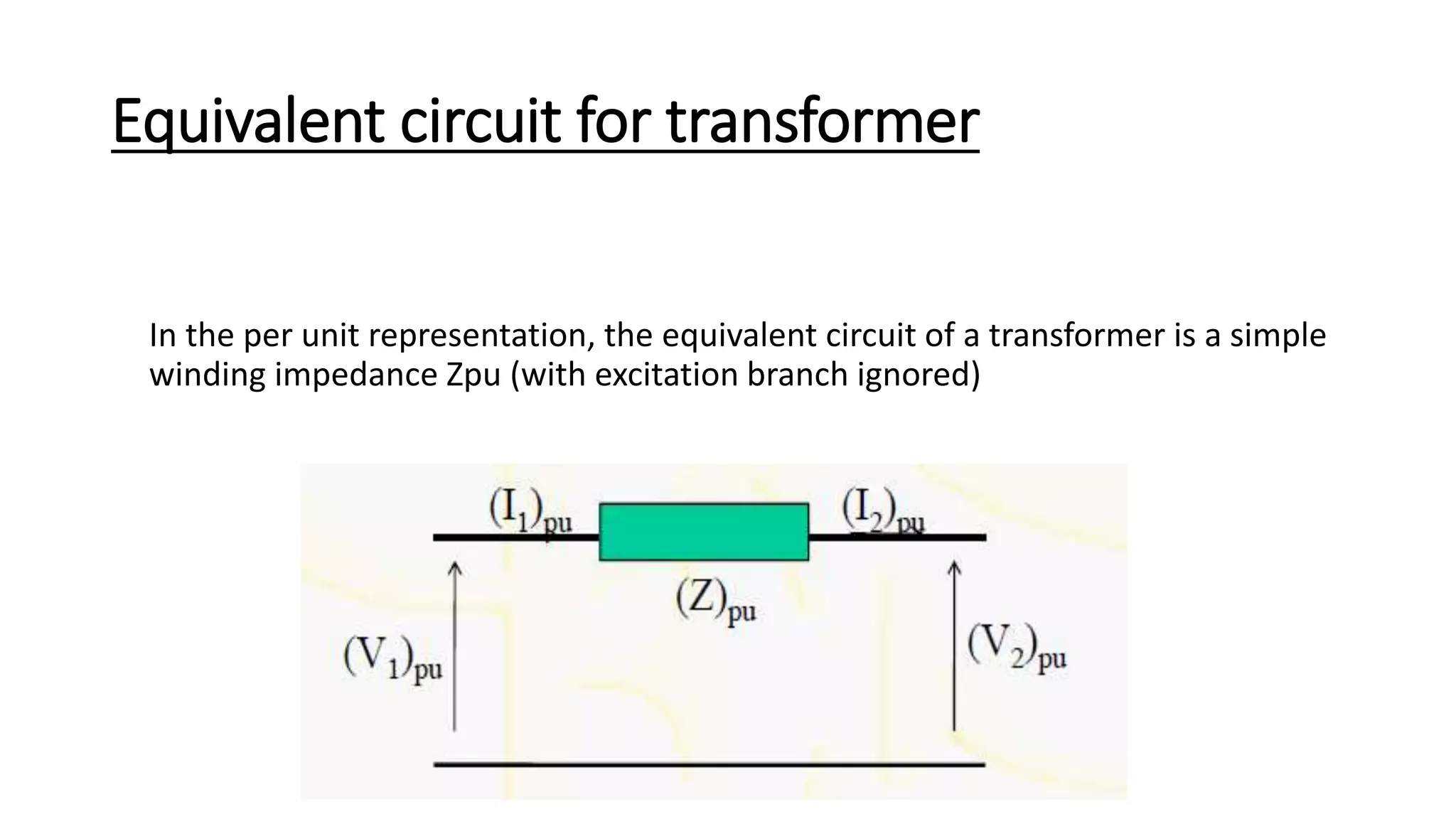
In the per unit representation, the equivalent circuit of a transformer is a simple
winding impedance Zpu (with excitation branch ignored)
Advantages of Per Unit System
• Normally we are dealing with numerics near unity rather than over a wide range.
• Provides a more meaningful comparison of parameters of machines with
different ratings.
• As the per unit values of parameters of a machine of a given design normally falls
within a certain range, a typical value can be used if such parameters are not
provided.
Per unit

Per unit

  • 2.
    Per Unit System Theper-unit value of any quantity is defined as the ratio of actual value in any unit to the base or reference value in the same unit. Any quantity is converted into per unit quantity by dividing the numeral value by the chosen base value of the same dimension. The per-unit value is dimensionless.
  • 3.
    Per Unit System Anyvalue can be taken as the Base Value. However, it is chosen to make computation easy. It is usually taken equal to the rating of a machine/transformer in the power circuit. Power equipment impedance ratings are usually given in p.u. (expressed in %) based on their rated voltage and VA.
  • 4.
    Basic Units The 4basic electrical quantities are: • Voltage V (volt) • Current I (amp) • Impedance Z (ohm) • Power S (VA) For single-phase circuits, • V(volt) = Z(ohm) × I(amp); • S (VA) = V(volt) × I(amp)*
  • 5.
    Per unit notation Inper unit notation, the physical quantity is expressed as a fraction of the reference value, i.e. per unit value = actual value/base value in the same unit. e.g. V(in per unit) = V(in kV)/V base (in kV) where the base value is a reference value for magnitude.
  • 6.
    Base Quantities In perunit notation we would like to keep the basic relations: Vpu = Zpu Ipu; Spu = Vpu Ipu* Hence the base quantities should be chosen such that Base voltage (VB) = base impedance (ZB) × base current (IB) Base power (SB) = base voltage (VB) × base current(IB)
  • 7.
    Base Quantities Thus onlytwo of the base quantities can be arbitrarily chosen, the other two will follow directly. It is common practice to specify base power (SB) and base voltage (VB) Then it follows base current IB = SB/VB base impedance ZB = VB/IB =V𝐵2/SB
  • 8.
    Percentage Values An equivalentway to express the per unit value is the percentage value where Percentage value = per unit value × 100% However, percentage values are not so convenient to use since Vpercent ≠ Zpercent × Ipercent
  • 9.
    Base Value for3-phase systems For 3-phase systems it is common practice to describe system operation with: total 3-phase power S = 𝑆3−ɸ line voltage V = Vline line current I = Iline equivalent impedance/phase Z = Zph with (in magnitude) V = √3ZI; S = √3VI.
  • 10.
    Base Value for3-phase systems Hence if base values are chosen for: total 3-phase power SB line voltage VB Then base line current IB = SB/ √3VB base impedance ZB = VB/ √3IB = V𝐵2/SB
  • 11.
    Equivalent circuit fortransformer In the per unit representation, the equivalent circuit of a transformer is a simple winding impedance Zpu (with excitation branch ignored)
  • 12.
    Advantages of PerUnit System • Normally we are dealing with numerics near unity rather than over a wide range. • Provides a more meaningful comparison of parameters of machines with different ratings. • As the per unit values of parameters of a machine of a given design normally falls within a certain range, a typical value can be used if such parameters are not provided.