ECM Roadmap


Maximizing your Enterprise Content
Management investment
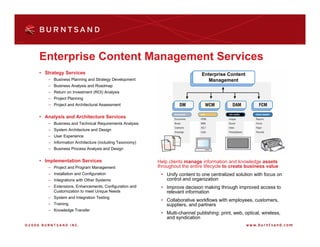
Enterprise Content Management Services
• Strategy Services                                                      Enterprise Content
   – Business Planning and Strategy Development                            Management
   – Business Analysis and Roadmap
   – Return on Investment (ROI) Analysis
   – Project Planning
   – Project and Architectural Assessment


• Analysis and Architecture Services
   – Business and Technical Requirements Analysis
   – System Architecture and Design
   – User Experience
   – Information Architecture (including Taxonomy)
   – Business Process Analysis and Design


• Implementation Services                            Help clients manage information and knowledge assets
   – Project and Program Management                  throughout the entire lifecycle to create business value
   – Installation and Configuration                   • Unify content to one centralized solution with focus on
   – Integrations with Other Systems                    control and organization
   – Extensions, Enhancements, Configuration and      • Improve decision making through improved access to
     Customization to meet Unique Needs                 relevant information
   – System and Integration Testing
                                                      • Collaborative workflows with employees, customers,
   – Training                                           suppliers, and partners
   – Knowledge Transfer
                                                      • Multi-channel publishing: print, web, optical, wireless,
                                                        and syndication
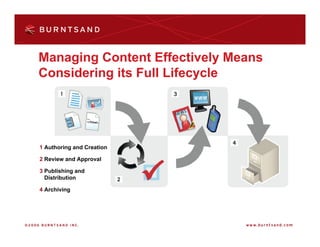
Managing Content Effectively Means
Considering its Full Lifecycle


1 Authoring and Creation

2 Review and Approval

3 Publishing and
  Distribution

4 Archiving
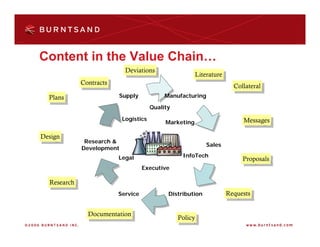
Content in the Value Chain…
                             Deviations
                             Deviations                  Literature
                                                          Literature
              Contracts
               Contracts                                                 Collateral
                                                                          Collateral
  Plans                    Supply            Manufacturing
   Plans
                                        Quality

                            Logistics                                       Messages
                                             Marketing                      Messages

Design
Design         Research &
                                                             Sales
              Development
                           Legal                   InfoTech
                                                                            Proposals
                                                                             Proposals
                                     Executive

  Research
   Research
                           Service            Distribution             Requests
                                                                        Requests

                Documentation
                Documentation                     Policy
                                                   Policy
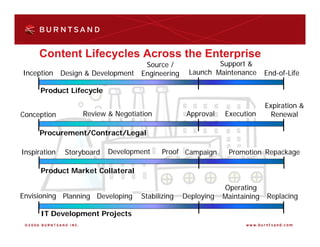
Content Lifecycles Across the Enterprise
                                      Source /              Support &
Inception     Design & Development   Engineering    Launch Maintenance       End-of-Life

      Product Lifecycle

                                                                             Expiration &
Conception          Review & Negotiation            Approval   Execution       Renewal

     Procurement/Contract/Legal

Inspiration    Storyboard   Development     Proof Campaign      Promotion Repackage

      Product Market Collateral

                                                               Operating
Envisioning Planning Developing      Stabilizing   Deploying   Maintaining   Replacing

      IT Development Projects
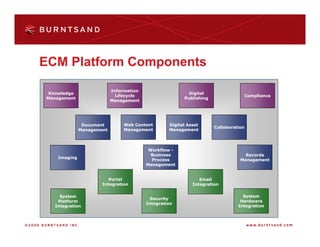
ECM Platform Components
• All the things that makeup the ECM platform
                  Information
  Knowledge                                              Digital
                            Lifecycle                                           Compliance
 Management                                            Publishing
                           Management


               Document        Web Content       Digital Asset
                                                                    Collaboration
              Management       Management        Management


                                         Workflow -
                                          Business                               Records
    Imaging
                                          Process                              Management
                                        Management


                         Portal                               Email
                      Integration                          Integration

     System                                                                     System
                                          Security
    Platform                                                                   Hardware
                                        Integration
   Integration                                                                Integration
ECM – Efficiency in the Value Chain
Efficiency Matrix for Content
                                       Create Once - Use Many – Almost…
       Process Enhancement


                             Collaboration        Compliance/
                                                    Control


                             Optimization         Consolidation


                                      Asset Execution
ECM
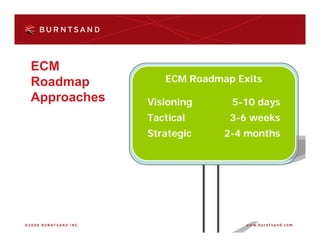
Roadmap         ECM Roadmap Exits
Approaches   Visioning     5-10 days
             Tactical      3-6 weeks
             Strategic    2-4 months
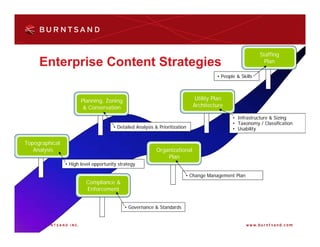
Staffing
     Enterprise Content Strategies                                                                           Plan

                                                                                       • People & Skills


                       Planning, Zoning                                       Utility Plan
                        & Conservation                                       Architecture

                                                                                              • Infrastructure & Sizing
                                                                                              • Taxonomy / Classification
                                      • Detailed Analysis & Prioritization                    • Usability

Topographical
   Analysis                                                Organizational
                                                               Plan
                • High level opportunity strategy

                                                                         • Change Management Plan
                         Compliance &
                         Enforcement


                                            • Governance & Standards
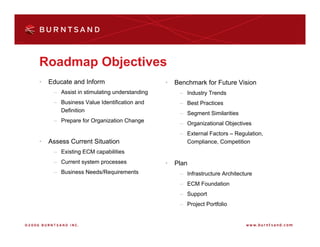
Roadmap Objectives
•   Educate and Inform                       •   Benchmark for Future Vision
     – Assist in stimulating understanding        – Industry Trends
     – Business Value Identification and          – Best Practices
       Definition
                                                  – Segment Similarities
     – Prepare for Organization Change
                                                  – Organizational Objectives
                                                  – External Factors – Regulation,
•   Assess Current Situation                        Compliance, Competition
     – Existing ECM capabilities
     – Current system processes              •   Plan
     – Business Needs/Requirements                – Infrastructure Architecture
                                                  – ECM Foundation
                                                  – Support
                                                  – Project Portfolio
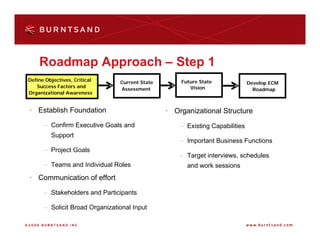
Roadmap Approach – Step 1
Define Objectives, Critical     Current State       Future State              Develop ECM
   Success Factors and                                 Vision
                                Assessment                                      Roadmap
Organizational Awareness


• Establish Foundation                          • Organizational Structure
      – Confirm Executive Goals and                 – Existing Capabilities
         Support
                                                    – Important Business Functions
      – Project Goals
                                                    – Target interviews, schedules
      – Teams and Individual Roles                    and work sessions
• Communication of effort

      – Stakeholders and Participants

      – Solicit Broad Organizational Input
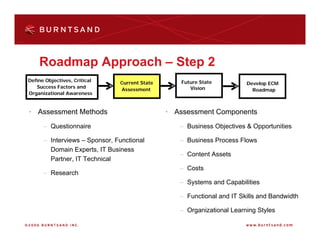
Roadmap Approach – Step 2
Define Objectives, Critical    Current State       Future State         Develop ECM
   Success Factors and                                Vision
                               Assessment                                 Roadmap
Organizational Awareness


• Assessment Methods                           • Assessment Components
      – Questionnaire                             – Business Objectives & Opportunities

      – Interviews – Sponsor, Functional          – Business Process Flows
        Domain Experts, IT Business
                                                  – Content Assets
        Partner, IT Technical
                                                  – Costs
      – Research
                                                  – Systems and Capabilities

                                                  – Functional and IT Skills and Bandwidth

                                                  – Organizational Learning Styles
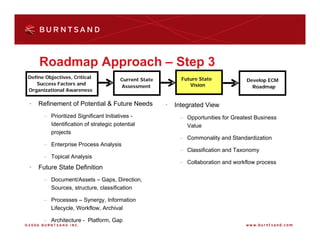
Roadmap Approach – Step 3
Define Objectives, Critical           Current State         Future State            Develop ECM
   Success Factors and                                         Vision
                                      Assessment                                      Roadmap
Organizational Awareness

•   Refinement of Potential & Future Needs            •   Integrated View
      – Prioritized Significant Initiatives -              – Opportunities for Greatest Business
        Identification of strategic potential                Value
        projects
                                                           – Commonality and Standardization
      – Enterprise Process Analysis
                                                           – Classification and Taxonomy
      – Topical Analysis
                                                           – Collaboration and workflow process
•   Future State Definition
      – Document/Assets – Gaps, Direction,
        Sources, structure, classification

      – Processes – Synergy, Information
        Lifecycle, Workflow, Archival

      – Architecture - Platform, Gap
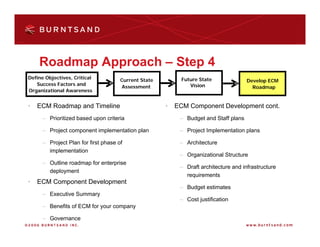
Roadmap Approach – Step 4
Define Objectives, Critical           Current State         Future State              Develop ECM
   Success Factors and                                         Vision
                                      Assessment                                        Roadmap
Organizational Awareness


•   ECM Roadmap and Timeline                          •   ECM Component Development cont.
      – Prioritized based upon criteria                    – Budget and Staff plans

      – Project component implementation plan              – Project Implementation plans

      – Project Plan for first phase of                    – Architecture
        implementation
                                                           – Organizational Structure
      – Outline roadmap for enterprise
                                                           – Draft architecture and infrastructure
        deployment
                                                             requirements
•   ECM Component Development
                                                           – Budget estimates
      – Executive Summary
                                                           – Cost justification
      – Benefits of ECM for your company

      – Governance
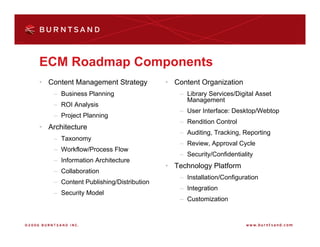
ECM Roadmap Components
• Content Management Strategy           • Content Organization
    – Business Planning                     – Library Services/Digital Asset
                                              Management
    – ROI Analysis
                                            – User Interface: Desktop/Webtop
    – Project Planning
                                            – Rendition Control
• Architecture
                                            – Auditing, Tracking, Reporting
    – Taxonomy
                                            – Review, Approval Cycle
    – Workflow/Process Flow
                                            – Security/Confidentiality
    – Information Architecture
                                        • Technology Platform
    – Collaboration
                                            – Installation/Configuration
    – Content Publishing/Distribution
                                            – Integration
    – Security Model
                                            – Customization
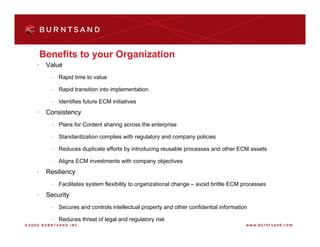
Benefits to your Organization
•    Value
      – Rapid time to value

      – Rapid transition into implementation

      – Identifies future ECM initiatives
•    Consistency
      – Plans for Content sharing across the enterprise

      – Standardization complies with regulatory and company policies

      – Reduces duplicate efforts by introducing reusable processes and other ECM assets

      – Aligns ECM investments with company objectives
•    Resiliency
      – Facilitates system flexibility to organizational change – avoid brittle ECM processes
•    Security
      – Secures and controls intellectual property and other confidential information

      – Reduces threat of legal and regulatory risk
Critical Success Factors – ECM Overall
• Business Involvement is an Absolute Requirement
    – Identification of Champions
    – Effective and frequent communication
    – Support for Organizational relearning
• Enterprise view/approach is important
    – Institutionalize & Evangelize ECM
• Departmental/Business Area must be aligned with the Enterprise Plan
    – ECM must operate as a single cohesive initiative
• Disciplined Deployment
• Must address volume needs
• Ongoing Evaluation
Critical Success Factors – Project by Project

•   Ease of use                        •   Frameworks and delegation
•   Effective classification           •   Cross-pollination
•   Rapid access                       •   Security and access control
•   Alignment with key processes and   •   Judicious use of standards
    applications
                                       •   Reliability of information
•   Effective change management
                                       •   Creating a culture of sharing
Example Projects
• Medical Device Company
• Biotech/Small Pharma
• Commercial Insurance Provider
• Consumer Device Manufacturer
• Retail Banking & Financial Services
• Retail Sales
•Consolidation
                                                                •Optimization
ROI – Areas of Opportunity                                      •Collaboration
                                                                •Compliance/Control
• Project Portfolio
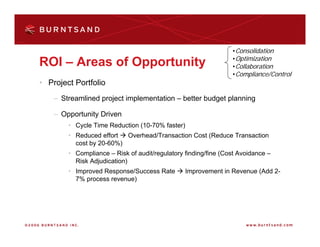
    – Streamlined project implementation – better budget planning

    – Opportunity Driven
        • Cycle Time Reduction (10-70% faster)
        • Reduced effort  Overhead/Transaction Cost (Reduce Transaction
          cost by 20-60%)
        • Compliance – Risk of audit/regulatory finding/fine (Cost Avoidance –
          Risk Adjudication)
        • Improved Response/Success Rate        Improvement in Revenue (Add 2-
          7% process revenue)
•Consolidation
                                                                •Optimization
ROI – Areas of Opportunity                                      •Collaboration
                                                                •Compliance/Control
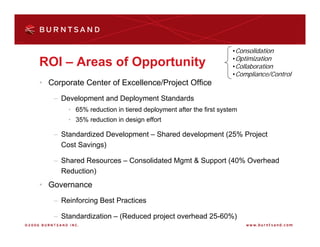
• Corporate Center of Excellence/Project Office
   – Development and Deployment Standards
       • 65% reduction in tiered deployment after the first system
       • 35% reduction in design effort

   – Standardized Development – Shared development (25% Project
     Cost Savings)

   – Shared Resources – Consolidated Mgmt & Support (40% Overhead
     Reduction)
• Governance
   – Reinforcing Best Practices

   – Standardization – (Reduced project overhead 25-60%)
•Consolidation
                                                                 •Optimization
   ROI – Areas of Opportunity                                    •Collaboration
                                                                 •Compliance/Control
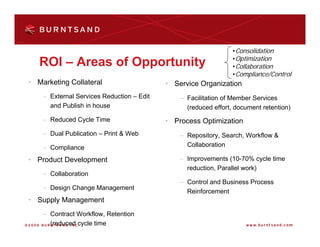
• Marketing Collateral                     • Service Organization
    – External Services Reduction – Edit       – Facilitation of Member Services
      and Publish in house                       (reduced effort, document retention)
    – Reduced Cycle Time                   • Process Optimization
    – Dual Publication – Print & Web           – Repository, Search, Workflow &
    – Compliance                                 Collaboration

• Product Development                          – Improvements (10-70% cycle time
                                                 reduction, Parallel work)
    – Collaboration
                                               – Control and Business Process
    – Design Change Management
                                                 Reinforcement
• Supply Management
    – Contract Workflow, Retention
      (reduced cycle time
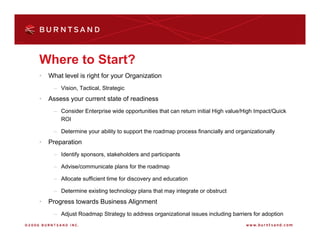
Where to Start?
•   What level is right for your Organization
     – Vision, Tactical, Strategic
•   Assess your current state of readiness
     – Consider Enterprise wide opportunities that can return initial High value/High Impact/Quick
       ROI

     – Determine your ability to support the roadmap process financially and organizationally
•   Preparation
     – Identify sponsors, stakeholders and participants

     – Advise/communicate plans for the roadmap

     – Allocate sufficient time for discovery and education

     – Determine existing technology plans that may integrate or obstruct
•   Progress towards Business Alignment
     – Adjust Roadmap Strategy to address organizational issues including barriers for adoption

Ecm roadmap v2 0

  • 1.
    ECM Roadmap Maximizing yourEnterprise Content Management investment
  • 2.
    Enterprise Content ManagementServices • Strategy Services Enterprise Content – Business Planning and Strategy Development Management – Business Analysis and Roadmap – Return on Investment (ROI) Analysis – Project Planning – Project and Architectural Assessment • Analysis and Architecture Services – Business and Technical Requirements Analysis – System Architecture and Design – User Experience – Information Architecture (including Taxonomy) – Business Process Analysis and Design • Implementation Services Help clients manage information and knowledge assets – Project and Program Management throughout the entire lifecycle to create business value – Installation and Configuration • Unify content to one centralized solution with focus on – Integrations with Other Systems control and organization – Extensions, Enhancements, Configuration and • Improve decision making through improved access to Customization to meet Unique Needs relevant information – System and Integration Testing • Collaborative workflows with employees, customers, – Training suppliers, and partners – Knowledge Transfer • Multi-channel publishing: print, web, optical, wireless, and syndication
  • 3.
    Managing Content EffectivelyMeans Considering its Full Lifecycle 1 Authoring and Creation 2 Review and Approval 3 Publishing and Distribution 4 Archiving
  • 4.
    Content in theValue Chain… Deviations Deviations Literature Literature Contracts Contracts Collateral Collateral Plans Supply Manufacturing Plans Quality Logistics Messages Marketing Messages Design Design Research & Sales Development Legal InfoTech Proposals Proposals Executive Research Research Service Distribution Requests Requests Documentation Documentation Policy Policy
  • 5.
    Content Lifecycles Acrossthe Enterprise Source / Support & Inception Design & Development Engineering Launch Maintenance End-of-Life Product Lifecycle Expiration & Conception Review & Negotiation Approval Execution Renewal Procurement/Contract/Legal Inspiration Storyboard Development Proof Campaign Promotion Repackage Product Market Collateral Operating Envisioning Planning Developing Stabilizing Deploying Maintaining Replacing IT Development Projects
  • 6.
    ECM Platform Components •All the things that makeup the ECM platform Information Knowledge Digital Lifecycle Compliance Management Publishing Management Document Web Content Digital Asset Collaboration Management Management Management Workflow - Business Records Imaging Process Management Management Portal Email Integration Integration System System Security Platform Hardware Integration Integration Integration
  • 7.
    ECM – Efficiencyin the Value Chain Efficiency Matrix for Content Create Once - Use Many – Almost… Process Enhancement Collaboration Compliance/ Control Optimization Consolidation Asset Execution
  • 8.
    ECM Roadmap ECM Roadmap Exits Approaches Visioning 5-10 days Tactical 3-6 weeks Strategic 2-4 months
  • 9.
    Staffing Enterprise Content Strategies Plan • People & Skills Planning, Zoning Utility Plan & Conservation Architecture • Infrastructure & Sizing • Taxonomy / Classification • Detailed Analysis & Prioritization • Usability Topographical Analysis Organizational Plan • High level opportunity strategy • Change Management Plan Compliance & Enforcement • Governance & Standards
  • 10.
    Roadmap Objectives • Educate and Inform • Benchmark for Future Vision – Assist in stimulating understanding – Industry Trends – Business Value Identification and – Best Practices Definition – Segment Similarities – Prepare for Organization Change – Organizational Objectives – External Factors – Regulation, • Assess Current Situation Compliance, Competition – Existing ECM capabilities – Current system processes • Plan – Business Needs/Requirements – Infrastructure Architecture – ECM Foundation – Support – Project Portfolio
  • 11.
    Roadmap Approach –Step 1 Define Objectives, Critical Current State Future State Develop ECM Success Factors and Vision Assessment Roadmap Organizational Awareness • Establish Foundation • Organizational Structure – Confirm Executive Goals and – Existing Capabilities Support – Important Business Functions – Project Goals – Target interviews, schedules – Teams and Individual Roles and work sessions • Communication of effort – Stakeholders and Participants – Solicit Broad Organizational Input
  • 12.
    Roadmap Approach –Step 2 Define Objectives, Critical Current State Future State Develop ECM Success Factors and Vision Assessment Roadmap Organizational Awareness • Assessment Methods • Assessment Components – Questionnaire – Business Objectives & Opportunities – Interviews – Sponsor, Functional – Business Process Flows Domain Experts, IT Business – Content Assets Partner, IT Technical – Costs – Research – Systems and Capabilities – Functional and IT Skills and Bandwidth – Organizational Learning Styles
  • 13.
    Roadmap Approach –Step 3 Define Objectives, Critical Current State Future State Develop ECM Success Factors and Vision Assessment Roadmap Organizational Awareness • Refinement of Potential & Future Needs • Integrated View – Prioritized Significant Initiatives - – Opportunities for Greatest Business Identification of strategic potential Value projects – Commonality and Standardization – Enterprise Process Analysis – Classification and Taxonomy – Topical Analysis – Collaboration and workflow process • Future State Definition – Document/Assets – Gaps, Direction, Sources, structure, classification – Processes – Synergy, Information Lifecycle, Workflow, Archival – Architecture - Platform, Gap
  • 14.
    Roadmap Approach –Step 4 Define Objectives, Critical Current State Future State Develop ECM Success Factors and Vision Assessment Roadmap Organizational Awareness • ECM Roadmap and Timeline • ECM Component Development cont. – Prioritized based upon criteria – Budget and Staff plans – Project component implementation plan – Project Implementation plans – Project Plan for first phase of – Architecture implementation – Organizational Structure – Outline roadmap for enterprise – Draft architecture and infrastructure deployment requirements • ECM Component Development – Budget estimates – Executive Summary – Cost justification – Benefits of ECM for your company – Governance
  • 15.
    ECM Roadmap Components •Content Management Strategy • Content Organization – Business Planning – Library Services/Digital Asset Management – ROI Analysis – User Interface: Desktop/Webtop – Project Planning – Rendition Control • Architecture – Auditing, Tracking, Reporting – Taxonomy – Review, Approval Cycle – Workflow/Process Flow – Security/Confidentiality – Information Architecture • Technology Platform – Collaboration – Installation/Configuration – Content Publishing/Distribution – Integration – Security Model – Customization
  • 16.
    Benefits to yourOrganization • Value – Rapid time to value – Rapid transition into implementation – Identifies future ECM initiatives • Consistency – Plans for Content sharing across the enterprise – Standardization complies with regulatory and company policies – Reduces duplicate efforts by introducing reusable processes and other ECM assets – Aligns ECM investments with company objectives • Resiliency – Facilitates system flexibility to organizational change – avoid brittle ECM processes • Security – Secures and controls intellectual property and other confidential information – Reduces threat of legal and regulatory risk
  • 17.
    Critical Success Factors– ECM Overall • Business Involvement is an Absolute Requirement – Identification of Champions – Effective and frequent communication – Support for Organizational relearning • Enterprise view/approach is important – Institutionalize & Evangelize ECM • Departmental/Business Area must be aligned with the Enterprise Plan – ECM must operate as a single cohesive initiative • Disciplined Deployment • Must address volume needs • Ongoing Evaluation
  • 18.
    Critical Success Factors– Project by Project • Ease of use • Frameworks and delegation • Effective classification • Cross-pollination • Rapid access • Security and access control • Alignment with key processes and • Judicious use of standards applications • Reliability of information • Effective change management • Creating a culture of sharing
  • 19.
    Example Projects • MedicalDevice Company • Biotech/Small Pharma • Commercial Insurance Provider • Consumer Device Manufacturer • Retail Banking & Financial Services • Retail Sales
  • 20.
    •Consolidation •Optimization ROI – Areas of Opportunity •Collaboration •Compliance/Control • Project Portfolio – Streamlined project implementation – better budget planning – Opportunity Driven • Cycle Time Reduction (10-70% faster) • Reduced effort Overhead/Transaction Cost (Reduce Transaction cost by 20-60%) • Compliance – Risk of audit/regulatory finding/fine (Cost Avoidance – Risk Adjudication) • Improved Response/Success Rate Improvement in Revenue (Add 2- 7% process revenue)
  • 21.
    •Consolidation •Optimization ROI – Areas of Opportunity •Collaboration •Compliance/Control • Corporate Center of Excellence/Project Office – Development and Deployment Standards • 65% reduction in tiered deployment after the first system • 35% reduction in design effort – Standardized Development – Shared development (25% Project Cost Savings) – Shared Resources – Consolidated Mgmt & Support (40% Overhead Reduction) • Governance – Reinforcing Best Practices – Standardization – (Reduced project overhead 25-60%)
  • 22.
    •Consolidation •Optimization ROI – Areas of Opportunity •Collaboration •Compliance/Control • Marketing Collateral • Service Organization – External Services Reduction – Edit – Facilitation of Member Services and Publish in house (reduced effort, document retention) – Reduced Cycle Time • Process Optimization – Dual Publication – Print & Web – Repository, Search, Workflow & – Compliance Collaboration • Product Development – Improvements (10-70% cycle time reduction, Parallel work) – Collaboration – Control and Business Process – Design Change Management Reinforcement • Supply Management – Contract Workflow, Retention (reduced cycle time
  • 23.
    Where to Start? • What level is right for your Organization – Vision, Tactical, Strategic • Assess your current state of readiness – Consider Enterprise wide opportunities that can return initial High value/High Impact/Quick ROI – Determine your ability to support the roadmap process financially and organizationally • Preparation – Identify sponsors, stakeholders and participants – Advise/communicate plans for the roadmap – Allocate sufficient time for discovery and education – Determine existing technology plans that may integrate or obstruct • Progress towards Business Alignment – Adjust Roadmap Strategy to address organizational issues including barriers for adoption