Enterprise Content Management
Solutions - Roadmap Strategy and
Implementation Challenges
Shiva Hullavarad*, Russell O’Hare, Ashok Roy
Office of Records and Information Management,
University of Alaska System, Fairbanks, AK 99775
* Corresponding author: R-208D, 910 Yukon Drive, University of Alaska System, Fairbanks, AK 99775
Phone: +1 907-405-8074; Email: sshullavarad@alaska.edu
Author Biography
• Dr. Shiva Hullavarad is Enterprise Content and Electronics Records Administrator
for the University of Alaska System. He holds four university degrees and
ECM/ERM practitioner. Shiva reviews and approves all ECM/ERM process changes
and implementation requests submitted by campus administrators. He has
authored 81 technical papers and presented at national conferences.
• Dr. Russell O’Hare is the Chief Records Officer for the University of Alaska System.
He holds four university degrees and is a certified records manager. He is
responsible for the university records information compliance program, approves
university retention and disposition schedules, and is the university Red Flag
program administrator. He oversees the statewide records center, micrographic,
and enterprise content management offices.
• Dr. Ashok K. Roy is Vice President for Finance & Administration/ CFO of the
University of Alaska System& Associate Professor of Business Administration at
University of Alaska Fairbanks. He holds six university degrees and five
professional certifications. Dr. Roy has also authored over 83 publications in trade
and academic journals including chapters in two encyclopedias.
Enterprise Content Management
• ECM is defined as the strategies, tools, processes,
and skills an organization needs to manage all of its
information assets (regardless of type) over their
lifecycle.
• ECM system can capture, process, access, measure,
integrate, and store all of this information, regardless
of whether it is in structured (databases) or
unstructured (e.g., e-mail, word, spreadsheet, image,
audio, video) format or in hard copy.
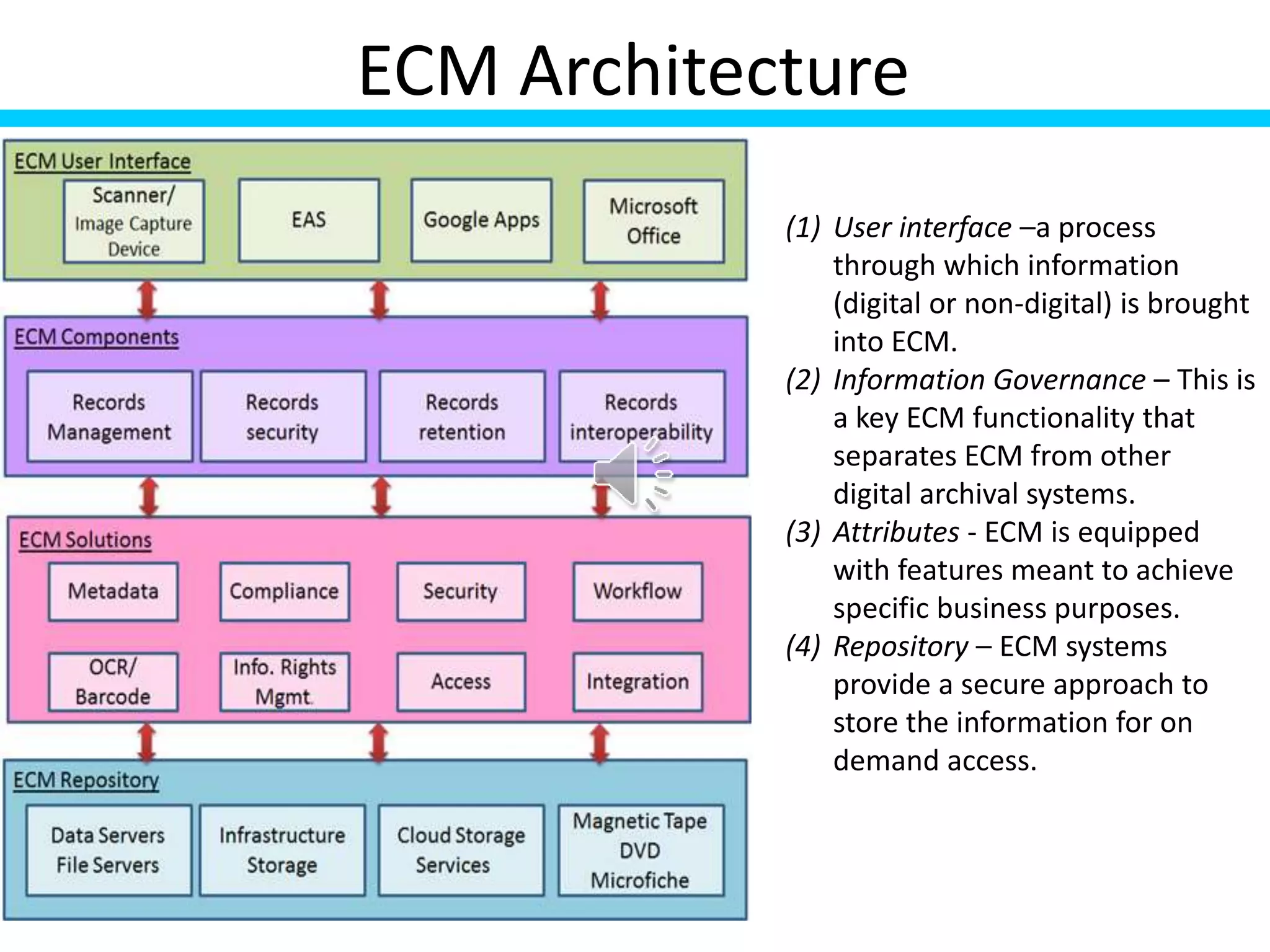
ECM Architecture
(1) User interface –a process
through which information
(digital or non-digital) is brought
into ECM.
(2) Information Governance – This is
a key ECM functionality that
separates ECM from other
digital archival systems.
(3) Attributes - ECM is equipped
with features meant to achieve
specific business purposes.
(4) Repository – ECM systems
provide a secure approach to
store the information for on
demand access.
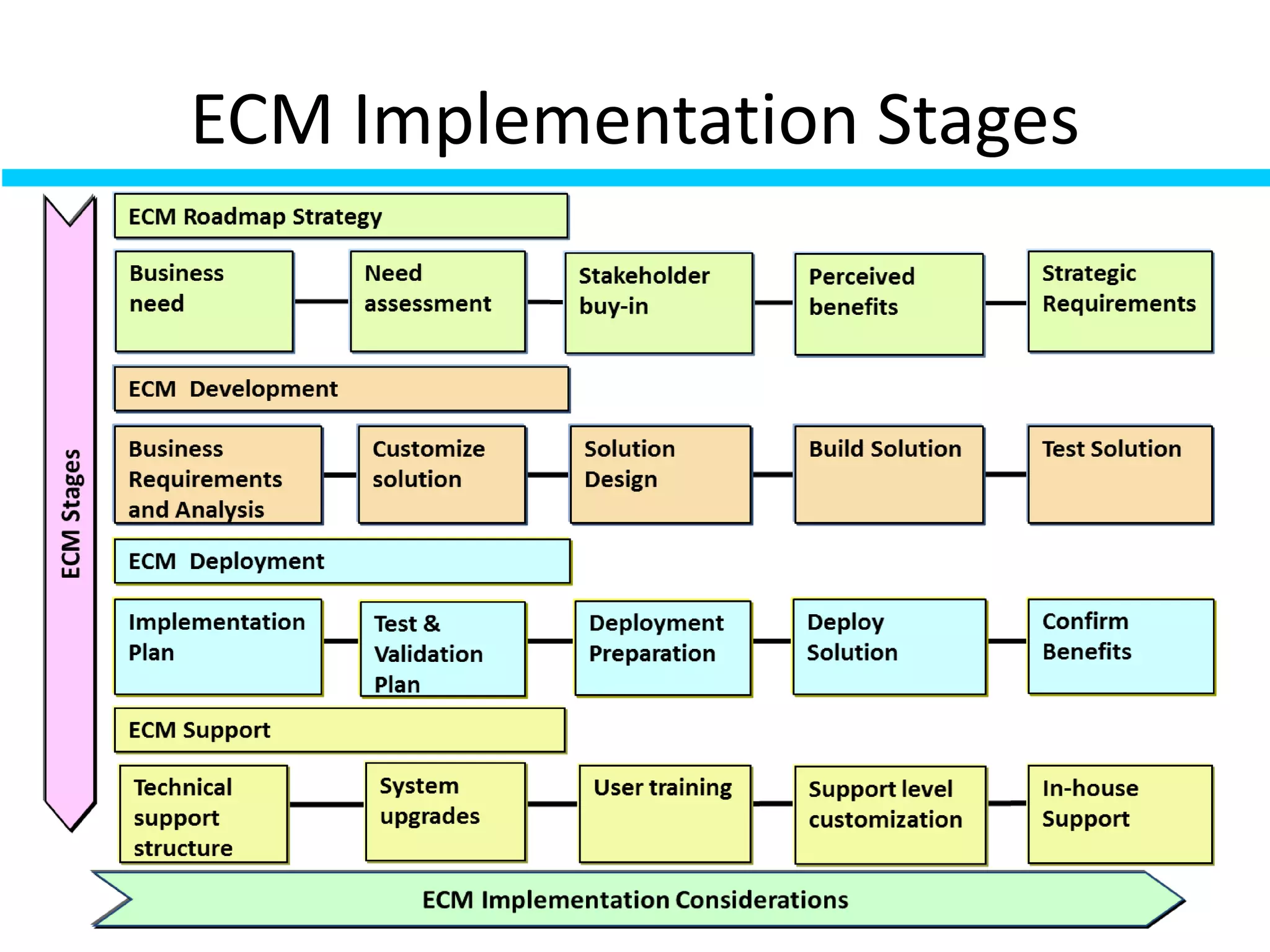
ECM Implementation Stages
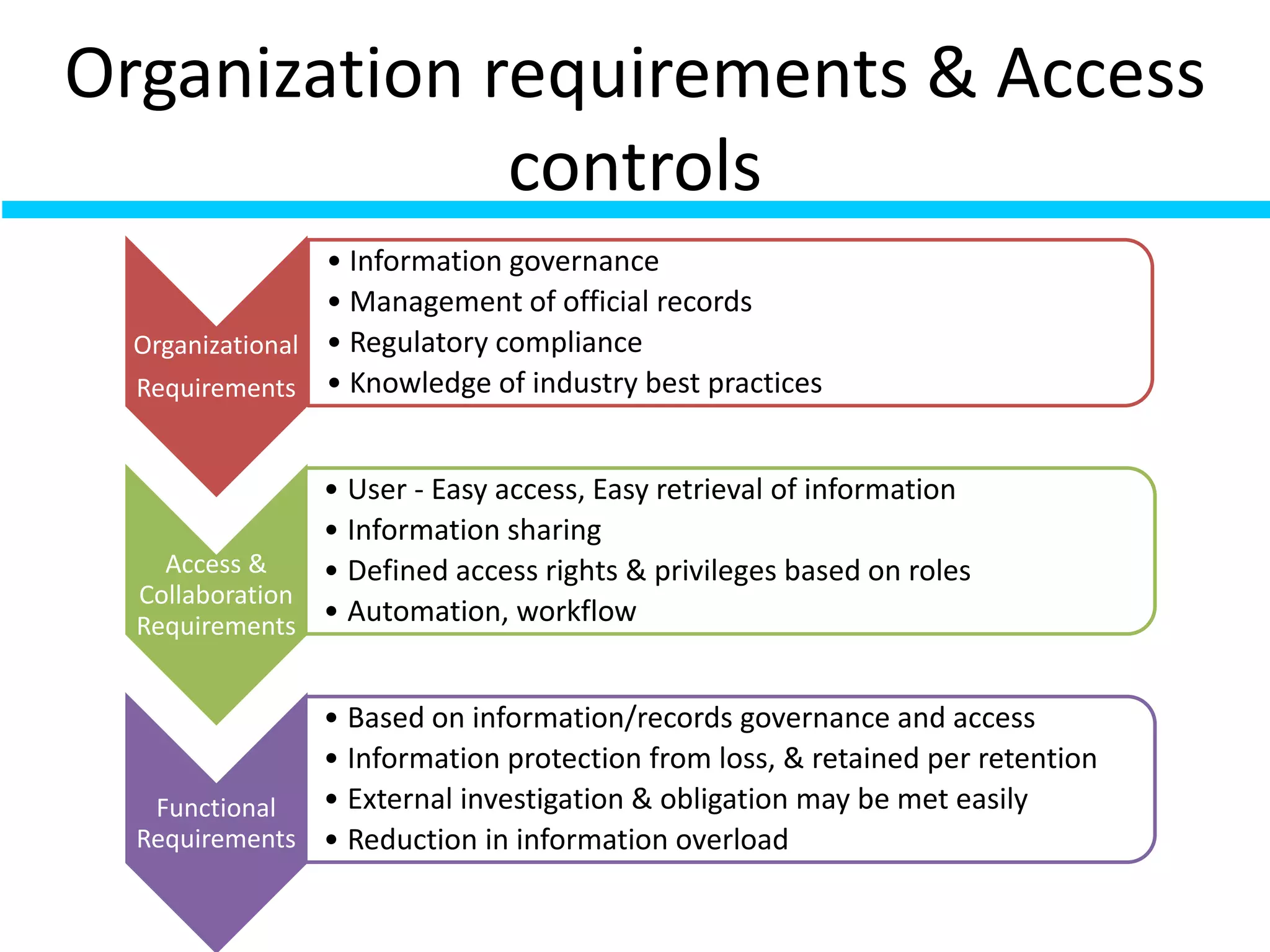
Organization requirements & Access
controls
Organizational
Requirements
• Information governance
• Management of official records
• Regulatory compliance
• Knowledge of industry best practices
Access &
Collaboration
Requirements
• User - Easy access, Easy retrieval of information
• Information sharing
• Defined access rights & privileges based on roles
• Automation, workflow
Functional
Requirements
• Based on information/records governance and access
• Information protection from loss, & retained per retention
• External investigation & obligation may be met easily
• Reduction in information overload
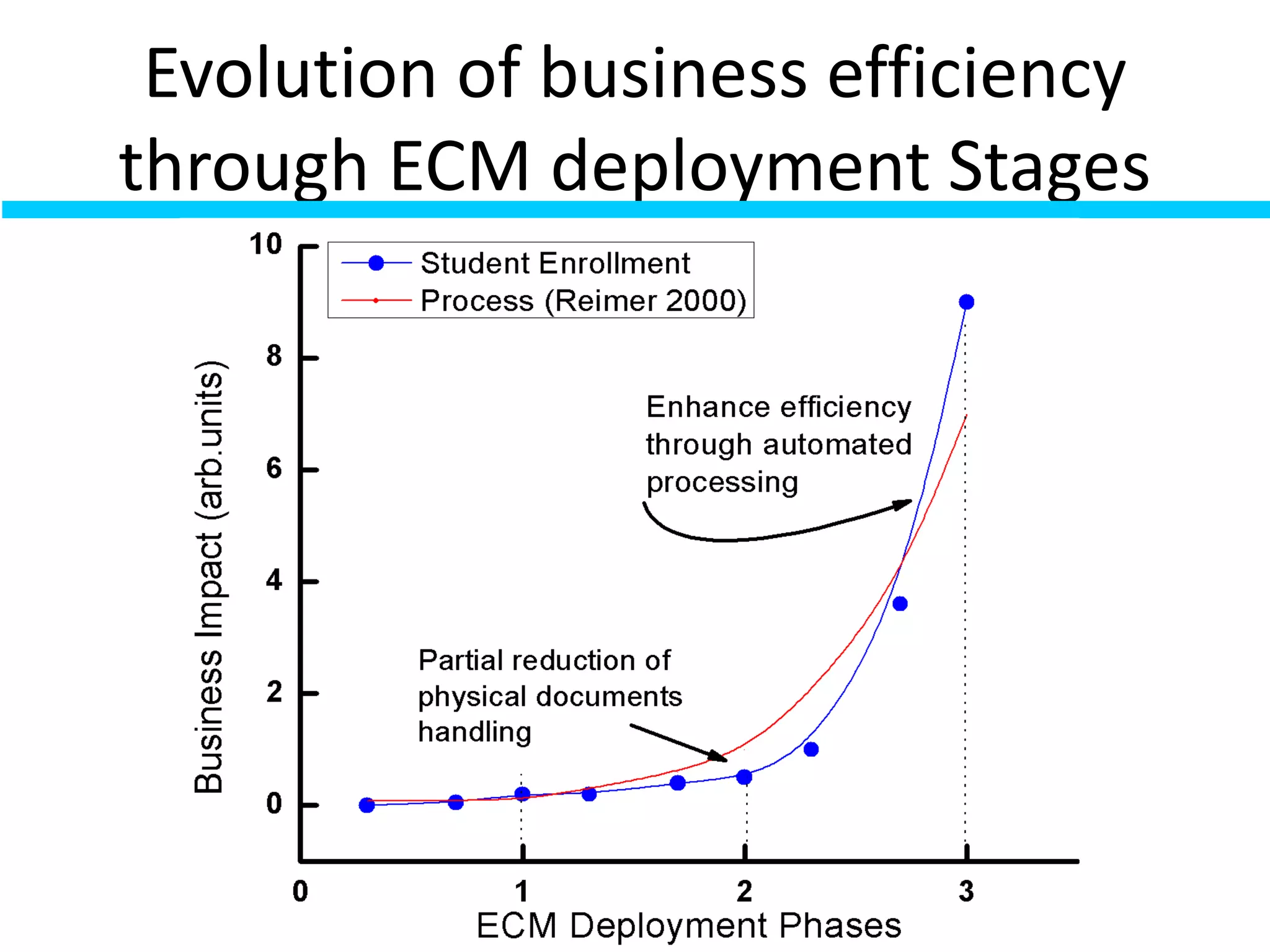
Evolution of business efficiency
through ECM deployment Stages
Conclusions
1. ECM solutions offer robust functionality in handling
information regardless of their origin, minimize operating
costs, improve customer service, and minimize risk.
2. Understanding the true nature of data and information
streams is very critical to automate the process.
3. The ECM implementation stages play a key role in
business impact and can be accelerated by scoping the
type of enterprise content, type of architecture and user
training.
4. The lag in implementation can be minimized by analyzing
the type of information, implementing a suitable ECM
platform, identifying the challenges, and training
personnel.

Enterprise Content Management - Implementation Strategy

  • 1.
    Enterprise Content Management Solutions- Roadmap Strategy and Implementation Challenges Shiva Hullavarad*, Russell O’Hare, Ashok Roy Office of Records and Information Management, University of Alaska System, Fairbanks, AK 99775 * Corresponding author: R-208D, 910 Yukon Drive, University of Alaska System, Fairbanks, AK 99775 Phone: +1 907-405-8074; Email: sshullavarad@alaska.edu
  • 2.
    Author Biography • Dr.Shiva Hullavarad is Enterprise Content and Electronics Records Administrator for the University of Alaska System. He holds four university degrees and ECM/ERM practitioner. Shiva reviews and approves all ECM/ERM process changes and implementation requests submitted by campus administrators. He has authored 81 technical papers and presented at national conferences. • Dr. Russell O’Hare is the Chief Records Officer for the University of Alaska System. He holds four university degrees and is a certified records manager. He is responsible for the university records information compliance program, approves university retention and disposition schedules, and is the university Red Flag program administrator. He oversees the statewide records center, micrographic, and enterprise content management offices. • Dr. Ashok K. Roy is Vice President for Finance & Administration/ CFO of the University of Alaska System& Associate Professor of Business Administration at University of Alaska Fairbanks. He holds six university degrees and five professional certifications. Dr. Roy has also authored over 83 publications in trade and academic journals including chapters in two encyclopedias.
  • 3.
    Enterprise Content Management •ECM is defined as the strategies, tools, processes, and skills an organization needs to manage all of its information assets (regardless of type) over their lifecycle. • ECM system can capture, process, access, measure, integrate, and store all of this information, regardless of whether it is in structured (databases) or unstructured (e.g., e-mail, word, spreadsheet, image, audio, video) format or in hard copy.
  • 4.
    ECM Architecture (1) Userinterface –a process through which information (digital or non-digital) is brought into ECM. (2) Information Governance – This is a key ECM functionality that separates ECM from other digital archival systems. (3) Attributes - ECM is equipped with features meant to achieve specific business purposes. (4) Repository – ECM systems provide a secure approach to store the information for on demand access.
  • 5.
  • 6.
    Organization requirements &Access controls Organizational Requirements • Information governance • Management of official records • Regulatory compliance • Knowledge of industry best practices Access & Collaboration Requirements • User - Easy access, Easy retrieval of information • Information sharing • Defined access rights & privileges based on roles • Automation, workflow Functional Requirements • Based on information/records governance and access • Information protection from loss, & retained per retention • External investigation & obligation may be met easily • Reduction in information overload
  • 7.
    Evolution of businessefficiency through ECM deployment Stages
  • 8.
    Conclusions 1. ECM solutionsoffer robust functionality in handling information regardless of their origin, minimize operating costs, improve customer service, and minimize risk. 2. Understanding the true nature of data and information streams is very critical to automate the process. 3. The ECM implementation stages play a key role in business impact and can be accelerated by scoping the type of enterprise content, type of architecture and user training. 4. The lag in implementation can be minimized by analyzing the type of information, implementing a suitable ECM platform, identifying the challenges, and training personnel.