Electrochemical Machining
(ECM)
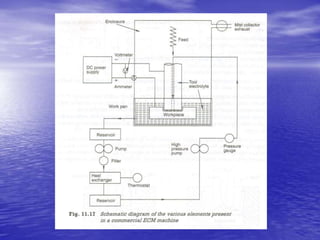
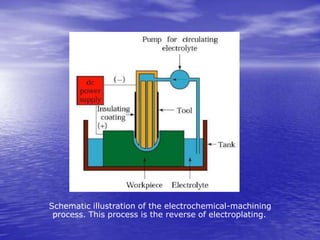
Schematic illustration of the electrochemical-machining
process. This process is the reverse of electroplating.
Operation
• Material is depleted from anode workpiece
(positive pole) and transported to a cathode tool
(negative pole) in an electrolyte bath
• Electrolyte flows rapidly between the two poles
to carry off depleted material, so it does not
plate onto tool
• Electrode materials: Aluminium, Cu, brass,
titanium, cupro-nickel and stainless steel
• Tool has inverse shape of part
• Tool size and shape must allow for the gap
Tool material
Properties expected out of the tool material:
• High electrical and thermal conductivity
• Good stiffness
• Easy machinability - particularly
important if complex shaped tools are
required
• High corrosion resistance - to protect
itself from the highly corrosive
electrolyte solution
• Rigidity - Rigidity of the tool construction
and material is important because the high
pressure can cause deflection of the tool
Electrolyte
Electrolytes used in ECM should be carefully
selected so that they provide the necessary
reactions without plating the cathode
Functions expected:
• Completing the electrical circuit between the tool
and the workpiece
• Allowing the desirable machining reactions to
take place
• Carrying away the heat generated during the
operation
• Carrying away products of reaction from the
zone of machining
Desirable electrolyte properties
• High electrical conductivity - easy ionisation
• Low viscosity - for easy flow
• High specific heat - to carry more heat
• Chemical stability - to be chemically neutral or
does not disintegrate during the reaction
• Resistance to formation of passivating film on
the workpiece surface
• Non corrosiveness and non-toxicity
• Inexpensiveness and easy availability
Salt solutions with water forming a large
proportion satisfy many of the above conditions
and therefore they are generally used
Design for electrolyte flow
Need for sufficient electrolyte flow between the
tool and the workpiece:
• To carry away the heat and the products of
machining
• To assist the machining process at the required
feed rate, producing a satisfactory surface finish
• Cavitation, stagnation and vortex formation
should be avoided since these lead to bad
surface finish
• There should be no sharp corners in the flow
path. All corners in the flow path should have a
radius
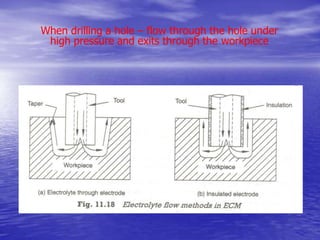
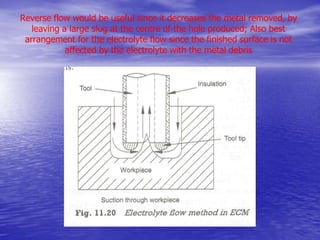
When drilling a hole – flow through the hole under
high pressure and exits through the workpiece
Reverse flow would be useful since it decreases the metal removed, by
leaving a large slug at the centre of the hole produced; Also best
arrangement for the electrolyte flow since the finished surface is not
affected by the electrolyte with the metal debris
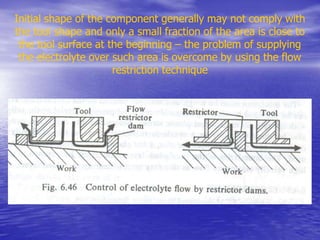
Initial shape of the component generally may not comply with
the tool shape and only a small fraction of the area is close to
the tool surface at the beginning – the problem of supplying
the electrolyte over such area is overcome by using the flow
restriction technique
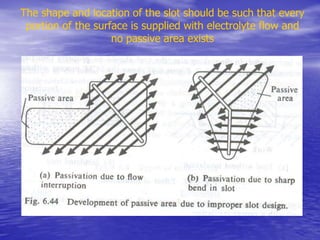
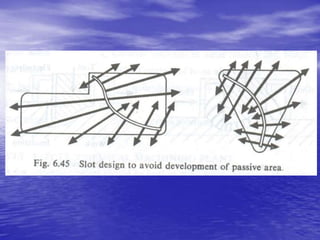
The shape and location of the slot should be such that every
portion of the surface is supplied with electrolyte flow and
no passive area exists
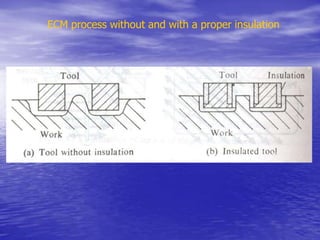
Insulation
• Insulation is important in the control of the electrical
current
Desirable qualities of insulation:
1. Adhesion to the tool: preformed insulation can be held
to the tool by shrinkfitting, adhesives or fasteners
2. Sealing without pores or leaks that could cause stray
machining by current leakage
3. Adequate thickness
4. Smoothness to avoid disturbing the flow of electrolyte
5. Resistance to heat for continuous service at 200°C without
breakdown
6. Durability to resist wear in guides and fixtures
7. Chemical resistance to the electrolyte
8. High electrical resistivity
9. Uniform application to minimize disturbance of the flow of
electrolyte and to prevent interference
10. Low water absorption
• Generally the simplest method of applying
insulation is by spraying or dipping
• Teflon, urethane, phenolic, expoxy, powder
coating and other materials are commonly
used for insulation
• Sprayed or dipped coatings of epoxy resins are
among the most effective insulating materials
• For optimum effectiveness, these coatings
should be used with a protective lip on the
tool to protect the edge of the insulation
from the flow force of the electrolyte
ECM process without and with a proper insulation
Process parameters
• MRR with ECM are sufficiently large and
comparable with that of the conventional
methods
• The rate of material removal in ECM is governed
by Faraday’s law and is a function of current
density.
• Current density is not only controlled by the
amount of current that the power supply is
delivering, but also by the size of the IEG
• A small IEG results in the highest current density.
However, when its very small, there is a danger of
sludge particles bridging the gap and causing a
short circuit
• When the gap is too large, current density is
reduced, resulting in a poor surface finish and
decreased MRR
• Other variables that affect the current density
and the MRR are:
1. Voltage
2. Feed rate
3. Electrolyte conductivity
4. Electrolyte composition
5. Electrolyte flow
6. Workpiece material
Voltage
• Voltage across the cutting gap influences
the current and the MRR and is controlled
in most ECM operations
• Low voltage decreases the equilbrium-
machining gap and results in a better
surface finish and finer tolerance control
• Increased current leads to electrolyte
heating – low temperature of the
electrolyte is conducive for a better
surface finish and tolerances
Feed rate
• As the tool approaches the work, the length of
the conductive path decreases and the magnitude
of the current increases
• High feed rate results in higher MRR
• Limitations of feed rate are removal of hydrogen
gas and products of machining;
Electrolyte conductivity
• Affects the resistance across the gap
• Increasing the concentration will cause
conductivity to rise
• Temperature increases of the electrolyte
also increases conductivity
• Low concentration and low temperature
will results in lower MRR
Electrolyte composition
• Composition directly influences conductivity,
MRR and surface characteristics
• Parameters used for a given application may not
yield the same ECM results if a different type of
electrolyte is used
• Normal development of an operation begins with
the selection of the correct electrolyte. The other
parameters and the cathode are adjusted to get
the desired result
Electrolyte flow rate
• The velocity and the electrolyte flow through the gap is
also an important parameter affecting the surface finish
and MRR
• If the velocity is too low, the heat and by-products of the
reaction build in the gap causing non-uniform material
removal
• A velocity that is too high will cause cavitation, also
promoting uneven material removal
• Increased electrolyte velocities require larger electrolyte
pumps that add capital cost to the system
• Pressure control is the method of controlling the flow
rate
Advantages
• Ability to machine complex 3D curved surfaces without feed marks
• Machines complicated shapes in single pass
• Capable of machining metals and alloys irrespective of their strength
and hardness
• Since metal removal is by mettalic ion exchange, there are no
cutting forces and the workpiece is left in a stress free state – very
thin sections can be machined
• There is little or no tool wear – so large number of components can
be machined without replacing the tool
• Not subjected to high temperatures
• Burr free
• Good surface finish
• Good accuracy and tolerance
• Low machining time
• Low scrap
• Automatic operation
Limitations
• Work must be electrically conductive
• Inability to machine sharp interior edges and corners
• Large power consumption and related problems (heavy initial
investment)
• Post machining cleaning is a must to reduce the corrosion of the
workpiece and ECM machine
• Tool design is complicated and needs cut and try methods to
achieve the final shape
• Although the parts produced by ECM are stress free, they are found
to have fatigue strength or endurance limit lowered by
approximately 10-25%. So may require post treatment (shot
peening) to restore the strength especially for situations where
fatigue strength is critical
• Additional problems related to machine tool requirements: power
supply, electrolyte handling and tool feed servo system
• High maintenance
• Can cause intergranular attack (IGA)
• High tooling and set-up costs
Applications
• Aerospace industries: machining gas turbine blades, airframe
component fabrication, honey-comb aircraft panels, jet engine blade
airfoils
• Manufacture of general machine parts: thin wall mechanical slotting,
difficult to machine hollow shafts, chain pinions, internal profile of
internal cams, driving joints, pump glands and impellers, connecting
rod, hydraulic spools, gear wheels
• Facing and turning complex 3D surfaces
• Die sinking, particularly deep narrow slots and holes
• Profiling and any odd shape contouring
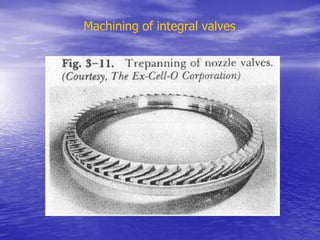
• Multiple hole drilling
• Trepanning
• Broaching
• Deburring
• Grinding
• Honing
• Cutting off
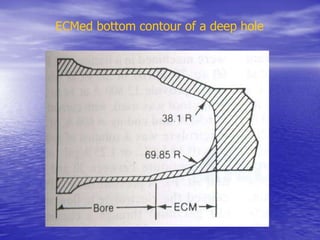
ECMed bottom contour of a deep hole
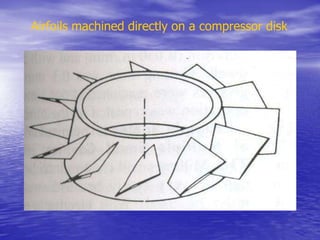
Airfoils machined directly on a compressor disk
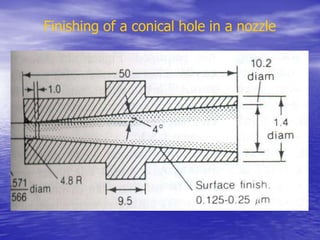
Finishing of a conical hole in a nozzle
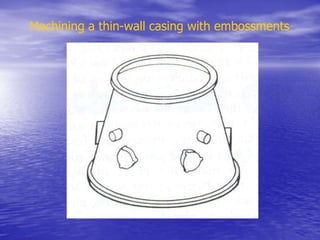
Machining a thin-wall casing with embossments
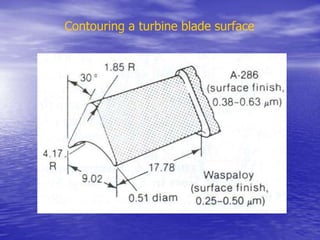
Contouring a turbine blade surface
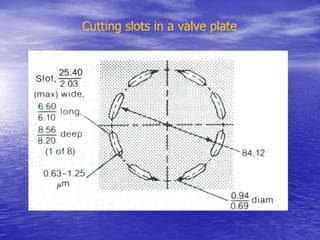
Cutting slots in a valve plate
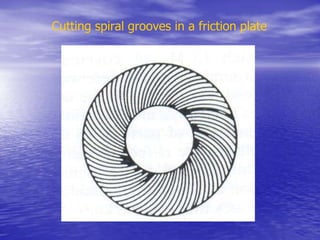
Cutting spiral grooves in a friction plate
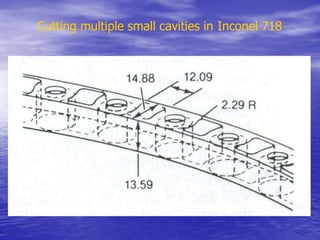
Cutting multiple small cavities in Inconel 718
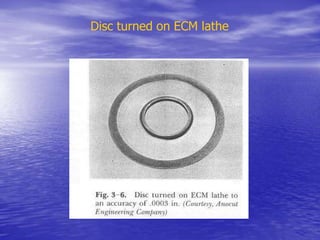
Disc turned on ECM lathe
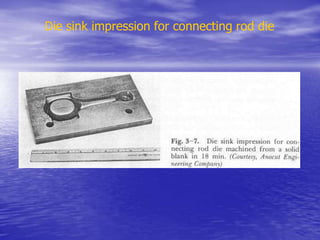
Die sink impression for connecting rod die
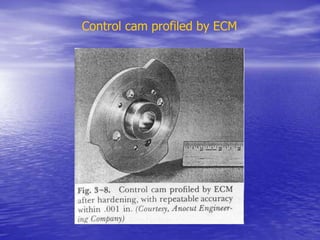
Control cam profiled by ECM
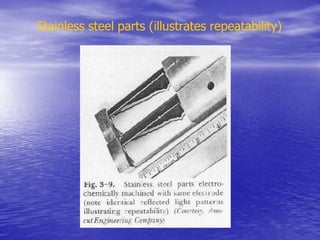
Stainless steel parts (illustrates repeatability)
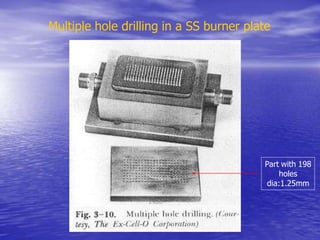
Multiple hole drilling in a SS burner plate
Part with 198
holes
dia:1.25mm
Machining of integral valves
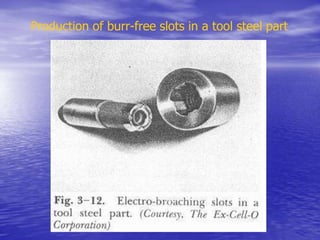
Production of burr-free slots in a tool steel part
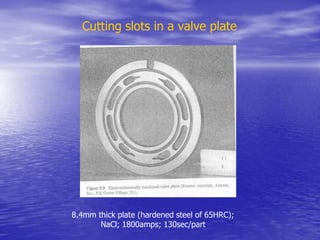
Cutting slots in a valve plate
8.4mm thick plate (hardened steel of 65HRC);
NaCl; 1800amps; 130sec/part
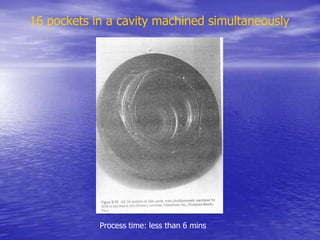
16 pockets in a cavity machined simultaneously
Process time: less than 6 mins
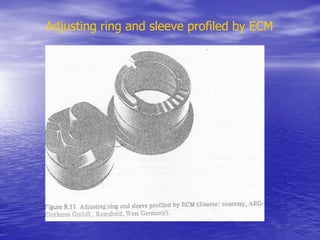
Adjusting ring and sleeve profiled by ECM
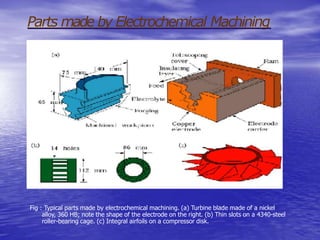
Parts made by Electrochemical Machining
Fig : Typical parts made by electrochemical machining. (a) Turbine blade made of a nickel
alloy, 360 HB; note the shape of the electrode on the right. (b) Thin slots on a 4340-steel
roller-bearing cage. (c) Integral airfoils on a compressor disk.
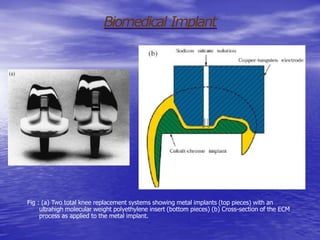
Biomedical Implant
Fig : (a) Two total knee replacement systems showing metal implants (top pieces) with an
ultrahigh molecular weight polyethylene insert (bottom pieces) (b) Cross-section of the ECM
process as applied to the metal implant.
Design considerations for Electrochemical
Machining
• Electrolyte erodes sharp surfaces and profiles so not suited
for sharp edges
• Irregular cavities may not be produced to the desired shape
with acceptable dimensional accuracy
• Designs should make provisions for small taper for holes
and cavities to be machined

Electro Chemical Machining

  • 1.
  • 3.
    Schematic illustration ofthe electrochemical-machining process. This process is the reverse of electroplating.
  • 4.
    Operation • Material isdepleted from anode workpiece (positive pole) and transported to a cathode tool (negative pole) in an electrolyte bath • Electrolyte flows rapidly between the two poles to carry off depleted material, so it does not plate onto tool • Electrode materials: Aluminium, Cu, brass, titanium, cupro-nickel and stainless steel • Tool has inverse shape of part • Tool size and shape must allow for the gap
  • 5.
    Tool material Properties expectedout of the tool material: • High electrical and thermal conductivity • Good stiffness • Easy machinability - particularly important if complex shaped tools are required • High corrosion resistance - to protect itself from the highly corrosive electrolyte solution • Rigidity - Rigidity of the tool construction and material is important because the high pressure can cause deflection of the tool
  • 6.
    Electrolyte Electrolytes used inECM should be carefully selected so that they provide the necessary reactions without plating the cathode Functions expected: • Completing the electrical circuit between the tool and the workpiece • Allowing the desirable machining reactions to take place • Carrying away the heat generated during the operation • Carrying away products of reaction from the zone of machining
  • 7.
    Desirable electrolyte properties •High electrical conductivity - easy ionisation • Low viscosity - for easy flow • High specific heat - to carry more heat • Chemical stability - to be chemically neutral or does not disintegrate during the reaction • Resistance to formation of passivating film on the workpiece surface • Non corrosiveness and non-toxicity • Inexpensiveness and easy availability Salt solutions with water forming a large proportion satisfy many of the above conditions and therefore they are generally used
  • 8.
    Design for electrolyteflow Need for sufficient electrolyte flow between the tool and the workpiece: • To carry away the heat and the products of machining • To assist the machining process at the required feed rate, producing a satisfactory surface finish • Cavitation, stagnation and vortex formation should be avoided since these lead to bad surface finish • There should be no sharp corners in the flow path. All corners in the flow path should have a radius
  • 9.
    When drilling ahole – flow through the hole under high pressure and exits through the workpiece
  • 10.
    Reverse flow wouldbe useful since it decreases the metal removed, by leaving a large slug at the centre of the hole produced; Also best arrangement for the electrolyte flow since the finished surface is not affected by the electrolyte with the metal debris
  • 11.
    Initial shape ofthe component generally may not comply with the tool shape and only a small fraction of the area is close to the tool surface at the beginning – the problem of supplying the electrolyte over such area is overcome by using the flow restriction technique
  • 12.
    The shape andlocation of the slot should be such that every portion of the surface is supplied with electrolyte flow and no passive area exists
  • 14.
    Insulation • Insulation isimportant in the control of the electrical current Desirable qualities of insulation: 1. Adhesion to the tool: preformed insulation can be held to the tool by shrinkfitting, adhesives or fasteners 2. Sealing without pores or leaks that could cause stray machining by current leakage 3. Adequate thickness 4. Smoothness to avoid disturbing the flow of electrolyte 5. Resistance to heat for continuous service at 200°C without breakdown 6. Durability to resist wear in guides and fixtures 7. Chemical resistance to the electrolyte 8. High electrical resistivity 9. Uniform application to minimize disturbance of the flow of electrolyte and to prevent interference 10. Low water absorption
  • 15.
    • Generally thesimplest method of applying insulation is by spraying or dipping • Teflon, urethane, phenolic, expoxy, powder coating and other materials are commonly used for insulation • Sprayed or dipped coatings of epoxy resins are among the most effective insulating materials • For optimum effectiveness, these coatings should be used with a protective lip on the tool to protect the edge of the insulation from the flow force of the electrolyte
  • 16.
    ECM process withoutand with a proper insulation
  • 17.
    Process parameters • MRRwith ECM are sufficiently large and comparable with that of the conventional methods • The rate of material removal in ECM is governed by Faraday’s law and is a function of current density. • Current density is not only controlled by the amount of current that the power supply is delivering, but also by the size of the IEG • A small IEG results in the highest current density. However, when its very small, there is a danger of sludge particles bridging the gap and causing a short circuit • When the gap is too large, current density is reduced, resulting in a poor surface finish and decreased MRR
  • 18.
    • Other variablesthat affect the current density and the MRR are: 1. Voltage 2. Feed rate 3. Electrolyte conductivity 4. Electrolyte composition 5. Electrolyte flow 6. Workpiece material
  • 19.
    Voltage • Voltage acrossthe cutting gap influences the current and the MRR and is controlled in most ECM operations • Low voltage decreases the equilbrium- machining gap and results in a better surface finish and finer tolerance control • Increased current leads to electrolyte heating – low temperature of the electrolyte is conducive for a better surface finish and tolerances
  • 20.
    Feed rate • Asthe tool approaches the work, the length of the conductive path decreases and the magnitude of the current increases • High feed rate results in higher MRR • Limitations of feed rate are removal of hydrogen gas and products of machining;
  • 21.
    Electrolyte conductivity • Affectsthe resistance across the gap • Increasing the concentration will cause conductivity to rise • Temperature increases of the electrolyte also increases conductivity • Low concentration and low temperature will results in lower MRR
  • 22.
    Electrolyte composition • Compositiondirectly influences conductivity, MRR and surface characteristics • Parameters used for a given application may not yield the same ECM results if a different type of electrolyte is used • Normal development of an operation begins with the selection of the correct electrolyte. The other parameters and the cathode are adjusted to get the desired result
  • 23.
    Electrolyte flow rate •The velocity and the electrolyte flow through the gap is also an important parameter affecting the surface finish and MRR • If the velocity is too low, the heat and by-products of the reaction build in the gap causing non-uniform material removal • A velocity that is too high will cause cavitation, also promoting uneven material removal • Increased electrolyte velocities require larger electrolyte pumps that add capital cost to the system • Pressure control is the method of controlling the flow rate
  • 24.
    Advantages • Ability tomachine complex 3D curved surfaces without feed marks • Machines complicated shapes in single pass • Capable of machining metals and alloys irrespective of their strength and hardness • Since metal removal is by mettalic ion exchange, there are no cutting forces and the workpiece is left in a stress free state – very thin sections can be machined • There is little or no tool wear – so large number of components can be machined without replacing the tool • Not subjected to high temperatures • Burr free • Good surface finish • Good accuracy and tolerance • Low machining time • Low scrap • Automatic operation
  • 25.
    Limitations • Work mustbe electrically conductive • Inability to machine sharp interior edges and corners • Large power consumption and related problems (heavy initial investment) • Post machining cleaning is a must to reduce the corrosion of the workpiece and ECM machine • Tool design is complicated and needs cut and try methods to achieve the final shape • Although the parts produced by ECM are stress free, they are found to have fatigue strength or endurance limit lowered by approximately 10-25%. So may require post treatment (shot peening) to restore the strength especially for situations where fatigue strength is critical • Additional problems related to machine tool requirements: power supply, electrolyte handling and tool feed servo system • High maintenance • Can cause intergranular attack (IGA) • High tooling and set-up costs
  • 26.
    Applications • Aerospace industries:machining gas turbine blades, airframe component fabrication, honey-comb aircraft panels, jet engine blade airfoils • Manufacture of general machine parts: thin wall mechanical slotting, difficult to machine hollow shafts, chain pinions, internal profile of internal cams, driving joints, pump glands and impellers, connecting rod, hydraulic spools, gear wheels • Facing and turning complex 3D surfaces • Die sinking, particularly deep narrow slots and holes • Profiling and any odd shape contouring • Multiple hole drilling • Trepanning • Broaching • Deburring • Grinding • Honing • Cutting off
  • 27.
    ECMed bottom contourof a deep hole
  • 28.
    Airfoils machined directlyon a compressor disk
  • 29.
    Finishing of aconical hole in a nozzle
  • 30.
    Machining a thin-wallcasing with embossments
  • 31.
    Contouring a turbineblade surface
  • 32.
    Cutting slots ina valve plate
  • 33.
    Cutting spiral groovesin a friction plate
  • 34.
    Cutting multiple smallcavities in Inconel 718
  • 35.
    Disc turned onECM lathe
  • 36.
    Die sink impressionfor connecting rod die
  • 37.
  • 38.
    Stainless steel parts(illustrates repeatability)
  • 39.
    Multiple hole drillingin a SS burner plate Part with 198 holes dia:1.25mm
  • 40.
  • 41.
    Production of burr-freeslots in a tool steel part
  • 42.
    Cutting slots ina valve plate 8.4mm thick plate (hardened steel of 65HRC); NaCl; 1800amps; 130sec/part
  • 43.
    16 pockets ina cavity machined simultaneously Process time: less than 6 mins
  • 44.
    Adjusting ring andsleeve profiled by ECM
  • 45.
    Parts made byElectrochemical Machining Fig : Typical parts made by electrochemical machining. (a) Turbine blade made of a nickel alloy, 360 HB; note the shape of the electrode on the right. (b) Thin slots on a 4340-steel roller-bearing cage. (c) Integral airfoils on a compressor disk.
  • 46.
    Biomedical Implant Fig :(a) Two total knee replacement systems showing metal implants (top pieces) with an ultrahigh molecular weight polyethylene insert (bottom pieces) (b) Cross-section of the ECM process as applied to the metal implant.
  • 48.
    Design considerations forElectrochemical Machining • Electrolyte erodes sharp surfaces and profiles so not suited for sharp edges • Irregular cavities may not be produced to the desired shape with acceptable dimensional accuracy • Designs should make provisions for small taper for holes and cavities to be machined