MOON PHASES
POWERPOINT
2
• The Moon orbits the Earth
• The Moon doesn’t shine on its own; it
reflects sunlight
Important Key Points
The revolution of the moon around
the Earth causes the moon to appear
to have phases.
NSF North Mississippi GK-8
Why does the moon have phases?
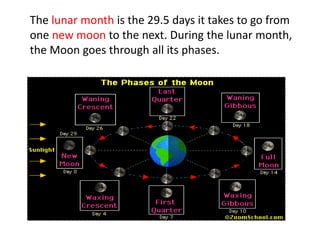
The lunar month is the 29.5 days it takes to go from
one new moon to the next. During the lunar month,
the Moon goes through all its phases.
FULL
QUARTER
CRESCENT
GIBBOUS
FOUR MAIN SHAPES
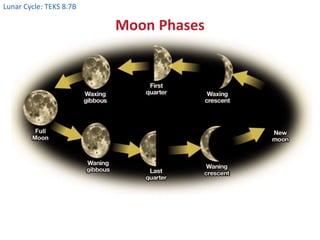
Waxing or Waning?
Waxing means the moon is
“growing”. If the moon is
getting bright from the right it
is waxing.
Waning means the moon is
“shrinking”. If the moon is
dark on the right it is
waning.
Lunar Cycle: TEKS 8.7B
Moon Phases
Lunar Cycle: TEKS 8.7B
How can I determine which phase the moon is in?
• Step 1: Look at which side is illuminated.
– If the right side is illuminated then it is waxing.
– If the left side is illuminated then it is waning.
– Or if all is illuminated then it is a full moon
– If there is no illumination then it is a new moon.
• Step 2: Look at the shape and decide if it is full, quarter
(half moon), crescent (less than half) or gibbous (more
than half).
**Note, a waxing quarter is called 1st Quarter. A waning
quarter is called 3rd Quarter.
Lunar Cycle: TEKS 8.7B
Let’s practice!
• Step 1: Look at which side is illuminated.
– If the right side is illuminated then it is
waxing.
– If the left side is illuminated then it is waning.
– Or if all is illuminated then it is a full moon
– If there is no illumination then it is a new
moon.
• Step 2: Look at the shape and decide if it is
full, quarter (half moon), crescent (less than
half) or gibbous (more than half).
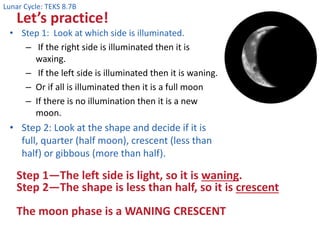
Step 1—The left side is light, so it is waning.
Step 2—The shape is less than half, so it is crescent
The moon phase is a WANING CRESCENT
Lunar Cycle: TEKS 8.7B
Let’s practice!
• Step 1: Look at which side is illuminated.
– If the right side is illuminated then it is
waxing.
– If the left side is illuminated then it is waning.
– Or if all is illuminated then it is a full moon
– If there is no illumination then it is a new
moon.
• Step 2: Look at the shape and decide if it is full,
quarter (half moon), crescent (less than half) or
gibbous (more than half).
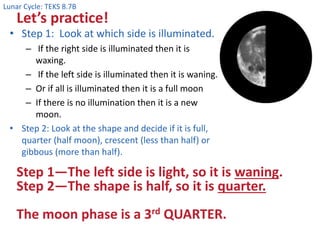
Step 1—The left side is light, so it is waning.
Step 2—The shape is half, so it is quarter.
The moon phase is a 3rd QUARTER.
Lunar Cycle: TEKS 8.7B
• Which phase is shown here?
On Your Own Example 1
Lunar Cycle: TEKS 8.7B
• Which phase is shown here?
On Your Own Example 2
Lunar Cycle: TEKS 8.7B
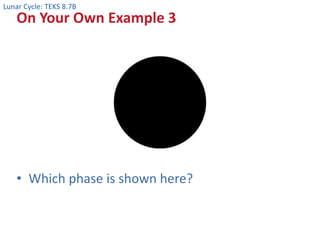
• Which phase is shown here?
On Your Own Example 3
Lunar Cycle: TEKS 8.7B
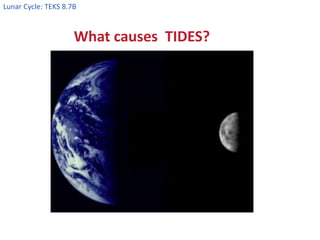
What causes TIDES?
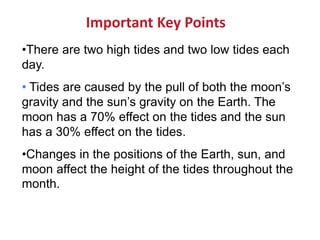
•There are two high tides and two low tides each
day.
• Tides are caused by the pull of both the moon’s
gravity and the sun’s gravity on the Earth. The
moon has a 70% effect on the tides and the sun
has a 30% effect on the tides.
•Changes in the positions of the Earth, sun, and
moon affect the height of the tides throughout the
month.
Important Key Points
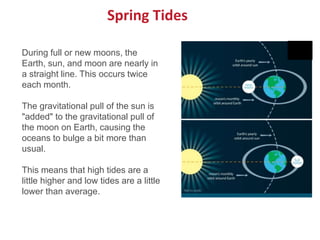
During full or new moons, the
Earth, sun, and moon are nearly in
a straight line. This occurs twice
each month.
The gravitational pull of the sun is
"added" to the gravitational pull of
the moon on Earth, causing the
oceans to bulge a bit more than
usual.
This means that high tides are a
little higher and low tides are a little
lower than average.
Spring Tides
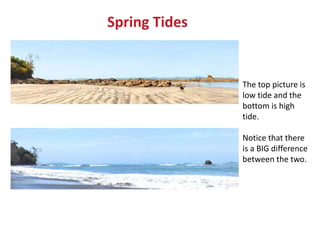
The top picture is
low tide and the
bottom is high
tide.
Notice that there
is a BIG difference
between the two.
Spring Tides
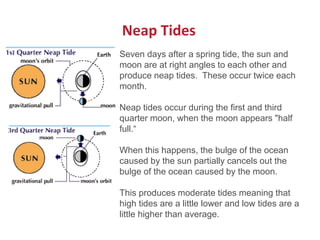
Seven days after a spring tide, the sun and
moon are at right angles to each other and
produce neap tides. These occur twice each
month.
Neap tides occur during the first and third
quarter moon, when the moon appears "half
full.“
When this happens, the bulge of the ocean
caused by the sun partially cancels out the
bulge of the ocean caused by the moon.
This produces moderate tides meaning that
high tides are a little lower and low tides are a
little higher than average.
Neap Tides
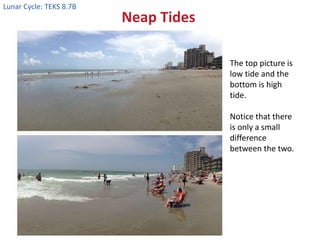
Lunar Cycle: TEKS 8.7B
The top picture is
low tide and the
bottom is high
tide.
Notice that there
is only a small
difference
between the two.
Neap Tides

Moon Phases

  • 1.
  • 2.
    2 • The Moonorbits the Earth • The Moon doesn’t shine on its own; it reflects sunlight Important Key Points
  • 3.
    The revolution ofthe moon around the Earth causes the moon to appear to have phases. NSF North Mississippi GK-8 Why does the moon have phases?
  • 4.
    The lunar monthis the 29.5 days it takes to go from one new moon to the next. During the lunar month, the Moon goes through all its phases.
  • 5.
  • 6.
    Waxing or Waning? Waxingmeans the moon is “growing”. If the moon is getting bright from the right it is waxing. Waning means the moon is “shrinking”. If the moon is dark on the right it is waning.
  • 7.
    Lunar Cycle: TEKS8.7B Moon Phases
  • 8.
    Lunar Cycle: TEKS8.7B How can I determine which phase the moon is in? • Step 1: Look at which side is illuminated. – If the right side is illuminated then it is waxing. – If the left side is illuminated then it is waning. – Or if all is illuminated then it is a full moon – If there is no illumination then it is a new moon. • Step 2: Look at the shape and decide if it is full, quarter (half moon), crescent (less than half) or gibbous (more than half). **Note, a waxing quarter is called 1st Quarter. A waning quarter is called 3rd Quarter.
  • 9.
    Lunar Cycle: TEKS8.7B Let’s practice! • Step 1: Look at which side is illuminated. – If the right side is illuminated then it is waxing. – If the left side is illuminated then it is waning. – Or if all is illuminated then it is a full moon – If there is no illumination then it is a new moon. • Step 2: Look at the shape and decide if it is full, quarter (half moon), crescent (less than half) or gibbous (more than half). Step 1—The left side is light, so it is waning. Step 2—The shape is less than half, so it is crescent The moon phase is a WANING CRESCENT
  • 10.
    Lunar Cycle: TEKS8.7B Let’s practice! • Step 1: Look at which side is illuminated. – If the right side is illuminated then it is waxing. – If the left side is illuminated then it is waning. – Or if all is illuminated then it is a full moon – If there is no illumination then it is a new moon. • Step 2: Look at the shape and decide if it is full, quarter (half moon), crescent (less than half) or gibbous (more than half). Step 1—The left side is light, so it is waning. Step 2—The shape is half, so it is quarter. The moon phase is a 3rd QUARTER.
  • 11.
    Lunar Cycle: TEKS8.7B • Which phase is shown here? On Your Own Example 1
  • 12.
    Lunar Cycle: TEKS8.7B • Which phase is shown here? On Your Own Example 2
  • 13.
    Lunar Cycle: TEKS8.7B • Which phase is shown here? On Your Own Example 3
  • 14.
    Lunar Cycle: TEKS8.7B What causes TIDES?
  • 15.
    •There are twohigh tides and two low tides each day. • Tides are caused by the pull of both the moon’s gravity and the sun’s gravity on the Earth. The moon has a 70% effect on the tides and the sun has a 30% effect on the tides. •Changes in the positions of the Earth, sun, and moon affect the height of the tides throughout the month. Important Key Points
  • 16.
    During full ornew moons, the Earth, sun, and moon are nearly in a straight line. This occurs twice each month. The gravitational pull of the sun is "added" to the gravitational pull of the moon on Earth, causing the oceans to bulge a bit more than usual. This means that high tides are a little higher and low tides are a little lower than average. Spring Tides
  • 17.
    The top pictureis low tide and the bottom is high tide. Notice that there is a BIG difference between the two. Spring Tides
  • 18.
    Seven days aftera spring tide, the sun and moon are at right angles to each other and produce neap tides. These occur twice each month. Neap tides occur during the first and third quarter moon, when the moon appears "half full.“ When this happens, the bulge of the ocean caused by the sun partially cancels out the bulge of the ocean caused by the moon. This produces moderate tides meaning that high tides are a little lower and low tides are a little higher than average. Neap Tides
  • 19.
    Lunar Cycle: TEKS8.7B The top picture is low tide and the bottom is high tide. Notice that there is only a small difference between the two. Neap Tides