Learning Objects
• Ican explain the differences between solar
and lunar eclipses.
• I can identify the types of eclipses based on
the positions of the earth, moon, and sun.
• I can identify the phase of the moon with
each type of eclipse.
3.
What is anEclipse?
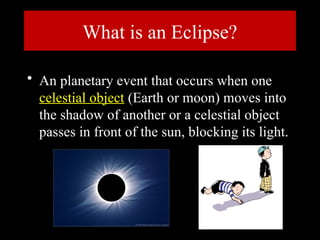
• An planetary event that occurs when one
celestial object (Earth or moon) moves into
the shadow of another or a celestial object
passes in front of the sun, blocking its light.
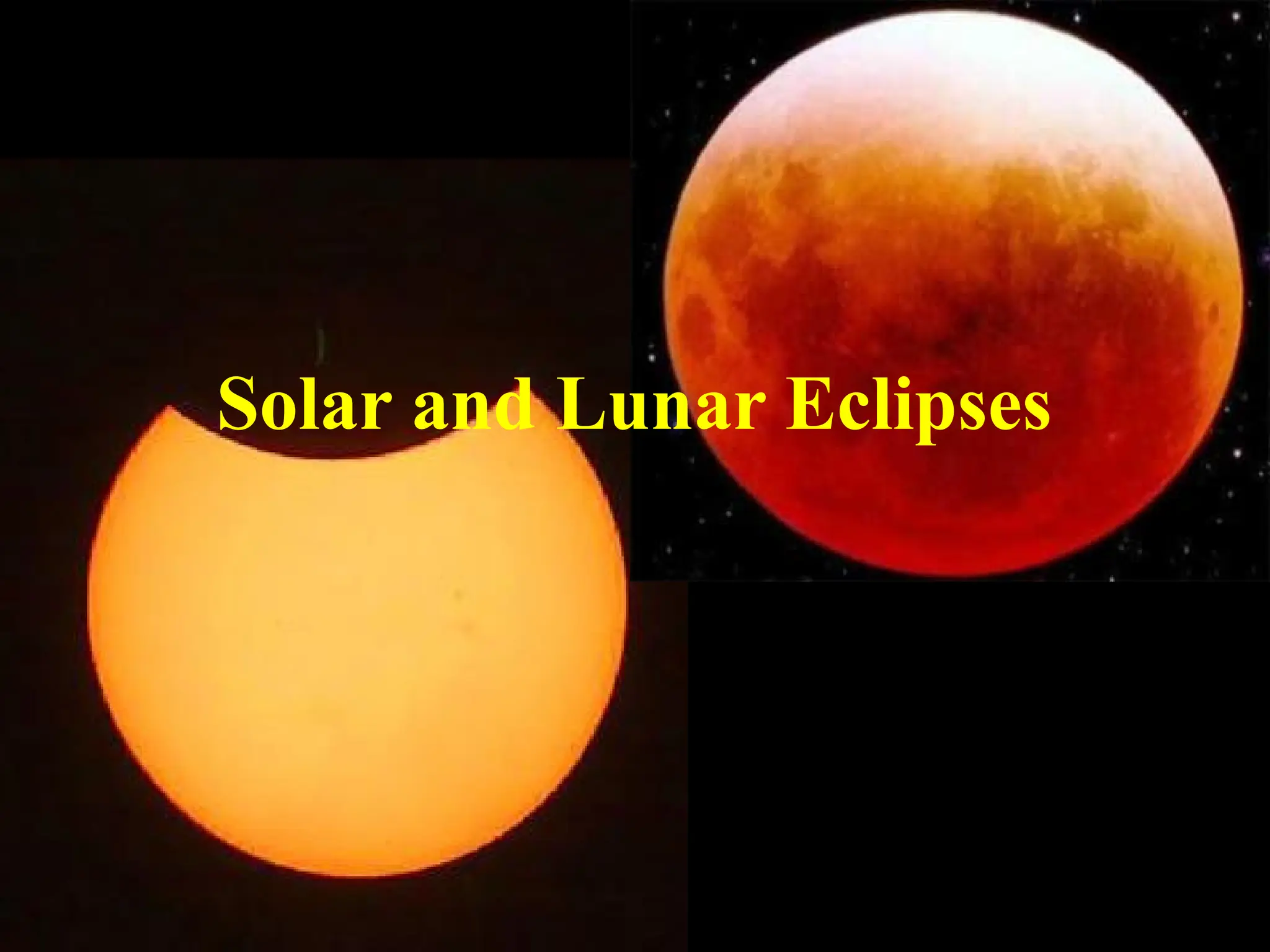
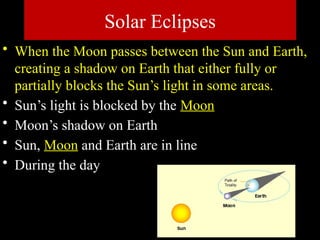
• When theMoon passes between the Sun and Earth,
creating a shadow on Earth that either fully or
partially blocks the Sun’s light in some areas.
• Sun’s light is blocked by the Moon
• Moon’s shadow on Earth
• Sun, Moon and Earth are in line
• During the day
Solar Eclipses
6.
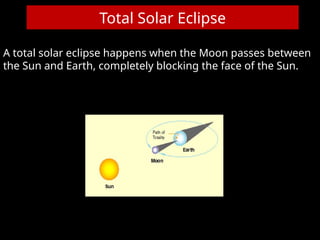
Total Solar Eclipse
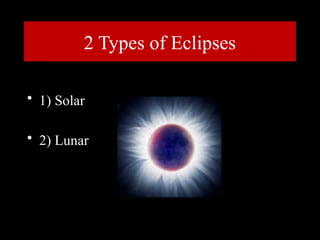
Atotal solar eclipse happens when the Moon passes between
the Sun and Earth, completely blocking the face of the Sun.
7.
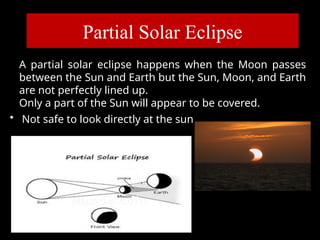
Partial Solar Eclipse
•Not safe to look directly at the sun
A partial solar eclipse happens when the Moon passes
between the Sun and Earth but the Sun, Moon, and Earth
are not perfectly lined up.
Only a part of the Sun will appear to be covered.
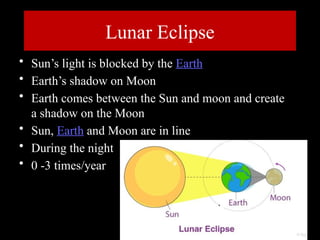
Lunar Eclipse
• Sun’slight is blocked by the Earth
• Earth’s shadow on Moon
• Earth comes between the Sun and moon and create
a shadow on the Moon
• Sun, Earth and Moon are in line
• During the night
• 0 -3 times/year
10.
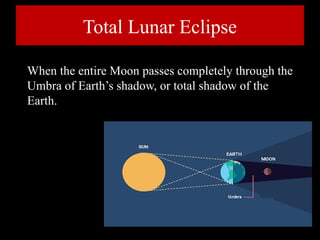
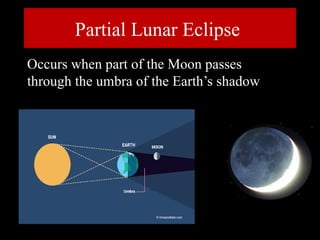
Total Lunar Eclipse
Whenthe entire Moon passes completely through the
Umbra of Earth’s shadow, or total shadow of the
Earth.
Moons orbit andstats
• Moons orbit around the earth is egg-shaped
• Mean distance – 384,400km
• Closest – 363,300km
• Farthest – 404,500km
13.
1
3
Is it SAFEto watch a LUNAR ECLIPSE
with your unprotected eyes?
Yes! Because all LUNAR ECLIPSES
occur at night so you are looking at the
moon NOT the sun! HAVE FUN! 13



![Eclipse presentation[1]](https://cdn.slidesharecdn.com/ss_thumbnails/eclipsepresentation1-120104131043-phpapp01-thumbnail.jpg?width=640&height=640&fit=bounds)


