SSoollaarr aanndd LLuunnaarr EEcclliippsseess
What is an eclipse? 
• An eclipse occurs any time a celestial 
body passes in front of the Sun, blocking 
its light. 
– Examples: 
1. Earth 
2. The Moon
Celestial Bodies Line Up… 
• Syzygy- When the Moon, the Earth, and 
the Sun line up perfectly for an eclipse.
What are the types of eclipses? 
• There are 2 types: 
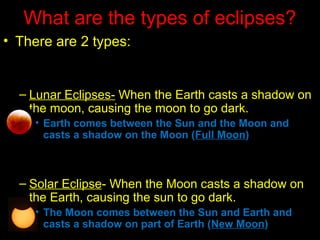
– Lunar Eclipses- When the Earth casts a shadow on 
the moon, causing the moon to go dark. 
• Earth comes between the Sun and the Moon and 
casts a shadow on the Moon (Full Moon) 
– Solar Eclipse- When the Moon casts a shadow on 
the Earth, causing the sun to go dark. 
• The Moon comes between the Sun and Earth and 
casts a shadow on part of Earth (New Moon)
Parts of the shadow: 
• Umbra – The dark inner portion of the shadow 
cone. 
– Think Direct Shadow 
• Penumbral – the lighter outer portion of the 
shadow. 
– Think “Side” Shadow
Lunar Eclipse 
• The Earth moves between the Sun and the Moon 
– Blocks the Sun’s light 
– Causes the moon to glow red. 
• There are 3 types: 
– Total 
– Partial 
– Penumbral
Types of Lunar Eclipses 
• Total Lunar Eclipse – when the Moon passes 
completely into the umbra, or total shadow, of 
the Earth. 
• Partial Lunar Eclipse – Occur when the Moon 
does not fully move into the umbra, or total 
shadow, of the Earth. 
• Penumbral Lunar Eclipse – When the moon 
passes only through the penumbra, or partial 
shadow. 
– These eclipses are barely visible.
Total Lunar Eclipse : 
when the Moon passes completely into the umbra, or total 
shadow, of the Earth:
So, Why is the Moon Red 
during an Eclipse? 
• The Earth’s atmosphere filters some sunlight 
and allows it to reach the Moon’s surface 
• The blue light is removed 
– This light is usually scattered down to make a blue 
sky over the earth in daytime 
• Remaining light is red or orange 
– Some of this remaining light is refracted, or bent, so 
that a small part of it reaches the Moon 
• Exact appearance depends on dust and clouds 
in the Earth’s atmosphere 
https://www.youtube.com/watch?v=a6CXLf_74AE
Partial Lunar Eclipse: 
Occur when the Moon does not fully move into the 
umbra, or total shadow, of Earth
Penumbral Lunar Eclipse: 
When the moon passes only through the penumbra, or partial shadow. 
These eclipses are barely visible.
12 
Solar Eclipses 
• When the Moon’s shadow covers part of 
the Earth 
• Only happens at New Moon 
• Three types: 
– Annular 
– Partial 
– Total
Types of Solar Eclipses 
• Total Solar Eclipse – can only occur if you are at the 
exact spot within the moon’s umbra (which isn’t very 
big). 
• Partial Solar Eclipse – Visible is you are in the 
penumbra of the shadow. 
– Only some of the moon will be shadowed. 
• Annular Eclipse – occurs when the moon is farthest 
from the Earth in its orbit. 
– Moon look smaller, so during the eclipse you see an outer 
ring of light from the Sun.
14 
Total Solar Eclipse 
• Observers in the “umbra” shadow  see a total eclipse 
– (safe to view the Sun); can see the corona (Outside layer of sun) 
• Those in “penumbra”  see a partial eclipse 
– not safe to look directly at Sun 
• Only lasts a few minutes 
• Path of Totality about 10,000 miles long, only 100 miles wide
Total Solar Eclipse: 
can only occur if you are at the exact spot within the 
moon’s umbra (which isn’t very big).
16 
Photo of a Total Eclipse 
https://www.youtube.com/watch?v=xx3EwETgN38
Partial Solar Eclipse: 
Visible if you are in the penumbra of the shadow. 
-Only some of the moon will be shadowed.
18 
Annular Solar Eclipse 
• When the Moon is too far to completely cover the Sun—the umbra doesn’t 
reach the Earth 
• Sun appears as a donut around the Moon
Annular Solar Eclipse: 
•Occurs when the moon is farthest from the Earth in its orbit. 
•Moon look smaller, so during the eclipse you see an outer ring of light from the Sun.
20 
Photos of an Annular Eclipse 
http://sunearthday.nasa.gov/2006/multimedia/gal_010.php; photos taken by Fred Espenak
How often do Eclipses Happen? 
• That depends!! 
– Lunar Eclipses happen more often than Solar Eclipses. 
• Why? 
– Well everyone who is experiencing nighttime during a 
lunar eclipse can see it. 
• But you have to be at the exact spot on Earth to 
see a Solar Eclipse. 
• The spot on Earth is so small, that the same place 
only sees a Solar Eclipse every 350 years!!
When will the next Eclipse happen? 
Date Type of 
Eclipse 
Where What will the Eclipse Look 
Like? 
March 20, 
2015 
Total Solar 
Eclipse 
-Europe 
-North/East Asia 
-North/West Africa 
-West in North America 
-Atlantic 
-Arctic 
April 4, 
2015 
Partial Lunar 
Eclipse 
-Much of Asia 
-Australia 
-Much of North America 
-Much of South America 
-Pacific, Atlantic, Indian Ocean 
-Arctic 
-Antarctica 
September 
13, 2015 
Partial Solar 
Eclipse 
-South in Africa 
-Atlantic 
- Indian Ocean 
- Antarctica 
September 
28, 2014 
Total Lunar 
Eclipse 
-Europe 
-South/East Asia 
-Africa 
-Much of North America 
-Much of South America 
-Pacific, Atlantic, Indian Ocean 
-Arctic 
-Antarctica

Eclipses by WSTA412

  • 1.
  • 2.
    What is aneclipse? • An eclipse occurs any time a celestial body passes in front of the Sun, blocking its light. – Examples: 1. Earth 2. The Moon
  • 3.
    Celestial Bodies LineUp… • Syzygy- When the Moon, the Earth, and the Sun line up perfectly for an eclipse.
  • 4.
    What are thetypes of eclipses? • There are 2 types: – Lunar Eclipses- When the Earth casts a shadow on the moon, causing the moon to go dark. • Earth comes between the Sun and the Moon and casts a shadow on the Moon (Full Moon) – Solar Eclipse- When the Moon casts a shadow on the Earth, causing the sun to go dark. • The Moon comes between the Sun and Earth and casts a shadow on part of Earth (New Moon)
  • 5.
    Parts of theshadow: • Umbra – The dark inner portion of the shadow cone. – Think Direct Shadow • Penumbral – the lighter outer portion of the shadow. – Think “Side” Shadow
  • 6.
    Lunar Eclipse •The Earth moves between the Sun and the Moon – Blocks the Sun’s light – Causes the moon to glow red. • There are 3 types: – Total – Partial – Penumbral
  • 7.
    Types of LunarEclipses • Total Lunar Eclipse – when the Moon passes completely into the umbra, or total shadow, of the Earth. • Partial Lunar Eclipse – Occur when the Moon does not fully move into the umbra, or total shadow, of the Earth. • Penumbral Lunar Eclipse – When the moon passes only through the penumbra, or partial shadow. – These eclipses are barely visible.
  • 8.
    Total Lunar Eclipse: when the Moon passes completely into the umbra, or total shadow, of the Earth:
  • 9.
    So, Why isthe Moon Red during an Eclipse? • The Earth’s atmosphere filters some sunlight and allows it to reach the Moon’s surface • The blue light is removed – This light is usually scattered down to make a blue sky over the earth in daytime • Remaining light is red or orange – Some of this remaining light is refracted, or bent, so that a small part of it reaches the Moon • Exact appearance depends on dust and clouds in the Earth’s atmosphere https://www.youtube.com/watch?v=a6CXLf_74AE
  • 10.
    Partial Lunar Eclipse: Occur when the Moon does not fully move into the umbra, or total shadow, of Earth
  • 11.
    Penumbral Lunar Eclipse: When the moon passes only through the penumbra, or partial shadow. These eclipses are barely visible.
  • 12.
    12 Solar Eclipses • When the Moon’s shadow covers part of the Earth • Only happens at New Moon • Three types: – Annular – Partial – Total
  • 13.
    Types of SolarEclipses • Total Solar Eclipse – can only occur if you are at the exact spot within the moon’s umbra (which isn’t very big). • Partial Solar Eclipse – Visible is you are in the penumbra of the shadow. – Only some of the moon will be shadowed. • Annular Eclipse – occurs when the moon is farthest from the Earth in its orbit. – Moon look smaller, so during the eclipse you see an outer ring of light from the Sun.
  • 14.
    14 Total SolarEclipse • Observers in the “umbra” shadow  see a total eclipse – (safe to view the Sun); can see the corona (Outside layer of sun) • Those in “penumbra”  see a partial eclipse – not safe to look directly at Sun • Only lasts a few minutes • Path of Totality about 10,000 miles long, only 100 miles wide
  • 15.
    Total Solar Eclipse: can only occur if you are at the exact spot within the moon’s umbra (which isn’t very big).
  • 16.
    16 Photo ofa Total Eclipse https://www.youtube.com/watch?v=xx3EwETgN38
  • 17.
    Partial Solar Eclipse: Visible if you are in the penumbra of the shadow. -Only some of the moon will be shadowed.
  • 18.
    18 Annular SolarEclipse • When the Moon is too far to completely cover the Sun—the umbra doesn’t reach the Earth • Sun appears as a donut around the Moon
  • 19.
    Annular Solar Eclipse: •Occurs when the moon is farthest from the Earth in its orbit. •Moon look smaller, so during the eclipse you see an outer ring of light from the Sun.
  • 20.
    20 Photos ofan Annular Eclipse http://sunearthday.nasa.gov/2006/multimedia/gal_010.php; photos taken by Fred Espenak
  • 21.
    How often doEclipses Happen? • That depends!! – Lunar Eclipses happen more often than Solar Eclipses. • Why? – Well everyone who is experiencing nighttime during a lunar eclipse can see it. • But you have to be at the exact spot on Earth to see a Solar Eclipse. • The spot on Earth is so small, that the same place only sees a Solar Eclipse every 350 years!!
  • 22.
    When will thenext Eclipse happen? Date Type of Eclipse Where What will the Eclipse Look Like? March 20, 2015 Total Solar Eclipse -Europe -North/East Asia -North/West Africa -West in North America -Atlantic -Arctic April 4, 2015 Partial Lunar Eclipse -Much of Asia -Australia -Much of North America -Much of South America -Pacific, Atlantic, Indian Ocean -Arctic -Antarctica September 13, 2015 Partial Solar Eclipse -South in Africa -Atlantic - Indian Ocean - Antarctica September 28, 2014 Total Lunar Eclipse -Europe -South/East Asia -Africa -Much of North America -Much of South America -Pacific, Atlantic, Indian Ocean -Arctic -Antarctica

Editor's Notes

  • #13 Diagram from Fred Espenak, may be found along with lots of good information at http://www.mreclipse.com/Special/SEprimer.html
  • #15 Diagram by Fred Espenak and more information may be found at www.MrEclipse.com
  • #17 From http://sunearthday.nasa.gov/2006/multimedia/gal_008.php
  • #19 Diagram from Fred Espenak, may be found along with information at http://www.mreclipse.com/Special/SEprimer.html
  • #21 From http://sunearthday.nasa.gov/2006/multimedia/gal_010.php; photos taken by Fred Espenak