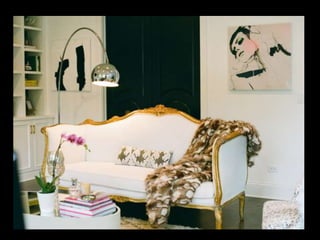
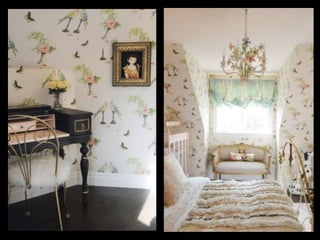
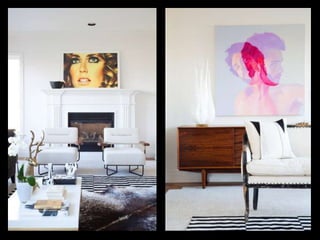
ECLECTICISM
Module: Design past and present
Raffles International Institute
April 2014, Sandra Draskovic
eclectic
Origin: late 17th century (as a term in philosophy): from
Greek eklektikos, from eklegein 'pick out', from ek 'out' +
legein 'choose'.
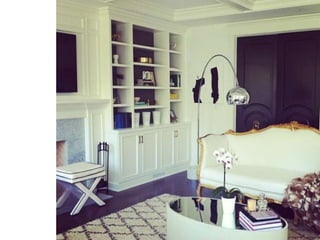
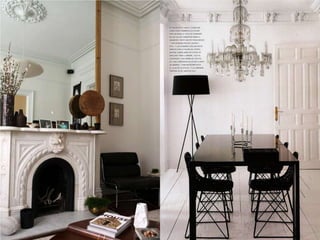
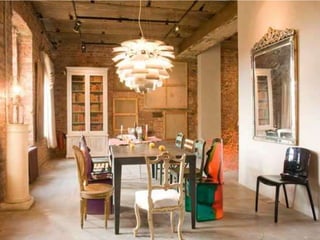
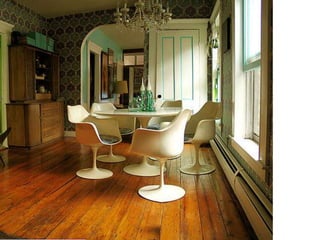
Interior/architecture: deriving ideas, style, or taste from a
broad and diverse range of sources, styles.
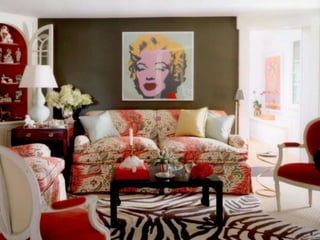
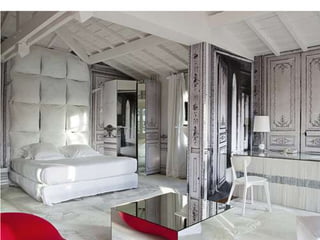
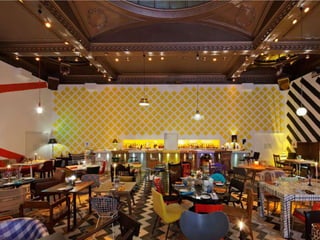
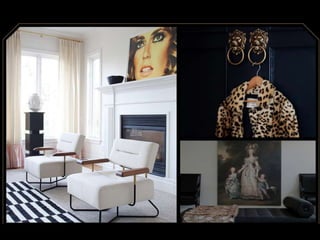
Example:“universities offering an eclectic mix of courses”
Philosophy: Denoting or belonging to a class of ancient
philosophers who did not belong to or found any recognized
school of thought but selected doctrines from various schools
of thought.
eklektikos, “selective”
“juxtaposition of elements and ideas from
different systems and styles risks a
fundamental incoherence”
“established styles are losing their novelty or
revealing their defects as changes of
historical circumstance or scientific
knowledge occur.”
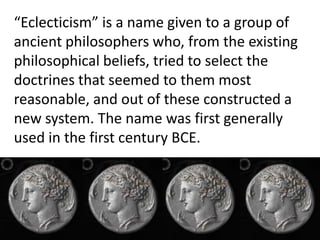
“Eclecticism” is a name given to a group of
ancient philosophers who, from the existing
philosophical beliefs, tried to select the
doctrines that seemed to them most
reasonable, and out of these constructed a
new system. The name was first generally
used in the first century BCE.
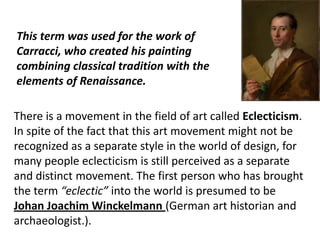
There is a movement in the field of art called Eclecticism.
In spite of the fact that this art movement might not be
recognized as a separate style in the world of design, for
many people eclecticism is still perceived as a separate
and distinct movement. The first person who has brought
the term “eclectic” into the world is presumed to be
Johan Joachim Winckelmann (German art historian and
archaeologist.).
This term was used for the work of
Carracci, who created his painting
combining classical tradition with the
elements of Renaissance.
ECLECTICISM =
to combine or interpret elements or particular
styles from different time periods and different
origins within a single project in a rather harmony-
like manner, conceptual cohesive connectivity.
Taking interior décor as an example to illustrate the process of
eclectic style creation, it is necessary to say that an artist first
creates kind of a “skeleton”, which is then decorated and brought
into one piece of work.
Eclectic style is like a “pot” that includes many different elements
from the variety of styles that have exactly different beginning and
appeared in the different period within the history.
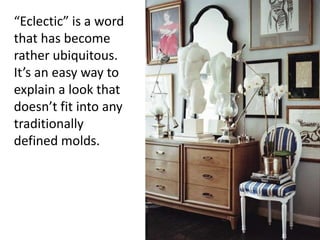
“Eclectic” is a word
that has become
rather ubiquitous.
It’s an easy way to
explain a look that
doesn’t fit into any
traditionally
defined molds.
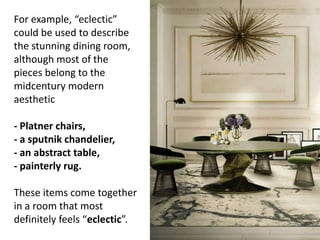
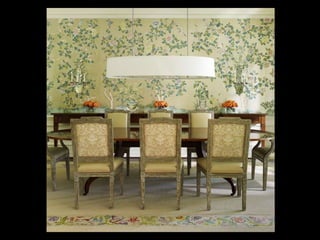
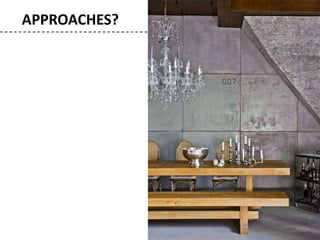
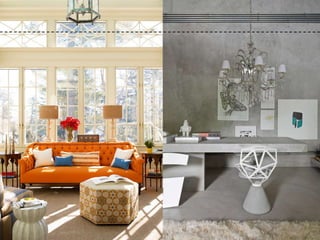
For example, “eclectic”
could be used to describe
the stunning dining room,
although most of the
pieces belong to the
midcentury modern
aesthetic
- Platner chairs,
- a sputnik chandelier,
- an abstract table,
- painterly rug.
These items come together
in a room that most
definitely feels “eclectic”.
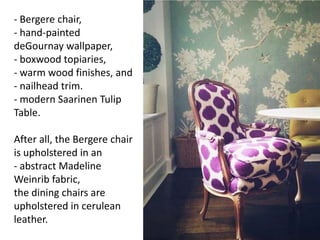
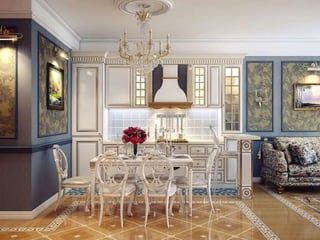
- Bergere chair,
- hand-painted
deGournay wallpaper,
- boxwood topiaries,
- warm wood finishes, and
- nailhead trim.
- modern Saarinen Tulip
Table.
After all, the Bergere chair
is upholstered in an
- abstract Madeline
Weinrib fabric,
the dining chairs are
upholstered in cerulean
leather.
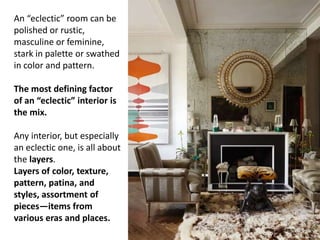
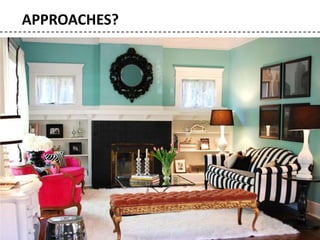
An “eclectic” room can be
polished or rustic,
masculine or feminine,
stark in palette or swathed
in color and pattern.
The most defining factor
of an “eclectic” interior is
the mix.
Any interior, but especially
an eclectic one, is all about
the layers.
Layers of color, texture,
pattern, patina, and
styles, assortment of
pieces—items from
various eras and places.
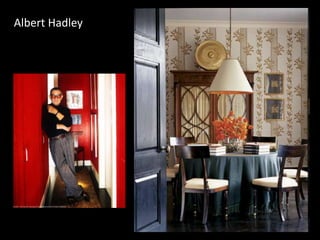
Albert Hadley
Eclecticism is a conceptual approach that does not hold
rigidly to a single paradigm or set of assumptions, but
instead draws upon multiple theories, styles, or ideas to
gain complementary insights into a subject, or applies
different theories in particular cases.
The term eclecticism is used to describe the combination,
in a single work, of elements from different historical
styles, chiefly in architecture and, by implication, in the
fine and decorative arts. The term is sometimes also
loosely applied to the general stylistic variety of 19th-
century architecture after Neo-classicism and Historicism.
WHAT IS ECLECTICISM?
The eclectic style it is characterized by the fact that it
is not a particular style. It is the borrowing of a
variety of styles, ideas and theories, drawn from
different time periods and different origins and
combining them within a single project.
- A lot of efforts, thoughts, and creativity is necessary in order to
make the project in eclectic style look logically interconnected.
- More than just throwing everything together, eclectic design works
to make all these different styles work cohesively.
- Elements are thoughtfully connected with the other parts of the
style in the space.
- Colors, fabric and finish tend to be neutral to further help these
different influences come together and avoid the chaotic look with
the other features of the design.
HOW TO ACHIEVE?
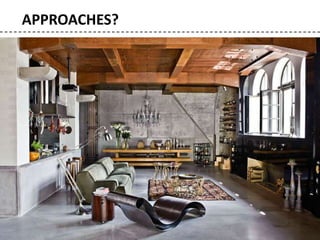
1. One can create a combination of all the different styles
such as Mission, Modern, Traditional, Country, Exotic,
Contemporary, Loft, Tropical, Retro 70s, Mediterranean,
Asian, Ethnic, Lodge, Neoclassical, and achieve amazing
results.
2. Eclectic mix one can simply overcome a stylistic
stagnation and innovate with interpretation of design
principles, colors, shapes, forms, textures, materials of a
style or movement and suit the interior to the needs and
personalities of their owners, be it a neo-classicist or new
age assortment or some contemporary hybrid.
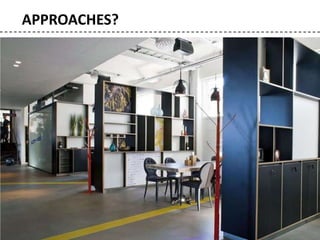
APPROACHES?
APPROACHES?
APPROACHES?
APPROACHES?
APPROACHES?
APPROACHES?
APPROACHES?
APPROACHES?
APPROACHES?
APPROACHES?
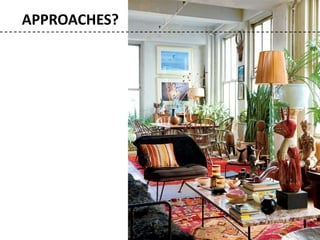
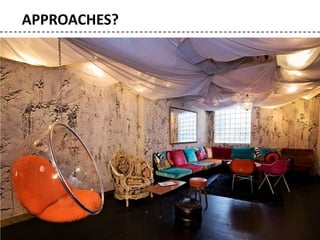
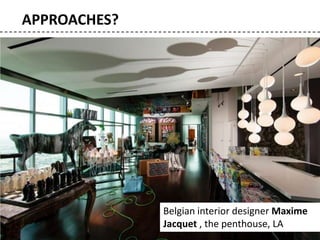
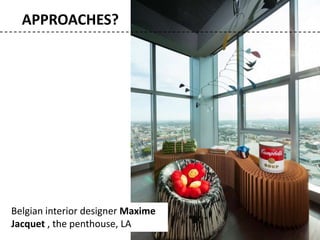
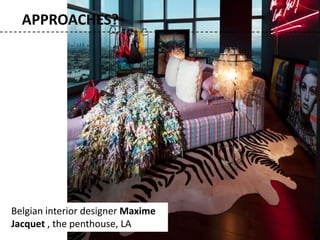
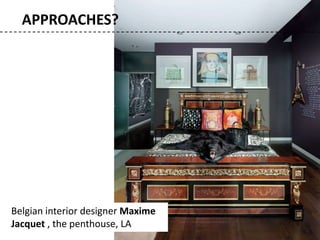
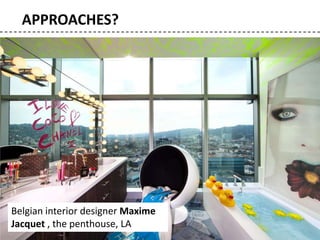
Belgian interior designer Maxime
Jacquet , the penthouse, LA
APPROACHES?
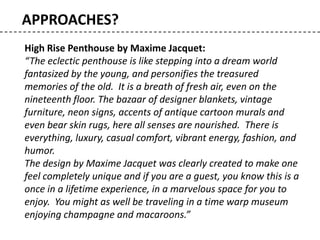
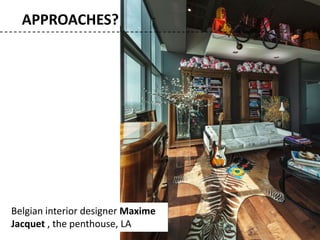
High Rise Penthouse by Maxime Jacquet:
“The eclectic penthouse is like stepping into a dream world
fantasized by the young, and personifies the treasured
memories of the old. It is a breath of fresh air, even on the
nineteenth floor. The bazaar of designer blankets, vintage
furniture, neon signs, accents of antique cartoon murals and
even bear skin rugs, here all senses are nourished. There is
everything, luxury, casual comfort, vibrant energy, fashion, and
humor.
The design by Maxime Jacquet was clearly created to make one
feel completely unique and if you are a guest, you know this is a
once in a lifetime experience, in a marvelous space for you to
enjoy. You might as well be traveling in a time warp museum
enjoying champagne and macaroons.”
APPROACHES?
Belgian interior designer Maxime
Jacquet , the penthouse, LA
APPROACHES?
Belgian interior designer Maxime
Jacquet , the penthouse, LA
Belgian interior designer Maxime
Jacquet , the penthouse, LA
APPROACHES?
Belgian interior designer Maxime
Jacquet , the penthouse, LA
APPROACHES?
Belgian interior designer Maxime
Jacquet , the penthouse, LA
APPROACHES?
INTERPRETATIONS AND INVENTIONS
TRANSFORMATION
EXTRUSION
ROTATION
RE-SCALING
MIRROR
REPETITION
PLANES AND SURFACES
EXTRACTION
ADDING
MULTIPLICATION
CUT-OUT
MACRO
FOLDING
ESTABLISHING VOLUME
TRANSFIGURATION
DIRECTION
COMPOSITION
VARIATION
ANOMALY
LAYERING
MODIFICATION
SPATIAL MOULDING
LINEAR
DYNAMIC
SYMETRY
ASYMETRY
MODULE
PATTERN
INTERCONECTION
…
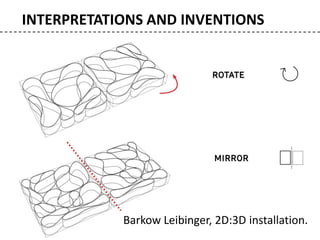
INTERPRETATIONS AND INVENTIONS
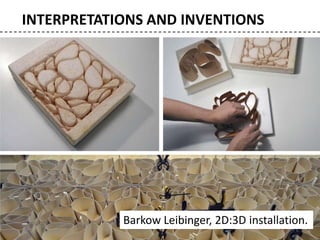
Barkow Leibinger, 2D:3D installation.
INTERPRETATIONS AND INVENTIONS
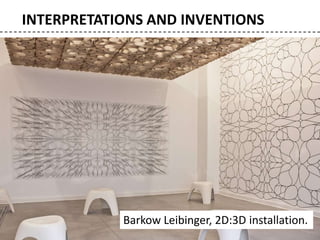
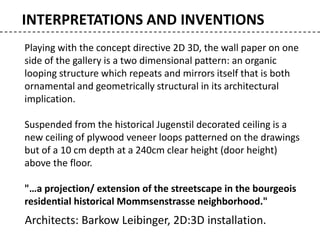
Architects: Barkow Leibinger, 2D:3D installation.
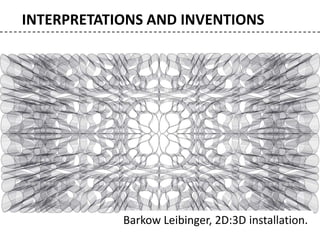
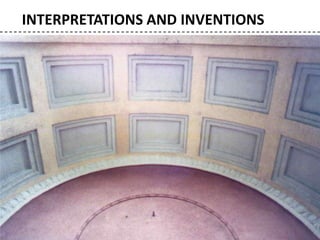
Playing with the concept directive 2D 3D, the wall paper on one
side of the gallery is a two dimensional pattern: an organic
looping structure which repeats and mirrors itself that is both
ornamental and geometrically structural in its architectural
implication.
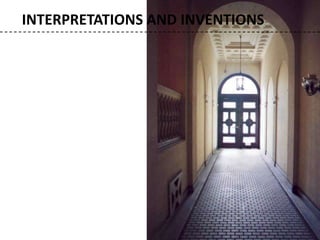
Suspended from the historical Jugenstil decorated ceiling is a
new ceiling of plywood veneer loops patterned on the drawings
but of a 10 cm depth at a 240cm clear height (door height)
above the floor.
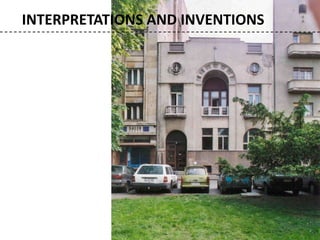
"…a projection/ extension of the streetscape in the bourgeois
residential historical Mommsenstrasse neighborhood."
INTERPRETATIONS AND INVENTIONS
Barkow Leibinger, 2D:3D installation.
INTERPRETATIONS AND INVENTIONS
Barkow Leibinger, 2D:3D installation.
INTERPRETATIONS AND INVENTIONS
Barkow Leibinger, 2D:3D installation.
INTERPRETATIONS AND INVENTIONS
Eclecticism, origin, principles and applications

Eclecticism, origin, principles and applications

  • 1.
    ECLECTICISM Module: Design pastand present Raffles International Institute April 2014, Sandra Draskovic
  • 2.
    eclectic Origin: late 17thcentury (as a term in philosophy): from Greek eklektikos, from eklegein 'pick out', from ek 'out' + legein 'choose'. Interior/architecture: deriving ideas, style, or taste from a broad and diverse range of sources, styles. Example:“universities offering an eclectic mix of courses” Philosophy: Denoting or belonging to a class of ancient philosophers who did not belong to or found any recognized school of thought but selected doctrines from various schools of thought.
  • 3.
    eklektikos, “selective” “juxtaposition ofelements and ideas from different systems and styles risks a fundamental incoherence” “established styles are losing their novelty or revealing their defects as changes of historical circumstance or scientific knowledge occur.”
  • 4.
    “Eclecticism” is aname given to a group of ancient philosophers who, from the existing philosophical beliefs, tried to select the doctrines that seemed to them most reasonable, and out of these constructed a new system. The name was first generally used in the first century BCE.
  • 5.
    There is amovement in the field of art called Eclecticism. In spite of the fact that this art movement might not be recognized as a separate style in the world of design, for many people eclecticism is still perceived as a separate and distinct movement. The first person who has brought the term “eclectic” into the world is presumed to be Johan Joachim Winckelmann (German art historian and archaeologist.). This term was used for the work of Carracci, who created his painting combining classical tradition with the elements of Renaissance.
  • 6.
    ECLECTICISM = to combineor interpret elements or particular styles from different time periods and different origins within a single project in a rather harmony- like manner, conceptual cohesive connectivity. Taking interior décor as an example to illustrate the process of eclectic style creation, it is necessary to say that an artist first creates kind of a “skeleton”, which is then decorated and brought into one piece of work. Eclectic style is like a “pot” that includes many different elements from the variety of styles that have exactly different beginning and appeared in the different period within the history.
  • 7.
    “Eclectic” is aword that has become rather ubiquitous. It’s an easy way to explain a look that doesn’t fit into any traditionally defined molds.
  • 8.
    For example, “eclectic” couldbe used to describe the stunning dining room, although most of the pieces belong to the midcentury modern aesthetic - Platner chairs, - a sputnik chandelier, - an abstract table, - painterly rug. These items come together in a room that most definitely feels “eclectic”.
  • 9.
    - Bergere chair, -hand-painted deGournay wallpaper, - boxwood topiaries, - warm wood finishes, and - nailhead trim. - modern Saarinen Tulip Table. After all, the Bergere chair is upholstered in an - abstract Madeline Weinrib fabric, the dining chairs are upholstered in cerulean leather.
  • 10.
    An “eclectic” roomcan be polished or rustic, masculine or feminine, stark in palette or swathed in color and pattern. The most defining factor of an “eclectic” interior is the mix. Any interior, but especially an eclectic one, is all about the layers. Layers of color, texture, pattern, patina, and styles, assortment of pieces—items from various eras and places.
  • 24.
  • 25.
    Eclecticism is aconceptual approach that does not hold rigidly to a single paradigm or set of assumptions, but instead draws upon multiple theories, styles, or ideas to gain complementary insights into a subject, or applies different theories in particular cases. The term eclecticism is used to describe the combination, in a single work, of elements from different historical styles, chiefly in architecture and, by implication, in the fine and decorative arts. The term is sometimes also loosely applied to the general stylistic variety of 19th- century architecture after Neo-classicism and Historicism. WHAT IS ECLECTICISM?
  • 26.
    The eclectic styleit is characterized by the fact that it is not a particular style. It is the borrowing of a variety of styles, ideas and theories, drawn from different time periods and different origins and combining them within a single project. - A lot of efforts, thoughts, and creativity is necessary in order to make the project in eclectic style look logically interconnected. - More than just throwing everything together, eclectic design works to make all these different styles work cohesively. - Elements are thoughtfully connected with the other parts of the style in the space. - Colors, fabric and finish tend to be neutral to further help these different influences come together and avoid the chaotic look with the other features of the design. HOW TO ACHIEVE?
  • 27.
    1. One cancreate a combination of all the different styles such as Mission, Modern, Traditional, Country, Exotic, Contemporary, Loft, Tropical, Retro 70s, Mediterranean, Asian, Ethnic, Lodge, Neoclassical, and achieve amazing results. 2. Eclectic mix one can simply overcome a stylistic stagnation and innovate with interpretation of design principles, colors, shapes, forms, textures, materials of a style or movement and suit the interior to the needs and personalities of their owners, be it a neo-classicist or new age assortment or some contemporary hybrid. APPROACHES?
  • 28.
  • 29.
  • 30.
  • 31.
  • 32.
  • 33.
  • 34.
  • 36.
  • 37.
    APPROACHES? Belgian interior designerMaxime Jacquet , the penthouse, LA
  • 38.
    APPROACHES? High Rise Penthouseby Maxime Jacquet: “The eclectic penthouse is like stepping into a dream world fantasized by the young, and personifies the treasured memories of the old. It is a breath of fresh air, even on the nineteenth floor. The bazaar of designer blankets, vintage furniture, neon signs, accents of antique cartoon murals and even bear skin rugs, here all senses are nourished. There is everything, luxury, casual comfort, vibrant energy, fashion, and humor. The design by Maxime Jacquet was clearly created to make one feel completely unique and if you are a guest, you know this is a once in a lifetime experience, in a marvelous space for you to enjoy. You might as well be traveling in a time warp museum enjoying champagne and macaroons.”
  • 39.
    APPROACHES? Belgian interior designerMaxime Jacquet , the penthouse, LA
  • 40.
    APPROACHES? Belgian interior designerMaxime Jacquet , the penthouse, LA
  • 41.
    Belgian interior designerMaxime Jacquet , the penthouse, LA APPROACHES?
  • 42.
    Belgian interior designerMaxime Jacquet , the penthouse, LA APPROACHES?
  • 43.
    Belgian interior designerMaxime Jacquet , the penthouse, LA APPROACHES?
  • 44.
    INTERPRETATIONS AND INVENTIONS TRANSFORMATION EXTRUSION ROTATION RE-SCALING MIRROR REPETITION PLANESAND SURFACES EXTRACTION ADDING MULTIPLICATION CUT-OUT MACRO FOLDING ESTABLISHING VOLUME TRANSFIGURATION DIRECTION COMPOSITION VARIATION ANOMALY LAYERING MODIFICATION SPATIAL MOULDING LINEAR DYNAMIC SYMETRY ASYMETRY MODULE PATTERN INTERCONECTION …
  • 45.
    INTERPRETATIONS AND INVENTIONS BarkowLeibinger, 2D:3D installation.
  • 46.
    INTERPRETATIONS AND INVENTIONS Architects:Barkow Leibinger, 2D:3D installation. Playing with the concept directive 2D 3D, the wall paper on one side of the gallery is a two dimensional pattern: an organic looping structure which repeats and mirrors itself that is both ornamental and geometrically structural in its architectural implication. Suspended from the historical Jugenstil decorated ceiling is a new ceiling of plywood veneer loops patterned on the drawings but of a 10 cm depth at a 240cm clear height (door height) above the floor. "…a projection/ extension of the streetscape in the bourgeois residential historical Mommsenstrasse neighborhood."
  • 47.
    INTERPRETATIONS AND INVENTIONS BarkowLeibinger, 2D:3D installation.
  • 48.
    INTERPRETATIONS AND INVENTIONS BarkowLeibinger, 2D:3D installation.
  • 49.
    INTERPRETATIONS AND INVENTIONS BarkowLeibinger, 2D:3D installation.
  • 50.
  • 51.
  • 52.