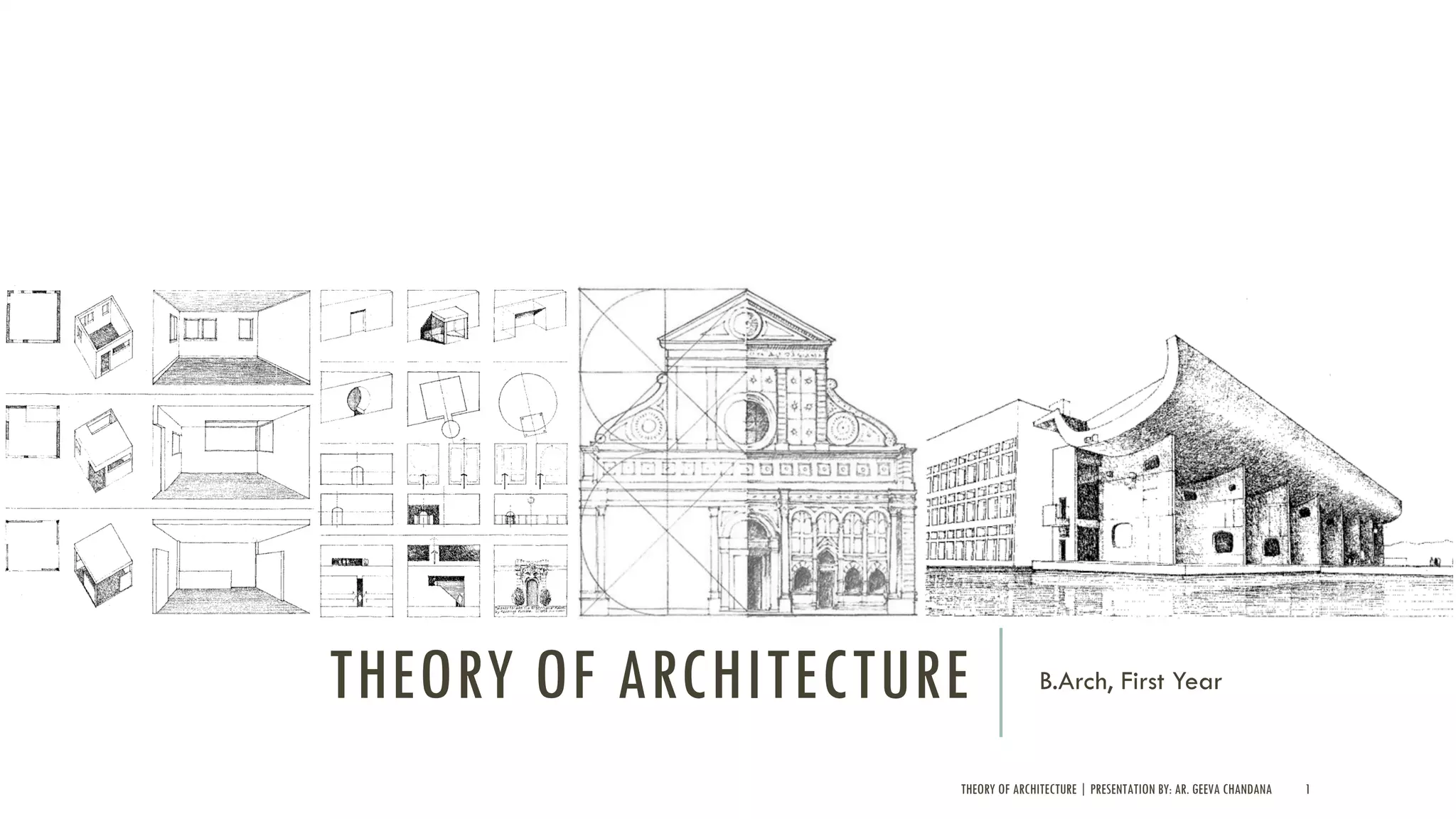
THEORY OF ARCHITECTURE B.Arch, First Year
THEORY OF ARCHITECTURE | PRESENTATION BY: AR. GEEVA CHANDANA 1
THEORY OF ARCHITECTURE | PRESENTATION BY: AR. GEEVA CHANDANA 2
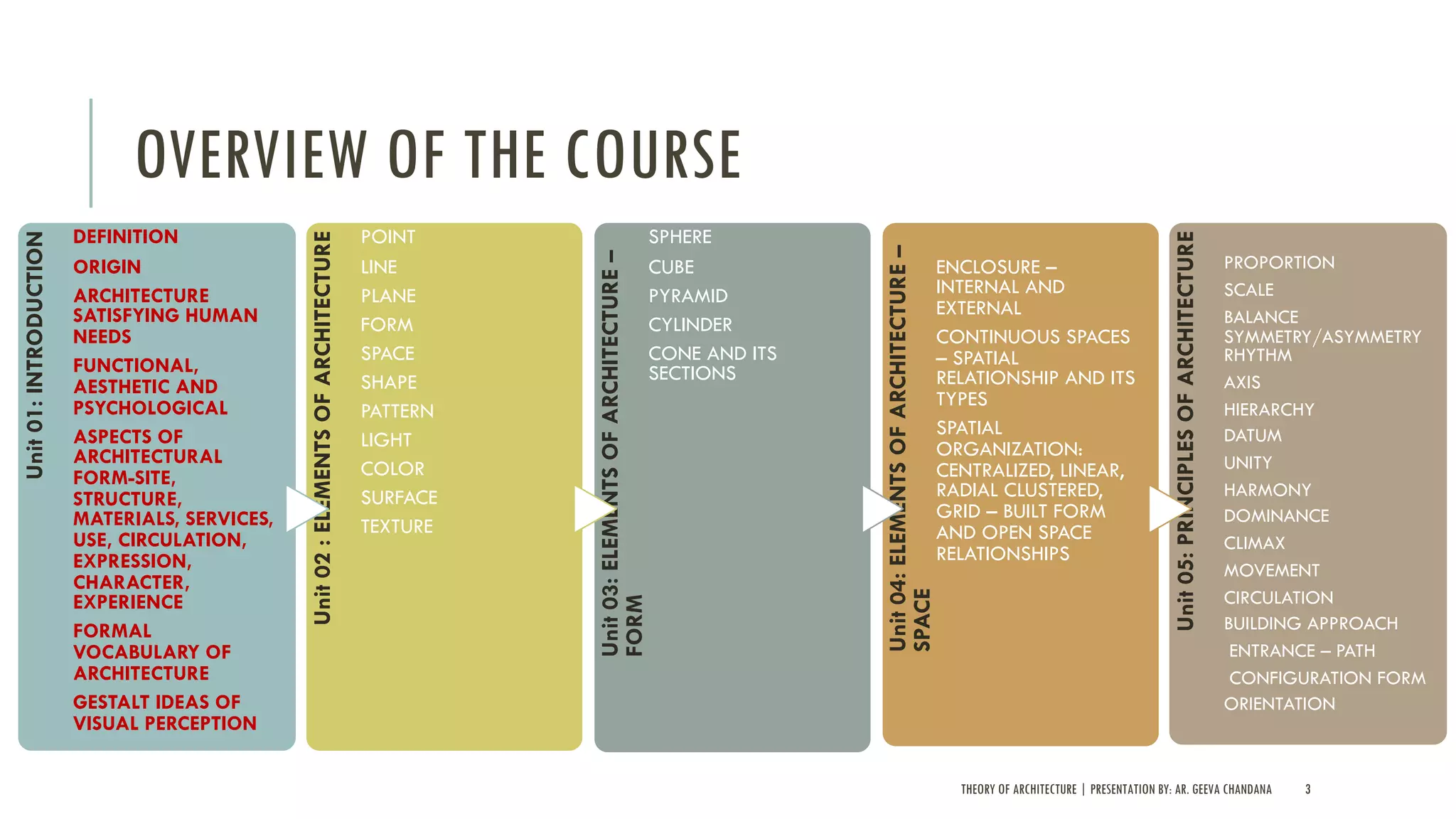
OVERVIEW OF THE COURSE
Unit01:INTRODUCTION
DEFINITION
ORIGIN
ARCHITECTURE
SATISFYING HUMAN
NEEDS
FUNCTIONAL,
AESTHETIC AND
PSYCHOLOGICAL
ASPECTS OF
ARCHITECTURAL
FORM-SITE,
STRUCTURE,
MATERIALS, SERVICES,
USE, CIRCULATION,
EXPRESSION,
CHARACTER,
EXPERIENCE
FORMAL
VOCABULARY OF
ARCHITECTURE
GESTALT IDEAS OF
VISUAL PERCEPTION
Unit02:ELEMENTSOFARCHITECTURE
POINT
LINE
PLANE
FORM
SPACE
SHAPE
PATTERN
LIGHT
COLOR
SURFACE
TEXTURE
Unit03:ELEMENTSOFARCHITECTURE–
FORM
SPHERE
CUBE
PYRAMID
CYLINDER
CONE AND ITS
SECTIONS
Unit04:ELEMENTSOFARCHITECTURE–
SPACE
ENCLOSURE –
INTERNAL AND
EXTERNAL
CONTINUOUS SPACES
– SPATIAL
RELATIONSHIP AND ITS
TYPES
SPATIAL
ORGANIZATION:
CENTRALIZED, LINEAR,
RADIAL CLUSTERED,
GRID – BUILT FORM
AND OPEN SPACE
RELATIONSHIPS
Unit05:PRINCIPLESOFARCHITECTURE
PROPORTION
SCALE
BALANCE
SYMMETRY/ASYMMETRY
RHYTHM
AXIS
HIERARCHY
DATUM
UNITY
HARMONY
DOMINANCE
CLIMAX
MOVEMENT
CIRCULATION
BUILDING APPROACH
ENTRANCE – PATH
CONFIGURATION FORM
ORIENTATION
THEORY OF ARCHITECTURE | PRESENTATION BY: AR. GEEVA CHANDANA 3
THE TERM : ARCHITECTURE
§Originated from the Greek word “Architekton”
§[ Archi – great / chief, Tekton – builder / creator ]
§Architecture is the art and science of building
§It is the conscious creation of utilitarian spaces with the
deliberate use of material
§Architecture should be technically efficient and
aesthetically pleasing.
THEORY OF ARCHITECTURE | PRESENTATION BY: AR. GEEVA CHANDANA 4
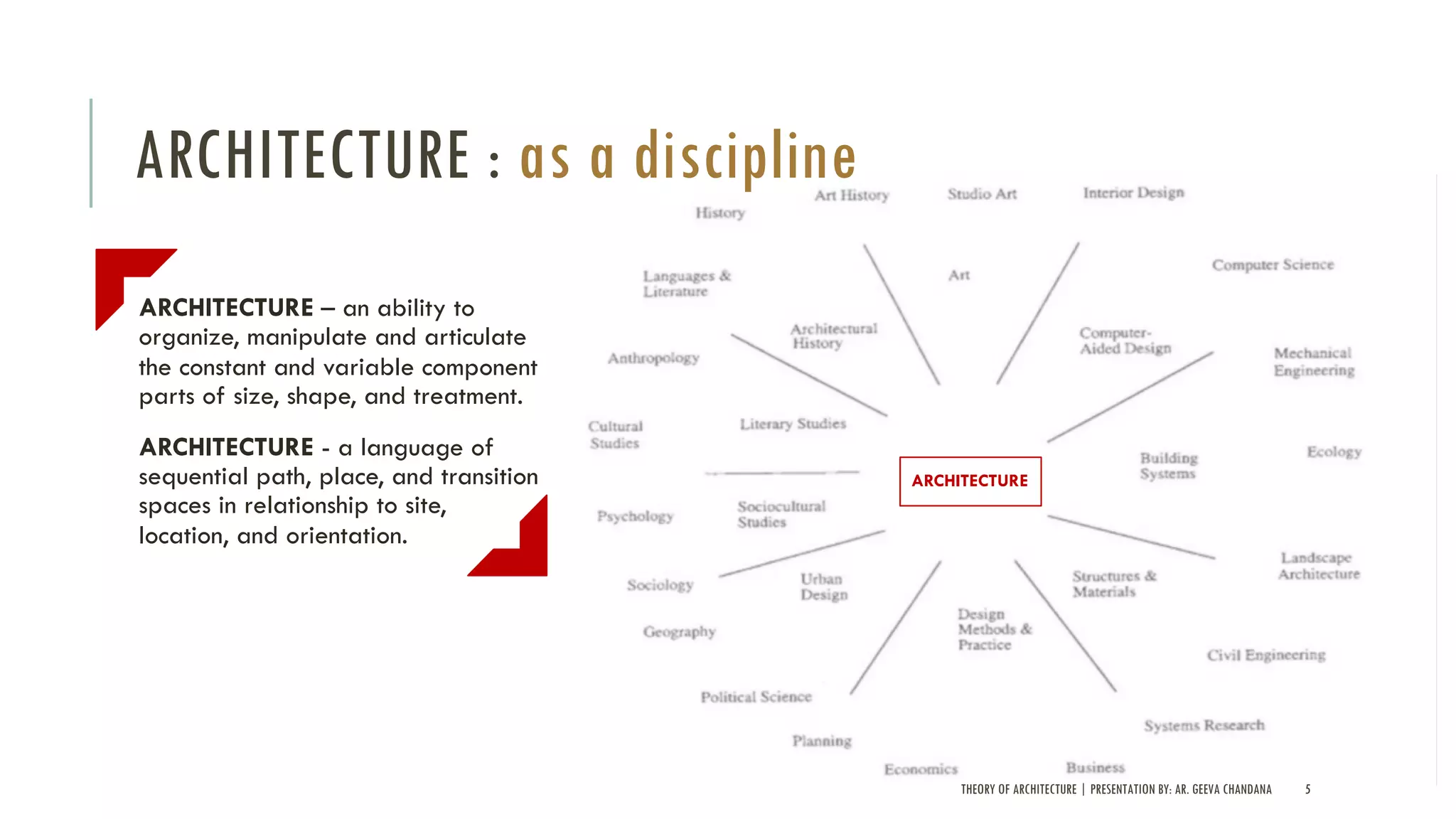
ARCHITECTURE : as a discipline
ARCHITECTURE – an ability to
organize, manipulate and articulate
the constant and variable component
parts of size, shape, and treatment.
ARCHITECTURE - a language of
sequential path, place, and transition
spaces in relationship to site,
location, and orientation.
THEORY OF ARCHITECTURE | PRESENTATION BY: AR. GEEVA CHANDANA 5
ARCHITECTURE
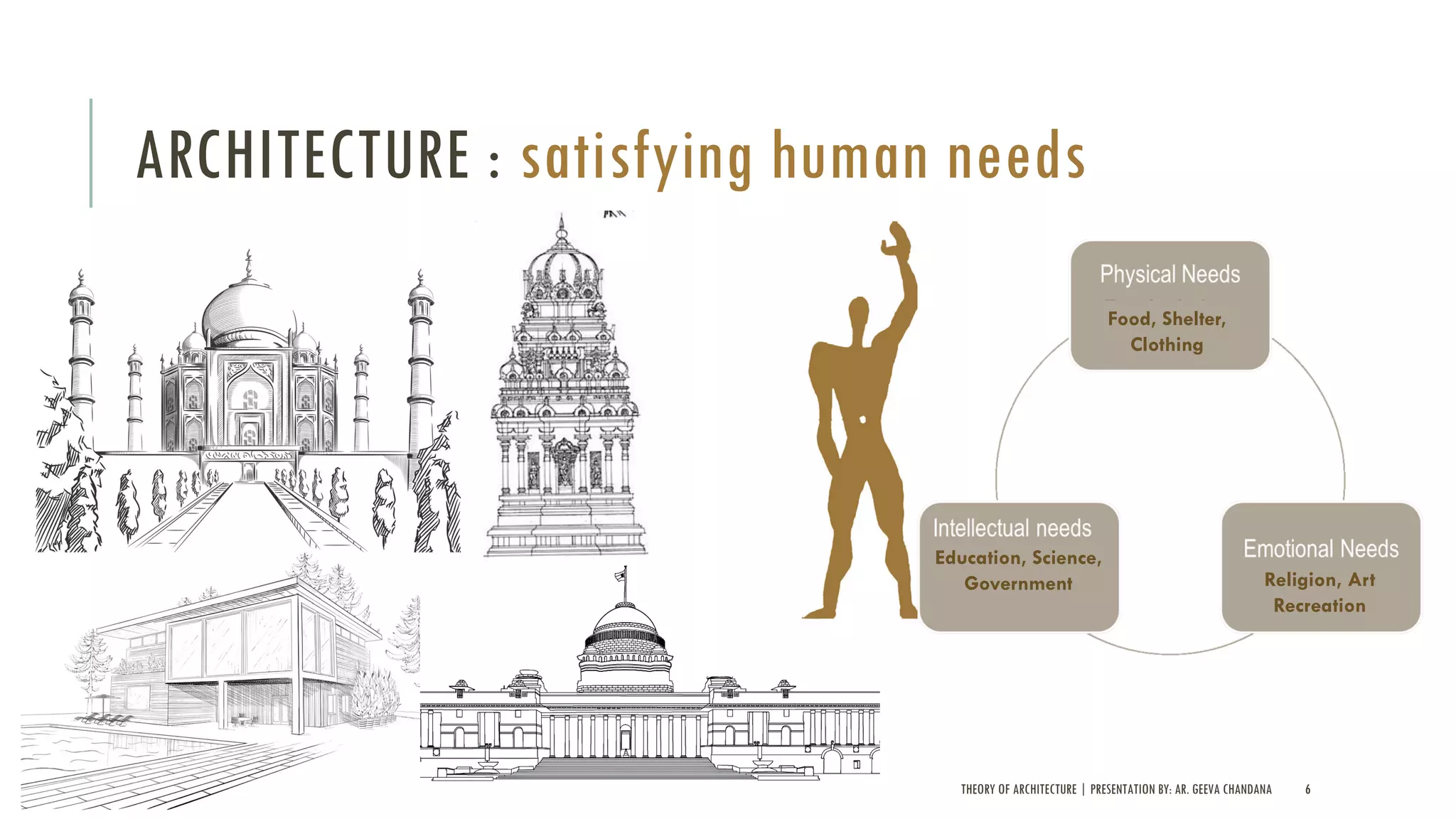
ARCHITECTURE : satisfying human needs
THEORY OF ARCHITECTURE | PRESENTATION BY: AR. GEEVA CHANDANA 6
Food, Shelter,
Clothing
Education, Science,
Government Religion, Art
Recreation
THEORY OF ARCHITECTURE | PRESENTATION BY: AR. GEEVA CHANDANA 7
ARCHITECTURE : functional
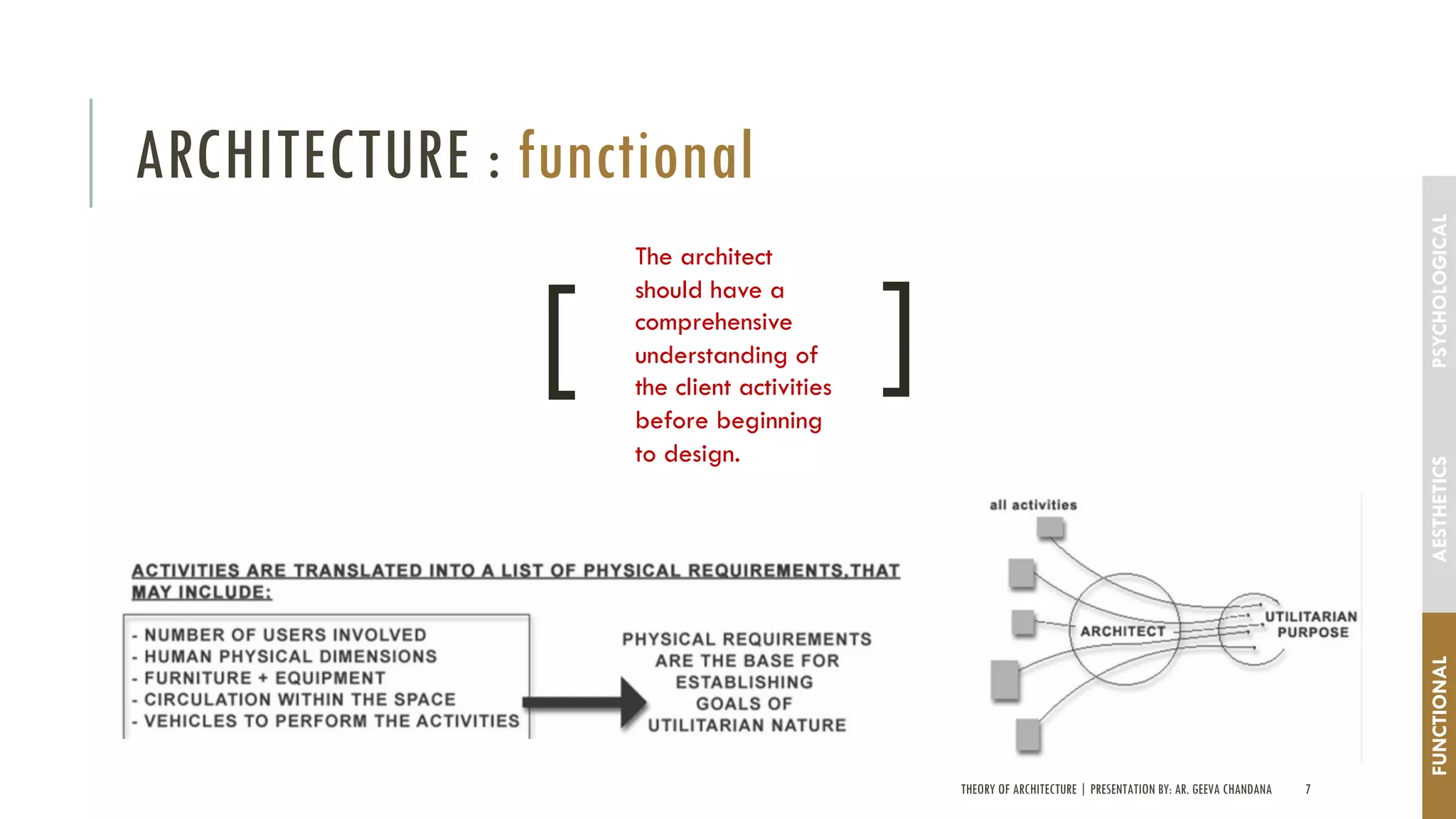
The architect
should have a
comprehensive
understanding of
the client activities
before beginning
to design.
[ [
FUNCTIONALAESTHETICSPSYCHOLOGICAL
THEORY OF ARCHITECTURE | PRESENTATION BY: AR. GEEVA CHANDANA 8
ARCHITECTURE : functional
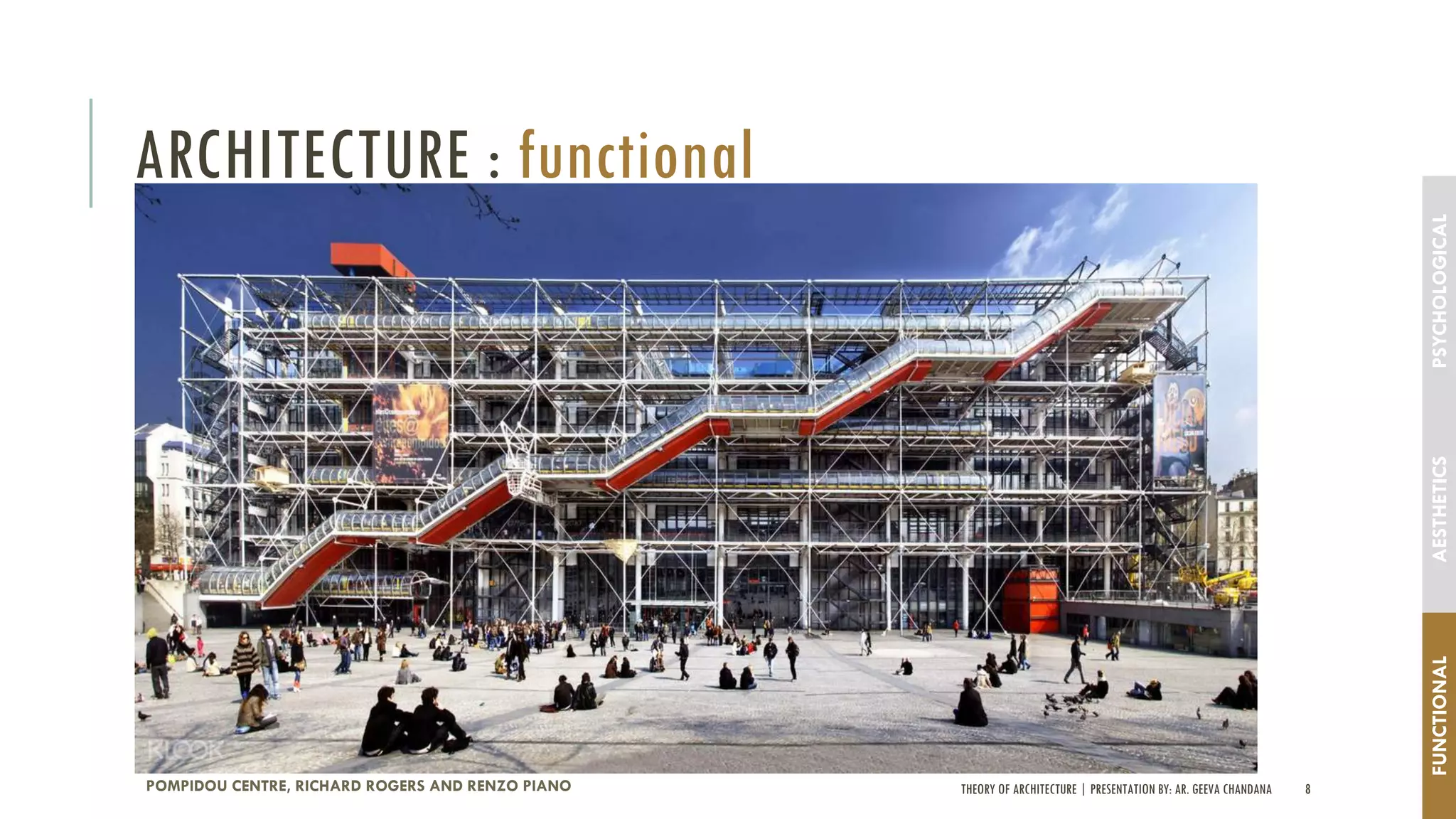
POMPIDOU CENTRE, RICHARD ROGERS AND RENZO PIANO
FUNCTIONALAESTHETICSPSYCHOLOGICAL
THEORY OF ARCHITECTURE | PRESENTATION BY: AR. GEEVA CHANDANA 9
ARCHITECTURE : functional
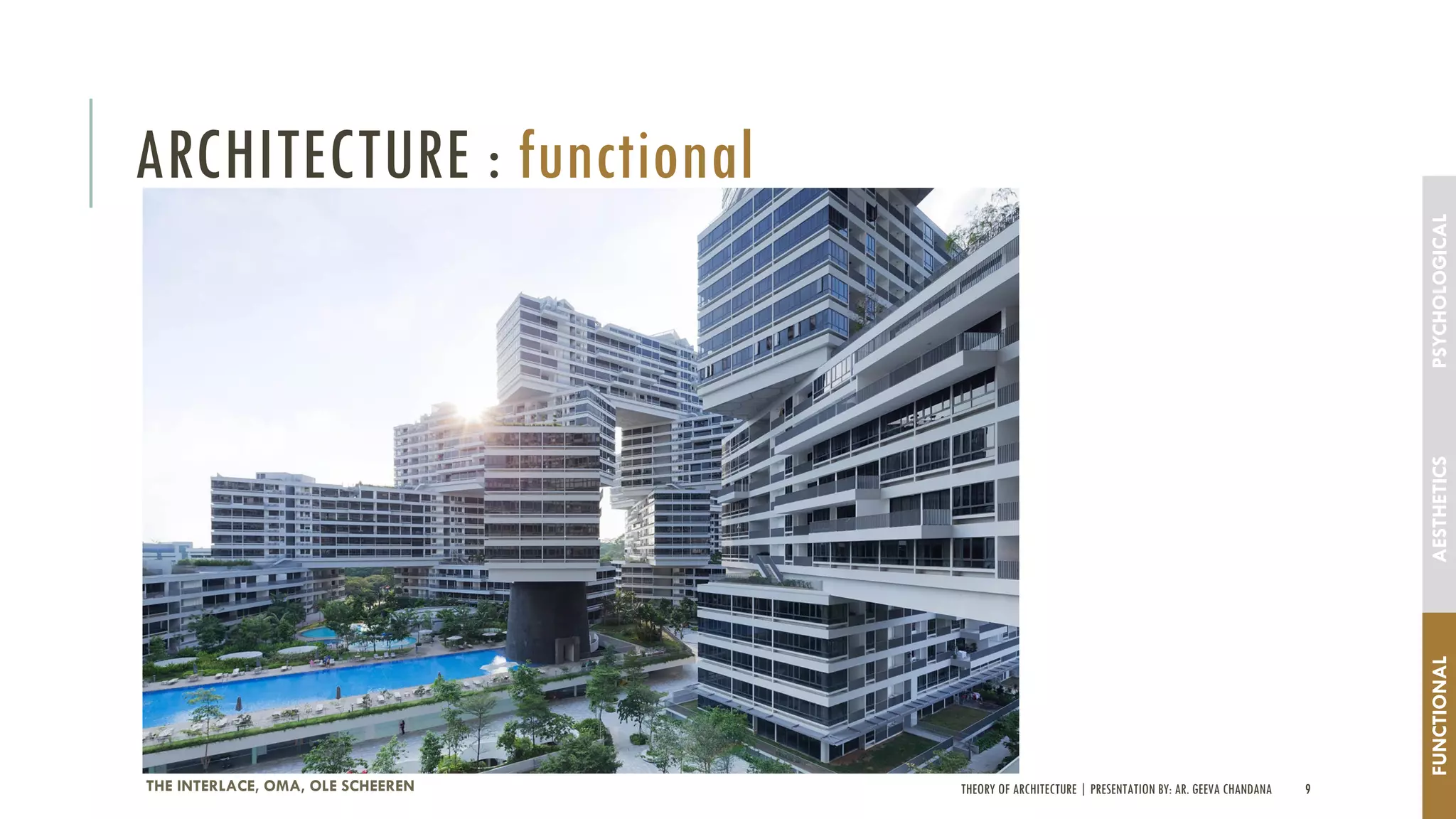
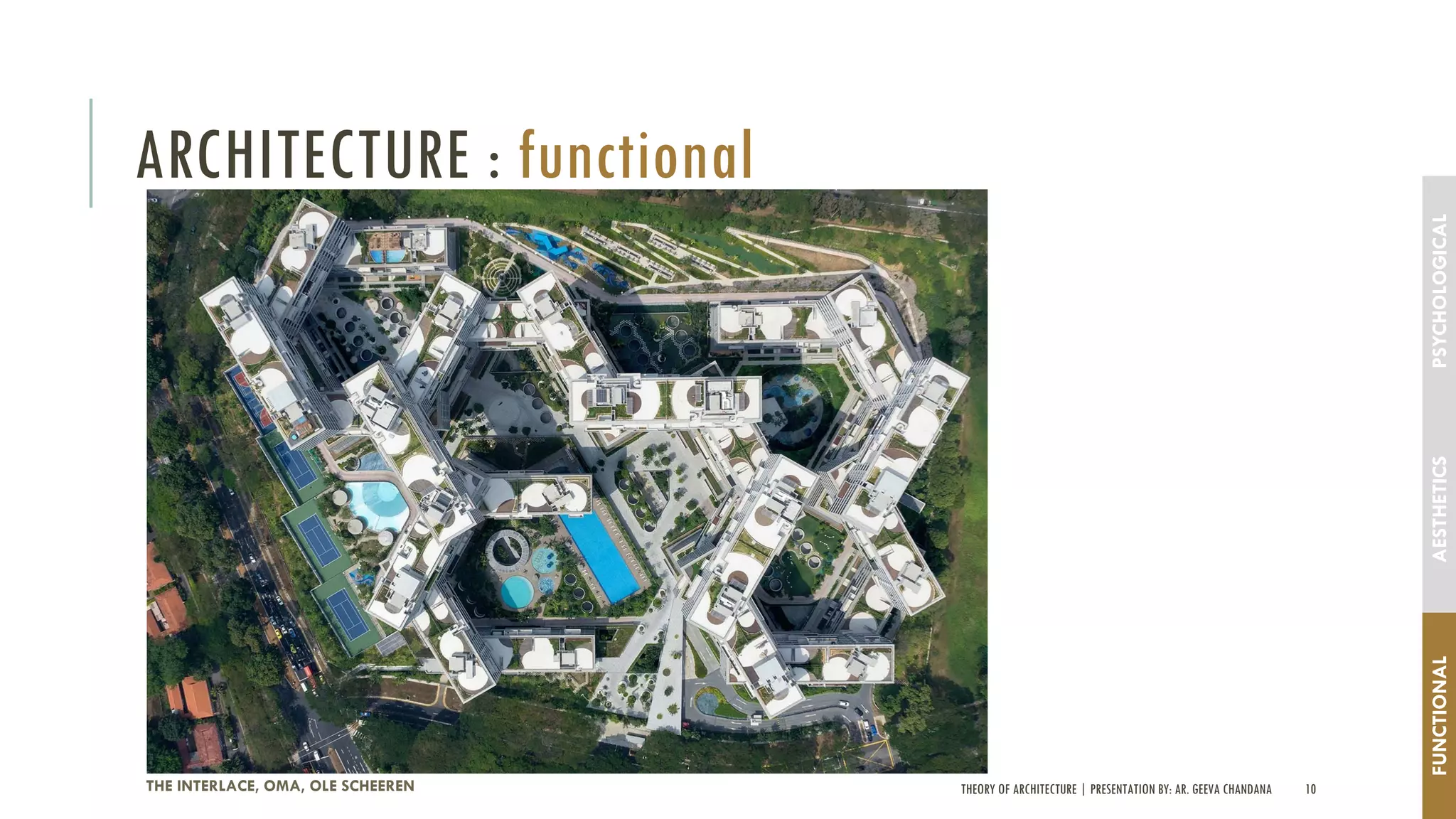
THE INTERLACE, OMA, OLE SCHEEREN
FUNCTIONALAESTHETICSPSYCHOLOGICAL
THEORY OF ARCHITECTURE | PRESENTATION BY: AR. GEEVA CHANDANA 10
ARCHITECTURE : functional
FUNCTIONALAESTHETICSPSYCHOLOGICAL
THE INTERLACE, OMA, OLE SCHEEREN
THEORY OF ARCHITECTURE | PRESENTATION BY: AR. GEEVA CHANDANA 11
ARCHITECTURE : functional
FUNCTIONALAESTHETICSPSYCHOLOGICAL
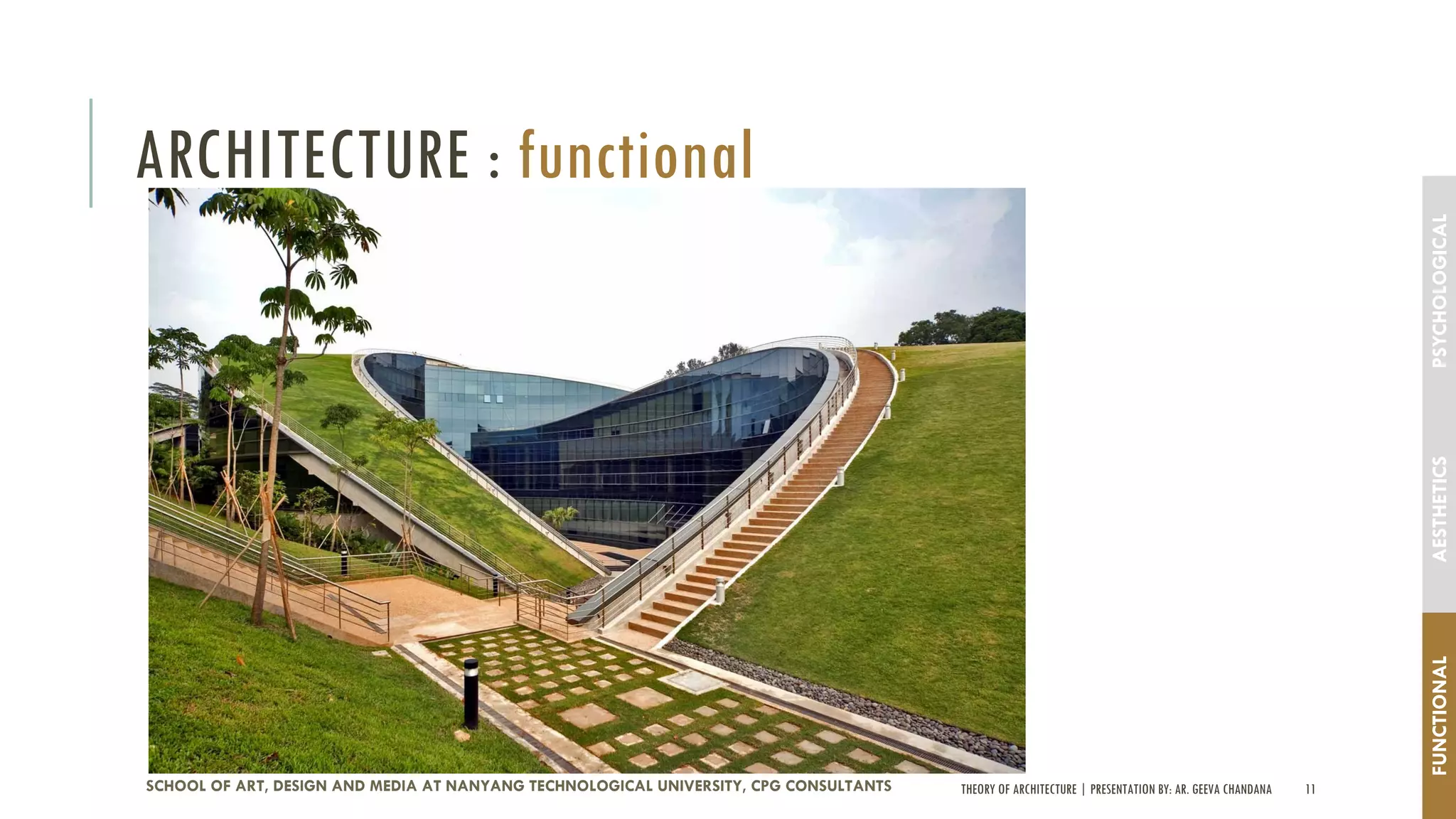
SCHOOL OF ART, DESIGN AND MEDIA AT NANYANG TECHNOLOGICAL UNIVERSITY, CPG CONSULTANTS
THEORY OF ARCHITECTURE | PRESENTATION BY: AR. GEEVA CHANDANA 12
ARCHITECTURE : functional
FUNCTIONALAESTHETICSPSYCHOLOGICAL
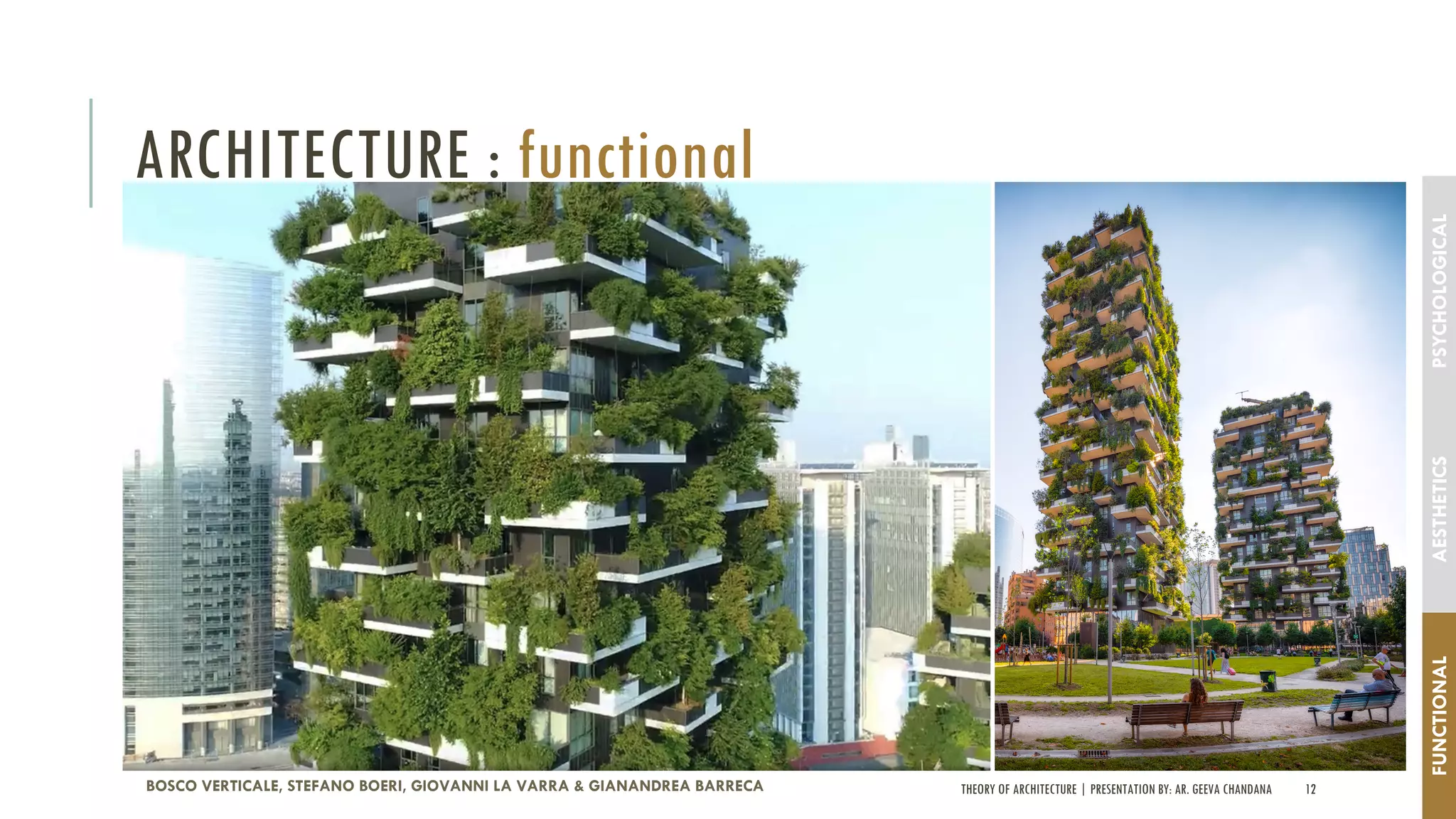
BOSCO VERTICALE, STEFANO BOERI, GIOVANNI LA VARRA & GIANANDREA BARRECA
THEORY OF ARCHITECTURE | PRESENTATION BY: AR. GEEVA CHANDANA 13
ARCHITECTURE : aesthetics
FUNCTIONALAESTHETICSPSYCHOLOGICAL
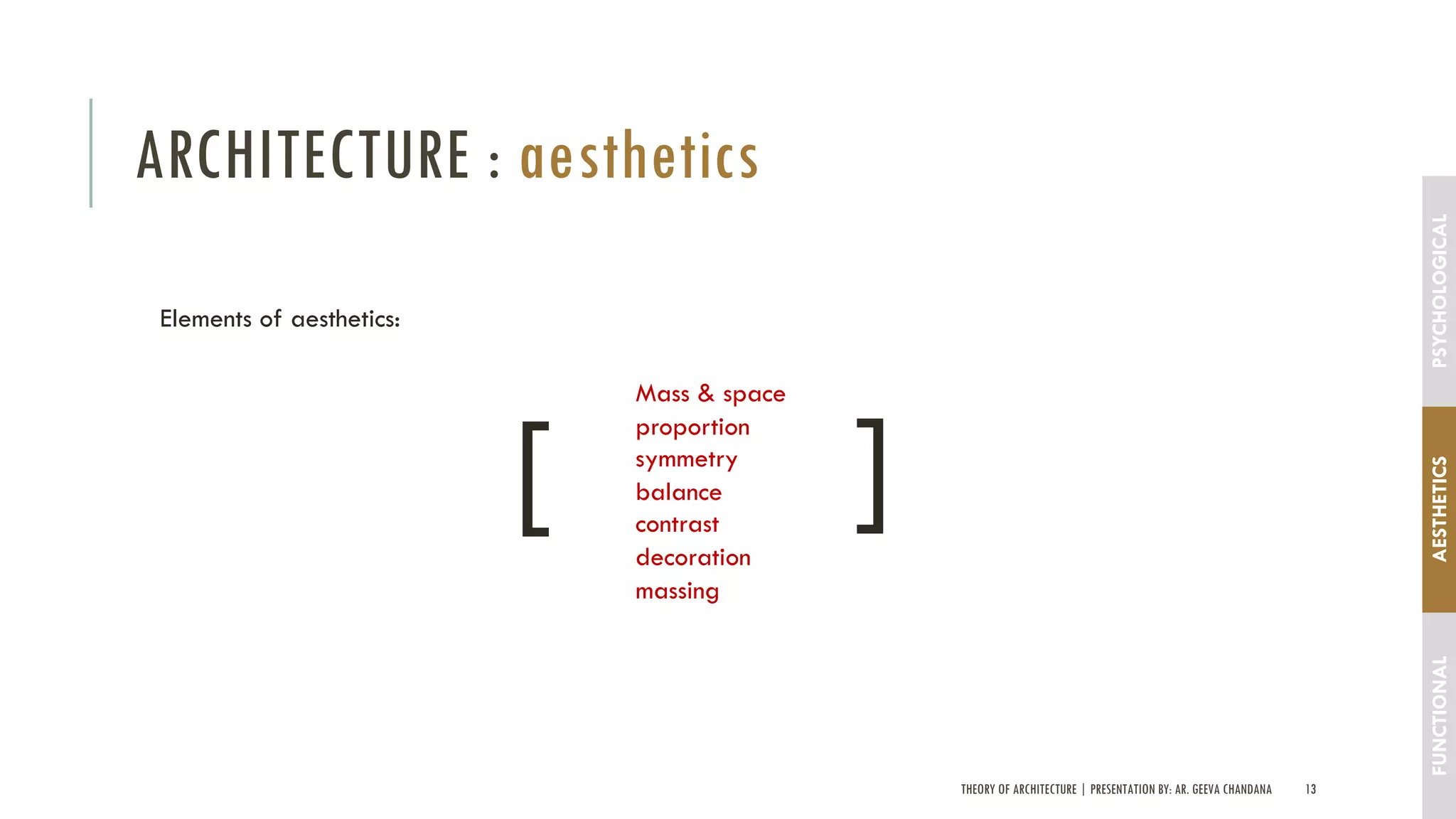
Elements of aesthetics:
Mass & space
proportion
symmetry
balance
contrast
decoration
massing
[ [
THEORY OF ARCHITECTURE | PRESENTATION BY: AR. GEEVA CHANDANA 14
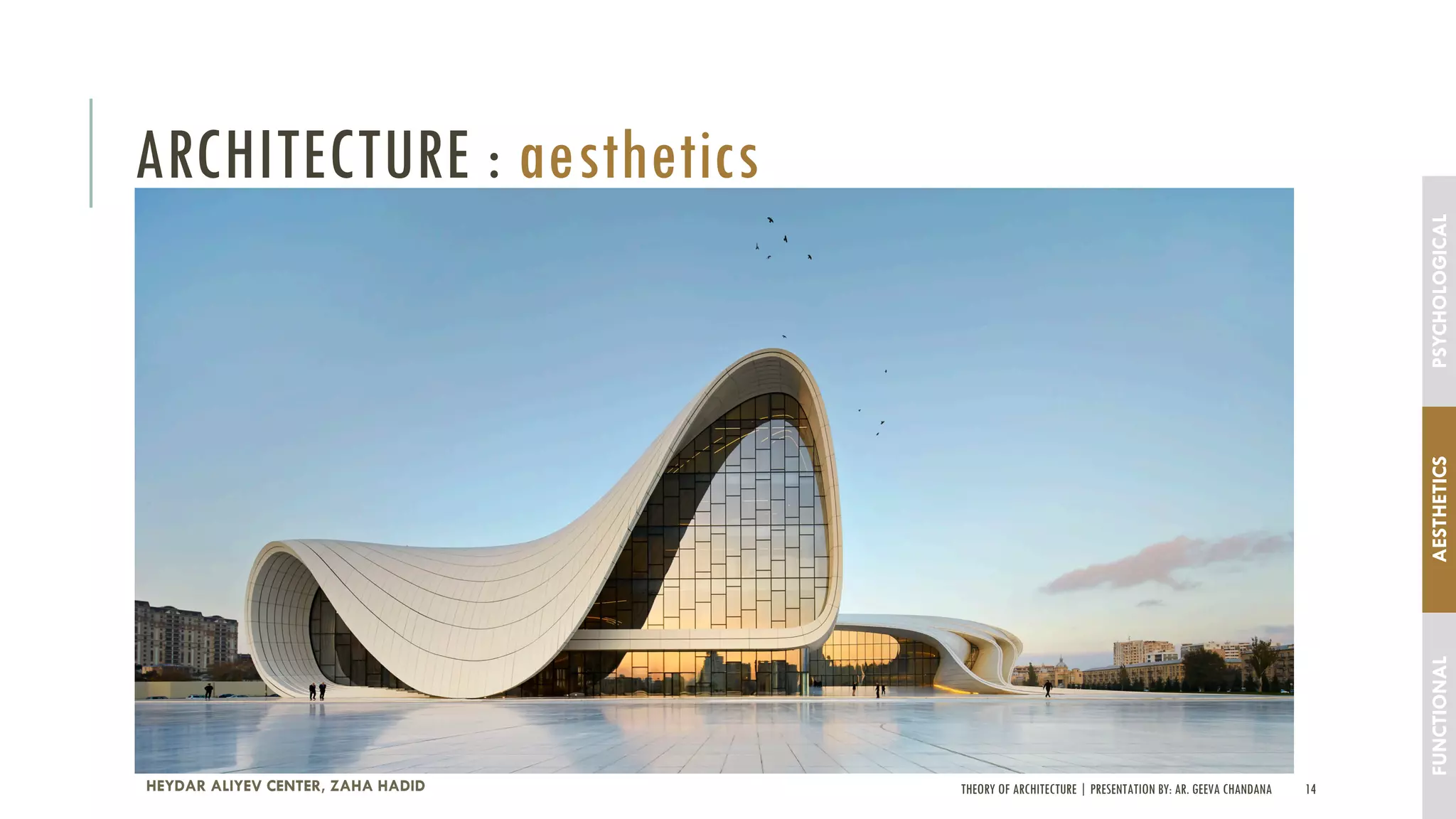
ARCHITECTURE : aesthetics
HEYDAR ALIYEV CENTER, ZAHA HADID
FUNCTIONALAESTHETICSPSYCHOLOGICAL
THEORY OF ARCHITECTURE | PRESENTATION BY: AR. GEEVA CHANDANA 15
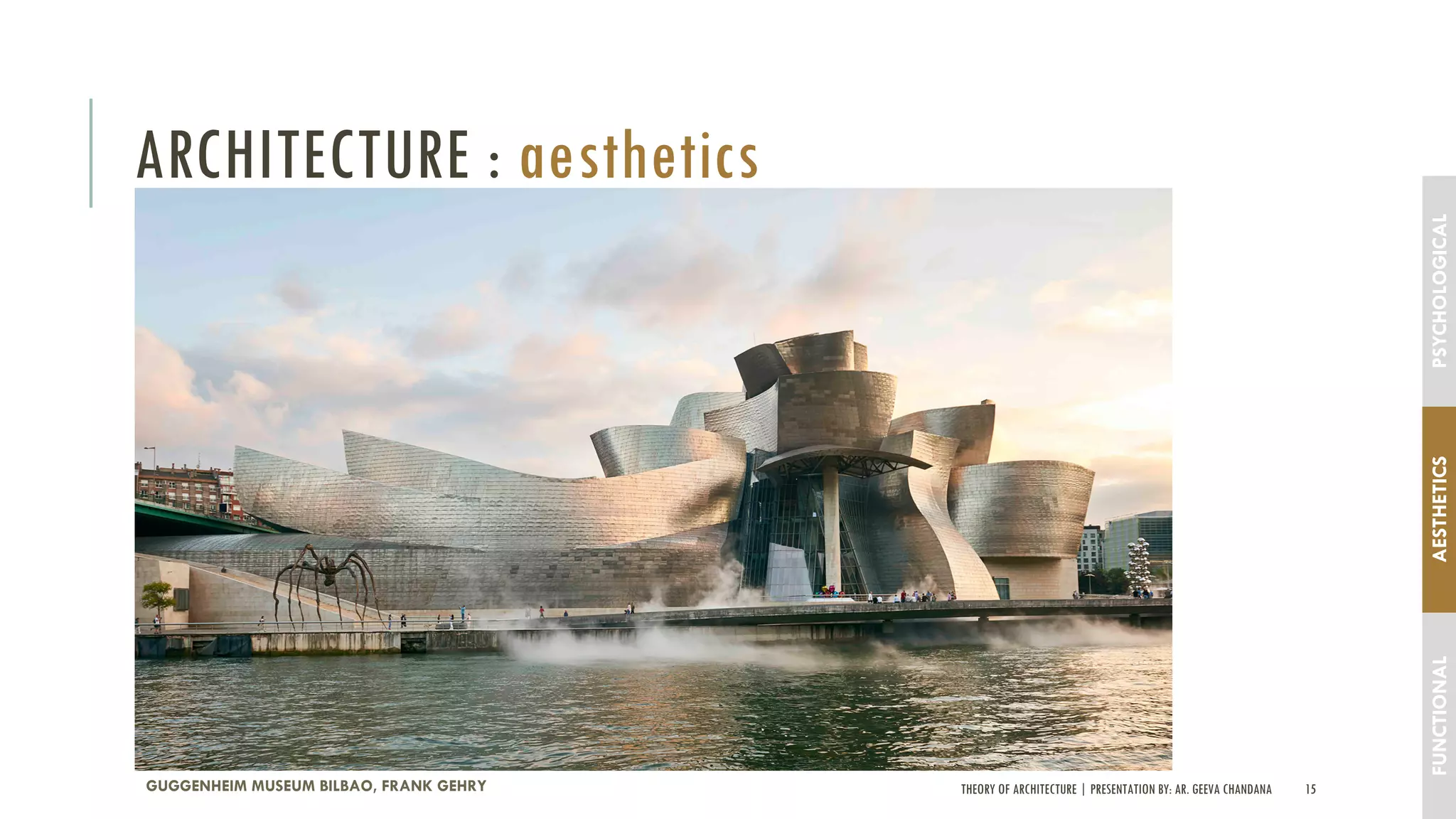
ARCHITECTURE : aesthetics
GUGGENHEIM MUSEUM BILBAO, FRANK GEHRY
FUNCTIONALAESTHETICSPSYCHOLOGICAL
THEORY OF ARCHITECTURE | PRESENTATION BY: AR. GEEVA CHANDANA 16
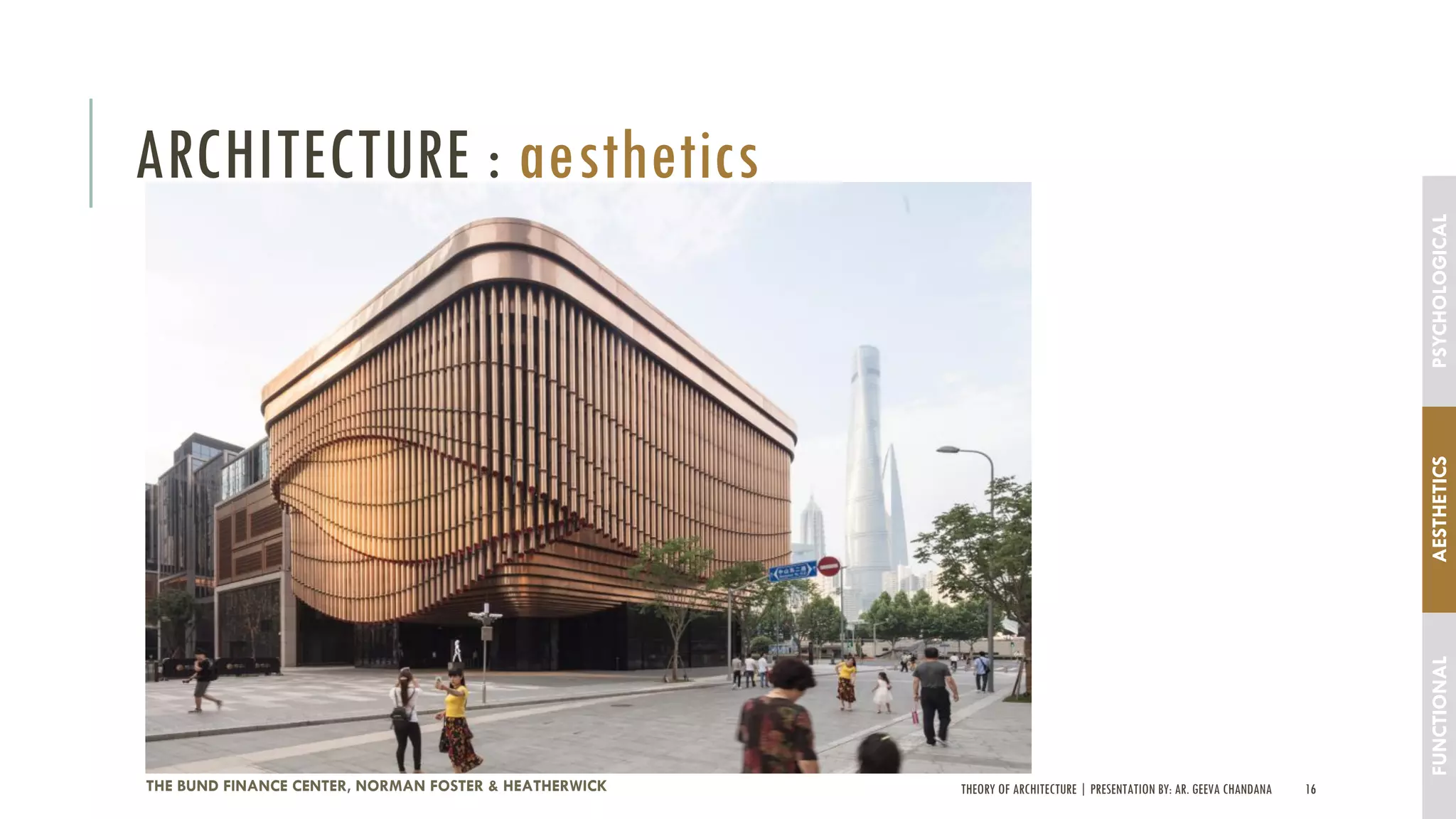
ARCHITECTURE : aesthetics
THE BUND FINANCE CENTER, NORMAN FOSTER & HEATHERWICK
FUNCTIONALAESTHETICSPSYCHOLOGICAL
THEORY OF ARCHITECTURE | PRESENTATION BY: AR. GEEVA CHANDANA 17
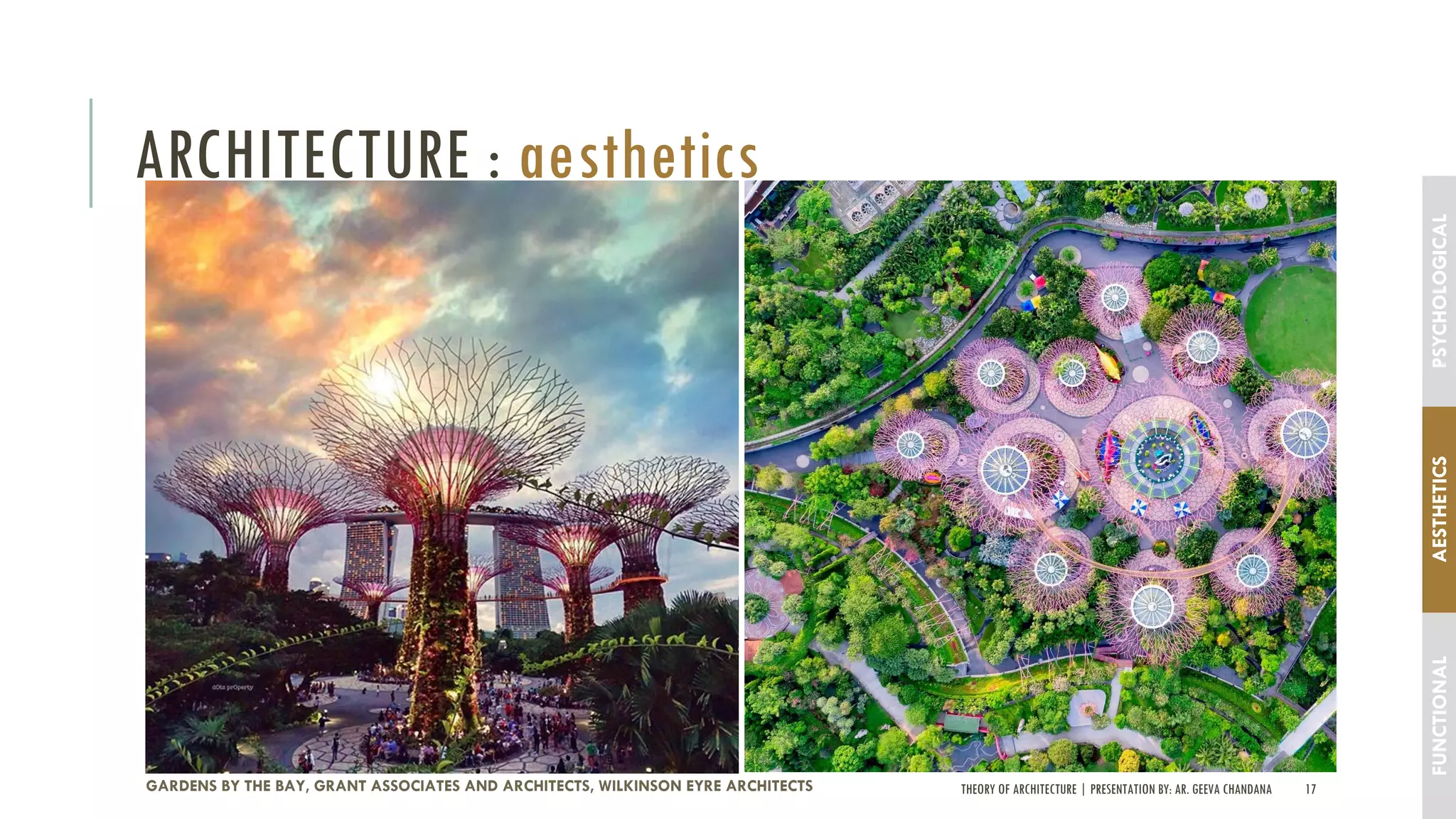
ARCHITECTURE : aesthetics
GARDENS BY THE BAY, GRANT ASSOCIATES AND ARCHITECTS, WILKINSON EYRE ARCHITECTS
FUNCTIONALAESTHETICSPSYCHOLOGICAL
THEORY OF ARCHITECTURE | PRESENTATION BY: AR. GEEVA CHANDANA 18
ARCHITECTURE : psychological
FUNCTIONALAESTHETICSPSYCHOLOGICAL
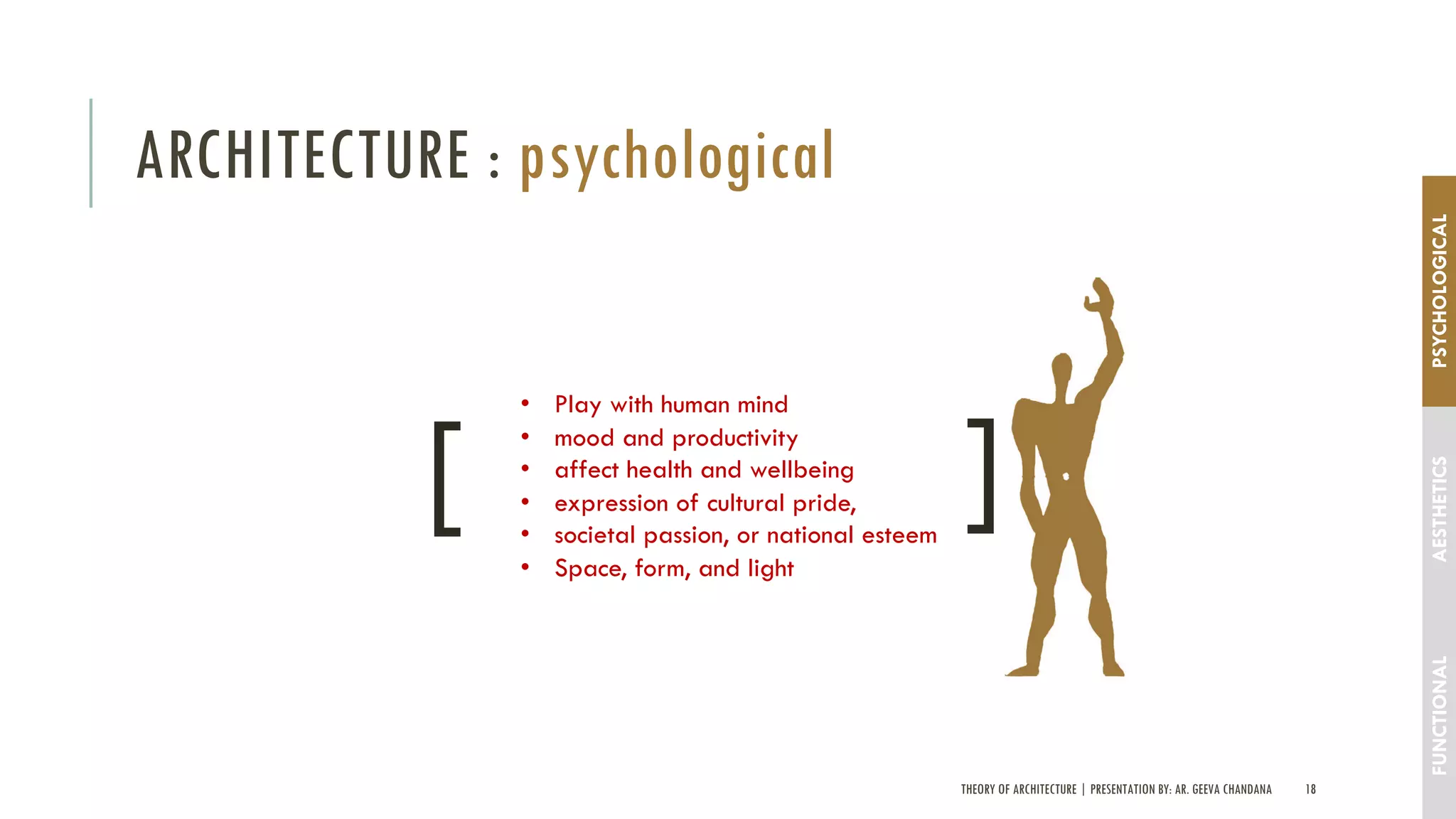
• Play with human mind
• mood and productivity
• affect health and wellbeing
• expression of cultural pride,
• societal passion, or national esteem
• Space, form, and light
[ [
THEORY OF ARCHITECTURE | PRESENTATION BY: AR. GEEVA CHANDANA 19
ARCHITECTURE : psychological
FUNCTIONALAESTHETICSPSYCHOLOGICAL
• Physical structure has a significant effect on human behavior.
As humans find themselves spending more time enclosed within the walls of structure, it becomes valuable
to design structures integrating features of the natural environment and structural landscape features into
the human-made environment (Joye, 2007).
• Research suggests the design of residential and commercial space has pervasive effects on its
inhabitants and is an important consideration in architectural design.
• Space, form, and light are elements that are often incorporated either purposefully or
unconsciously for aesthetic or practical reasons but more pointedly give people meaning, purpose
and stability amidst an ever changing physical universe of seeming chaos.
[ [
THEORY OF ARCHITECTURE | PRESENTATION BY: AR. GEEVA CHANDANA 20
ARCHITECTURE : psychological
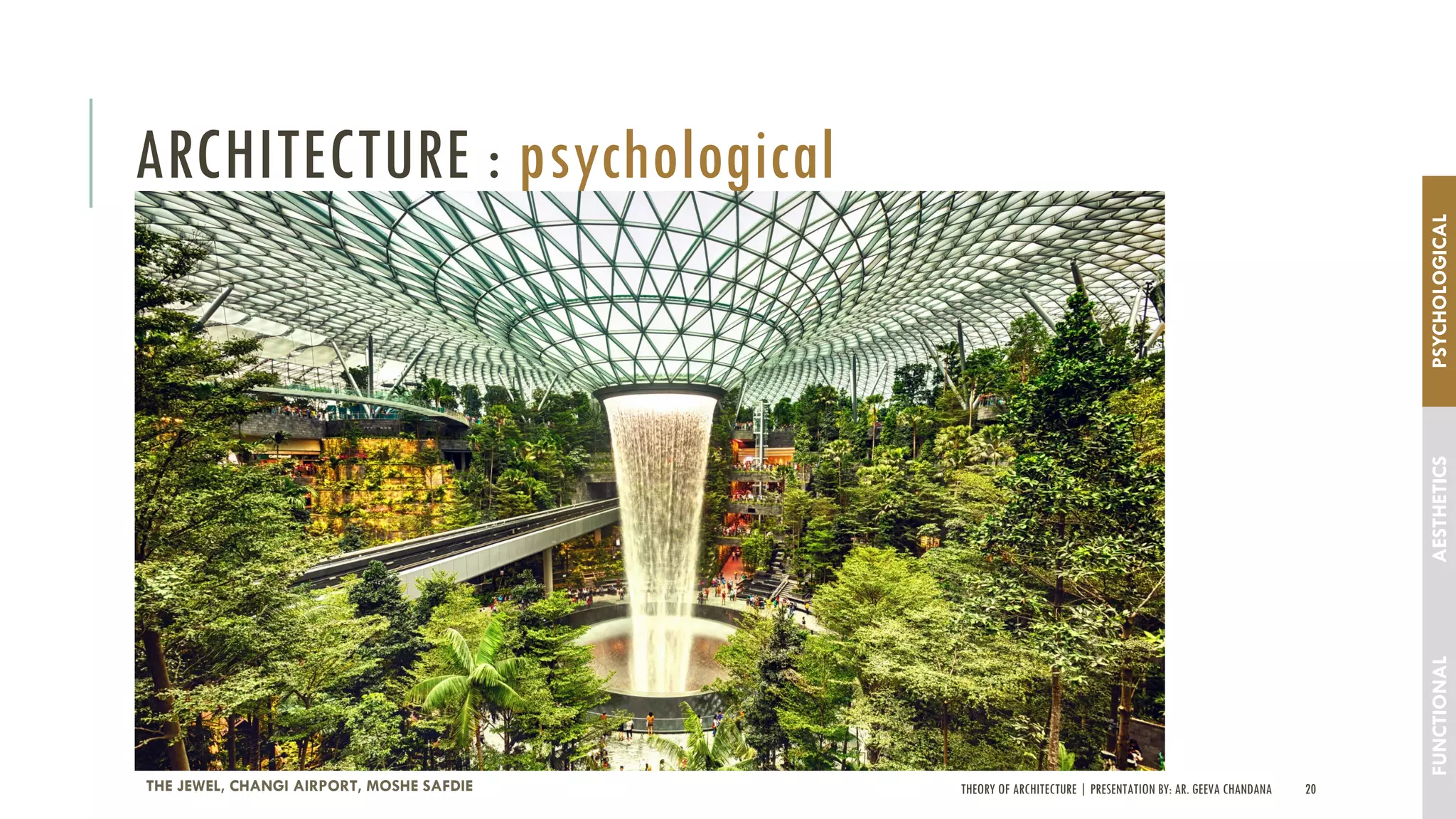
THE JEWEL, CHANGI AIRPORT, MOSHE SAFDIE
FUNCTIONALAESTHETICSPSYCHOLOGICAL
THEORY OF ARCHITECTURE | PRESENTATION BY: AR. GEEVA CHANDANA 21
ARCHITECTURE : psychological
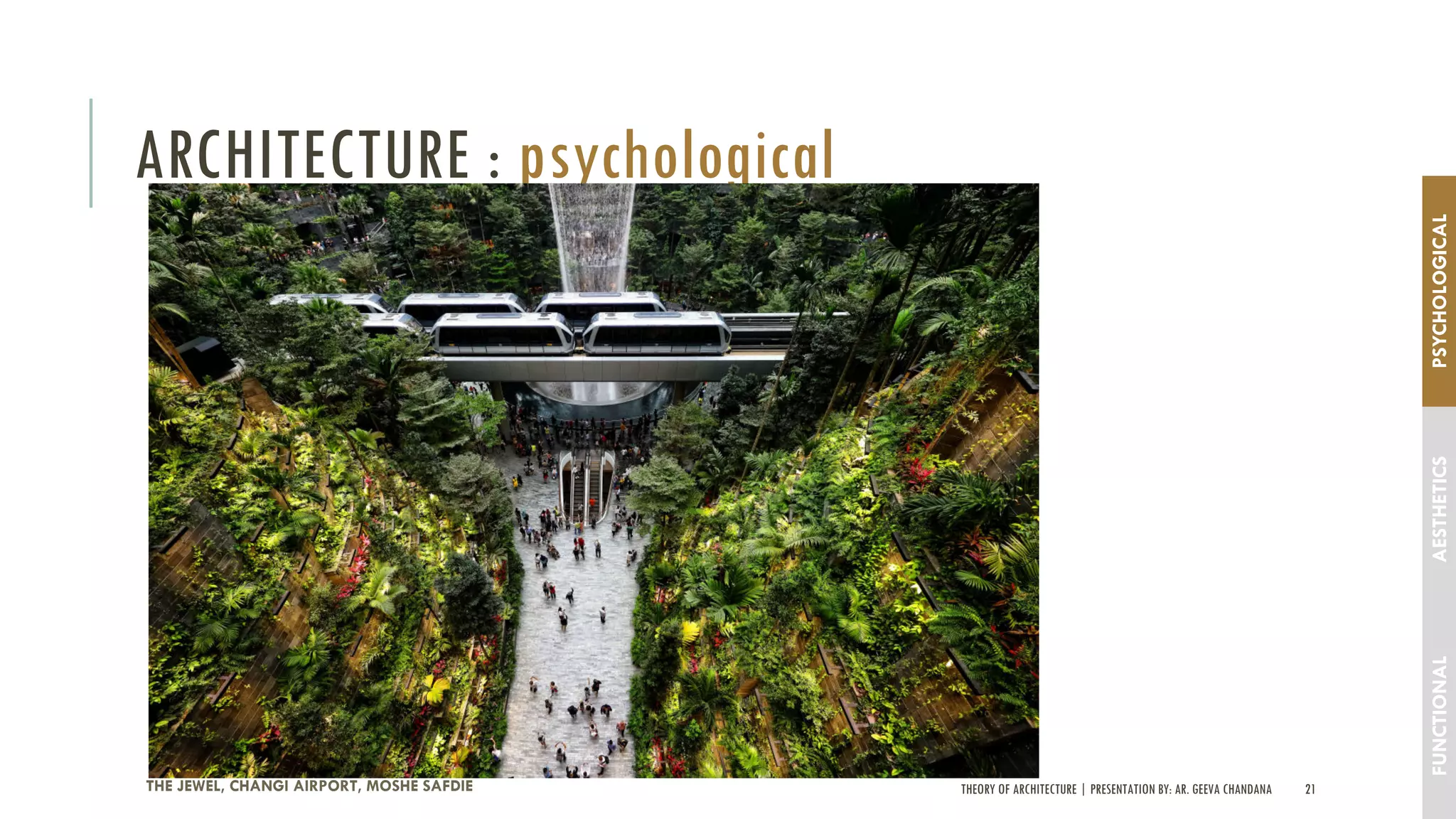
THE JEWEL, CHANGI AIRPORT, MOSHE SAFDIE
FUNCTIONALAESTHETICSPSYCHOLOGICAL
THEORY OF ARCHITECTURE | PRESENTATION BY: AR. GEEVA CHANDANA 22
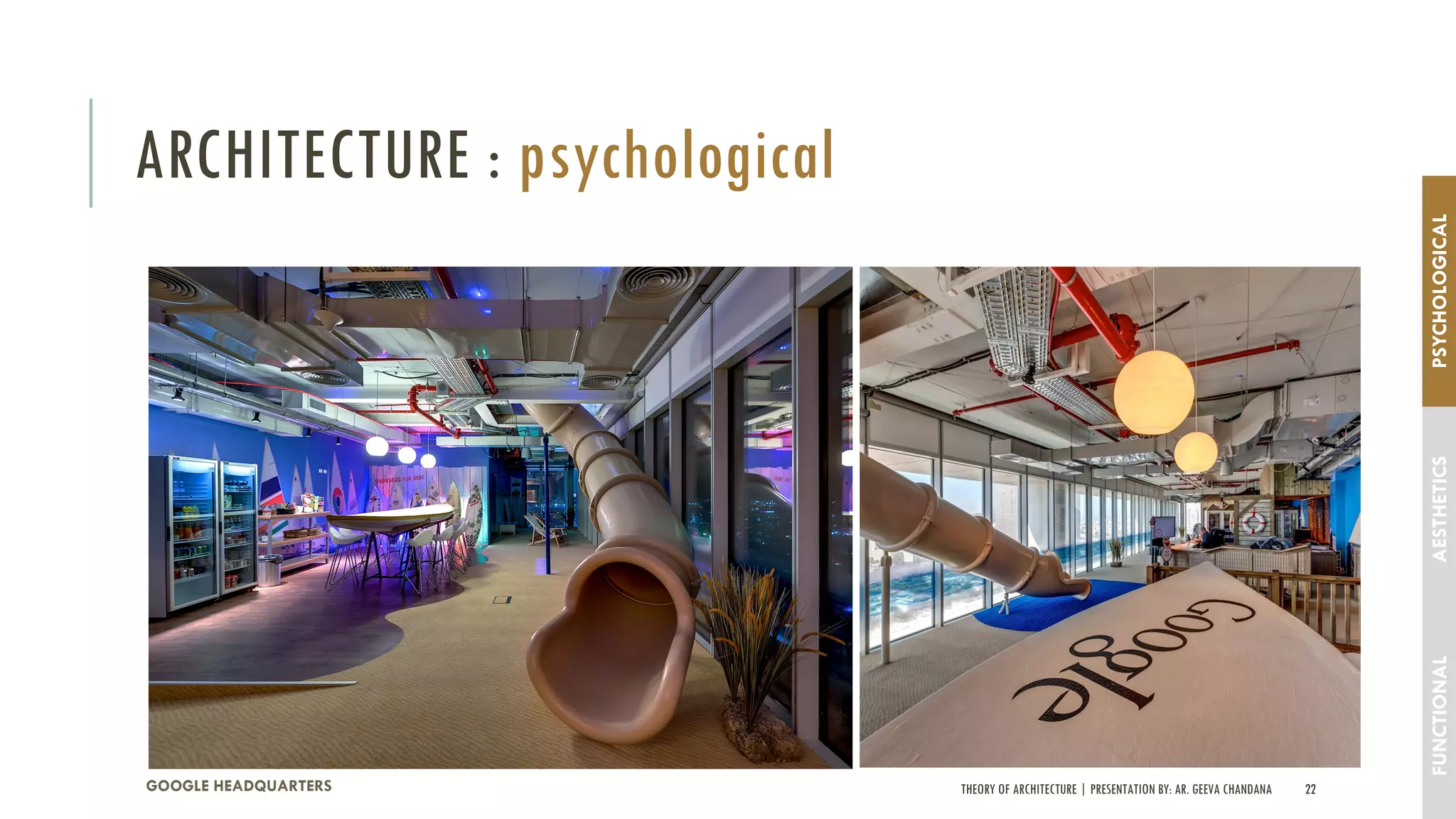
ARCHITECTURE : psychological
GOOGLE HEADQUARTERS
FUNCTIONALAESTHETICSPSYCHOLOGICAL
THEORY OF ARCHITECTURE | PRESENTATION BY: AR. GEEVA CHANDANA 23
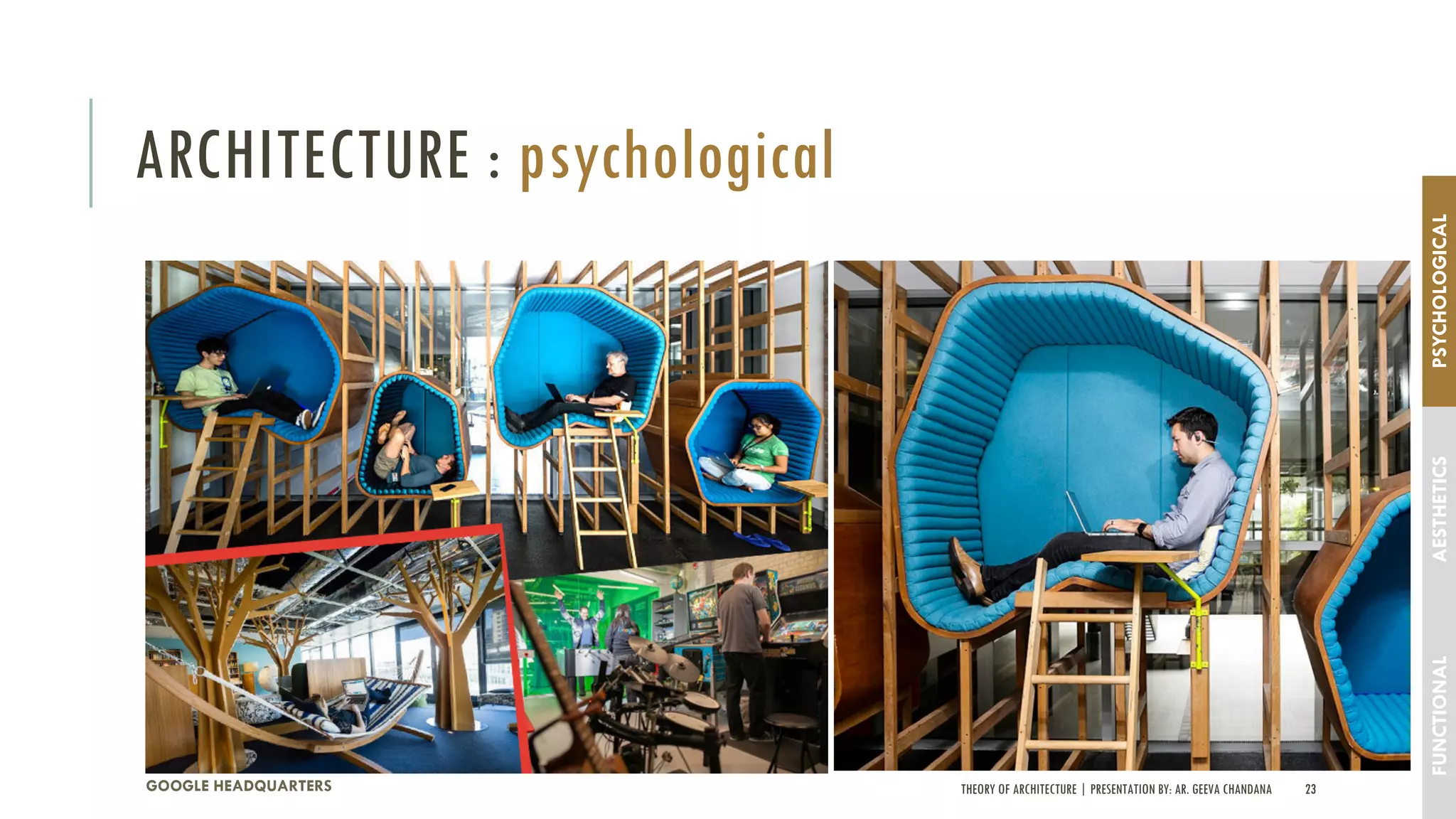
ARCHITECTURE : psychological
GOOGLE HEADQUARTERS
FUNCTIONALAESTHETICSPSYCHOLOGICAL
THEORY OF ARCHITECTURE | PRESENTATION BY: AR. GEEVA CHANDANA 24
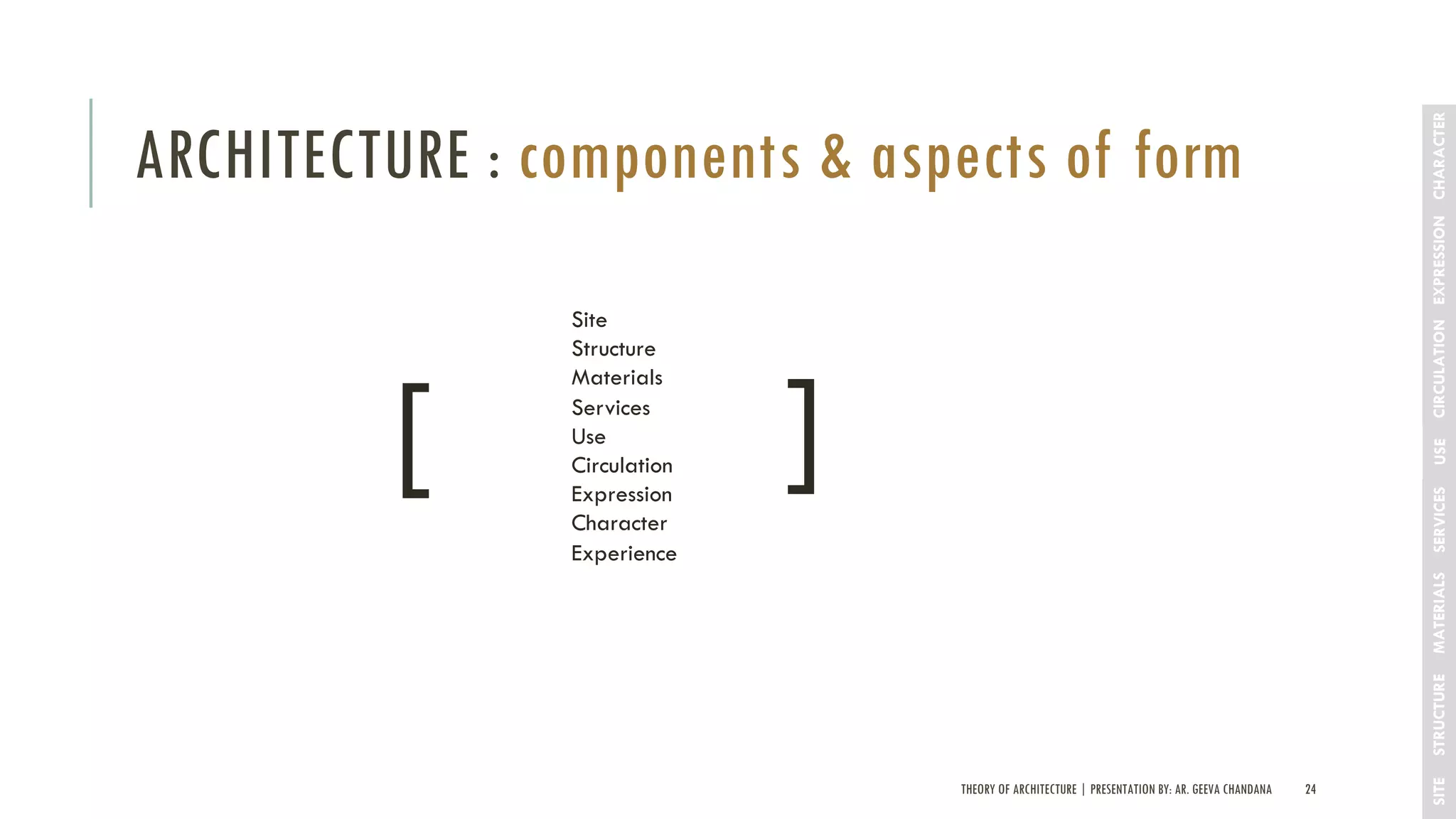
ARCHITECTURE : components & aspects of form
SITESTRUCTURE
Site
Structure
Materials
Services
Use
Circulation
Expression
Character
Experience
[
[
MATERIALSSERVICESUSECIRCULATIONEXPRESSIONCHARACTER
THEORY OF ARCHITECTURE | PRESENTATION BY: AR. GEEVA CHANDANA 25
ARCHITECTURE : components & aspects of form
SITESTRUCTUREMATERIALSSERVICESUSECIRCULATIONEXPRESSIONCHARACTER
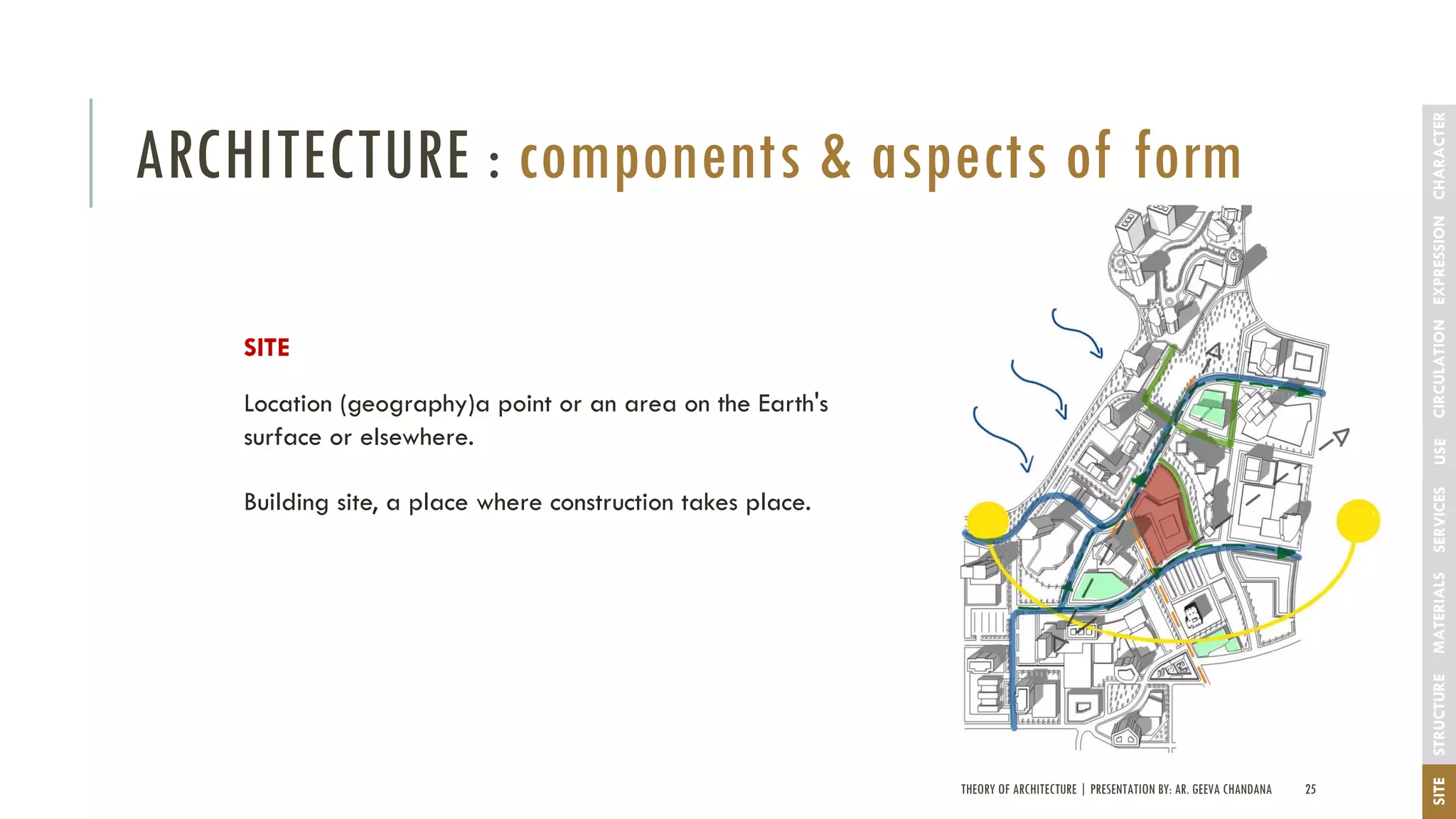
SITE
Location (geography)a point or an area on the Earth's
surface or elsewhere.
Building site, a place where construction takes place.
THEORY OF ARCHITECTURE | PRESENTATION BY: AR. GEEVA CHANDANA 26
ARCHITECTURE : components & aspects of form
SITESTRUCTUREMATERIALSSERVICESUSECIRCULATIONEXPRESSIONCHARACTER
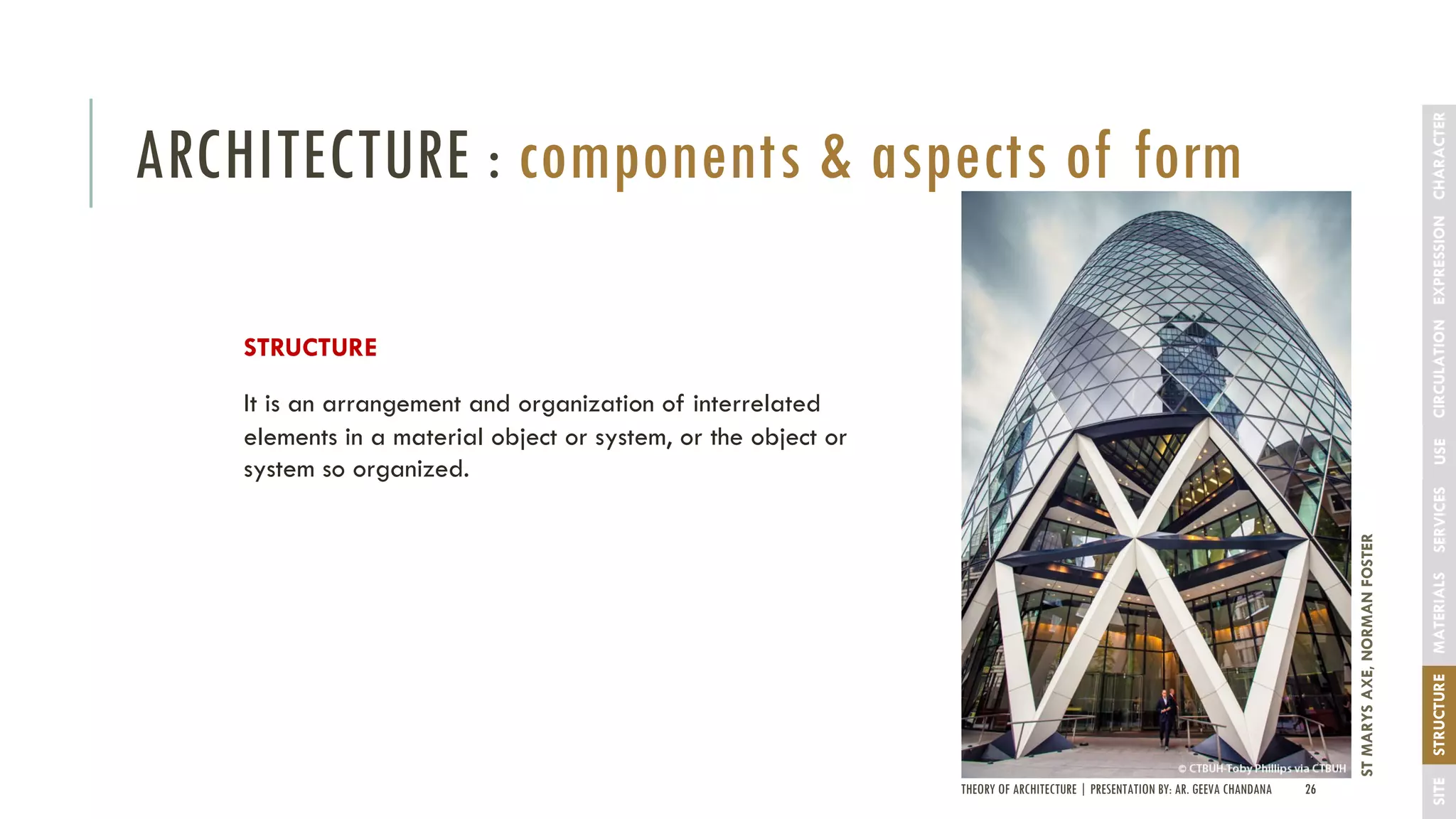
STRUCTURE
It is an arrangement and organization of interrelated
elements in a material object or system, or the object or
system so organized.
STMARYSAXE,NORMANFOSTER
THEORY OF ARCHITECTURE | PRESENTATION BY: AR. GEEVA CHANDANA 27
ARCHITECTURE : components & aspects of form
SITESTRUCTUREMATERIALSSERVICESUSECIRCULATIONEXPRESSIONCHARACTER
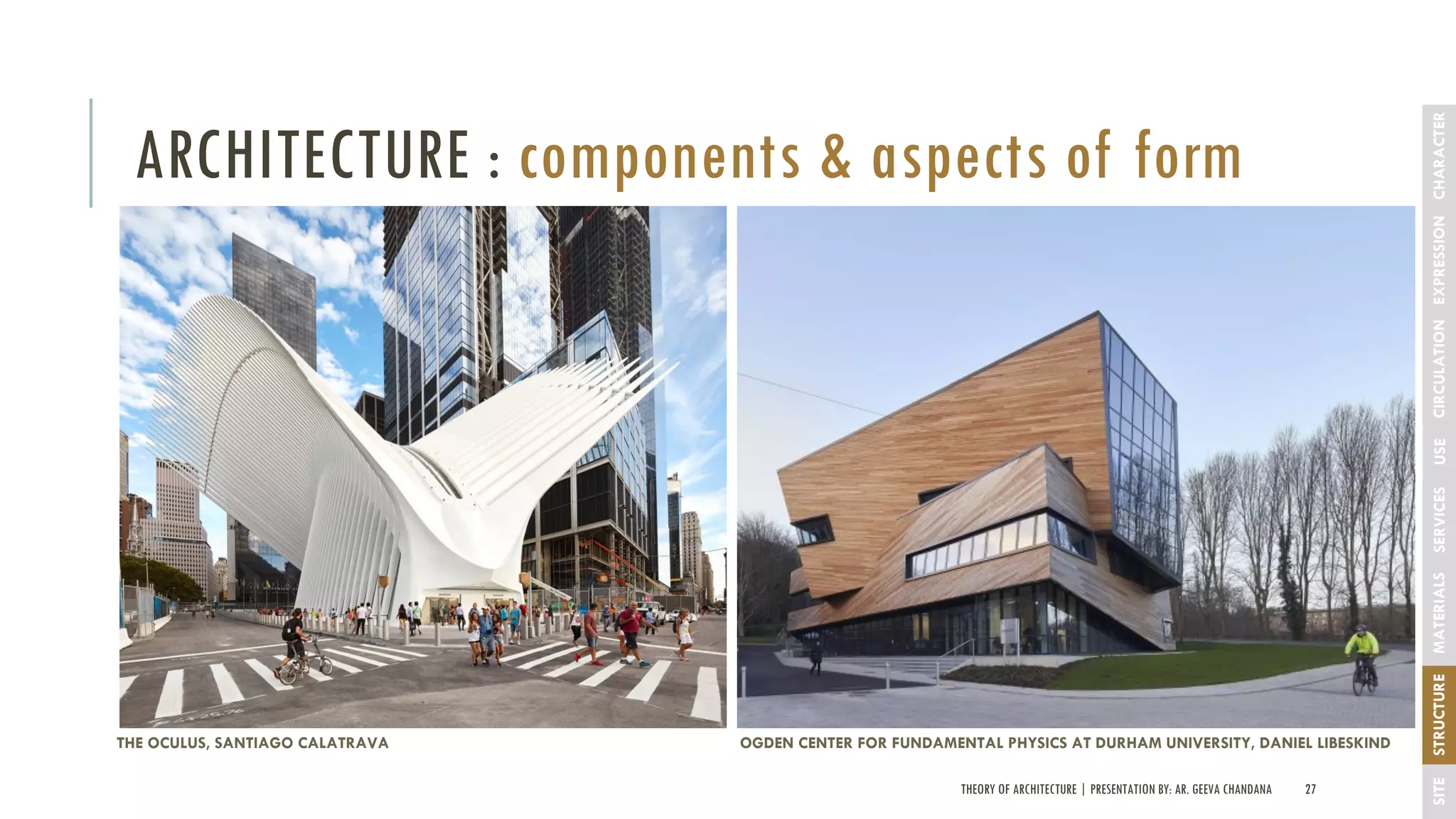
THE OCULUS, SANTIAGO CALATRAVA OGDEN CENTER FOR FUNDAMENTAL PHYSICS AT DURHAM UNIVERSITY, DANIEL LIBESKIND
THEORY OF ARCHITECTURE | PRESENTATION BY: AR. GEEVA CHANDANA 28
ARCHITECTURE : components & aspects of form
SITESTRUCTUREMATERIALSSERVICESUSECIRCULATIONEXPRESSIONCHARACTER
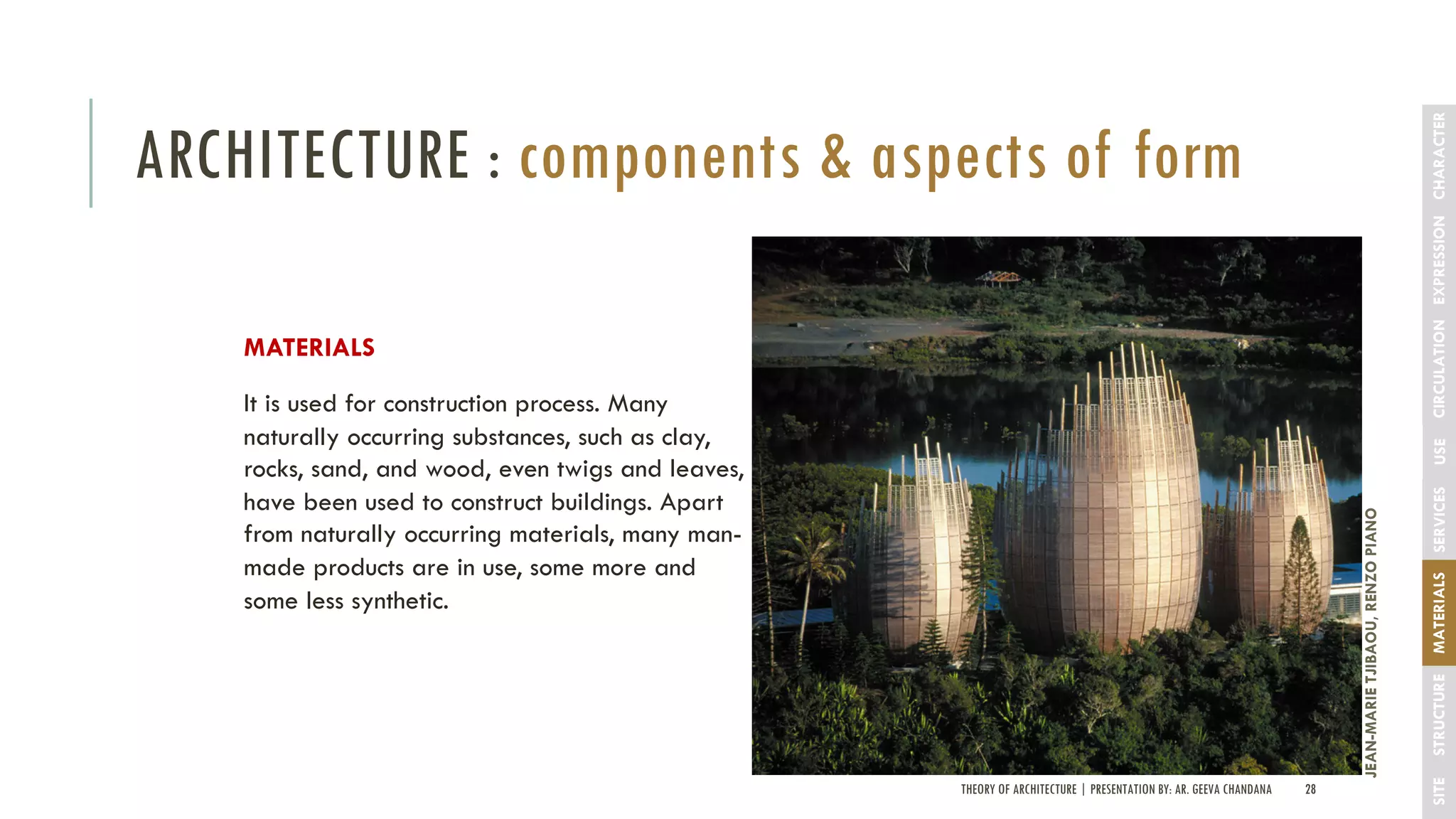
MATERIALS
It is used for construction process. Many
naturally occurring substances, such as clay,
rocks, sand, and wood, even twigs and leaves,
have been used to construct buildings. Apart
from naturally occurring materials, many man-
made products are in use, some more and
some less synthetic.
JEAN-MARIETJIBAOU,RENZOPIANO
THEORY OF ARCHITECTURE | PRESENTATION BY: AR. GEEVA CHANDANA 29
ARCHITECTURE : components & aspects of form
SITESTRUCTUREMATERIALSSERVICESUSECIRCULATIONEXPRESSIONCHARACTER
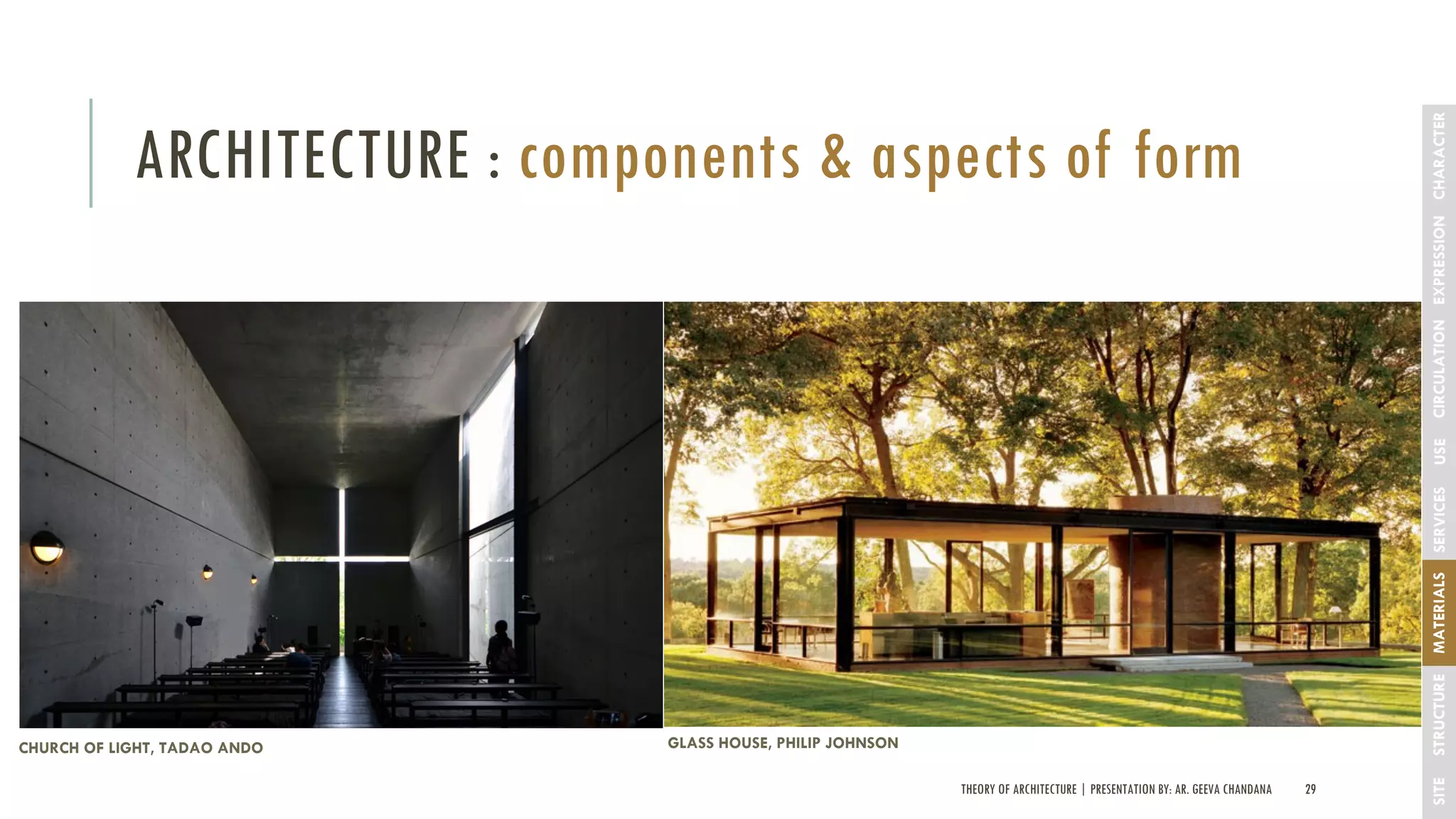
CHURCH OF LIGHT, TADAO ANDO GLASS HOUSE, PHILIP JOHNSON
THEORY OF ARCHITECTURE | PRESENTATION BY: AR. GEEVA CHANDANA 30
ARCHITECTURE : components & aspects of form
SITESTRUCTUREMATERIALSSERVICESUSECIRCULATIONEXPRESSIONCHARACTER
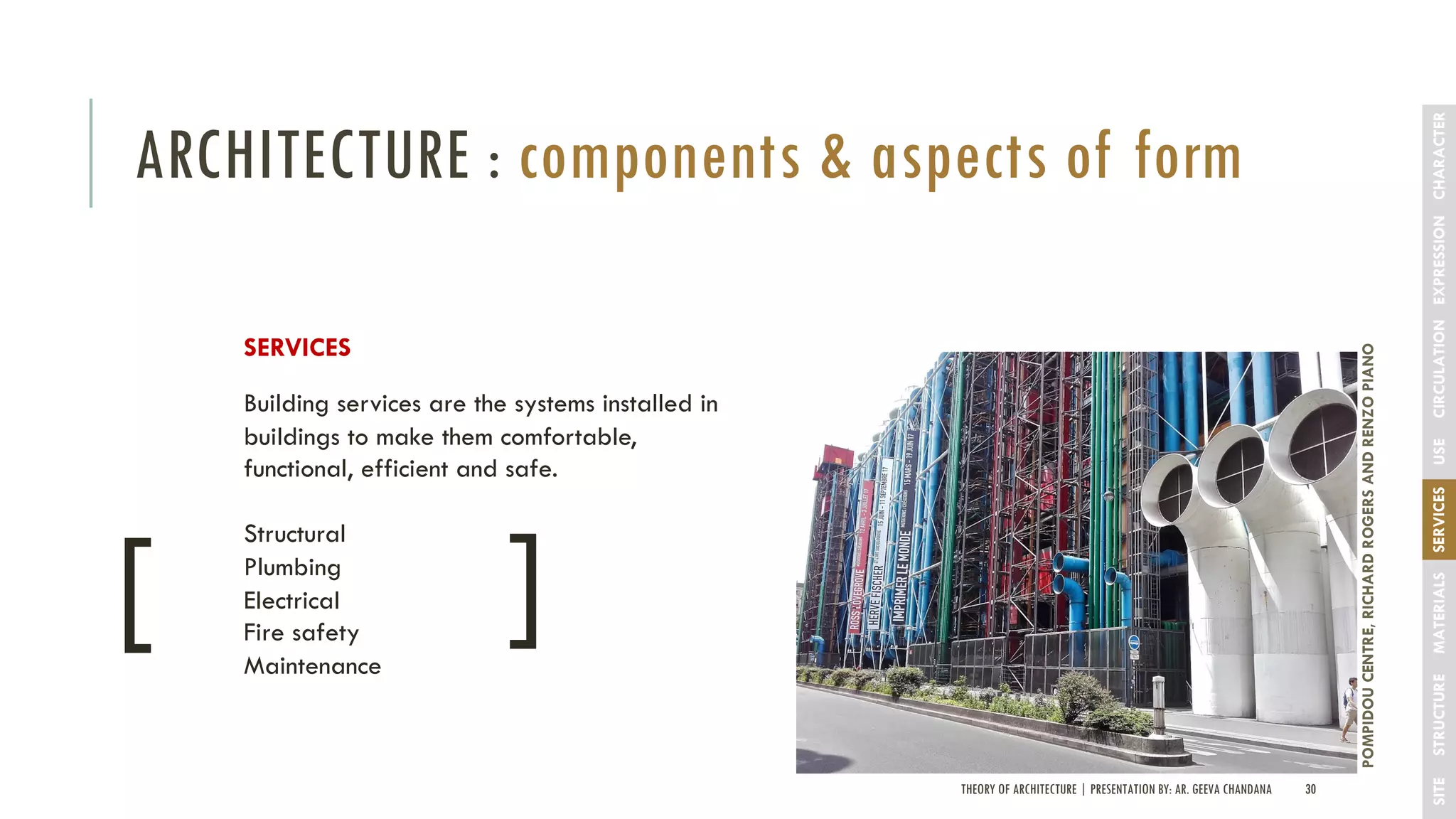
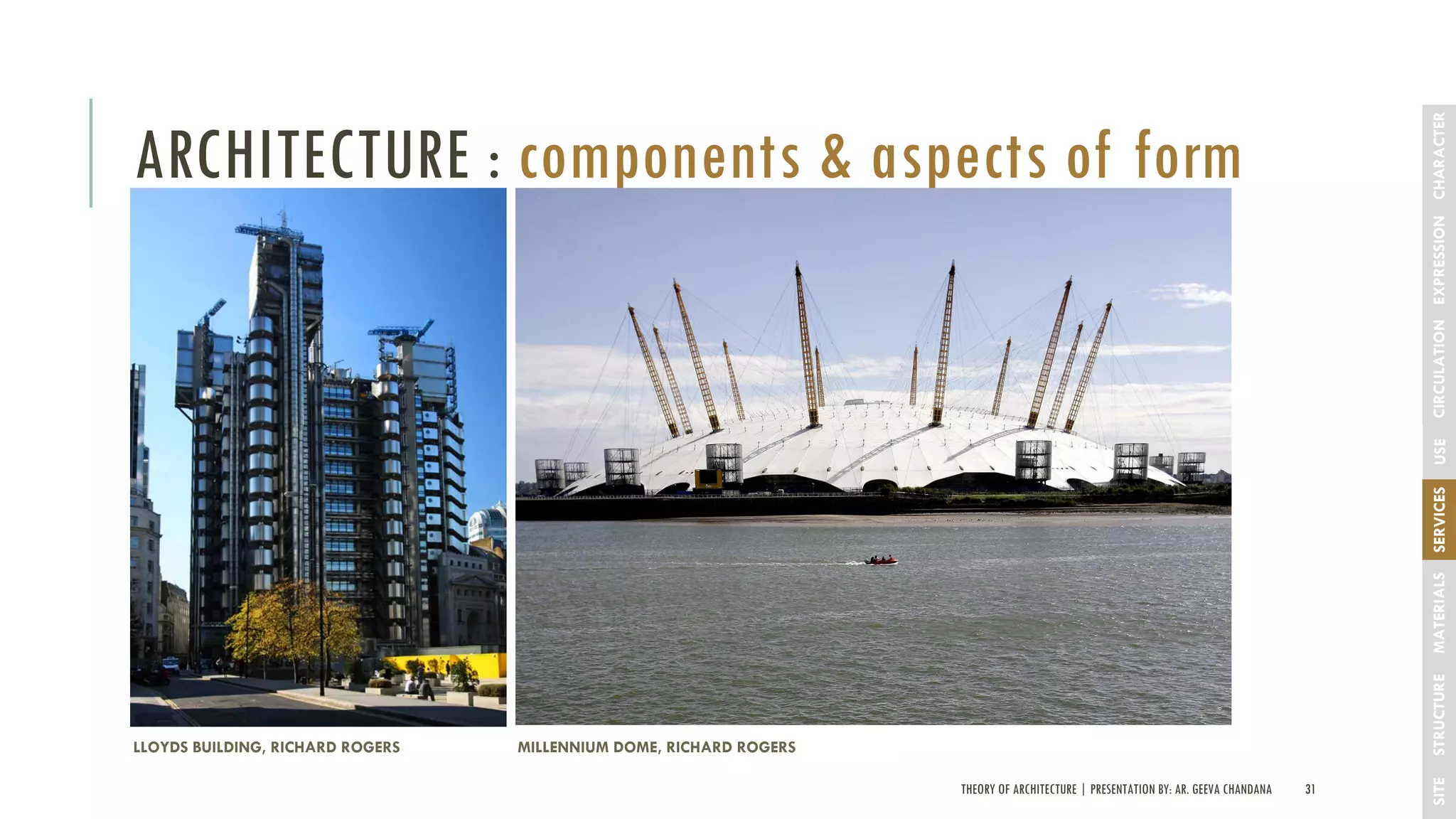
SERVICES
Building services are the systems installed in
buildings to make them comfortable,
functional, efficient and safe.
Structural
Plumbing
Electrical
Fire safety
Maintenance
POMPIDOUCENTRE,RICHARDROGERSANDRENZOPIANO
[
[
THEORY OF ARCHITECTURE | PRESENTATION BY: AR. GEEVA CHANDANA 31
ARCHITECTURE : components & aspects of form
SITESTRUCTUREMATERIALSSERVICESUSECIRCULATIONEXPRESSIONCHARACTER
LLOYDS BUILDING, RICHARD ROGERS MILLENNIUM DOME, RICHARD ROGERS
THEORY OF ARCHITECTURE | PRESENTATION BY: AR. GEEVA CHANDANA 32
ARCHITECTURE : components & aspects of form
SITESTRUCTUREMATERIALSSERVICESUSECIRCULATIONEXPRESSIONCHARACTER
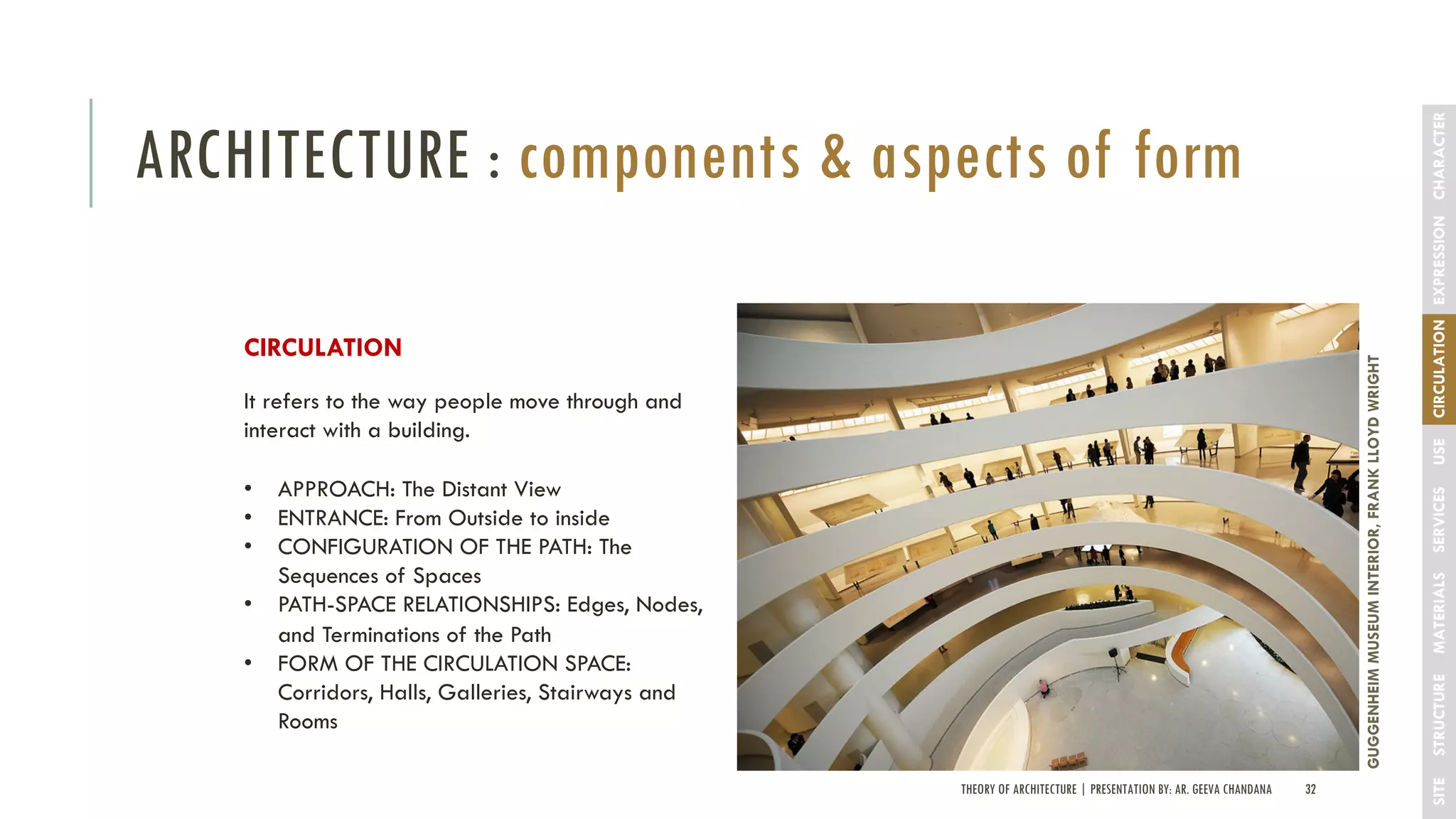
CIRCULATION
It refers to the way people move through and
interact with a building.
• APPROACH: The Distant View
• ENTRANCE: From Outside to inside
• CONFIGURATION OF THE PATH: The
Sequences of Spaces
• PATH-SPACE RELATIONSHIPS: Edges, Nodes,
and Terminations of the Path
• FORM OF THE CIRCULATION SPACE:
Corridors, Halls, Galleries, Stairways and
Rooms
GUGGENHEIMMUSEUMINTERIOR,FRANKLLOYDWRIGHT
THEORY OF ARCHITECTURE | PRESENTATION BY: AR. GEEVA CHANDANA 33
ARCHITECTURE : components & aspects of form
SITESTRUCTUREMATERIALSSERVICESUSECIRCULATIONEXPRESSIONCHARACTER
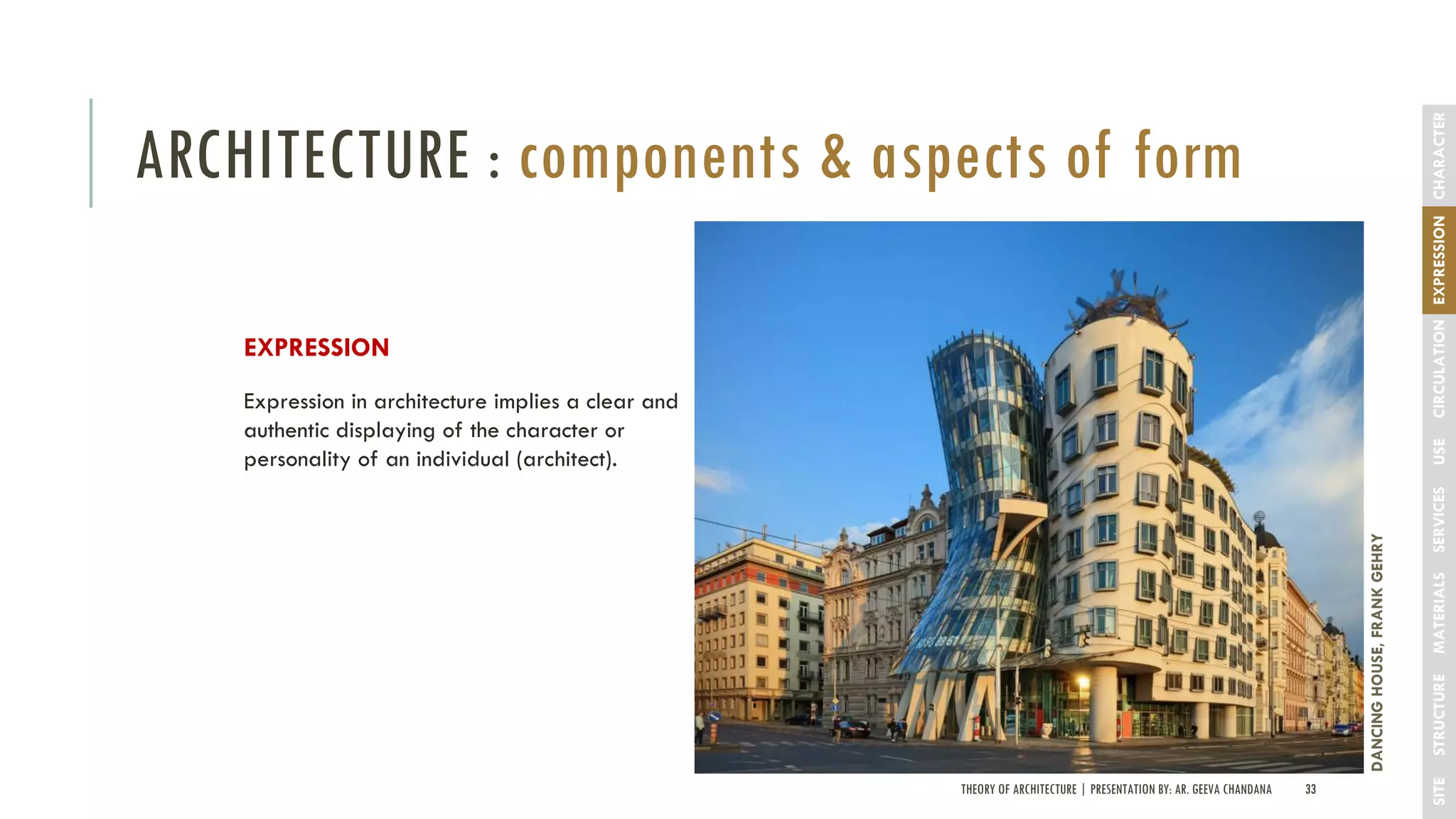
EXPRESSION
Expression in architecture implies a clear and
authentic displaying of the character or
personality of an individual (architect).
DANCINGHOUSE,FRANKGEHRY
THEORY OF ARCHITECTURE | PRESENTATION BY: AR. GEEVA CHANDANA 34
ARCHITECTURE : components & aspects of form
SITESTRUCTUREMATERIALSSERVICESUSECIRCULATIONEXPRESSIONCHARACTER
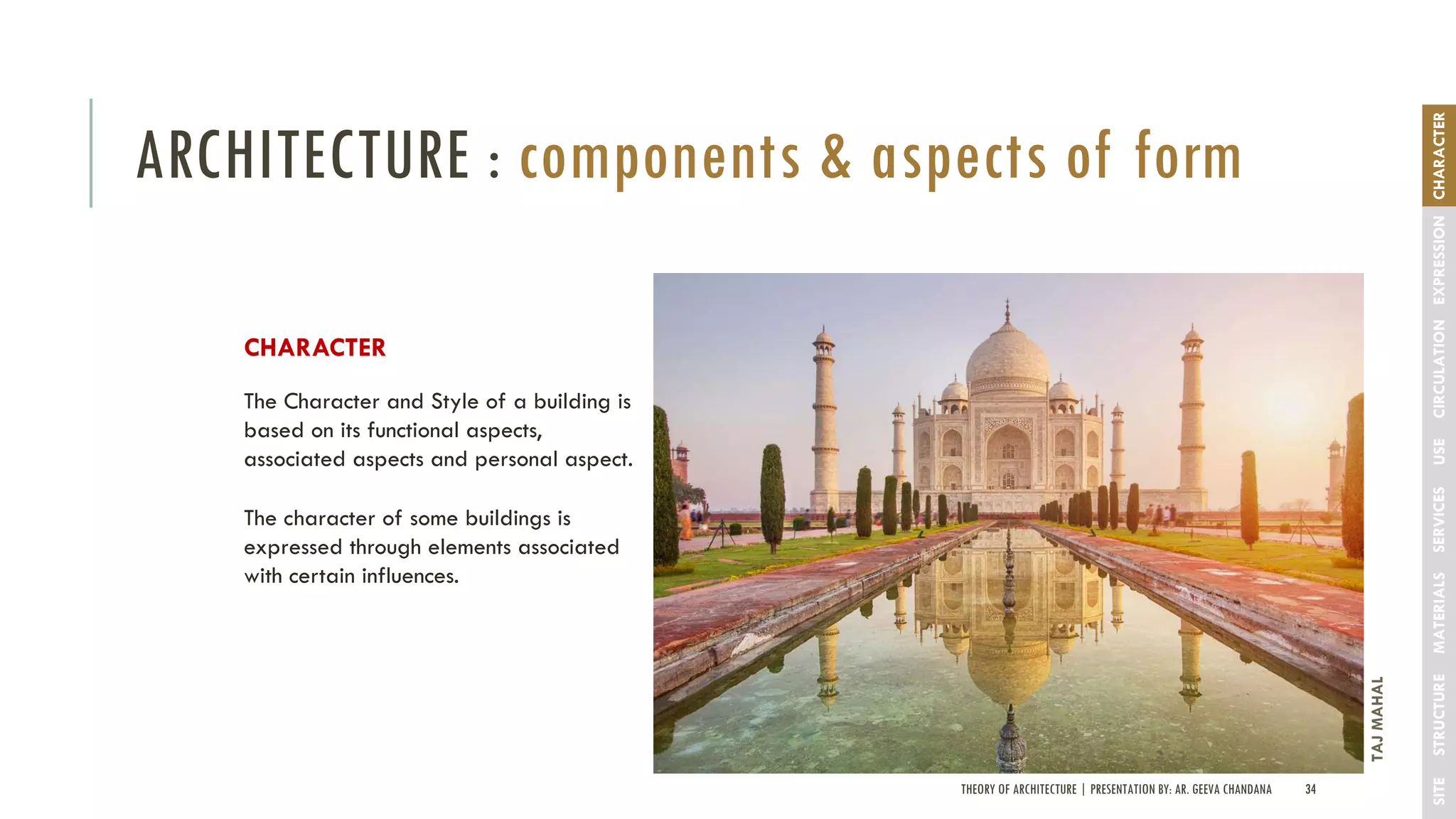
CHARACTER
The Character and Style of a building is
based on its functional aspects,
associated aspects and personal aspect.
The character of some buildings is
expressed through elements associated
with certain influences.
TAJMAHAL
THEORY OF ARCHITECTURE | PRESENTATION BY: AR. GEEVA CHANDANA 35
ARCHITECTURE : components & aspects of form
SITESTRUCTUREMATERIALSSERVICESUSECIRCULATIONCHARACTEREXPERIENCE
EXPERIENCE
Experience in architecture is the art of
articulating a clear user story/journey
through a design as intended by the
architect.
SAGRADAFAMILIA,ANTONIOGAUDI
GESTALT IDEAS OF VISUAL PERCEPTION
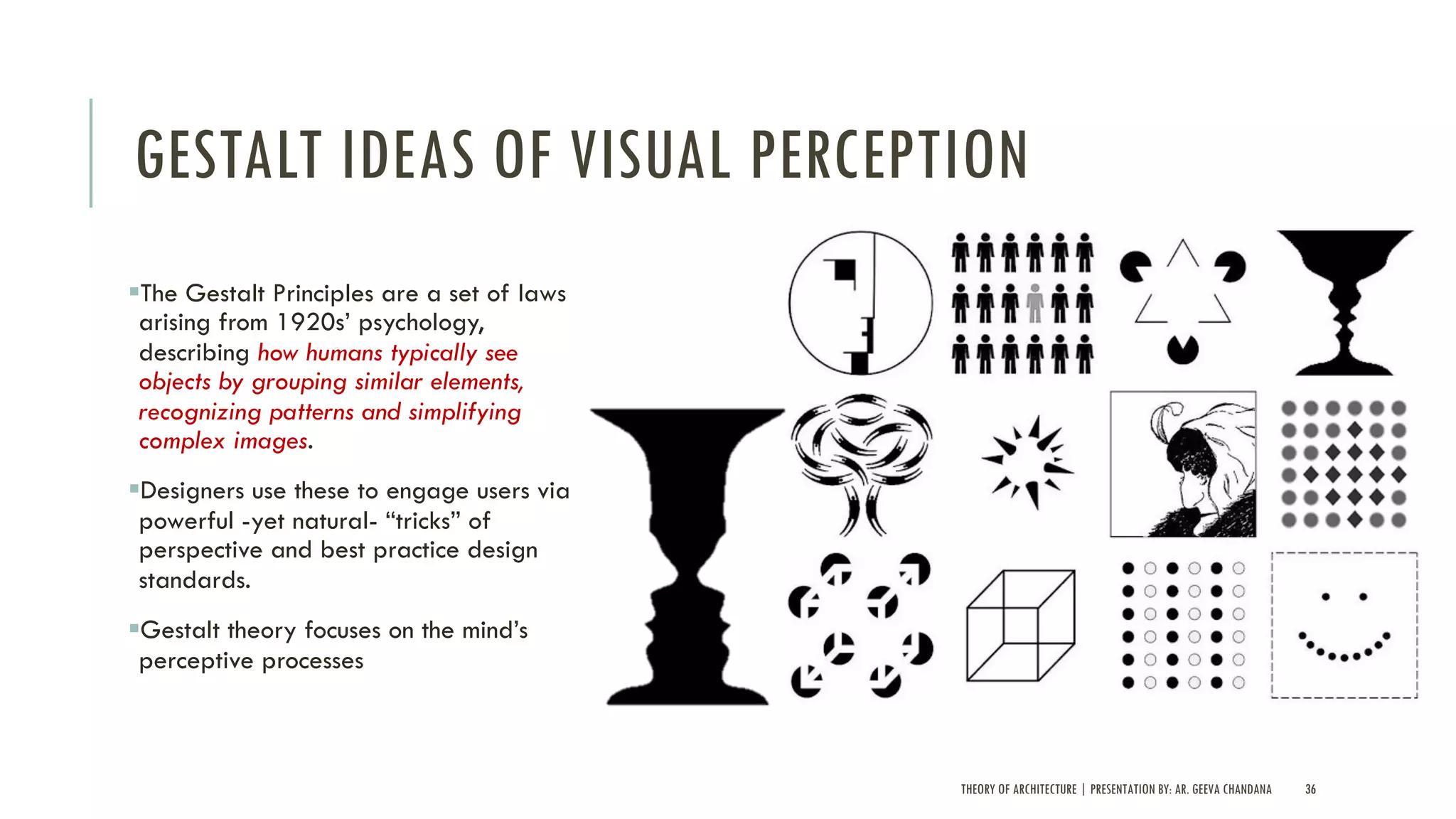
§The Gestalt Principles are a set of laws
arising from 1920s’ psychology,
describing how humans typically see
objects by grouping similar elements,
recognizing patterns and simplifying
complex images.
§Designers use these to engage users via
powerful -yet natural- “tricks” of
perspective and best practice design
standards.
§Gestalt theory focuses on the mind’s
perceptive processes
THEORY OF ARCHITECTURE | PRESENTATION BY: AR. GEEVA CHANDANA 36
THEORY OF ARCHITECTURE | PRESENTATION BY: AR. GEEVA CHANDANA 37
GESTALT IDEAS OF VISUAL PERCEPTION
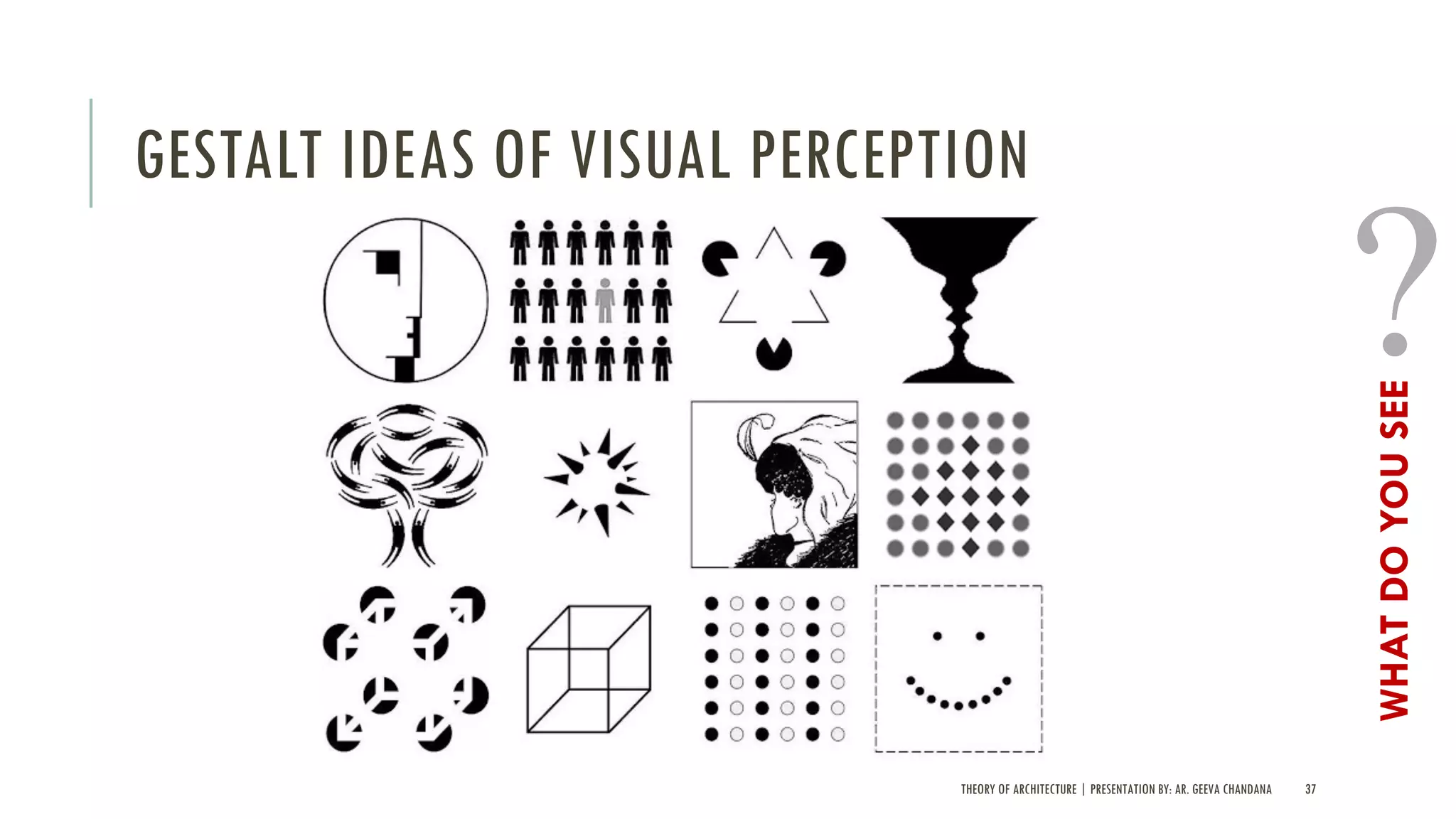
WHATDOYOUSEE
THEORY OF ARCHITECTURE | PRESENTATION BY: AR. GEEVA CHANDANA 38
GESTALT IDEAS OF VISUAL PERCEPTION
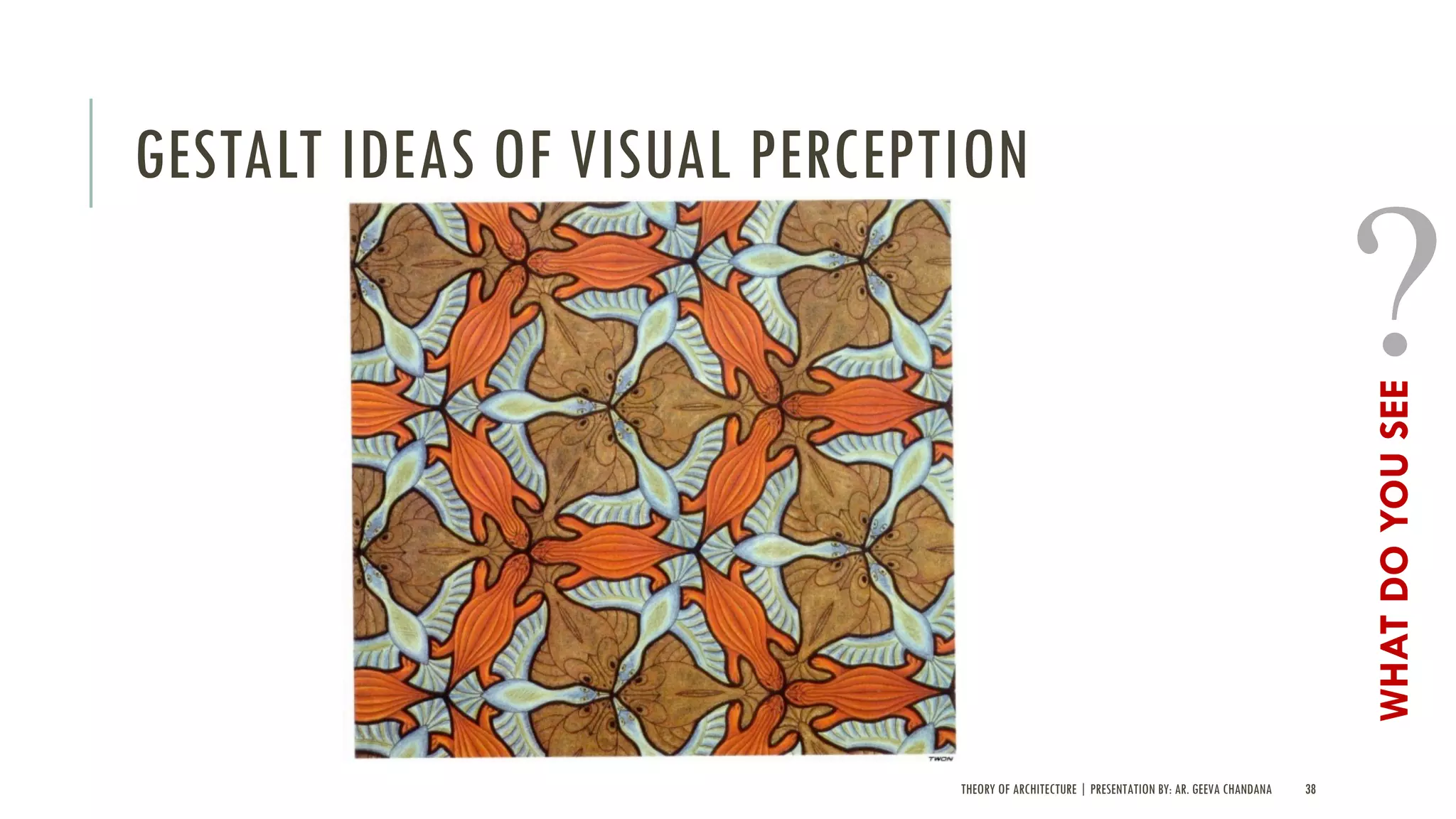
WHATDOYOUSEE
THEORY OF ARCHITECTURE | PRESENTATION BY: AR. GEEVA CHANDANA 39
GESTALT THEORY : principles
Closure
Common Fate
Common Region
Continuation
Convexity
Figure-Ground
Proximity
Regularity
Similarity
Symmetry
Synchrony
[
[
THEORY OF ARCHITECTURE | PRESENTATION BY: AR. GEEVA CHANDANA 40
GESTALT THEORY : principles
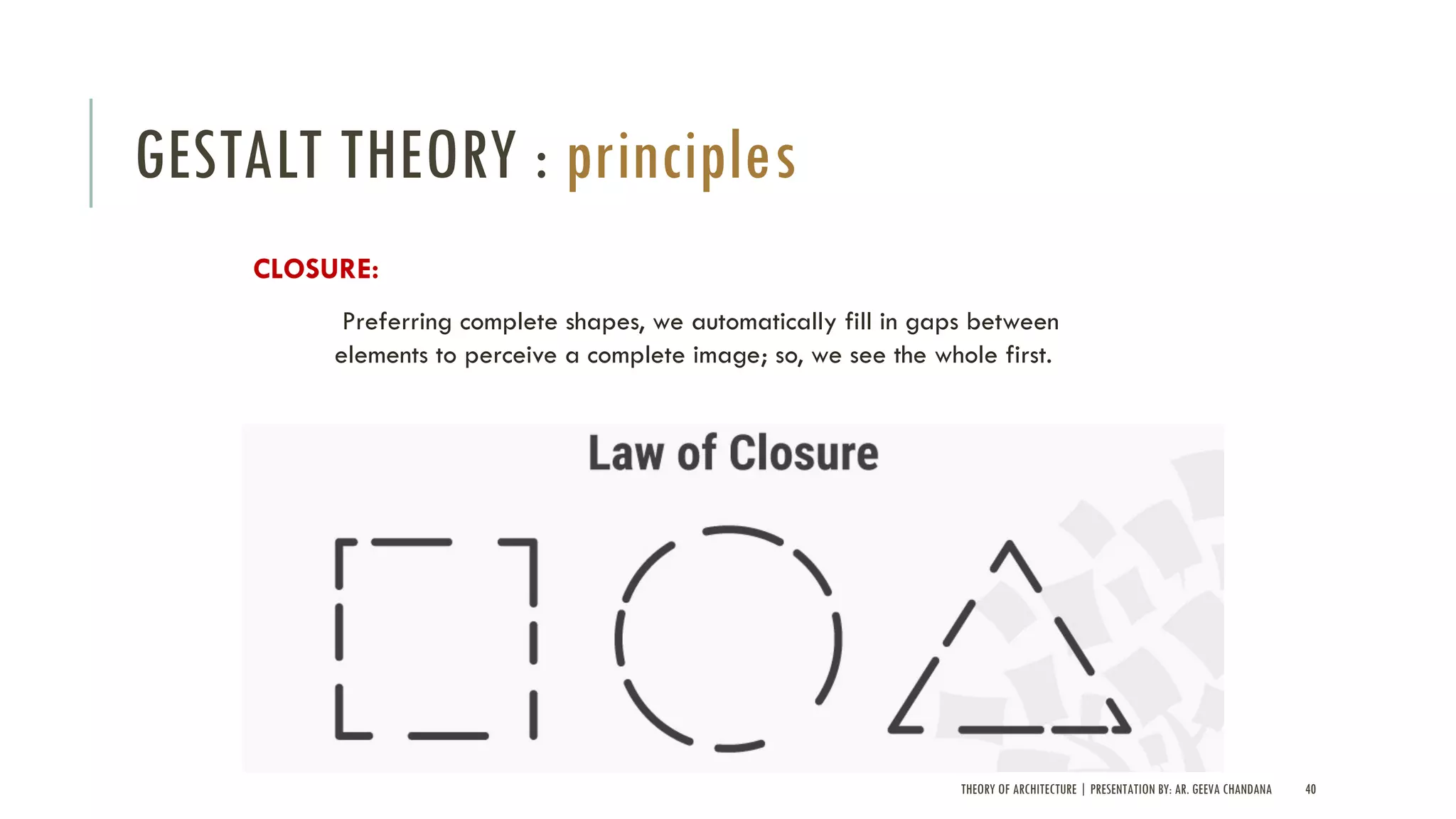
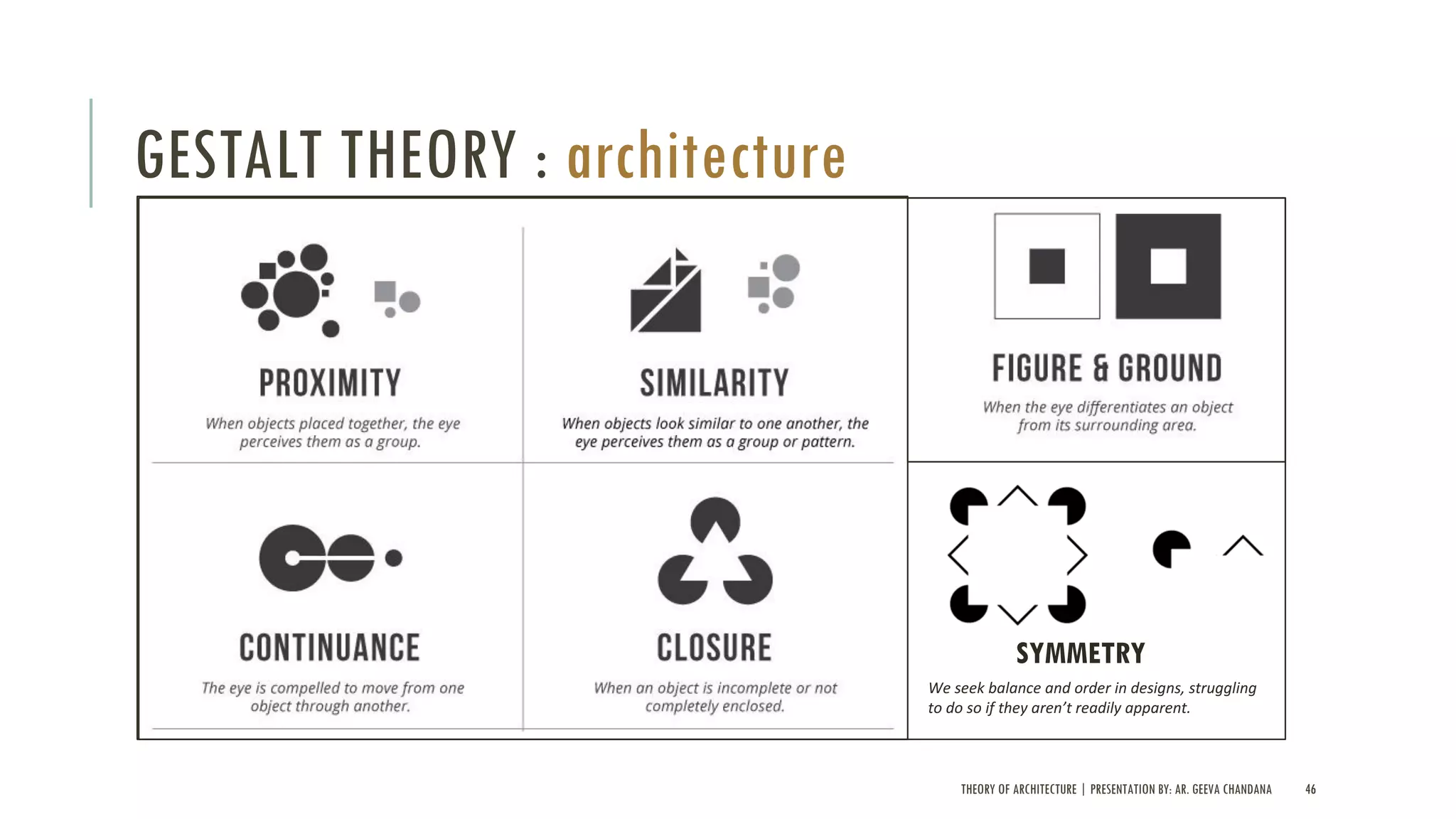
Preferring complete shapes, we automatically fill in gaps between
elements to perceive a complete image; so, we see the whole first.
CLOSURE:
THEORY OF ARCHITECTURE | PRESENTATION BY: AR. GEEVA CHANDANA 41
GESTALT THEORY : principles
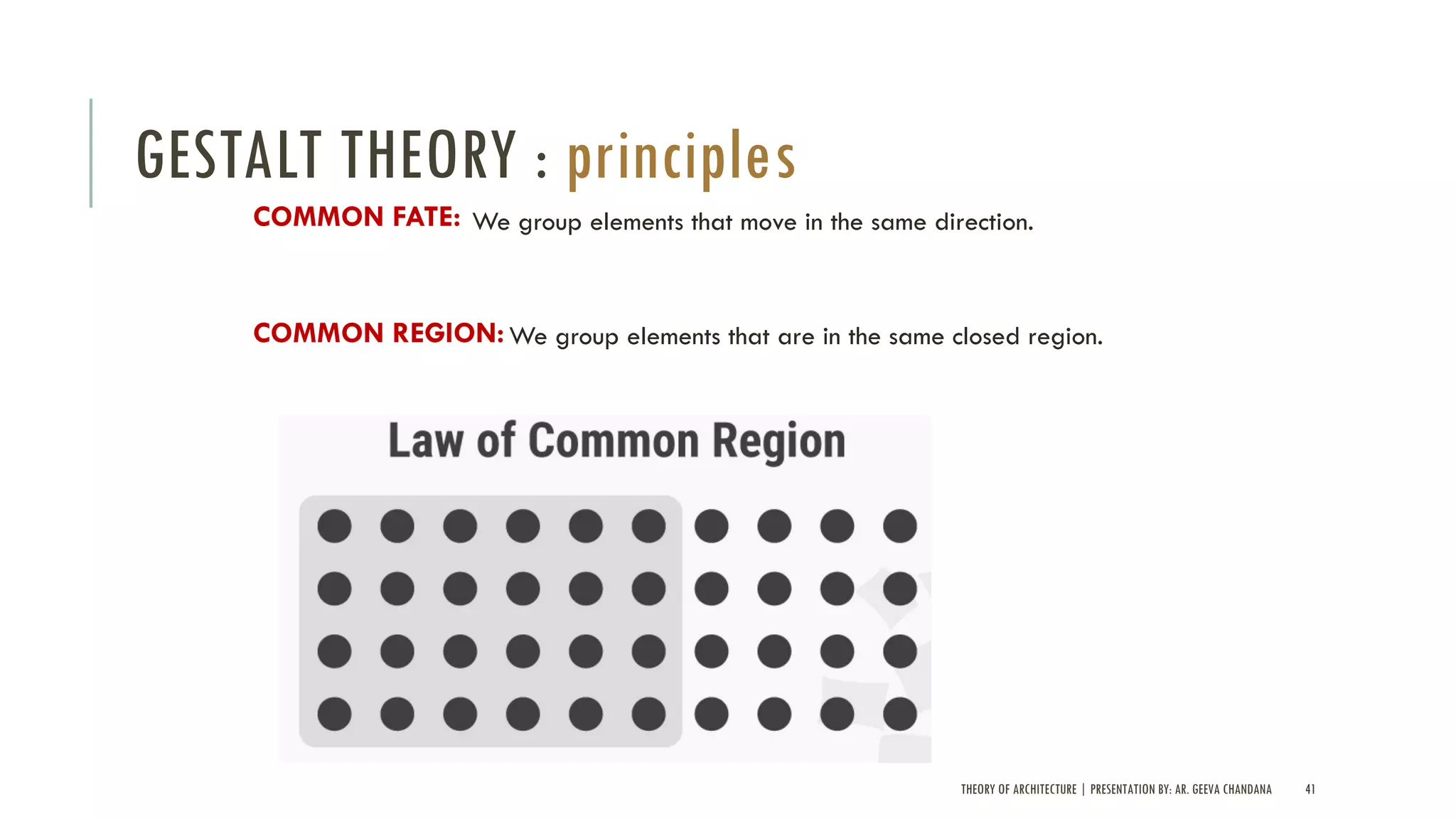
We group elements that move in the same direction.COMMON FATE:
We group elements that are in the same closed region.COMMON REGION:
THEORY OF ARCHITECTURE | PRESENTATION BY: AR. GEEVA CHANDANA 42
GESTALT THEORY : principles
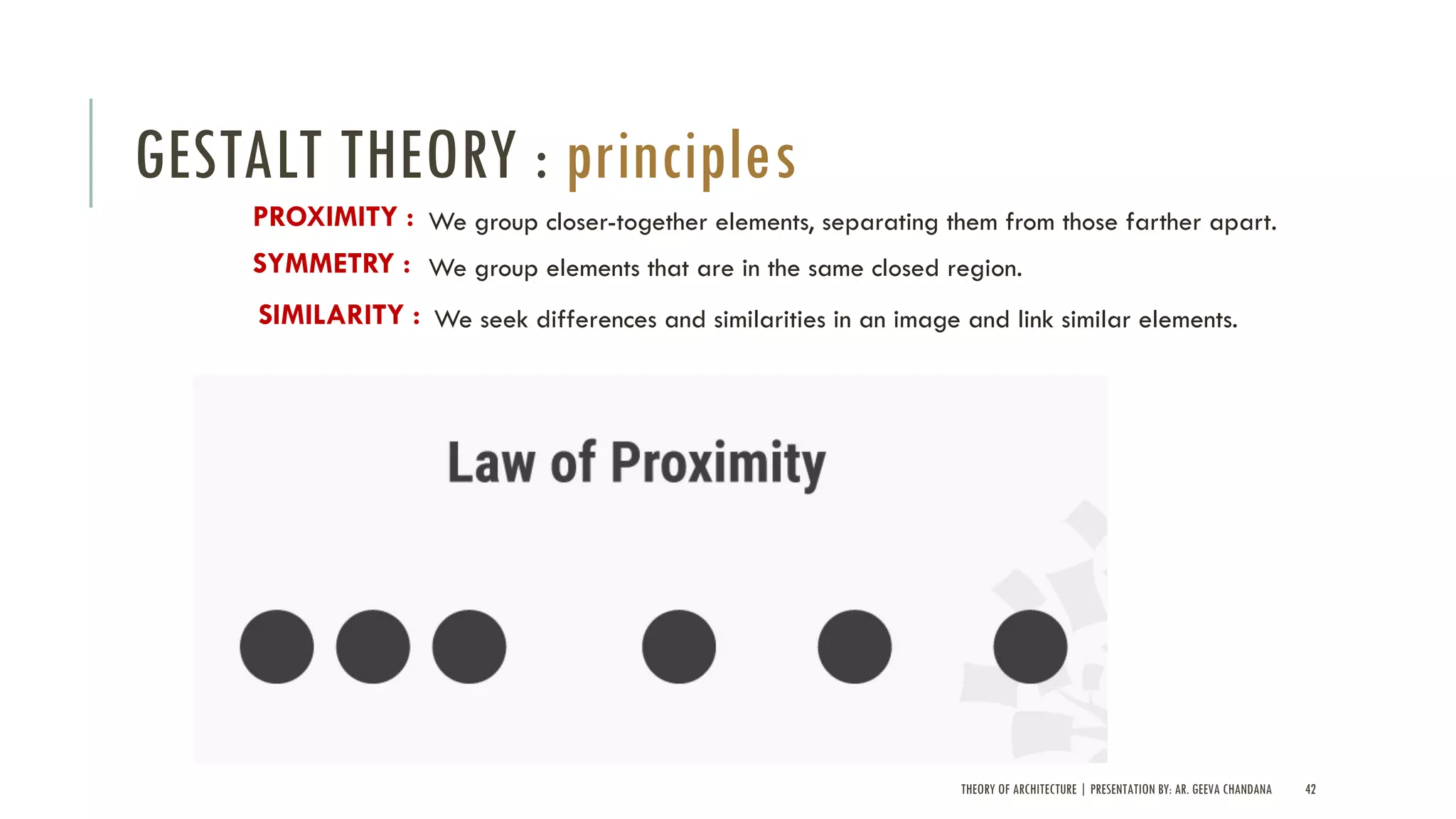
We group closer-together elements, separating them from those farther apart.PROXIMITY :
We group elements that are in the same closed region.SYMMETRY :
We seek differences and similarities in an image and link similar elements.SIMILARITY :
THEORY OF ARCHITECTURE | PRESENTATION BY: AR. GEEVA CHANDANA 43
GESTALT THEORY : principles
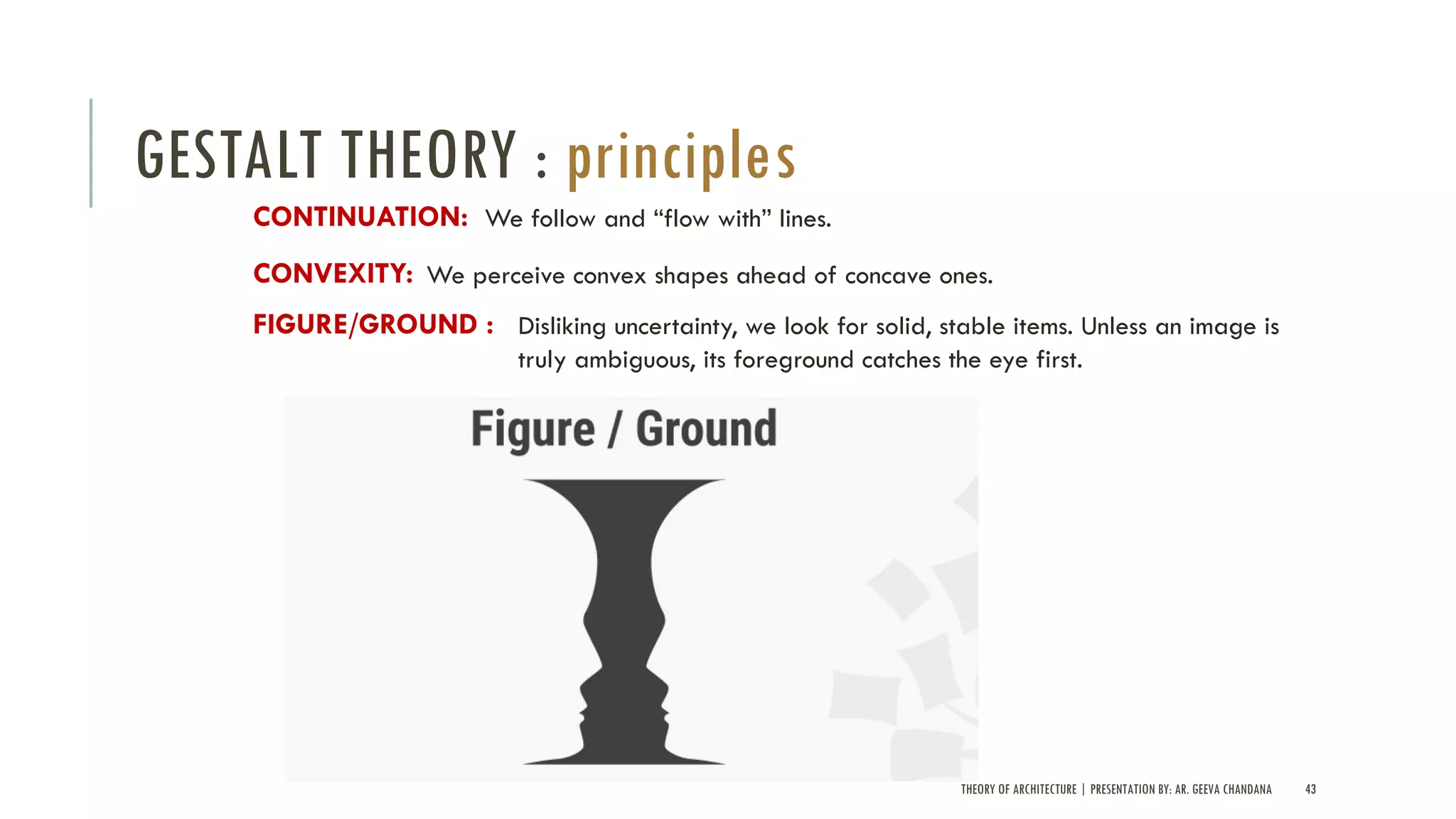
We follow and “flow with” lines.CONTINUATION:
We perceive convex shapes ahead of concave ones.CONVEXITY:
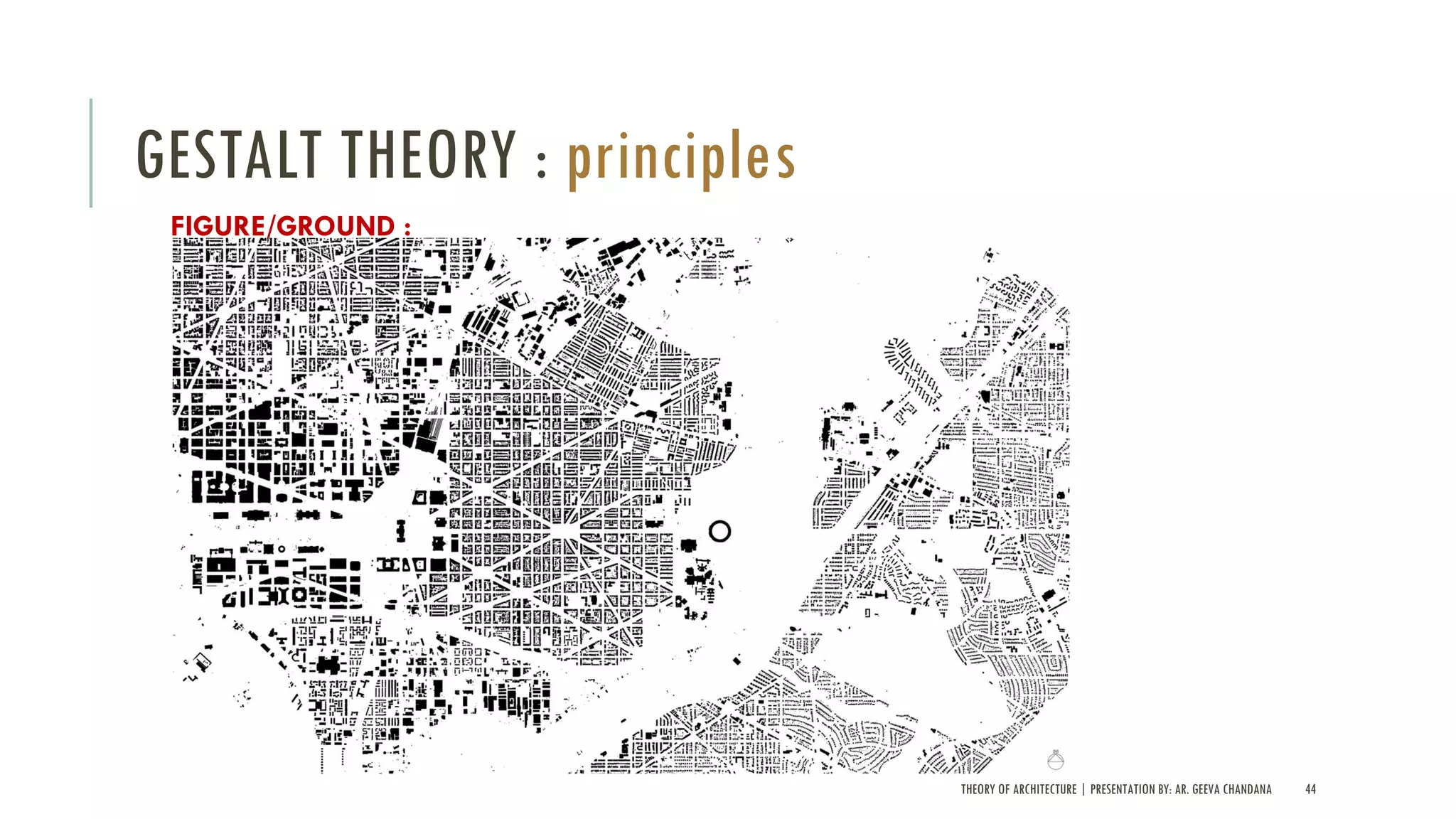
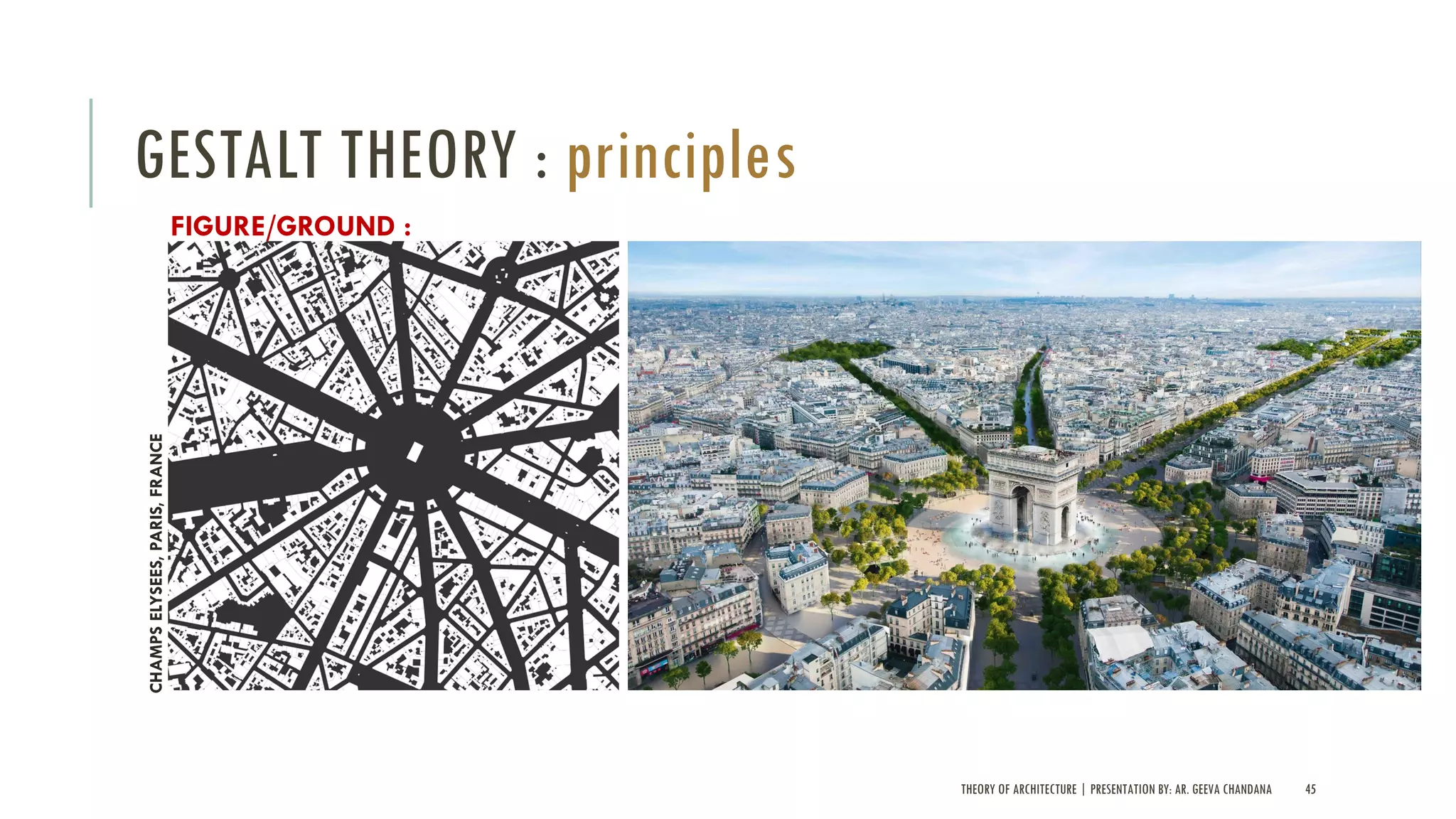
Disliking uncertainty, we look for solid, stable items. Unless an image is
truly ambiguous, its foreground catches the eye first.
FIGURE/GROUND :
THEORY OF ARCHITECTURE | PRESENTATION BY: AR. GEEVA CHANDANA 44
GESTALT THEORY : principles
FIGURE/GROUND :
THEORY OF ARCHITECTURE | PRESENTATION BY: AR. GEEVA CHANDANA 45
GESTALT THEORY : principles
FIGURE/GROUND :
CHAMPSELYSEES,PARIS,FRANCE
THEORY OF ARCHITECTURE | PRESENTATION BY: AR. GEEVA CHANDANA 46
GESTALT THEORY : architecture
SYMMETRY
We	seek	balance	and	order	in	designs,	struggling	
to	do	so	if	they	aren’t	readily	apparent.
THEORY OF ARCHITECTURE | PRESENTATION BY: AR. GEEVA CHANDANA 47
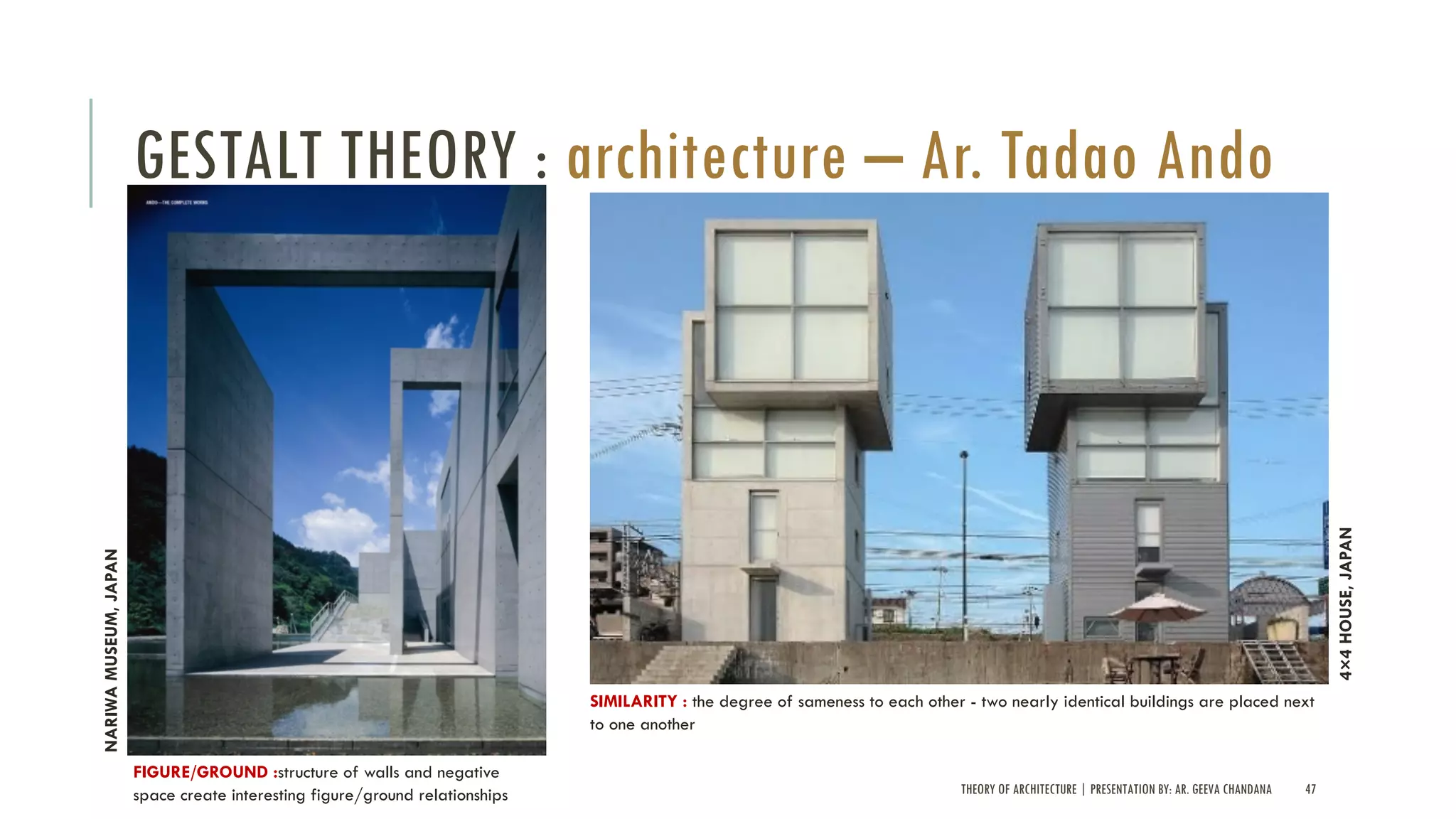
GESTALT THEORY : architecture – Ar. Tadao Ando
FIGURE/GROUND :structure of walls and negative
space create interesting figure/ground relationships
NARIWAMUSEUM,JAPAN
SIMILARITY : the degree of sameness to each other - two nearly identical buildings are placed next
to one another
4×4HOUSE,JAPAN
THEORY OF ARCHITECTURE | PRESENTATION BY: AR. GEEVA CHANDANA 48
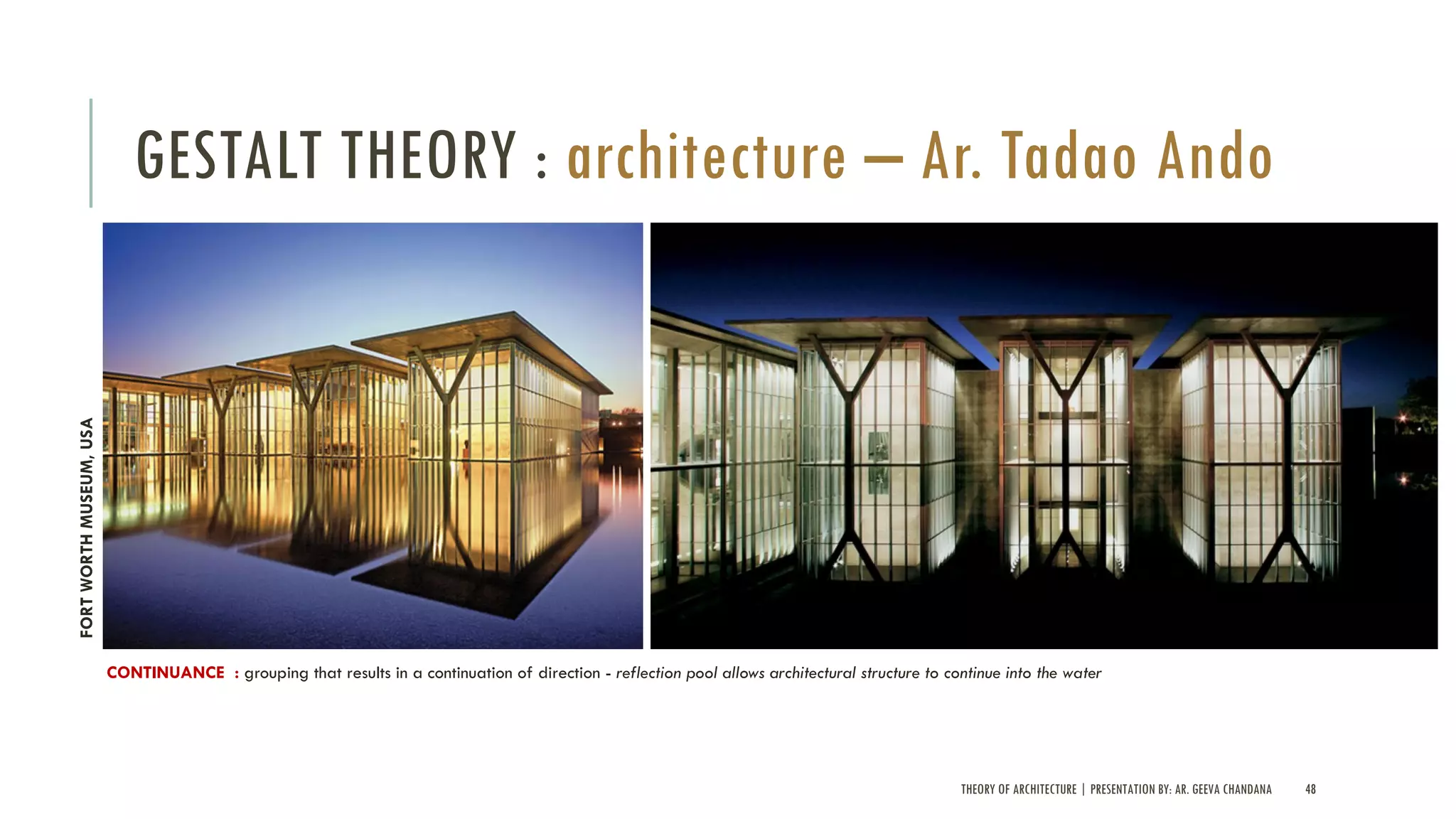
GESTALT THEORY : architecture – Ar. Tadao Ando
CONTINUANCE : grouping that results in a continuation of direction - reflection pool allows architectural structure to continue into the water
FORTWORTHMUSEUM,USA
THEORY OF ARCHITECTURE | PRESENTATION BY: AR. GEEVA CHANDANA 49
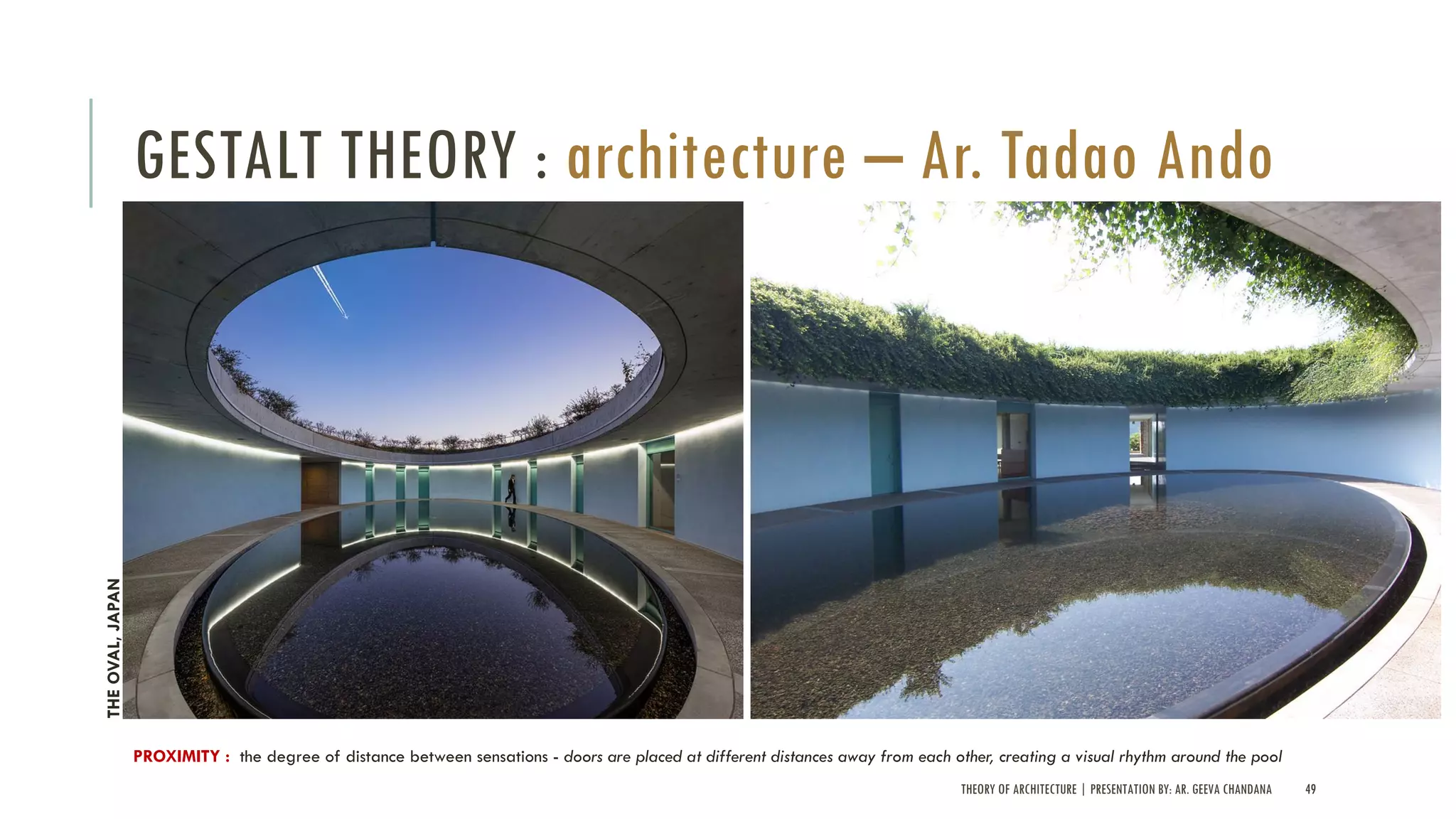
GESTALT THEORY : architecture – Ar. Tadao Ando
PROXIMITY : the degree of distance between sensations - doors are placed at different distances away from each other, creating a visual rhythm around the pool
THEOVAL,JAPAN
THEORY OF ARCHITECTURE | PRESENTATION BY: AR. GEEVA CHANDANA 50
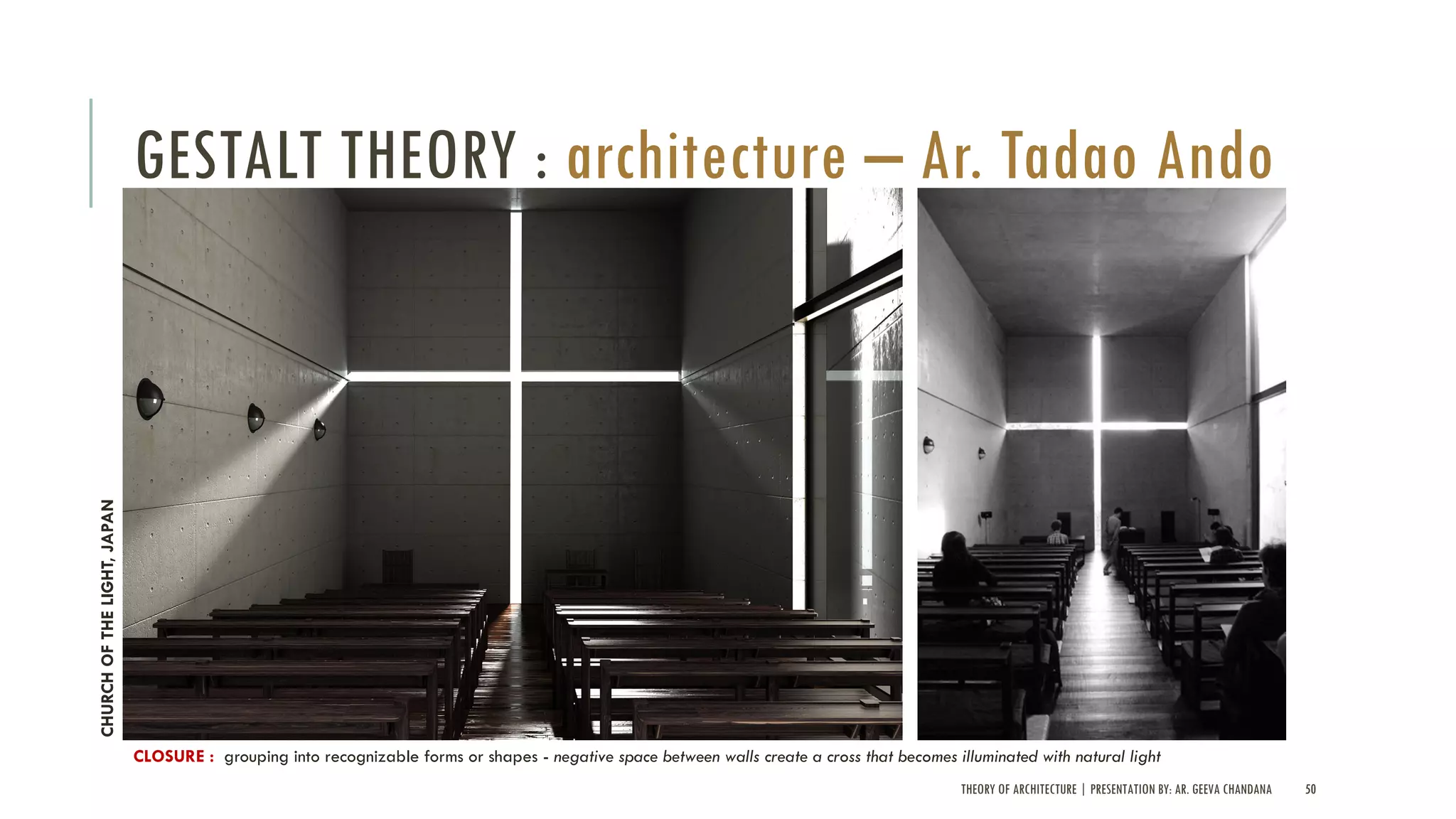
GESTALT THEORY : architecture – Ar. Tadao Ando
CLOSURE : grouping into recognizable forms or shapes - negative space between walls create a cross that becomes illuminated with natural light
CHURCHOFTHELIGHT,JAPAN
THEORY OF ARCHITECTURE | PRESENTATION BY: AR. GEEVA CHANDANA 51

Theory of architecture

  • 1.
    THEORY OF ARCHITECTUREB.Arch, First Year THEORY OF ARCHITECTURE | PRESENTATION BY: AR. GEEVA CHANDANA 1
  • 2.
    THEORY OF ARCHITECTURE| PRESENTATION BY: AR. GEEVA CHANDANA 2
  • 3.
    OVERVIEW OF THECOURSE Unit01:INTRODUCTION DEFINITION ORIGIN ARCHITECTURE SATISFYING HUMAN NEEDS FUNCTIONAL, AESTHETIC AND PSYCHOLOGICAL ASPECTS OF ARCHITECTURAL FORM-SITE, STRUCTURE, MATERIALS, SERVICES, USE, CIRCULATION, EXPRESSION, CHARACTER, EXPERIENCE FORMAL VOCABULARY OF ARCHITECTURE GESTALT IDEAS OF VISUAL PERCEPTION Unit02:ELEMENTSOFARCHITECTURE POINT LINE PLANE FORM SPACE SHAPE PATTERN LIGHT COLOR SURFACE TEXTURE Unit03:ELEMENTSOFARCHITECTURE– FORM SPHERE CUBE PYRAMID CYLINDER CONE AND ITS SECTIONS Unit04:ELEMENTSOFARCHITECTURE– SPACE ENCLOSURE – INTERNAL AND EXTERNAL CONTINUOUS SPACES – SPATIAL RELATIONSHIP AND ITS TYPES SPATIAL ORGANIZATION: CENTRALIZED, LINEAR, RADIAL CLUSTERED, GRID – BUILT FORM AND OPEN SPACE RELATIONSHIPS Unit05:PRINCIPLESOFARCHITECTURE PROPORTION SCALE BALANCE SYMMETRY/ASYMMETRY RHYTHM AXIS HIERARCHY DATUM UNITY HARMONY DOMINANCE CLIMAX MOVEMENT CIRCULATION BUILDING APPROACH ENTRANCE – PATH CONFIGURATION FORM ORIENTATION THEORY OF ARCHITECTURE | PRESENTATION BY: AR. GEEVA CHANDANA 3
  • 4.
    THE TERM :ARCHITECTURE §Originated from the Greek word “Architekton” §[ Archi – great / chief, Tekton – builder / creator ] §Architecture is the art and science of building §It is the conscious creation of utilitarian spaces with the deliberate use of material §Architecture should be technically efficient and aesthetically pleasing. THEORY OF ARCHITECTURE | PRESENTATION BY: AR. GEEVA CHANDANA 4
  • 5.
    ARCHITECTURE : asa discipline ARCHITECTURE – an ability to organize, manipulate and articulate the constant and variable component parts of size, shape, and treatment. ARCHITECTURE - a language of sequential path, place, and transition spaces in relationship to site, location, and orientation. THEORY OF ARCHITECTURE | PRESENTATION BY: AR. GEEVA CHANDANA 5 ARCHITECTURE
  • 6.
    ARCHITECTURE : satisfyinghuman needs THEORY OF ARCHITECTURE | PRESENTATION BY: AR. GEEVA CHANDANA 6 Food, Shelter, Clothing Education, Science, Government Religion, Art Recreation
  • 7.
    THEORY OF ARCHITECTURE| PRESENTATION BY: AR. GEEVA CHANDANA 7 ARCHITECTURE : functional The architect should have a comprehensive understanding of the client activities before beginning to design. [ [ FUNCTIONALAESTHETICSPSYCHOLOGICAL
  • 8.
    THEORY OF ARCHITECTURE| PRESENTATION BY: AR. GEEVA CHANDANA 8 ARCHITECTURE : functional POMPIDOU CENTRE, RICHARD ROGERS AND RENZO PIANO FUNCTIONALAESTHETICSPSYCHOLOGICAL
  • 9.
    THEORY OF ARCHITECTURE| PRESENTATION BY: AR. GEEVA CHANDANA 9 ARCHITECTURE : functional THE INTERLACE, OMA, OLE SCHEEREN FUNCTIONALAESTHETICSPSYCHOLOGICAL
  • 10.
    THEORY OF ARCHITECTURE| PRESENTATION BY: AR. GEEVA CHANDANA 10 ARCHITECTURE : functional FUNCTIONALAESTHETICSPSYCHOLOGICAL THE INTERLACE, OMA, OLE SCHEEREN
  • 11.
    THEORY OF ARCHITECTURE| PRESENTATION BY: AR. GEEVA CHANDANA 11 ARCHITECTURE : functional FUNCTIONALAESTHETICSPSYCHOLOGICAL SCHOOL OF ART, DESIGN AND MEDIA AT NANYANG TECHNOLOGICAL UNIVERSITY, CPG CONSULTANTS
  • 12.
    THEORY OF ARCHITECTURE| PRESENTATION BY: AR. GEEVA CHANDANA 12 ARCHITECTURE : functional FUNCTIONALAESTHETICSPSYCHOLOGICAL BOSCO VERTICALE, STEFANO BOERI, GIOVANNI LA VARRA & GIANANDREA BARRECA
  • 13.
    THEORY OF ARCHITECTURE| PRESENTATION BY: AR. GEEVA CHANDANA 13 ARCHITECTURE : aesthetics FUNCTIONALAESTHETICSPSYCHOLOGICAL Elements of aesthetics: Mass & space proportion symmetry balance contrast decoration massing [ [
  • 14.
    THEORY OF ARCHITECTURE| PRESENTATION BY: AR. GEEVA CHANDANA 14 ARCHITECTURE : aesthetics HEYDAR ALIYEV CENTER, ZAHA HADID FUNCTIONALAESTHETICSPSYCHOLOGICAL
  • 15.
    THEORY OF ARCHITECTURE| PRESENTATION BY: AR. GEEVA CHANDANA 15 ARCHITECTURE : aesthetics GUGGENHEIM MUSEUM BILBAO, FRANK GEHRY FUNCTIONALAESTHETICSPSYCHOLOGICAL
  • 16.
    THEORY OF ARCHITECTURE| PRESENTATION BY: AR. GEEVA CHANDANA 16 ARCHITECTURE : aesthetics THE BUND FINANCE CENTER, NORMAN FOSTER & HEATHERWICK FUNCTIONALAESTHETICSPSYCHOLOGICAL
  • 17.
    THEORY OF ARCHITECTURE| PRESENTATION BY: AR. GEEVA CHANDANA 17 ARCHITECTURE : aesthetics GARDENS BY THE BAY, GRANT ASSOCIATES AND ARCHITECTS, WILKINSON EYRE ARCHITECTS FUNCTIONALAESTHETICSPSYCHOLOGICAL
  • 18.
    THEORY OF ARCHITECTURE| PRESENTATION BY: AR. GEEVA CHANDANA 18 ARCHITECTURE : psychological FUNCTIONALAESTHETICSPSYCHOLOGICAL • Play with human mind • mood and productivity • affect health and wellbeing • expression of cultural pride, • societal passion, or national esteem • Space, form, and light [ [
  • 19.
    THEORY OF ARCHITECTURE| PRESENTATION BY: AR. GEEVA CHANDANA 19 ARCHITECTURE : psychological FUNCTIONALAESTHETICSPSYCHOLOGICAL • Physical structure has a significant effect on human behavior. As humans find themselves spending more time enclosed within the walls of structure, it becomes valuable to design structures integrating features of the natural environment and structural landscape features into the human-made environment (Joye, 2007). • Research suggests the design of residential and commercial space has pervasive effects on its inhabitants and is an important consideration in architectural design. • Space, form, and light are elements that are often incorporated either purposefully or unconsciously for aesthetic or practical reasons but more pointedly give people meaning, purpose and stability amidst an ever changing physical universe of seeming chaos. [ [
  • 20.
    THEORY OF ARCHITECTURE| PRESENTATION BY: AR. GEEVA CHANDANA 20 ARCHITECTURE : psychological THE JEWEL, CHANGI AIRPORT, MOSHE SAFDIE FUNCTIONALAESTHETICSPSYCHOLOGICAL
  • 21.
    THEORY OF ARCHITECTURE| PRESENTATION BY: AR. GEEVA CHANDANA 21 ARCHITECTURE : psychological THE JEWEL, CHANGI AIRPORT, MOSHE SAFDIE FUNCTIONALAESTHETICSPSYCHOLOGICAL
  • 22.
    THEORY OF ARCHITECTURE| PRESENTATION BY: AR. GEEVA CHANDANA 22 ARCHITECTURE : psychological GOOGLE HEADQUARTERS FUNCTIONALAESTHETICSPSYCHOLOGICAL
  • 23.
    THEORY OF ARCHITECTURE| PRESENTATION BY: AR. GEEVA CHANDANA 23 ARCHITECTURE : psychological GOOGLE HEADQUARTERS FUNCTIONALAESTHETICSPSYCHOLOGICAL
  • 24.
    THEORY OF ARCHITECTURE| PRESENTATION BY: AR. GEEVA CHANDANA 24 ARCHITECTURE : components & aspects of form SITESTRUCTURE Site Structure Materials Services Use Circulation Expression Character Experience [ [ MATERIALSSERVICESUSECIRCULATIONEXPRESSIONCHARACTER
  • 25.
    THEORY OF ARCHITECTURE| PRESENTATION BY: AR. GEEVA CHANDANA 25 ARCHITECTURE : components & aspects of form SITESTRUCTUREMATERIALSSERVICESUSECIRCULATIONEXPRESSIONCHARACTER SITE Location (geography)a point or an area on the Earth's surface or elsewhere. Building site, a place where construction takes place.
  • 26.
    THEORY OF ARCHITECTURE| PRESENTATION BY: AR. GEEVA CHANDANA 26 ARCHITECTURE : components & aspects of form SITESTRUCTUREMATERIALSSERVICESUSECIRCULATIONEXPRESSIONCHARACTER STRUCTURE It is an arrangement and organization of interrelated elements in a material object or system, or the object or system so organized. STMARYSAXE,NORMANFOSTER
  • 27.
    THEORY OF ARCHITECTURE| PRESENTATION BY: AR. GEEVA CHANDANA 27 ARCHITECTURE : components & aspects of form SITESTRUCTUREMATERIALSSERVICESUSECIRCULATIONEXPRESSIONCHARACTER THE OCULUS, SANTIAGO CALATRAVA OGDEN CENTER FOR FUNDAMENTAL PHYSICS AT DURHAM UNIVERSITY, DANIEL LIBESKIND
  • 28.
    THEORY OF ARCHITECTURE| PRESENTATION BY: AR. GEEVA CHANDANA 28 ARCHITECTURE : components & aspects of form SITESTRUCTUREMATERIALSSERVICESUSECIRCULATIONEXPRESSIONCHARACTER MATERIALS It is used for construction process. Many naturally occurring substances, such as clay, rocks, sand, and wood, even twigs and leaves, have been used to construct buildings. Apart from naturally occurring materials, many man- made products are in use, some more and some less synthetic. JEAN-MARIETJIBAOU,RENZOPIANO
  • 29.
    THEORY OF ARCHITECTURE| PRESENTATION BY: AR. GEEVA CHANDANA 29 ARCHITECTURE : components & aspects of form SITESTRUCTUREMATERIALSSERVICESUSECIRCULATIONEXPRESSIONCHARACTER CHURCH OF LIGHT, TADAO ANDO GLASS HOUSE, PHILIP JOHNSON
  • 30.
    THEORY OF ARCHITECTURE| PRESENTATION BY: AR. GEEVA CHANDANA 30 ARCHITECTURE : components & aspects of form SITESTRUCTUREMATERIALSSERVICESUSECIRCULATIONEXPRESSIONCHARACTER SERVICES Building services are the systems installed in buildings to make them comfortable, functional, efficient and safe. Structural Plumbing Electrical Fire safety Maintenance POMPIDOUCENTRE,RICHARDROGERSANDRENZOPIANO [ [
  • 31.
    THEORY OF ARCHITECTURE| PRESENTATION BY: AR. GEEVA CHANDANA 31 ARCHITECTURE : components & aspects of form SITESTRUCTUREMATERIALSSERVICESUSECIRCULATIONEXPRESSIONCHARACTER LLOYDS BUILDING, RICHARD ROGERS MILLENNIUM DOME, RICHARD ROGERS
  • 32.
    THEORY OF ARCHITECTURE| PRESENTATION BY: AR. GEEVA CHANDANA 32 ARCHITECTURE : components & aspects of form SITESTRUCTUREMATERIALSSERVICESUSECIRCULATIONEXPRESSIONCHARACTER CIRCULATION It refers to the way people move through and interact with a building. • APPROACH: The Distant View • ENTRANCE: From Outside to inside • CONFIGURATION OF THE PATH: The Sequences of Spaces • PATH-SPACE RELATIONSHIPS: Edges, Nodes, and Terminations of the Path • FORM OF THE CIRCULATION SPACE: Corridors, Halls, Galleries, Stairways and Rooms GUGGENHEIMMUSEUMINTERIOR,FRANKLLOYDWRIGHT
  • 33.
    THEORY OF ARCHITECTURE| PRESENTATION BY: AR. GEEVA CHANDANA 33 ARCHITECTURE : components & aspects of form SITESTRUCTUREMATERIALSSERVICESUSECIRCULATIONEXPRESSIONCHARACTER EXPRESSION Expression in architecture implies a clear and authentic displaying of the character or personality of an individual (architect). DANCINGHOUSE,FRANKGEHRY
  • 34.
    THEORY OF ARCHITECTURE| PRESENTATION BY: AR. GEEVA CHANDANA 34 ARCHITECTURE : components & aspects of form SITESTRUCTUREMATERIALSSERVICESUSECIRCULATIONEXPRESSIONCHARACTER CHARACTER The Character and Style of a building is based on its functional aspects, associated aspects and personal aspect. The character of some buildings is expressed through elements associated with certain influences. TAJMAHAL
  • 35.
    THEORY OF ARCHITECTURE| PRESENTATION BY: AR. GEEVA CHANDANA 35 ARCHITECTURE : components & aspects of form SITESTRUCTUREMATERIALSSERVICESUSECIRCULATIONCHARACTEREXPERIENCE EXPERIENCE Experience in architecture is the art of articulating a clear user story/journey through a design as intended by the architect. SAGRADAFAMILIA,ANTONIOGAUDI
  • 36.
    GESTALT IDEAS OFVISUAL PERCEPTION §The Gestalt Principles are a set of laws arising from 1920s’ psychology, describing how humans typically see objects by grouping similar elements, recognizing patterns and simplifying complex images. §Designers use these to engage users via powerful -yet natural- “tricks” of perspective and best practice design standards. §Gestalt theory focuses on the mind’s perceptive processes THEORY OF ARCHITECTURE | PRESENTATION BY: AR. GEEVA CHANDANA 36
  • 37.
    THEORY OF ARCHITECTURE| PRESENTATION BY: AR. GEEVA CHANDANA 37 GESTALT IDEAS OF VISUAL PERCEPTION WHATDOYOUSEE
  • 38.
    THEORY OF ARCHITECTURE| PRESENTATION BY: AR. GEEVA CHANDANA 38 GESTALT IDEAS OF VISUAL PERCEPTION WHATDOYOUSEE
  • 39.
    THEORY OF ARCHITECTURE| PRESENTATION BY: AR. GEEVA CHANDANA 39 GESTALT THEORY : principles Closure Common Fate Common Region Continuation Convexity Figure-Ground Proximity Regularity Similarity Symmetry Synchrony [ [
  • 40.
    THEORY OF ARCHITECTURE| PRESENTATION BY: AR. GEEVA CHANDANA 40 GESTALT THEORY : principles Preferring complete shapes, we automatically fill in gaps between elements to perceive a complete image; so, we see the whole first. CLOSURE:
  • 41.
    THEORY OF ARCHITECTURE| PRESENTATION BY: AR. GEEVA CHANDANA 41 GESTALT THEORY : principles We group elements that move in the same direction.COMMON FATE: We group elements that are in the same closed region.COMMON REGION:
  • 42.
    THEORY OF ARCHITECTURE| PRESENTATION BY: AR. GEEVA CHANDANA 42 GESTALT THEORY : principles We group closer-together elements, separating them from those farther apart.PROXIMITY : We group elements that are in the same closed region.SYMMETRY : We seek differences and similarities in an image and link similar elements.SIMILARITY :
  • 43.
    THEORY OF ARCHITECTURE| PRESENTATION BY: AR. GEEVA CHANDANA 43 GESTALT THEORY : principles We follow and “flow with” lines.CONTINUATION: We perceive convex shapes ahead of concave ones.CONVEXITY: Disliking uncertainty, we look for solid, stable items. Unless an image is truly ambiguous, its foreground catches the eye first. FIGURE/GROUND :
  • 44.
    THEORY OF ARCHITECTURE| PRESENTATION BY: AR. GEEVA CHANDANA 44 GESTALT THEORY : principles FIGURE/GROUND :
  • 45.
    THEORY OF ARCHITECTURE| PRESENTATION BY: AR. GEEVA CHANDANA 45 GESTALT THEORY : principles FIGURE/GROUND : CHAMPSELYSEES,PARIS,FRANCE
  • 46.
    THEORY OF ARCHITECTURE| PRESENTATION BY: AR. GEEVA CHANDANA 46 GESTALT THEORY : architecture SYMMETRY We seek balance and order in designs, struggling to do so if they aren’t readily apparent.
  • 47.
    THEORY OF ARCHITECTURE| PRESENTATION BY: AR. GEEVA CHANDANA 47 GESTALT THEORY : architecture – Ar. Tadao Ando FIGURE/GROUND :structure of walls and negative space create interesting figure/ground relationships NARIWAMUSEUM,JAPAN SIMILARITY : the degree of sameness to each other - two nearly identical buildings are placed next to one another 4×4HOUSE,JAPAN
  • 48.
    THEORY OF ARCHITECTURE| PRESENTATION BY: AR. GEEVA CHANDANA 48 GESTALT THEORY : architecture – Ar. Tadao Ando CONTINUANCE : grouping that results in a continuation of direction - reflection pool allows architectural structure to continue into the water FORTWORTHMUSEUM,USA
  • 49.
    THEORY OF ARCHITECTURE| PRESENTATION BY: AR. GEEVA CHANDANA 49 GESTALT THEORY : architecture – Ar. Tadao Ando PROXIMITY : the degree of distance between sensations - doors are placed at different distances away from each other, creating a visual rhythm around the pool THEOVAL,JAPAN
  • 50.
    THEORY OF ARCHITECTURE| PRESENTATION BY: AR. GEEVA CHANDANA 50 GESTALT THEORY : architecture – Ar. Tadao Ando CLOSURE : grouping into recognizable forms or shapes - negative space between walls create a cross that becomes illuminated with natural light CHURCHOFTHELIGHT,JAPAN
  • 51.
    THEORY OF ARCHITECTURE| PRESENTATION BY: AR. GEEVA CHANDANA 51