Prepared by: Mbarek EL-farhaoui
Supervised by: Mr. Ahmed Atlagh
‘A thousand teachers, a thousand methods’
Outline
I. Basic Concepts
II. General overview of the method
III. Advantages of the method
VI. Criteria for Effective teaching Methods
I. Basic Concepts
Approach
Provides principles to decide what kind of content and
what sort of procedures are appropriate.
Method
It is HOW the teaching is to be conducted. It is a practical
realization of an approach
Technique
Any of a wide variety of activities or devices in the
language classroom for realizing lesson objectives. It must
be consistent with ‘a method ’ and in harmony with an
‘approach’
II. General overview of the method
A main proponent of the eclectic approach is Rivers
(1981). According to him, an eclectic appraoch allows
language teachers to « absorb the best techniques of all
the well known language teaching methods into their
classroom procedures, using them for the purposes for
which they are most approproate »
Origin: late 17th century (as a term in philosophy):
from Greek eklektikos, from eklegein ‘pick out’, from
ek ‘out’ + lege in ‘choose’
Only well-trained teachers can become eclectic: teachers
with no theoretical thinking about the advantages and
drawbacks of any approach cannot use it.
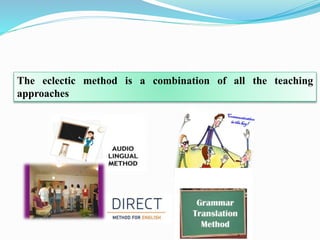
The eclectic method is a combination of all the teaching
approaches
III. Advantages
Multiple tasks, high interaction, lively learning and fast
results are the salient features of this method
A main proponent of the eclectic approach is Rivers (1981).
According to him, an eclectic appraoch allows language
teachers to « absorb the best techniques of all the well known
language teaching methods into their classroom procedures,
using them for the purposes for which they are most
approproate » p.55
Flexibility in choosing any aspect or method that teachers
think suitable for teaching
Giving a chance to students to see different kinds of teaching
techniques that break monotony
It helps connect life experiences to the ideas presented
Teachers have the chance to choose different kinds of
teaching techniques in each class
VI. Criteria for effective teaching methods
It must be simple for both teacher and learner, and must be
within the capabilities of all teachers. Also, the teacher
must feel that pupils are progressing satisfactorily.
It must bring about a balance between the spoken and
written or printed word (and must be flexible enough for the
teacher to concentrate on the area (s)he wants).
It must overcome the conflict between fluency and
accuracy.
It must reflect the linguistic habits the child has already
acquired by learning his/her mother tongue and their ability to
assimilate a new language.
It must enable work done with modern teaching aids (e.g.
audio-visual aids, computer) to be an extension of the method
used in class.
It must be sufficiently flexible to cope with various class
conditions ( as far as pupils' specific / general interests are
concerned )
It must ensure that pupils are given the opportunity of
having the greatest number of meaningful contacts possible
both with and in the foreign language

Eclectic method

  • 1.
    Prepared by: MbarekEL-farhaoui Supervised by: Mr. Ahmed Atlagh ‘A thousand teachers, a thousand methods’
  • 2.
    Outline I. Basic Concepts II.General overview of the method III. Advantages of the method VI. Criteria for Effective teaching Methods
  • 3.
    I. Basic Concepts Approach Providesprinciples to decide what kind of content and what sort of procedures are appropriate. Method It is HOW the teaching is to be conducted. It is a practical realization of an approach
  • 4.
    Technique Any of awide variety of activities or devices in the language classroom for realizing lesson objectives. It must be consistent with ‘a method ’ and in harmony with an ‘approach’
  • 5.
    II. General overviewof the method A main proponent of the eclectic approach is Rivers (1981). According to him, an eclectic appraoch allows language teachers to « absorb the best techniques of all the well known language teaching methods into their classroom procedures, using them for the purposes for which they are most approproate » Origin: late 17th century (as a term in philosophy): from Greek eklektikos, from eklegein ‘pick out’, from ek ‘out’ + lege in ‘choose’
  • 6.
    Only well-trained teacherscan become eclectic: teachers with no theoretical thinking about the advantages and drawbacks of any approach cannot use it.
  • 7.
    The eclectic methodis a combination of all the teaching approaches
  • 8.
    III. Advantages Multiple tasks,high interaction, lively learning and fast results are the salient features of this method A main proponent of the eclectic approach is Rivers (1981). According to him, an eclectic appraoch allows language teachers to « absorb the best techniques of all the well known language teaching methods into their classroom procedures, using them for the purposes for which they are most approproate » p.55
  • 9.
    Flexibility in choosingany aspect or method that teachers think suitable for teaching Giving a chance to students to see different kinds of teaching techniques that break monotony It helps connect life experiences to the ideas presented Teachers have the chance to choose different kinds of teaching techniques in each class
  • 10.
    VI. Criteria foreffective teaching methods It must be simple for both teacher and learner, and must be within the capabilities of all teachers. Also, the teacher must feel that pupils are progressing satisfactorily. It must bring about a balance between the spoken and written or printed word (and must be flexible enough for the teacher to concentrate on the area (s)he wants). It must overcome the conflict between fluency and accuracy.
  • 11.
    It must reflectthe linguistic habits the child has already acquired by learning his/her mother tongue and their ability to assimilate a new language. It must enable work done with modern teaching aids (e.g. audio-visual aids, computer) to be an extension of the method used in class. It must be sufficiently flexible to cope with various class conditions ( as far as pupils' specific / general interests are concerned )
  • 12.
    It must ensurethat pupils are given the opportunity of having the greatest number of meaningful contacts possible both with and in the foreign language