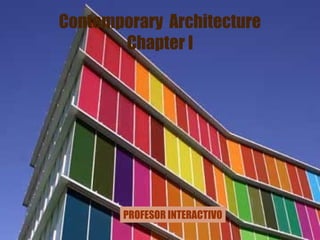
Contemporary Architecture
Chapter I

PROFESOR INTERACTIVO
Architecture
Contemporary

The main idea of contemporary architecture lies
mainly in rejecting historical styles. Facing classic
trends of the last third of the nineteenth century,
contemporary architecture comes with a totally
different proposition to what already existed.
Architecture
Contemporary
The Industrial
Revolution and the
French Revolution
brought about a radical
change in architecture
with the manufacture
of new building
materials and cheaper
mass production.

THE CRYSTAL PALACE / JOSEPH PAXTON 1851
Architecture
Contemporary
Moreover, provided a
more stark vision,
generated by the
ideological changes
that led to the
formation of
democracies in the
world and led the
architects to eliminate
the luxuries of the
buildings.

THE HOUSE OF BLACK MOTHER OF GOD/ JOSEF GOCÁR
CITY OF PRAGUE/ CZECH REPUBLIC 1911
Architecture
Contemporary
The neoclassical style was introduced in the
design of buildings seeking purity of lines, so the
discovery of the ruins of Pompeii and other
archaeological treasures Greco Romans was
adapted to the new times.

IT WAS AN ECLECTIC ARCHITECTURE IN WHICH MANY STYLES ARE MIXED
Architecture
Contemporary
The main features in
construction are:
-Cornices and friezes
with metopes and
triglyphs.
-Grecas
-Garlands vegetables:
flowers, fruits...
-Palms y laurels
Architecture
Contemporary
And constructions more
used :
-Columns
commemorative
-Temples
-Triumphal arches
-Propylaea
The Great Arc de Triumph
was the tribute of Napoleon
  Bonaparte to his invincible
army, but the Emperor was
deposed and died without
seeing the colossal
work completed.
Architecture
Contemporary
The iron,
steel, zinc and
glass were
becoming part
of a new
design
concept,
closer to
engineering
that the
architectural
design.

Since 1872 Gustave
Eiffel obtained
contracts
abroad, in 1877
is built a bridge
over the Douro
River in Portugal,
a steel single arc of
160 meters.
In 1884 its factory
was already
famous in the world.
He melted the Statue
Of Liberty in 1886,
later worked
in the Tower that
bears his name,
and that was his
biggest project.
Architecture
Contemporary
BROOKLYN BRIDGE
Architects: John Augustus
Roebling 1883
height: 83 metros
length: 1,834 metros
The engineering began to have a greater role, the economy of means, the clean lines,
the shortest time to its construction, the easy technical and the lack of ornate
ornaments that gave the new materials. The world governments preferred to invest
in engineering projects for real estate development plans and works, rather than
architectural.
Architecture
Contemporary
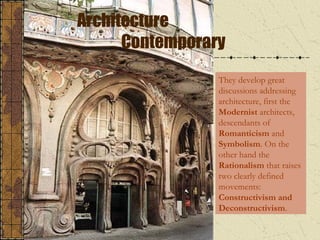
They develop great
discussions addressing
architecture, first the
Modernist architects,
descendants of
Romanticism and
Symbolism. On the
other hand the
Rationalism that raises
two clearly defined
movements:
Constructivism and
Deconstructivism.
Architecture
Contemporary

Modernism
developed in
Europe and
receives
different names.
In Spain, better
known as
Catalan
Modernism are
develops mainly
in Barcelona.
In France and
Belgium is
known as Art
Nouveau,
Modern Style
in England and
in Germany as
Jugendstil.

Modernism
1880 to 1902
Architecture
Contemporary

JOSEF MARIA OLBRICH 1898-99

The Vienna Secession in
Austria is the movement that
leads to Modernism, that although this already had been
developing for some time, is the year 1897 when a group of artists
from different disciplines and led by Gustave Klimt who pose
open criticism of industrialization and rescue craft of the
work of the craftsman.
Architecture
Contemporary
The most representative
Spanish architects are:

Víctor Beltrí y Roqueta

Lluís Domènech i
Montaner

Antoní Gaudí
Architecture
Contemporary
Víctor Beltrí y Roqueta
Born in the city of Tortosa
(Catalonia) on April 16, 1862 and
died in Cartagena on February 4,
1935.

Watch detail
Tarraga House

Aguirre Palace, 1898

Grand Hotel, 1916
Architecture
Contemporary
Holy Cross and
Saint Paul Hospital.
World Heritage.
UNESCO, 1930

Lluís
Domènech i
Montaner
(December 21, 1850 December 27, 1923)
Born in Barcelona,
he studied
architecture, was
chair professor in the
School of
Architecture of
Barcelona. From that
position influenced
the Catalan
modernist
architecture.

Facade of the Palau
of Catalan
music,1908
Architecture
Contemporary
Antoní Gaudí
Catalan artist born in Reus on June 25, 1852 and died in Barcelona
on June 10, 1926, is the greatest exponent of Catalan modernist
architecture and even the whole modernist architecture,
fundamentally so prolific in his work, absolutely inspired by nature
and rigorous application of geometry and mathematical
calculation, physical in each of its buildings.

Haga clic sobre la imagen
Architecture
Contemporary
Art Nouveau
Architectural style is developed in Belgium and France.
Architecture
Contemporary
Its main representatives were:
Victor Horta (1861 Ghent-Brussels
1947), Belgian architect, pioneer of
Modernism.
American House

Architect House
Architecture
Contemporary

Hector Guimard (París 1867 - Nueva
York 1942) is the main representative
of Art Nouveau in France.

Castel Beranger
Architecture
Contemporary

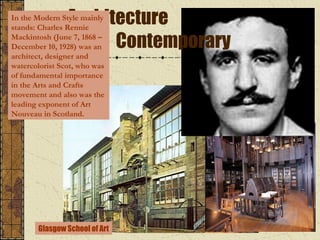
In the Modern Style mainly
stands: Charles Rennie
Mackintosh (June 7, 1868 –
December 10, 1928) was an
architect, designer and
watercolorist Scot, who was
of fundamental importance
in the Arts and Crafts
movement and also was the
leading exponent of Art
Nouveau in Scotland.

Glasgow School of Art
Architecture
Contemporary
Jugendstiles el movimiento que marca la
movement is the
Jugendstil
pacesetter in Germany, Austria and
pauta en Alemania, Austria y en los
Netherlands, highlighting
países bajos, destacándose in
particularmentework ofde Josef Maria
particular the la obra Josef María
Olbrich.
Olbrich.

Amstel House, Berlín

Wagner Apartment in Viena
Architecture
Contemporary
Joseph Maria Olbrich (1867-1908)
Architect and industrial designer born in
Opava, Czech Republic.

He was part of the rebel movement in Vienna, along with Josef Hoffmann (1870-1956).
In the beginning of this modernism appears Otto Wagner (1841-1918), father of this
movement. Wagner will also have a type of architecture that reacts against historicism,
far from the traditional guidelines. Although attempts to infuse his work of rationalism,
continue to rely on the ornamental.
Architecture
Contemporary
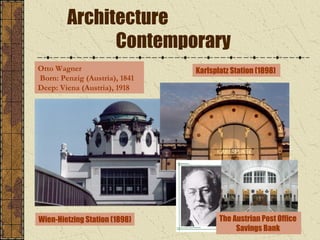
Otto Wagner
Born: Penzig (Austria), 1841
Deep: Viena (Austria), 1918

Wien-Hietzing Station (1898)

Karlsplatz Station (1898)

The Austrian Post Office
Savings Bank

Contemporary Architecture

  • 1.
  • 2.
    Architecture Contemporary The main ideaof contemporary architecture lies mainly in rejecting historical styles. Facing classic trends of the last third of the nineteenth century, contemporary architecture comes with a totally different proposition to what already existed.
  • 3.
    Architecture Contemporary The Industrial Revolution andthe French Revolution brought about a radical change in architecture with the manufacture of new building materials and cheaper mass production. THE CRYSTAL PALACE / JOSEPH PAXTON 1851
  • 4.
    Architecture Contemporary Moreover, provided a morestark vision, generated by the ideological changes that led to the formation of democracies in the world and led the architects to eliminate the luxuries of the buildings. THE HOUSE OF BLACK MOTHER OF GOD/ JOSEF GOCÁR CITY OF PRAGUE/ CZECH REPUBLIC 1911
  • 5.
    Architecture Contemporary The neoclassical stylewas introduced in the design of buildings seeking purity of lines, so the discovery of the ruins of Pompeii and other archaeological treasures Greco Romans was adapted to the new times. IT WAS AN ECLECTIC ARCHITECTURE IN WHICH MANY STYLES ARE MIXED
  • 6.
    Architecture Contemporary The main featuresin construction are: -Cornices and friezes with metopes and triglyphs. -Grecas -Garlands vegetables: flowers, fruits... -Palms y laurels
  • 7.
    Architecture Contemporary And constructions more used: -Columns commemorative -Temples -Triumphal arches -Propylaea The Great Arc de Triumph was the tribute of Napoleon   Bonaparte to his invincible army, but the Emperor was deposed and died without seeing the colossal work completed.
  • 8.
    Architecture Contemporary The iron, steel, zincand glass were becoming part of a new design concept, closer to engineering that the architectural design. Since 1872 Gustave Eiffel obtained contracts abroad, in 1877 is built a bridge over the Douro River in Portugal, a steel single arc of 160 meters. In 1884 its factory was already famous in the world. He melted the Statue Of Liberty in 1886, later worked in the Tower that bears his name, and that was his biggest project.
  • 9.
    Architecture Contemporary BROOKLYN BRIDGE Architects: JohnAugustus Roebling 1883 height: 83 metros length: 1,834 metros The engineering began to have a greater role, the economy of means, the clean lines, the shortest time to its construction, the easy technical and the lack of ornate ornaments that gave the new materials. The world governments preferred to invest in engineering projects for real estate development plans and works, rather than architectural.
  • 10.
    Architecture Contemporary They develop great discussionsaddressing architecture, first the Modernist architects, descendants of Romanticism and Symbolism. On the other hand the Rationalism that raises two clearly defined movements: Constructivism and Deconstructivism.
  • 11.
    Architecture Contemporary Modernism developed in Europe and receives differentnames. In Spain, better known as Catalan Modernism are develops mainly in Barcelona. In France and Belgium is known as Art Nouveau, Modern Style in England and in Germany as Jugendstil. Modernism 1880 to 1902
  • 12.
    Architecture Contemporary JOSEF MARIA OLBRICH1898-99 The Vienna Secession in Austria is the movement that leads to Modernism, that although this already had been developing for some time, is the year 1897 when a group of artists from different disciplines and led by Gustave Klimt who pose open criticism of industrialization and rescue craft of the work of the craftsman.
  • 13.
    Architecture Contemporary The most representative Spanisharchitects are: Víctor Beltrí y Roqueta Lluís Domènech i Montaner Antoní Gaudí
  • 14.
    Architecture Contemporary Víctor Beltrí yRoqueta Born in the city of Tortosa (Catalonia) on April 16, 1862 and died in Cartagena on February 4, 1935. Watch detail Tarraga House Aguirre Palace, 1898 Grand Hotel, 1916
  • 15.
    Architecture Contemporary Holy Cross and SaintPaul Hospital. World Heritage. UNESCO, 1930 Lluís Domènech i Montaner (December 21, 1850 December 27, 1923) Born in Barcelona, he studied architecture, was chair professor in the School of Architecture of Barcelona. From that position influenced the Catalan modernist architecture. Facade of the Palau of Catalan music,1908
  • 16.
    Architecture Contemporary Antoní Gaudí Catalan artistborn in Reus on June 25, 1852 and died in Barcelona on June 10, 1926, is the greatest exponent of Catalan modernist architecture and even the whole modernist architecture, fundamentally so prolific in his work, absolutely inspired by nature and rigorous application of geometry and mathematical calculation, physical in each of its buildings. Haga clic sobre la imagen
  • 17.
  • 18.
    Architecture Contemporary Its main representativeswere: Victor Horta (1861 Ghent-Brussels 1947), Belgian architect, pioneer of Modernism. American House Architect House
  • 19.
    Architecture Contemporary Hector Guimard (París1867 - Nueva York 1942) is the main representative of Art Nouveau in France. Castel Beranger
  • 20.
    Architecture Contemporary In the ModernStyle mainly stands: Charles Rennie Mackintosh (June 7, 1868 – December 10, 1928) was an architect, designer and watercolorist Scot, who was of fundamental importance in the Arts and Crafts movement and also was the leading exponent of Art Nouveau in Scotland. Glasgow School of Art
  • 21.
    Architecture Contemporary Jugendstiles el movimientoque marca la movement is the Jugendstil pacesetter in Germany, Austria and pauta en Alemania, Austria y en los Netherlands, highlighting países bajos, destacándose in particularmentework ofde Josef Maria particular the la obra Josef María Olbrich. Olbrich. Amstel House, Berlín Wagner Apartment in Viena
  • 22.
    Architecture Contemporary Joseph Maria Olbrich(1867-1908) Architect and industrial designer born in Opava, Czech Republic. He was part of the rebel movement in Vienna, along with Josef Hoffmann (1870-1956). In the beginning of this modernism appears Otto Wagner (1841-1918), father of this movement. Wagner will also have a type of architecture that reacts against historicism, far from the traditional guidelines. Although attempts to infuse his work of rationalism, continue to rely on the ornamental.
  • 23.
    Architecture Contemporary Otto Wagner Born: Penzig(Austria), 1841 Deep: Viena (Austria), 1918 Wien-Hietzing Station (1898) Karlsplatz Station (1898) The Austrian Post Office Savings Bank