Document
on
MEDITERRAREAN STYLE
Made by:
Pridhi Ahuja
PGIDS–A
Cohort 2015-17
Sem-3
CONTENTS
1. Meaning of the word Page No. 3
3. Application in Interiors Page No. 5,6
2. History Page No. 4
4. Characteristics Page No. 7,8
5. Exemplars Page No. 9,10
7. Accessories Page No. 13
6. Furniture Page No. 11,12
9. Fabric Page No. 14
8. Textures Page No. 14
CONTENTS
11. Flooring Page No. 16
13. Ceiling and Lighting Page No. 18
12. Exterior Page No. 17
14. Landscape Page No. 19
15. Staircase Page No. 20
17. Architects Page No. 22
16. Motifs Page No. 21
18. References Page No. 23,24
10. Color Palette Page No. 15
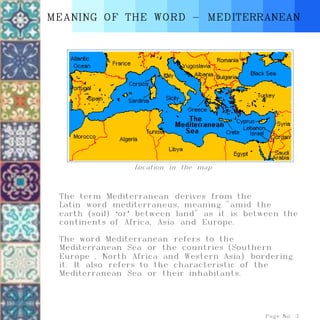
The term Mediterranean derives from the
Latin word mediterraneus, meaning "amid the
earth (soil) ‘or’ between land" as it is between the
continents of Africa, Asia and Europe.
The word Mediterranean refers to the
Mediterranean Sea or the countries (Southern
Europe , North Africa and Western Asia) bordering
it. It also refers to the characteristic of the
Mediterranean Sea or their inhabitants.
MEANING OF THE WORD - MEDITERRANEAN
Page No. 3
Location in the map
HISTORY
Page No. 4
Mediterranean Revival is a design style introduced
in the United States in the waning nineteenth
century variously incorporating references from
Spanish Renaissance, Spanish Colonial, Beaux-Arts,
Italian Renaissance, and Venetian Gothic
architecture. The Mediterranean Revival style in
architecture is based on capturing the feeling of a
Mediterranean villa. The style was an eclectic design
and it became popular during the 1920s and 1930s.
To attract more tourists, they sought to embrace a
unique aesthetic - something that felt exotic and
relaxing. Florida and California had something else
in common as well: a Spanish colonial history. The
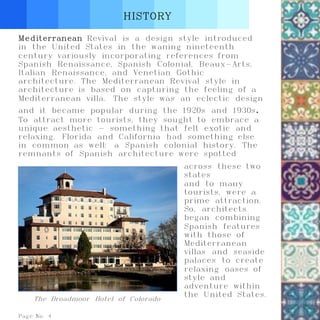
remnants of Spanish architecture were spotted
The Broadmoor Hotel of Colorado
across these two
states
and to many
tourists, were a
prime attraction.
So, architects
began combining
Spanish features
with those of
Mediterranean
villas and seaside
palaces to create
relaxing oases of
style and
adventure within
the United States.
MEDITERRANEAN STYLE
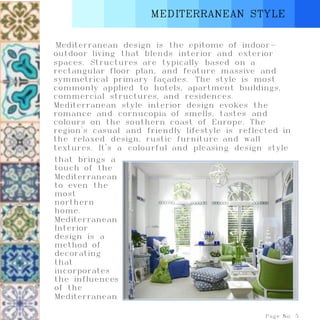
Mediterranean design is the epitome of indoor-
outdoor living that blends interior and exterior
spaces. Structures are typically based on a
rectangular floor plan, and feature massive and
symmetrical primary façades. The style is most
commonly applied to hotels, apartment buildings,
commercial structures, and residences.
Mediterranean style interior design evokes the
romance and cornucopia of smells, tastes and
colours on the southern coast of Europe. The
region's casual and friendly lifestyle is reflected in
the relaxed design, rustic furniture and wall
textures. It's a colourful and pleasing design style
Page No. 5
that brings a
touch of the
Mediterranean
to even the
most
northern
home.
Mediterranean
Interior
design is a
method of
decorating
that
incorporates
the influences
of the
Mediterranean
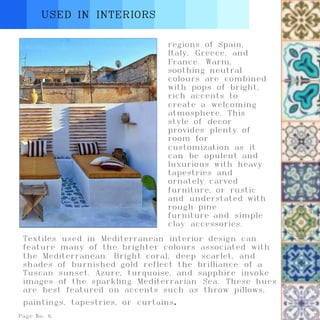
regions of Spain,
Italy, Greece, and
France. Warm,
soothing neutral
colours are combined
with pops of bright,
rich accents to
create a welcoming
atmosphere. This
style of decor
provides plenty of
room for
customization as it
can be opulent and
luxurious with heavy
tapestries and
ornately carved
furniture, or rustic
and understated with
rough pine
furniture and simple
clay accessories.
Page No. 6
Textiles used in Mediterranean interior design can
feature many of the brighter colours associated with
the Mediterranean. Bright coral, deep scarlet, and
shades of burnished gold reflect the brilliance of a
Tuscan sunset. Azure, turquoise, and sapphire invoke
images of the sparkling Mediterrarian Sea. These hues
are best featured on accents such as throw pillows,
paintings, tapestries, or curtains.
USED IN INTERIORS
CHARACTERSTICS
Page No.7
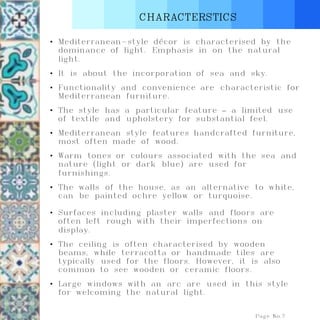
• Mediterranean-style décor is characterised by the
dominance of light. Emphasis in on the natural
light.
• It is about the incorporation of sea and sky.
• Functionality and convenience are characteristic for
Mediterranean furniture.
• The style has a particular feature – a limited use
of textile and upholstery for substantial feel.
• Mediterranean style features handcrafted furniture,
most often made of wood.
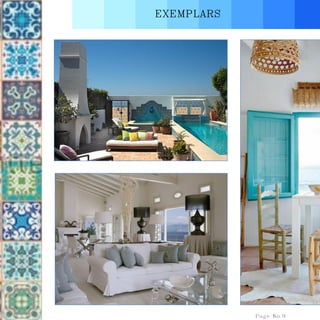
• Warm tones or colours associated with the sea and
nature (light or dark blue) are used for
furnishings.
• The walls of the house, as an alternative to white,
can be painted ochre yellow or turquoise.
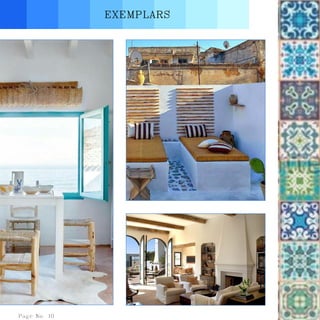
• Surfaces including plaster walls and floors are
often left rough with their imperfections on
display.
• The ceiling is often characterised by wooden
beams, while terracotta or handmade tiles are
typically used for the floors. However, it is also
common to see wooden or ceramic floors.
• Large windows with an arc are used in this style
for welcoming the natural light.
Page No. 8
CHARACTERSTICS
• The living room is the gathering point for families
and friends and usually such meetings include a
meal. As a result living room and dining room areas
are often combined.
• The furniture is usually made of wood / olive is
traditional for the region. The furniture is light and
natural. It is rustic, typically heavy medium-dark
wood with ornate hand-carving.
• The linen and the white colour of the upholstery
sofas are more than usual.
• High ceilings and wooden beams, stone walls and
large fireplaces are the key elements indoors.
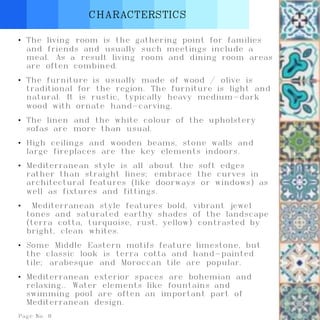
• Mediterranean style is all about the soft edges
rather than straight lines; embrace the curves in
architectural features (like doorways or windows) as
well as fixtures and fittings.
• Mediterranean style features bold, vibrant jewel
tones and saturated earthy shades of the landscape
(terra cotta, turquoise, rust, yellow) contrasted by
bright, clean whites.
• Some Middle Eastern motifs feature limestone, but
the classic look is terra cotta and hand-painted
tile; arabesque and Moroccan tile are popular.
• Mediterranean exterior spaces are bohemian and
relaxing.. Water elements like fountains and
swimming pool are often an important part of
Mediterranean design.
EXEMPLARS
Page No.9
Page No. 10
EXEMPLARS
FURNITURE
Page No. 11
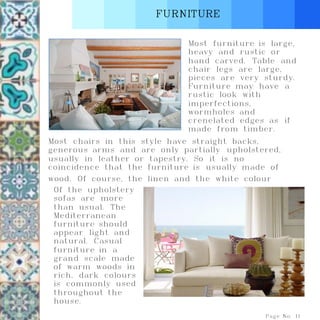
Most furniture is large,
heavy and rustic or
hand carved. Table and
chair legs are large,
pieces are very sturdy.
Furniture may have a
rustic look with
imperfections,
wormholes and
crenelated edges as if
made from timber.
Most chairs in this style have straight backs,
generous arms and are only partially upholstered,
usually in leather or tapestry. So it is no
coincidence that the furniture is usually made of
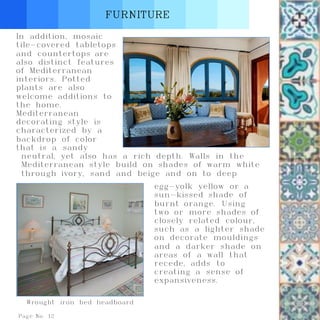
wood. Of course, the linen and the white colour
Of the upholstery
sofas are more
than usual. The
Mediterranean
furniture should
appear light and
natural. Casual
furniture in a
grand scale made
of warm woods in
rich, dark colours
is commonly used
throughout the
house.
Page No. 12
FURNITURE
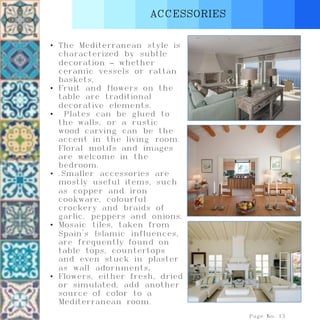
Wrought iron bed headboard
In addition, mosaic
tile-covered tabletops
and countertops are
also distinct features
of Mediterranean
interiors. Potted
plants are also
welcome additions to
the home.
Mediterranean
decorating style is
characterized by a
backdrop of color
that is a sandy
neutral, yet also has a rich depth. Walls in the
Mediterranean style build on shades of warm white
through ivory, sand and beige and on to deep
egg-yolk yellow or a
sun-kissed shade of
burnt orange. Using
two or more shades of
closely related colour,
such as a lighter shade
on decorate mouldings
and a darker shade on
areas of a wall that
recede, adds to
creating a sense of
expansiveness.
ACCESSORIES
Page No. 13
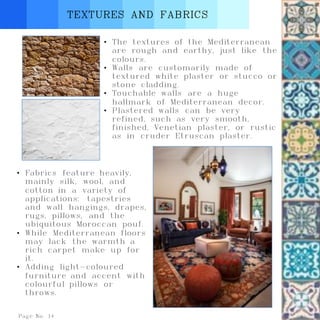
• The Mediterranean style is
characterized by subtle
decoration – whether
ceramic vessels or rattan
baskets,
• Fruit and flowers on the
table are traditional
decorative elements.
• Plates can be glued to
the walls, or a rustic
wood carving can be the
accent in the living room.
Floral motifs and images
are welcome in the
bedroom.
• .Smaller accessories are
mostly useful items, such
as copper and iron
cookware, colourful
crockery and braids of
garlic, peppers and onions.
• Mosaic tiles, taken from
Spain's Islamic influences,
are frequently found on
table tops, countertops
and even stuck in plaster
as wall adornments.
• Flowers, either fresh, dried
or simulated, add another
source of color to a
Mediterranean room.
Page No. 14
TEXTURES AND FABRICS
• The textures of the Mediterranean
are rough and earthy, just like the
colours.
• Walls are customarily made of
textured white plaster or stucco or
stone cladding.
• Touchable walls are a huge
hallmark of Mediterranean decor.
• Plastered walls can be very
refined, such as very smooth,
finished, Venetian plaster, or rustic
as in cruder Etruscan plaster.
• Fabrics feature heavily,
mainly silk, wool, and
cotton in a variety of
applications: tapestries
and wall hangings, drapes,
rugs, pillows, and the
ubiquitous Moroccan pouf.
• While Mediterranean floors
may lack the warmth a
rich carpet make up for
it.
• Adding light-coloured
furniture and accent with
colourful pillows or
throws.
COLOR PALETTE
Page No. 15
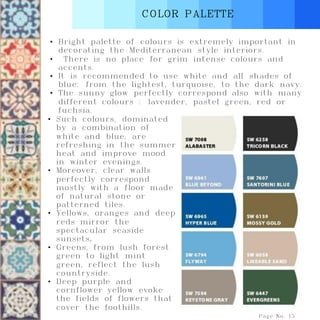
• Bright palette of colours is extremely important in
decorating the Mediterranean style interiors.
• There is no place for grim intense colours and
accents.
• It is recommended to use white and all shades of
blue: from the lightest, turquoise, to the dark navy.
• The sunny glow perfectly correspond also with many
different colours : lavender, pastel green, red or
fuchsia.
• Such colours, dominated
by a combination of
white and blue, are
refreshing in the summer
heat and improve mood
in winter evenings.
• Moreover, clear walls
perfectly correspond
mostly with a floor made
of natural stone or
patterned tiles.
• Yellows, oranges and deep
reds mirror the
spectacular seaside
sunsets.
• Greens, from lush forest
green to light mint
green, reflect the lush
countryside.
• Deep purple and
cornflower yellow evoke
the fields of flowers that
cover the foothills.
Page No. 16
FLOOR
Floor Plan : Homes usually have a similar floor plan
including a distinct foyer or entryway alcove, a large
open living room, a large kitchen in the back of the
house, a large dining room and then a gathering of
cosy bedrooms off the main living areas or on a
second floor.
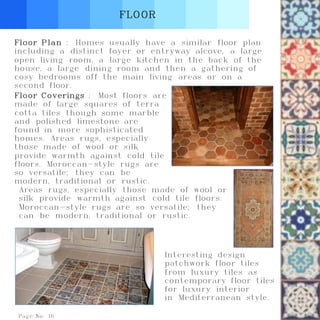
Floor Coverings : Most floors are
made of large squares of terra
cotta tiles though some marble
and polished limestone are
found in more sophisticated
homes. Areas rugs, especially
those made of wool or silk
provide warmth against cold tile
floors. Moroccan-style rugs are
so versatile; they can be
modern, traditional or rustic.
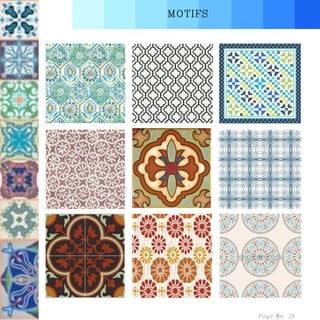
Interesting design
patchwork floor tiles
from luxury tiles as
contemporary floor tiles
for luxury interior
in Mediterranean style.
Areas rugs, especially those made of wool or
silk provide warmth against cold tile floors.
Moroccan-style rugs are so versatile; they
can be modern, traditional or rustic.
EXTERIOR
Page No. 17
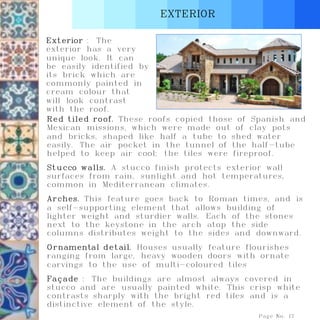
Exterior : The
exterior has a very
unique look. It can
be easily identified by
its brick which are
commonly painted in
cream colour that
will look contrast
with the roof.
Red tiled roof. These roofs copied those of Spanish and
Mexican missions, which were made out of clay pots
and bricks, shaped like half a tube to shed water
easily. The air pocket in the tunnel of the half-tube
helped to keep air cool; the tiles were fireproof.
Stucco walls. A stucco finish protects exterior wall
surfaces from rain, sunlight and hot temperatures,
common in Mediterranean climates.
Arches. This feature goes back to Roman times, and is
a self-supporting element that allows building of
lighter weight and sturdier walls. Each of the stones
next to the keystone in the arch atop the side
columns distributes weight to the sides and downward.
Ornamental detail. Houses usually feature flourishes
ranging from large, heavy wooden doors with ornate
carvings to the use of multi-coloured tiles
Façade : The buildings are almost always covered in
stucco and are usually painted white. This crisp white
contrasts sharply with the bright red tiles and is a
distinctive element of the style.
Page No. 18
CEILING AND LIGHTING
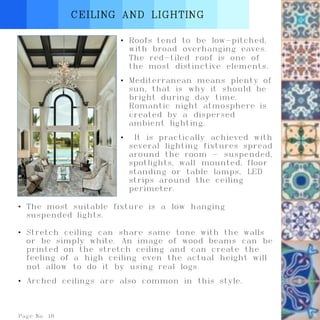
• Roofs tend to be low-pitched,
with broad overhanging eaves.
The red-tiled roof is one of
the most distinctive elements.
• Mediterranean means plenty of
sun, that is why it should be
bright during day time.
Romantic night atmosphere is
created by a dispersed
ambient lighting.
• It is practically achieved with
several lighting fixtures spread
around the room - suspended,
spotlights, wall mounted, floor
standing or table lamps, LED
strips around the ceiling
perimeter.
• The most suitable fixture is a low hanging
suspended lights.
• Stretch ceiling can share same tone with the walls
or be simply white. An image of wood beams can be
printed on the stretch ceiling and can create the
feeling of a high ceiling even the actual height will
not allow to do it by using real logs.
• Arched ceilings are also common in this style.
LANDSCAPE
Page No. 19
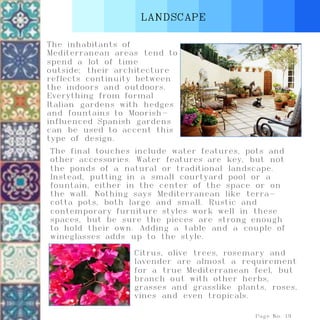
The inhabitants of
Mediterranean areas tend to
spend a lot of time
outside; their architecture
reflects continuity between
the indoors and outdoors.
Everything from formal
Italian gardens with hedges
and fountains to Moorish-
influenced Spanish gardens
can be used to accent this
type of design.
Citrus, olive trees, rosemary and
lavender are almost a requirement
for a true Mediterranean feel, but
branch out with other herbs,
grasses and grasslike plants, roses,
vines and even tropicals.
The final touches include water features, pots and
other accessories. Water features are key, but not
the ponds of a natural or traditional landscape.
Instead, putting in a small courtyard pool or a
fountain, either in the center of the space or on
the wall. Nothing says Mediterranean like terra-
cotta pots, both large and small. Rustic and
contemporary furniture styles work well in these
spaces, but be sure the pieces are strong enough
to hold their own. Adding a table and a couple of
wineglasses adds up to the style.
STAIRCASE
Page No. 20
The Mediterranean design style is known for its
grandiose structures and large interior spaces no
matter what type of room it is applied on. This
means that even an area such as the staircase and
hallway, which are most commonly small spaces
between the rooms, will appear as a space which is
bigger than needed.
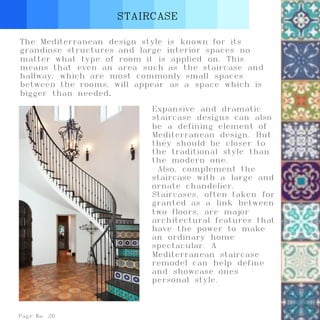
Expansive and dramatic
staircase designs can also
be a defining element of
Mediterranean design. But
they should be closer to
the traditional style than
the modern one.
Also, complement the
staircase with a large and
ornate chandelier.
Staircases, often taken for
granted as a link between
two floors, are major
architectural features that
have the power to make
an ordinary home
spectacular. A
Mediterranean staircase
remodel can help define
and showcase ones
personal style.
MOTIFS
Page No. 21
Page No. 22
ARCHITECTS/ DESIGNERS
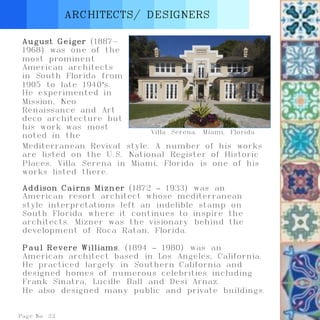
August Geiger (1887-
1968) was one of the
most prominent
American architects
in South Florida from
1905 to late 1940’s.
He experimented in
Mission, Neo
Renaissance and Art
deco architecture but
his work was most
noted in the
Addison Cairns Mizner (1872 – 1933) was an
American resort architect whose mediterranean
style interpretations left an indelible stamp on
South Florida where it continues to inspire the
architects. Mizner was the visionary behind the
development of Roca Ratan, Florida.
Paul Revere Williams, (1894 – 1980) was an
American architect based in Los Angeles, California.
He practiced largely in Southern California and
designed homes of numerous celebrities including
Frank Sinatra, Lucille Ball and Desi Arnaz.
He also designed many public and private buildings.
Villa Serena. Miami, Florida
Mediterranean Revival style. A number of his works
are listed on the U.S. National Register of Historic
Places. Villa Serena in Miami, Florida is one of his
works listed there.
REFERENCES
• 2016 (2016) What is a Mediterranean style house?
(with pictures). Available at:
http://www.wisegeek.com/what-is-a-
mediterranean-style-house.htm (Accessed: 2 Nov
2016)
• Mediterranean revival architecture (2016)
in Wikipedia. Available at:
https://en.wikipedia.org/wiki/Mediterranean_Revival
_architecture (Accessed: 2 Nov 2016)
• Chuck (2006) Mediterranean revival style. Available
at:
http://www.buffaloah.com/a/DCTNRY/m/medit.html
(Accessed: 2 Nov 2016)
• BG, F. (2005) Creatiing Mediterranean style home.
Available at:
http://furnish.bg/en/news/Mediterranean_style_.ht
ml (Accessed: 2 Nov 2016)
• 16 stylish Mediterranean staircase designs for your
daily dose of elegance (2015) Available at:
http://www.architectureartdesigns.com/16-stylish-
mediterranean-staircase-designs-for-your-daily-
dose-of-elegance/ (Accessed: 3 Nov 2016)
• (No Date) Available at:
http://www.houzz.com/mediterranean-staircase
(Accessed: 3 Nov 2016).
REFERENCES
• Asaff, B. (no date) Mediterranean style interior
design. Available at:
http://interiordesign.lovetoknow.com/Mediterranean_S
tyle_Interior_Design (Accessed: 1 Nov 2016).
• yael (2016) Characteristics of Mediterranean decor -
abode. Available at:
http://blog.qualitybath.com/bathroom/bathroom-
fixtures/characteristics-of-mediterranean-decor/
(Accessed: 1 Nov 2016)
• Networks, S. (2016) Mediterranean style 101. Available
at: http://www.hgtv.com/design/decorating/design-
101/mediterranean-style-101 (Accessed:1 Nov 2016)
• Frederick, L. (1997) Tuscan style decor - Tuscan
interior design - home portfolio - design styles.
Available at: http://www.homeportfolio.com/design-
styles/tuscan-style-defined (Accessed: 1 Nov 2016)
• (No Date) Available at:
http://www.houzz.com/ideabooks/2281/thumbs/moder
nizing-mediterranea-interpreting-european-rustic-
design-for-today (Accessed: 2 Nov 2016)
• Inc, Ny. (2012) NYCeiling Inc. - news & articles -
Mediterranean style. Available at:
http://nyceiling.com/post-107/ (Accessed: 3 Nov
2016

Medittarian Style

  • 1.
    Document on MEDITERRAREAN STYLE Made by: PridhiAhuja PGIDS–A Cohort 2015-17 Sem-3
  • 2.
    CONTENTS 1. Meaning ofthe word Page No. 3 3. Application in Interiors Page No. 5,6 2. History Page No. 4 4. Characteristics Page No. 7,8 5. Exemplars Page No. 9,10 7. Accessories Page No. 13 6. Furniture Page No. 11,12 9. Fabric Page No. 14 8. Textures Page No. 14
  • 3.
    CONTENTS 11. Flooring PageNo. 16 13. Ceiling and Lighting Page No. 18 12. Exterior Page No. 17 14. Landscape Page No. 19 15. Staircase Page No. 20 17. Architects Page No. 22 16. Motifs Page No. 21 18. References Page No. 23,24 10. Color Palette Page No. 15
  • 4.
    The term Mediterraneanderives from the Latin word mediterraneus, meaning "amid the earth (soil) ‘or’ between land" as it is between the continents of Africa, Asia and Europe. The word Mediterranean refers to the Mediterranean Sea or the countries (Southern Europe , North Africa and Western Asia) bordering it. It also refers to the characteristic of the Mediterranean Sea or their inhabitants. MEANING OF THE WORD - MEDITERRANEAN Page No. 3 Location in the map
  • 5.
    HISTORY Page No. 4 MediterraneanRevival is a design style introduced in the United States in the waning nineteenth century variously incorporating references from Spanish Renaissance, Spanish Colonial, Beaux-Arts, Italian Renaissance, and Venetian Gothic architecture. The Mediterranean Revival style in architecture is based on capturing the feeling of a Mediterranean villa. The style was an eclectic design and it became popular during the 1920s and 1930s. To attract more tourists, they sought to embrace a unique aesthetic - something that felt exotic and relaxing. Florida and California had something else in common as well: a Spanish colonial history. The remnants of Spanish architecture were spotted The Broadmoor Hotel of Colorado across these two states and to many tourists, were a prime attraction. So, architects began combining Spanish features with those of Mediterranean villas and seaside palaces to create relaxing oases of style and adventure within the United States.
  • 6.
    MEDITERRANEAN STYLE Mediterranean designis the epitome of indoor- outdoor living that blends interior and exterior spaces. Structures are typically based on a rectangular floor plan, and feature massive and symmetrical primary façades. The style is most commonly applied to hotels, apartment buildings, commercial structures, and residences. Mediterranean style interior design evokes the romance and cornucopia of smells, tastes and colours on the southern coast of Europe. The region's casual and friendly lifestyle is reflected in the relaxed design, rustic furniture and wall textures. It's a colourful and pleasing design style Page No. 5 that brings a touch of the Mediterranean to even the most northern home. Mediterranean Interior design is a method of decorating that incorporates the influences of the Mediterranean
  • 7.
    regions of Spain, Italy,Greece, and France. Warm, soothing neutral colours are combined with pops of bright, rich accents to create a welcoming atmosphere. This style of decor provides plenty of room for customization as it can be opulent and luxurious with heavy tapestries and ornately carved furniture, or rustic and understated with rough pine furniture and simple clay accessories. Page No. 6 Textiles used in Mediterranean interior design can feature many of the brighter colours associated with the Mediterranean. Bright coral, deep scarlet, and shades of burnished gold reflect the brilliance of a Tuscan sunset. Azure, turquoise, and sapphire invoke images of the sparkling Mediterrarian Sea. These hues are best featured on accents such as throw pillows, paintings, tapestries, or curtains. USED IN INTERIORS
  • 8.
    CHARACTERSTICS Page No.7 • Mediterranean-styledécor is characterised by the dominance of light. Emphasis in on the natural light. • It is about the incorporation of sea and sky. • Functionality and convenience are characteristic for Mediterranean furniture. • The style has a particular feature – a limited use of textile and upholstery for substantial feel. • Mediterranean style features handcrafted furniture, most often made of wood. • Warm tones or colours associated with the sea and nature (light or dark blue) are used for furnishings. • The walls of the house, as an alternative to white, can be painted ochre yellow or turquoise. • Surfaces including plaster walls and floors are often left rough with their imperfections on display. • The ceiling is often characterised by wooden beams, while terracotta or handmade tiles are typically used for the floors. However, it is also common to see wooden or ceramic floors. • Large windows with an arc are used in this style for welcoming the natural light.
  • 9.
    Page No. 8 CHARACTERSTICS •The living room is the gathering point for families and friends and usually such meetings include a meal. As a result living room and dining room areas are often combined. • The furniture is usually made of wood / olive is traditional for the region. The furniture is light and natural. It is rustic, typically heavy medium-dark wood with ornate hand-carving. • The linen and the white colour of the upholstery sofas are more than usual. • High ceilings and wooden beams, stone walls and large fireplaces are the key elements indoors. • Mediterranean style is all about the soft edges rather than straight lines; embrace the curves in architectural features (like doorways or windows) as well as fixtures and fittings. • Mediterranean style features bold, vibrant jewel tones and saturated earthy shades of the landscape (terra cotta, turquoise, rust, yellow) contrasted by bright, clean whites. • Some Middle Eastern motifs feature limestone, but the classic look is terra cotta and hand-painted tile; arabesque and Moroccan tile are popular. • Mediterranean exterior spaces are bohemian and relaxing.. Water elements like fountains and swimming pool are often an important part of Mediterranean design.
  • 10.
  • 11.
  • 12.
    FURNITURE Page No. 11 Mostfurniture is large, heavy and rustic or hand carved. Table and chair legs are large, pieces are very sturdy. Furniture may have a rustic look with imperfections, wormholes and crenelated edges as if made from timber. Most chairs in this style have straight backs, generous arms and are only partially upholstered, usually in leather or tapestry. So it is no coincidence that the furniture is usually made of wood. Of course, the linen and the white colour Of the upholstery sofas are more than usual. The Mediterranean furniture should appear light and natural. Casual furniture in a grand scale made of warm woods in rich, dark colours is commonly used throughout the house.
  • 13.
    Page No. 12 FURNITURE Wroughtiron bed headboard In addition, mosaic tile-covered tabletops and countertops are also distinct features of Mediterranean interiors. Potted plants are also welcome additions to the home. Mediterranean decorating style is characterized by a backdrop of color that is a sandy neutral, yet also has a rich depth. Walls in the Mediterranean style build on shades of warm white through ivory, sand and beige and on to deep egg-yolk yellow or a sun-kissed shade of burnt orange. Using two or more shades of closely related colour, such as a lighter shade on decorate mouldings and a darker shade on areas of a wall that recede, adds to creating a sense of expansiveness.
  • 14.
    ACCESSORIES Page No. 13 •The Mediterranean style is characterized by subtle decoration – whether ceramic vessels or rattan baskets, • Fruit and flowers on the table are traditional decorative elements. • Plates can be glued to the walls, or a rustic wood carving can be the accent in the living room. Floral motifs and images are welcome in the bedroom. • .Smaller accessories are mostly useful items, such as copper and iron cookware, colourful crockery and braids of garlic, peppers and onions. • Mosaic tiles, taken from Spain's Islamic influences, are frequently found on table tops, countertops and even stuck in plaster as wall adornments. • Flowers, either fresh, dried or simulated, add another source of color to a Mediterranean room.
  • 15.
    Page No. 14 TEXTURESAND FABRICS • The textures of the Mediterranean are rough and earthy, just like the colours. • Walls are customarily made of textured white plaster or stucco or stone cladding. • Touchable walls are a huge hallmark of Mediterranean decor. • Plastered walls can be very refined, such as very smooth, finished, Venetian plaster, or rustic as in cruder Etruscan plaster. • Fabrics feature heavily, mainly silk, wool, and cotton in a variety of applications: tapestries and wall hangings, drapes, rugs, pillows, and the ubiquitous Moroccan pouf. • While Mediterranean floors may lack the warmth a rich carpet make up for it. • Adding light-coloured furniture and accent with colourful pillows or throws.
  • 16.
    COLOR PALETTE Page No.15 • Bright palette of colours is extremely important in decorating the Mediterranean style interiors. • There is no place for grim intense colours and accents. • It is recommended to use white and all shades of blue: from the lightest, turquoise, to the dark navy. • The sunny glow perfectly correspond also with many different colours : lavender, pastel green, red or fuchsia. • Such colours, dominated by a combination of white and blue, are refreshing in the summer heat and improve mood in winter evenings. • Moreover, clear walls perfectly correspond mostly with a floor made of natural stone or patterned tiles. • Yellows, oranges and deep reds mirror the spectacular seaside sunsets. • Greens, from lush forest green to light mint green, reflect the lush countryside. • Deep purple and cornflower yellow evoke the fields of flowers that cover the foothills.
  • 17.
    Page No. 16 FLOOR FloorPlan : Homes usually have a similar floor plan including a distinct foyer or entryway alcove, a large open living room, a large kitchen in the back of the house, a large dining room and then a gathering of cosy bedrooms off the main living areas or on a second floor. Floor Coverings : Most floors are made of large squares of terra cotta tiles though some marble and polished limestone are found in more sophisticated homes. Areas rugs, especially those made of wool or silk provide warmth against cold tile floors. Moroccan-style rugs are so versatile; they can be modern, traditional or rustic. Interesting design patchwork floor tiles from luxury tiles as contemporary floor tiles for luxury interior in Mediterranean style. Areas rugs, especially those made of wool or silk provide warmth against cold tile floors. Moroccan-style rugs are so versatile; they can be modern, traditional or rustic.
  • 18.
    EXTERIOR Page No. 17 Exterior: The exterior has a very unique look. It can be easily identified by its brick which are commonly painted in cream colour that will look contrast with the roof. Red tiled roof. These roofs copied those of Spanish and Mexican missions, which were made out of clay pots and bricks, shaped like half a tube to shed water easily. The air pocket in the tunnel of the half-tube helped to keep air cool; the tiles were fireproof. Stucco walls. A stucco finish protects exterior wall surfaces from rain, sunlight and hot temperatures, common in Mediterranean climates. Arches. This feature goes back to Roman times, and is a self-supporting element that allows building of lighter weight and sturdier walls. Each of the stones next to the keystone in the arch atop the side columns distributes weight to the sides and downward. Ornamental detail. Houses usually feature flourishes ranging from large, heavy wooden doors with ornate carvings to the use of multi-coloured tiles Façade : The buildings are almost always covered in stucco and are usually painted white. This crisp white contrasts sharply with the bright red tiles and is a distinctive element of the style.
  • 19.
    Page No. 18 CEILINGAND LIGHTING • Roofs tend to be low-pitched, with broad overhanging eaves. The red-tiled roof is one of the most distinctive elements. • Mediterranean means plenty of sun, that is why it should be bright during day time. Romantic night atmosphere is created by a dispersed ambient lighting. • It is practically achieved with several lighting fixtures spread around the room - suspended, spotlights, wall mounted, floor standing or table lamps, LED strips around the ceiling perimeter. • The most suitable fixture is a low hanging suspended lights. • Stretch ceiling can share same tone with the walls or be simply white. An image of wood beams can be printed on the stretch ceiling and can create the feeling of a high ceiling even the actual height will not allow to do it by using real logs. • Arched ceilings are also common in this style.
  • 20.
    LANDSCAPE Page No. 19 Theinhabitants of Mediterranean areas tend to spend a lot of time outside; their architecture reflects continuity between the indoors and outdoors. Everything from formal Italian gardens with hedges and fountains to Moorish- influenced Spanish gardens can be used to accent this type of design. Citrus, olive trees, rosemary and lavender are almost a requirement for a true Mediterranean feel, but branch out with other herbs, grasses and grasslike plants, roses, vines and even tropicals. The final touches include water features, pots and other accessories. Water features are key, but not the ponds of a natural or traditional landscape. Instead, putting in a small courtyard pool or a fountain, either in the center of the space or on the wall. Nothing says Mediterranean like terra- cotta pots, both large and small. Rustic and contemporary furniture styles work well in these spaces, but be sure the pieces are strong enough to hold their own. Adding a table and a couple of wineglasses adds up to the style.
  • 21.
    STAIRCASE Page No. 20 TheMediterranean design style is known for its grandiose structures and large interior spaces no matter what type of room it is applied on. This means that even an area such as the staircase and hallway, which are most commonly small spaces between the rooms, will appear as a space which is bigger than needed. Expansive and dramatic staircase designs can also be a defining element of Mediterranean design. But they should be closer to the traditional style than the modern one. Also, complement the staircase with a large and ornate chandelier. Staircases, often taken for granted as a link between two floors, are major architectural features that have the power to make an ordinary home spectacular. A Mediterranean staircase remodel can help define and showcase ones personal style.
  • 22.
  • 23.
    Page No. 22 ARCHITECTS/DESIGNERS August Geiger (1887- 1968) was one of the most prominent American architects in South Florida from 1905 to late 1940’s. He experimented in Mission, Neo Renaissance and Art deco architecture but his work was most noted in the Addison Cairns Mizner (1872 – 1933) was an American resort architect whose mediterranean style interpretations left an indelible stamp on South Florida where it continues to inspire the architects. Mizner was the visionary behind the development of Roca Ratan, Florida. Paul Revere Williams, (1894 – 1980) was an American architect based in Los Angeles, California. He practiced largely in Southern California and designed homes of numerous celebrities including Frank Sinatra, Lucille Ball and Desi Arnaz. He also designed many public and private buildings. Villa Serena. Miami, Florida Mediterranean Revival style. A number of his works are listed on the U.S. National Register of Historic Places. Villa Serena in Miami, Florida is one of his works listed there.
  • 24.
    REFERENCES • 2016 (2016)What is a Mediterranean style house? (with pictures). Available at: http://www.wisegeek.com/what-is-a- mediterranean-style-house.htm (Accessed: 2 Nov 2016) • Mediterranean revival architecture (2016) in Wikipedia. Available at: https://en.wikipedia.org/wiki/Mediterranean_Revival _architecture (Accessed: 2 Nov 2016) • Chuck (2006) Mediterranean revival style. Available at: http://www.buffaloah.com/a/DCTNRY/m/medit.html (Accessed: 2 Nov 2016) • BG, F. (2005) Creatiing Mediterranean style home. Available at: http://furnish.bg/en/news/Mediterranean_style_.ht ml (Accessed: 2 Nov 2016) • 16 stylish Mediterranean staircase designs for your daily dose of elegance (2015) Available at: http://www.architectureartdesigns.com/16-stylish- mediterranean-staircase-designs-for-your-daily- dose-of-elegance/ (Accessed: 3 Nov 2016) • (No Date) Available at: http://www.houzz.com/mediterranean-staircase (Accessed: 3 Nov 2016).
  • 25.
    REFERENCES • Asaff, B.(no date) Mediterranean style interior design. Available at: http://interiordesign.lovetoknow.com/Mediterranean_S tyle_Interior_Design (Accessed: 1 Nov 2016). • yael (2016) Characteristics of Mediterranean decor - abode. Available at: http://blog.qualitybath.com/bathroom/bathroom- fixtures/characteristics-of-mediterranean-decor/ (Accessed: 1 Nov 2016) • Networks, S. (2016) Mediterranean style 101. Available at: http://www.hgtv.com/design/decorating/design- 101/mediterranean-style-101 (Accessed:1 Nov 2016) • Frederick, L. (1997) Tuscan style decor - Tuscan interior design - home portfolio - design styles. Available at: http://www.homeportfolio.com/design- styles/tuscan-style-defined (Accessed: 1 Nov 2016) • (No Date) Available at: http://www.houzz.com/ideabooks/2281/thumbs/moder nizing-mediterranea-interpreting-european-rustic- design-for-today (Accessed: 2 Nov 2016) • Inc, Ny. (2012) NYCeiling Inc. - news & articles - Mediterranean style. Available at: http://nyceiling.com/post-107/ (Accessed: 3 Nov 2016