History of interior design
By
Pravin Kumar
Interior Design
 art and science
 Enhancing the interior of a building
 achieve a healthier and more aesthetically pleasing environment for the people
using the space.
Interior Designer
 Someone who plans,
 researches,
 coordinates, and
 manages such enhancement projects.
Interior design is a multifaceted profession that includes

conceptual development,
space planning,
site inspections,
programming,
research,
communicating with the stakeholders of a project,
construction management, and execution of the design.
History of Interior Design
Some of the designs are widely used after world war 2
 Victorian design 1837 – 1901AD
 Arts & Crafts 1860 – 1910AD
 Art Nouveau, 1890 - 1910AD
 Eclecticism 1900s – Now
 Colonial 1905 -Now
VICTORIAN 1837-1901 AD
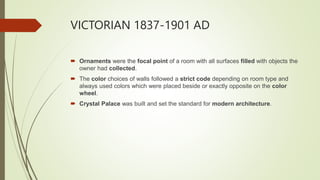
 Ornaments were the focal point of a room with all surfaces filled with objects the
owner had collected.
 The color choices of walls followed a strict code depending on room type and
always used colors which were placed beside or exactly opposite on the color
wheel.
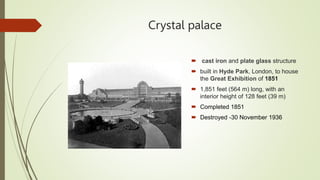
 Crystal Palace was built and set the standard for modern architecture.
Crystal palace
 cast iron and plate glass structure
 built in Hyde Park, London, to house
the Great Exhibition of 1851
 1,851 feet (564 m) long, with an
interior height of 128 feet (39 m)
 Completed 1851
 Destroyed -30 November 1936
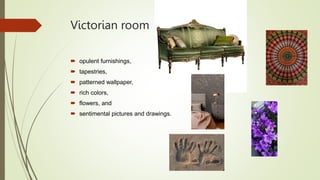
Victorian room
 opulent furnishings,
 tapestries,
 patterned wallpaper,
 rich colors,
 flowers, and
 sentimental pictures and drawings.
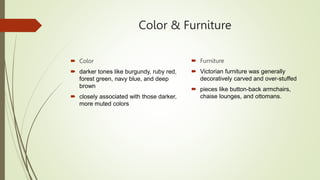
Color & Furniture
 Color
 darker tones like burgundy, ruby red,
forest green, navy blue, and deep
brown
 closely associated with those darker,
more muted colors
 Furniture
 Victorian furniture was generally
decoratively carved and over-stuffed
 pieces like button-back armchairs,
chaise lounges, and ottomans.
Lighting & Home Decor
 Essential to this design style
are light fixtures and candles
 Tiffany lamps (with lampshades
made of glass) Popular
 wall sconces and chandeliers
 Accessories and decorations , cover
every surface
 gallery wall of framed pictures,
displayed China, souvenirs, vases,
and lace doilies
 embroidered cushions decorated
couches, and potted plants like
palms and ferns were popular
 Stained glass was also a common
way to add color to rooms
Coverings & Floorings
 Curtains lined with silk or wool
 Walls covered with the rich, dark
paint colors
 wallpaper with bold floral, leaf, or
vine motifs
 painted to look like marble or wood-
grained finishings
 Wood, specifically parquet patterns
most common
 floor cloths , carpeting , toward the
second half of the era
 Tiled floors with a repeating
geometric design in the middle.
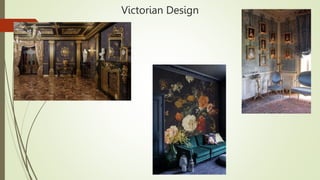
Victorian Design
Arts & Crafts 1860-1910 AD
 traditional crafts to produce items of furniture and decoration
 a belief in craftsmanship which stresses the inherent beauty of the material
 the importance of nature as inspiration
 value of simplicity, utility, and beauty.
Arts & Crafts 1860-1910 AD
 Four categories of arts & Crafts
 Textile,
 Decorative
 Paper,
 Functional,
 Fashion Crafts
Arts & Crafts
 originated in the late 19th and early 20th centuries
 Excessive décor of Victorianism and the mass production
 Improve the quality of domestic interiors by reviving the applied arts.
 The designs use natural raw materials and textures such as stone, brick, and
wood.
 with hand-crafted and well-designed decorative finishes, textiles, and useful
objects
 follow a simple and open floor plan.
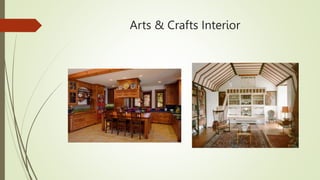
Arts & Crafts Interior
 Nature is a consistent theme
 textiles and wallpaper designs bring the natural world indoors
 countryside inspires the designs, which often feature motifs that honour traditional
country hedgerows
 flowers,
 fruits,
 colorful birds.
Arts & Crafts Interior
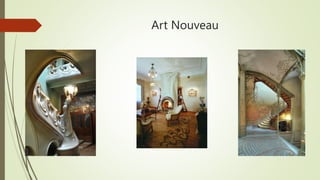
Art Nouveau 1890 - 1910AD
 New art
 Art should be a way of life is philosophy
 Ornamental style of art that flourished between about 1890 and 1910 throughout
Europe and the United States
 Attempted to blend interiors with exterior natural elements and therefore much
design took the form of curved lines and was inspired by plant life and flowers
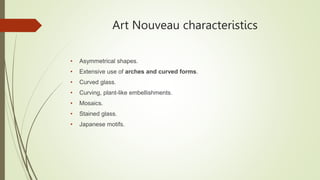
Art Nouveau characteristics
• Asymmetrical shapes.
• Extensive use of arches and curved forms.
• Curved glass.
• Curving, plant-like embellishments.
• Mosaics.
• Stained glass.
• Japanese motifs.
Art Nouveau
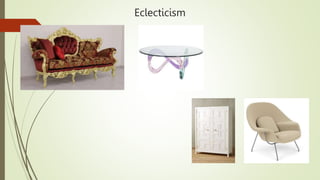
Eclecticism 1900s – Now
 Eclecticism is from the Greek word eklektikos means "to choose the best”
 emerged in the 19th century in Europe
 blends different styles and motifs together to create a unique aesthetic
 it created a need for people with an understanding of differing styles and interior
design history
 Demand in the style into the middle and lower classes.
Characteristics of Eclectic Style
 Mixed patterns and textures.
isn’t homogenous—take risks by mixing patterns, textures, or both!
 Combination of old and new.
Louis XIV sofa could be paired with a lucite coffee table
 Incorporation of global influences
Don’t be afraid to place antique lacquer armoire from China next to a Saarinen
womb chair!
 Gallery walls
collage of furnishings.
Decorating an Eclectic Interior
 Choose a unifying color
few colors to repeat throughout your design scheme
 Provide a focal point.
help draw the eye to the desired place
 Mix and match patterns, prints, and texture
mismatched patterns and textures throughout your room to help create a sense of visual
harmony
 Mix style genres
Different combinations of collectibles or featured items to get a sense of what goes together
 Include negative space
Break up your eclectic interior design with neutral colors and blank
Eclecticism
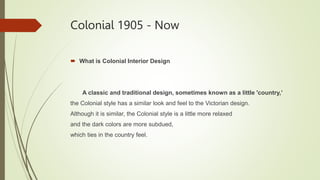
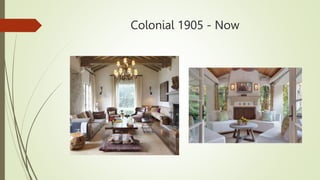
Colonial 1905 - Now
 What is Colonial Interior Design
A classic and traditional design, sometimes known as a little 'country,’
the Colonial style has a similar look and feel to the Victorian design.
Although it is similar, the Colonial style is a little more relaxed
and the dark colors are more subdued,
which ties in the country feel.
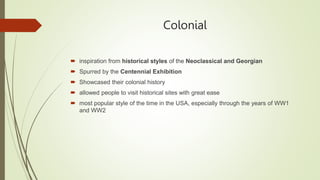
Colonial
 inspiration from historical styles of the Neoclassical and Georgian
 Spurred by the Centennial Exhibition
 Showcased their colonial history
 allowed people to visit historical sites with great ease
 most popular style of the time in the USA, especially through the years of WW1
and WW2
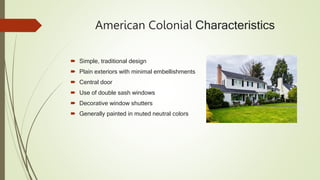
American Colonial Characteristics
 Simple, traditional design
 Plain exteriors with minimal embellishments
 Central door
 Use of double sash windows
 Decorative window shutters
 Generally painted in muted neutral colors
Colonial 1905 - Now
Frank Lloyd Wright
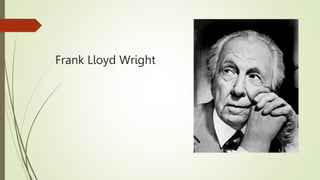
Frank Lloyd Wright
 American architect
 Born-8 June 1867 Richland Center, Wisconsin, United States
 Died-9 April 1959
 He designed more than 1,000 structures & 380 were actually built. over a creative
period of 70 years
 UNESCO designated eight of them— (United Nations Educational, Scientific and
Cultural Organization)
 Including Fallingwater,
 The Guggenheim Museum, and
 Unity Temple—as World Heritage sites in 2019..
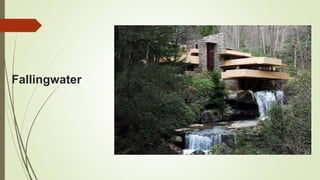
Fallingwater
Fallingwater
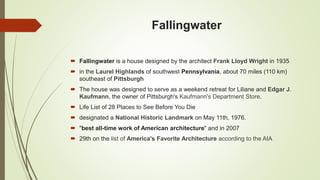
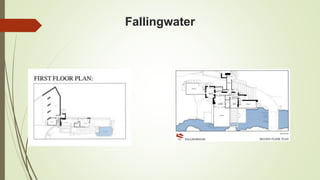
 Fallingwater is a house designed by the architect Frank Lloyd Wright in 1935
 in the Laurel Highlands of southwest Pennsylvania, about 70 miles (110 km)
southeast of Pittsburgh
 The house was designed to serve as a weekend retreat for Liliane and Edgar J.
Kaufmann, the owner of Pittsburgh's Kaufmann's Department Store.
 Life List of 28 Places to See Before You Die
 designated a National Historic Landmark on May 11th, 1976.
 "best all-time work of American architecture" and in 2007
 29th on the list of America's Favorite Architecture according to the AIA
Fallingwater
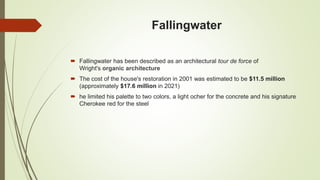
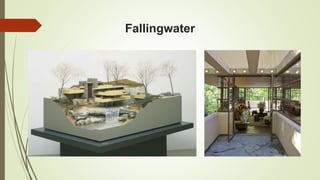
 Fallingwater has been described as an architectural tour de force of
Wright's organic architecture
 The cost of the house's restoration in 2001 was estimated to be $11.5 million
(approximately $17.6 million in 2021)
 he limited his palette to two colors, a light ocher for the concrete and his signature
Cherokee red for the steel
Fallingwater
Fallingwater
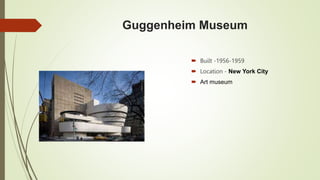
Guggenheim Museum
 Built -1956-1959
 Location - New York City
 Art museum
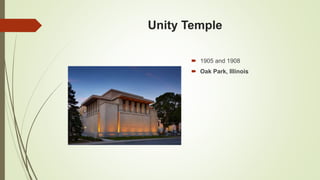
Unity Temple
 1905 and 1908
 Oak Park, Illinois
Q&A
THANK YOU

Historical facts.pptx

  • 1.
    History of interiordesign By Pravin Kumar
  • 2.
    Interior Design  artand science  Enhancing the interior of a building  achieve a healthier and more aesthetically pleasing environment for the people using the space.
  • 3.
    Interior Designer  Someonewho plans,  researches,  coordinates, and  manages such enhancement projects. Interior design is a multifaceted profession that includes conceptual development, space planning, site inspections, programming, research, communicating with the stakeholders of a project, construction management, and execution of the design.
  • 4.
    History of InteriorDesign Some of the designs are widely used after world war 2  Victorian design 1837 – 1901AD  Arts & Crafts 1860 – 1910AD  Art Nouveau, 1890 - 1910AD  Eclecticism 1900s – Now  Colonial 1905 -Now
  • 5.
    VICTORIAN 1837-1901 AD Ornaments were the focal point of a room with all surfaces filled with objects the owner had collected.  The color choices of walls followed a strict code depending on room type and always used colors which were placed beside or exactly opposite on the color wheel.  Crystal Palace was built and set the standard for modern architecture.
  • 6.
    Crystal palace  castiron and plate glass structure  built in Hyde Park, London, to house the Great Exhibition of 1851  1,851 feet (564 m) long, with an interior height of 128 feet (39 m)  Completed 1851  Destroyed -30 November 1936
  • 7.
    Victorian room  opulentfurnishings,  tapestries,  patterned wallpaper,  rich colors,  flowers, and  sentimental pictures and drawings.
  • 8.
    Color & Furniture Color  darker tones like burgundy, ruby red, forest green, navy blue, and deep brown  closely associated with those darker, more muted colors  Furniture  Victorian furniture was generally decoratively carved and over-stuffed  pieces like button-back armchairs, chaise lounges, and ottomans.
  • 9.
    Lighting & HomeDecor  Essential to this design style are light fixtures and candles  Tiffany lamps (with lampshades made of glass) Popular  wall sconces and chandeliers  Accessories and decorations , cover every surface  gallery wall of framed pictures, displayed China, souvenirs, vases, and lace doilies  embroidered cushions decorated couches, and potted plants like palms and ferns were popular  Stained glass was also a common way to add color to rooms
  • 10.
    Coverings & Floorings Curtains lined with silk or wool  Walls covered with the rich, dark paint colors  wallpaper with bold floral, leaf, or vine motifs  painted to look like marble or wood- grained finishings  Wood, specifically parquet patterns most common  floor cloths , carpeting , toward the second half of the era  Tiled floors with a repeating geometric design in the middle.
  • 11.
  • 12.
    Arts & Crafts1860-1910 AD  traditional crafts to produce items of furniture and decoration  a belief in craftsmanship which stresses the inherent beauty of the material  the importance of nature as inspiration  value of simplicity, utility, and beauty.
  • 13.
    Arts & Crafts1860-1910 AD  Four categories of arts & Crafts  Textile,  Decorative  Paper,  Functional,  Fashion Crafts
  • 14.
    Arts & Crafts originated in the late 19th and early 20th centuries  Excessive décor of Victorianism and the mass production  Improve the quality of domestic interiors by reviving the applied arts.  The designs use natural raw materials and textures such as stone, brick, and wood.  with hand-crafted and well-designed decorative finishes, textiles, and useful objects  follow a simple and open floor plan.
  • 15.
    Arts & CraftsInterior  Nature is a consistent theme  textiles and wallpaper designs bring the natural world indoors  countryside inspires the designs, which often feature motifs that honour traditional country hedgerows  flowers,  fruits,  colorful birds.
  • 16.
    Arts & CraftsInterior
  • 17.
    Art Nouveau 1890- 1910AD  New art  Art should be a way of life is philosophy  Ornamental style of art that flourished between about 1890 and 1910 throughout Europe and the United States  Attempted to blend interiors with exterior natural elements and therefore much design took the form of curved lines and was inspired by plant life and flowers
  • 18.
    Art Nouveau characteristics •Asymmetrical shapes. • Extensive use of arches and curved forms. • Curved glass. • Curving, plant-like embellishments. • Mosaics. • Stained glass. • Japanese motifs.
  • 19.
  • 20.
    Eclecticism 1900s –Now  Eclecticism is from the Greek word eklektikos means "to choose the best”  emerged in the 19th century in Europe  blends different styles and motifs together to create a unique aesthetic  it created a need for people with an understanding of differing styles and interior design history  Demand in the style into the middle and lower classes.
  • 21.
    Characteristics of EclecticStyle  Mixed patterns and textures. isn’t homogenous—take risks by mixing patterns, textures, or both!  Combination of old and new. Louis XIV sofa could be paired with a lucite coffee table  Incorporation of global influences Don’t be afraid to place antique lacquer armoire from China next to a Saarinen womb chair!  Gallery walls collage of furnishings.
  • 22.
    Decorating an EclecticInterior  Choose a unifying color few colors to repeat throughout your design scheme  Provide a focal point. help draw the eye to the desired place  Mix and match patterns, prints, and texture mismatched patterns and textures throughout your room to help create a sense of visual harmony  Mix style genres Different combinations of collectibles or featured items to get a sense of what goes together  Include negative space Break up your eclectic interior design with neutral colors and blank
  • 23.
  • 24.
    Colonial 1905 -Now  What is Colonial Interior Design A classic and traditional design, sometimes known as a little 'country,’ the Colonial style has a similar look and feel to the Victorian design. Although it is similar, the Colonial style is a little more relaxed and the dark colors are more subdued, which ties in the country feel.
  • 25.
    Colonial  inspiration fromhistorical styles of the Neoclassical and Georgian  Spurred by the Centennial Exhibition  Showcased their colonial history  allowed people to visit historical sites with great ease  most popular style of the time in the USA, especially through the years of WW1 and WW2
  • 26.
    American Colonial Characteristics Simple, traditional design  Plain exteriors with minimal embellishments  Central door  Use of double sash windows  Decorative window shutters  Generally painted in muted neutral colors
  • 27.
  • 28.
  • 29.
    Frank Lloyd Wright American architect  Born-8 June 1867 Richland Center, Wisconsin, United States  Died-9 April 1959  He designed more than 1,000 structures & 380 were actually built. over a creative period of 70 years  UNESCO designated eight of them— (United Nations Educational, Scientific and Cultural Organization)  Including Fallingwater,  The Guggenheim Museum, and  Unity Temple—as World Heritage sites in 2019..
  • 30.
  • 31.
    Fallingwater  Fallingwater isa house designed by the architect Frank Lloyd Wright in 1935  in the Laurel Highlands of southwest Pennsylvania, about 70 miles (110 km) southeast of Pittsburgh  The house was designed to serve as a weekend retreat for Liliane and Edgar J. Kaufmann, the owner of Pittsburgh's Kaufmann's Department Store.  Life List of 28 Places to See Before You Die  designated a National Historic Landmark on May 11th, 1976.  "best all-time work of American architecture" and in 2007  29th on the list of America's Favorite Architecture according to the AIA
  • 32.
    Fallingwater  Fallingwater hasbeen described as an architectural tour de force of Wright's organic architecture  The cost of the house's restoration in 2001 was estimated to be $11.5 million (approximately $17.6 million in 2021)  he limited his palette to two colors, a light ocher for the concrete and his signature Cherokee red for the steel
  • 33.
  • 34.
  • 35.
    Guggenheim Museum  Built-1956-1959  Location - New York City  Art museum
  • 36.
    Unity Temple  1905and 1908  Oak Park, Illinois
  • 37.
  • 38.