ECHO-
CARDIOGRAPHY
AROOSA MANAZIR
LECTURER, RADIOGRAPHY &
IMAGING TECHNOLOGY
AFRO ASIAN INSTITUTE, LAHORE
PAKISTAN
List of Contents
▪ Definition
▪ Basic Principle
▪ Utility of Echo
▪ Echocardiography Machine
▪ Cardiac Anatomy
▪ Indications
▪ Modalities of Echocardiography
▪ Types of Echocardiography
▪ Detailed Description
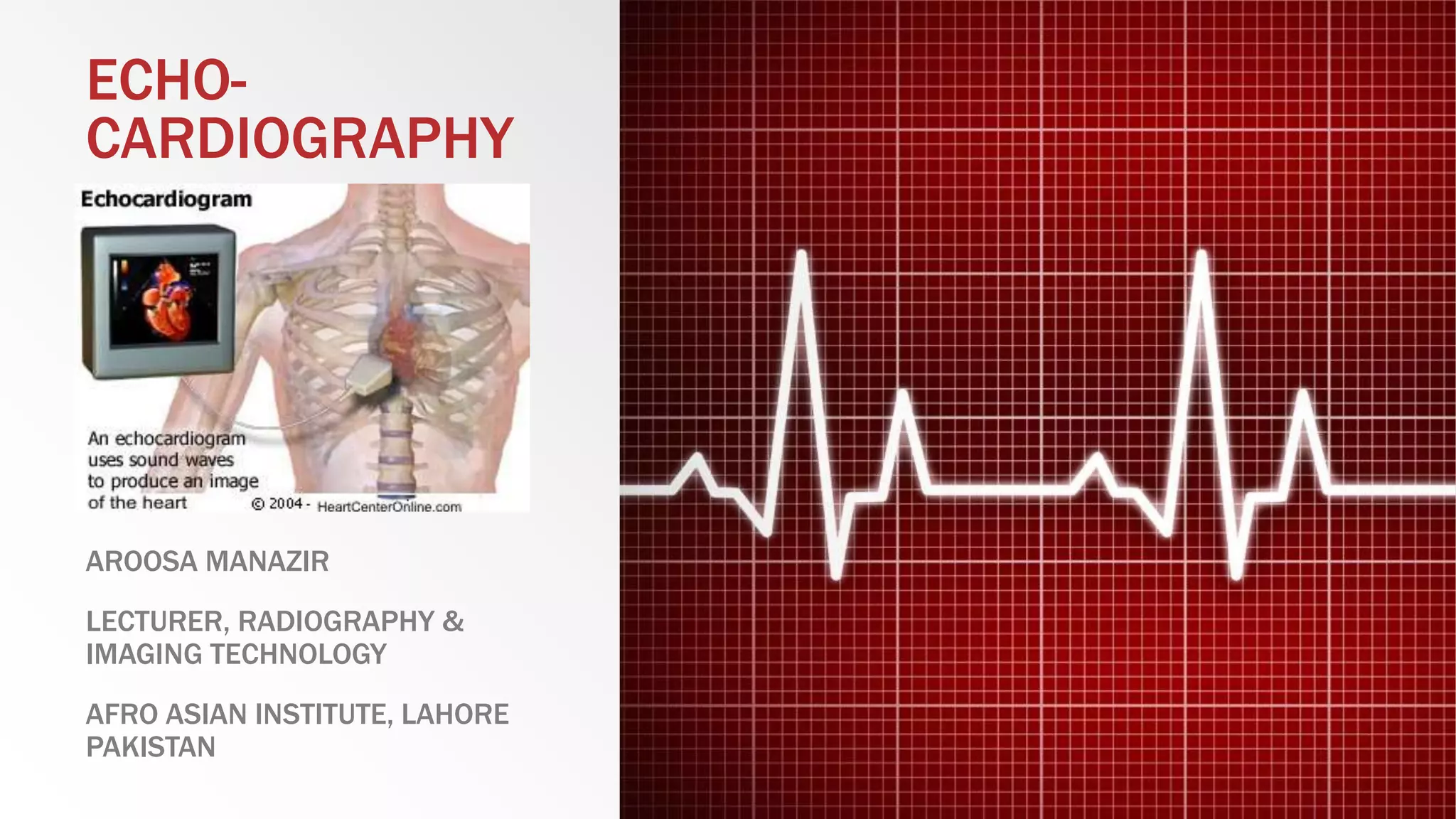
Echocardiography
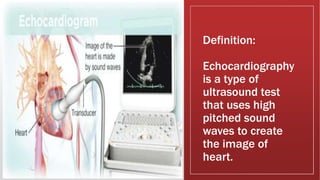
Definition:
Echocardiography
is a type of
ultrasound test
that uses high
pitched sound
waves to create
the image of
heart.
Basic Principle
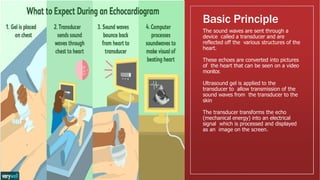
The sound waves are sent through a
device called a transducer and are
reflected off the various structures of the
heart.
These echoes are converted into pictures
of the heart that can be seen on a video
monitor.
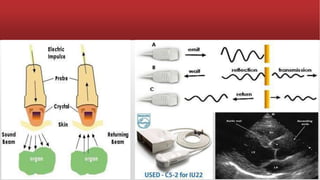
Ultrasound gel is applied to the
transducer to allow transmission of the
sound waves from the transducer to the
skin
The transducer transforms the echo
(mechanical energy) into an electrical
signal which is processed and displayed
as an image on the screen.
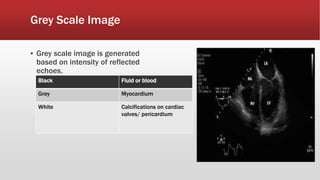
Grey Scale Image
▪ Grey scale image is generated
based on intensity of reflected
echoes.
Black Fluid or blood
Grey Myocardium
White Calcifications on cardiac
valves/ pericardium
Utility of Echocardiography
▪ A non-invasive diagnostic technique
▪ Widely used in clinical cardiology
▪ Involves use of ultrasound , so have no radiation risks
▪ Used to assess cardiacstructure and haemodynamic function.
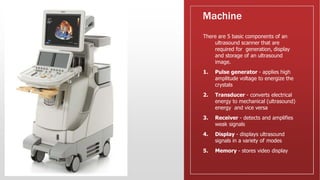
Machine
There are 5 basic components of an
ultrasound scanner that are
required for generation, display
and storage of an ultrasound
image.
1. Pulse generator - applies high
amplitude voltage to energize the
crystals
2. Transducer - converts electrical
energy to mechanical (ultrasound)
energy and vice versa
3. Receiver - detects and amplifies
weak signals
4. Display - displays ultrasound
signals in a variety of modes
5. Memory - stores video display
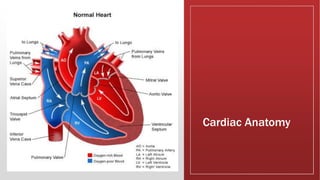
Cardiac Anatomy
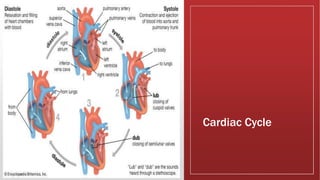
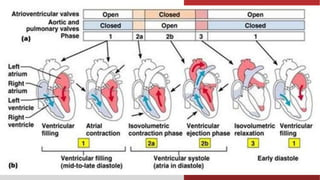
Cardiac Cycle
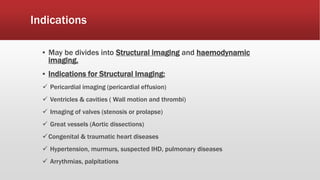
Indications
▪ May be divides into Structural imaging and haemodynamic
imaging.
▪ Indications for Structural Imaging:
 Pericardial imaging (pericardial effusion)
 Ventricles & cavities ( Wall motion and thrombi)
 Imaging of valves (stenosis or prolapse)
 Great vessels (Aortic dissections)
Congenital & traumatic heart diseases
 Hypertension, murmurs, suspected IHD, pulmonary diseases
 Arrythmias, palpitations
Indications
▪ Indiacations for Haemodynamic Imaging:
 Blood flow through heart valves
 Blood flow through cardiac chambers
 Systolic and diastolic functions
Modalities of Echo
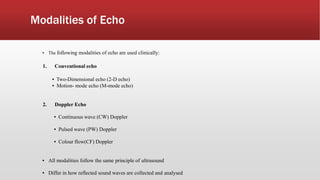
▪ The following modalities of echo are used clinically:
1. Conventional echo
▪ Two-Dimensional echo (2-D echo)
▪ Motion- mode echo (M-mode echo)
2. Doppler Echo
▪ Continuous wave (CW) Doppler
▪ Pulsed wave (PW) Doppler
▪ Colour flow(CF) Doppler
▪ All modalities follow the same principle of ultrasound
▪ Differ in how reflected sound waves are collected and analysed
Two-Dimensional Echo (2-D echo)
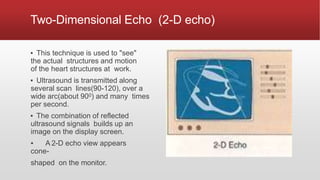
▪ This technique is used to "see"
the actual structures and motion
of the heart structures at work.
▪ Ultrasound is transmitted along
several scan lines(90-120), over a
wide arc(about 900) and many times
per second.
▪ The combination of reflected
ultrasound signals builds up an
image on the display screen.
▪ A 2-D echo view appears
cone-
shaped on the monitor.
M-Mode echocardiography
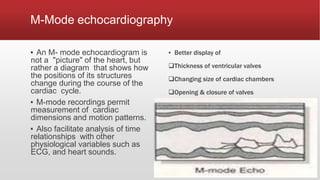
▪ An M- mode echocardiogram is
not a "picture" of the heart, but
rather a diagram that shows how
the positions of its structures
change during the course of the
cardiac cycle.
▪ M-mode recordings permit
measurement of cardiac
dimensions and motion patterns.
▪ Also facilitate analysis of time
relationships with other
physiological variables such as
ECG, and heart sounds.
▪ Better display of
Thickness of ventricular valves
Changing size of cardiac chambers
Opening & closure of valves
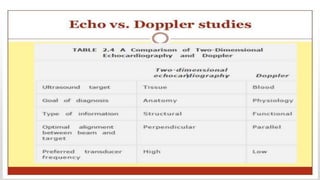
Doppler Echocardiography
▪ Doppler echocardiography is a
method for detecting the direction and
velocity of moving blood within the
heart.
▪ Pulsed Wave (PW) useful for low
velocity flow e.g. MV flow
▪ Continuous Wave (CW) useful for
high velocity flow e.g aortic stenosis
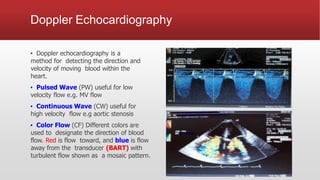
▪ Color Flow (CF) Different colors are
used to designate the direction of blood
flow. Red is flow toward, and blue is flow
away from the transducer (BART) with
turbulent flow shown as a mosaic pattern.
Types of Echocardiography
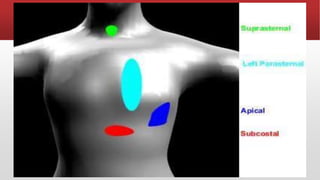
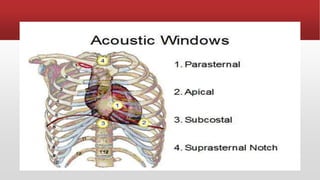
▪ Trans-thoracic
 Parasternal window
 Subcostal window
 Apical window
 Supraternal window
▪ Trans-esophageal
▪ Intra-vascular
 Intracardiac
 Intracoronary
▪ Epicardial
▪ Stress Echo
▪ Contrast Echo
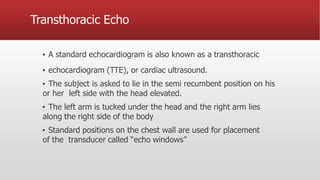
Transthoracic Echo
▪ A standard echocardiogram is also known as a transthoracic
▪ echocardiogram (TTE), or cardiac ultrasound.
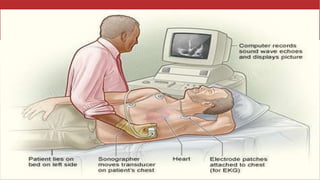
▪ The subject is asked to lie in the semi recumbent position on his
or her left side with the head elevated.
▪ The left arm is tucked under the head and the right arm lies
along the right side of the body
▪ Standard positions on the chest wall are used for placement
of the transducer called “echo windows”
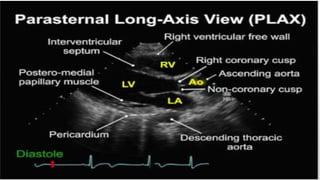
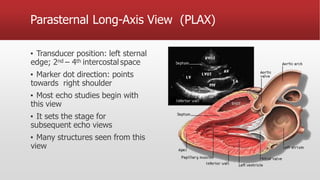
Parasternal Long-Axis View (PLAX)
▪ Transducer position: left sternal
edge; 2nd – 4th intercostal space
▪ Marker dot direction: points
towards right shoulder
▪ Most echo studies begin with
this view
▪ It sets the stage for
subsequent echo views
▪ Many structures seen from this
view
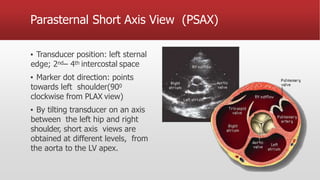
Parasternal Short Axis View (PSAX)
▪ Transducer position: left sternal
edge; 2nd– 4th intercostal space
▪ Marker dot direction: points
towards left shoulder(900
clockwise from PLAX view)
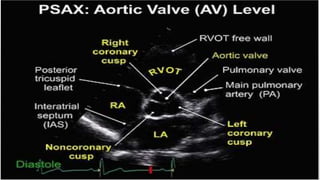
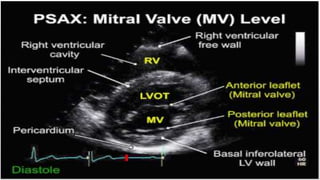
▪ By tilting transducer on an axis
between the left hip and right
shoulder, short axis views are
obtained at different levels, from
the aorta to the LV apex.
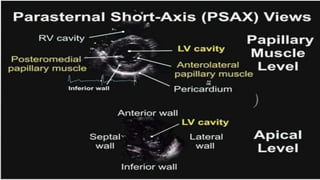
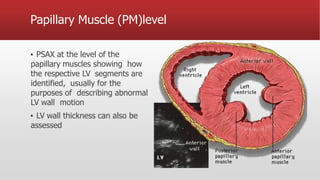
Papillary Muscle (PM)level
▪ PSAX at the level of the
papillary muscles showing how
the respective LV segments are
identified, usually for the
purposes of describing abnormal
LV wall motion
▪ LV wall thickness can also be
assessed
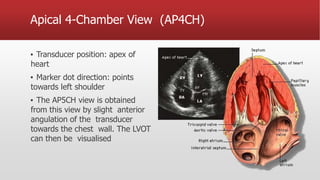
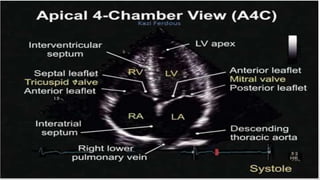
Apical 4-Chamber View (AP4CH)
▪ Transducer position: apex of
heart
▪ Marker dot direction: points
towards left shoulder
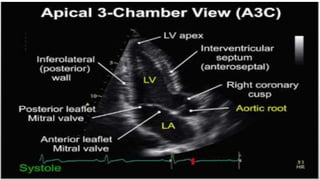
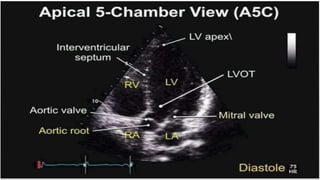
▪ The AP5CH view is obtained
from this view by slight anterior
angulation of the transducer
towards the chest wall. The LVOT
can then be visualised
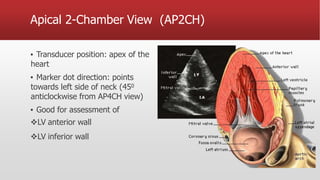
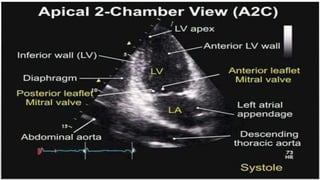
Apical 2-Chamber View (AP2CH)
▪ Transducer position: apex of the
heart
▪ Marker dot direction: points
towards left side of neck (450
anticlockwise from AP4CH view)
▪ Good for assessment of
LV anterior wall
LV inferior wall
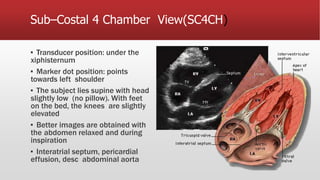
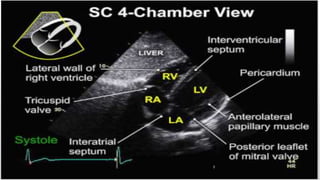
Sub–Costal 4 Chamber View(SC4CH)
▪ Transducer position: under the
xiphisternum
▪ Marker dot position: points
towards left shoulder
▪ The subject lies supine with head
slightly low (no pillow). With feet
on the bed, the knees are slightly
elevated
▪ Better images are obtained with
the abdomen relaxed and during
inspiration
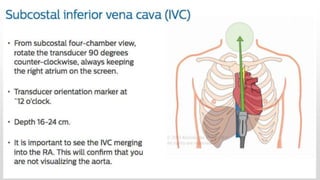
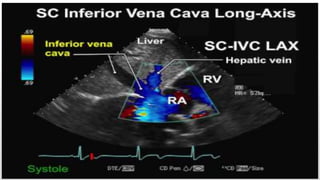
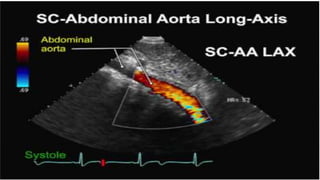
▪ Interatrial septum, pericardial
effusion, desc abdominal aorta
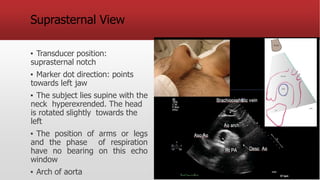
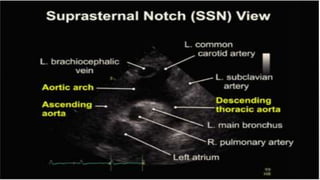
Suprasternal View
▪ Transducer position:
suprasternal notch
▪ Marker dot direction: points
towards left jaw
▪ The subject lies supine with the
neck hyperexrended. The head
is rotated slightly towards the
left
▪ The position of arms or legs
and the phase of respiration
have no bearing on this echo
window
▪ Arch of aorta
Transoesophageal Echo
▪ clinical success of transesophageal echocardiography
▪ First, the close proximity of the esophagus to the posterior
wall of the heart makes this approach ideal for examining
several important structures. Second, the ability to position the
transducer in the esophagus or stomach for extended periods
provides an opportunity to monitor the heart over time, such
as during cardiac surgery. Third, although more invasive than
other forms of echocardiography, the technique has proven to
be extremely safe and well tolerated so that it can be
performed in critically ill patients and very small infants.
Cont....
▪ A form of upper endoscopy
▪ Informed consent should be obtained.
▪ The patient should fast for at least 4 to 6hours
▪ Any history of dysphagia or other forms ofesophageal abnormalities
should be sought.
▪ Intravenous access and both supplemental oxygen andsuction should
be available
▪ use topical anesthetic to numb the posterior pharynx
▪ Airway can be inserted
Indications for TEE
▪ Assessment of:
 Non-diagnostic TTE
Prosthetic valves
 Infective endocarditis
 Cardiac tumors
 Atrial septal abnormalities
 Aortic dissection
 Intra-operative monitoring
 Suspected cardio-embolic event
Contraindications for TEE
 Esophageal pathology
 Severe dysphagia
 Esophageal stricture
 Esophageal diverticula
 Bleeding esophageal varices
 Esophageal cancer
 Cervical spine disorders
 Severe atlantoaxial joint disorders
 Orthopedic conditions that prevent neck flexion
Procedure of TEE
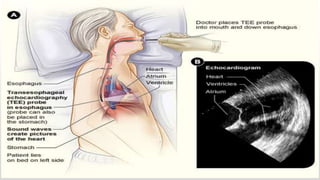
▪ T he patient is placed in the left lateral decubitus position.
▪ Dentures should be removed, and in most patients, a bite
block is placed between the teeth to prevent damage to the
probe.
▪ After the probe has been lubricated with surgical jelly, it is
introduced into the oropharynx and gradually advanced while
the patient is urged to facilitate intubation.
▪ Once the probe has passed into the esophagus, a complete
examination can usually be performed in 10 to 30 minutes.
Epicardial Imaging
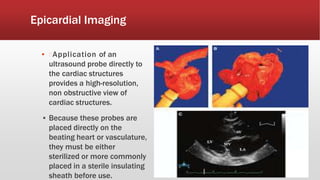
▪ Application of an
ultrasound probe directly to
the cardiac structures
provides a high-resolution,
non obstructive view of
cardiac structures.
▪ Because these probes are
placed directly on the
beating heart or vasculature,
they must be either
sterilized or more commonly
placed in a sterile insulating
sheath before use.
Intravascular Echocardiography
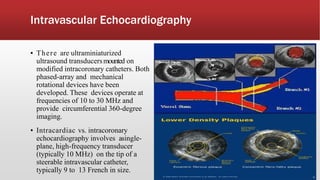
▪ There are ultraminiaturized
ultrasound transducersmounted on
modified intracoronary catheters. Both
phased-array and mechanical
rotational devices have been
developed. These devices operate at
frequencies of 10 to 30 MHz and
provide circumferential 360-degree
imaging.
▪ Intracardiac vs. intracoronary
echocardiography involves asingle-
plane, high-frequency transducer
(typically 10 MHz) on the tip of a
steerable intravascular catheter,
typically 9 to 13 French in size.
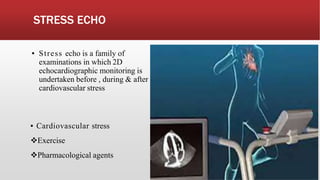
STRESS ECHO
▪ Stress echo is a family of
examinations in which 2D
echocardiographic monitoring is
undertaken before , during & after
cardiovascular stress
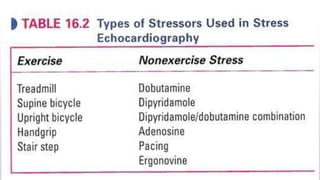
▪ Cardiovascular stress
Exercise
Pharmacological agents
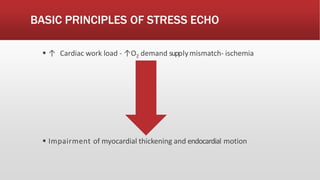
BASIC PRINCIPLES OF STRESS ECHO
 ↑ Cardiac work load - ↑O2 demand supplymismatch- ischemia
 Impairment of myocardial thickening and endocardial motion
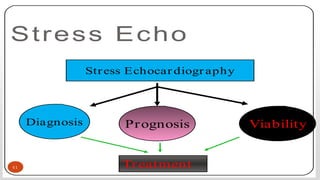
Stress Echo
Stress Echocar diogr aphy
Diagnosis Prognosis Viability
Treatment41
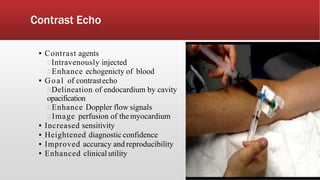
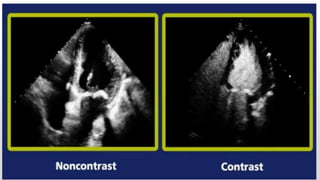
Contrast Echo
▪ Contrast agents
Intravenously injected
Enhance echogenicty of blood
▪ Goal of contrastecho
Delineation of endocardium by cavity
opacification
Enhance Doppler flow signals
Image perfusion of themyocardium
▪ Increased sensitivity
▪ Heightened diagnostic confidence
▪ Improved accuracy and reproducibility
▪ Enhanced clinical utility
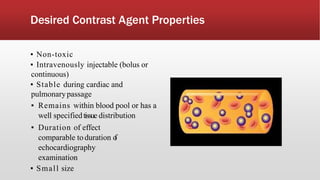
Desired Contrast Agent Properties
▪ Non-toxic
▪ Intravenously injectable (bolus or
continuous)
▪ Stable during cardiac and
pulmonarypassage
▪ Remains within blood pool or has a
well specifiedtissue distribution
▪ Duration of effect
comparable to duration of
echocardiography
examination
▪ Small size
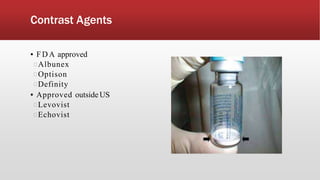
Contrast Agents
▪ FDA approved
Albunex
Optison
Definity
▪ Approved outside US
Levovist
Echovist
Conclusion
▪ Echocardiography provides a substantial amount of structural and
functional information about heart.
▪ Still frames provide anatomical detail.
▪ Dynamic images tell us heart physiology.
▪ The quality of echo is highly operator dependent and
proportional to experience and skills.
Echocardiography

Echocardiography

  • 1.
    ECHO- CARDIOGRAPHY AROOSA MANAZIR LECTURER, RADIOGRAPHY& IMAGING TECHNOLOGY AFRO ASIAN INSTITUTE, LAHORE PAKISTAN
  • 2.
    List of Contents ▪Definition ▪ Basic Principle ▪ Utility of Echo ▪ Echocardiography Machine ▪ Cardiac Anatomy ▪ Indications ▪ Modalities of Echocardiography ▪ Types of Echocardiography ▪ Detailed Description
  • 3.
  • 4.
    Definition: Echocardiography is a typeof ultrasound test that uses high pitched sound waves to create the image of heart.
  • 5.
    Basic Principle The soundwaves are sent through a device called a transducer and are reflected off the various structures of the heart. These echoes are converted into pictures of the heart that can be seen on a video monitor. Ultrasound gel is applied to the transducer to allow transmission of the sound waves from the transducer to the skin The transducer transforms the echo (mechanical energy) into an electrical signal which is processed and displayed as an image on the screen.
  • 8.
    Grey Scale Image ▪Grey scale image is generated based on intensity of reflected echoes. Black Fluid or blood Grey Myocardium White Calcifications on cardiac valves/ pericardium
  • 9.
    Utility of Echocardiography ▪A non-invasive diagnostic technique ▪ Widely used in clinical cardiology ▪ Involves use of ultrasound , so have no radiation risks ▪ Used to assess cardiacstructure and haemodynamic function.
  • 10.
    Machine There are 5basic components of an ultrasound scanner that are required for generation, display and storage of an ultrasound image. 1. Pulse generator - applies high amplitude voltage to energize the crystals 2. Transducer - converts electrical energy to mechanical (ultrasound) energy and vice versa 3. Receiver - detects and amplifies weak signals 4. Display - displays ultrasound signals in a variety of modes 5. Memory - stores video display
  • 11.
  • 12.
  • 14.
    Indications ▪ May bedivides into Structural imaging and haemodynamic imaging. ▪ Indications for Structural Imaging:  Pericardial imaging (pericardial effusion)  Ventricles & cavities ( Wall motion and thrombi)  Imaging of valves (stenosis or prolapse)  Great vessels (Aortic dissections) Congenital & traumatic heart diseases  Hypertension, murmurs, suspected IHD, pulmonary diseases  Arrythmias, palpitations
  • 15.
    Indications ▪ Indiacations forHaemodynamic Imaging:  Blood flow through heart valves  Blood flow through cardiac chambers  Systolic and diastolic functions
  • 16.
    Modalities of Echo ▪The following modalities of echo are used clinically: 1. Conventional echo ▪ Two-Dimensional echo (2-D echo) ▪ Motion- mode echo (M-mode echo) 2. Doppler Echo ▪ Continuous wave (CW) Doppler ▪ Pulsed wave (PW) Doppler ▪ Colour flow(CF) Doppler ▪ All modalities follow the same principle of ultrasound ▪ Differ in how reflected sound waves are collected and analysed
  • 17.
    Two-Dimensional Echo (2-Decho) ▪ This technique is used to "see" the actual structures and motion of the heart structures at work. ▪ Ultrasound is transmitted along several scan lines(90-120), over a wide arc(about 900) and many times per second. ▪ The combination of reflected ultrasound signals builds up an image on the display screen. ▪ A 2-D echo view appears cone- shaped on the monitor.
  • 18.
    M-Mode echocardiography ▪ AnM- mode echocardiogram is not a "picture" of the heart, but rather a diagram that shows how the positions of its structures change during the course of the cardiac cycle. ▪ M-mode recordings permit measurement of cardiac dimensions and motion patterns. ▪ Also facilitate analysis of time relationships with other physiological variables such as ECG, and heart sounds. ▪ Better display of Thickness of ventricular valves Changing size of cardiac chambers Opening & closure of valves
  • 19.
    Doppler Echocardiography ▪ Dopplerechocardiography is a method for detecting the direction and velocity of moving blood within the heart. ▪ Pulsed Wave (PW) useful for low velocity flow e.g. MV flow ▪ Continuous Wave (CW) useful for high velocity flow e.g aortic stenosis ▪ Color Flow (CF) Different colors are used to designate the direction of blood flow. Red is flow toward, and blue is flow away from the transducer (BART) with turbulent flow shown as a mosaic pattern.
  • 21.
    Types of Echocardiography ▪Trans-thoracic  Parasternal window  Subcostal window  Apical window  Supraternal window ▪ Trans-esophageal ▪ Intra-vascular  Intracardiac  Intracoronary ▪ Epicardial ▪ Stress Echo ▪ Contrast Echo
  • 22.
    Transthoracic Echo ▪ Astandard echocardiogram is also known as a transthoracic ▪ echocardiogram (TTE), or cardiac ultrasound. ▪ The subject is asked to lie in the semi recumbent position on his or her left side with the head elevated. ▪ The left arm is tucked under the head and the right arm lies along the right side of the body ▪ Standard positions on the chest wall are used for placement of the transducer called “echo windows”
  • 25.
    Parasternal Long-Axis View(PLAX) ▪ Transducer position: left sternal edge; 2nd – 4th intercostal space ▪ Marker dot direction: points towards right shoulder ▪ Most echo studies begin with this view ▪ It sets the stage for subsequent echo views ▪ Many structures seen from this view
  • 27.
    Parasternal Short AxisView (PSAX) ▪ Transducer position: left sternal edge; 2nd– 4th intercostal space ▪ Marker dot direction: points towards left shoulder(900 clockwise from PLAX view) ▪ By tilting transducer on an axis between the left hip and right shoulder, short axis views are obtained at different levels, from the aorta to the LV apex.
  • 28.
    Papillary Muscle (PM)level ▪PSAX at the level of the papillary muscles showing how the respective LV segments are identified, usually for the purposes of describing abnormal LV wall motion ▪ LV wall thickness can also be assessed
  • 32.
    Apical 4-Chamber View(AP4CH) ▪ Transducer position: apex of heart ▪ Marker dot direction: points towards left shoulder ▪ The AP5CH view is obtained from this view by slight anterior angulation of the transducer towards the chest wall. The LVOT can then be visualised
  • 34.
    Apical 2-Chamber View(AP2CH) ▪ Transducer position: apex of the heart ▪ Marker dot direction: points towards left side of neck (450 anticlockwise from AP4CH view) ▪ Good for assessment of LV anterior wall LV inferior wall
  • 38.
    Sub–Costal 4 ChamberView(SC4CH) ▪ Transducer position: under the xiphisternum ▪ Marker dot position: points towards left shoulder ▪ The subject lies supine with head slightly low (no pillow). With feet on the bed, the knees are slightly elevated ▪ Better images are obtained with the abdomen relaxed and during inspiration ▪ Interatrial septum, pericardial effusion, desc abdominal aorta
  • 43.
    Suprasternal View ▪ Transducerposition: suprasternal notch ▪ Marker dot direction: points towards left jaw ▪ The subject lies supine with the neck hyperexrended. The head is rotated slightly towards the left ▪ The position of arms or legs and the phase of respiration have no bearing on this echo window ▪ Arch of aorta
  • 45.
    Transoesophageal Echo ▪ clinicalsuccess of transesophageal echocardiography ▪ First, the close proximity of the esophagus to the posterior wall of the heart makes this approach ideal for examining several important structures. Second, the ability to position the transducer in the esophagus or stomach for extended periods provides an opportunity to monitor the heart over time, such as during cardiac surgery. Third, although more invasive than other forms of echocardiography, the technique has proven to be extremely safe and well tolerated so that it can be performed in critically ill patients and very small infants.
  • 46.
    Cont.... ▪ A formof upper endoscopy ▪ Informed consent should be obtained. ▪ The patient should fast for at least 4 to 6hours ▪ Any history of dysphagia or other forms ofesophageal abnormalities should be sought. ▪ Intravenous access and both supplemental oxygen andsuction should be available ▪ use topical anesthetic to numb the posterior pharynx ▪ Airway can be inserted
  • 47.
    Indications for TEE ▪Assessment of:  Non-diagnostic TTE Prosthetic valves  Infective endocarditis  Cardiac tumors  Atrial septal abnormalities  Aortic dissection  Intra-operative monitoring  Suspected cardio-embolic event
  • 48.
    Contraindications for TEE Esophageal pathology  Severe dysphagia  Esophageal stricture  Esophageal diverticula  Bleeding esophageal varices  Esophageal cancer  Cervical spine disorders  Severe atlantoaxial joint disorders  Orthopedic conditions that prevent neck flexion
  • 49.
    Procedure of TEE ▪T he patient is placed in the left lateral decubitus position. ▪ Dentures should be removed, and in most patients, a bite block is placed between the teeth to prevent damage to the probe. ▪ After the probe has been lubricated with surgical jelly, it is introduced into the oropharynx and gradually advanced while the patient is urged to facilitate intubation. ▪ Once the probe has passed into the esophagus, a complete examination can usually be performed in 10 to 30 minutes.
  • 51.
    Epicardial Imaging ▪ Applicationof an ultrasound probe directly to the cardiac structures provides a high-resolution, non obstructive view of cardiac structures. ▪ Because these probes are placed directly on the beating heart or vasculature, they must be either sterilized or more commonly placed in a sterile insulating sheath before use.
  • 52.
    Intravascular Echocardiography ▪ Thereare ultraminiaturized ultrasound transducersmounted on modified intracoronary catheters. Both phased-array and mechanical rotational devices have been developed. These devices operate at frequencies of 10 to 30 MHz and provide circumferential 360-degree imaging. ▪ Intracardiac vs. intracoronary echocardiography involves asingle- plane, high-frequency transducer (typically 10 MHz) on the tip of a steerable intravascular catheter, typically 9 to 13 French in size.
  • 53.
    STRESS ECHO ▪ Stressecho is a family of examinations in which 2D echocardiographic monitoring is undertaken before , during & after cardiovascular stress ▪ Cardiovascular stress Exercise Pharmacological agents
  • 54.
    BASIC PRINCIPLES OFSTRESS ECHO  ↑ Cardiac work load - ↑O2 demand supplymismatch- ischemia  Impairment of myocardial thickening and endocardial motion
  • 56.
    Stress Echo Stress Echocardiogr aphy Diagnosis Prognosis Viability Treatment41
  • 57.
    Contrast Echo ▪ Contrastagents Intravenously injected Enhance echogenicty of blood ▪ Goal of contrastecho Delineation of endocardium by cavity opacification Enhance Doppler flow signals Image perfusion of themyocardium ▪ Increased sensitivity ▪ Heightened diagnostic confidence ▪ Improved accuracy and reproducibility ▪ Enhanced clinical utility
  • 58.
    Desired Contrast AgentProperties ▪ Non-toxic ▪ Intravenously injectable (bolus or continuous) ▪ Stable during cardiac and pulmonarypassage ▪ Remains within blood pool or has a well specifiedtissue distribution ▪ Duration of effect comparable to duration of echocardiography examination ▪ Small size
  • 59.
    Contrast Agents ▪ FDAapproved Albunex Optison Definity ▪ Approved outside US Levovist Echovist
  • 61.
    Conclusion ▪ Echocardiography providesa substantial amount of structural and functional information about heart. ▪ Still frames provide anatomical detail. ▪ Dynamic images tell us heart physiology. ▪ The quality of echo is highly operator dependent and proportional to experience and skills.