UNDERSTANDING
E.C.G
DR. K. MALATHI
M.D. SCHOLAR.
DEPT OF KAYACHIKITSA
CONTENTS
 INTRODUCTION
FUNDAMENTAL PRINCIPLES
CONDUCTION SYSTEM OF HEART
LEADS
WHAT IS ELECTRO CARDIOGRAM
NORMAL ECG
RHYTHM, RATE, NORMAL INTERVALS
CLINICAL INTERPRETATION
INTRODUCTION
 ELECROCARDIOGRAPHY - the process of
producing recording of the heart's electrical activity
through repeated cardiac cycles.
ELECTROCARDIOGRAM - (ECG) is a representation of
the electrical events of the cardiac cycle.
EKG – A German version of the word, is a tool used to
visualize the electricity that flows through the Heart.
HISTORY
1842- Italian scientist Carlo Matteucci realizes
that electricity is associated with the heart beat.
1924 - The noble prize for physiology or
medicine is given to William Einthoven for his
work on ECG.
The importance of the ECG.
▪It is a vital test for determining –
Arrhythmias
Myocardial ischemia and infarction
Pericarditis Chamber hypertrophy
Electrolyte disturbances (i.e. hyperkalemia,
hypokalemia)
Drug toxicity
Fundamental Principles
 Transmembrane ionic currents are ultimately
responsible for the potentials that are recorded as
an ECG.
 An electrode senses positive potentials when an
activation front is moving toward it and negative
potentials when the activation front is moving
away from it.
Fundamental Principles
 Contraction of any muscle is associated with
electrical changes called Depolarization.
 A Phase of recovery/relaxation of any muscle
called Repolarization.
 These changes can be detected by electrodes
attached to the surface of the body.
Conduction system of the Heart
 THE SINO-ATRIAL (SA)
NODE.
 THE ATRIO-VENTRICULAR
(AV) NODE.
 THE BUNDLE OF HIS.
 THE LEFT AND RIGHT
BUNDLE BRANCHES.
 THE PURKINJE FIBRES.
ECG Leads
 The standard ECG has 12 leads:
3 Standard Limb Leads
3 Augmented Limb Leads
6 Precordial Leads
 Bipolar Leads: Two different points on the
body.
 Unipolar Leads: One point on the body and
a virtual reference point with zero electrical
potential, located in the center of the heart
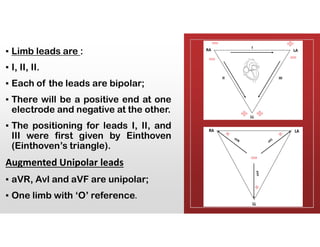
▪ Limb leads are :
▪ I, II, II.
▪ Each of the leads are bipolar;
▪ There will be a positive end at one
electrode and negative at the other.
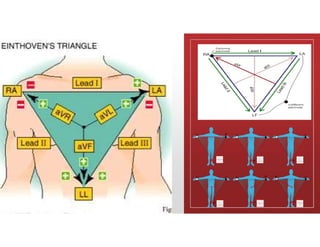
▪ The positioning for leads I, II, and
III were first given by Einthoven
(Einthoven’s triangle).
Augmented Unipolar leads
▪ aVR, Avl and aVF are unipolar;
▪ One limb with ‘O’ reference.
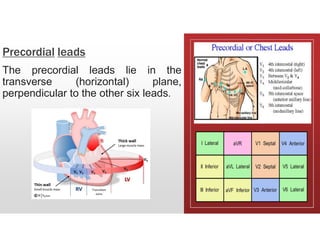
Precordial leads
The precordial leads lie in the
transverse (horizontal) plane,
perpendicular to the other six leads.
The ECG Paper
Horizontally
One small box - 0.04 s
One large box - 0.20 s
Vertically
One large box - 0.5 mV
•Speed = 25mm/sec
•VLimb Leads = 10mm/mV
•VChest Leads = 10mm/mV
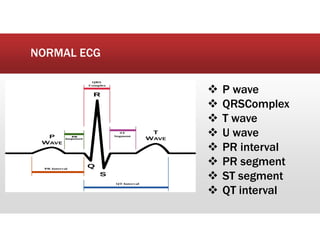
NORMAL ECG
 P wave
 QRSComplex
 T wave
 U wave
 PR interval
 PR segment
 ST segment
 QT interval
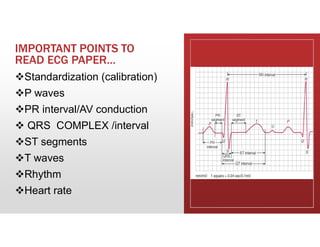
IMPORTANT POINTS TO
READ ECG PAPER…
Standardization (calibration)
P waves
PR interval/AV conduction
 QRS COMPLEX /interval
ST segments
T waves
Rhythm
Heart rate
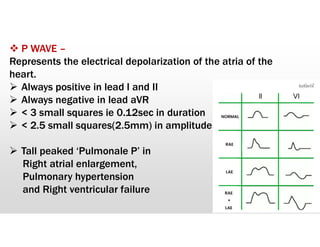
 P WAVE –
Represents the electrical depolarization of the atria of the
heart.
 Always positive in lead I and II
 Always negative in lead aVR
 < 3 small squares ie 0.12sec in duration
 < 2.5 small squares(2.5mm) in amplitude
 Tall peaked ‘Pulmonale P’ in
Right atrial enlargement,
Pulmonary hypertension
and Right ventricular failure
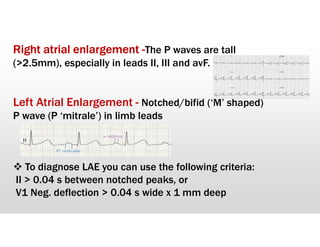
Right atrial enlargement -The P waves are tall
(>2.5mm), especially in leads II, III and avF.
Left Atrial Enlargement - Notched/bifid (‘M’ shaped)
P wave (P ‘mitrale’) in limb leads
 To diagnose LAE you can use the following criteria:
II > 0.04 s between notched peaks, or
V1 Neg. deflection > 0.04 s wide x 1 mm deep
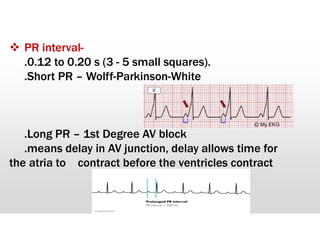
 PR interval-
.0.12 to 0.20 s (3 - 5 small squares).
.Short PR – Wolff-Parkinson-White
.Long PR – 1st Degree AV block
.means delay in AV junction, delay allows time for
the atria to contract before the ventricles contract
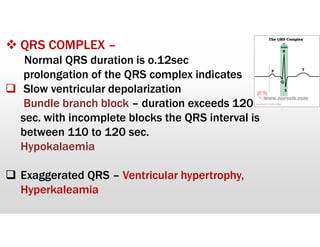
 QRS COMPLEX –
Normal QRS duration is o.12sec
prolongation of the QRS complex indicates
 Slow ventricular depolarization
Bundle branch block – duration exceeds 120
sec. with incomplete blocks the QRS interval is
between 110 to 120 sec.
Hypokalaemia
 Exaggerated QRS – Ventricular hypertrophy,
Hyperkaleamia
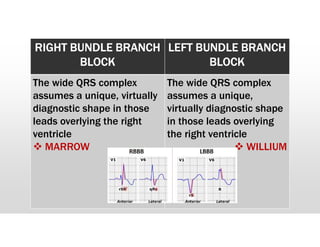
RIGHT BUNDLE BRANCH
BLOCK
LEFT BUNDLE BRANCH
BLOCK
The wide QRS complex
assumes a unique, virtually
diagnostic shape in those
leads overlying the right
ventricle
 MARROW
The wide QRS complex
assumes a unique,
virtually diagnostic shape
in those leads overlying
the right ventricle
 WILLIUM
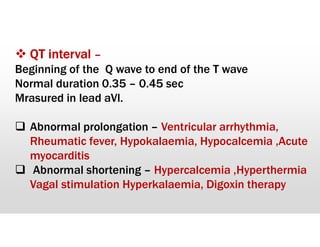
 QT interval –
Beginning of the Q wave to end of the T wave
Normal duration 0.35 – 0.45 sec
Mrasured in lead aVl.
 Abnormal prolongation – Ventricular arrhythmia,
Rheumatic fever, Hypokalaemia, Hypocalcemia ,Acute
myocarditis
 Abnormal shortening – Hypercalcemia ,Hyperthermia
Vagal stimulation Hyperkalaemia, Digoxin therapy
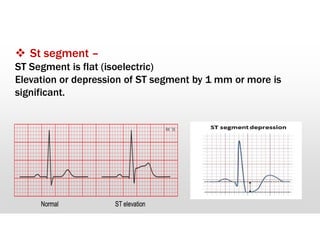
 St segment –
ST Segment is flat (isoelectric)
Elevation or depression of ST segment by 1 mm or more is
significant.
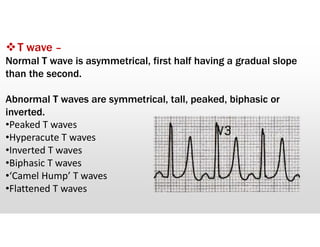
T wave –
Normal T wave is asymmetrical, first half having a gradual slope
than the second.
Abnormal T waves are symmetrical, tall, peaked, biphasic or
inverted.
•Peaked T waves
•Hyperacute T waves
•Inverted T waves
•Biphasic T waves
•‘Camel Hump’ T waves
•Flattened T waves
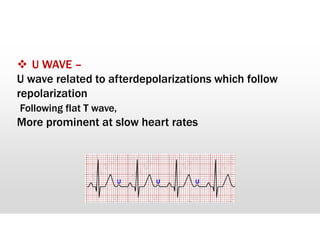
 U WAVE –
U wave related to afterdepolarizations which follow
repolarization
Following flat T wave,
More prominent at slow heart rates
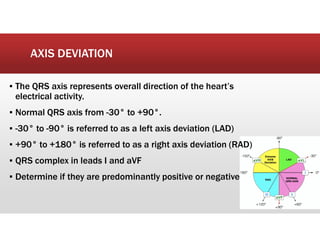
AXIS DEVIATION
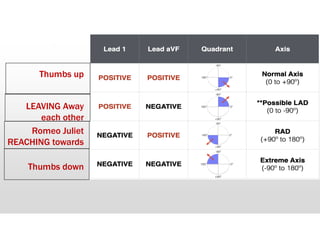
▪ The QRS axis represents overall direction of the heart’s
electrical activity.
▪ Normal QRS axis from -30° to +90°.
▪ -30° to -90° is referred to as a left axis deviation (LAD)
▪ +90° to +180° is referred to as a right axis deviation (RAD)
▪ QRS complex in leads I and aVF
▪ Determine if they are predominantly positive or negative
Thumbs up
Romeo Juliet
REACHING towards
Thumbs down
LEAVING Away
each other
RHYTHM
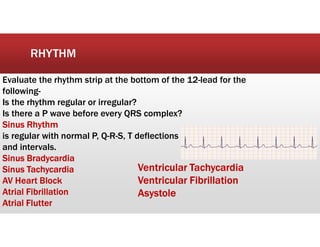
Evaluate the rhythm strip at the bottom of the 12-lead for the
following-
Is the rhythm regular or irregular?
Is there a P wave before every QRS complex?
Sinus Rhythm
is regular with normal P, Q-R-S, T deflections
and intervals.
Sinus Bradycardia
Sinus Tachycardia
AV Heart Block
Atrial Fibrillation
Atrial Flutter
Ventricular Tachycardia
Ventricular Fibrillation
Asystole
RATE
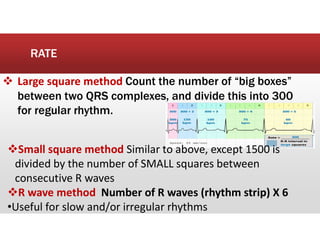
 Large square method Count the number of “big boxes”
between two QRS complexes, and divide this into 300
for regular rhythm.
Small square method Similar to above, except 1500 is
divided by the number of SMALL squares between
consecutive R waves
R wave method Number of R waves (rhythm strip) X 6
•Useful for slow and/or irregular rhythms
Technical Errors and Artifacts
Artifacts that may interfere with interpretation can come
from movement of the patient or electrodes, electrical
disturbances related to current leakage and grounding
failure, and external sources such as electrical stimulators
or cauteries.
Misplacement of one or more electrodes is a common
cause for errors.
Significant misplacement of precordial electrodes.
Dr.K.Malathi
M.D.Scholar
Dept.Of kayachikitsa

E.C.G. UNDERSTANDING AND INTERPRETATION

  • 1.
    UNDERSTANDING E.C.G DR. K. MALATHI M.D.SCHOLAR. DEPT OF KAYACHIKITSA
  • 2.
    CONTENTS  INTRODUCTION FUNDAMENTAL PRINCIPLES CONDUCTIONSYSTEM OF HEART LEADS WHAT IS ELECTRO CARDIOGRAM NORMAL ECG RHYTHM, RATE, NORMAL INTERVALS CLINICAL INTERPRETATION
  • 3.
    INTRODUCTION  ELECROCARDIOGRAPHY -the process of producing recording of the heart's electrical activity through repeated cardiac cycles. ELECTROCARDIOGRAM - (ECG) is a representation of the electrical events of the cardiac cycle. EKG – A German version of the word, is a tool used to visualize the electricity that flows through the Heart.
  • 4.
    HISTORY 1842- Italian scientistCarlo Matteucci realizes that electricity is associated with the heart beat. 1924 - The noble prize for physiology or medicine is given to William Einthoven for his work on ECG.
  • 5.
    The importance ofthe ECG. ▪It is a vital test for determining – Arrhythmias Myocardial ischemia and infarction Pericarditis Chamber hypertrophy Electrolyte disturbances (i.e. hyperkalemia, hypokalemia) Drug toxicity
  • 6.
    Fundamental Principles  Transmembraneionic currents are ultimately responsible for the potentials that are recorded as an ECG.  An electrode senses positive potentials when an activation front is moving toward it and negative potentials when the activation front is moving away from it.
  • 7.
    Fundamental Principles  Contractionof any muscle is associated with electrical changes called Depolarization.  A Phase of recovery/relaxation of any muscle called Repolarization.  These changes can be detected by electrodes attached to the surface of the body.
  • 8.
    Conduction system ofthe Heart  THE SINO-ATRIAL (SA) NODE.  THE ATRIO-VENTRICULAR (AV) NODE.  THE BUNDLE OF HIS.  THE LEFT AND RIGHT BUNDLE BRANCHES.  THE PURKINJE FIBRES.
  • 9.
    ECG Leads  Thestandard ECG has 12 leads: 3 Standard Limb Leads 3 Augmented Limb Leads 6 Precordial Leads  Bipolar Leads: Two different points on the body.  Unipolar Leads: One point on the body and a virtual reference point with zero electrical potential, located in the center of the heart
  • 10.
    ▪ Limb leadsare : ▪ I, II, II. ▪ Each of the leads are bipolar; ▪ There will be a positive end at one electrode and negative at the other. ▪ The positioning for leads I, II, and III were first given by Einthoven (Einthoven’s triangle). Augmented Unipolar leads ▪ aVR, Avl and aVF are unipolar; ▪ One limb with ‘O’ reference.
  • 12.
    Precordial leads The precordialleads lie in the transverse (horizontal) plane, perpendicular to the other six leads.
  • 13.
    The ECG Paper Horizontally Onesmall box - 0.04 s One large box - 0.20 s Vertically One large box - 0.5 mV •Speed = 25mm/sec •VLimb Leads = 10mm/mV •VChest Leads = 10mm/mV
  • 14.
    NORMAL ECG  Pwave  QRSComplex  T wave  U wave  PR interval  PR segment  ST segment  QT interval
  • 15.
    IMPORTANT POINTS TO READECG PAPER… Standardization (calibration) P waves PR interval/AV conduction  QRS COMPLEX /interval ST segments T waves Rhythm Heart rate
  • 16.
     P WAVE– Represents the electrical depolarization of the atria of the heart.  Always positive in lead I and II  Always negative in lead aVR  < 3 small squares ie 0.12sec in duration  < 2.5 small squares(2.5mm) in amplitude  Tall peaked ‘Pulmonale P’ in Right atrial enlargement, Pulmonary hypertension and Right ventricular failure
  • 17.
    Right atrial enlargement-The P waves are tall (>2.5mm), especially in leads II, III and avF. Left Atrial Enlargement - Notched/bifid (‘M’ shaped) P wave (P ‘mitrale’) in limb leads  To diagnose LAE you can use the following criteria: II > 0.04 s between notched peaks, or V1 Neg. deflection > 0.04 s wide x 1 mm deep
  • 18.
     PR interval- .0.12to 0.20 s (3 - 5 small squares). .Short PR – Wolff-Parkinson-White .Long PR – 1st Degree AV block .means delay in AV junction, delay allows time for the atria to contract before the ventricles contract
  • 19.
     QRS COMPLEX– Normal QRS duration is o.12sec prolongation of the QRS complex indicates  Slow ventricular depolarization Bundle branch block – duration exceeds 120 sec. with incomplete blocks the QRS interval is between 110 to 120 sec. Hypokalaemia  Exaggerated QRS – Ventricular hypertrophy, Hyperkaleamia
  • 20.
    RIGHT BUNDLE BRANCH BLOCK LEFTBUNDLE BRANCH BLOCK The wide QRS complex assumes a unique, virtually diagnostic shape in those leads overlying the right ventricle  MARROW The wide QRS complex assumes a unique, virtually diagnostic shape in those leads overlying the right ventricle  WILLIUM
  • 21.
     QT interval– Beginning of the Q wave to end of the T wave Normal duration 0.35 – 0.45 sec Mrasured in lead aVl.  Abnormal prolongation – Ventricular arrhythmia, Rheumatic fever, Hypokalaemia, Hypocalcemia ,Acute myocarditis  Abnormal shortening – Hypercalcemia ,Hyperthermia Vagal stimulation Hyperkalaemia, Digoxin therapy
  • 22.
     St segment– ST Segment is flat (isoelectric) Elevation or depression of ST segment by 1 mm or more is significant.
  • 23.
    T wave – NormalT wave is asymmetrical, first half having a gradual slope than the second. Abnormal T waves are symmetrical, tall, peaked, biphasic or inverted. •Peaked T waves •Hyperacute T waves •Inverted T waves •Biphasic T waves •‘Camel Hump’ T waves •Flattened T waves
  • 24.
     U WAVE– U wave related to afterdepolarizations which follow repolarization Following flat T wave, More prominent at slow heart rates
  • 25.
    AXIS DEVIATION ▪ TheQRS axis represents overall direction of the heart’s electrical activity. ▪ Normal QRS axis from -30° to +90°. ▪ -30° to -90° is referred to as a left axis deviation (LAD) ▪ +90° to +180° is referred to as a right axis deviation (RAD) ▪ QRS complex in leads I and aVF ▪ Determine if they are predominantly positive or negative
  • 26.
    Thumbs up Romeo Juliet REACHINGtowards Thumbs down LEAVING Away each other
  • 27.
    RHYTHM Evaluate the rhythmstrip at the bottom of the 12-lead for the following- Is the rhythm regular or irregular? Is there a P wave before every QRS complex? Sinus Rhythm is regular with normal P, Q-R-S, T deflections and intervals. Sinus Bradycardia Sinus Tachycardia AV Heart Block Atrial Fibrillation Atrial Flutter Ventricular Tachycardia Ventricular Fibrillation Asystole
  • 28.
    RATE  Large squaremethod Count the number of “big boxes” between two QRS complexes, and divide this into 300 for regular rhythm. Small square method Similar to above, except 1500 is divided by the number of SMALL squares between consecutive R waves R wave method Number of R waves (rhythm strip) X 6 •Useful for slow and/or irregular rhythms
  • 29.
    Technical Errors andArtifacts Artifacts that may interfere with interpretation can come from movement of the patient or electrodes, electrical disturbances related to current leakage and grounding failure, and external sources such as electrical stimulators or cauteries. Misplacement of one or more electrodes is a common cause for errors. Significant misplacement of precordial electrodes.
  • 30.