CHEST PAIN
MARYAM JAMILAH BINTI ABDUL HAMID
082013100002
IMS BANGALORE
Learning Outcome
• Definition
• Type of chest pain
• Etiology
• Characteristic of cardiac chest pain
• Ischaemic cardiac pain vs non-cardiac
chest pain
• Differential diagnosis
Chest Pain
Definition:
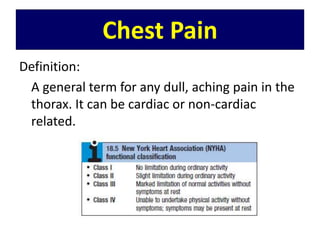
A general term for any dull, aching pain in the
thorax. It can be cardiac or non-cardiac
related.
Etiology
Cardiac
• Myocardial
ischemia & trauma
• Angina pectoris
• Acute Coronary
Syndromes
Non-Cardiac
•Aortic stenosis
•Aortic dissection
•Pericarditis
•Pulmonary embolism
•Pulmonary hypertension
•Pneumonia/pleuritis
•Spontaneous hypertension
•Esophageal reflux
•Esophageal spasm
•Peptic ulcer
•Gallbladder disease
•Musculoskeletal disease
•Herpes zoster
•Emotional & psychiatric
conditions
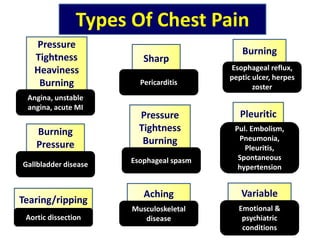
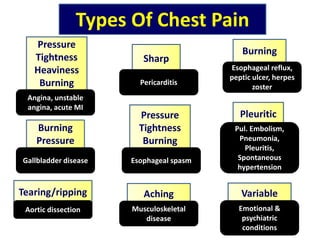
Types Of Chest Pain
Pleuritic
Sharp
Burning
Pressure
Tightness
Heaviness
Burning
Tearing/ripping
Burning
Pressure
Angina, unstable
angina, acute MI
Pericarditis
Aortic dissection
Gallbladder disease
Pul. Embolism,
Pneumonia,
Pleuritis,
Spontaneous
hypertension
Esophageal reflux,
peptic ulcer, herpes
zoster
Pressure
Tightness
Burning
VariableAching
Emotional &
psychiatric
conditions
Esophageal spasm
Musculoskeletal
disease
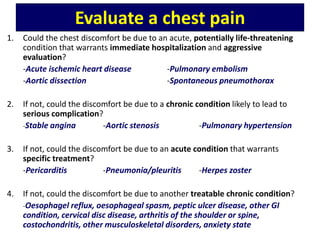
Evaluate a chest pain
1. Could the chest discomfort be due to an acute, potentially life-threatening
condition that warrants immediate hospitalization and aggressive
evaluation?
-Acute ischemic heart disease -Pulmonary embolism
-Aortic dissection -Spontaneous pneumothorax
2. If not, could the discomfort be due to a chronic condition likely to lead to
serious complication?
-Stable angina -Aortic stenosis -Pulmonary hypertension
3. If not, could the discomfort be due to an acute condition that warrants
specific treatment?
-Pericarditis -Pneumonia/pleuritis -Herpes zoster
4. If not, could the discomfort be due to another treatable chronic condition?
-Oesophagel reflux, oesophageal spasm, peptic ulcer disease, other GI
condition, cervical disc disease, arthritis of the shoulder or spine,
costochondritis, other musculoskeletal disorders, anxiety state
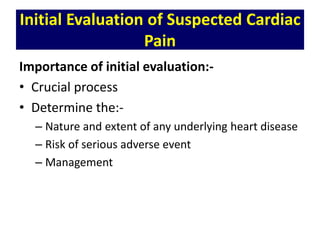
Initial Evaluation of Suspected Cardiac
Pain
Importance of initial evaluation:-
• Crucial process
• Determine the:-
– Nature and extent of any underlying heart disease
– Risk of serious adverse event
– Management
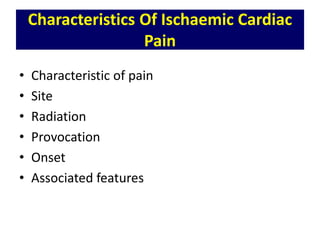
Characteristics Of Ischaemic Cardiac
Pain
• Characteristic of pain
• Site
• Radiation
• Provocation
• Onset
• Associated features
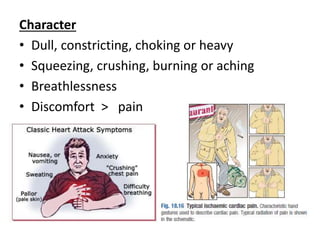
Character
• Dull, constricting, choking or heavy
• Squeezing, crushing, burning or aching
• Breathlessness
• Discomfort > pain
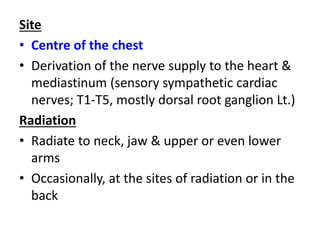
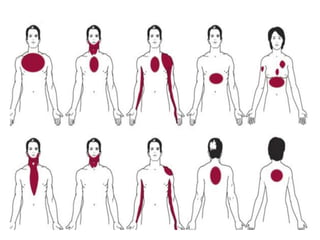
Site
• Centre of the chest
• Derivation of the nerve supply to the heart &
mediastinum (sensory sympathetic cardiac
nerves; T1-T5, mostly dorsal root ganglion Lt.)
Radiation
• Radiate to neck, jaw & upper or even lower
arms
• Occasionally, at the sites of radiation or in the
back
Provocation
• Angina pain: during exertion and promptly
relieved by rest (<5 minutes), pain may
exacerbated by emotion but occur more
readily by exertion; large meal, cold wind
• Crescendo/Unstable angina: similar pain can
be precipitated by minimal exertion or at rest
• Decubitus angina: increase venous
return/preload by lying down can provoke
pain in vulnerable patients
Onset
• Myocardial infarction (MI): Pain of MI takes
several minutes or longer to develop
• Angina: Pain builds up gradually in proportion
to the intensity of exertion
• Aortic dissection, massive pulmonary
embolism or pneumothorax : Pain is very
sudden or instantaneous
• Musculoskeletal or psychological: Pain occur
after exertion
Associated features
• Autonomic disturbance; sweating, nausea,
vomiting
• Breathlessness: pulmonary congestion from
transient ischaemic Lt. ventricular dysfunction
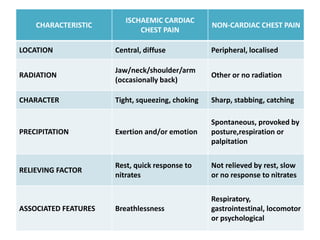
CHARACTERISTIC
ISCHAEMIC CARDIAC
CHEST PAIN
NON-CARDIAC CHEST PAIN
LOCATION Central, diffuse Peripheral, localised
RADIATION
Jaw/neck/shoulder/arm
(occasionally back)
Other or no radiation
CHARACTER Tight, squeezing, choking Sharp, stabbing, catching
PRECIPITATION Exertion and/or emotion
Spontaneous, provoked by
posture,respiration or
palpitation
RELIEVING FACTOR
Rest, quick response to
nitrates
Not relieved by rest, slow
or no response to nitrates
ASSOCIATED FEATURES Breathlessness
Respiratory,
gastrointestinal, locomotor
or psychological
Differential Diagnosis of
Chest Pain
• Anxiety/emotion
• Cardiac
• Aortic
• Oesophageal
• Lungs/pleura
• Musculoskeletal
• Neurological
Anxiety
• Common cause for atypical chest pain
• Lack of relationship with exercise
• Receiving bad news
Cardiac
• Myocardial ishaemia (angina), MI, myocarditis,
pericarditis, mitral valve prolapse
• Myocarditis & pericarditis:
– Pain felt retrosternally, to the Lt. of the sternum, or in
the Lt./Rt. Shoulder
– Intensity varies with movement and phase of
respiration. ‘sharp’ and may ‘catch’ during inspiration,
coughing or lying flat.
– Occasionally, history of prodromal viral illness
Aortic
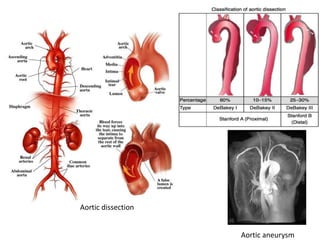
• Aortic dissection, aortic aneurysm
• Aortic dissection:
– Pain is severe, sharp and tearing
– Penetrating through to the back
– Abrupt in onset
– Pain follows path of the dissection
Aortic aneurysm
Aortic dissection
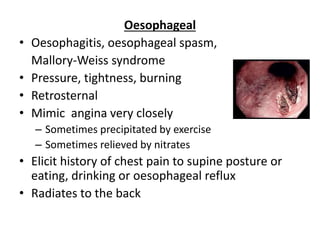
Oesophageal
• Oesophagitis, oesophageal spasm,
Mallory-Weiss syndrome
• Pressure, tightness, burning
• Retrosternal
• Mimic angina very closely
– Sometimes precipitated by exercise
– Sometimes relieved by nitrates
• Elicit history of chest pain to supine posture or
eating, drinking or oesophageal reflux
• Radiates to the back
Lungs/Pleura
• Bronchospasm, pulmonary infarct,
pneumonia, tracheitis, pneumothorax,
pulmonary embolism, malignancy,
tuberculosis
• Bronchospasm:
– Reversible airways obstruction (e.g. asthma):
exertional chest tightness that is relieved by rest.
Difficult to distinguish from ischaemic chest
tightness
• Pneumonia, pleuritis and pulmonary
embolism:
– Pleuritic pain (sharp pain when breathing)
Musculoskeletal
• Osteoarthritis, rib fracture/injury, costochondritis
(Tietze’s syndrome), intercostal muscle injury,
epidemic myalgia (Bornholm disease-by
coxsackievirus)
• Aching
• Very variable in site and intensity
• Vary with posture and movement of upper body
• Can be accompanied by local tenderness over a
rib or costal cartilage
• Injuries related to everyday activities or viral
infection
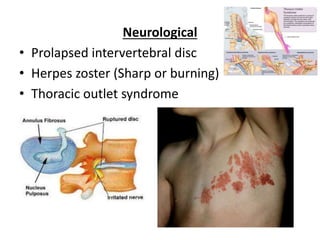
Neurological
• Prolapsed intervertebral disc
• Herpes zoster (Sharp or burning)
• Thoracic outlet syndrome
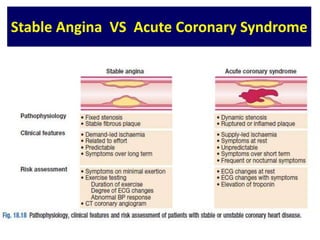
Stable Angina VS Acute Coronary Syndrome
STABLE ANGINA ACUTE CORONARY SYNDROMES
(unstable angina, STEMI, NSTEMI)
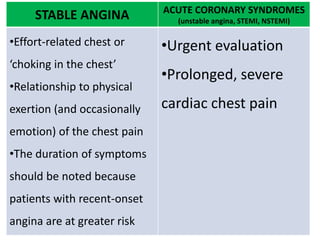
•Effort-related chest or
‘choking in the chest’
•Relationship to physical
exertion (and occasionally
emotion) of the chest pain
•The duration of symptoms
should be noted because
patients with recent-onset
angina are at greater risk
•Urgent evaluation
•Prolonged, severe
cardiac chest pain
STABLE ANGINA ACUTE CORONARY SYNDROMES
(unstable angina, STEMI, NSTEMI)
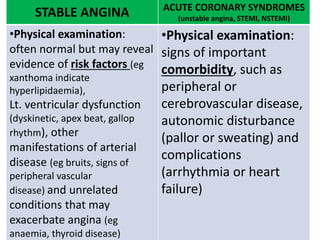
•Physical examination:
often normal but may reveal
evidence of risk factors (eg
xanthoma indicate
hyperlipidaemia),
Lt. ventricular dysfunction
(dyskinetic, apex beat, gallop
rhythm), other
manifestations of arterial
disease (eg bruits, signs of
peripheral vascular
disease) and unrelated
conditions that may
exacerbate angina (eg
anaemia, thyroid disease)
•Physical examination:
signs of important
comorbidity, such as
peripheral or
cerebrovascular disease,
autonomic disturbance
(pallor or sweating) and
complications
(arrhythmia or heart
failure)
STABLE ANGINA ACUTE CORONARY SYNDROMES
(unstable angina, STEMI, NSTEMI)
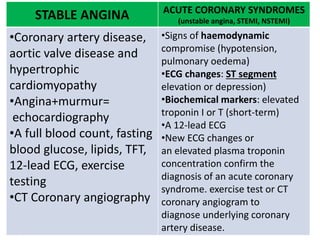
•Coronary artery disease,
aortic valve disease and
hypertrophic
cardiomyopathy
•Angina+murmur=
echocardiography
•A full blood count, fasting
blood glucose, lipids, TFT,
12-lead ECG, exercise
testing
•CT Coronary angiography
•Signs of haemodynamic
compromise (hypotension,
pulmonary oedema)
•ECG changes: ST segment
elevation or depression)
•Biochemical markers: elevated
troponin I or T (short-term)
•A 12-lead ECG
•New ECG changes or
an elevated plasma troponin
concentration confirm the
diagnosis of an acute coronary
syndrome. exercise test or CT
coronary angiogram to
diagnose underlying coronary
artery disease.
Types Of Chest Pain
Pleuritic
Sharp
Burning
Pressure
Tightness
Heaviness
Burning
Tearing/ripping
Burning
Pressure
Angina, unstable
angina, acute MI
Pericarditis
Aortic dissection
Gallbladder disease
Pul. Embolism,
Pneumonia,
Pleuritis,
Spontaneous
hypertension
Esophageal reflux,
peptic ulcer, herpes
zoster
Pressure
Tightness
Burning
VariableAching
Emotional &
psychiatric
conditions
Esophageal spasm
Musculoskeletal
disease
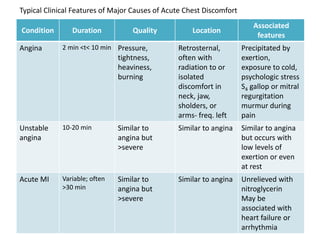
Condition Duration Quality Location
Associated
features
Angina 2 min <t< 10 min Pressure,
tightness,
heaviness,
burning
Retrosternal,
often with
radiation to or
isolated
discomfort in
neck, jaw,
sholders, or
arms- freq. left
Precipitated by
exertion,
exposure to cold,
psychologic stress
S4 gallop or mitral
regurgitation
murmur during
pain
Unstable
angina
10-20 min Similar to
angina but
>severe
Similar to angina Similar to angina
but occurs with
low levels of
exertion or even
at rest
Acute MI Variable; often
>30 min
Similar to
angina but
>severe
Similar to angina Unrelieved with
nitroglycerin
May be
associated with
heart failure or
arrhythmia
Typical Clinical Features of Major Causes of Acute Chest Discomfort
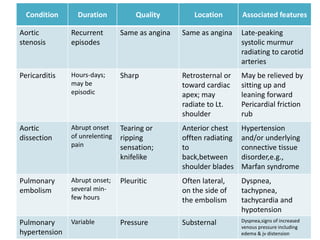
Condition Duration Quality Location Associated features
Aortic
stenosis
Recurrent
episodes
Same as angina Same as angina Late-peaking
systolic murmur
radiating to carotid
arteries
Pericarditis Hours-days;
may be
episodic
Sharp Retrosternal or
toward cardiac
apex; may
radiate to Lt.
shoulder
May be relieved by
sitting up and
leaning forward
Pericardial friction
rub
Aortic
dissection
Abrupt onset
of unrelenting
pain
Tearing or
ripping
sensation;
knifelike
Anterior chest
offten radiating
to
back,between
shoulder blades
Hypertension
and/or underlying
connective tissue
disorder,e.g.,
Marfan syndrome
Pulmonary
embolism
Abrupt onset;
several min-
few hours
Pleuritic Often lateral,
on the side of
the embolism
Dyspnea,
tachypnea,
tachycardia and
hypotension
Pulmonary
hypertension
Variable Pressure Substernal Dyspnea,signs of increased
venous pressure including
edema & jv distension
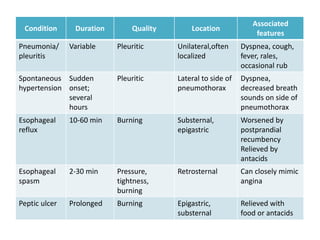
Condition Duration Quality Location
Associated
features
Pneumonia/
pleuritis
Variable Pleuritic Unilateral,often
localized
Dyspnea, cough,
fever, rales,
occasional rub
Spontaneous
hypertension
Sudden
onset;
several
hours
Pleuritic Lateral to side of
pneumothorax
Dyspnea,
decreased breath
sounds on side of
pneumothorax
Esophageal
reflux
10-60 min Burning Substernal,
epigastric
Worsened by
postprandial
recumbency
Relieved by
antacids
Esophageal
spasm
2-30 min Pressure,
tightness,
burning
Retrosternal Can closely mimic
angina
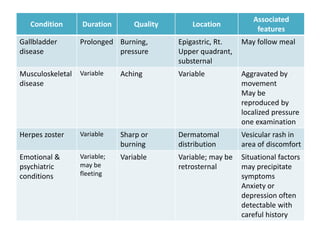
Peptic ulcer Prolonged Burning Epigastric,
substernal
Relieved with
food or antacids
Condition Duration Quality Location
Associated
features
Gallbladder
disease
Prolonged Burning,
pressure
Epigastric, Rt.
Upper quadrant,
substernal
May follow meal
Musculoskeletal
disease
Variable Aching Variable Aggravated by
movement
May be
reproduced by
localized pressure
one examination
Herpes zoster Variable Sharp or
burning
Dermatomal
distribution
Vesicular rash in
area of discomfort
Emotional &
psychiatric
conditions
Variable;
may be
fleeting
Variable Variable; may be
retrosternal
Situational factors
may precipitate
symptoms
Anxiety or
depression often
detectable with
careful history
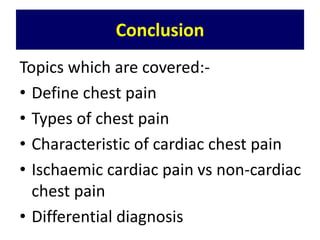
Conclusion
Topics which are covered:-
• Define chest pain
• Types of chest pain
• Characteristic of cardiac chest pain
• Ischaemic cardiac pain vs non-cardiac
chest pain
• Differential diagnosis
References
• Davidson’s Principles & Practice of Medicine
23rd Edition
• Harrison’s Internal Medicine 18th Edition
• Hutchinson’s Clinical Method 22nd Edition
Chest pain

Chest pain

  • 1.
    CHEST PAIN MARYAM JAMILAHBINTI ABDUL HAMID 082013100002 IMS BANGALORE
  • 2.
    Learning Outcome • Definition •Type of chest pain • Etiology • Characteristic of cardiac chest pain • Ischaemic cardiac pain vs non-cardiac chest pain • Differential diagnosis
  • 3.
    Chest Pain Definition: A generalterm for any dull, aching pain in the thorax. It can be cardiac or non-cardiac related.
  • 4.
    Etiology Cardiac • Myocardial ischemia &trauma • Angina pectoris • Acute Coronary Syndromes Non-Cardiac •Aortic stenosis •Aortic dissection •Pericarditis •Pulmonary embolism •Pulmonary hypertension •Pneumonia/pleuritis •Spontaneous hypertension •Esophageal reflux •Esophageal spasm •Peptic ulcer •Gallbladder disease •Musculoskeletal disease •Herpes zoster •Emotional & psychiatric conditions
  • 5.
    Types Of ChestPain Pleuritic Sharp Burning Pressure Tightness Heaviness Burning Tearing/ripping Burning Pressure Angina, unstable angina, acute MI Pericarditis Aortic dissection Gallbladder disease Pul. Embolism, Pneumonia, Pleuritis, Spontaneous hypertension Esophageal reflux, peptic ulcer, herpes zoster Pressure Tightness Burning VariableAching Emotional & psychiatric conditions Esophageal spasm Musculoskeletal disease
  • 6.
    Evaluate a chestpain 1. Could the chest discomfort be due to an acute, potentially life-threatening condition that warrants immediate hospitalization and aggressive evaluation? -Acute ischemic heart disease -Pulmonary embolism -Aortic dissection -Spontaneous pneumothorax 2. If not, could the discomfort be due to a chronic condition likely to lead to serious complication? -Stable angina -Aortic stenosis -Pulmonary hypertension 3. If not, could the discomfort be due to an acute condition that warrants specific treatment? -Pericarditis -Pneumonia/pleuritis -Herpes zoster 4. If not, could the discomfort be due to another treatable chronic condition? -Oesophagel reflux, oesophageal spasm, peptic ulcer disease, other GI condition, cervical disc disease, arthritis of the shoulder or spine, costochondritis, other musculoskeletal disorders, anxiety state
  • 7.
    Initial Evaluation ofSuspected Cardiac Pain Importance of initial evaluation:- • Crucial process • Determine the:- – Nature and extent of any underlying heart disease – Risk of serious adverse event – Management
  • 8.
    Characteristics Of IschaemicCardiac Pain • Characteristic of pain • Site • Radiation • Provocation • Onset • Associated features
  • 9.
    Character • Dull, constricting,choking or heavy • Squeezing, crushing, burning or aching • Breathlessness • Discomfort > pain
  • 10.
    Site • Centre ofthe chest • Derivation of the nerve supply to the heart & mediastinum (sensory sympathetic cardiac nerves; T1-T5, mostly dorsal root ganglion Lt.) Radiation • Radiate to neck, jaw & upper or even lower arms • Occasionally, at the sites of radiation or in the back
  • 12.
    Provocation • Angina pain:during exertion and promptly relieved by rest (<5 minutes), pain may exacerbated by emotion but occur more readily by exertion; large meal, cold wind • Crescendo/Unstable angina: similar pain can be precipitated by minimal exertion or at rest • Decubitus angina: increase venous return/preload by lying down can provoke pain in vulnerable patients
  • 13.
    Onset • Myocardial infarction(MI): Pain of MI takes several minutes or longer to develop • Angina: Pain builds up gradually in proportion to the intensity of exertion • Aortic dissection, massive pulmonary embolism or pneumothorax : Pain is very sudden or instantaneous • Musculoskeletal or psychological: Pain occur after exertion
  • 14.
    Associated features • Autonomicdisturbance; sweating, nausea, vomiting • Breathlessness: pulmonary congestion from transient ischaemic Lt. ventricular dysfunction
  • 15.
    CHARACTERISTIC ISCHAEMIC CARDIAC CHEST PAIN NON-CARDIACCHEST PAIN LOCATION Central, diffuse Peripheral, localised RADIATION Jaw/neck/shoulder/arm (occasionally back) Other or no radiation CHARACTER Tight, squeezing, choking Sharp, stabbing, catching PRECIPITATION Exertion and/or emotion Spontaneous, provoked by posture,respiration or palpitation RELIEVING FACTOR Rest, quick response to nitrates Not relieved by rest, slow or no response to nitrates ASSOCIATED FEATURES Breathlessness Respiratory, gastrointestinal, locomotor or psychological
  • 16.
    Differential Diagnosis of ChestPain • Anxiety/emotion • Cardiac • Aortic • Oesophageal • Lungs/pleura • Musculoskeletal • Neurological
  • 17.
    Anxiety • Common causefor atypical chest pain • Lack of relationship with exercise • Receiving bad news Cardiac • Myocardial ishaemia (angina), MI, myocarditis, pericarditis, mitral valve prolapse • Myocarditis & pericarditis: – Pain felt retrosternally, to the Lt. of the sternum, or in the Lt./Rt. Shoulder – Intensity varies with movement and phase of respiration. ‘sharp’ and may ‘catch’ during inspiration, coughing or lying flat. – Occasionally, history of prodromal viral illness
  • 18.
    Aortic • Aortic dissection,aortic aneurysm • Aortic dissection: – Pain is severe, sharp and tearing – Penetrating through to the back – Abrupt in onset – Pain follows path of the dissection
  • 19.
  • 20.
    Oesophageal • Oesophagitis, oesophagealspasm, Mallory-Weiss syndrome • Pressure, tightness, burning • Retrosternal • Mimic angina very closely – Sometimes precipitated by exercise – Sometimes relieved by nitrates • Elicit history of chest pain to supine posture or eating, drinking or oesophageal reflux • Radiates to the back
  • 21.
    Lungs/Pleura • Bronchospasm, pulmonaryinfarct, pneumonia, tracheitis, pneumothorax, pulmonary embolism, malignancy, tuberculosis • Bronchospasm: – Reversible airways obstruction (e.g. asthma): exertional chest tightness that is relieved by rest. Difficult to distinguish from ischaemic chest tightness • Pneumonia, pleuritis and pulmonary embolism: – Pleuritic pain (sharp pain when breathing)
  • 22.
    Musculoskeletal • Osteoarthritis, ribfracture/injury, costochondritis (Tietze’s syndrome), intercostal muscle injury, epidemic myalgia (Bornholm disease-by coxsackievirus) • Aching • Very variable in site and intensity • Vary with posture and movement of upper body • Can be accompanied by local tenderness over a rib or costal cartilage • Injuries related to everyday activities or viral infection
  • 23.
    Neurological • Prolapsed intervertebraldisc • Herpes zoster (Sharp or burning) • Thoracic outlet syndrome
  • 24.
    Stable Angina VSAcute Coronary Syndrome
  • 25.
    STABLE ANGINA ACUTECORONARY SYNDROMES (unstable angina, STEMI, NSTEMI) •Effort-related chest or ‘choking in the chest’ •Relationship to physical exertion (and occasionally emotion) of the chest pain •The duration of symptoms should be noted because patients with recent-onset angina are at greater risk •Urgent evaluation •Prolonged, severe cardiac chest pain
  • 26.
    STABLE ANGINA ACUTECORONARY SYNDROMES (unstable angina, STEMI, NSTEMI) •Physical examination: often normal but may reveal evidence of risk factors (eg xanthoma indicate hyperlipidaemia), Lt. ventricular dysfunction (dyskinetic, apex beat, gallop rhythm), other manifestations of arterial disease (eg bruits, signs of peripheral vascular disease) and unrelated conditions that may exacerbate angina (eg anaemia, thyroid disease) •Physical examination: signs of important comorbidity, such as peripheral or cerebrovascular disease, autonomic disturbance (pallor or sweating) and complications (arrhythmia or heart failure)
  • 27.
    STABLE ANGINA ACUTECORONARY SYNDROMES (unstable angina, STEMI, NSTEMI) •Coronary artery disease, aortic valve disease and hypertrophic cardiomyopathy •Angina+murmur= echocardiography •A full blood count, fasting blood glucose, lipids, TFT, 12-lead ECG, exercise testing •CT Coronary angiography •Signs of haemodynamic compromise (hypotension, pulmonary oedema) •ECG changes: ST segment elevation or depression) •Biochemical markers: elevated troponin I or T (short-term) •A 12-lead ECG •New ECG changes or an elevated plasma troponin concentration confirm the diagnosis of an acute coronary syndrome. exercise test or CT coronary angiogram to diagnose underlying coronary artery disease.
  • 29.
    Types Of ChestPain Pleuritic Sharp Burning Pressure Tightness Heaviness Burning Tearing/ripping Burning Pressure Angina, unstable angina, acute MI Pericarditis Aortic dissection Gallbladder disease Pul. Embolism, Pneumonia, Pleuritis, Spontaneous hypertension Esophageal reflux, peptic ulcer, herpes zoster Pressure Tightness Burning VariableAching Emotional & psychiatric conditions Esophageal spasm Musculoskeletal disease
  • 30.
    Condition Duration QualityLocation Associated features Angina 2 min <t< 10 min Pressure, tightness, heaviness, burning Retrosternal, often with radiation to or isolated discomfort in neck, jaw, sholders, or arms- freq. left Precipitated by exertion, exposure to cold, psychologic stress S4 gallop or mitral regurgitation murmur during pain Unstable angina 10-20 min Similar to angina but >severe Similar to angina Similar to angina but occurs with low levels of exertion or even at rest Acute MI Variable; often >30 min Similar to angina but >severe Similar to angina Unrelieved with nitroglycerin May be associated with heart failure or arrhythmia Typical Clinical Features of Major Causes of Acute Chest Discomfort
  • 31.
    Condition Duration QualityLocation Associated features Aortic stenosis Recurrent episodes Same as angina Same as angina Late-peaking systolic murmur radiating to carotid arteries Pericarditis Hours-days; may be episodic Sharp Retrosternal or toward cardiac apex; may radiate to Lt. shoulder May be relieved by sitting up and leaning forward Pericardial friction rub Aortic dissection Abrupt onset of unrelenting pain Tearing or ripping sensation; knifelike Anterior chest offten radiating to back,between shoulder blades Hypertension and/or underlying connective tissue disorder,e.g., Marfan syndrome Pulmonary embolism Abrupt onset; several min- few hours Pleuritic Often lateral, on the side of the embolism Dyspnea, tachypnea, tachycardia and hypotension Pulmonary hypertension Variable Pressure Substernal Dyspnea,signs of increased venous pressure including edema & jv distension
  • 32.
    Condition Duration QualityLocation Associated features Pneumonia/ pleuritis Variable Pleuritic Unilateral,often localized Dyspnea, cough, fever, rales, occasional rub Spontaneous hypertension Sudden onset; several hours Pleuritic Lateral to side of pneumothorax Dyspnea, decreased breath sounds on side of pneumothorax Esophageal reflux 10-60 min Burning Substernal, epigastric Worsened by postprandial recumbency Relieved by antacids Esophageal spasm 2-30 min Pressure, tightness, burning Retrosternal Can closely mimic angina Peptic ulcer Prolonged Burning Epigastric, substernal Relieved with food or antacids
  • 33.
    Condition Duration QualityLocation Associated features Gallbladder disease Prolonged Burning, pressure Epigastric, Rt. Upper quadrant, substernal May follow meal Musculoskeletal disease Variable Aching Variable Aggravated by movement May be reproduced by localized pressure one examination Herpes zoster Variable Sharp or burning Dermatomal distribution Vesicular rash in area of discomfort Emotional & psychiatric conditions Variable; may be fleeting Variable Variable; may be retrosternal Situational factors may precipitate symptoms Anxiety or depression often detectable with careful history
  • 34.
    Conclusion Topics which arecovered:- • Define chest pain • Types of chest pain • Characteristic of cardiac chest pain • Ischaemic cardiac pain vs non-cardiac chest pain • Differential diagnosis
  • 35.
    References • Davidson’s Principles& Practice of Medicine 23rd Edition • Harrison’s Internal Medicine 18th Edition • Hutchinson’s Clinical Method 22nd Edition

Editor's Notes

  • #21 Mallory–Weiss syndrome or gastro-esophageal laceration syndrome refers to bleeding from tears (a Mallory-Weiss tear) in the mucosa at the junction of the stomach and esophagus, usually caused by severe alcoholism, retching, coughing, or vomiting.
  • #25 Episodes of myocardial ischemia are due to an abrupt reduction in coronary blood flow caused by thrombosis or spasm (supply-led ischemia). In contrast, stable angina is related to a fixed obstruction and usually precipitated by an increase in myocardial oxygen demand (demand-led ischemia)
  • #27 Bruits= turbulence blood flow Comorbidity=the simultaneous presence of two chronic diseases or conditions in a patient.