
Addis Ababa Institute of Technology
(AAIT) Department of Electrical and
Computer Engineering
ECEG-3201 Digital Logic Design
AAIT, Department of
Electrical and Computer
Engineering
Nebyu Yonas Sutri2
Learning Outcomes
 At the end of the lecture, students should be able to:
 Design a synchronous counter for any count sequence
using the following steps:
 Step 1: State diagram
 Step 2: Next-state table
 Step 3: Flip-flop transition table
 Step 4: Circuit excitation table
 Step 5: Karnaugh maps
 Step 6: Logic expression for the flip-flop inputs
 Step 7: Counter implementation
3
AAIT, Department of
Electrical and Computer
Engineering
Nebyu Yonas Sutri
Synchronous Counter
 The counter have a fixed time relationship with
each other and generally count at the same time.
 A synchronous counter is one which all the
flip-flops are connected to the same clock.
4
AAIT, Department of
Electrical and Computer
Engineering
Nebyu Yonas Sutri
Sequential Circuits
 Depends on a clock signal and goes through
a set of sequence of states.
 Also called State Machines.
 A counter is a type of sequential circuit.
 Consists of combinational logic section and
memory section.
5
AAIT, Department of
Electrical and Computer
Engineering
Nebyu Yonas Sutri
Sequential Circuits
6
AAIT, Department of
Electrical and Computer
Engineering
Nebyu Yonas Sutri
Sequential Circuit Design Procedures
 The 7 steps in sequential circuit design are:
 Step 1: State diagram
 Step 2: Next-state table
 Step 3: Flip-flop transition table
 Step 4: Circuit excitation table
 Step 5: Karnaugh maps
 Step 6: Logic expression for the flip-flop inputs
 Step 7: Counter Implementation
7
AAIT, Department of
Electrical and Computer
Engineering
Nebyu Yonas Sutri
Step 1: The State Diagram
 A state machine is described by a state diagram.
 It shows the progression of states in the state
machine.
 E.g: 3-bit Gray code counter:
8
AAIT, Department of
Electrical and Computer
Engineering
Nebyu Yonas Sutri
Step 2: Next-State Table
 Lists each state along with the corresponding next
state.
 Next state – state that the counter goes to from its
present state upon application of clock pulse.
 E.g: 3-bit Gray code counter
PRESENT STATE NEXT STATE
Q2 Q1 Q0 Q2 Q1 Q0
0
0
0
0
1
1
1
1
0
0
1
1
1
1
0
0
0
1
1
0
0
1
1
0
0
0
0
1
1
1
1
0
0
1
1
1
1
0
0
0
1
1
0
0
1
1
0
0
9
AAIT, Department of
Electrical and Computer
Engineering
Nebyu Yonas Sutri
Step 3: Flip-Flop Transition Table
 To derive the transition table of the J-K flip-flop, let’s
examine the possible transitions:
 0  0
 FF is in RESET mode: J = K =
 FF is in No Change mode: J = K =
 0  0 happens when: J = K =
 0  1
 FF is in SET mode: J = K =
 FF is in Toggle mode: J = K =
 0  1 happens when: J = K =
 1  0
 FF is in RESET mode: J = K =
 FF is in Toggle mode: J = K =
 1  0 happens when: J = K =
0 1
0 0
0 X
01
1 1
1 X
0 1
1 1
1X
10
AAIT, Department of
Electrical and Computer
Engineering
Nebyu Yonas Sutri
Step 3: Flip-Flop Transition Table
 1  1
 FF is in SET mode: J = 1, K = 0
 FF is in No change mode: J = 0, K = 0
 1  1 happens when: J = X, K = 0
 The J-K transition (or excitation) table is:
OUTPUT TRANSITIONS FLIP-FLOP INPUTS
Q Q+ J K
0
0
1
1




0
1
0
1
0 X
1 X
X 1
X 0
11
AAIT, Department of
Electrical and Computer
Engineering
Nebyu Yonas Sutri
Step 4: Circuit Excitation Table
 Derived from the next-state table and flip-flop
transition table:
 E.g. 3-bit Gray code counter
PRESENT STATE NEXT STATE Excitation Inputs
Q2 Q1 Q0 Q2 Q1 Q0 J2 K2 J1 K1 J0 K0
0
0
0
0
1
1
1
1
0
0
1
1
1
1
0
0
0
1
1
0
0
1
1
0
0
0
0
1
1
1
1
0
0
1
1
1
1
0
0
0
1
1
0
0
1
1
0
0
0
0
0
1
X
X
X
X
X
X
X
X
0
0
0
1
0
1
X
X
X
X
0
0
X
X
0
0
0
1
X
X
1
X
X
0
1
X
X
0
X
0
1
X
X
0
1
X
OUTPUT TRANSITIONS FLIP-FLOP INPUTS
Q Q+ J K
0
0
1
1




0
1
0
1
0 X
1 X
X 1
X 0
12
AAIT, Department of
Electrical and Computer
Engineering
Nebyu Yonas Sutri
Step 4: Circuit Excitation Table
 Derived from the next-state table and flip-flop
transition table:
 E.g. 3-bit Gray code counter
PRESENT STATE NEXT STATE Excitation Inputs
Q2 Q1 Q0 Q2 Q1 Q0 J2 K2 J1 K1 J0 K0
0
0
0
0
1
1
1
1
0
0
1
1
1
1
0
0
0
1
1
0
0
1
1
0
0
0
0
1
1
1
1
0
0
1
1
1
1
0
0
0
1
1
0
0
1
1
0
0
0
0
0
1
X
X
X
X
X
X
X
X
0
0
0
1
0
1
X
X
X
X
0
0
X
X
0
0
0
1
X
X
1
X
X
0
1
X
X
0
X
0
1
X
X
0
1
X
OUTPUT TRANSITIONS FLIP-FLOP INPUTS
Q Q+ J K
0
0
1
1




0
1
0
1
0 X
1 X
X 1
X 0
13
AAIT, Department of
Electrical and Computer
Engineering
Nebyu Yonas Sutri
Step 4: Circuit Excitation Table
 Derived from the next-state table and flip-flop
transition table:
 E.g. 3-bit Gray code counter
PRESENT STATE NEXT STATE Excitation Inputs
Q2 Q1 Q0 Q2 Q1 Q0 J2 K2 J1 K1 J0 K0
0
0
0
0
1
1
1
1
0
0
1
1
1
1
0
0
0
1
1
0
0
1
1
0
0
0
0
1
1
1
1
0
0
1
1
1
1
0
0
0
1
1
0
0
1
1
0
0
0
0
0
1
X
X
X
X
X
X
X
X
0
0
0
1
0
1
X
X
X
X
0
0
X
X
0
0
0
1
X
X
1
X
X
0
1
X
X
0
X
0
1
X
X
0
1
X
OUTPUT TRANSITIONS FLIP-FLOP INPUTS
Q Q+ J K
0
0
1
1




0
1
0
1
0 X
1 X
X 1
X 0
14
AAIT, Department of
Electrical and Computer
Engineering
Nebyu Yonas Sutri
Step 4: Circuit Excitation Table
 Derived from the next-state table and flip-flop
transition table:
 E.g. 3-bit Gray code counter
PRESENT STATE NEXT STATE Excitation Inputs
Q2 Q1 Q0 Q2 Q1 Q0 J2 K2 J1 K1 J0 K0
0
0
0
0
1
1
1
1
0
0
1
1
1
1
0
0
0
1
1
0
0
1
1
0
0
0
0
1
1
1
1
0
0
1
1
1
1
0
0
0
1
1
0
0
1
1
0
0
0
0
0
1
X
X
X
X
X
X
X
X
0
0
0
1
0
1
X
X
X
X
0
0
X
X
0
0
0
1
X
X
1
X
X
0
1
X
X
0
X
0
1
X
X
0
1
X
15
AAIT, Department of
Electrical and Computer
Engineering
Nebyu Yonas Sutri
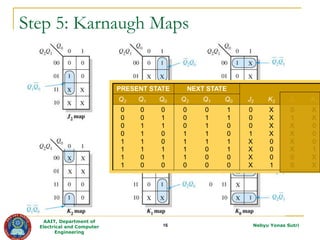
Step 5: Karnaugh Maps
16
AAIT, Department of
Electrical and Computer
Engineering
Nebyu Yonas Sutri
Step 5: Karnaugh Maps
PRESENT STATE NEXT STATE
Q2 Q1 Q0 Q2 Q1 Q0 J2 K2 J1 K1
0
0
0
0
1
1
1
1
0
0
1
1
1
1
0
0
0
1
1
0
0
1
1
0
0
0
0
1
1
1
1
0
0
1
1
1
1
0
0
0
1
1
0
0
1
1
0
0
0
0
0
1
X
X
X
X
X
X
X
X
0
0
0
1
0
1
X
X
X
X
0
0
X
X
0
0
0
1
X
X
17
AAIT, Department of
Electrical and Computer
Engineering
Nebyu Yonas Sutri
Step 5: Karnaugh Maps
18
AAIT, Department of
Electrical and Computer
Engineering
Nebyu Yonas Sutri
Step 6: Logic Expression for Flip-Flop
Inputs
 Derive the logic expression for the flip-flop
inputs from K-map simplification.
 E.g. 3-bit Gray code counter
012
012
021
021
1212120
1212120
QQK
QQJ
QQK
QQJ
QQQQQQK
QQQQQQJ






19
AAIT, Department of
Electrical and Computer
Engineering
Nebyu Yonas Sutri
Step 7: Circuit Implementation
 From the expressions for the J and K inputs,
we get the counter implementation.
20
AAIT, Department of
Electrical and Computer
Engineering
Nebyu Yonas Sutri
Exercise
 Design a 3-bit Gray code counter using D-flip flops
PRESENT STATE NEXT STATE Excitation Inputs
Q2 Q1 Q0 Q2 Q1 Q0 D2 D1 D0
0
0
0
0
1
1
1
1
0
0
1
1
1
1
0
0
0
1
1
0
0
1
1
0
0
0
0
1
1
1
1
0
0
1
1
1
1
0
0
0
1
1
0
0
1
1
0
0
0
0
0
1
1
1
1
0
0
1
1
1
1
0
0
0
1
1
0
0
1
1
0
0
21
AAIT, Department of
Electrical and Computer
Engineering
Nebyu Yonas Sutri
K-Map Simplification
0 1
00 0 0
01 1 0
11 1 1
10 0 1
Q2Q1
Q0 0 1
00 0 1
01 1 1
11 1 0
10 0 0
Q2Q1
Q0 0 1
00 1 1
01 0 0
11 1 1
10 0 0
Q2Q1
Q0
02012 QQQQD  02011 QQQQD  12122 QQQQD 
22
AAIT, Department of
Electrical and Computer
Engineering
Nebyu Yonas Sutri
 Design the three bit gray counter using D
Flip-Flops individually.
 Design an even bit counter in the following
counting sequence (0,2,4,6,8,0)
 Design an odd bit counter in the following
counting sequence (1,3,5,7,9,1)
What to Do this Week?

Eceg 3201-dld-lec 12-synchronous_counter_design

  • 1.
    Addis Ababa Instituteof Technology (AAIT) Department of Electrical and Computer Engineering ECEG-3201 Digital Logic Design
  • 2.
    AAIT, Department of Electricaland Computer Engineering Nebyu Yonas Sutri2 Learning Outcomes  At the end of the lecture, students should be able to:  Design a synchronous counter for any count sequence using the following steps:  Step 1: State diagram  Step 2: Next-state table  Step 3: Flip-flop transition table  Step 4: Circuit excitation table  Step 5: Karnaugh maps  Step 6: Logic expression for the flip-flop inputs  Step 7: Counter implementation
  • 3.
    3 AAIT, Department of Electricaland Computer Engineering Nebyu Yonas Sutri Synchronous Counter  The counter have a fixed time relationship with each other and generally count at the same time.  A synchronous counter is one which all the flip-flops are connected to the same clock.
  • 4.
    4 AAIT, Department of Electricaland Computer Engineering Nebyu Yonas Sutri Sequential Circuits  Depends on a clock signal and goes through a set of sequence of states.  Also called State Machines.  A counter is a type of sequential circuit.  Consists of combinational logic section and memory section.
  • 5.
    5 AAIT, Department of Electricaland Computer Engineering Nebyu Yonas Sutri Sequential Circuits
  • 6.
    6 AAIT, Department of Electricaland Computer Engineering Nebyu Yonas Sutri Sequential Circuit Design Procedures  The 7 steps in sequential circuit design are:  Step 1: State diagram  Step 2: Next-state table  Step 3: Flip-flop transition table  Step 4: Circuit excitation table  Step 5: Karnaugh maps  Step 6: Logic expression for the flip-flop inputs  Step 7: Counter Implementation
  • 7.
    7 AAIT, Department of Electricaland Computer Engineering Nebyu Yonas Sutri Step 1: The State Diagram  A state machine is described by a state diagram.  It shows the progression of states in the state machine.  E.g: 3-bit Gray code counter:
  • 8.
    8 AAIT, Department of Electricaland Computer Engineering Nebyu Yonas Sutri Step 2: Next-State Table  Lists each state along with the corresponding next state.  Next state – state that the counter goes to from its present state upon application of clock pulse.  E.g: 3-bit Gray code counter PRESENT STATE NEXT STATE Q2 Q1 Q0 Q2 Q1 Q0 0 0 0 0 1 1 1 1 0 0 1 1 1 1 0 0 0 1 1 0 0 1 1 0 0 0 0 1 1 1 1 0 0 1 1 1 1 0 0 0 1 1 0 0 1 1 0 0
  • 9.
    9 AAIT, Department of Electricaland Computer Engineering Nebyu Yonas Sutri Step 3: Flip-Flop Transition Table  To derive the transition table of the J-K flip-flop, let’s examine the possible transitions:  0  0  FF is in RESET mode: J = K =  FF is in No Change mode: J = K =  0  0 happens when: J = K =  0  1  FF is in SET mode: J = K =  FF is in Toggle mode: J = K =  0  1 happens when: J = K =  1  0  FF is in RESET mode: J = K =  FF is in Toggle mode: J = K =  1  0 happens when: J = K = 0 1 0 0 0 X 01 1 1 1 X 0 1 1 1 1X
  • 10.
    10 AAIT, Department of Electricaland Computer Engineering Nebyu Yonas Sutri Step 3: Flip-Flop Transition Table  1  1  FF is in SET mode: J = 1, K = 0  FF is in No change mode: J = 0, K = 0  1  1 happens when: J = X, K = 0  The J-K transition (or excitation) table is: OUTPUT TRANSITIONS FLIP-FLOP INPUTS Q Q+ J K 0 0 1 1     0 1 0 1 0 X 1 X X 1 X 0
  • 11.
    11 AAIT, Department of Electricaland Computer Engineering Nebyu Yonas Sutri Step 4: Circuit Excitation Table  Derived from the next-state table and flip-flop transition table:  E.g. 3-bit Gray code counter PRESENT STATE NEXT STATE Excitation Inputs Q2 Q1 Q0 Q2 Q1 Q0 J2 K2 J1 K1 J0 K0 0 0 0 0 1 1 1 1 0 0 1 1 1 1 0 0 0 1 1 0 0 1 1 0 0 0 0 1 1 1 1 0 0 1 1 1 1 0 0 0 1 1 0 0 1 1 0 0 0 0 0 1 X X X X X X X X 0 0 0 1 0 1 X X X X 0 0 X X 0 0 0 1 X X 1 X X 0 1 X X 0 X 0 1 X X 0 1 X OUTPUT TRANSITIONS FLIP-FLOP INPUTS Q Q+ J K 0 0 1 1     0 1 0 1 0 X 1 X X 1 X 0
  • 12.
    12 AAIT, Department of Electricaland Computer Engineering Nebyu Yonas Sutri Step 4: Circuit Excitation Table  Derived from the next-state table and flip-flop transition table:  E.g. 3-bit Gray code counter PRESENT STATE NEXT STATE Excitation Inputs Q2 Q1 Q0 Q2 Q1 Q0 J2 K2 J1 K1 J0 K0 0 0 0 0 1 1 1 1 0 0 1 1 1 1 0 0 0 1 1 0 0 1 1 0 0 0 0 1 1 1 1 0 0 1 1 1 1 0 0 0 1 1 0 0 1 1 0 0 0 0 0 1 X X X X X X X X 0 0 0 1 0 1 X X X X 0 0 X X 0 0 0 1 X X 1 X X 0 1 X X 0 X 0 1 X X 0 1 X OUTPUT TRANSITIONS FLIP-FLOP INPUTS Q Q+ J K 0 0 1 1     0 1 0 1 0 X 1 X X 1 X 0
  • 13.
    13 AAIT, Department of Electricaland Computer Engineering Nebyu Yonas Sutri Step 4: Circuit Excitation Table  Derived from the next-state table and flip-flop transition table:  E.g. 3-bit Gray code counter PRESENT STATE NEXT STATE Excitation Inputs Q2 Q1 Q0 Q2 Q1 Q0 J2 K2 J1 K1 J0 K0 0 0 0 0 1 1 1 1 0 0 1 1 1 1 0 0 0 1 1 0 0 1 1 0 0 0 0 1 1 1 1 0 0 1 1 1 1 0 0 0 1 1 0 0 1 1 0 0 0 0 0 1 X X X X X X X X 0 0 0 1 0 1 X X X X 0 0 X X 0 0 0 1 X X 1 X X 0 1 X X 0 X 0 1 X X 0 1 X OUTPUT TRANSITIONS FLIP-FLOP INPUTS Q Q+ J K 0 0 1 1     0 1 0 1 0 X 1 X X 1 X 0
  • 14.
    14 AAIT, Department of Electricaland Computer Engineering Nebyu Yonas Sutri Step 4: Circuit Excitation Table  Derived from the next-state table and flip-flop transition table:  E.g. 3-bit Gray code counter PRESENT STATE NEXT STATE Excitation Inputs Q2 Q1 Q0 Q2 Q1 Q0 J2 K2 J1 K1 J0 K0 0 0 0 0 1 1 1 1 0 0 1 1 1 1 0 0 0 1 1 0 0 1 1 0 0 0 0 1 1 1 1 0 0 1 1 1 1 0 0 0 1 1 0 0 1 1 0 0 0 0 0 1 X X X X X X X X 0 0 0 1 0 1 X X X X 0 0 X X 0 0 0 1 X X 1 X X 0 1 X X 0 X 0 1 X X 0 1 X
  • 15.
    15 AAIT, Department of Electricaland Computer Engineering Nebyu Yonas Sutri Step 5: Karnaugh Maps
  • 16.
    16 AAIT, Department of Electricaland Computer Engineering Nebyu Yonas Sutri Step 5: Karnaugh Maps PRESENT STATE NEXT STATE Q2 Q1 Q0 Q2 Q1 Q0 J2 K2 J1 K1 0 0 0 0 1 1 1 1 0 0 1 1 1 1 0 0 0 1 1 0 0 1 1 0 0 0 0 1 1 1 1 0 0 1 1 1 1 0 0 0 1 1 0 0 1 1 0 0 0 0 0 1 X X X X X X X X 0 0 0 1 0 1 X X X X 0 0 X X 0 0 0 1 X X
  • 17.
    17 AAIT, Department of Electricaland Computer Engineering Nebyu Yonas Sutri Step 5: Karnaugh Maps
  • 18.
    18 AAIT, Department of Electricaland Computer Engineering Nebyu Yonas Sutri Step 6: Logic Expression for Flip-Flop Inputs  Derive the logic expression for the flip-flop inputs from K-map simplification.  E.g. 3-bit Gray code counter 012 012 021 021 1212120 1212120 QQK QQJ QQK QQJ QQQQQQK QQQQQQJ      
  • 19.
    19 AAIT, Department of Electricaland Computer Engineering Nebyu Yonas Sutri Step 7: Circuit Implementation  From the expressions for the J and K inputs, we get the counter implementation.
  • 20.
    20 AAIT, Department of Electricaland Computer Engineering Nebyu Yonas Sutri Exercise  Design a 3-bit Gray code counter using D-flip flops PRESENT STATE NEXT STATE Excitation Inputs Q2 Q1 Q0 Q2 Q1 Q0 D2 D1 D0 0 0 0 0 1 1 1 1 0 0 1 1 1 1 0 0 0 1 1 0 0 1 1 0 0 0 0 1 1 1 1 0 0 1 1 1 1 0 0 0 1 1 0 0 1 1 0 0 0 0 0 1 1 1 1 0 0 1 1 1 1 0 0 0 1 1 0 0 1 1 0 0
  • 21.
    21 AAIT, Department of Electricaland Computer Engineering Nebyu Yonas Sutri K-Map Simplification 0 1 00 0 0 01 1 0 11 1 1 10 0 1 Q2Q1 Q0 0 1 00 0 1 01 1 1 11 1 0 10 0 0 Q2Q1 Q0 0 1 00 1 1 01 0 0 11 1 1 10 0 0 Q2Q1 Q0 02012 QQQQD  02011 QQQQD  12122 QQQQD 
  • 22.
    22 AAIT, Department of Electricaland Computer Engineering Nebyu Yonas Sutri  Design the three bit gray counter using D Flip-Flops individually.  Design an even bit counter in the following counting sequence (0,2,4,6,8,0)  Design an odd bit counter in the following counting sequence (1,3,5,7,9,1) What to Do this Week?