Download to read offline


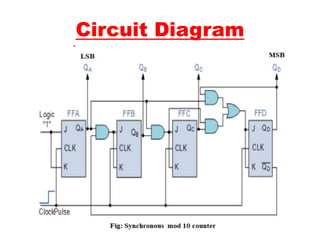
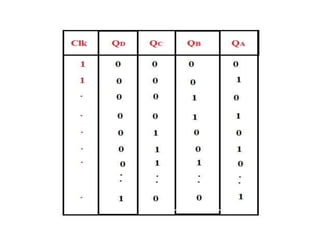


Synchronous counters use a common clock signal to toggle all flip-flops simultaneously, preventing propagation delay issues seen in asynchronous counters. A synchronous mod-10 (decimal) counter can be built from binary counters by adding logic to reset the count to 0 after reaching 10. This is achieved by detecting the 1001 state and toggling an additional flip-flop on the next clock pulse. Synchronous counters are used in applications like machine motion control and RPM measurement but require more components and complex circuitry compared to asynchronous counters.


