Behavior of RC structure
Training to LB technical staff on
Nepal National Building Code
Binay Shrestha
Why Buildings fail in an Earthquake
Lack of
• Strength.
• Ductility.
Introduced by
• Design deficiency (failure to understand failure 
mechanism, deficient system, calculation).
• Construction deficiency (lack of quality 
assurance: material, construction details).
Measures
Design
•System design.
•Component design.
Detailing
•Better behavior.
•To improve ductility of building.
Poor Performance of RC Frame Buildings
I. Design concept ignorance 
Strong column weak beam
Soft story
Short column
II. Construction Defects:
Weak / Cold joint 
Lap & end anchorage
Ductility
Poor Performance of RC Frame Buildings
I. Other
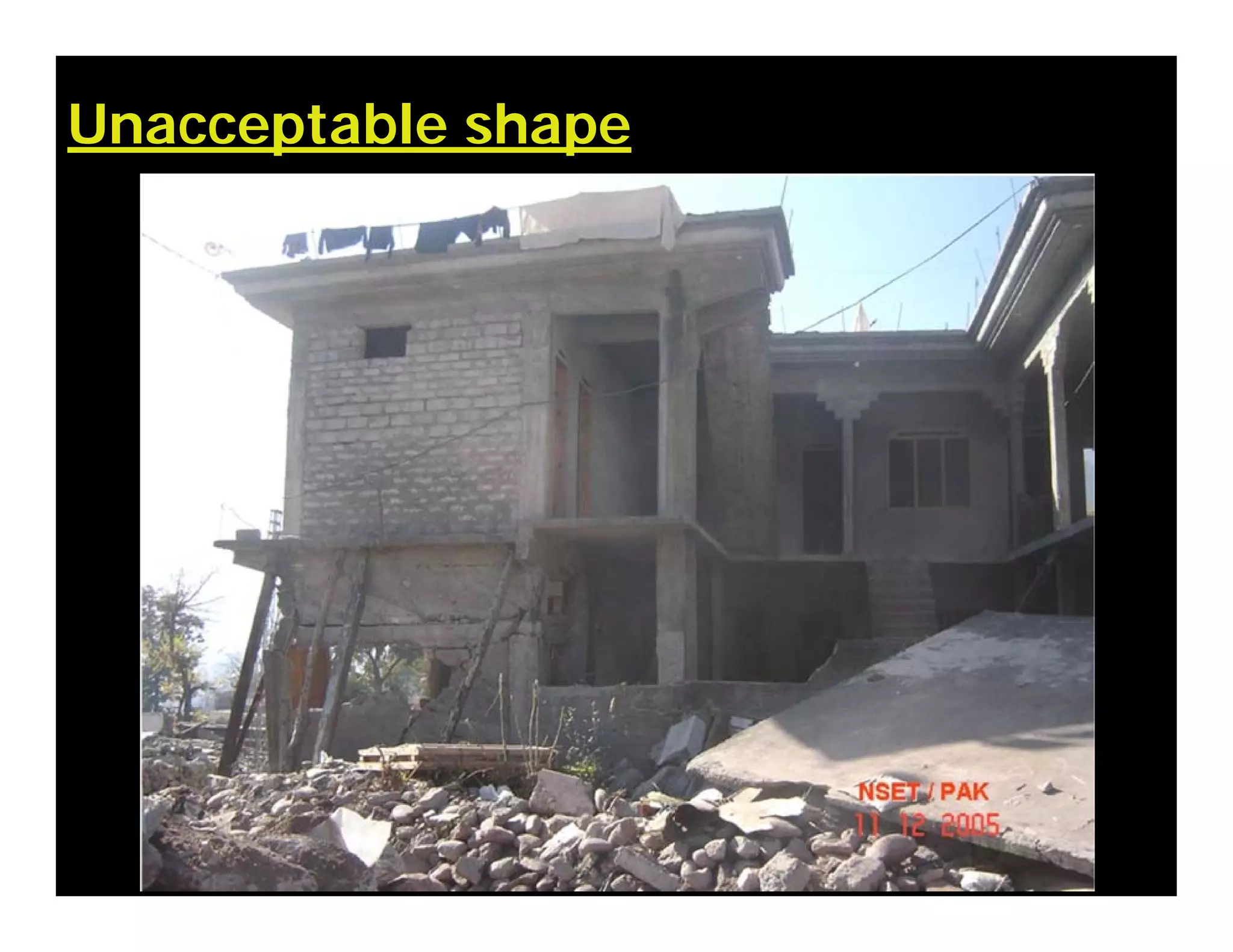
Unacceptable shape
Defective load path
Local soil condition. 
Hammering/ Pounding
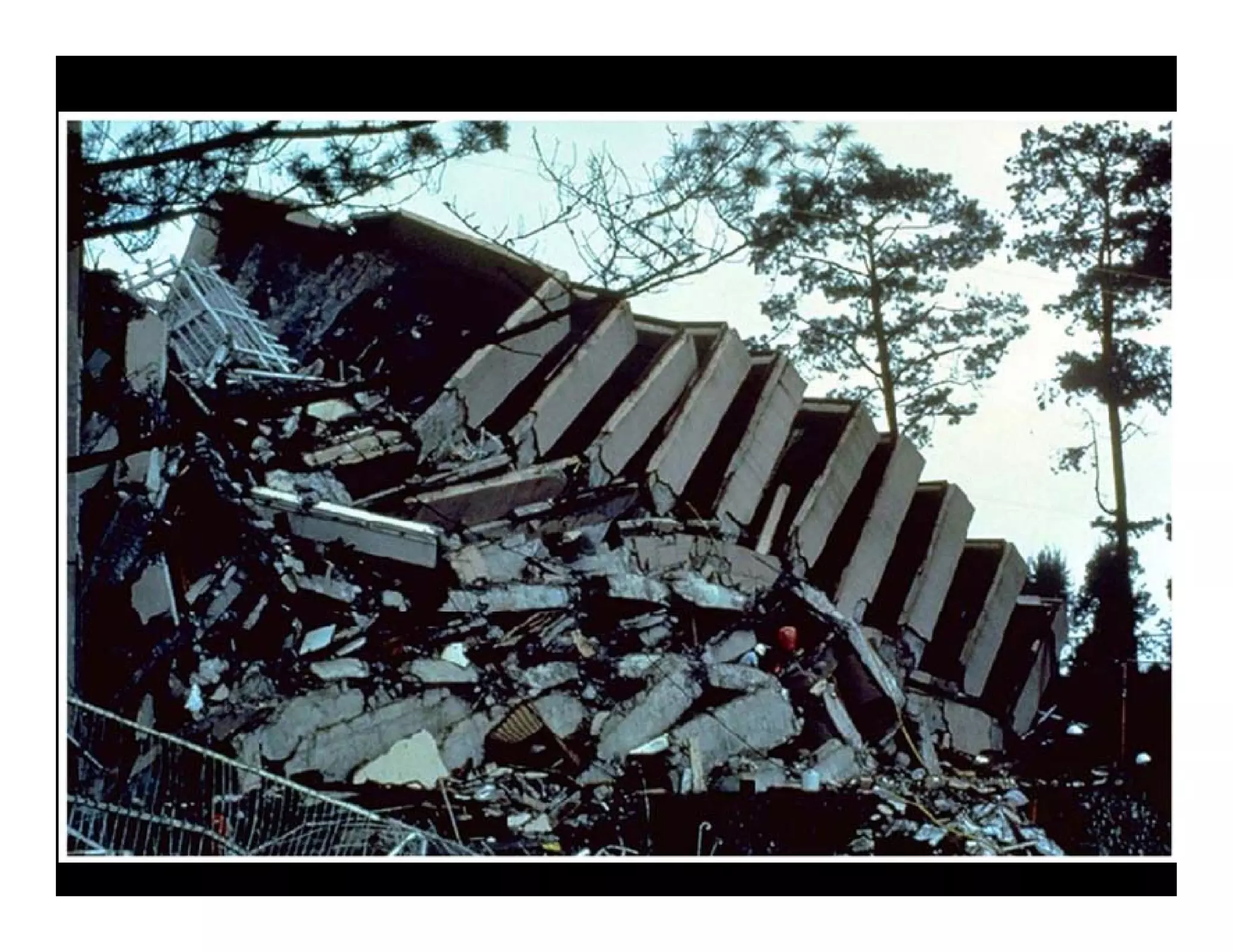
Design Concept Ignorance:
Strong column weak beam
(Pancake type damage)
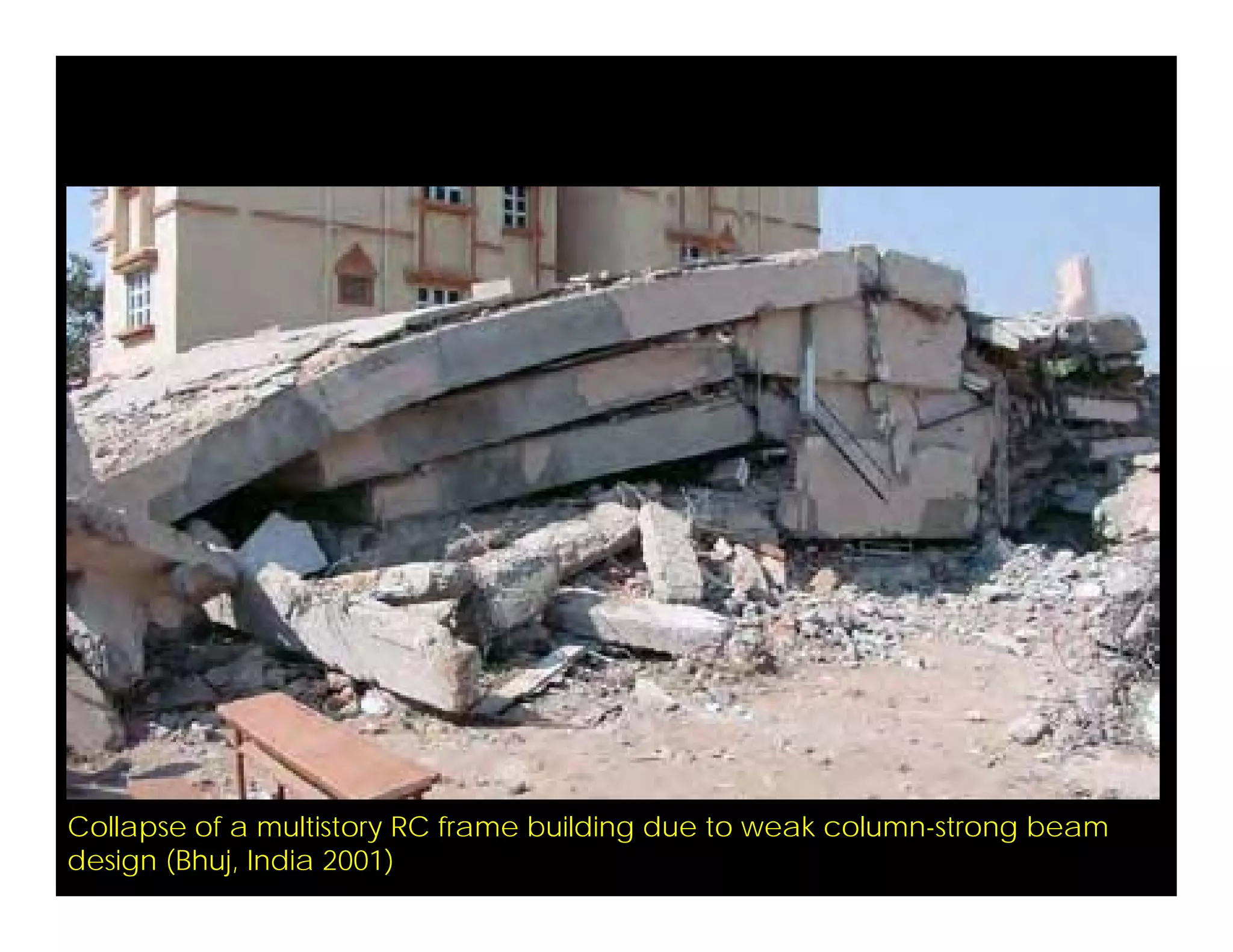
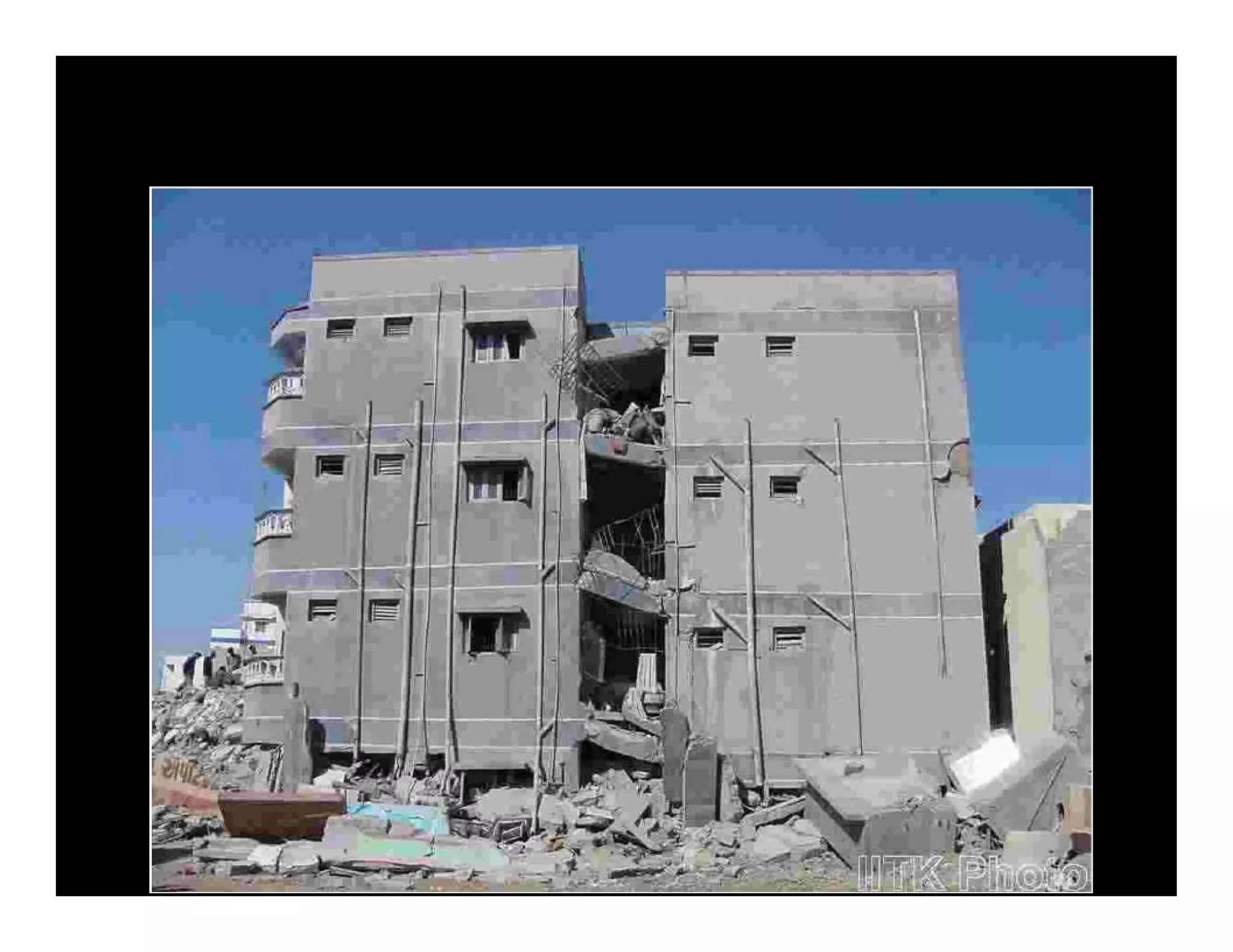
Collapse of a multistory RC frame building due to weak column-strong beam
design (Bhuj, India 2001)
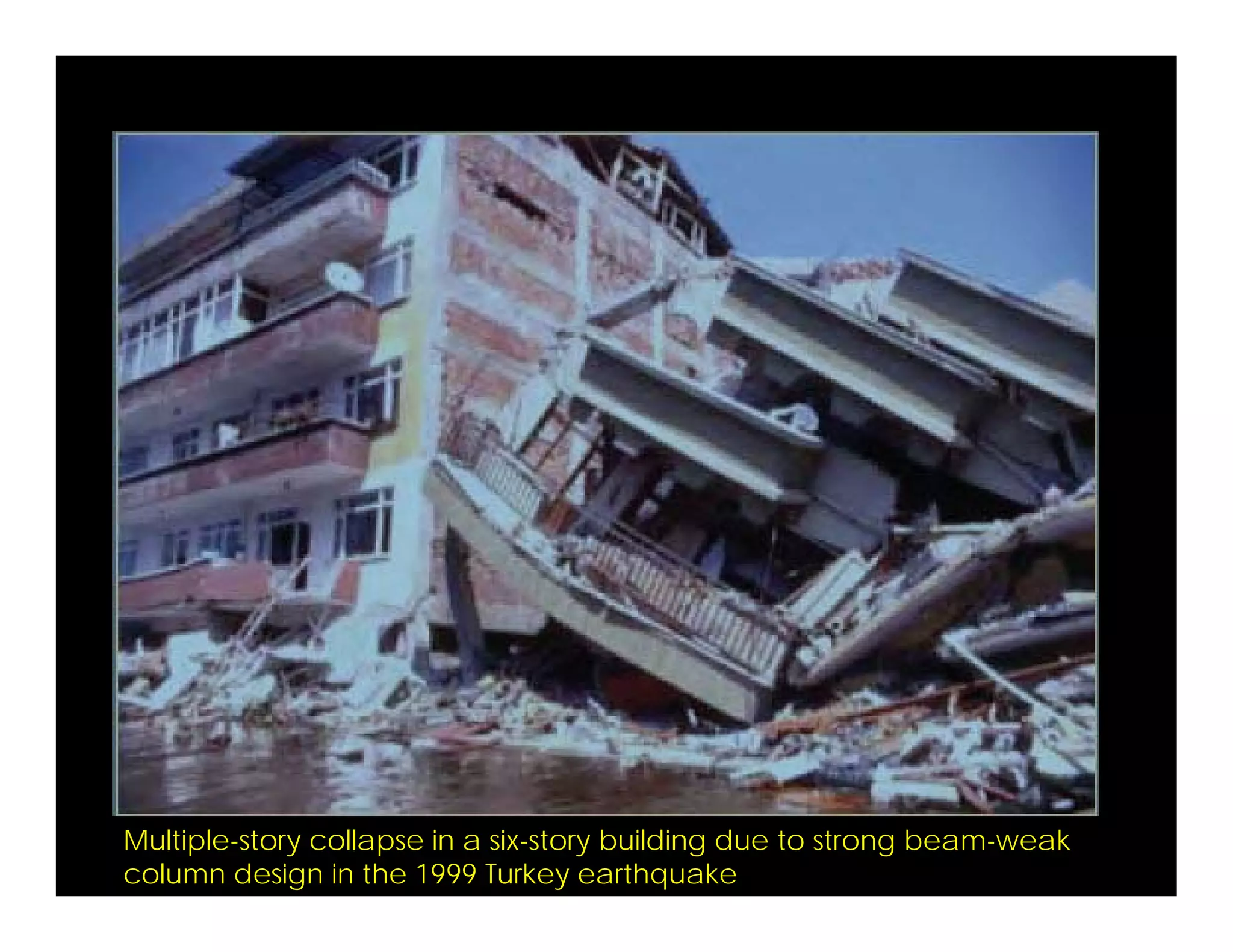
Multiple-story collapse in a six-story building due to strong beam-weak
column design in the 1999 Turkey earthquake
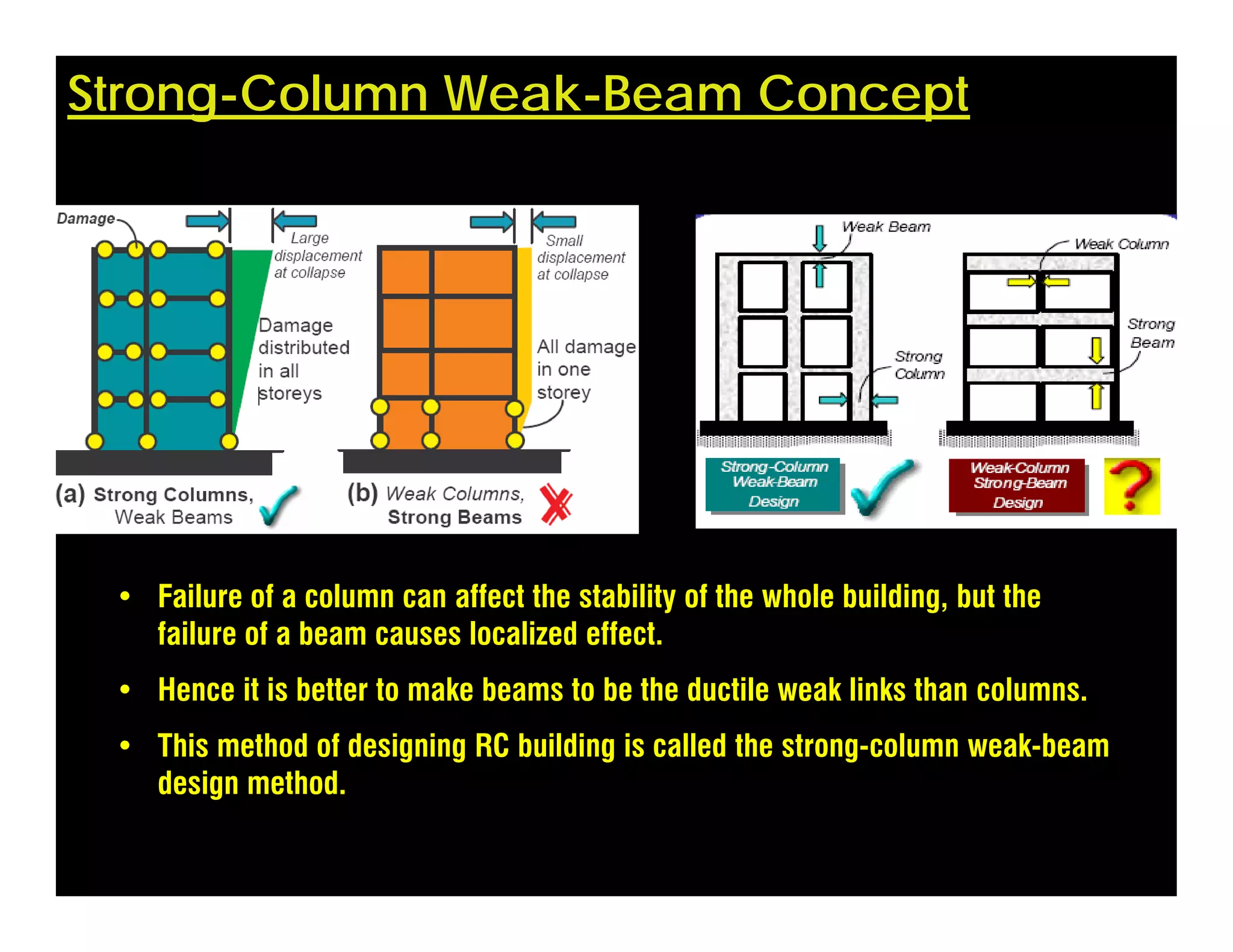
Strong-Column Weak-Beam Concept
• Failure of a column can affect the stability of the whole building, but the
failure of a beam causes localized effect.
• Hence it is better to make beams to be the ductile weak links than columns.
• This method of designing RC building is called the strong-column weak-beam
design method.
 Columns should be stronger than
beams and foundations should be
stronger than columns.
 Connections between beams &
columns and columns &
foundations should not fail so that
beams can safely transfer forces to
columns and columns to
foundations.
Strong-Column Weak-Beam Concept
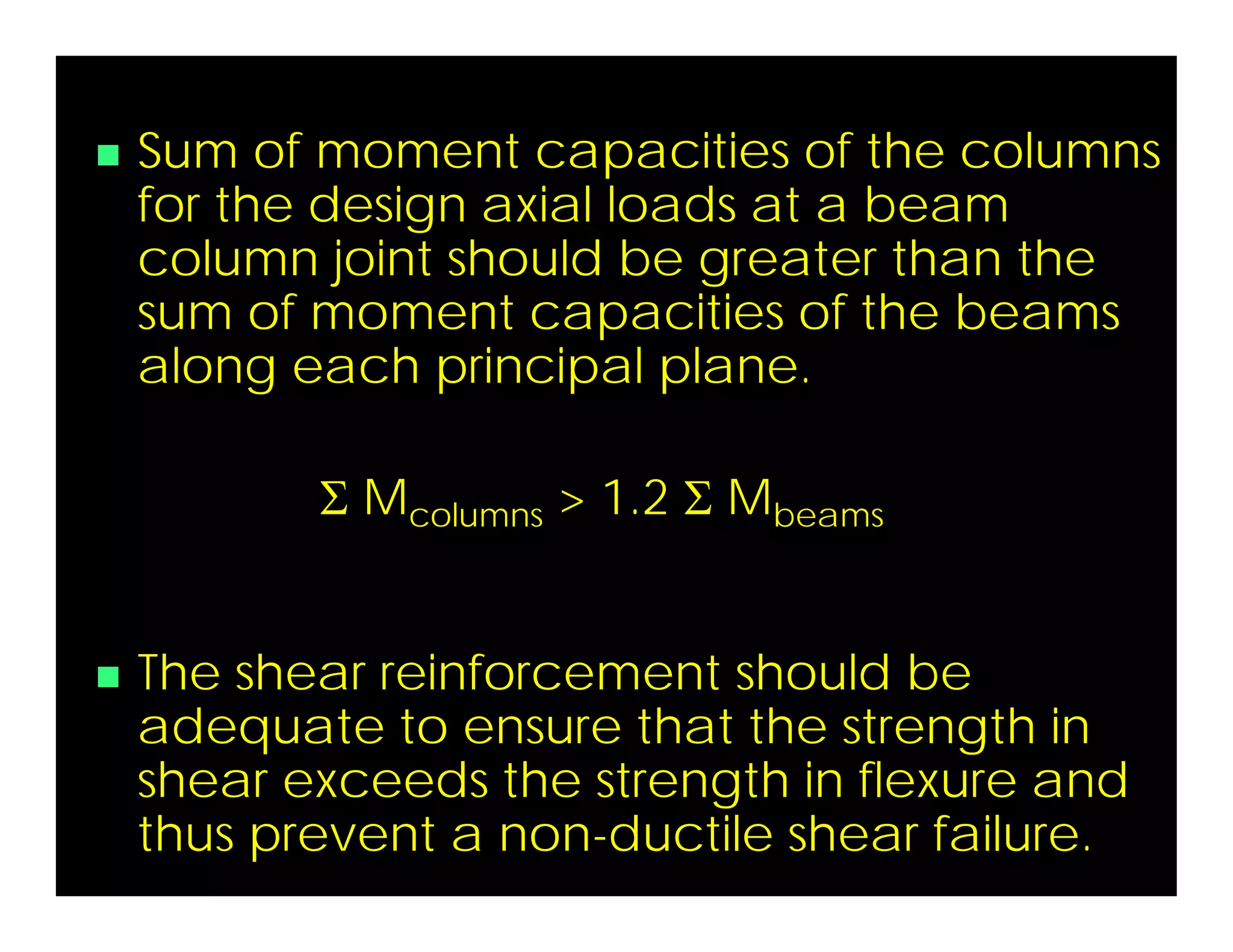
 Sum of moment capacities of the columns
for the design axial loads at a beam
column joint should be greater than the
sum of moment capacities of the beams
along each principal plane.
 Mcolumns > 1.2  Mbeams
 The shear reinforcement should be
adequate to ensure that the strength in
shear exceeds the strength in flexure and
thus prevent a non-ductile shear failure.
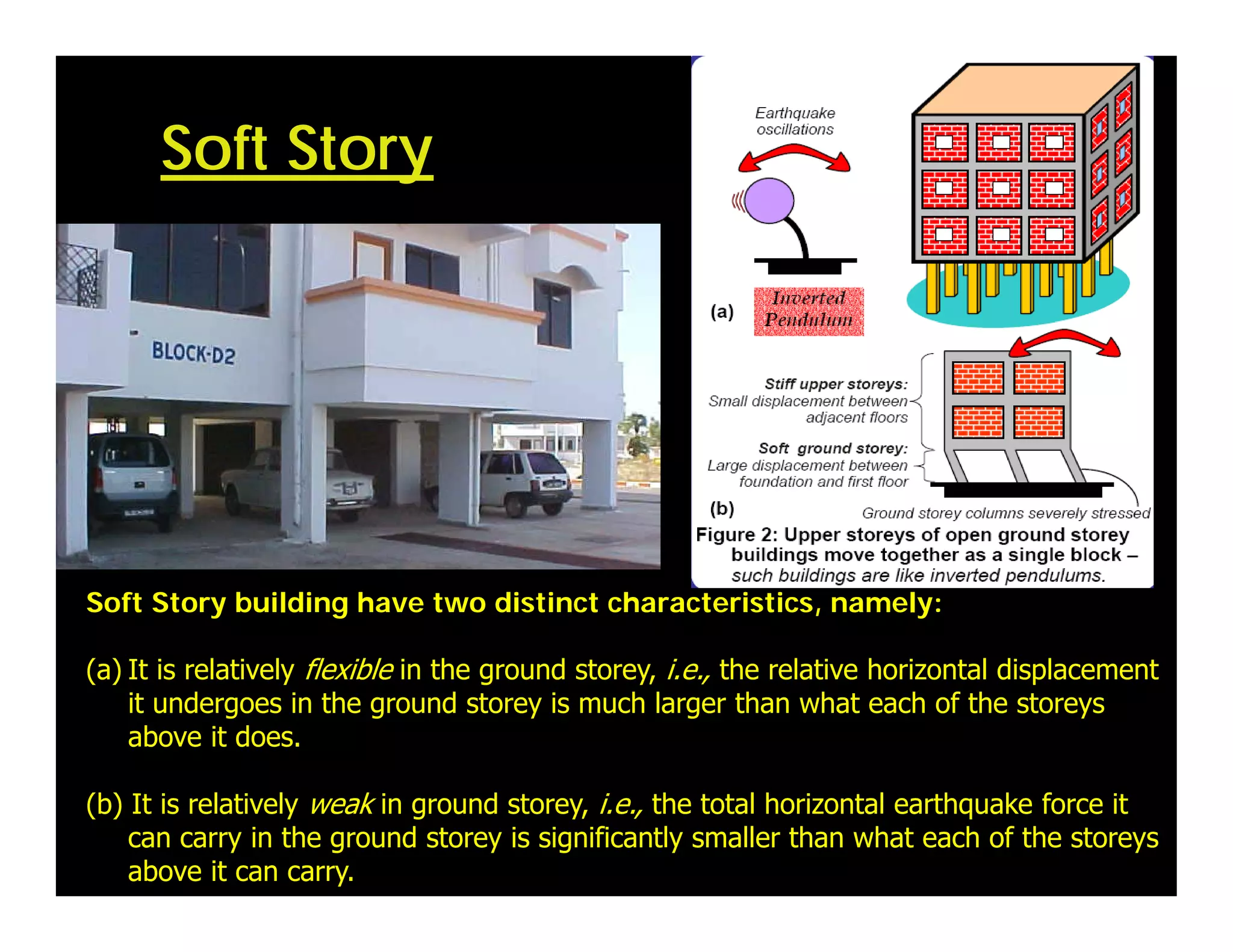
Soft Story
Soft Story building have two distinct characteristics, namely:
(a) It is relatively flexible in the ground storey, i.e., the relative horizontal displacement
it undergoes in the ground storey is much larger than what each of the storeys
above it does.
(b) It is relatively weak in ground storey, i.e., the total horizontal earthquake force it
can carry in the ground storey is significantly smaller than what each of the storeys
above it can carry.
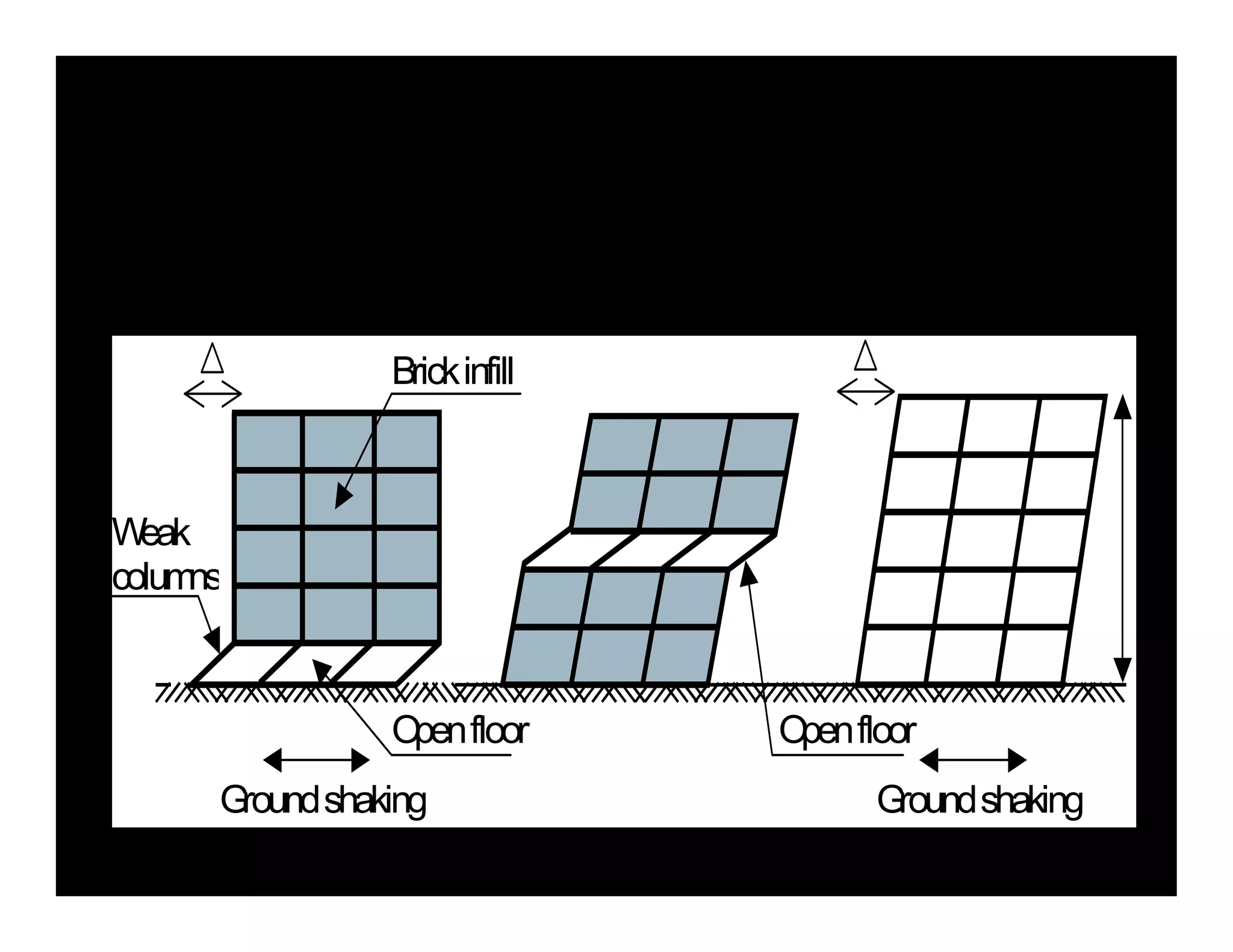
Soft Story
Weak
columns
Brickinfill
Openfloor Openfloor
Groundshaking Groundshaking
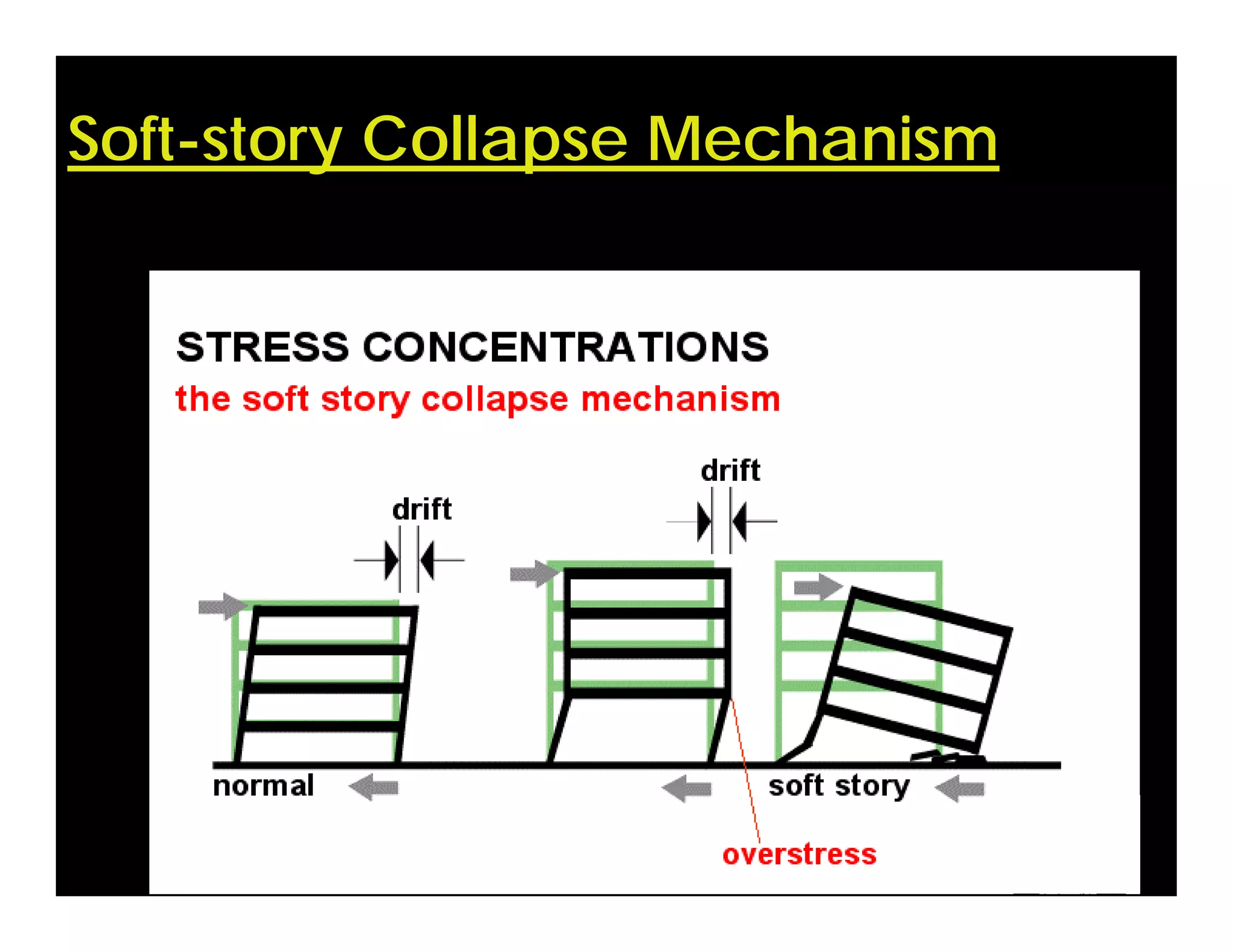
Soft-story Collapse Mechanism
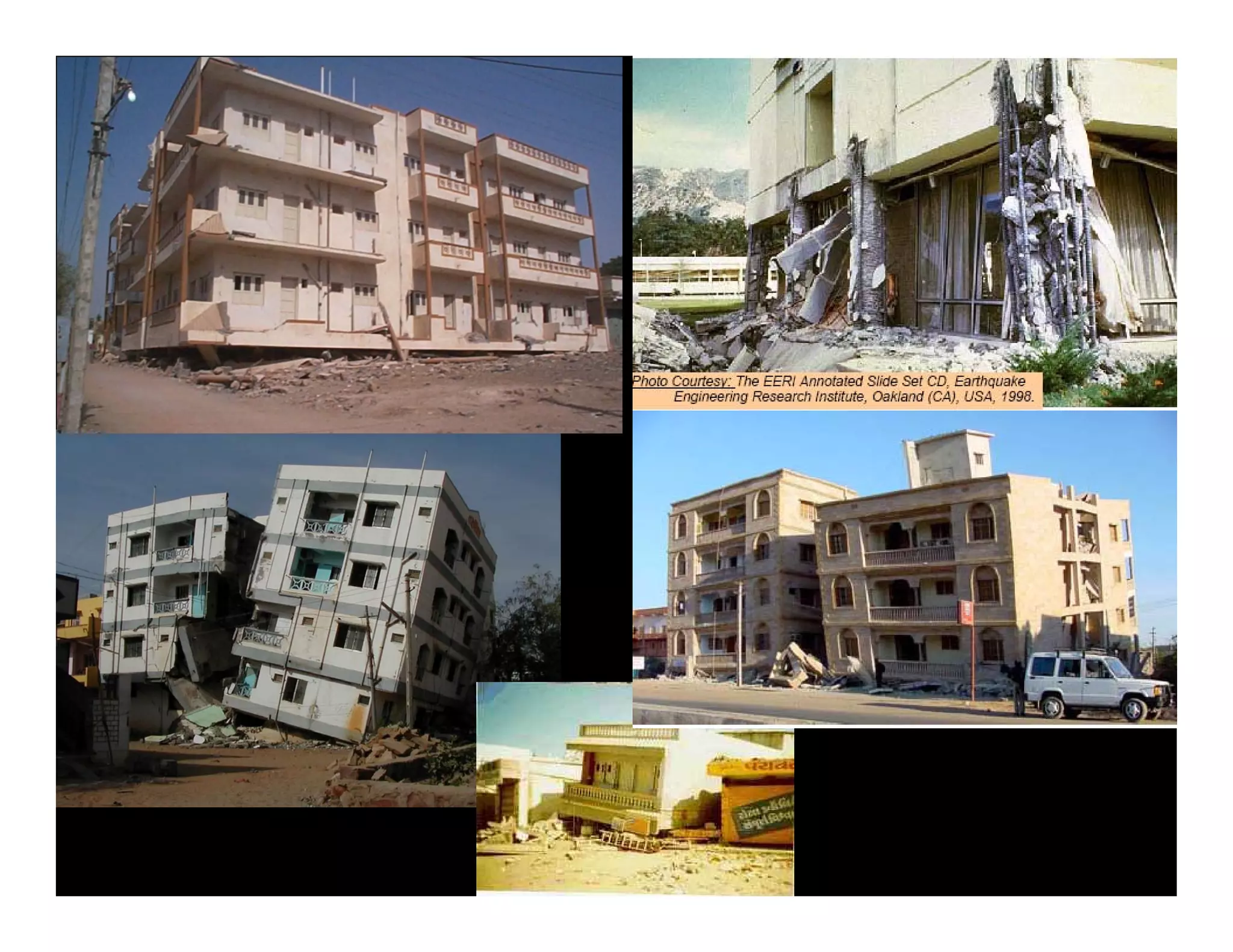
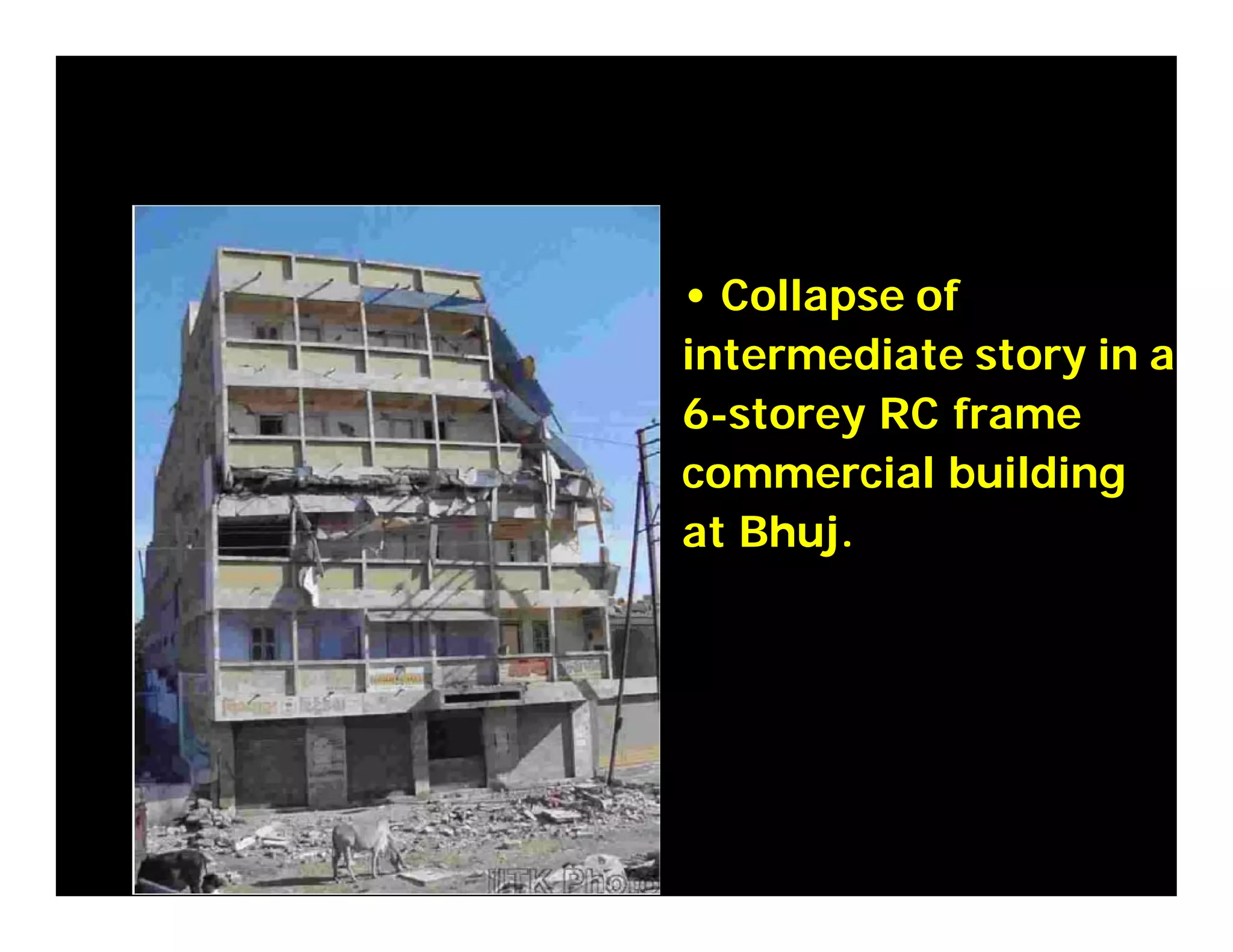
• Collapse of
intermediate story in a
6-storey RC frame
commercial building
at Bhuj.
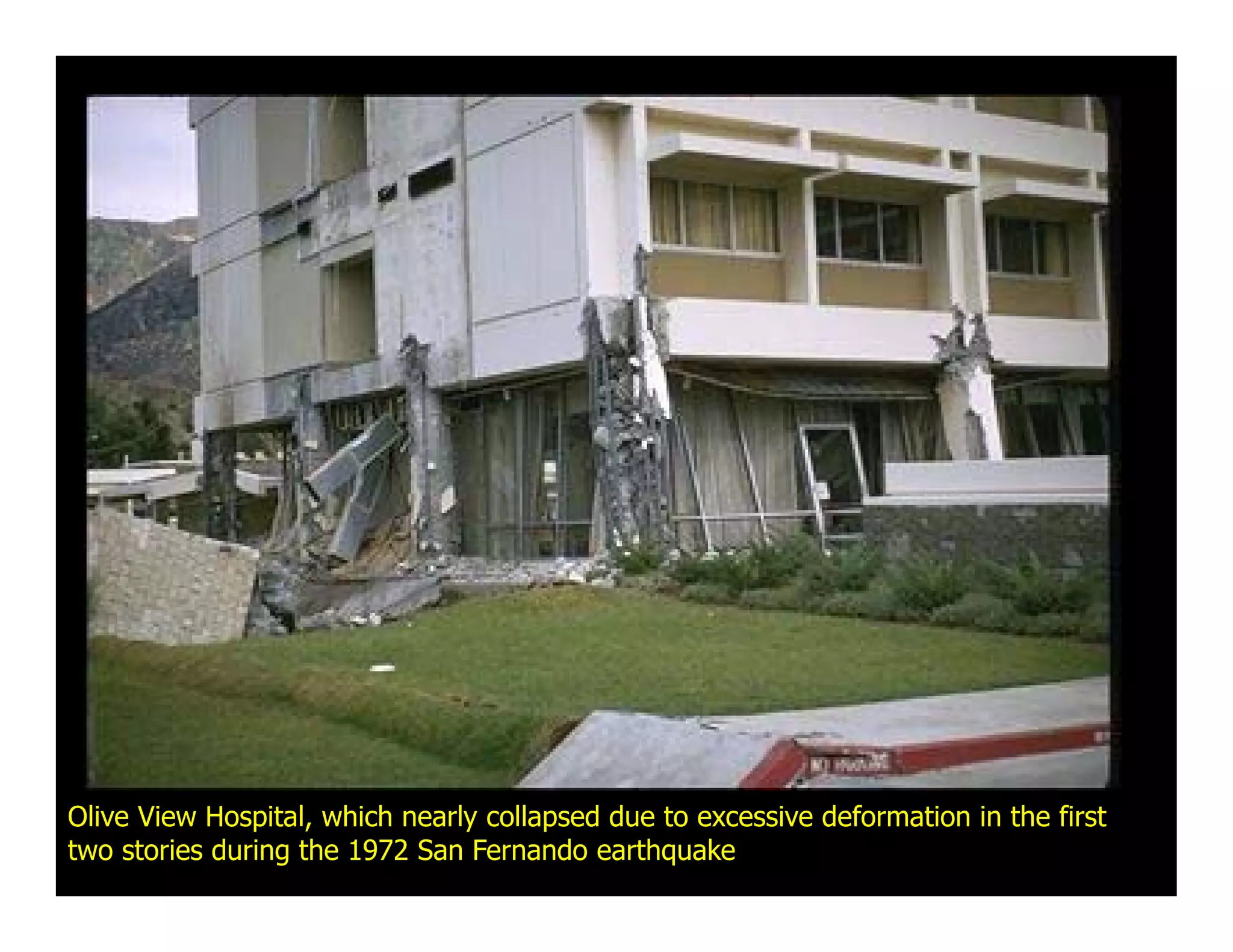
Olive View Hospital, which nearly collapsed due to excessive deformation in the first
two stories during the 1972 San Fernando earthquake
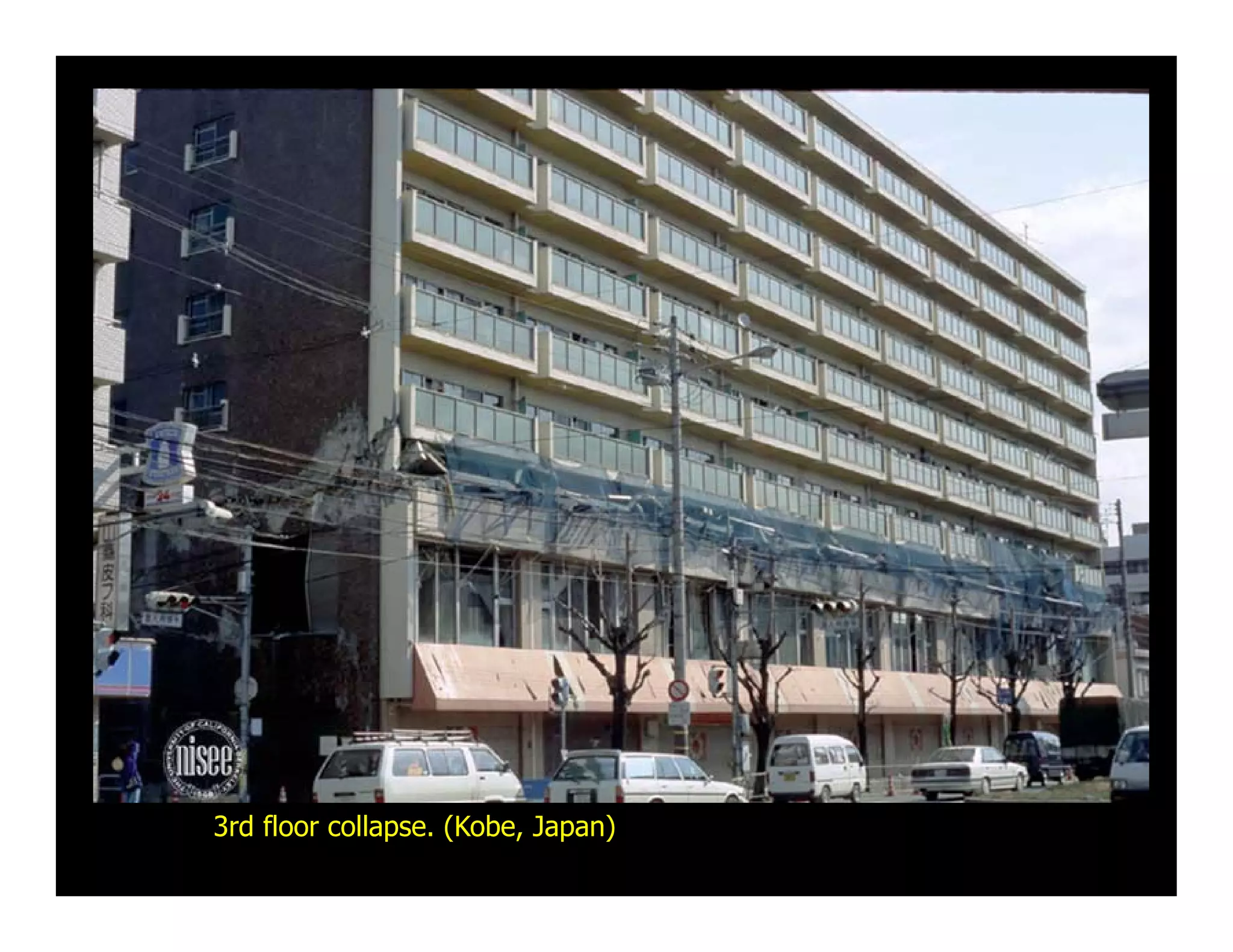
3rd floor collapse. (Kobe, Japan)
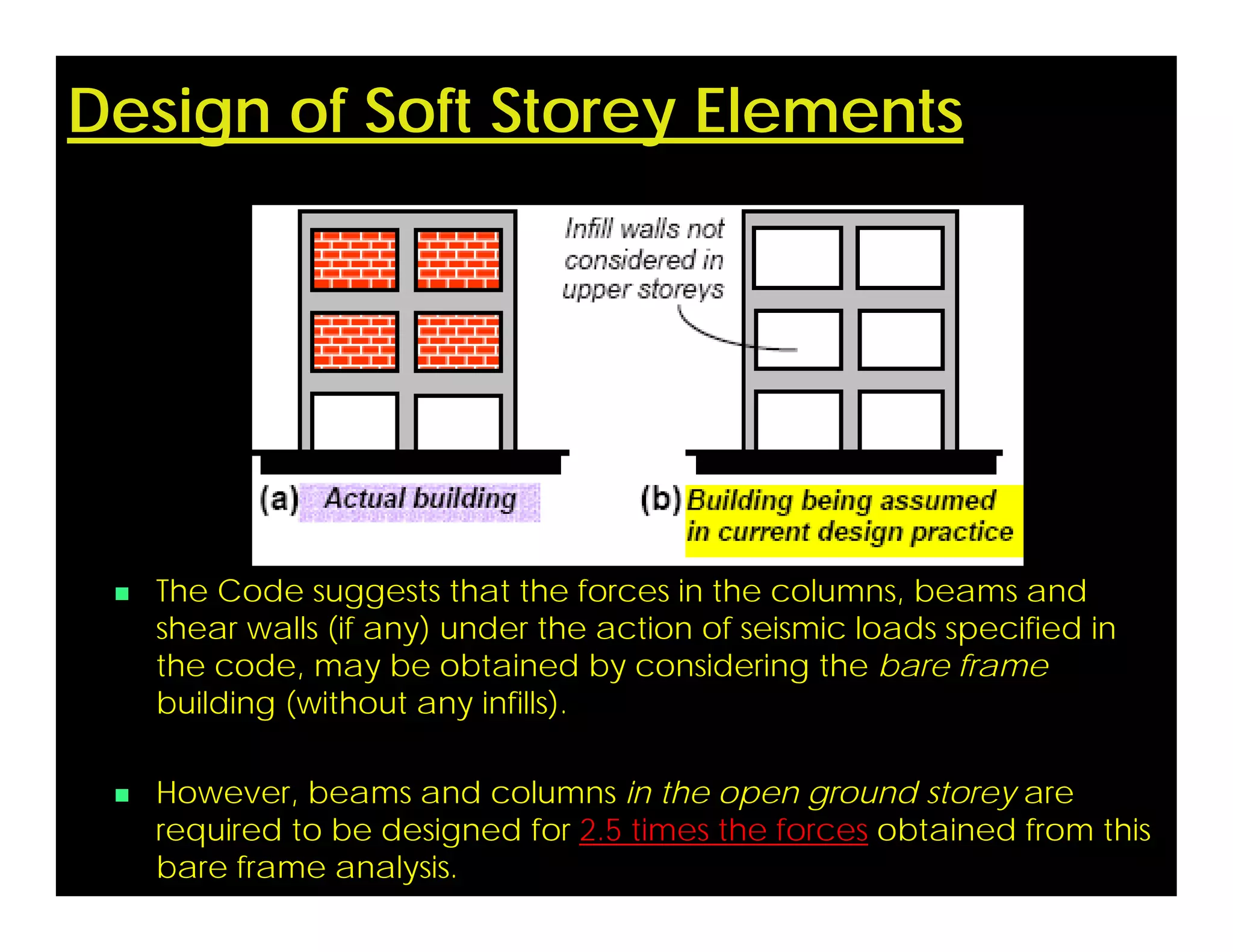
Design of Soft Storey Elements
 The Code suggests that the forces in the columns, beams and
shear walls (if any) under the action of seismic loads specified in
the code, may be obtained by considering the bare frame
building (without any infills).
 However, beams and columns in the open ground storey are
required to be designed for 2.5 times the forces obtained from this
bare frame analysis.
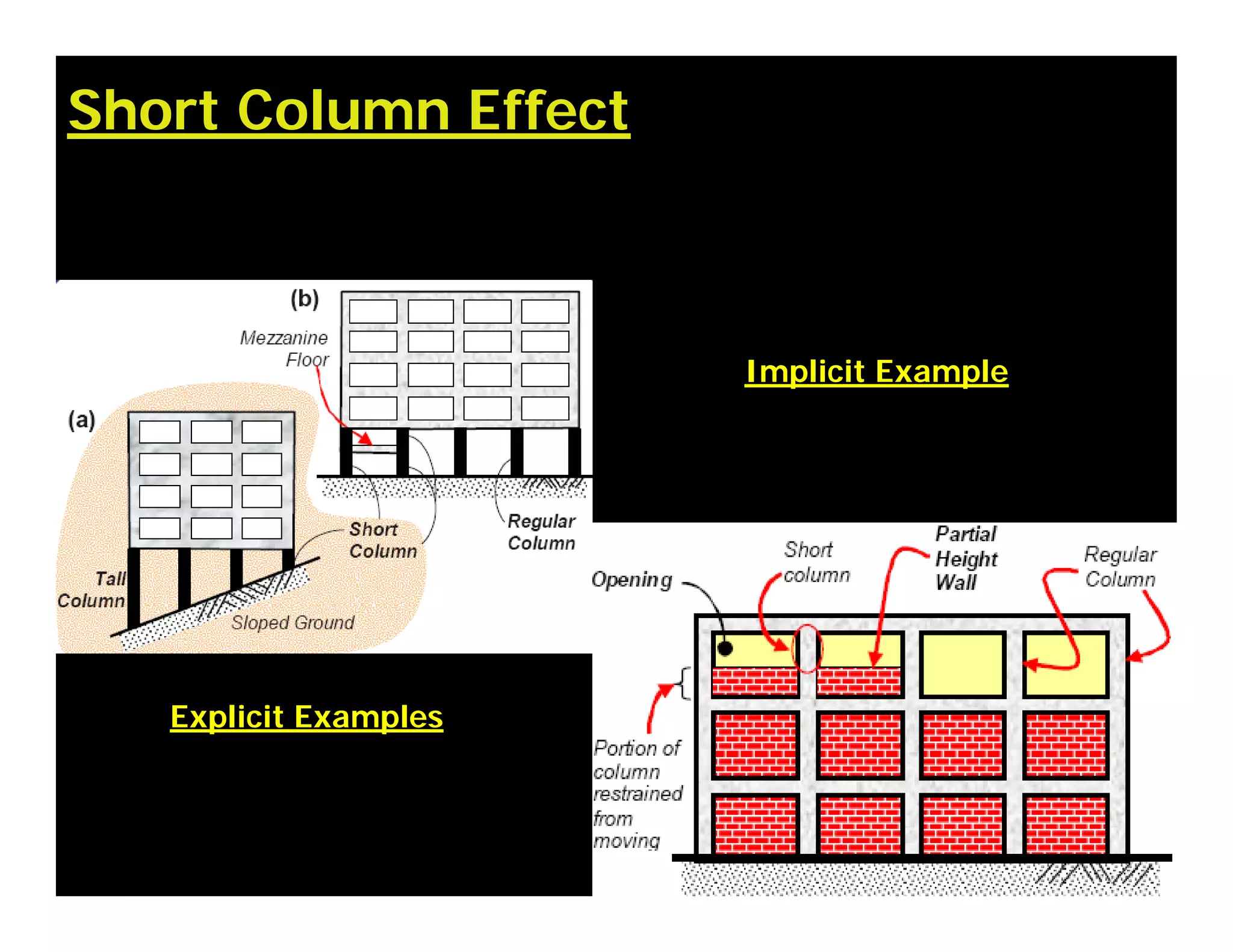
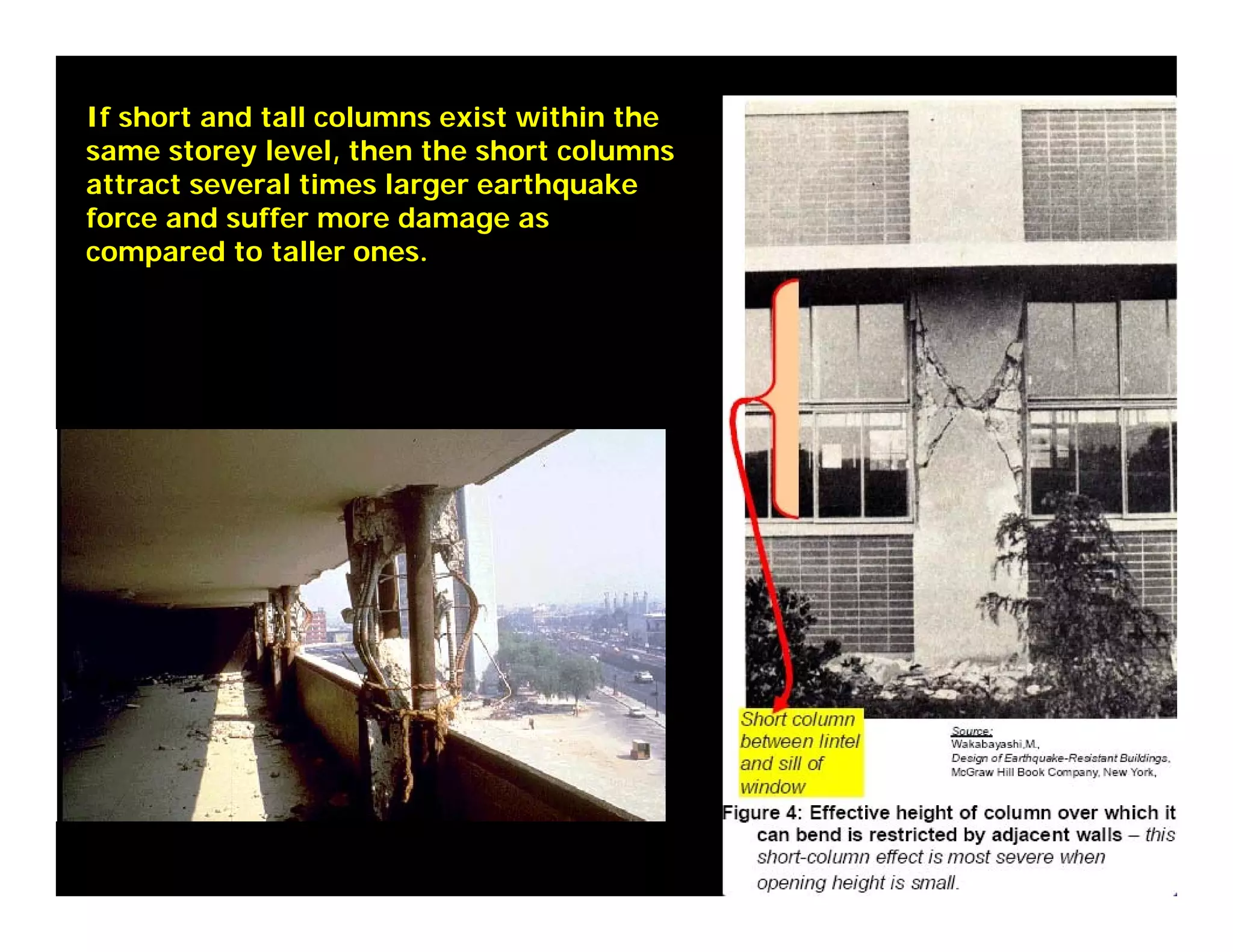
Short Column Effect
Explicit Examples
Implicit Example
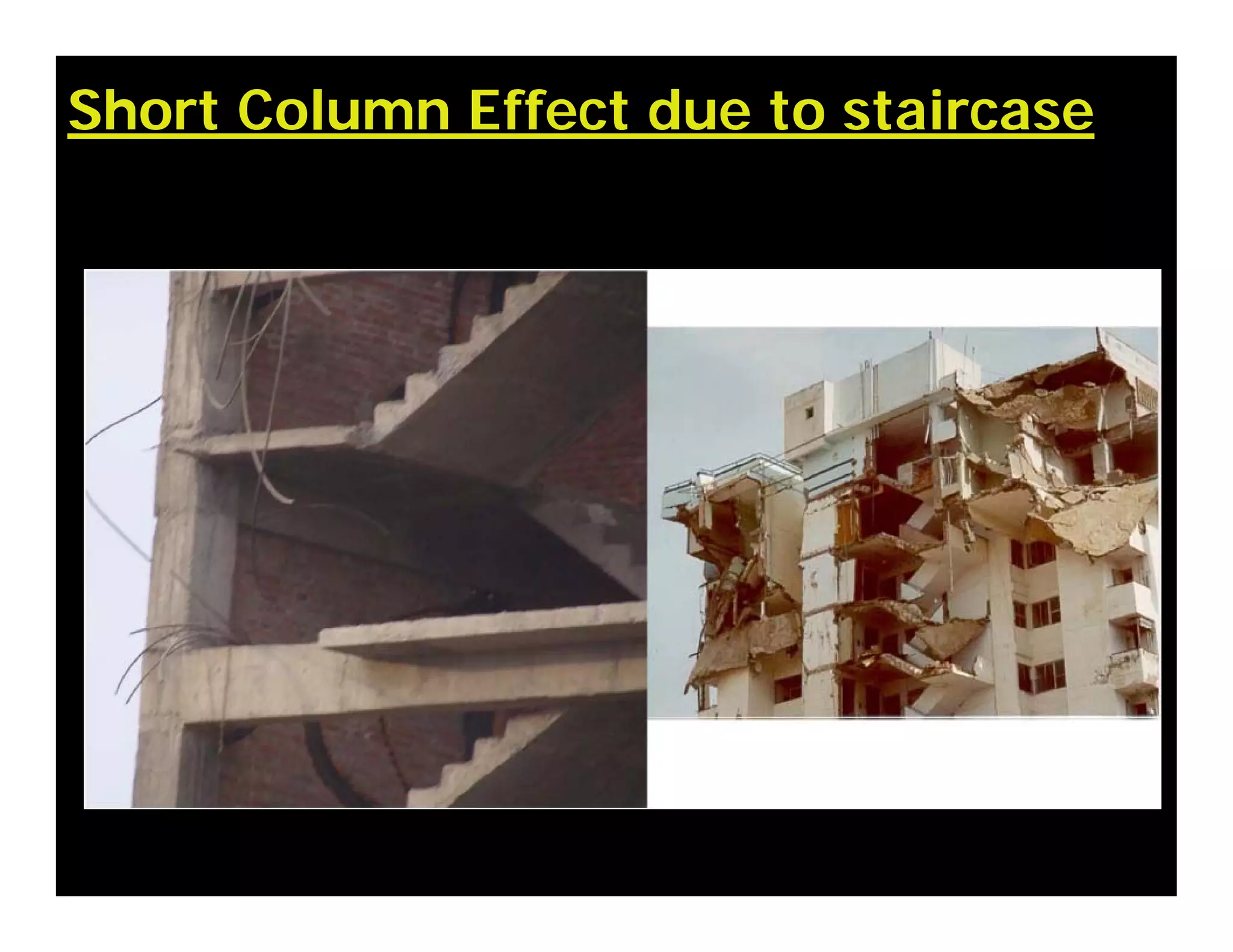
Short Column Effect due to staircase
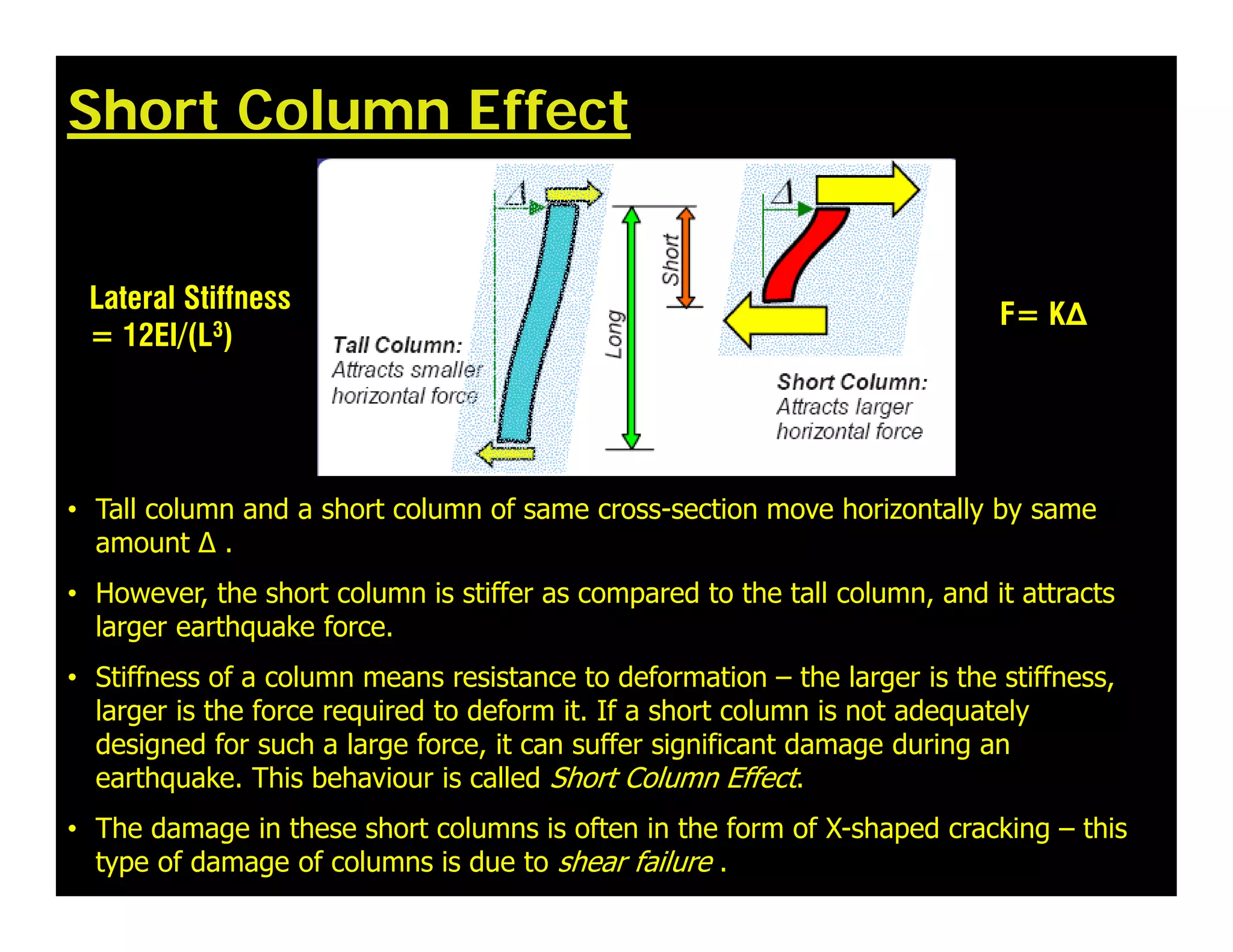
Short Column Effect
• Tall column and a short column of same cross-section move horizontally by same
amount ∆ .
• However, the short column is stiffer as compared to the tall column, and it attracts
larger earthquake force.
• Stiffness of a column means resistance to deformation – the larger is the stiffness,
larger is the force required to deform it. If a short column is not adequately
designed for such a large force, it can suffer significant damage during an
earthquake. This behaviour is called Short Column Effect.
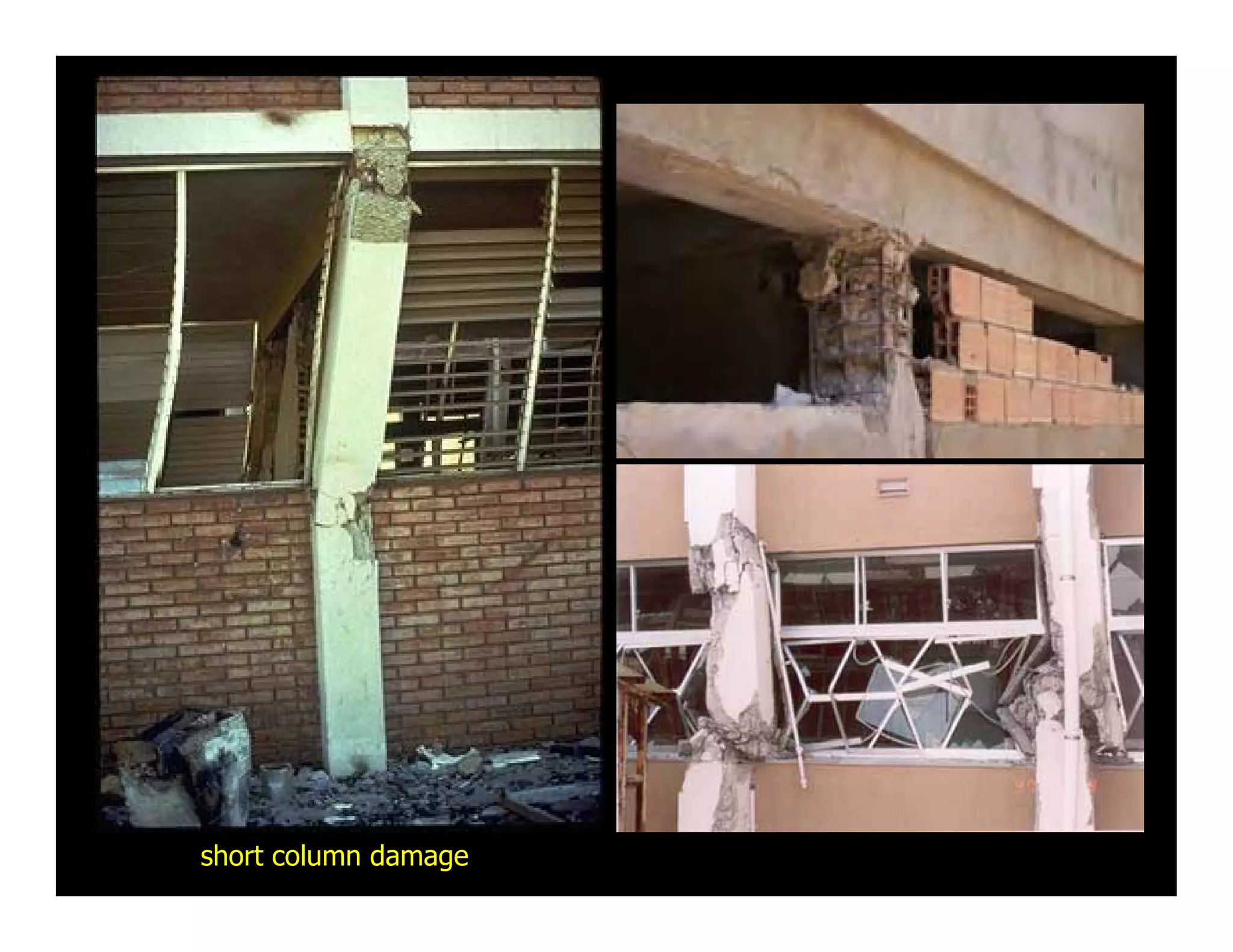
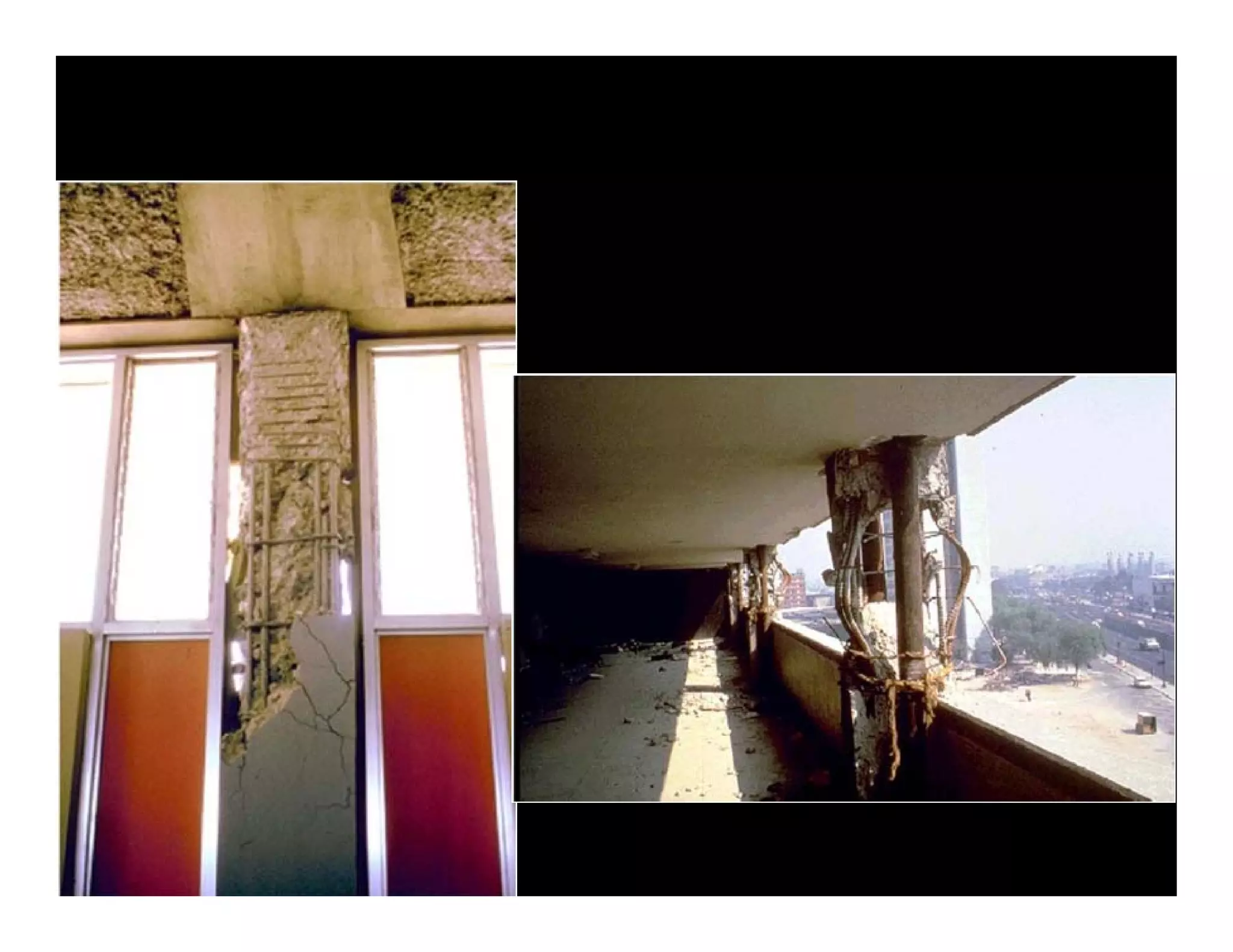
• The damage in these short columns is often in the form of X-shaped cracking – this
type of damage of columns is due to shear failure .
Lateral Stiffness
= 12EI/(L3)
F= K∆
If short and tall columns exist within the
same storey level, then the short columns
attract several times larger earthquake
force and suffer more damage as
compared to taller ones.
short column damage
Construction Defect:
Joints
Beam Column Joint
Beam Column Joint
Beam Column Joint
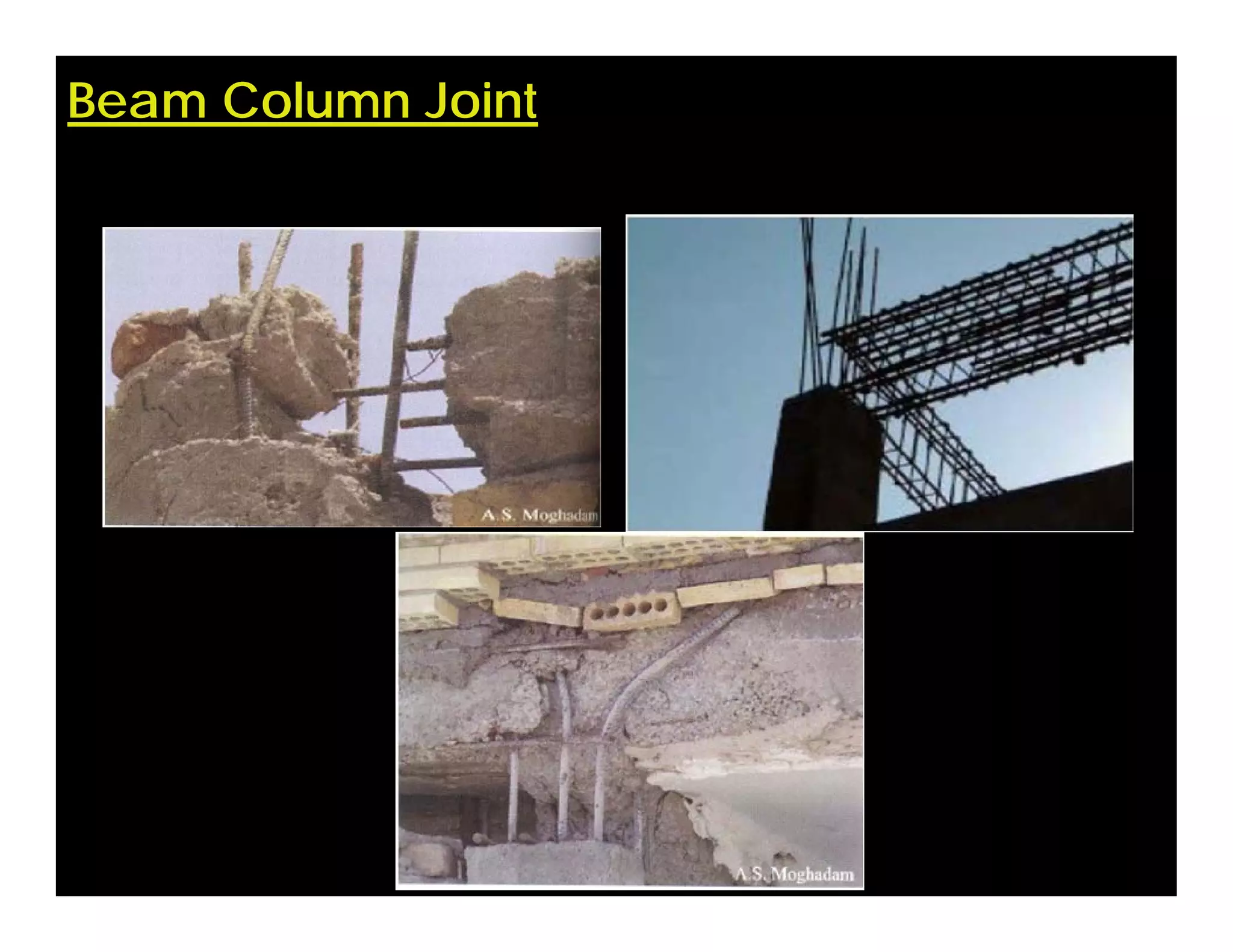
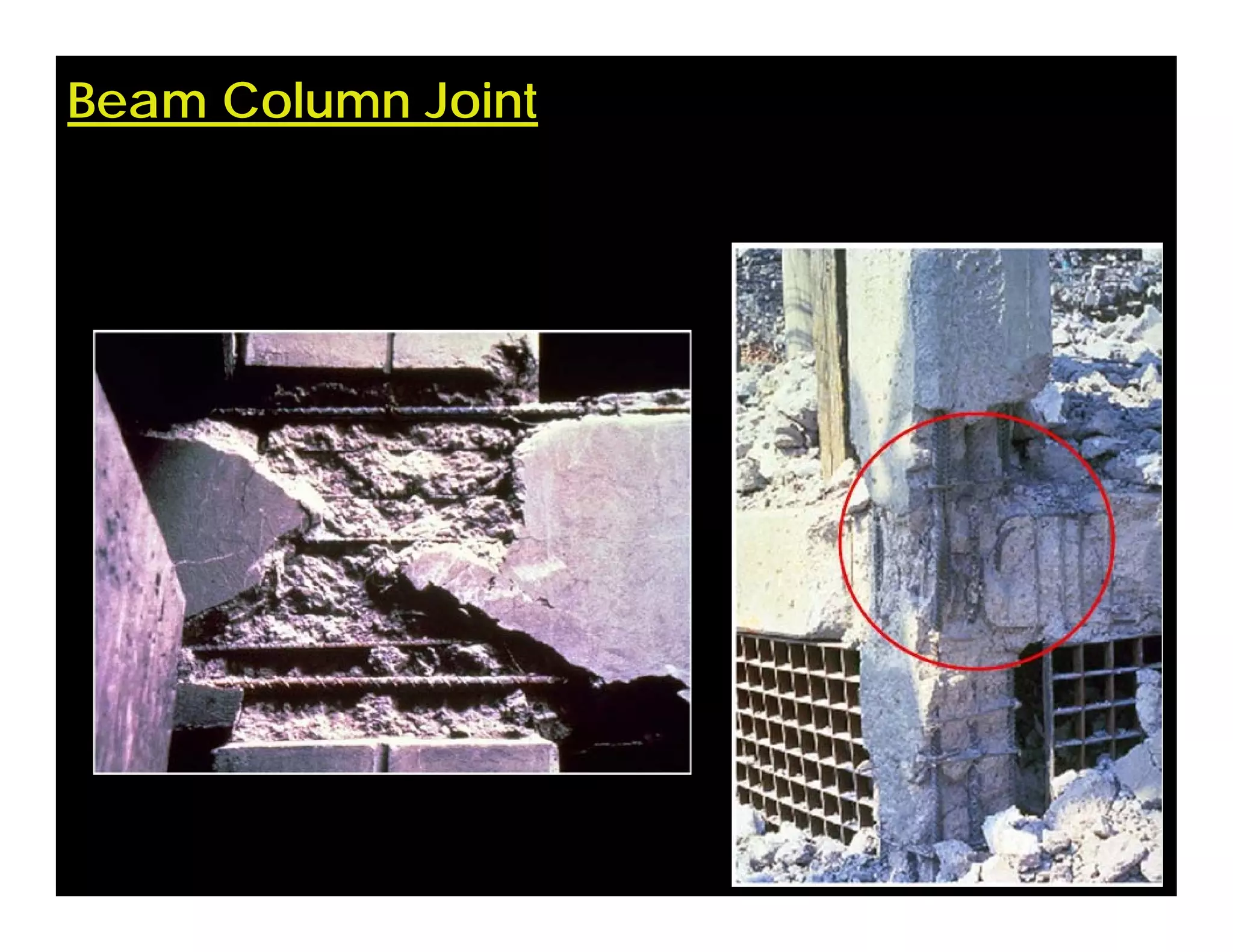
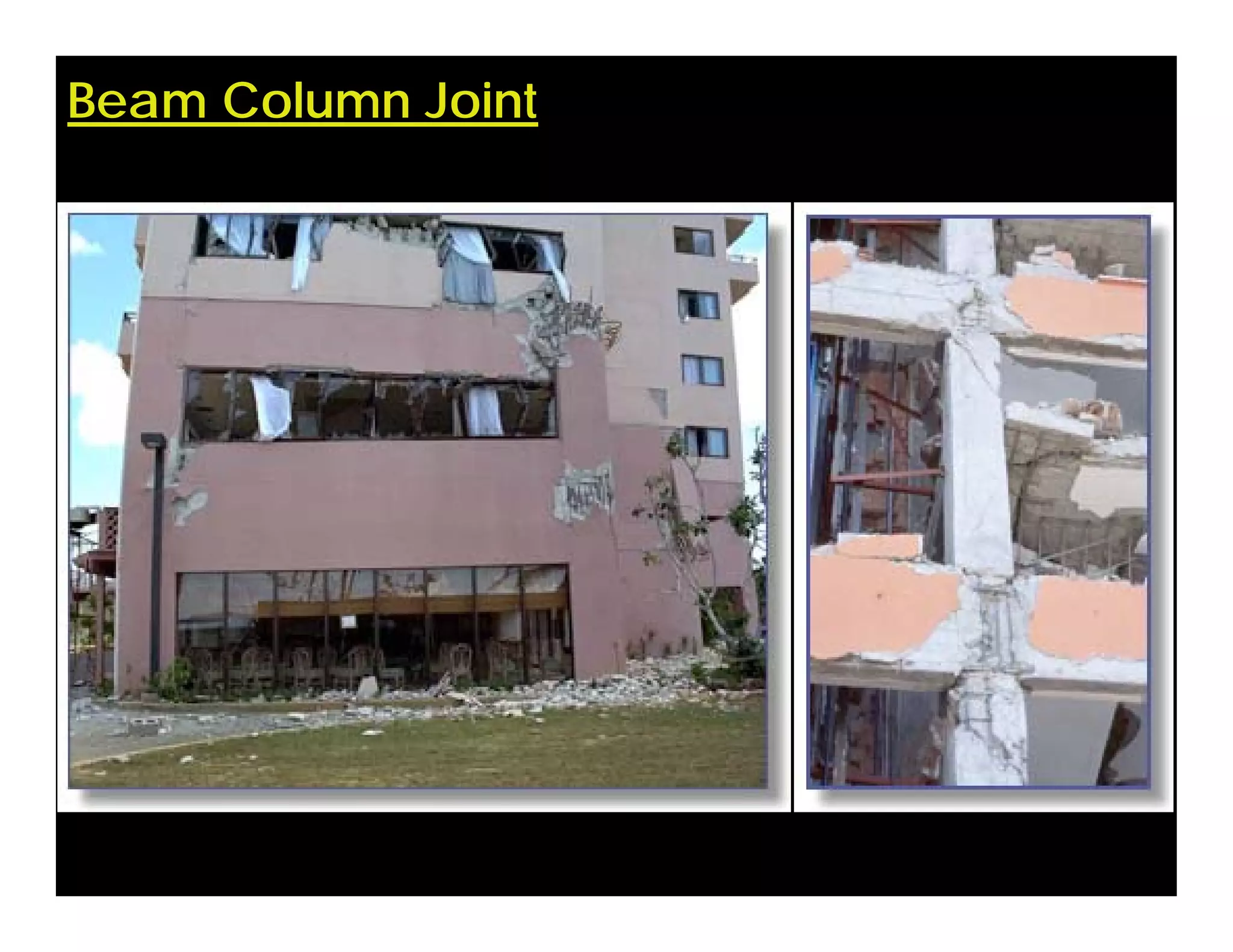
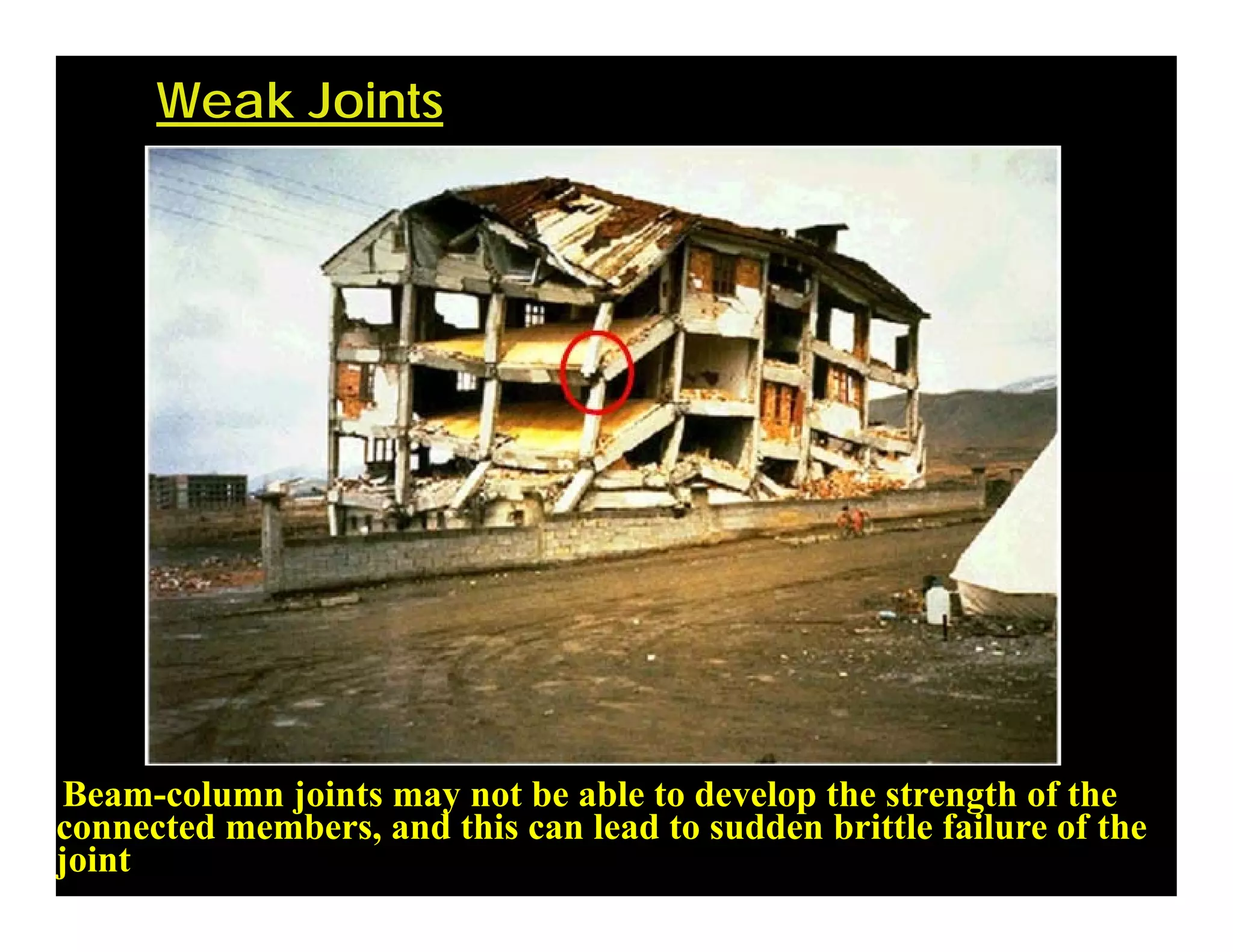
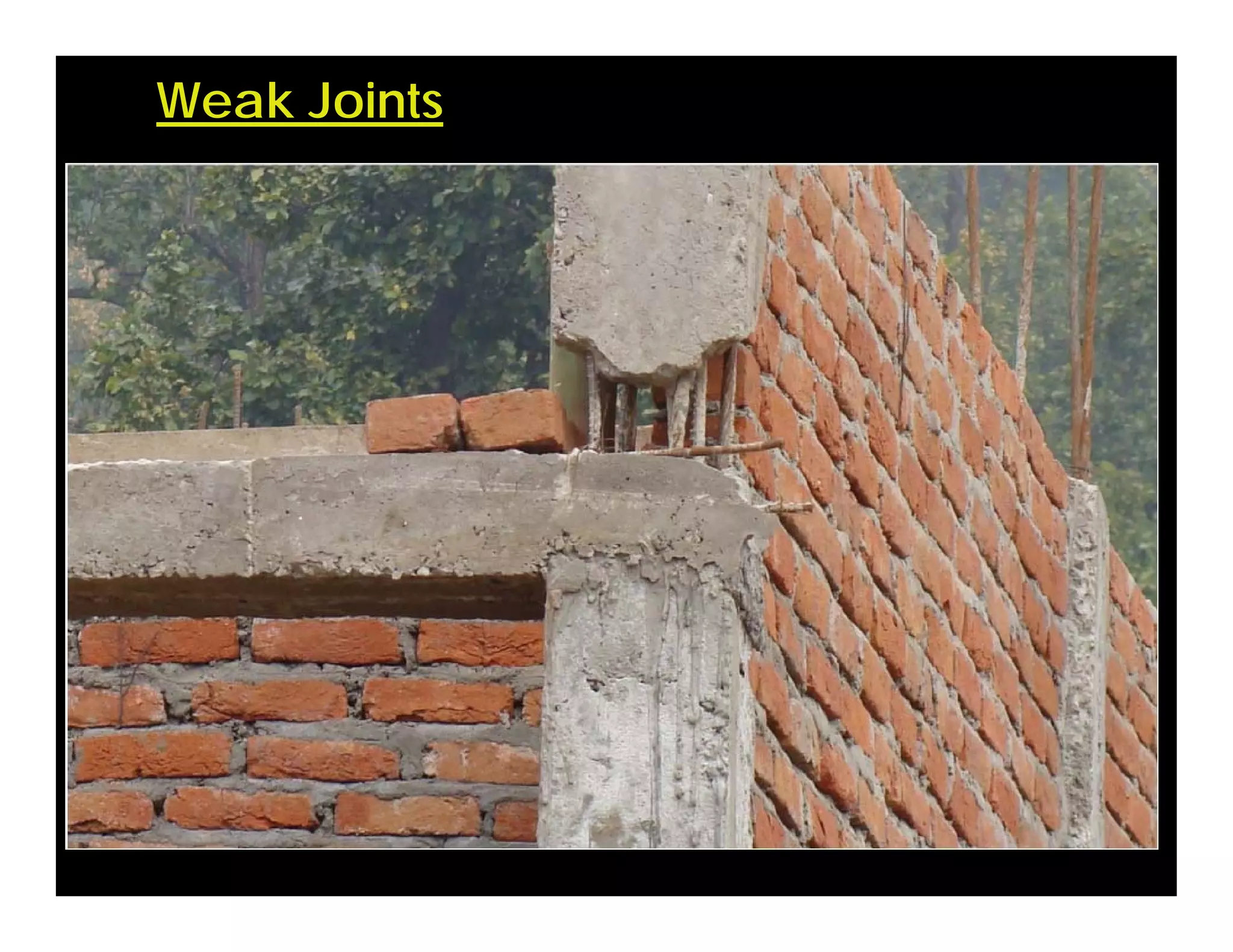
Weak Joints
Beam-column joints may not be able to develop the strength of the
connected members, and this can lead to sudden brittle failure of the
joint
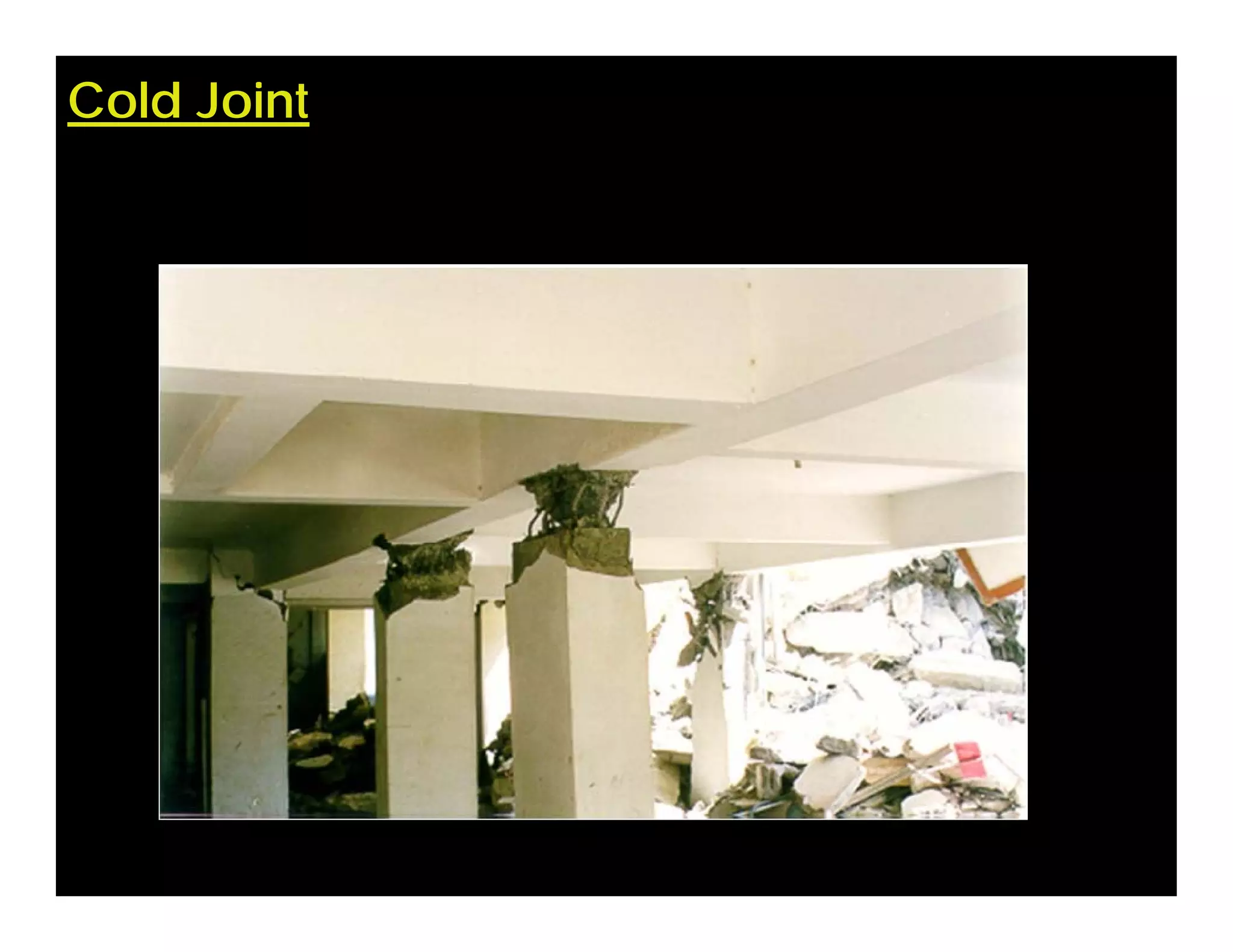
Cold Joint
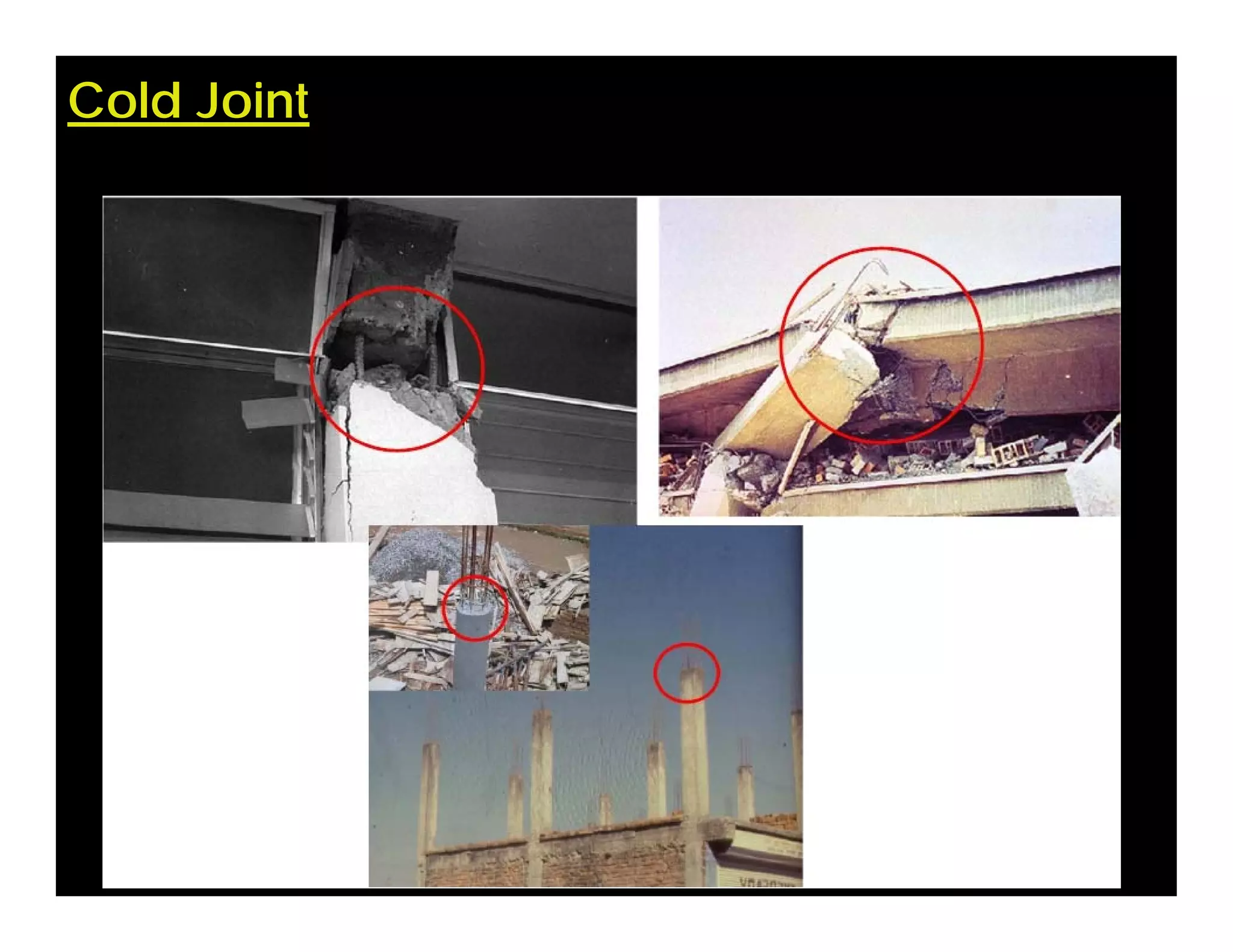
Cold Joint
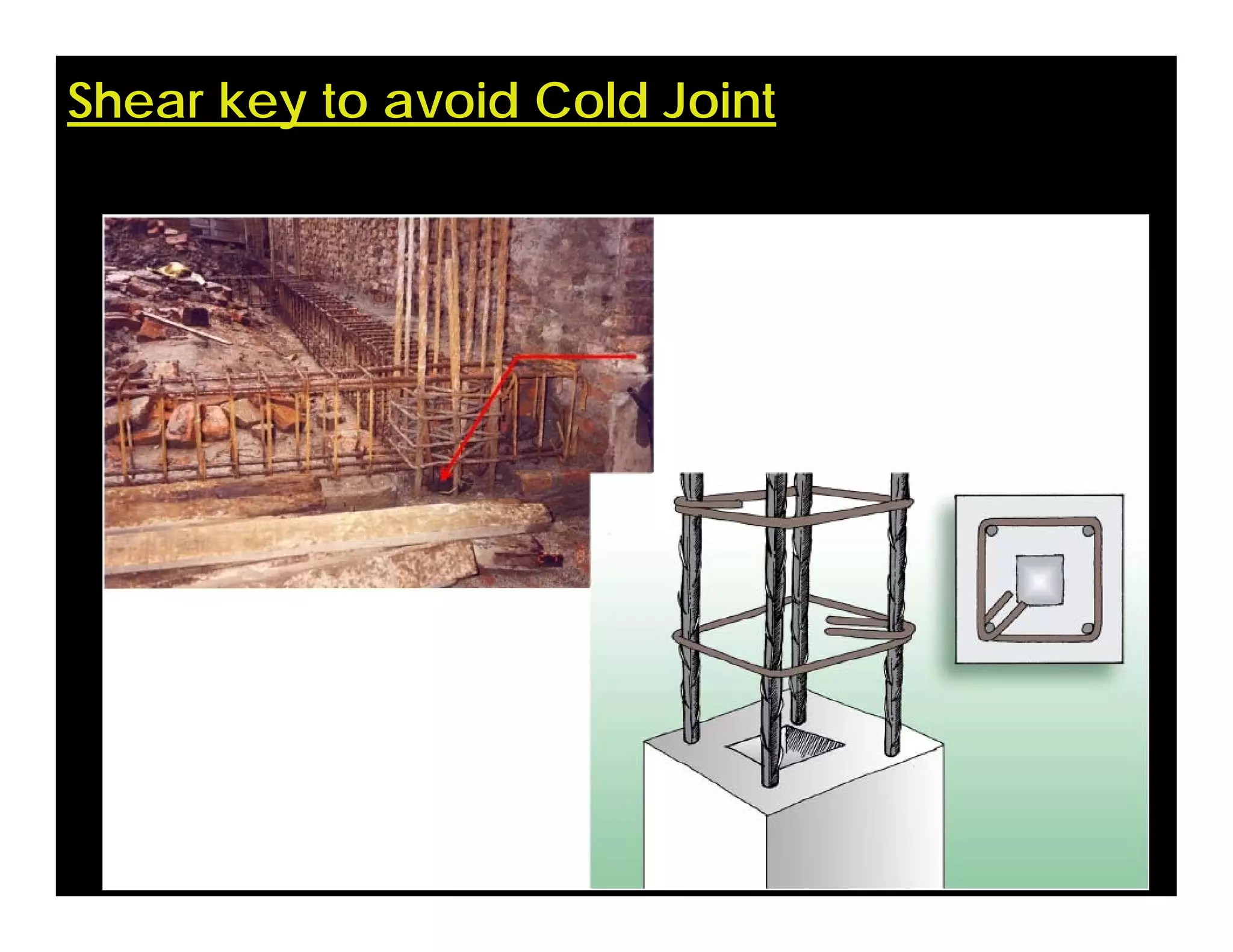
Shear key to avoid Cold Joint
Weak Joints
Lapping
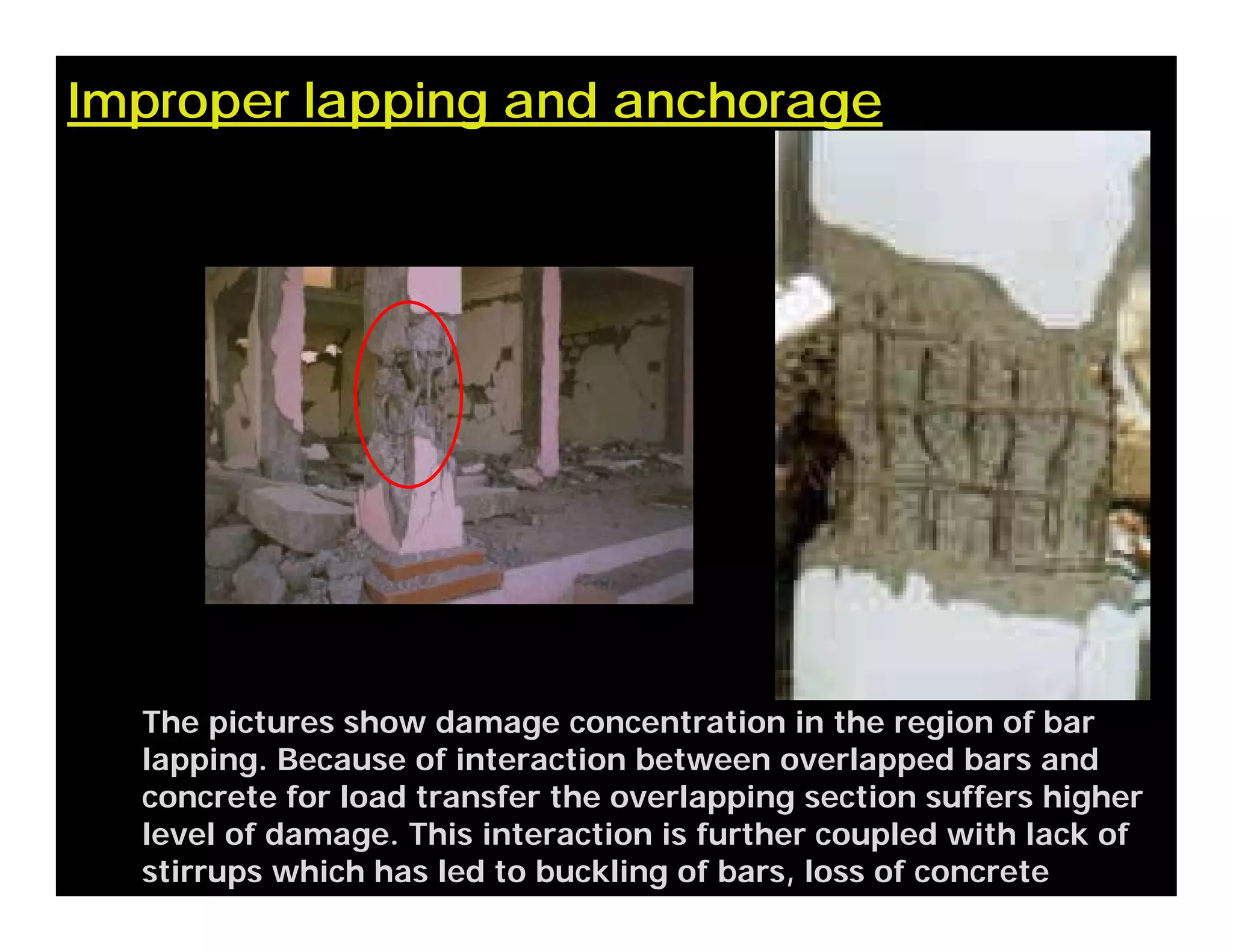
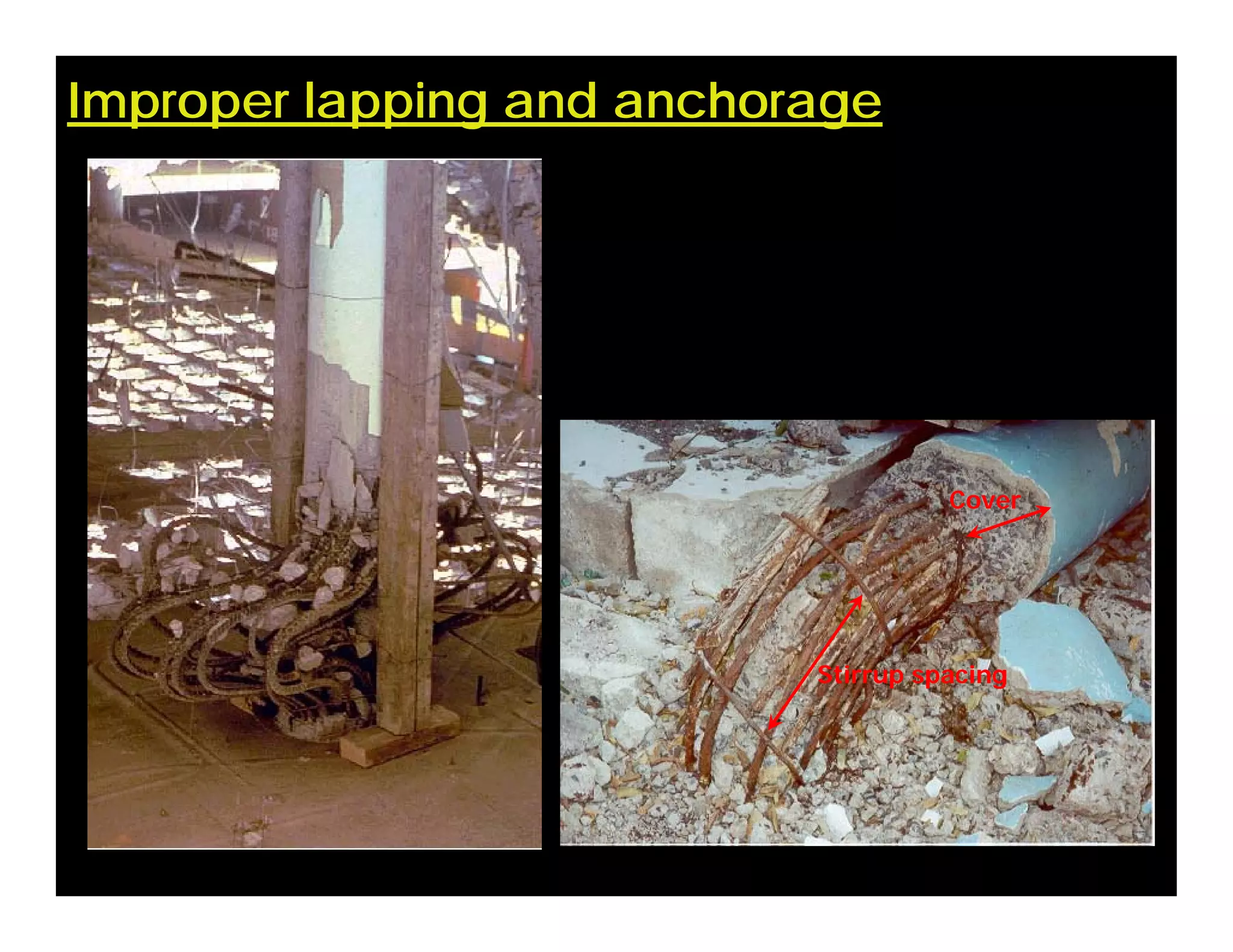
Improper lapping and anchorage
The pictures show damage concentration in the region of bar
lapping. Because of interaction between overlapped bars and
concrete for load transfer the overlapping section suffers higher
level of damage. This interaction is further coupled with lack of
stirrups which has led to buckling of bars, loss of concrete
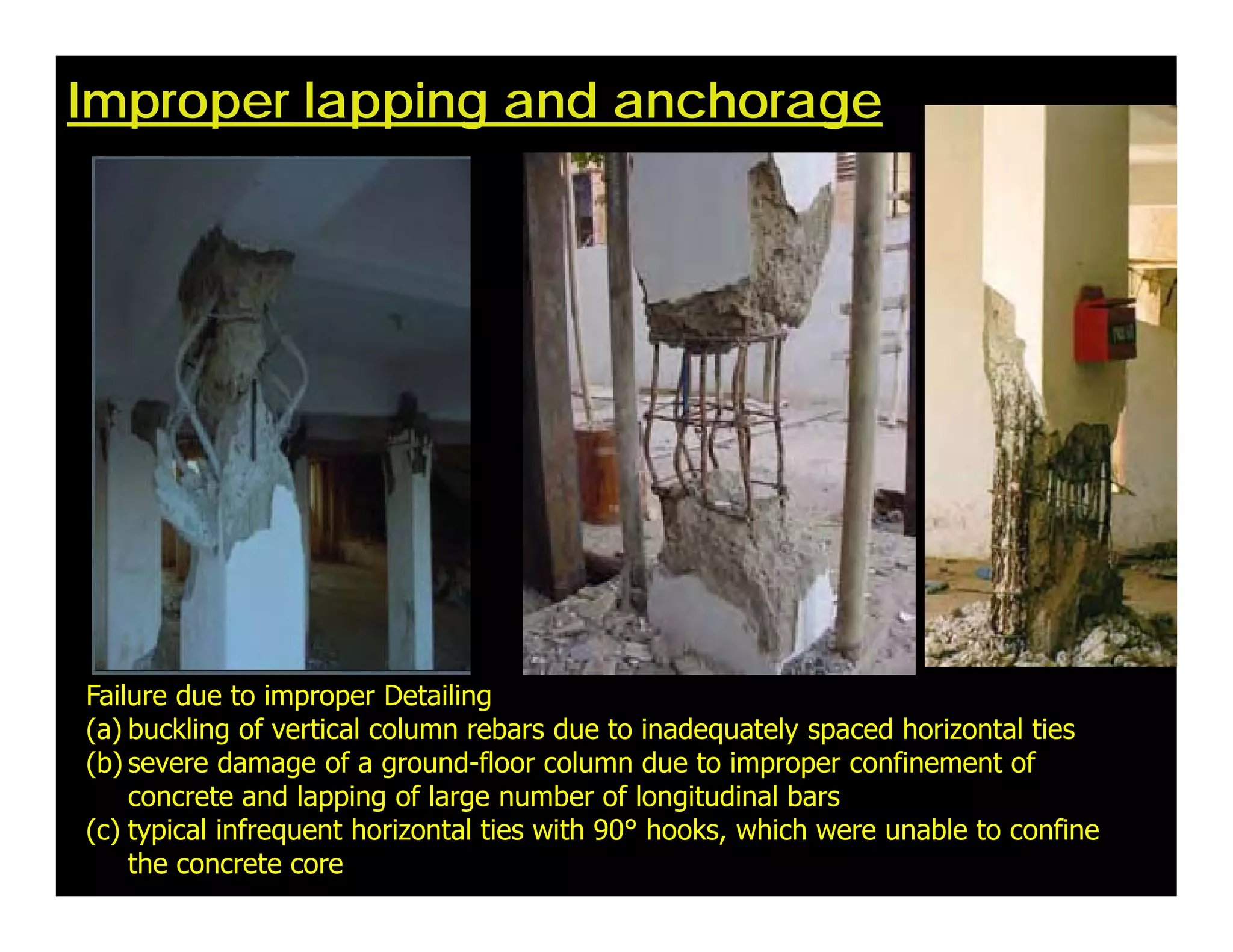
Improper lapping and anchorage
Failure due to improper Detailing
(a) buckling of vertical column rebars due to inadequately spaced horizontal ties
(b) severe damage of a ground-floor column due to improper confinement of
concrete and lapping of large number of longitudinal bars
(c) typical infrequent horizontal ties with 90° hooks, which were unable to confine
the concrete core
Improper lapping and anchorage
Cover
Stirrup spacing
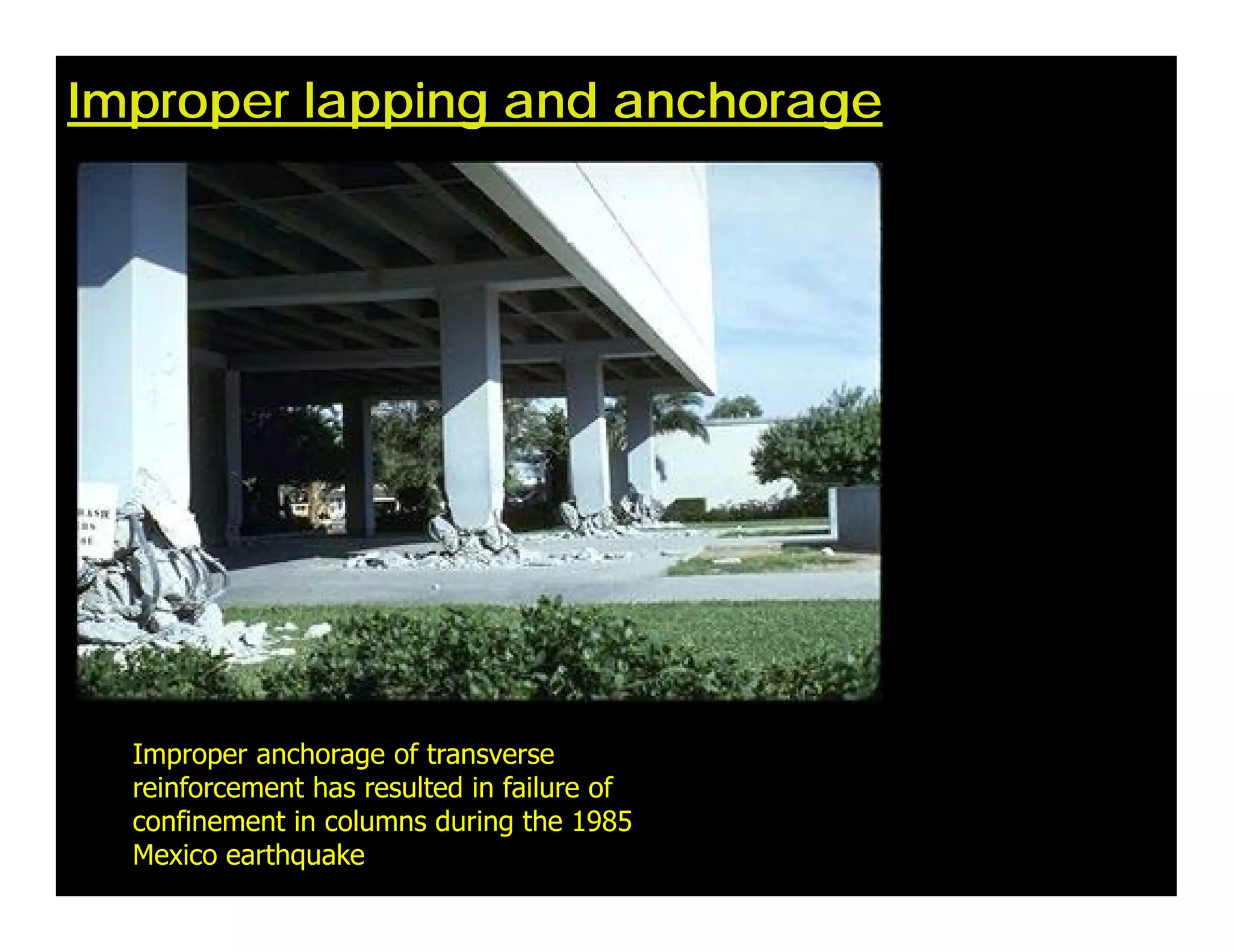
Improper lapping and anchorage
Improper anchorage of transverse
reinforcement has resulted in failure of
confinement in columns during the 1985
Mexico earthquake
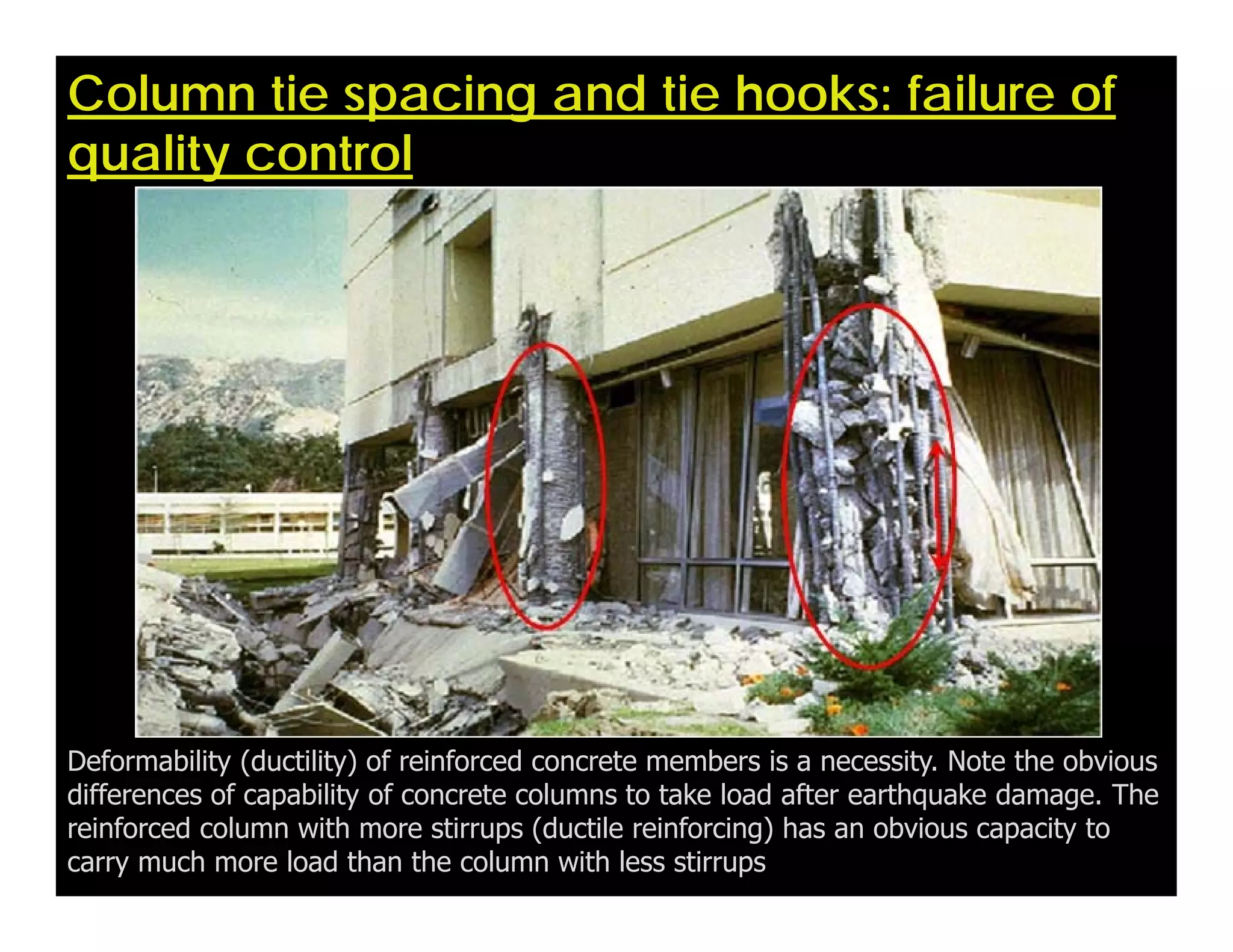
Column tie spacing and tie hooks: failure of
quality control
Deformability (ductility) of reinforced concrete members is a necessity. Note the obvious
differences of capability of concrete columns to take load after earthquake damage. The
reinforced column with more stirrups (ductile reinforcing) has an obvious capacity to
carry much more load than the column with less stirrups
Shape
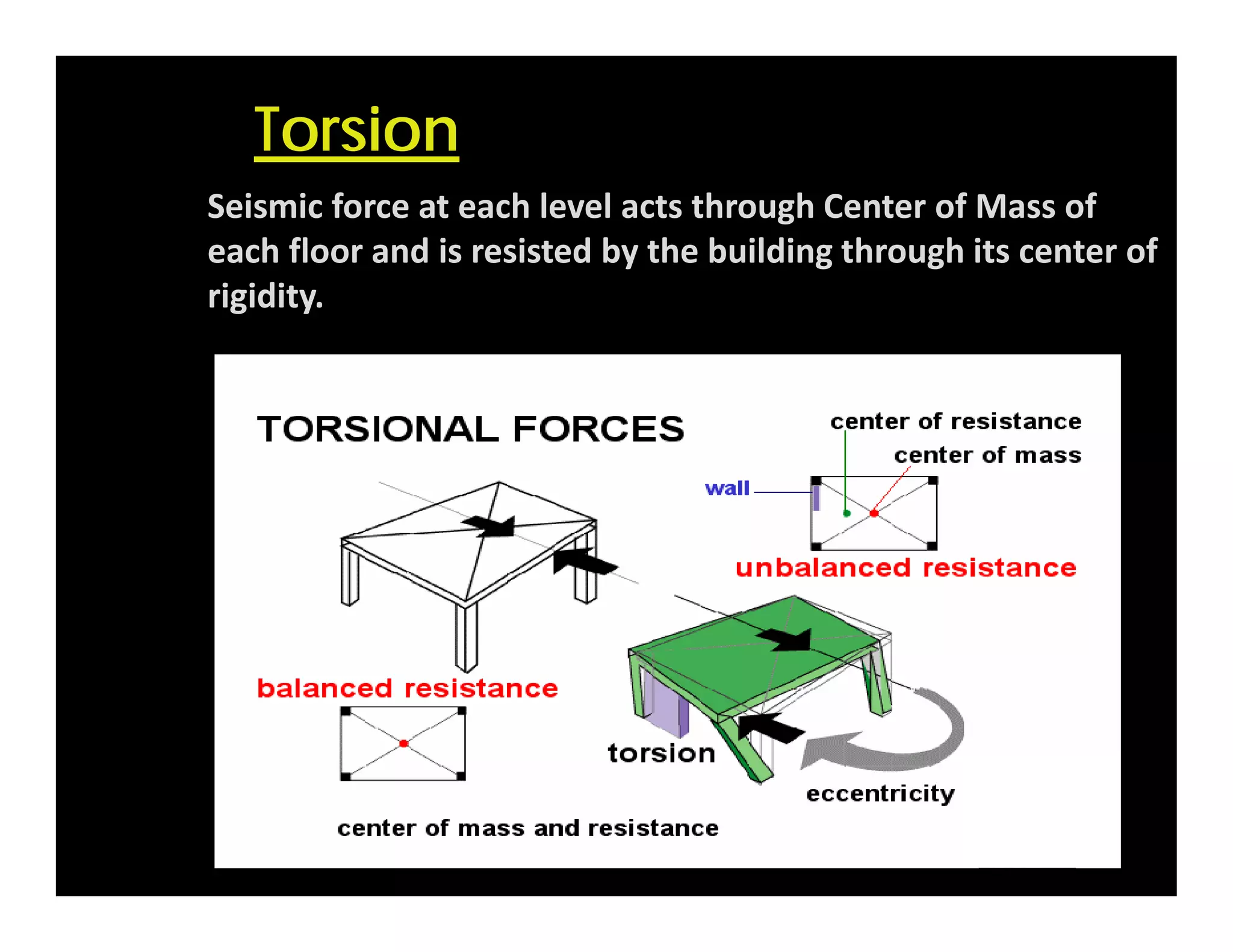
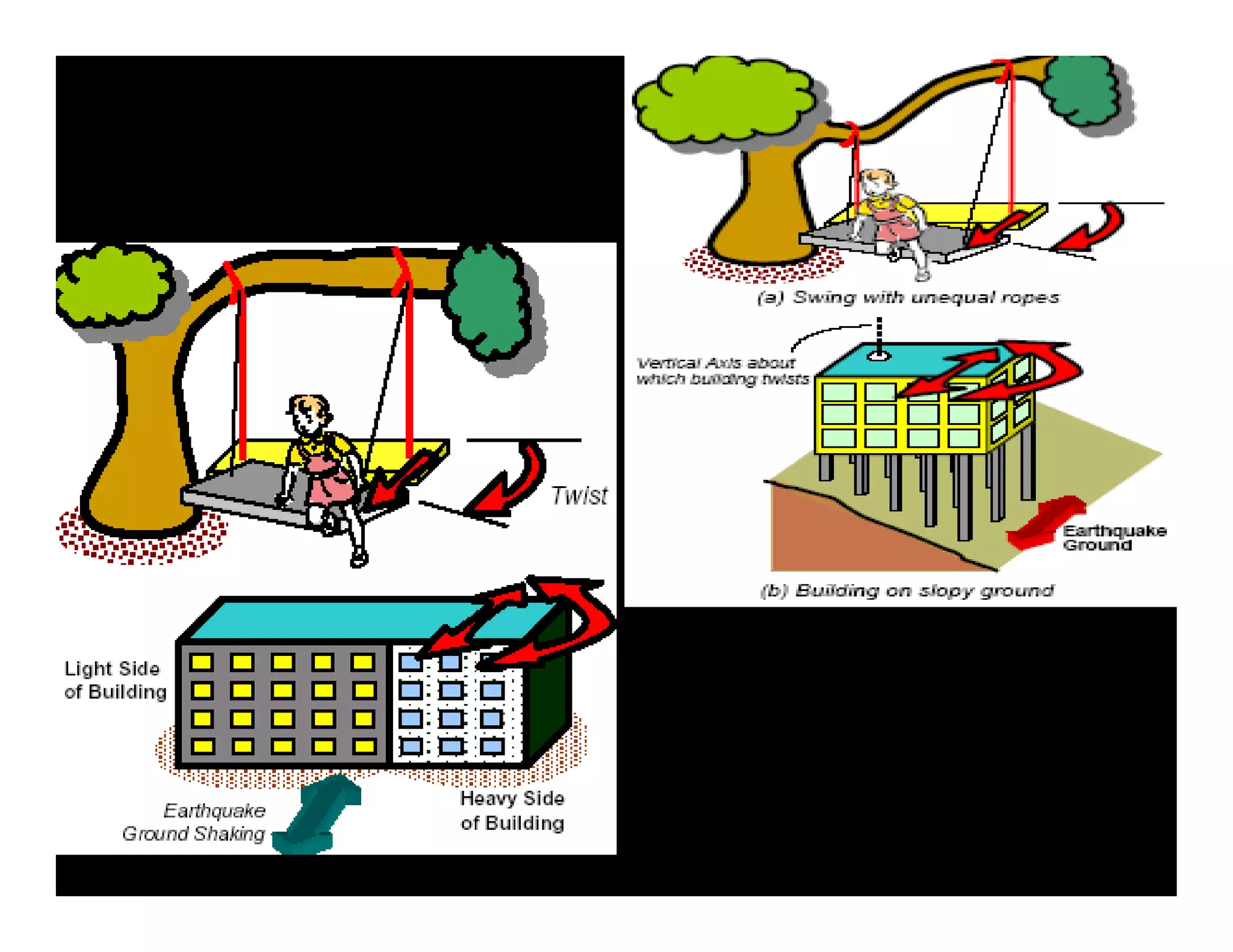
Torsion
Seismic force at each level acts through Center of Mass of 
each floor and is resisted by the building through its center of 
rigidity.
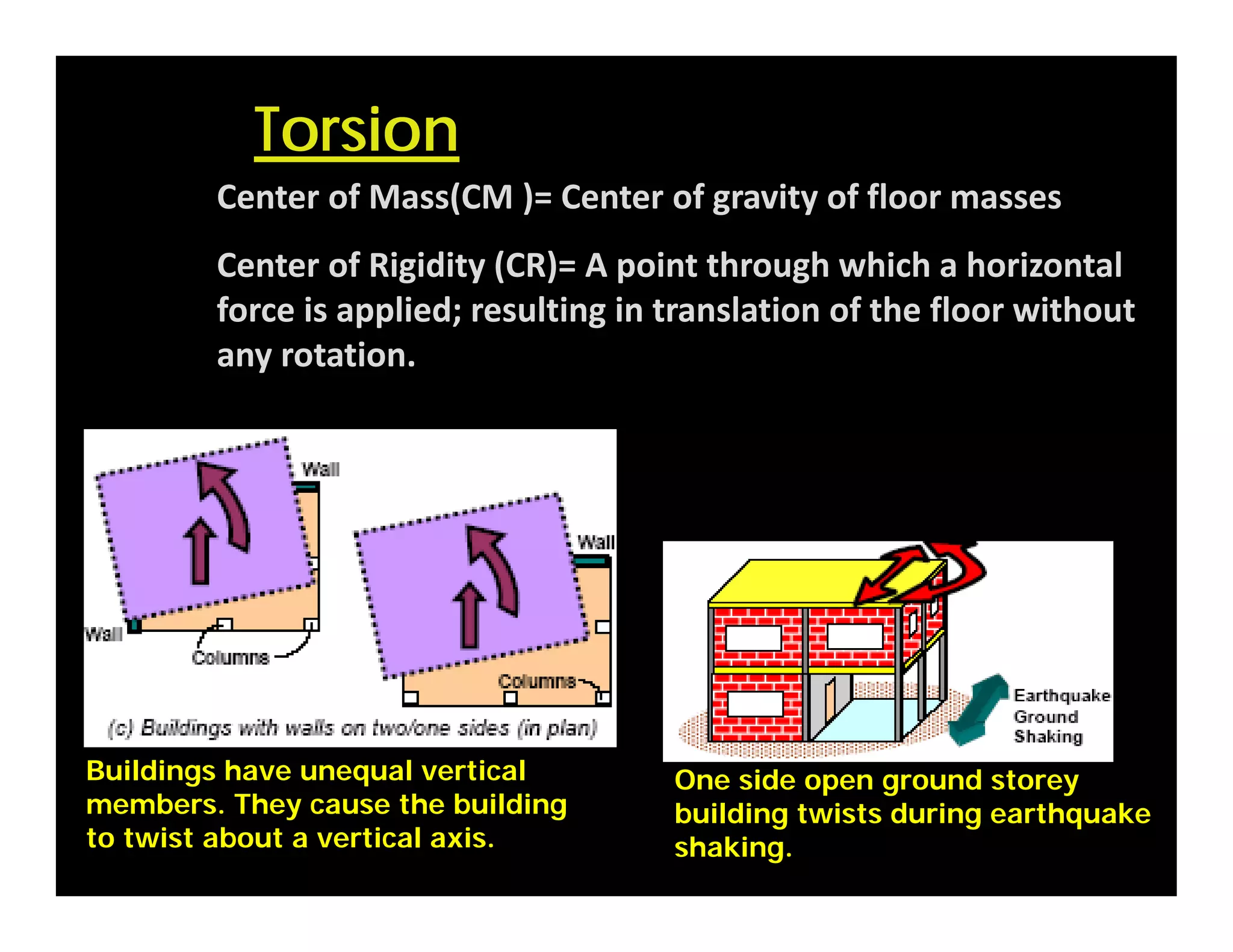
Buildings have unequal vertical
members. They cause the building
to twist about a vertical axis.
One side open ground storey
building twists during earthquake
shaking.
Torsion
Center of Mass(CM )= Center of gravity of floor masses 
Center of Rigidity (CR)= A point through which a horizontal 
force is applied; resulting in translation of the floor without 
any rotation.
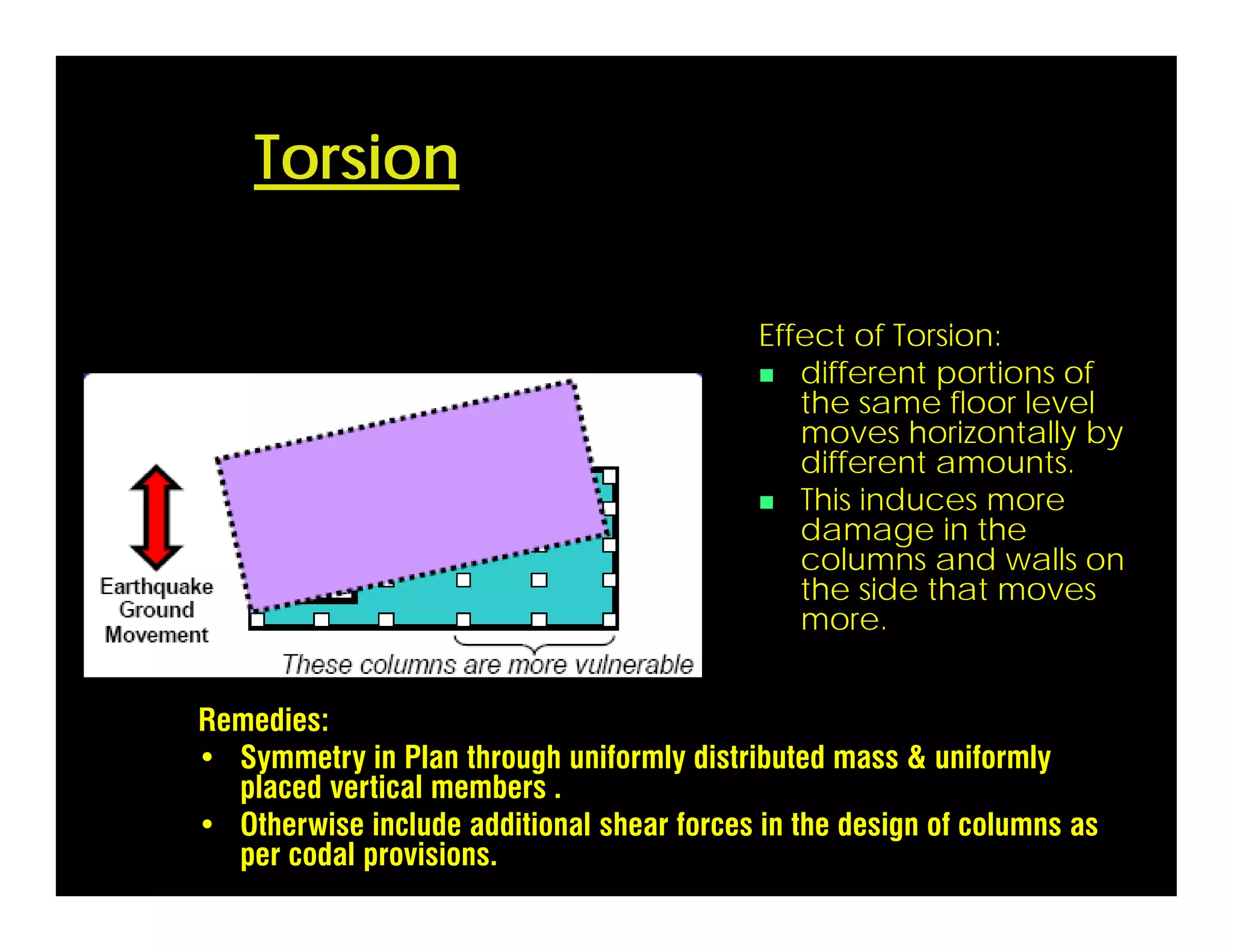
Effect of Torsion:
 different portions of
the same floor level
moves horizontally by
different amounts.
 This induces more
damage in the
columns and walls on
the side that moves
more.
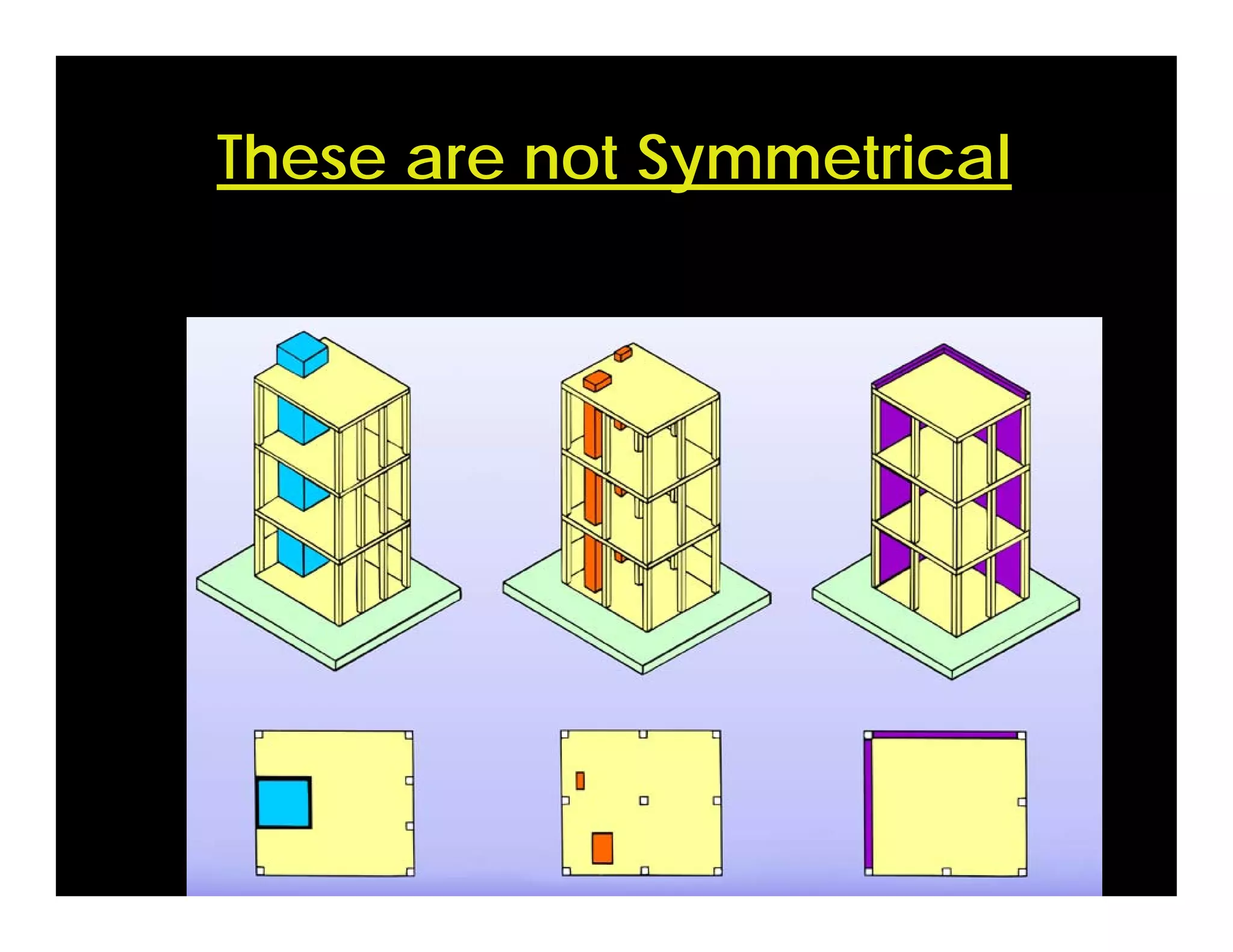
Remedies:
• Symmetry in Plan through uniformly distributed mass & uniformly
placed vertical members .
• Otherwise include additional shear forces in the design of columns as
per codal provisions.
Torsion
These are not Symmetrical
Unacceptable shape
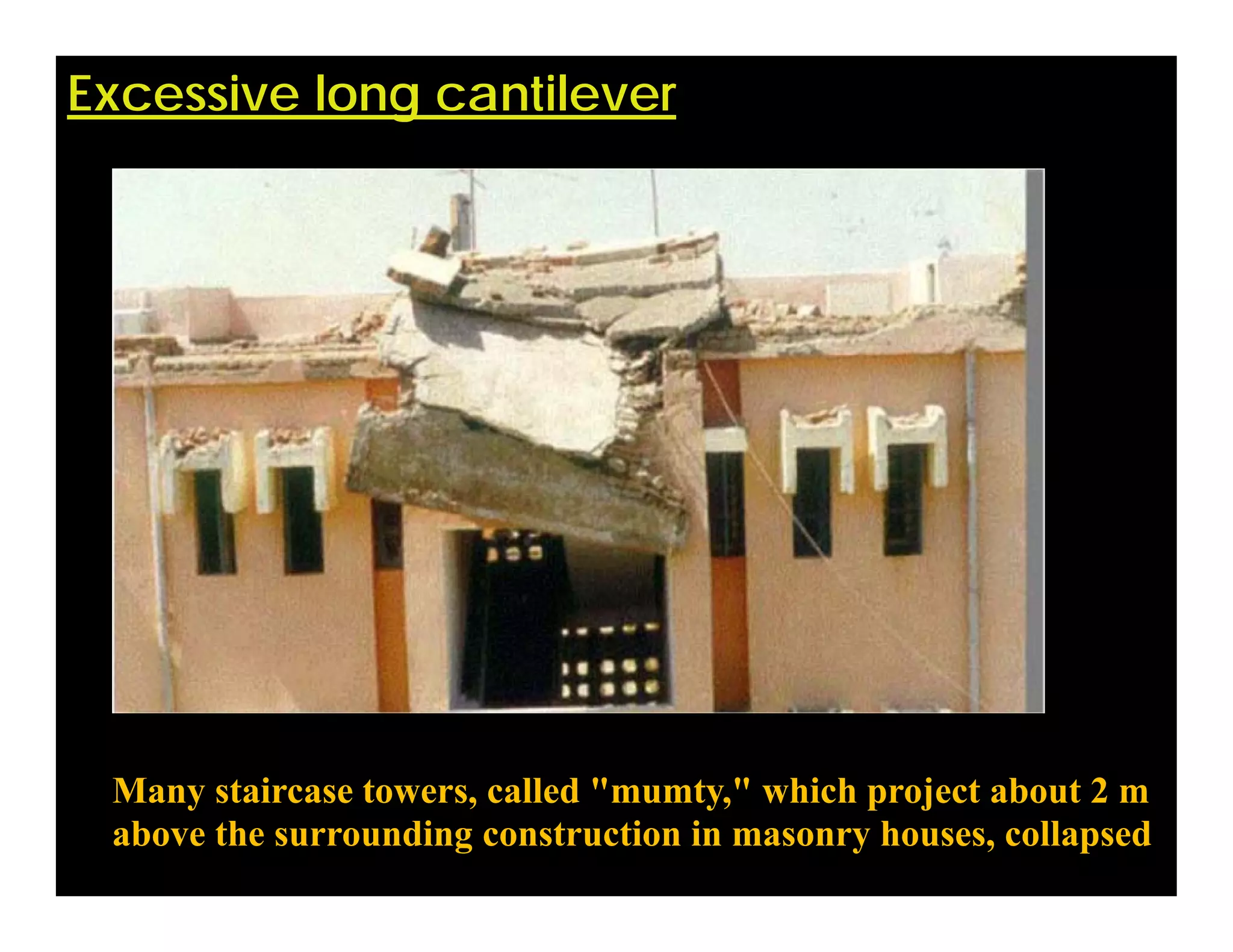
Excessive long cantilever
Many staircase towers, called "mumty," which project about 2 m
above the surrounding construction in masonry houses, collapsed.
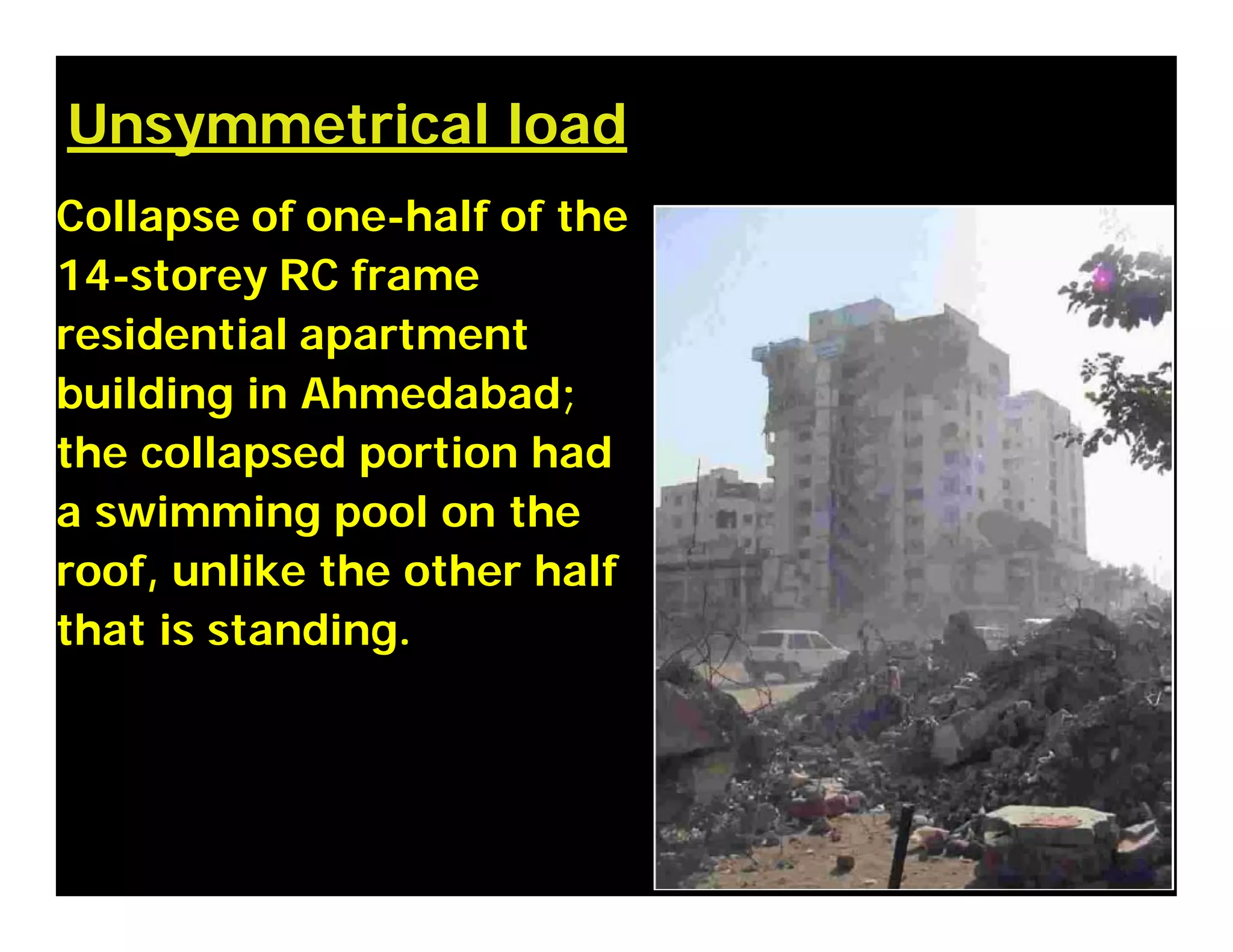
Unsymmetrical load
Collapse of one-half of the
14-storey RC frame
residential apartment
building in Ahmedabad;
the collapsed portion had
a swimming pool on the
roof, unlike the other half
that is standing.
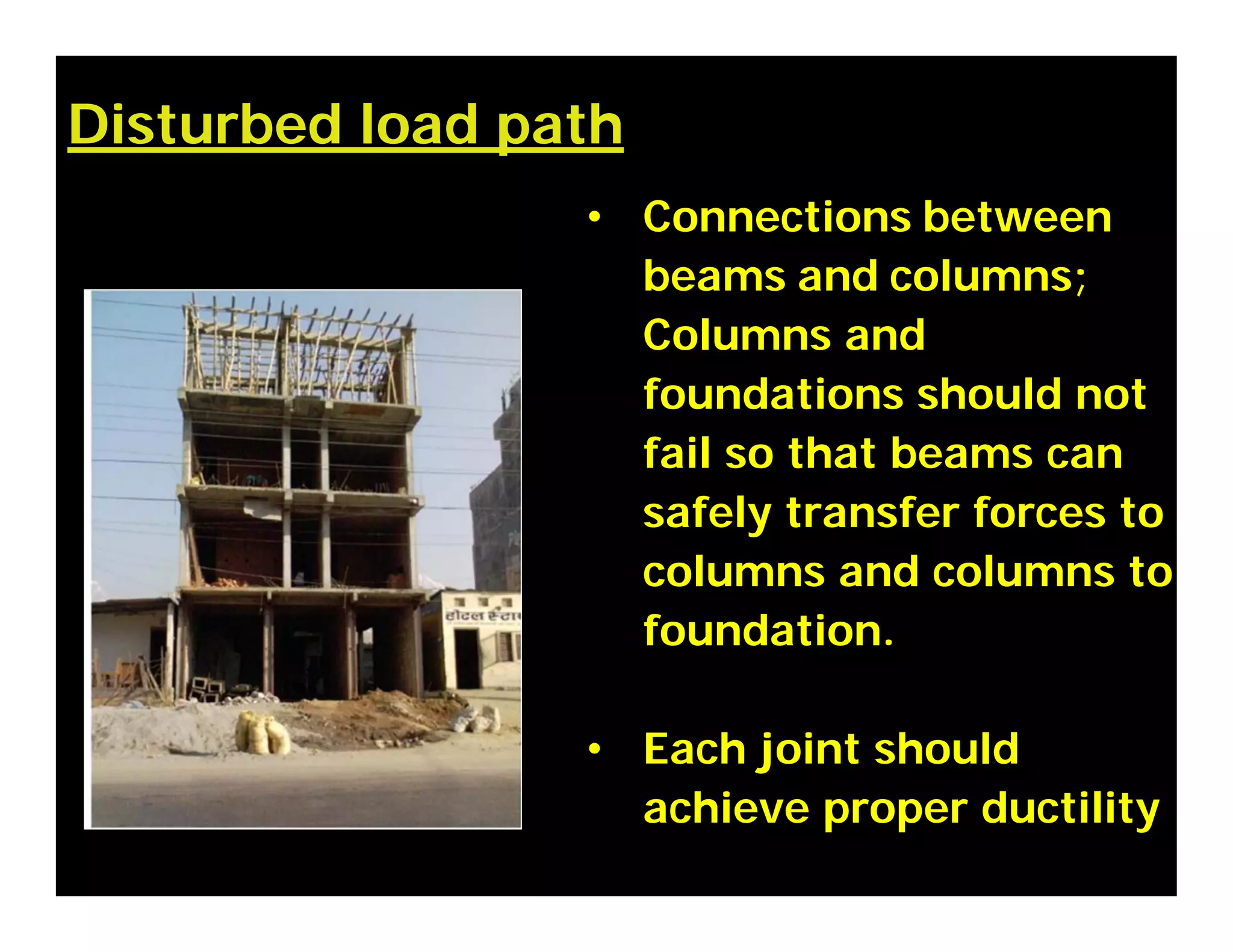
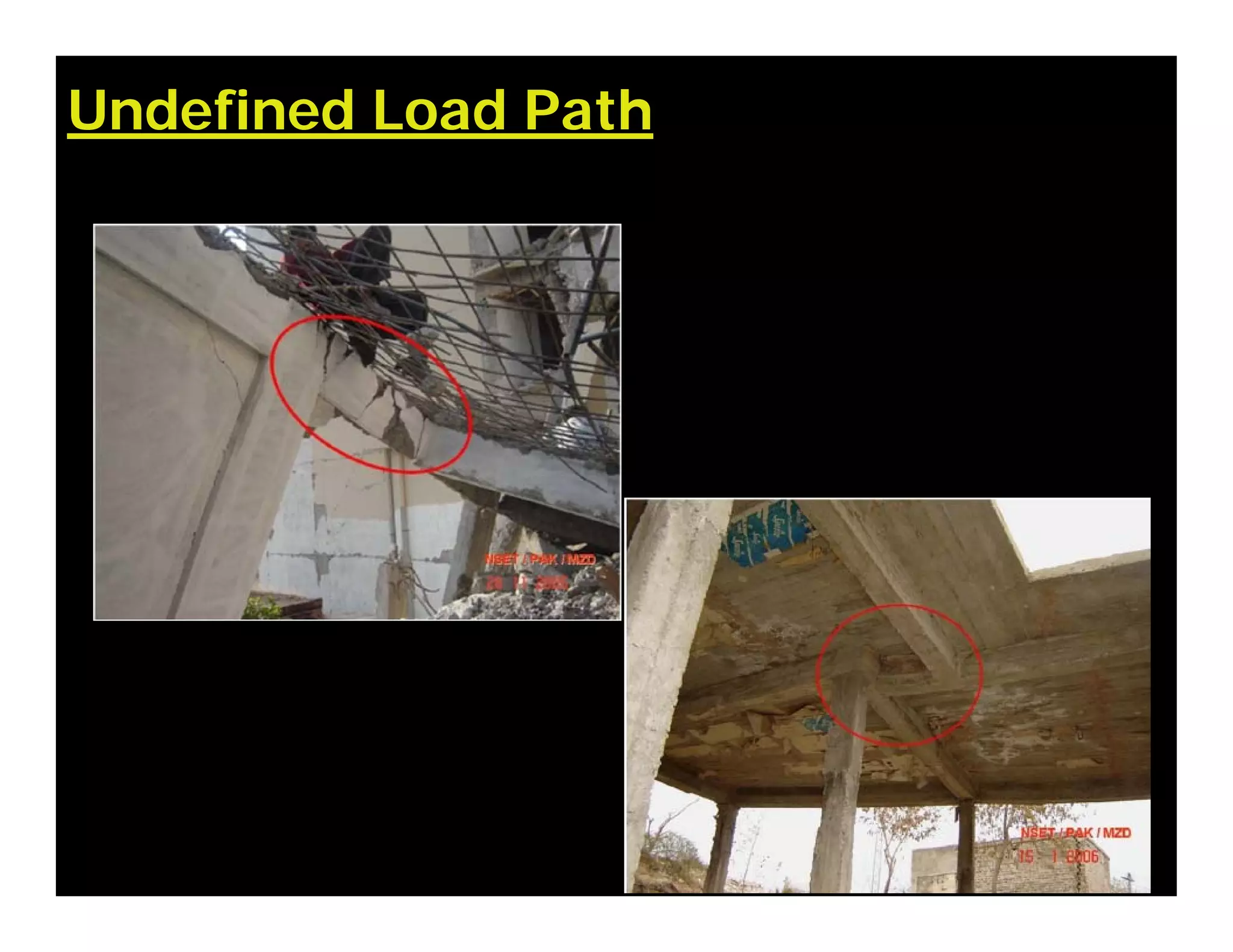
Disturbed load path
• Connections between
beams and columns;
Columns and
foundations should not
fail so that beams can
safely transfer forces to
columns and columns to
foundation.
• Each joint should
achieve proper ductility
Undefined Load Path
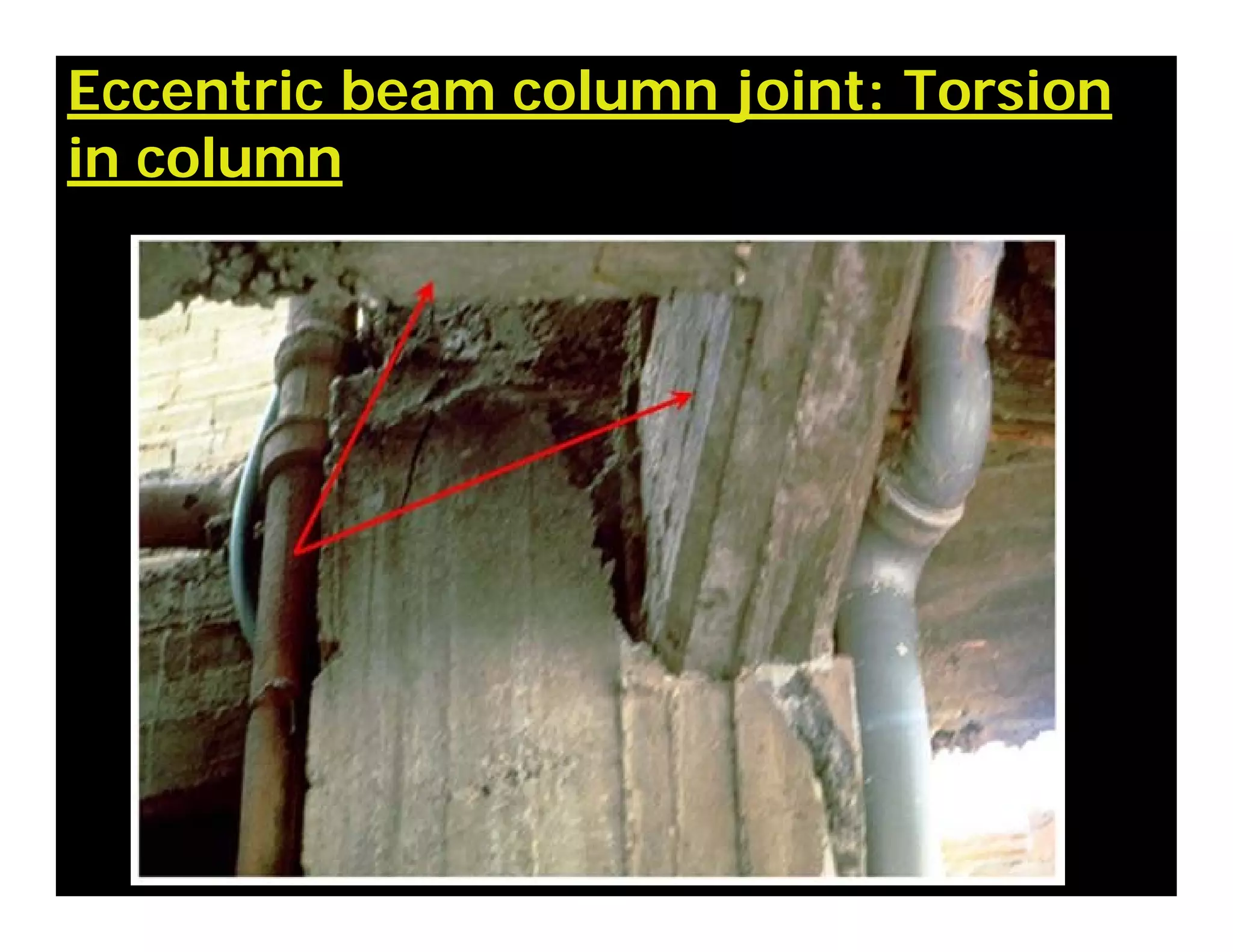
Eccentric beam column joint: Torsion
in column
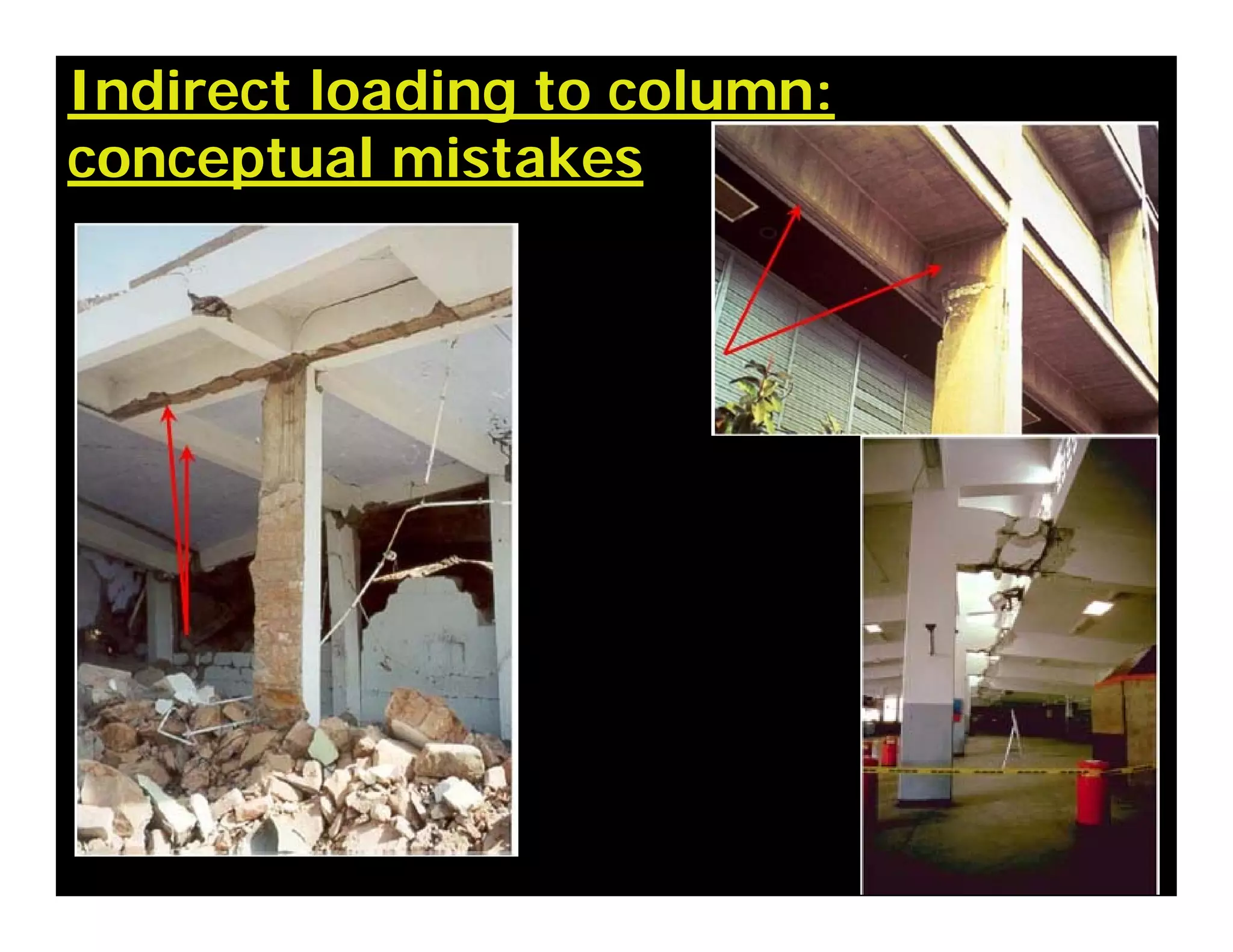
Indirect loading to column:
conceptual mistakes
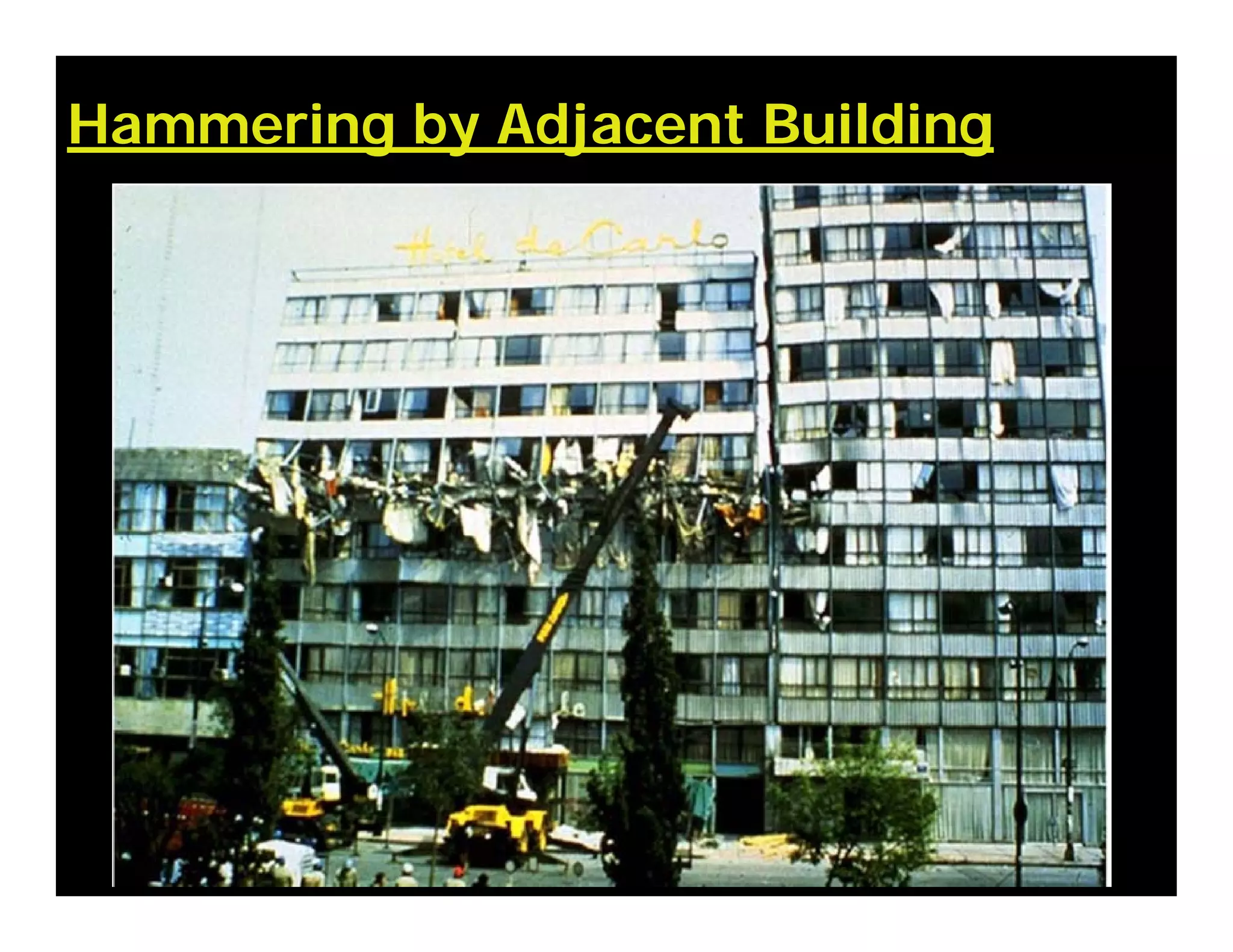
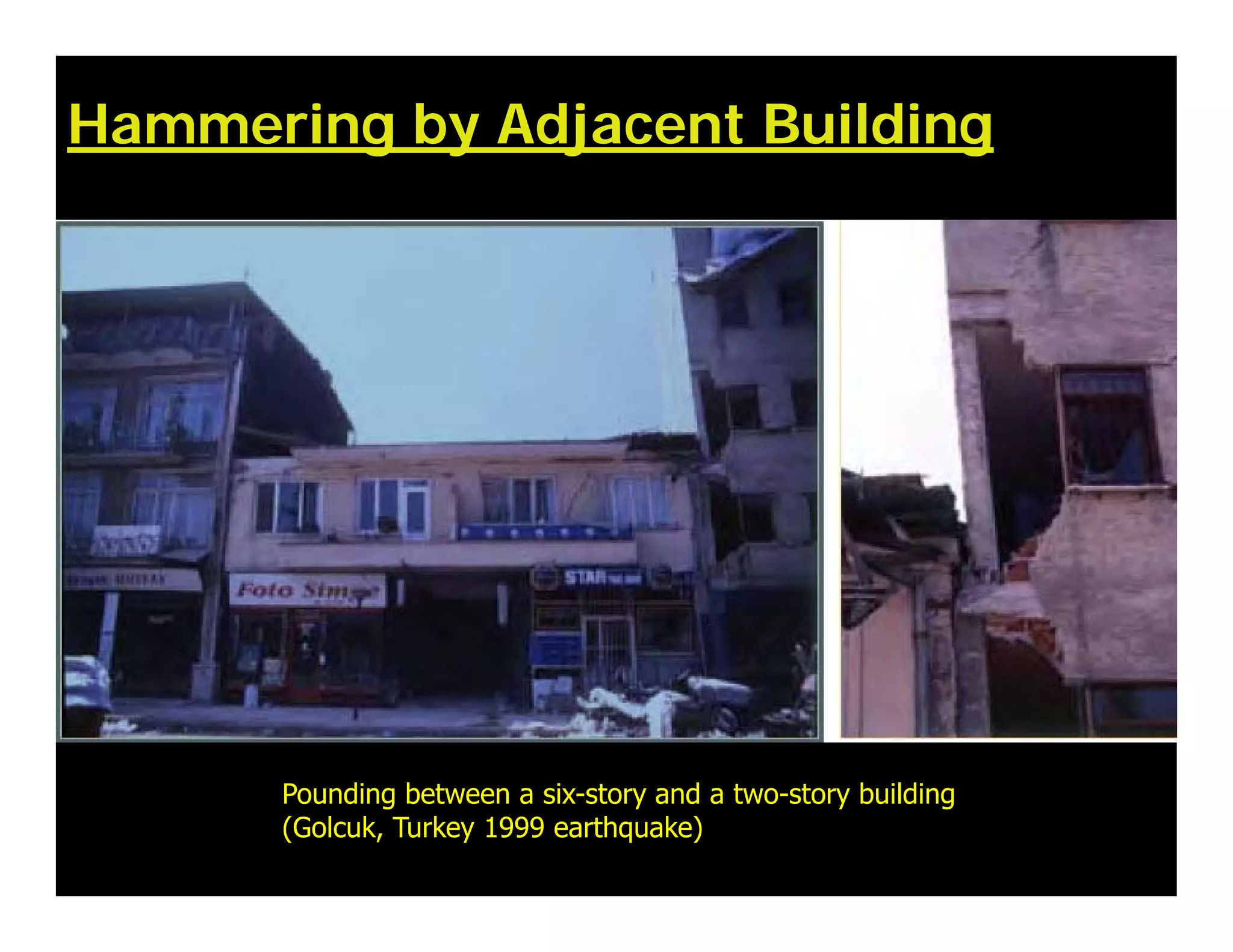
Hammering by Adjacent Building
Pounding between a six-story and a two-story building
(Golcuk, Turkey 1999 earthquake)
Inappropriate – Liquefiable area
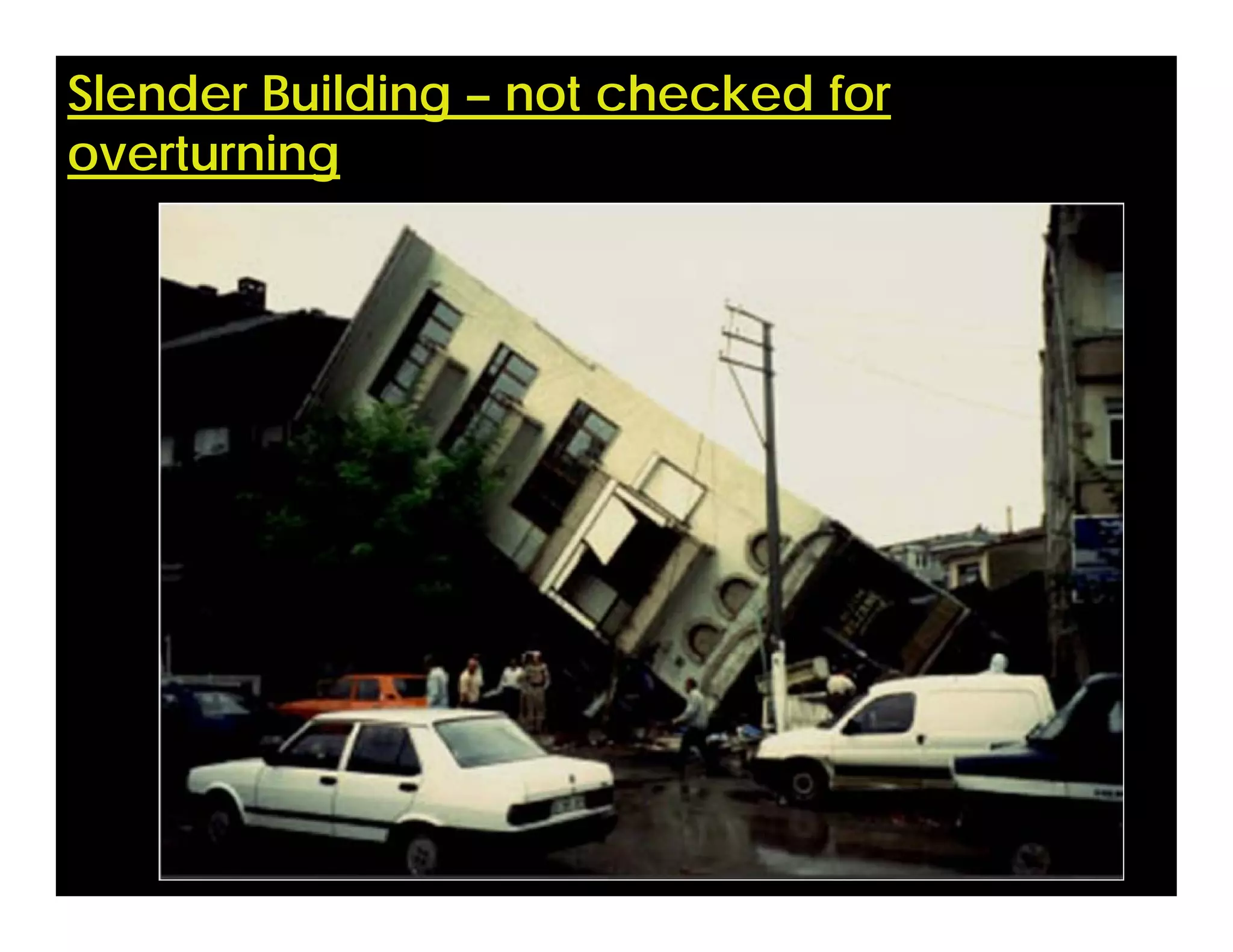
Slender Building – not checked for
overturning
THANK YOU !

Behavior of rc structure under earthquake loading

  • 1.
    Behavior of RCstructure Training to LB technical staff on Nepal National Building Code Binay Shrestha
  • 2.
    Why Buildings failin an Earthquake Lack of • Strength. • Ductility. Introduced by • Design deficiency (failure to understand failure  mechanism, deficient system, calculation). • Construction deficiency (lack of quality  assurance: material, construction details).
  • 3.
  • 4.
    Poor Performance ofRC Frame Buildings I. Design concept ignorance  Strong column weak beam Soft story Short column II. Construction Defects: Weak / Cold joint  Lap & end anchorage Ductility
  • 5.
    Poor Performance ofRC Frame Buildings I. Other Unacceptable shape Defective load path Local soil condition.  Hammering/ Pounding
  • 6.
    Design Concept Ignorance: Strongcolumn weak beam (Pancake type damage)
  • 8.
    Collapse of amultistory RC frame building due to weak column-strong beam design (Bhuj, India 2001)
  • 9.
    Multiple-story collapse ina six-story building due to strong beam-weak column design in the 1999 Turkey earthquake
  • 10.
    Strong-Column Weak-Beam Concept •Failure of a column can affect the stability of the whole building, but the failure of a beam causes localized effect. • Hence it is better to make beams to be the ductile weak links than columns. • This method of designing RC building is called the strong-column weak-beam design method.
  • 11.
     Columns shouldbe stronger than beams and foundations should be stronger than columns.  Connections between beams & columns and columns & foundations should not fail so that beams can safely transfer forces to columns and columns to foundations. Strong-Column Weak-Beam Concept
  • 12.
     Sum ofmoment capacities of the columns for the design axial loads at a beam column joint should be greater than the sum of moment capacities of the beams along each principal plane.  Mcolumns > 1.2  Mbeams  The shear reinforcement should be adequate to ensure that the strength in shear exceeds the strength in flexure and thus prevent a non-ductile shear failure.
  • 13.
  • 14.
    Soft Story buildinghave two distinct characteristics, namely: (a) It is relatively flexible in the ground storey, i.e., the relative horizontal displacement it undergoes in the ground storey is much larger than what each of the storeys above it does. (b) It is relatively weak in ground storey, i.e., the total horizontal earthquake force it can carry in the ground storey is significantly smaller than what each of the storeys above it can carry. Soft Story
  • 15.
  • 16.
  • 19.
    • Collapse of intermediatestory in a 6-storey RC frame commercial building at Bhuj.
  • 20.
    Olive View Hospital,which nearly collapsed due to excessive deformation in the first two stories during the 1972 San Fernando earthquake
  • 21.
    3rd floor collapse.(Kobe, Japan)
  • 22.
    Design of SoftStorey Elements  The Code suggests that the forces in the columns, beams and shear walls (if any) under the action of seismic loads specified in the code, may be obtained by considering the bare frame building (without any infills).  However, beams and columns in the open ground storey are required to be designed for 2.5 times the forces obtained from this bare frame analysis.
  • 23.
    Short Column Effect ExplicitExamples Implicit Example
  • 24.
    Short Column Effectdue to staircase
  • 25.
    Short Column Effect •Tall column and a short column of same cross-section move horizontally by same amount ∆ . • However, the short column is stiffer as compared to the tall column, and it attracts larger earthquake force. • Stiffness of a column means resistance to deformation – the larger is the stiffness, larger is the force required to deform it. If a short column is not adequately designed for such a large force, it can suffer significant damage during an earthquake. This behaviour is called Short Column Effect. • The damage in these short columns is often in the form of X-shaped cracking – this type of damage of columns is due to shear failure . Lateral Stiffness = 12EI/(L3) F= K∆
  • 26.
    If short andtall columns exist within the same storey level, then the short columns attract several times larger earthquake force and suffer more damage as compared to taller ones.
  • 27.
  • 29.
  • 30.
  • 31.
  • 32.
  • 33.
  • 34.
    Weak Joints Beam-column jointsmay not be able to develop the strength of the connected members, and this can lead to sudden brittle failure of the joint
  • 35.
  • 36.
  • 37.
    Shear key toavoid Cold Joint
  • 38.
  • 39.
  • 40.
    Improper lapping andanchorage The pictures show damage concentration in the region of bar lapping. Because of interaction between overlapped bars and concrete for load transfer the overlapping section suffers higher level of damage. This interaction is further coupled with lack of stirrups which has led to buckling of bars, loss of concrete
  • 41.
    Improper lapping andanchorage Failure due to improper Detailing (a) buckling of vertical column rebars due to inadequately spaced horizontal ties (b) severe damage of a ground-floor column due to improper confinement of concrete and lapping of large number of longitudinal bars (c) typical infrequent horizontal ties with 90° hooks, which were unable to confine the concrete core
  • 42.
    Improper lapping andanchorage Cover Stirrup spacing
  • 43.
    Improper lapping andanchorage Improper anchorage of transverse reinforcement has resulted in failure of confinement in columns during the 1985 Mexico earthquake
  • 44.
    Column tie spacingand tie hooks: failure of quality control Deformability (ductility) of reinforced concrete members is a necessity. Note the obvious differences of capability of concrete columns to take load after earthquake damage. The reinforced column with more stirrups (ductile reinforcing) has an obvious capacity to carry much more load than the column with less stirrups
  • 45.
  • 46.
  • 48.
    Buildings have unequalvertical members. They cause the building to twist about a vertical axis. One side open ground storey building twists during earthquake shaking. Torsion Center of Mass(CM )= Center of gravity of floor masses  Center of Rigidity (CR)= A point through which a horizontal  force is applied; resulting in translation of the floor without  any rotation.
  • 49.
    Effect of Torsion: different portions of the same floor level moves horizontally by different amounts.  This induces more damage in the columns and walls on the side that moves more. Remedies: • Symmetry in Plan through uniformly distributed mass & uniformly placed vertical members . • Otherwise include additional shear forces in the design of columns as per codal provisions. Torsion
  • 50.
    These are notSymmetrical
  • 51.
  • 52.
    Excessive long cantilever Manystaircase towers, called "mumty," which project about 2 m above the surrounding construction in masonry houses, collapsed.
  • 53.
    Unsymmetrical load Collapse ofone-half of the 14-storey RC frame residential apartment building in Ahmedabad; the collapsed portion had a swimming pool on the roof, unlike the other half that is standing.
  • 54.
    Disturbed load path •Connections between beams and columns; Columns and foundations should not fail so that beams can safely transfer forces to columns and columns to foundation. • Each joint should achieve proper ductility
  • 55.
  • 56.
    Eccentric beam columnjoint: Torsion in column
  • 57.
    Indirect loading tocolumn: conceptual mistakes
  • 58.
  • 59.
    Hammering by AdjacentBuilding Pounding between a six-story and a two-story building (Golcuk, Turkey 1999 earthquake)
  • 60.
  • 61.
    Slender Building –not checked for overturning
  • 62.