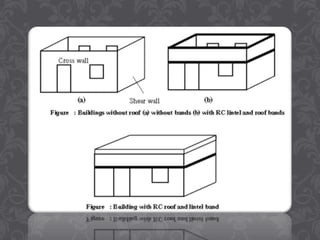
PRESENTATION ON “EARTHQUAKE
RESISTANCE MASSONARY STRUCTURE “

Prepared by:
RADHEY SHYAM VERMA
CIVIL ENGINEERING
ENROLLMENT NO.0710121
SEM:8TH
INTRODUCTION

*What is earthquake resistance masonry structure

*stresses in masonry walls during earthquake ground
motions.
*Applied element modeling of masonry.
*Flow chart of AEM numerical analysis for masonry
*wall behavior analysis
*How buildings can be made more resistant to earthquakes
*Earthquake Resistant Features in Buildings
*Advantages of masonry building
*conclusion
WHAT IS EARTHQUAKE RESISTANCE
MASONRY STRUCTURE

A structure which is constructed from the materials used by
masons, such as stone, brick, tiles, or the like is called massonary
structure.
Masonry structures are very weak to resist the earthquake
force as they have very less ductility.so to increase the ductility of
the masonry structures containment reinforcement are provided.
The structure made of the combination of the materials like
bricks , stones etc and containment reinforcement to resist the
earthquake forces is called earthquake resistance masonry
structure.
STRESSES IN MASONRY WALLS DURING
EARTHQUAKE GROUND MOTIONS

The walls of a masonry building offer resistance against lateral
dynamic loads by developing flexural and shear stresses, during
earthquake ground motions. In an attempt to identify the regions
in a masonry building where the flexural stresses and shear
stresses are a maximum during an earthquake, a linear dynamic
analysis has been carried out on a typical single storied masonry
building of plan dimensions 6.0m x 3.0m, when subjected to
earthquake ground motions.
It is assumed that the earthquake ground motion is
perpendicular to the cross walls of 6.0m length. Two openings
were provided in the cross-walls and none in the shear-walls.
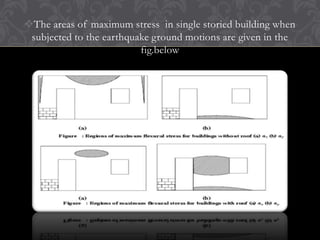
The areas of maximum stress in single storied building when
subjected to the earthquake ground motions are given in the
fig.below
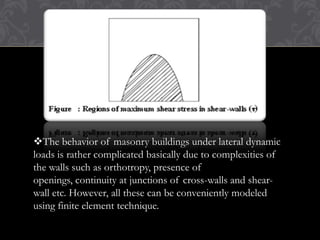
The behavior of masonry buildings under lateral dynamic
loads is rather complicated basically due to complexities of
the walls such as orthotropy, presence of
openings, continuity at junctions of cross-walls and shearwall etc. However, all these can be conveniently modeled
using finite element technique.
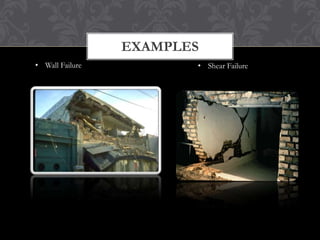
EXAMPLES
• Wall Failure

• Shear Failure
APPLED ELEMENT MODELLING OF
MASONRY

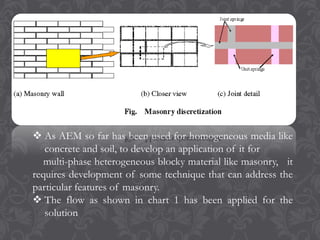
In AEM, structure is assumed to be virtually divided into small
square elements each of which is connected by pairs of normal
and shear springs set at contact locations with adjacent elements.
These springs bear the constitutive properties of the domain
material in the respective area of representations (Fig.below).
Global stiffness of structure is built up with all element stiffness
contributed by that of springs around corresponding element.
 Stress and strain are defined based on displacement of spring
end points of element edges.
 As AEM so far has been used for homogeneous media like
concrete and soil, to develop an application of it for
multi-phase heterogeneous blocky material like masonry, it
requires development of some technique that can address the
particular features of masonry.
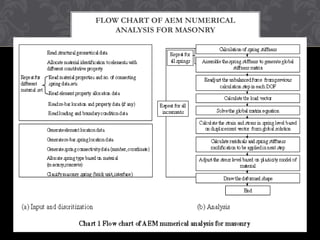
 The flow as shown in chart 1 has been applied for the
solution
FLOW CHART OF AEM NUMERICAL
ANALYSIS FOR MASONRY
WALL BEHAVIOR ANALYSIS

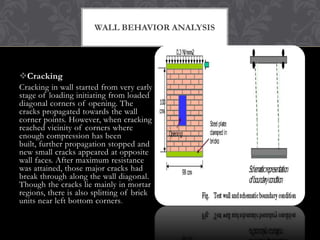
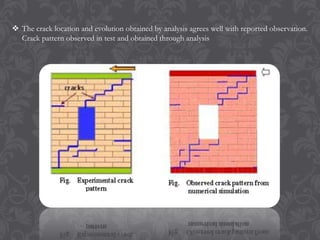
Cracking
Cracking in wall started from very early
stage of loading initiating from loaded
diagonal corners of opening. The
cracks propagated towards the wall
corner points. However, when cracking
reached vicinity of corners where
enough compression has been
built, further propagation stopped and
new small cracks appeared at opposite
wall faces. After maximum resistance
was attained, those major cracks had
break through along the wall diagonal.
Though the cracks lie mainly in mortar
regions, there is also splitting of brick
units near left bottom corners .
 The crack location and evolution obtained by analysis agrees well with reported observation.
Crack pattern observed in test and obtained through analysis
Flow of Stress
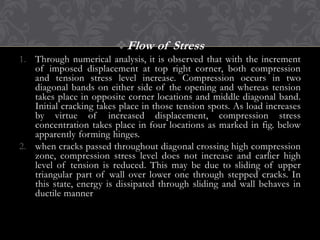
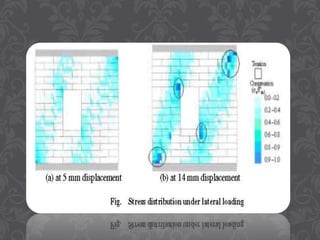
1. Through numerical analysis, it is observed that with the increment
of imposed displacement at top right corner, both compression
and tension stress level increase. Compression occurs in two
diagonal bands on either side of the opening and whereas tension
takes place in opposite corner locations and middle diagonal band.
Initial cracking takes place in those tension spots. As load increases
by virtue of increased displacement, compression stress
concentration takes place in four locations as marked in fig. below
apparently forming hinges.
2. when cracks passed throughout diagonal crossing high compression
zone, compression stress level does not increase and earlier high
level of tension is reduced. This may be due to sliding of upper
triangular part of wall over lower one through stepped cracks. In
this state, energy is dissipated through sliding and wall behaves in
ductile manner
Load-Displacement Relation
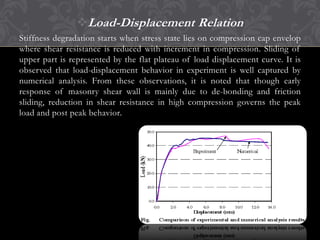
Stiffness degradation starts when stress state lies on compression cap envelop
where shear resistance is reduced with increment in compression. Sliding of
upper part is represented by the flat plateau of load displacement curve. It is
observed that load-displacement behavior in experiment is well captured by
numerical analysis. From these observations, it is noted that though early
response of masonry shear wall is mainly due to de-bonding and friction
sliding, reduction in shear resistance in high compression governs the peak
load and post peak behavior.
HOW BUILDINGS CAN BE MADE MORE RESISTANT TO
EARTHQUAKES

 Flexibility
• One of the most crucial physical features of earthquake resistant
buildings and structures is flexibility. Buildings and their foundations
need to be built to defy side to side movement
• Taller buildings are naturally more flexible than low rise buildings
and structures.

 Reinforced Walls, Beams and Trusses
Walls should also be strong enough to take the swaying load of an
earthquake. The walls must sway and go equally in both
directions. Reinforced beams and joints can also help prevent
deformity and collapse of buildings and structures during and
after an earthquake .
 Foundation
Foundational plates and cushions can be layered to let the sliding
movement and absorb the shock and movement during an
earthquake. These specially designed foundation plates and
cushions can help limit damage and help prevent collapse of
buildings and structures.
 The Future
Progress in the field of structural engineering looks
promising. Advances in the field of structural engineering and
manufacturing of building materials are being done and new and
more superior construction materials are emerging. Earthquakeproof buildings and structures may soon be a reality.
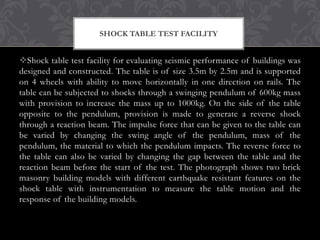
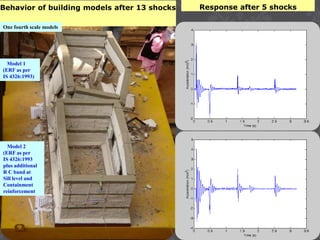
SHOCK TABLE TEST FACILITY

Shock table test facility for evaluating seismic performance of buildings was
designed and constructed. The table is of size 3.5m by 2.5m and is supported
on 4 wheels with ability to move horizontally in one direction on rails. The
table can be subjected to shocks through a swinging pendulum of 600kg mass
with provision to increase the mass up to 1000kg. On the side of the table
opposite to the pendulum, provision is made to generate a reverse shock
through a reaction beam. The impulse force that can be given to the table can
be varied by changing the swing angle of the pendulum, mass of the
pendulum, the material to which the pendulum impacts. The reverse force to
the table can also be varied by changing the gap between the table and the
reaction beam before the start of the test. The photograph shows two brick
masonry building models with different earthquake resistant features on the
shock table with instrumentation to measure the table motion and the
response of the building models.
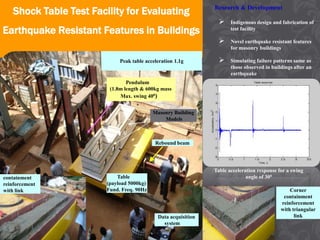
Shock Table Test Facility for Evaluating

Earthquake Resistant Features in Buildings

Research & Development




Peak table acceleration 1.1g



Indigenous design and fabrication of
test facility
Novel earthquake resistant features
for masonry buildings
Simulating failure patterns same as
those observed in buildings after an
earthquake

Pendulum
(1.8m length & 600kg mass
Max. swing 400)
Masonry Building
Models

Rebound beam

containment
reinforcement
with link

Table acceleration response for a swing
angle of 300

Table
(payload 5000kg)
Fund. Freq. 90Hz

Data acquisition
system

Corner
containment
reinforcement
with triangular
link
Behavior of building models after 13 shocks

Response after 5 shocks

One fourth scale models
Model 1
Response at top of cross wall
Model 1
(ERF as per
IS 4326:1993)

Model 2
(ERF as per
IS 4326:1993
plus additional
R C band at
Sill level and
Containment
reinforcement

Model 2
Response at top of cross wall
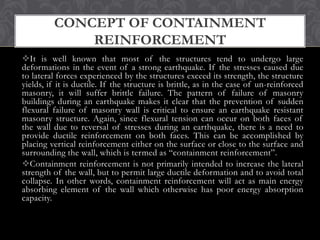
CONCEPT OF CONTAINMENT
REINFORCEMENT
It is well known that most of the structures tend to undergo large
deformations in the event of a strong earthquake. If the stresses caused due
to lateral forces experienced by the structures exceed its strength, the structure
yields, if it is ductile. If the structure is brittle, as in the case of un-reinforced
masonry, it will suffer brittle failure. The pattern of failure of masonry
buildings during an earthquake makes it clear that the prevention of sudden
flexural failure of masonry wall is critical to ensure an earthquake resistant
masonry structure. Again, since flexural tension can occur on both faces of
the wall due to reversal of stresses during an earthquake, there is a need to
provide ductile reinforcement on both faces. This can be accomplished by
placing vertical reinforcement either on the surface or close to the surface and
surrounding the wall, which is termed as “containment reinforcement”.
Containment reinforcement is not primarily intended to increase the lateral
strength of the wall, but to permit large ductile deformation and to avoid total
collapse. In other words, containment reinforcement will act as main energy
absorbing element of the wall which otherwise has poor energy absorption
capacity.
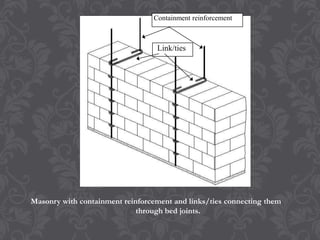
Containment reinforcementent

Link/tiese

Masonry with containment reinforcement and links/ties connecting them
through bed joints.
ADVANTAGE OF
MASONRY BUILDING
The use of materials such as brick and stone can increase the
thermal mass of a building.
Brick typically will not require painting and so can provide a
structure with reduced life-cycle costs.
Masonry is very heat resistant and thus provides good fire
protection.
Masonry walls are more resistant to projectiles, such as debris
from hurricanes tornadoes.
Masonry structures built in compression preferably with lime
mortar can have a useful life of more than 500 years as compared
to 30 to 100 for structures of steel or reinforced concrete.
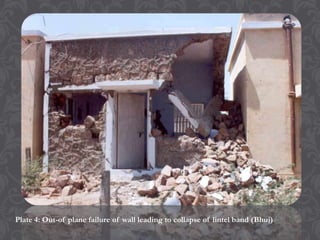
Plate 4: Out-of plane failure of wall leading to collapse of lintel band (Bhuj)
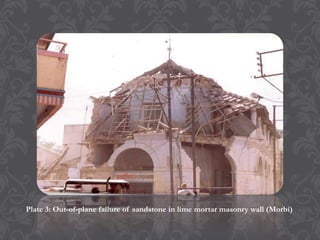
Plate 3: Out-of-plane failure of sandstone in lime mortar masonry wall (Morbi)
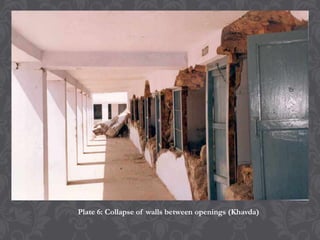
Plate 6: Collapse of walls between openings (Khavda)
CONCLUSION

we conclude that the un-reinforced masonry structures are more vulnerable
to damage than the reinforced structure during an earthquake. The reinforced
structure can withstand greater magnitudes of earthquakes and more
earthquakes than the un-reinforced structures
THANK YOU

Presentation on earthquake resistance massonary structure

  • 1.
    PRESENTATION ON “EARTHQUAKE RESISTANCEMASSONARY STRUCTURE “ Prepared by: RADHEY SHYAM VERMA CIVIL ENGINEERING ENROLLMENT NO.0710121 SEM:8TH
  • 2.
    INTRODUCTION *What is earthquakeresistance masonry structure *stresses in masonry walls during earthquake ground motions. *Applied element modeling of masonry. *Flow chart of AEM numerical analysis for masonry *wall behavior analysis *How buildings can be made more resistant to earthquakes *Earthquake Resistant Features in Buildings *Advantages of masonry building *conclusion
  • 3.
    WHAT IS EARTHQUAKERESISTANCE MASONRY STRUCTURE A structure which is constructed from the materials used by masons, such as stone, brick, tiles, or the like is called massonary structure. Masonry structures are very weak to resist the earthquake force as they have very less ductility.so to increase the ductility of the masonry structures containment reinforcement are provided. The structure made of the combination of the materials like bricks , stones etc and containment reinforcement to resist the earthquake forces is called earthquake resistance masonry structure.
  • 4.
    STRESSES IN MASONRYWALLS DURING EARTHQUAKE GROUND MOTIONS The walls of a masonry building offer resistance against lateral dynamic loads by developing flexural and shear stresses, during earthquake ground motions. In an attempt to identify the regions in a masonry building where the flexural stresses and shear stresses are a maximum during an earthquake, a linear dynamic analysis has been carried out on a typical single storied masonry building of plan dimensions 6.0m x 3.0m, when subjected to earthquake ground motions. It is assumed that the earthquake ground motion is perpendicular to the cross walls of 6.0m length. Two openings were provided in the cross-walls and none in the shear-walls.
  • 6.
    The areas ofmaximum stress in single storied building when subjected to the earthquake ground motions are given in the fig.below
  • 7.
    The behavior ofmasonry buildings under lateral dynamic loads is rather complicated basically due to complexities of the walls such as orthotropy, presence of openings, continuity at junctions of cross-walls and shearwall etc. However, all these can be conveniently modeled using finite element technique.
  • 8.
  • 9.
    APPLED ELEMENT MODELLINGOF MASONRY In AEM, structure is assumed to be virtually divided into small square elements each of which is connected by pairs of normal and shear springs set at contact locations with adjacent elements. These springs bear the constitutive properties of the domain material in the respective area of representations (Fig.below). Global stiffness of structure is built up with all element stiffness contributed by that of springs around corresponding element.  Stress and strain are defined based on displacement of spring end points of element edges.
  • 10.
     As AEMso far has been used for homogeneous media like concrete and soil, to develop an application of it for multi-phase heterogeneous blocky material like masonry, it requires development of some technique that can address the particular features of masonry.  The flow as shown in chart 1 has been applied for the solution
  • 11.
    FLOW CHART OFAEM NUMERICAL ANALYSIS FOR MASONRY
  • 12.
    WALL BEHAVIOR ANALYSIS Cracking Crackingin wall started from very early stage of loading initiating from loaded diagonal corners of opening. The cracks propagated towards the wall corner points. However, when cracking reached vicinity of corners where enough compression has been built, further propagation stopped and new small cracks appeared at opposite wall faces. After maximum resistance was attained, those major cracks had break through along the wall diagonal. Though the cracks lie mainly in mortar regions, there is also splitting of brick units near left bottom corners .
  • 13.
     The cracklocation and evolution obtained by analysis agrees well with reported observation. Crack pattern observed in test and obtained through analysis
  • 14.
    Flow of Stress 1.Through numerical analysis, it is observed that with the increment of imposed displacement at top right corner, both compression and tension stress level increase. Compression occurs in two diagonal bands on either side of the opening and whereas tension takes place in opposite corner locations and middle diagonal band. Initial cracking takes place in those tension spots. As load increases by virtue of increased displacement, compression stress concentration takes place in four locations as marked in fig. below apparently forming hinges. 2. when cracks passed throughout diagonal crossing high compression zone, compression stress level does not increase and earlier high level of tension is reduced. This may be due to sliding of upper triangular part of wall over lower one through stepped cracks. In this state, energy is dissipated through sliding and wall behaves in ductile manner
  • 16.
    Load-Displacement Relation Stiffness degradationstarts when stress state lies on compression cap envelop where shear resistance is reduced with increment in compression. Sliding of upper part is represented by the flat plateau of load displacement curve. It is observed that load-displacement behavior in experiment is well captured by numerical analysis. From these observations, it is noted that though early response of masonry shear wall is mainly due to de-bonding and friction sliding, reduction in shear resistance in high compression governs the peak load and post peak behavior.
  • 17.
    HOW BUILDINGS CANBE MADE MORE RESISTANT TO EARTHQUAKES  Flexibility • One of the most crucial physical features of earthquake resistant buildings and structures is flexibility. Buildings and their foundations need to be built to defy side to side movement • Taller buildings are naturally more flexible than low rise buildings and structures.  Reinforced Walls, Beams and Trusses Walls should also be strong enough to take the swaying load of an earthquake. The walls must sway and go equally in both directions. Reinforced beams and joints can also help prevent deformity and collapse of buildings and structures during and after an earthquake .
  • 18.
     Foundation Foundational platesand cushions can be layered to let the sliding movement and absorb the shock and movement during an earthquake. These specially designed foundation plates and cushions can help limit damage and help prevent collapse of buildings and structures.  The Future Progress in the field of structural engineering looks promising. Advances in the field of structural engineering and manufacturing of building materials are being done and new and more superior construction materials are emerging. Earthquakeproof buildings and structures may soon be a reality.
  • 19.
    SHOCK TABLE TESTFACILITY Shock table test facility for evaluating seismic performance of buildings was designed and constructed. The table is of size 3.5m by 2.5m and is supported on 4 wheels with ability to move horizontally in one direction on rails. The table can be subjected to shocks through a swinging pendulum of 600kg mass with provision to increase the mass up to 1000kg. On the side of the table opposite to the pendulum, provision is made to generate a reverse shock through a reaction beam. The impulse force that can be given to the table can be varied by changing the swing angle of the pendulum, mass of the pendulum, the material to which the pendulum impacts. The reverse force to the table can also be varied by changing the gap between the table and the reaction beam before the start of the test. The photograph shows two brick masonry building models with different earthquake resistant features on the shock table with instrumentation to measure the table motion and the response of the building models.
  • 20.
    Shock Table TestFacility for Evaluating Earthquake Resistant Features in Buildings Research & Development   Peak table acceleration 1.1g  Indigenous design and fabrication of test facility Novel earthquake resistant features for masonry buildings Simulating failure patterns same as those observed in buildings after an earthquake Pendulum (1.8m length & 600kg mass Max. swing 400) Masonry Building Models Rebound beam containment reinforcement with link Table acceleration response for a swing angle of 300 Table (payload 5000kg) Fund. Freq. 90Hz Data acquisition system Corner containment reinforcement with triangular link
  • 21.
    Behavior of buildingmodels after 13 shocks Response after 5 shocks One fourth scale models Model 1 Response at top of cross wall Model 1 (ERF as per IS 4326:1993) Model 2 (ERF as per IS 4326:1993 plus additional R C band at Sill level and Containment reinforcement Model 2 Response at top of cross wall
  • 22.
    CONCEPT OF CONTAINMENT REINFORCEMENT Itis well known that most of the structures tend to undergo large deformations in the event of a strong earthquake. If the stresses caused due to lateral forces experienced by the structures exceed its strength, the structure yields, if it is ductile. If the structure is brittle, as in the case of un-reinforced masonry, it will suffer brittle failure. The pattern of failure of masonry buildings during an earthquake makes it clear that the prevention of sudden flexural failure of masonry wall is critical to ensure an earthquake resistant masonry structure. Again, since flexural tension can occur on both faces of the wall due to reversal of stresses during an earthquake, there is a need to provide ductile reinforcement on both faces. This can be accomplished by placing vertical reinforcement either on the surface or close to the surface and surrounding the wall, which is termed as “containment reinforcement”. Containment reinforcement is not primarily intended to increase the lateral strength of the wall, but to permit large ductile deformation and to avoid total collapse. In other words, containment reinforcement will act as main energy absorbing element of the wall which otherwise has poor energy absorption capacity.
  • 23.
    Containment reinforcementent Link/tiese Masonry withcontainment reinforcement and links/ties connecting them through bed joints.
  • 24.
    ADVANTAGE OF MASONRY BUILDING Theuse of materials such as brick and stone can increase the thermal mass of a building. Brick typically will not require painting and so can provide a structure with reduced life-cycle costs. Masonry is very heat resistant and thus provides good fire protection. Masonry walls are more resistant to projectiles, such as debris from hurricanes tornadoes. Masonry structures built in compression preferably with lime mortar can have a useful life of more than 500 years as compared to 30 to 100 for structures of steel or reinforced concrete.
  • 25.
    Plate 4: Out-ofplane failure of wall leading to collapse of lintel band (Bhuj)
  • 26.
    Plate 3: Out-of-planefailure of sandstone in lime mortar masonry wall (Morbi)
  • 27.
    Plate 6: Collapseof walls between openings (Khavda)
  • 28.
    CONCLUSION we conclude thatthe un-reinforced masonry structures are more vulnerable to damage than the reinforced structure during an earthquake. The reinforced structure can withstand greater magnitudes of earthquakes and more earthquakes than the un-reinforced structures
  • 29.