EARTHQUAKE RESISTING
STRUCTURES
BY- VARUN
EARTHQUAKE RESISTING STRUCTURES
TECHNIQUES
Base Isolation Method- separate building from
ground by some rubber devices.
Energy Dissipation Device (Seismic Dampers)-
Special devices introduced in building to
absorb the energy produced by seismic
waves.
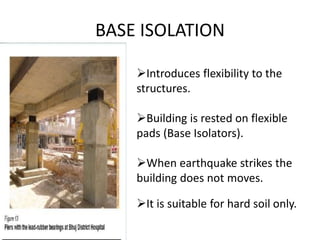
BASE ISOLATION
Introduces flexibility to the
structures.
Building is rested on flexible
pads (Base Isolators).
When earthquake strikes the
building does not moves.
It is suitable for hard soil only.
TYPES OF BASE ISOLATOR
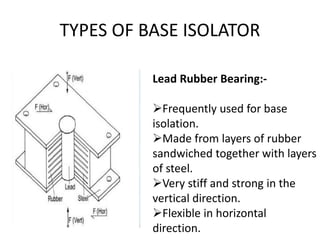
Lead Rubber Bearing:-
Frequently used for base
isolation.
Made from layers of rubber
sandwiched together with layers
of steel.
Very stiff and strong in the
vertical direction.
Flexible in horizontal
direction.
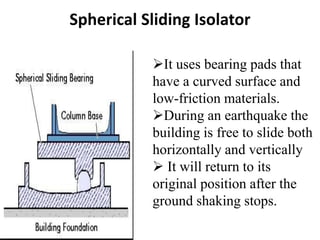
Spherical Sliding Isolator
It uses bearing pads that
have a curved surface and
low-friction materials.
During an earthquake the
building is free to slide both
horizontally and vertically
 It will return to its
original position after the
ground shaking stops.
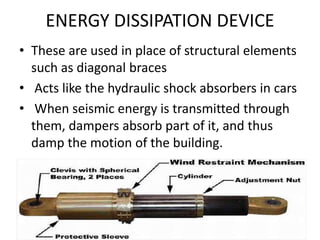
ENERGY DISSIPATION DEVICE
• These are used in place of structural elements
such as diagonal braces
• Acts like the hydraulic shock absorbers in cars
• When seismic energy is transmitted through
them, dampers absorb part of it, and thus
damp the motion of the building.
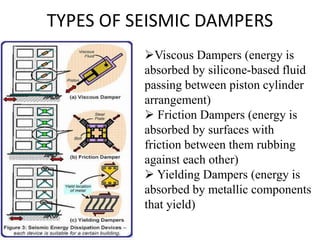
TYPES OF SEISMIC DAMPERS
Viscous Dampers (energy is
absorbed by silicone-based fluid
passing between piston cylinder
arrangement)
 Friction Dampers (energy is
absorbed by surfaces with
friction between them rubbing
against each other)
 Yielding Dampers (energy is
absorbed by metallic components
that yield)
SEISMIC DESIGN
General Principles of Seismic Design:
Structures should not be brittle or collapse
suddenly.
Resisting elements must be provided evenly
throughout the building.
All elements such as walls should be tied
together so as to act as an integrated unit
during earthquake shaking.
The building must be well connected to a
good foundation and the earth.
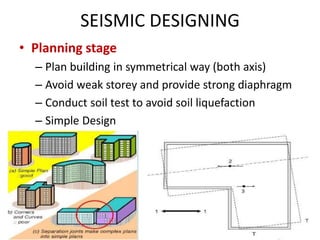
SEISMIC DESIGNING
• Planning stage
– Plan building in symmetrical way (both axis)
– Avoid weak storey and provide strong diaphragm
– Conduct soil test to avoid soil liquefaction
– Simple Design
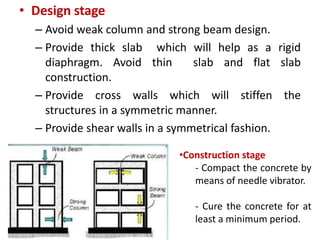
• Design stage
– Avoid weak column and strong beam design.
– Provide thick slab which will help as a rigid
diaphragm. Avoid thin slab and flat slab
construction.
– Provide cross walls which will stiffen the
structures in a symmetric manner.
– Provide shear walls in a symmetrical fashion.
•Construction stage
- Compact the concrete by
means of needle vibrator.
- Cure the concrete for at
least a minimum period.
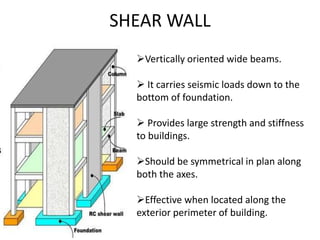
SHEAR WALL
Vertically oriented wide beams.
 It carries seismic loads down to the
bottom of foundation.
 Provides large strength and stiffness
to buildings.
Should be symmetrical in plan along
both the axes.
Effective when located along the
exterior perimeter of building.

Earthquake Resisting Structure Techniques

  • 1.
  • 3.
    EARTHQUAKE RESISTING STRUCTURES TECHNIQUES BaseIsolation Method- separate building from ground by some rubber devices. Energy Dissipation Device (Seismic Dampers)- Special devices introduced in building to absorb the energy produced by seismic waves.
  • 4.
    BASE ISOLATION Introduces flexibilityto the structures. Building is rested on flexible pads (Base Isolators). When earthquake strikes the building does not moves. It is suitable for hard soil only.
  • 5.
    TYPES OF BASEISOLATOR Lead Rubber Bearing:- Frequently used for base isolation. Made from layers of rubber sandwiched together with layers of steel. Very stiff and strong in the vertical direction. Flexible in horizontal direction.
  • 6.
    Spherical Sliding Isolator Ituses bearing pads that have a curved surface and low-friction materials. During an earthquake the building is free to slide both horizontally and vertically  It will return to its original position after the ground shaking stops.
  • 7.
    ENERGY DISSIPATION DEVICE •These are used in place of structural elements such as diagonal braces • Acts like the hydraulic shock absorbers in cars • When seismic energy is transmitted through them, dampers absorb part of it, and thus damp the motion of the building.
  • 8.
    TYPES OF SEISMICDAMPERS Viscous Dampers (energy is absorbed by silicone-based fluid passing between piston cylinder arrangement)  Friction Dampers (energy is absorbed by surfaces with friction between them rubbing against each other)  Yielding Dampers (energy is absorbed by metallic components that yield)
  • 9.
    SEISMIC DESIGN General Principlesof Seismic Design: Structures should not be brittle or collapse suddenly. Resisting elements must be provided evenly throughout the building. All elements such as walls should be tied together so as to act as an integrated unit during earthquake shaking. The building must be well connected to a good foundation and the earth.
  • 10.
    SEISMIC DESIGNING • Planningstage – Plan building in symmetrical way (both axis) – Avoid weak storey and provide strong diaphragm – Conduct soil test to avoid soil liquefaction – Simple Design
  • 11.
    • Design stage –Avoid weak column and strong beam design. – Provide thick slab which will help as a rigid diaphragm. Avoid thin slab and flat slab construction. – Provide cross walls which will stiffen the structures in a symmetric manner. – Provide shear walls in a symmetrical fashion. •Construction stage - Compact the concrete by means of needle vibrator. - Cure the concrete for at least a minimum period.
  • 12.
    SHEAR WALL Vertically orientedwide beams.  It carries seismic loads down to the bottom of foundation.  Provides large strength and stiffness to buildings. Should be symmetrical in plan along both the axes. Effective when located along the exterior perimeter of building.