PLASTIC SOLAR CELL
PRESENTED BY:
RANJEET KUMAR
1722004
M.TECH POWER SYSTEM
NIT PATNA
WHY USE SOLAR CELL
 Low maintenance, long lasting sources of energy.
 Provides cost-effective power supplies for people remote from the
main electricity grid.
 Non-polluting and silent sources of electricity.
 Convenient and flexible source for small amounts of power.
 Renewable and sustainable power, as a means to reduce global
warming.
INTRODUCTION
 The plastic solar cells uses nanotechnology and contains the first
solar cells able to harness the sun's invisible, infrared rays.
 The solar cell created is actually a hybrid, comprised of tiny nano rods
dispersed in an organic polymer or plastic.
 A layer only 200 nano meters thick is sandwiched between electrodes
and can produce at present about 0.7 volts.
 The working of this type of solar cells is same as that of
conventional solar cells but these solar cells are of small size and
harness all the rays from sun's radiation.
 Because of their small size and light weight, they exhibit unusual
and interesting properties
INFRARED PLASTIC SOLAR CELL
 Plastic solar cell can turn the suns power into electric energy even in a
cloudy day.
 The plastic material uses nanotechnology and contains the
1stgeneration solar cells that can harness the sun’s invisible infrared
rays.
 It uses specially designed nano particles called quantum dots.
 The quantum dots with a polymer is used to make the plastic that can
detect energy in the infrared.
CONSTRUCTION OF PLASTIC SOLAR CELL
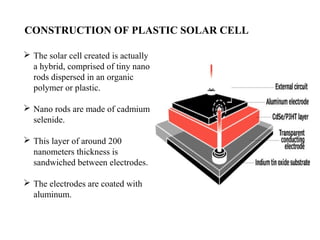
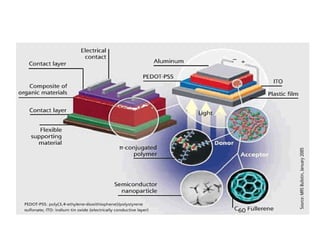
 The solar cell created is actually
a hybrid, comprised of tiny nano
rods dispersed in an organic
polymer or plastic.
 Nano rods are made of cadmium
selenide.
 This layer of around 200
nanometers thickness is
sandwiched between electrodes.
 The electrodes are coated with
aluminum.
WORKING OF PLASTIC SOLAR CELL
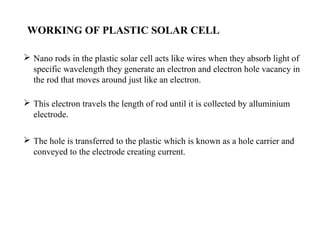
 Nano rods in the plastic solar cell acts like wires when they absorb light of
specific wavelength they generate an electron and electron hole vacancy in
the rod that moves around just like an electron.
 This electron travels the length of rod until it is collected by alluminium
electrode.
 The hole is transferred to the plastic which is known as a hole carrier and
conveyed to the electrode creating current.
IMPROVEMENTS
 Some of the obvious improvements include better light collection and
concentration.
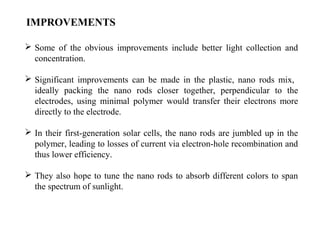
 Significant improvements can be made in the plastic, nano rods mix,
ideally packing the nano rods closer together, perpendicular to the
electrodes, using minimal polymer would transfer their electrons more
directly to the electrode.
 In their first-generation solar cells, the nano rods are jumbled up in the
polymer, leading to losses of current via electron-hole recombination and
thus lower efficiency.
 They also hope to tune the nano rods to absorb different colors to span
the spectrum of sunlight.
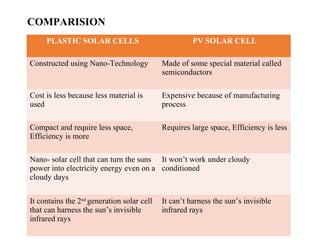
PLASTIC SOLAR CELLS PV SOLAR CELL
Constructed using Nano-Technology Made of some special material called
semiconductors
Cost is less because less material is
used
Expensive because of manufacturing
process
Compact and require less space,
Efficiency is more
Requires large space, Efficiency is less
Nano- solar cell that can turn the suns
power into electricity energy even on a
cloudy days
It won’t work under cloudy
conditioned
It contains the 2nd generation solar cell
that can harness the sun’s invisible
infrared rays
It can’t harness the sun’s invisible
infrared rays
COMPARISION
APPLICATIONS
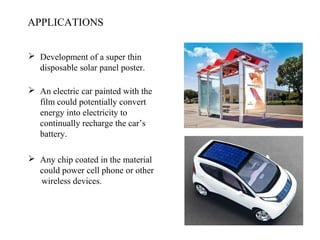
 Development of a super thin
disposable solar panel poster.
 An electric car painted with the
film could potentially convert
energy into electricity to
continually recharge the car’s
battery.
 Any chip coated in the material
could power cell phone or other
wireless devices.
ADVANTAGES
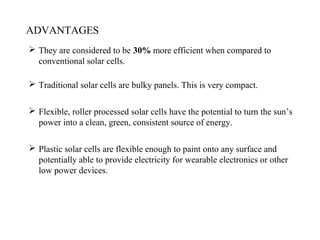
 They are considered to be 30% more efficient when compared to
conventional solar cells.
 Traditional solar cells are bulky panels. This is very compact.
 Flexible, roller processed solar cells have the potential to turn the sun’s
power into a clean, green, consistent source of energy.
 Plastic solar cells are flexible enough to paint onto any surface and
potentially able to provide electricity for wearable electronics or other
low power devices.
DISADVANTAGES
 The biggest problem with this is cost effectiveness. But that could
change with new material.
 Relatively shorter life span when continuously exposed to sunlight.
 Could possibly require higher maintenance and constant monitoring.
FUTURE PROSPECTS
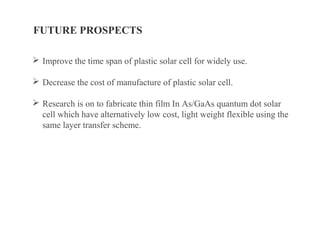
 Improve the time span of plastic solar cell for widely use.
 Decrease the cost of manufacture of plastic solar cell.
 Research is on to fabricate thin film In As/GaAs quantum dot solar
cell which have alternatively low cost, light weight flexible using the
same layer transfer scheme.
CONCLUSIONS
 Plastic solar cells help in exploiting the infrared radiation.
 More effective when compared to conventional solar cells.
 They are more compact and less bulky.
 They can even work on cloudy days.
 Though at present cost is a major drawback, it can be solved in the
near future.
REFERENCES
1)Introduction to Nanotechnology :Charles P Poole, Frank J Owens.
2)Nanomaterials: synthesis, properties and applications: Edelstein, A .S.
Cammarata
3)Solar energy-fundamentals, design, modeling, applications : G.N.Tiwari
4)Shraddha R. Jogdhankar, Channappa Bhyri , ” A Review Paper on
Infrared Plastic Solar Cell”.
5)Nabhani, Nader, and Milad Emami. "Nanotechnology and its
Applications in Solar Cells." transport 10: 11.
6)Tanabe, Katsuaki, Katsuyuki Watanabe, and Yasuhiko Arakawa.
"Flexible thin-film InAs/GaAs quantum dot solar cells." Applied Physics
Letters (2012):
THANK
YOU

Plastic solar cell

  • 1.
    PLASTIC SOLAR CELL PRESENTEDBY: RANJEET KUMAR 1722004 M.TECH POWER SYSTEM NIT PATNA
  • 2.
    WHY USE SOLARCELL  Low maintenance, long lasting sources of energy.  Provides cost-effective power supplies for people remote from the main electricity grid.  Non-polluting and silent sources of electricity.  Convenient and flexible source for small amounts of power.  Renewable and sustainable power, as a means to reduce global warming.
  • 3.
    INTRODUCTION  The plasticsolar cells uses nanotechnology and contains the first solar cells able to harness the sun's invisible, infrared rays.  The solar cell created is actually a hybrid, comprised of tiny nano rods dispersed in an organic polymer or plastic.  A layer only 200 nano meters thick is sandwiched between electrodes and can produce at present about 0.7 volts.  The working of this type of solar cells is same as that of conventional solar cells but these solar cells are of small size and harness all the rays from sun's radiation.  Because of their small size and light weight, they exhibit unusual and interesting properties
  • 4.
    INFRARED PLASTIC SOLARCELL  Plastic solar cell can turn the suns power into electric energy even in a cloudy day.  The plastic material uses nanotechnology and contains the 1stgeneration solar cells that can harness the sun’s invisible infrared rays.  It uses specially designed nano particles called quantum dots.  The quantum dots with a polymer is used to make the plastic that can detect energy in the infrared.
  • 5.
    CONSTRUCTION OF PLASTICSOLAR CELL  The solar cell created is actually a hybrid, comprised of tiny nano rods dispersed in an organic polymer or plastic.  Nano rods are made of cadmium selenide.  This layer of around 200 nanometers thickness is sandwiched between electrodes.  The electrodes are coated with aluminum.
  • 6.
    WORKING OF PLASTICSOLAR CELL  Nano rods in the plastic solar cell acts like wires when they absorb light of specific wavelength they generate an electron and electron hole vacancy in the rod that moves around just like an electron.  This electron travels the length of rod until it is collected by alluminium electrode.  The hole is transferred to the plastic which is known as a hole carrier and conveyed to the electrode creating current.
  • 8.
    IMPROVEMENTS  Some ofthe obvious improvements include better light collection and concentration.  Significant improvements can be made in the plastic, nano rods mix, ideally packing the nano rods closer together, perpendicular to the electrodes, using minimal polymer would transfer their electrons more directly to the electrode.  In their first-generation solar cells, the nano rods are jumbled up in the polymer, leading to losses of current via electron-hole recombination and thus lower efficiency.  They also hope to tune the nano rods to absorb different colors to span the spectrum of sunlight.
  • 9.
    PLASTIC SOLAR CELLSPV SOLAR CELL Constructed using Nano-Technology Made of some special material called semiconductors Cost is less because less material is used Expensive because of manufacturing process Compact and require less space, Efficiency is more Requires large space, Efficiency is less Nano- solar cell that can turn the suns power into electricity energy even on a cloudy days It won’t work under cloudy conditioned It contains the 2nd generation solar cell that can harness the sun’s invisible infrared rays It can’t harness the sun’s invisible infrared rays COMPARISION
  • 10.
    APPLICATIONS  Development ofa super thin disposable solar panel poster.  An electric car painted with the film could potentially convert energy into electricity to continually recharge the car’s battery.  Any chip coated in the material could power cell phone or other wireless devices.
  • 11.
    ADVANTAGES  They areconsidered to be 30% more efficient when compared to conventional solar cells.  Traditional solar cells are bulky panels. This is very compact.  Flexible, roller processed solar cells have the potential to turn the sun’s power into a clean, green, consistent source of energy.  Plastic solar cells are flexible enough to paint onto any surface and potentially able to provide electricity for wearable electronics or other low power devices.
  • 12.
    DISADVANTAGES  The biggestproblem with this is cost effectiveness. But that could change with new material.  Relatively shorter life span when continuously exposed to sunlight.  Could possibly require higher maintenance and constant monitoring.
  • 13.
    FUTURE PROSPECTS  Improvethe time span of plastic solar cell for widely use.  Decrease the cost of manufacture of plastic solar cell.  Research is on to fabricate thin film In As/GaAs quantum dot solar cell which have alternatively low cost, light weight flexible using the same layer transfer scheme.
  • 14.
    CONCLUSIONS  Plastic solarcells help in exploiting the infrared radiation.  More effective when compared to conventional solar cells.  They are more compact and less bulky.  They can even work on cloudy days.  Though at present cost is a major drawback, it can be solved in the near future.
  • 15.
    REFERENCES 1)Introduction to Nanotechnology:Charles P Poole, Frank J Owens. 2)Nanomaterials: synthesis, properties and applications: Edelstein, A .S. Cammarata 3)Solar energy-fundamentals, design, modeling, applications : G.N.Tiwari 4)Shraddha R. Jogdhankar, Channappa Bhyri , ” A Review Paper on Infrared Plastic Solar Cell”. 5)Nabhani, Nader, and Milad Emami. "Nanotechnology and its Applications in Solar Cells." transport 10: 11. 6)Tanabe, Katsuaki, Katsuyuki Watanabe, and Yasuhiko Arakawa. "Flexible thin-film InAs/GaAs quantum dot solar cells." Applied Physics Letters (2012):
  • 16.